




Abstract
Many countries in the Global North use the term “social economy”—also known as the third sector—to describe economies run by citizens rather than by state or business actors. Over the years, many Black feminist scholars that we have worked with also share the view that the concept of the “social economy” is limited to a European understanding. It fails to acknowledge those actors in the third sector who are excluded from interacting with the government or private sector. There is an assumption that the social economy is “socially inclined” and that it is a sector able to “interact” with the state and capitalist firms. What happens when certain groups of people cannot interact with the state or private sectors due to systemic exclusion? We argue that to transform literature on the social economy, we must use the term solidarity economy. Rejecting the sanitized language of the social economy, we use critical discourse and case study analyses to show the worldwide use of the term solidarity. Our work draws on theories of community economy intentional community to argue that the solidarity economy is a site of contestation and a way to push for social change.
Keywords
Introduction
Black, Indigenous, and other minority groups tend to congregate in the solidarity economy, also known as the third sector, as a place of refuge when they are marginalized and alienated from the state and private sectors. Not everyone can participate equally in the economy, a fact that is especially true for people of African descent. Economist Gordon Nembhard (2014a), in her work on structures of wealth building in low-income African American communities, argues that building an intentional community allows excluded people to create their own wealth systems.
These teachings of collectively building wealth are not new. In “Caliban, Social Reproduction and Our Future Yet to Come,” Black Canadian scholar Mullings (2021) shows that when Caribbean people have had their humanity stripped away, they learned to build in ways that make their own lives whole, as well as those of others they care about. This is the work of the solidarity economy: correcting an inhumane market system that relegates people of African descent, Indigenous people, and other minority groups to the sidelines (see Hossein, 2018). The risk inherent in challenging dominant economic systems forces the solidarity economy into hiding—sometimes in plain sight. People who choose to come together even knowing the risks are building a new economy because they cannot dare to chase formal charities and businesses (Spade, 2020).
Research on the social economy highlights the work of White organizers, especially those working to “interact” with other sectors, in this way erasing the cooperative economies of people of color. The Ogoni people of the Nigerian delta (Carr et al., 2001), the Self-Employed Women's Association in India (Bhatt, 2007), the Kuy people in Cambodia (Lyne, 2017), and the Movimento dos Trabalhadores Rurais Sem Terra (MST Landless Workers’ Movement) of Brazil (Dias Martins, 2000) are some of the examples of people using solidarity economies to bring change in business and society. So too are the bottom up efforts of Quilombos of Brazil, the Zapatistas of Mexico, the Black Lives Matter (BLM) movement, the Underground Railroad, and the Neechi Commons of Manitoba, Canada.
As Black women scholars working in political economy, we choose to use the term, solidarity economy. In our rejection of the language of the social economy, we say no to the erasure of collective organizing done by excluded groups outside in the Global South and historically excluded groups in the West. By choosing the solidarity economy, we highlight the contributions the Black diaspora, Indigenous, and Global South people have made to social economics. We only ever use the “social economy” when the word Black is in front of it. This way, we nullify the generic use of the “social economy” because its European origins do not resonate for many people (Hossein, 2018). We know that many Western countries opt for the term “social economy,” but this concept fails to acknowledge the tensions and exclusions within the economy and the social economy itself.
The social economy is also known as the third sector—a sector in which actors are neither state nor business firms. In the third sector, nonstate and noncapitalist institutions remake economies that are inclusive of those left out. The social economy is often told with its origins located in France. In France, the social economy has a “long tradition of defending the right to work and of searching for routes into work,” with a push to consider the inclusion of socially disadvantaged groups (Spear et al., 2017, p. 111). Canada's social economy legacy includes the Antigonish movement on the east coast and the Desjardins movement (cooperative banks) in Quebec. The former movement arose out of a search for solutions to the chronic socioeconomic problems that plagued the Atlantic provinces from the late 1800s (St. Francis Xavier University, 2018). With the help of two priests Coady and Tompkins, poor fisher folk organized into cooperatives to escape poverty and to gain power over their own means of production. Alphonse and Dorimène Desjardin set up the first Caisse Populaire in Levis, Quebec, beginning in the early 1900s, which became one of the most successful cooperative movements in the world (MacPherson, 2007). But it is the story of the working class artisans known as the Rochdale Pioneers, who protested against hazardous work and low wages that has come to dominate what we know about cooperativism (ICA, 2018). Through their cooperative, they provided quality foods and other basic goods at lower prices to the cooperative's members. “Most scholars” recognize this group of pioneers as the first cooperative, dating back to 1844 (Wilhoit, 2005). While these accounts are important to the rich history of the social economy, this history is Eurocentric and acknowledges only formal activities that interact with the state and private sectors. Historians John Curl (2012) and Richard C. Williams (2007) both highlight the contributions of Indigenous, African descended people and folks in the south.
Professor Ash Amin (2009) in his edited collection takes note of the ways people, through the situated practice of knowing the local context, come together. In the 1990s, the mothers of the Plaza de Mayo took to the streets of Buenos Aires to mobilize against the murders and kidnapings of their sons, husbands, and brothers by the state (Navarro, 1990). This form of protest by the women of Argentina was collective and it took a lot of courage, and they were in no position to negotiate with state officials who were harming them at the time. Those who support an “interactive social economy” miss the point that many people cannot (or will not) interact with the government or private sectors because of the danger to their lives. To assume that actors in the third sector are socially inclined to work with the private and public sectors is a wrong one. Societies which are culturally stratified makes for complications in the allocation of goods.
In the edited collection in the Black Social Economy (2018), the point was that the social economy like any other sector contains the tiering of class, race, and gender that affect its actors. Futures of Black Radicalism (Johnson & Lubin, 2017), edited by Gaye Theresa Johnson, and Alex Runin, reveal that many people who have endured enslavement, colonization, systemic racism, and racial capitalism are not ready to cooperate with their oppressors. They also show that Black people and other racially marginalized people will organize on their own. While the social economy is not equipped to reform a corrupt political economic system, the solidarity economy is mindful of action by racially marginalized people as noted in the work of Gordon Nebhard (2014). The solidarity economy is curated by those who have been excluded and who agitate for complete transformation. Black, Indigenous, and racialized people, especially those living in White-dominated countries, have had to struggle and contest openly to make change—and this can be deadly at times (Gordon Nembhard, 2014b; Hossein 2019; Mbembe, 2017).
In the first section of our article, we define social economy and solidarity economy to understand why we choose the latter term. In the second section, we explain our use of Black feminist theory, building on Hill Collins’ (2000) political economy work and anchoring our understandings in G.K. Gibson-Graham's theories. We also situate our work within Gordon Nembhard's (2014a) research on intentional communities and organizing during adversity and hostility. The methods we draw on to complete this analysis are based on critical discourse analysis and case studies. In the concluding section, we draw on case studies to show why solidarity helps oppressed people.
The Limits of the Social Economy
The social economy has served as a place of refuge for racially marginalized people to access and achieve financial and social goals. However, the history of the social economy largely excludes racialized populations, whose stories of organizing go untold within the Eurocentric perspective of the social economy's white gaze. The stories that dominate our learning about the social economy are the Rochdale Cooperative in the United Kingdom, the Antigonish movement on Canada's east coast, and the Desjardins cooperative movement in Quebec. 1
Many social economy practitioners and scholars ignore such examples of the Black experience, failing to grasp the contributions of Black and racialized people, especially women, in informal arenas (Banks, 2020; Hossein, 2013, 2019). The monies for social innovations are redirected away from people, women with the lived experience to bring lasting change.
Defining the Social Economy
Definitions of the social economy often assume that sectors can interact (Quarter & Mook, 2018). In Canada, the social economy is defined as “a bridging concept for organizations that have social objectives central to their mission and their practice, and either have explicit economic objectives or generate some economic value through the services they provide and purchases they undertake” (Quarter et al., 2017, p. 4). This means that the social economy is distinct from both the public sector (the government) and the private sector (corporations and for-profit businesses). The concept of “bridging” assumes this overlapping of sectors is useful, and while this is true in some contexts, it is not the case everywhere. This definition also presupposes that the three sectors can “engage” and “interact” and that perhaps this is the goal. Nevertheless, how can all three sectors “interact” when conflict and harms are taking place? The definition does not consider the possibility that these three sectors may be in complete opposition to one another. What happens when a segment of society is harmed by and fears the state and corporations or chooses to self-exclude and to not overlap with them?
The Fallacy of Bridging
Given these tensions in the social economy, it cannot “bridge” the state and private sectors. The meaning of “bridge” in the social economy literature cannot encompass those who are left out or how their needs can be heard. Quarter et al. (2017) offer a classification of the social economy as a means by which to visualize the third part of a capitalist economy. In it, they suggest four categories for social economy organizations: public sector nonprofits, community economic developments, social economy businesses, and civil society organizations. These categories largely comprise a white-washed and generic list of organizations whose work does not prioritize profit.
Despite the social economy's definition as “bridging” the state and private companies (Quarter & Mook, 2010), the idea that the three sectors—private, public, and social economy—can work toward a common goal is a fallacy. It discounts the struggles being undertaken in the solidarity economy and the exclusions of groups from the social economy. No room is made for those left out of the system because of racial inequities or racial capitalism. The concept of belonging is lost when we assume that we can “bridge” and build “partnerships.” Such an assumption is erroneous, as the following quote of John A. Powell, a civil rights expert and director of the Othering and Belonging Institute at UC Berkeley, shows: “Belonging is based on the recognition of our full humanity without having to become something different or pretend we’re all the same. We are always both the same (humanity) and different (human), and are also multiple and dynamic, constantly renegotiating who we are” (Powell, 2021). Powell thus notes that difference is key to making people feel they are free to engage in the economy and society. His point highlights that this notion of “belonging”— that is, taking note of people's identities—is important in considering how goods are shared. The “bridging” concept should recognize the need for extra steps in the current ecosystem of the social economy to remove the alienating politics from within it and to listen to excluded groups and minorities to ensure they have a sense of belonging.
Some scholars have invested in this idea of bridging when they write about the social economy. However, they ignore the bias that is within the social economy when they push for this bridging. The Venn diagram in Figure 1 displays the interactive social economy according to Quarter et al. (2017). The spheres depict the overlapping of the three sectors, but the diagram fails to show the exclusions. The actors of the social economy who can negotiate with the dominant powers do so, and those who cannot are relegated to the vague space called “civil society.”
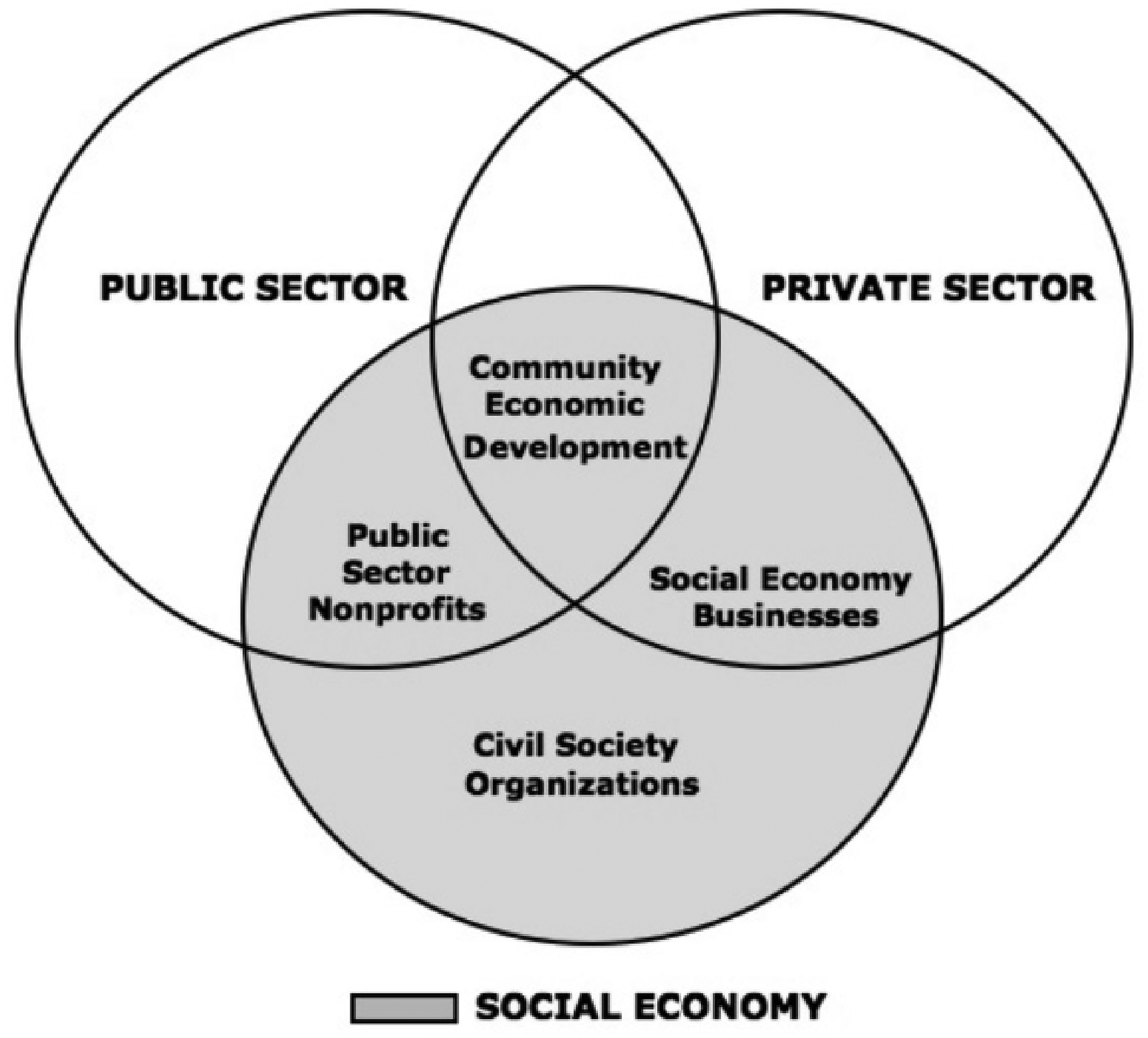
Venn diagram of the “interactive” social economy by Quarter et al. (2017).
Racially marginalized groups make known the elitism lurking within the other two sectors such as the state and the firms (Hossein, 2017, 2018). Many of these groups operate in lower part of the shaded area in the civil society, separate from the overlapping, where people hide what they do. Much of the social economy literature assumes “cooperation,” “partnership,” and “interaction,” but this is simply not the experience for excluded minorities. The social economy, as it stands, does not address “race” and racism that alienate certain groups. Nor does it address “race” and racism within the sector itself. In “Racial Equity in Co-ops: 6 Key Challenges and How to Meet Them,” Gordon Nembhard (2020) discusses racism that is within the cooperative sector. She reminds us that coops exist in a society built on racism, thus “coops cannot be automatically anti-racist.” She shows us that the underlying assumption that racism cannot exist within the social economy sector is a false one.
Solidarity Economy: An Invention of People Struggling for Life
Being in solidarity means accepting others, but not only as they are, but also as they should be; tolerating their limitations and defects, but not renouncing to the good impulse of welcoming them to overcome them with our service. Freedom and solidarity cannot be opposing or excluding values, but complementary ones. To achieve this solidarity, our contribution and surrender must be so spontaneous and natural as to be able to proceed towards the transformation of our own inherited human nature, miserable to a certain extent, as well as towards that of the agenda of this transformation who are our fellow humans (Arizmendiarrieta, 2017, p. 76).
Father Arizmendiarrieta founded the Mondragon Cooperative Corporation (MCC) in the Basque region of Spain to help people who were culturally and economically oppressed (Mollner, 1984). In the quote above, Arizmendiarrieta clarifies what solidarity means. In many parts of the world, the move toward solidarity does not make assumptions of being a place to reconcile and to compromise with capitalist economic systems. In fact, the solidarity economy takes on “conflict,” “protest,” and “struggle.” The solidarity economy is about people who have to struggle to survive and fight for their rights in racial capitalist environments (Akuno, 2017).
It is not enough to define the actors and how they interact with the other two sectors. In choosing to use the term, solidarity economy over social economy, we begin to acknowledge the conflicts existing in the economy. Quilombos of Brazil, the Zapatistas in Mexico, the BLM Movement in the United States, the Underground Railroad in Canada and the United States, and the Neechi Commons of Manitoba Canada are only a handful of examples of solidarity economies working to systematically transform inequities in business and society.
Many people know the adage, “Politics without economics is symbol without substance.” Put another way, we can protest and fight for Black equal rights, but unless we connect political standing to the economy, things will not change in society. 2 We also then acknowledge why the solidarity economy is relevant to making governments and markets equitable and respectful of all people. The solidarity economy must thus go beyond being an “interactive” social economy to one that is prepared to embrace conflict and upheaval for change to come around. In mapping the economy through an antiracist lens and feminist, we see that exclusions are occurring. Not all actors in the economy can engage with one another, because allocations are being made based on identity politics both within the economy and between the three sectors. To assume an “interactive” social economy makes the social economy complicit in these harms.
Crediting the Global South Origins in the Solidarity Economy
It was two decades ago at the first World Social Forum in Porto Alegre, Brazil, that this term “solidarity” took hold for activists around the world. Solidarities are formed because of deeply rooted inequities in the world. 3 Racially marginalized and economically excluded people who do not trust the (social) economy will choose not to interact with sectors that historically and currently cause them harm. Community economies scholar Miller (2010) defines the solidarity economy as a “movement of movements,” a form of economics based on cooperativism, equity, and social and economic democracy. Solidarity economies are waged on multiple platforms, making it a diverse movement focused on resistance to the neoliberal economic order (Bell et al., 2018). The rest of the world is vested in the solidarity economy because of what it brings to those who are excluded from formal systems. The solidarity economy makes room for militancy and purposeful disruption as ways to undo exclusionary economic systems (Loxley, 2008; Thomas, 1974).
The solidarity economy is an international concept and movement. Allard and Matthaei (2008) report that the language of the “solidarity economy” was first adapted from the work of Chilean professor of philosophy Luis Razeto. Contemporary use of the term emerged in the early 1980s in France and South America (Allard & Matthaei, 2008; Miller, 2005), and it is now used the world over, including by international organizations. For example, the International Labour Organization (ILO) uses the term to address labor conditions and worker rights (Fonteneau, 2011) 4 ; and the United Nations (2015) uses it in its work on poverty, as does Organisation for Economic Co-operation and Development (OECD) in tackling issues of global inequalities. 5 Activism and policy work in the third sector addresses social and economic exclusion in Europe (Bridge et al., 2009). While the “social economy” often seeks to supplement or complement the existing social order, maintaining the marginalization of Black and Indigenous people and other minority groups, the solidarity economy pushes for change and transformative action. Since the 1990s, many networks have made global connections, and a worldwide movement was born out of a meeting of the 1997 International Solidarity Group in Lima, Peru (which later became the Intercontinental Network for the Promotion of Social Solidarity Economy). The economia solidaria is about peoples’ movements; and making the solidarity economy is about fighting to make major changes, not negotiating within the prevailing system.
Defining Solidarity Economy
In Development as Freedom, Nobel economist Sen (1999) explained that lack of access to opportunities limits what poor people can achieve and that it is not materiality alone that matters. People who are routinely bypassed for goods and access to opportunities will take action to change these systems that limit their freedoms. This is done through the solidarity economy, where people resist their economic and political oppression by intentionally choosing to come together and engage in struggle. The work by Borowiak (2015) is worth understanding what it means for the solidarity economy to be understood across cultural contexts.
The solidarity economy is an international concept. As noted in Figure 1, Quarter and Mook's (2010) Venn diagram of a social economy contemplates the overlapping relationships between the three sectors without noting the tensions. While the diagram offers a preliminary and taxonomic understanding of the social economy in Canada and the United States, it does not provide any understanding of racialized and marginalized communities and their (often informal and unpaid) work of resistance to and transformation of dominant economic structures. The point here is that “solidarity” as a term has meaning for people in the Global South—that is, for excluded minorities. The social economy sector as it stands is a catch-all sector for many things. It is far too complacent and vested in cooperating with business and governments to upset the racist status quo.
Solidarity is a place not only where racially excluded people can meet the needs of their economic livelihoods but also where the reproduction of inequalities for certain groups can be stemmed. The solidarity sector, which is mindful of identity politics, not only helps people to cope but also allows them to voice their concerns and have their contributions seen. People who find themselves in the solidarity economy are there because of crisis, and they are the chief architects of undoing the harms caused by an exclusionary economic system.
Theory and Methods Coming Together
Progressive scholars who ignore the different ways of engaging with economic livelihoods and who do not draw on or read literature that reflects the lived experiences they study fail to capture what is really going on for people of color in business and society. There is too much negating and not enough acknowledging of the biases within social and cooperative economies. For decades, feminists and those in the community economies research network (Gibson-Graham, 1996; Gibson-Graham & Dombroski, 2020) have spoken about the profound silence about the reality that most market activities going on in our world are hidden from plain view.
Black Women in Community Economies as a Theory for Global Solidarities
The solidarity economy is about how people cocurate economic livelihoods together. Feminist Hill Collins’ (2000) early work on political economy and Black women has assisted us in thinking through concepts of lived experience and resisting the double bind of racism and sexism as women work and build up community. Political theorist Hooker (2009), in Race and the Politics of Solidarity, points out that racialized minorities alienated by a system will group together because of various intersecting and overlapping identities, for example, being Black. This politics of racialized solidarity comes into being because Black people are lost in an ecosystem that is supposed to be about community well-being. We also see in the work of political scientist Sharon D. Wright Austin (2018) in The Caribbeanization of Black Politics in the US how people will create their own bonds and connections to align on certain topics. Gordon Nembhard (2014b) has documented the legacy of cooperation in Black minority communities, arguing that people had an abundance of knowledge on cooperative systems but hid most of this knowledge because of the dangers in society.
The body of work by Gibson-Graham (2006) reveals that most of life's interactions are hidden, like the submerged part of an iceberg, and that people all over the world engage in diverse economies (see Figure 2). 6 Gibson-Graham's ideas of postcapitalist politics move beyond ideological boundaries. In the iceberg analogy, only formal markets (the top of iceberg) are visible because they are on the surface. But the living world economy, where most people interact with one another, is submerged below water (the mass body of the iceberg). Gibson-Graham et al.'s (2013) picture is compelling because it means we need to let go of the myth that there is only one form of doing business—because, in reality, all kinds of business exchanges exist beyond capitalist formal systems. The “hidden parts” in the submerged iceberg are purposefully hidden, because choosing solidarity to stand up to inequities is risky work. Studies of other locations and racially oppressed geographies show that solidarity economies exist in these other spaces and always have (Mullings, 2021).
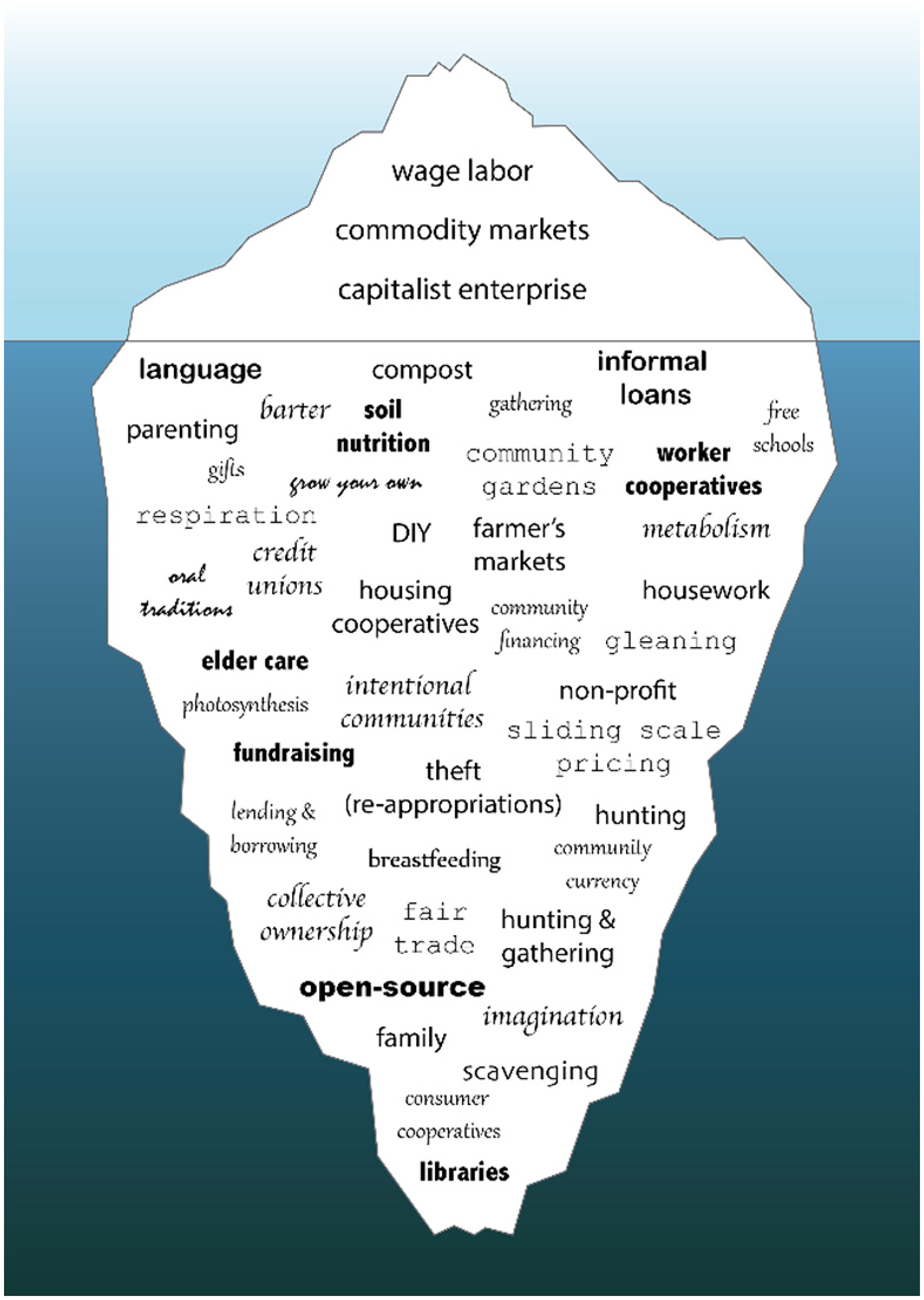
The diverse economies iceberg (J.K. Gibson Graham).
This theorizing of community economies assumes that local people are engaged in their own cooperative systems outside of the ideological binaries of Capitalism versus Marxism. The invisible activities are informal, nonmonetized, and social, but without them the capitalist economy would languish. Reframing how we see the “social economy” thus calls for a change in the lens through which it is viewed. In the podcast Frontiers of Commoning, Bollier (2021) interviews Katherine Gibson, one of the feminist scholars behind community economies and in this interview she has pushed for stepping out of binaries to address matters of identity politics that interrupt the ways in the podcast which people can live in society. Gibson, a Western Sydney professor, argues that even within community economies, the politics of whiteness needs to be addressed.
This is where Black women theorizing on the political economy and community work is useful. What they do is community economics (though it is never remunerated as such) (Banks, 2020; Hill Collins, 2000). The solidarity economy acknowledges the history of socioeconomic organizing and existing practices that recognize, tend to, and protect communities of color from the indignities they face in the economic sector. Hossein (2019) calls on the Black social economy to disrupt mainstream thinking and set a historical reality in interpreting how people of color engage with the third sector. In the case studies below, we show how Black people politicize their economic cooperation for transformational change. Values that the social economy claims to espouse fall short when large segments of the movement remain unframed and their stories untold. Without this acknowledgment, the Black social economy remains invisible and thus upholds racial injustice, violence, exclusion, and trauma in Canada and elsewhere.
Case Study Analysis of Lived Experience
Case studies give us a heuristic means of understanding through rich examples of lived experience. They can “enhance our understanding of contexts, communities and individuals” (Hamilton & Corbett-Whittier, 2013, p. 2) and capture contextual complexities. Profiling different solidarity movements allows us to analyze local struggles for economic and social cooperation and broaden the context to a “movement of movements” with global reach. Outlining the resistances of particular cases brings to bear the lived experiences of diverse groups under the aegis of the solidarity movement. It also allows for an understanding of intricate experiences that are distinctive but nevertheless share the qualities of the struggle and resistance of the solidarity economy. Political scientist John Gerring (2004, p. 341) argues that case studies can be defined as a detailed interrogation of a single phenomenon, where the purpose is to “elucidate features of a larger class of similar phenomenon.” Using case studies allows us to draw similarities between solidarity economy movements to advocate for rejecting the use of social economy language and to choose, instead, the language of solidarity.
Language and Critical Discourse Analysis
Fairclough (1989, p. 17) theorizes language as “discourse [and] language as social practices determined by social structures.” Taylor (2004, p. 436) argues that “CDA [Critical Discourse Analysis] … allows a detailed investigation of the relationship of language to other social processes, and of how language works within power relations.” CDA is a means by which to understand the social processes taken up by the language of the social economy. It uncovers the Eurocentric, exclusionary, and formal nature of the term and spotlights the repercussions and erasures of using the language of the social economy over that of the solidarity economy. The language of the social economy sustains the marginal position of racialized actors, disallowing space for racialized stories of collectivity and risk in the third sector. The language of solidarity names an extensive history of struggle and resistance and is inclusive of those who are excluded by a narrowly defined White, colonial ethos of formality. [Naming] has the power to connect isolated groups and people, to bring us together by identifying our common ground, our shared visions and values. In Brazil, the term “economia solidaria” has been a powerful organizing tool because of its ability, with just a few words, to name and connect a set of economic practices that had been previously disconnected (Hossein, 2017, p. 6).
A language of solidarity economy must be chosen instead of the social economy to recognize and represent the ways in which racialized people organize, struggle against, and resist oppressive and exclusionary economic systems instead of trying to work within them. Interrogating the language of the social economy and its social and economic implications through CDA allows us to advocate for and use the language of solidarity economy.
Case Studies of the Solidarity Economy
The Global South is to be credited for advancing use of the term solidarity economy as a way to transform the economy through struggle instead of through working within the prevailing economic order. In an edited collection of case studies from around the world, Hossein and Christabell (2022) show how informal cooperatives known as rotating savings and credit associations are attending to people's financial needs. The experiences of people and their own living reality, what Black feminists call “lived experience,” brings credibility to the solidarity economy. Political scientist Sharon D. Wright Austin (2007) argues that without active community-led social capital by Black people, White planter elites would not change the status quo through government channels. She also contends that Black people need their own economic base to transform the politics. Economist Jessica Gordon Nembhard (2014a, p. 112) teaches us that people of color, women, and other discriminated groups “need mechanisms to insure that [they] are not systematically left out.” Solidarity economies for excluded people are primarily about provisioning and self-sufficiency, and these objectives transcend North/South divides. This is why case study analysis in a number of different cultural contexts shows the risks people take to collectively organize and set up financial economies.
The actions people take to counteract these obstacles undergird the concept of solidarity economies. The case studies that follow demonstrate historical and current diverse solidarity economies around the world. Brazil's Quilombos, the Zapatistas in the Chiapas region of Mexico, BLM movement, the Underground Railroad, and the Neechi worker cooperative by Indigenous people in Manitoba, Canada are cases where citizens under attack are coming together through collective action correct the wrongdoing, and this comes with a degree of life risk.
Brazil's Quilombos—A Site of Freedom
The Quilombos are an example of the African people's creation of economies based on cooperativism as an act of defiance against enslavement (Bohn & Grossi, 2018; Ferreira, 2019; Silva, forthcoming). Enslaved Africans ran into the hills and forests and created Quilombos (Smith, 2016): communities established in the hinterlands of Brazil and throughout the Americas, including Jamaica, Haiti, and Suriname (Kars, 2016). Quilombolas refers to the people, mostly people escaping enslavement (also known as Maroons), who inhabited the settlements, which ranged from three to over 100 people. One of the most famous Quilombos was Palmares, which grew to 20,000 inhabitants and was an autonomous republic in the1690s until its destruction in 1694 (Palmares, Historical Republic, Brazil, n.d.).
Afro-Brazilian activist Beatriz Nascimento devoted her life to restoring the role of Quilombos as sites of struggle for people. She drew attention to how the deliberate cooperation of Black people enabled them to come together in Brazil with a strong voice (Smith, 2016; Smith et al., 2021). Quilombos were mainly subsistence cooperative communities, defying the monocrop ethos of the time and drawing on African systems of crops for local diet, crop rotation, and slash and burn farming (De la Torre Cueva, 2011; Shore, 2017). They owe their survival to the African people's innovative use of a treacherous landscape, which became a means by which to shelter and defend the settlements from raids (PBS News Hour, 2019). In the Ribeira Valley of Brazil, with the instability and eventual collapse of the goldmining industry in the 1790s, Quilombolas were also able to seize more territorial control (Shore, 2017).
In the settlements, ties of kinship and collectivity were cemented through solidarity, and these supported autonomy (Silva, forthcoming). The Afro-Brazilian struggle for survival was unremitting (Ferreira, 2019). The Quilombos faced daily raids from plantation owners and local elites, who saw Black people as an obstacle to capitalist development. Through economic cooperation, the Maroons transformed the landscape in ways that challenged the plantation and extractive industries. Many settlements developed as alternatives to the plantation economy and the slave trade. The Quilombo settlements were “based on communal ownership of land, family labor, and the cultivation of staple crops in tropical forests” (Stucchi, 1998, as cited in Shore, 2017, p. 62). Quilombo members were extremely resourceful, fending off decades of attacks on their land and livelihoods, which they continue to this day. There is currently a state-led appropriation of the lands of Afro-descendent farmers and fisher folk, leading to the displacement of settlements from ancestral lands and the expulsion of families from their lands (Shore, 2017). Black people are being denied a livelihood, and the Quilombo struggle for recognition of land rights continues.
The 2021 data from the Comissão Pró-Índio de São Paulo indicates that there are 3,467 Quilombos that still subsist as remnants since the abolition of slavery in Brazil in 1888 (Andrade, 2021). The same source reports only 186 Quilombos as holding title in Brazil (Andrade, 2021). In his 2017 paper, Edward Shore reported that 3,000 Quilombos continue to fight for territorial land rights since the ratification of article 68, “a constitutional provision that granted legal recognition and territorial rights to Quilombo descendants” (Shore, 2017, p. 58). Much like their ancestors, Quilombolas and Maroon descendants continue to live on subsistence settlements, but they face growing threats to their communities and livelihoods (Kelley, 2002; Silva, forthcoming).
The narrative around Quilombos is often that they are fraudulent communities looking to steal land. Quilombolas descendants are repeatedly forced to prove their right to their own land (Farfán-Santos, 2015), and they are being attacked by the state and siphoned off from state goods (Amparo, 2020; Bledsoe, 2019; Shayne & Manfredi, 2019). During the 2018 presidential election, the Bolsonaro campaign actively incited violence and anti-Black rhetoric as the means of portraying Quilombolas as lazy and as threats to the political agenda of the country. This incited violence and the impetus to “neutralize” the threats to progress posed by the Quilombos (PBS News Hour, 2019). As a result, many business elites and authorities see Quilombo lands as opportunities for corporate development and hydroelectric dam projects. These are obstructing people's lives by taking away their land. “Afro-Brazilian farmers have linked their campaign for environmental justice to their ancestor's battels for land and subsistence rights” (Shore, 2017, p. 73).
The legacy of the Quilombos as a cooperative institution is rooted in the collective fight to politically transform active racism in the economy. In the work of Patricia Ferreira (2019), she is also arguing that the “mainstream” version of the solidarity economy has missed the fight for new economies in her country of Brazil. This case is about the lived experiences of Afro-Brazilians who fought and continue to fight for their goods and basic human rights. This case is also about transformation: it is about unsettling the state and private sector rather than “interacting” or trying to reform an exclusionary economic structure. Through struggle and resistance, the concept of solidarity is about the local activists who are warring against an unlivable system.
The Zapatistas in Mexico
The Zapatistas in Chiapas, Mexico, continue to teach the world about solidarity economy that may result in violent conflict. As of 2019, it has been 25 years since the uprising of the Zapatista Army of National Liberation (known in Spanish as Ejército Zapatista de Liberación Nacional [EZLN]). This uprising started the Zapatista movement, transforming it from a surreptitious guerilla organization in the 1980s to one with “national and international salience [which] has made it a model for Indigenous and anti-globalization struggles, as well as for democratization efforts inside and outside of Mexico” (Inclán, 2018). The EZLN was a direct result of Mexico's push to become a part of the OECD as well as of the signing of the North American Free Trade Agreement. These moves by the one-party Mexican Regime sparked outrage among Indigenous groups, as they saw that their lands and way of life would be threatened under the business and political elites (Darling, 2008).
The Zapatista movement reached global audiences through their revolutionary use of the internet to announce movement campaigns. International public and media attention focusing on the government gave shelter to the “poorly armed indigenous insurgents against a repressive response from the Mexican State” (Inclán, 2018). The Zapatistas took over large areas of land for their headquarters and for use by Indigenous peoples. Throughout the 1990s and early 2000s, the Zapatistas engaged in many forms of protest, from land invasions to meetings, marches, and peace talks (Gilbreth & Otero, 2001). Around election times, Indigenous people took risks occupying buildings and staging sit-ins to make their issues heard (Cleaver, 1998). Throughout the process, many lives were lost and negotiations reneged upon. For example, after 11 days of fighting during the initial uprising of the Zapatista movement, on January 1, 2004, 300 people had been killed (Godelmann, 2014). Moreover, the San Andrés Accords were signed but never fully recognized by any government (Stahler-Sholk, 2016). This evidence of lack of goodwill has led many people decide to opt out of working with a hostile state.
The Zapatista movement employed many forms of organizing, from candlelight vigils to violent protests. Images of unrest and unnecessary force were broadcast for the world to see. This public struggle has made the solidarity economy relevant to change making. After years of fighting and dying, the Zapatistas set up the Juntas de Buen Gobierno (Good Governance Councils) in five regional authority centers in 2003 (Speed, 2007). The Zapatistas set up health centers, schools, and business cooperatives to develop their communities from within. They made use of technology and media to make their cause known to the world. This has inspired protests in dozens of countries (Cleaver, 1998) and has intensified the Indigenous cause (van der Haar, 2004). The focus on local development helps people to live and to meet their own economic needs and avoid producing for an extractive economy or world systems (Thomas, 2004).
Economic Exclusion and the Collective Organizing of African Americans
The economic exclusion of African Americans is not new. In 1865, 400,000 acres of White-owned land was expropriated by Major General William Tecumseh Sherman to be parceled out in 40-acre lots to some 3.9 million recently freed slaves in an order that came to be known as “40 acres and a mule.” With the election of Andrew Johnson, the order was reneged upon and the land remained in the possession of White plantation owners who rented the land to Black people for the purposes of sharecropping. Systemic inequities like high interest loans and a vicious debt cycle enabled the extraction of “monumental wealth from the labor of Black people long after abolition” (Philpott, 2021). Even with this violence, Black farmers were able to collectively organize. They created the Colored Farmers’ National Alliance and Cooperative Union, organizing to buy land and tools and pool money (Philpott, 2021).
Economic exclusion continues today, with the U.S. Department of Agriculture and the subjection of Black farmers to systemic violence and anti-Black racism through their exclusion from loans and other means of assistance (Penniman, 2016). The violence in the U.S. south targeting Black farmers “whose very existence threatened the sharecropping system” has caused losses of about 14 million acres of Black-owned farmland in the United States (Penniman, 2016). After a century of dispossession of land through racist farm policies (Philpott, 2021), assets and land owned by Black Americans are low.
While the economic exclusion of African Americans is not new, neither is the struggle against this exclusion through collective organizing and the formation of cooperative institutions. The dangers and systemic discrimination faced by non-White people force people to decide whether to openly organize. The development of Black farm collectives and worker cooperatives has been a way to counter business exclusion and a means for people to be self-sufficient. These examples illustrate that the solidarity economy is both formal and informal.
The BLM Movement
Started as the hashtag #BLM after the 2012 death of Trayvon Martin and the acquittal of his killer, the BLM movement began to organize in cities all over the world. The fight against anti-Black racism and state violence galvanized many citizens in many places to take up the struggle in solidarity against the killing of Black boys and men. From the beginning, Black Lives Matter Toronto has been a community-owned endeavour. We’re not an organization; we’re a group of grassroots Black intellectuals … our work is global work and our liberation will be globalized liberation, and so we are deeply invested in organizing that builds connections and relationships (Khan & Newbold, 2018, p. 140).
BLM has made a point of listing the various forms of violence and exclusions Black people endure living in the United States. It has mobilized media and built solidarity systems to fight for racial equality and justice. Through its grassroots organizing and the galvanization of groups, BLM has become an international solidarity movement with depth and breadth in the name of transformational change to the education, criminal justice, political, and economic systems that disproportionately disadvantage Black communities. BLM organizers started Freedom Rides that brought more than 500 activists from 18 different cities to Ferguson, Missouri, to converge into a national campaign (Hillstrom, 2018, p. viii) against the insidious and pervasive nature of anti-Black racism. The fight against anti-Black racism and state violence against Black bodies galvanized many citizens, Black and White, in many places.
BLM and 2SLGBTQ+ Organizing in the Solidarity Economy
A long history of systematic violence against and erasure of the Black 2SLGBTQ+ community exists in both Canada and abroad (Perry & Camp, 2020; Whitfield et al., 2014). In the summer of 2016, BLM Toronto brought the annual Toronto Pride Parade to a halt in protest of police presence at pride celebrations and the “anti-Blackness” of Pride. The protest brought to light the intersection of race and sexuality and the exclusion of particular bodies. It also brought to bear “the contributions of black trans and queer people in early Pride movements” (Battersby, 2016) as well as bringing change with a list of demands that was signed by the Pride executive in the midst of the protest. Ultimately, police were no longer invited to the parade and funding for Black queer programming was increased (BLM Canada, 2016). As a result of their actions, BLM organizers were subjected to violence and harassment, a testament to the risk involved in solidarity organizing. Through grassroots organizing, BLM continues to take risks and incite action against the violence and economic, political, and social exclusion of Black bodies through worldwide action.
In Making All BLM Reimagining Freedom in the Twenty-First Century, historian Barabara Ransby (2018, p. xii) warns against seeing the BLM movement as monolithic, instead pointing to “five distinct but interrelated themes that have arisen as the BLMM [Black Lives Matter Movement] has evolved.” These include Blackness and Black oppression, as reflected in the slogan “Unapologetically Black”; the role of social media and the social media personalities; the youth-centered nature of the movement and the intergenerational politics that have surrounded it; sexism within the movement and new Black feminist and abolitionist-informed practices that seek to hold activists accountable for sexist behaviour; and finally, the class politics of the movement and leaders’ critique of racial capitalism.
BLM is often seen as a civil rights movement; however, it is also a part of the solidarity economy because people are standing up to unequal economic and political systems. In The Walrus, Mochama (2020) reminds us that the African diaspora has always brought collective and cooperative money systems with them. Similarly, in the quote above, Ransby (2018) argues that racial capitalism is at the very core of the frustration young Black people feel and that young people organizing a movement will unfold as a form of connecting and working together.
BLM, Mutual Aid, and Taking an Economic Stand
Mutual aid is a well-worn practice by Black and other racialized folks, crucial to the solidarity economy. Roach-McFarlane (2021) shows how the Black Panther Party's (BPP) grassroots organizing of free medical care and food programs for poor Black people has long been associated with radical mutual aid initiatives, which reveal the inadequacy and reticence of the state. These programs took an economic stand, undermining the orthodoxy of the neoliberal agenda and underpinning the BPP ideologies of community, mutual aid, and solidarity. Roach-McFarlane (2021) points to the need for social organizing and the iniquities of capitalism. He also points to the need for mutual aid, not as charity but as a means to confront, identify, and struggle against the racialized, gendered, and classed disparities of capitalism. Roach-McFarlane (2021) underscores that the COVID-19 pandemic has once again emphasized how individualism is served and “deepen[s] already entrenched inequalities in society.” Mutual aid is a means of combating the inequalities highlighted by the pandemic, as Black and other racialized people organize to ensure their needs are met. In the context of the COVID-19 pandemic specifically, mutual aid initiatives have emerged in the wake of state violence. In 2020, the BLM movement in the United States and Canada created mutual aid platforms to fund projects in response to the disproportionate effects on unemployment rates, rates of hospitalization, and deaths due to the COVID-19 pandemic on the Black community. Over the course of two rounds of fundraising, over 1,500 Black people received microgrants to help mitigate hardships during the pandemic (BLM Canada, 2021). BLM is a “movement of movements,” continuing informal and formal cooperative and collective building to change the financial and social inequalities faced by Black communities.
The Underground Railroad
The Underground Railroad was a cooperative network of White allies and abolitionists that led enslaved African people to “freedom” from the United States into Canada. This is often the whole of the account, but as George Elliot Clark (cited in Bakan, 2008, p. 4) notes, “the price of the flattering self-portrait is public lying, falsified history, and self-destructive blindness.” People had to withstand the risk of being re-enslaved and endure many violent indignities, and they were not always safe once they escaped. The existence of slavery in Canada is a scarcely known fact. But as early as 1747, thousands of people were enslaved in Canada (Bakan, 2008), where slavery continued until 1834. Canada also has a long contemptible history of the colonization of and violence toward Black and Indigenous peoples.
The Underground Railroad is usually told as a freedom story, with White abolitionists as the central actors (LaRoche, 2014). Hossein (2018) draws on the work of Du Bois (1907), Marcus Garvey, Haynes (2018), and Gordon Nembhard (2014b) among others to demonstrate that the rich history of Black cooperation, struggle, and resistance is a long legacy of those under attack. Mutual aid and organizing were viewed as subversive, and people had to hide their efforts. While the Underground Railroad was a cooperative and seditious system—a series of safe havens for Maroons (Black folks escaping slavery)—to transform society and end slavery, it is not viewed as part of the origins of the solidarity economy in the Americas.
Clearly, the Underground Railroad was a solidarity system—Maroons organized economic goods with abolitionists and Indigenous peoples to escape and then set-up their own community economies (Haro & Coles, 2019; Kelley, 2002). People pooled in-kind goods, refuge, transport costs, and money to move people into routes and ad hoc safe spaces (Haro & Coles, 2019). Bakan (2008) argues that the Underground Railroad was also a site of sometimes violent struggles and resistance by enslaved Black people and their allies. This larger context is one of “grand marronage—the process of flight from slavery, a fundamental form of flagrant defiance by captive African Americans and a chronic bane of the chattel system” (Sayers, 2004, p. 436). Enslaved African American people were thus part of a complex cooperative system that helped undermine the slavery system (Sayers, 2004). The solidarity of the Underground Railroad was hidden because of the dangers of revealing its tactics. Maroons and their allies knew that the way to defeat the dominant power was not to negotiate but to disengage from an oppressive and violent system.
The Neechi Co-Op—An Indigenous Contribution
The Neechi Co-op is an example of the solidarity economy at work in our communities and the struggle that needs to precede transformative change (Canadian Worker Coop Federation, 2018; Loxley, 2008). The cooperative was born out of the end of a training program for Aboriginal people in the early 1990s, which eventually expanded to the Neechi Commons. “Neechi means friend/sister/brother in Cree and Ojibwa” (Neechi Commons, 2010). The commons played host to a number of initiatives, including an Indigenous grocery and specialty store, restaurant, and arts market (Neechi Commons, 2010) as well as to partnerships with other Aboriginal businesses. The Neechi Commons bought its inventory locally and put money back into the economy of a poor area of Winnipeg, Manitoba, with the focus on local development (Loxley, 2008; Pearce & Wuttunee, 2015).
The Neechi Co-op affected Canada's economic development sector. 7 It was by and for Aboriginal peoples, and based on 11 principles developed by Neechi itself: (1) use of locally produced goods and services, (2) production of goods and services for local use, (3) local reinvestment of profits, (4) long-term employment of local residents, (5) local skill development, (6) local decision-making, (7) public health, (8) physical environment, (9) neighborhood stability, (10) human dignity, and (11) support for other Community Economic Development initiatives (Neechi Principles, n.d.). These principles have been used by the Manitoba Government in its own economic development framework.
The Neechi Co-op's work focused on marginalized peoples and provided employment and a sense of community (Pearce & Wuttunee, 2015). It worked to undo internalized racism and oppression through democratic decision-making and by addressing trauma and distress instead of disregarding it. The commons building itself “earned Green Globe certification for its geo-thermal and cooling systems” (Pearce & Wuttunee, 2015, p. 4), working to address environmental concerns and the work being done in the Aboriginal community. From the outset, the Neechi Co-op recognized the relationship between community and social healing with economic healing, a mainstay of the solidarity economy. This worked to re-embed the social needs of the community into the economy. Despite the length of its run, Neechi always struggled against gender-based bias, internalized racism, and economic exclusion, as noted in 2014 by Louise Champagne, formerly the president of Neechi: One of the hardest things in this project has been getting the financing. When you are poor you live from hand to mouth and that's Neechi too. We struggle and live from hand to mouth and have survived in a very competitive food industry. It has not gotten any easier in the 25 years we have been here. The level of sales you have to earn to survive has quadrupled. If you aren't hitting those sales levels then suppliers don't even want to look at you because you aren't going to survive. It's very tough for small businesses but that is who we are in the wider world. We are still here despite all the challenges because of stick-with-it-ness (Pearce & Wuttunee, 2015).
The purpose of the Neechi Co-op was to create a cooperative economy mindful of the local needs of Indigenous people. Neechi did this work for three decades before it was forced to halt its operations.
This struggle in the solidarity economy can take decades to see any change. The solidarity economy is not about reform or accommodating corporate or state elites. The Neechi Co-op was a key part of helping to transform the exclusionary economy in Winnipeg. The Neechi principles validated workers’ contributions, provided goods based on local needs, and ensured that economics were respectful of the needs of excluded people. This work Neechi did was about repairing harms and inventing new economies.
Conclusion
In choosing the term solidarity economy, we reject the Eurocentrism of the social economy and propose an alternative language for the Black diaspora and other marginalized groups. Traditional use of the language of the social economy calls forth a White, European, and formal history of recognized organizations working within the prevailing economic system (capitalism). It does not include the collective organizing by people of color and other marginalized groups, who must struggle against the violence and exclusionary practices of capitalism. The social economy does not account for long histories of collective struggle by the Black diaspora, nor the risks taken in resistance to the harms of capitalism.
The solidarity economy—a more inclusive, less prescriptive language—accounts for the informal organizing done by people of color: for example, informal cooperative banking collectives or rotating savings and credit associations (ROSCAs). Such collectives are not recognized within the current definitions of the social economy despite their being crucial systems of resistance to exclusionary financial practices within the capitalist economy. Women of color turn to these collectives to help them in their economic endeavors where they would otherwise be prohibited (Hossein, 2015). Definitions of the social economy would also not include our solidarity examples of the Underground Railroad, BLM, the Zapatistas, the Quilombos of Brazil, and the Neechi Co-op, as these definitions fail to recognize resistances to the status quo. These long histories of struggle have led to real social and economic changes for people of color and other marginalized groups. We choose a language reflective of these truths.
The “solidarity economy” is an international concept that the rest of the world recognizes, and we should join them. People in the Global South must be credited with instructing us about solidarity economies as a means to engage in conflict and to transform unequal economic and political systems. The cases we analyzed demonstrate how everyday people take risks to carve out safe and just social economies (Gordon Nembhard, 2014a; Navarro, 1990).
Learning about the self-help and business activism of people who are economically, politically, and socially excluded disrupts our understanding of the social economy. The Neechi Co-op understood that producing locally for Indigenous people and being mindful of the planet is how we live well together. The social economy may work for a homogenous European experience, but for people excluded from the market and alienated in society, the third sector must be referred to as the solidarity economy.
Critical discourse analysis and language are powerful connective tools and acknowledge different forms of organizing beyond practices formally recognized by mainstream social economy literature. The people of the Global South are often used as sites for learning about the social economy; however, in terms of the meaning of the struggle at the core of the solidarity economy, these places are seldom recognized as the possessors of this expertise. People in the Global South have repeatedly demonstrated that they will organize solidarity economies to address the crises and traumas they endure.
The untold stories of how Black and racialized people organize in the solidarity economy must be framed in ways that make them visible. The feminist economics of the Black diaspora troubles the neoliberal and capitalist economy that excludes racialized and other minorities and dominates so much of the world today. It does this by allowing us to find the theory we need to reflect on how racially excluded people can co-opt goods to make a difference in the economy and society. Legal scholar Spade (2020) correctly argues that solidarity is not trying to bend into managed foundations and nonprofits and that mutual aid is about using what you have locally to bring change. People move toward solidarity economies to achieve their life projects locally and in doing this usually face risks. In The Great Transformation (1944), Karl Polanyi outlined that a “double movement” will take hold when people are alienated from development.
People of the Global South and historically excluded groups in the Global North must be credited for inciting the world to change how it uses language—that is, choosing solidarity and rejecting the Eurocentric norms and economic exclusions of minorities that come with the language and literature of the social economy. The solidarity economy is transforming unjust systems of socioeconomic oppression. The language of solidarity calls forth long histories and current forms of informal and formal cooperative organizing. The language of solidarity economy credits the less formal work of cooperation and acknowledges racial and other economy exclusions in the social economy and its literature. The language of solidarity is inclusive in that it necessarily encompasses the voices of marginalized people regardless of geography and makes no assumption that it has to engage with the state and private sector—in fact, it assumes there is no overlapping with those sectors. The language of solidarity—as we seen through our case studies—can serve as a powerful tool for organizing and transformation, and this language must be chosen over that of the social economy.
Footnotes
Acknowledgments
The authors would like to recognize the generous funding from the Canada Research Chair (CRC) programme funded by SSHRC and the Ontario government's Early Researcher Award. We are thankful to the first year Business funded by SSHRC & Society students who took the introductory course on the social economy at York University from 2016 to 2020. We are grateful for the conversations with members of the DISE Collective, and special thanks go to the late Jack Quarter, the late Jack Quarter, Christabell P.J., and Sharon Austin for helping us to unpack these ideas on the solidarity economy.
Declaration of Conflicting Interests
The authors declared no potential conflicts of interest with respect to the research, authorship, and/or publication of this article.
Funding
The authors disclosed receipt of the following financial support for the research, authorship, and/or publication of this article: This work was supported by the SSHRC's Canada Research Chairs and the Early Researcher Award, Province of Ontario.
