




Abstract
This review provides a critical analysis of the emerging role of video games in higher education, with a specific focus on their theoretical foundations, practical implications, and potential areas for future research. The author posits that despite the potential benefits of video games in promoting student engagement and enhancing learning outcomes, the integration of these games into higher education curricula faces significant theoretical and practical challenges that have not been adequately explored in current scholarly works. Through the synthesis and critical analysis of recent research, this review highlights the significant tensions that arise when attempting to implement game-based learning in higher education settings, despite its perceived benefits. This review conducts a systematic literature review and employs a well-established thematic analysis framework. The author has identified five crucial areas that necessitate additional investigation. These include the epistemological underpinnings of game-based learning, the assessment of long-term learning outcomes, the equity implications of game-based education, the integration of emerging technologies, and the development of game design frameworks tailored for higher education. The purpose of this review is to stimulate a more nuanced and critical discussion regarding the impact of video games in higher education. This entails transcending techno-optimism and embracing a more theoretically informed and empirically substantiated perspective.
Keywords
Introduction
Digital technology’s integration into higher education fundamentally alters pedagogical methods, especially with the rise of video game-based learning (Medeshova et al., 2025). The evolution of technology represents more than the adoption of new tools; it constitutes a paradigm shift in pedagogical approaches and student interaction (Slade et al., 2025). Empirical research, such as that conducted by Yu and Cardoso-Leite (2023), indicates that well-designed gaming technologies can foster innovative interactive learning experiences, thereby mitigating contemporary pedagogical challenges in higher education.
With the aim of accommodating the evolving needs of students and the dynamic job market, higher education institutions have shown considerable interest in incorporating video games into their curricula, a trend that has captured the attention of educators and researchers (Choi-Lundberg et al., 2023). Nevertheless, the fervor surrounding game-based learning in higher education often surpasses the thorough analysis of its theoretical underpinnings and practical consequences.
The aim of this review is threefold: firstly, to conduct a critical examination of the theoretical underpinnings of game-based learning in higher education; secondly, to analyze the empirical evidence regarding the effectiveness of video games in achieving learning outcomes in higher education; and finally, to pinpoint key areas for future research that can address current gaps in understanding. The author of this review contends that the integration of video games into higher education is impeded by unresolved theoretical contradictions, practical implementation complexities, and a dearth of substantial long-term evidence.
The following review is organized in the subsequent manner: The first section investigates the evolution of game-based learning theory in higher education, with a critical analysis of its epistemological foundations. Additionally, it examines empirical research on the influence of video games on educational achievements and student participation, emphasizing favorable findings as well as methodological constraints. Furthermore, it addresses the obstacles and constraints associated with the integration of game-based learning in higher education environments. Ultimately, it delineates five crucial domains for future investigation that have the potential to greatly enhance our comprehension of the impact of video games in higher education. This review undertakes a thorough analysis, exploring various crucial aspects of discussion. Each of these aspects builds upon the previous ones, resulting in a comprehensive overview of the present state and future possibilities of video games in higher education. The subsequent section will analyze the concept of educational games and define the quality parameters for this review.
Educational games and quality parameters
This review adopts specific parameters for evaluating the quality of educational games. This review defines educational games as structured, interactive digital environments designed to foster learning through play. These encompass both purpose-built educational software and commercially available games adapted for pedagogical applications (Denham et al., 2023). This definition recognizes the inherent pedagogical value of diverse gaming experiences while preserving analytical rigor.
Identifying high-quality games within these parameters necessitates three fundamental criteria, each rooted in established theoretical frameworks. Initially, a robust system architecture must be implemented to ensure seamless user engagement, aligning with Plass et al.’ s (2020) emphasis on technological affordances within educational game design. A second crucial element is the pedagogical alignment of game mechanics and learning objectives, which should adhere to Gee’s (2005) principles of effective game-based learning. Thirdly, rigorous assessment protocols, consistent with Coleman and Money’s (2019) framework for evaluating educational game efficacy, are necessary to empirically validate effectiveness.
This review’s parameters considers both purpose-designed educational games and commercially produced titles, including major industry productions (referred to as ‘AAA games’) that have been adapted for pedagogical use (Fidan et al., 2024). AAA video games, the pinnacle of commercial game development, distinguished by their considerable budgets and high production values, utilize sophisticated engagement mechanics adaptable for educational applications (Sikora et al., 2024). This inclusive definition recognizes that educational merit can be found in both purpose-built educational software and in high-quality commercial games carefully adapted for academic use (Fidan et al., 2024). For example, intricate commercial strategy games may enhance historical comprehension, while advanced simulation games could aid in the acquisition of scientific concepts (Sikora et al., 2024).
Game-based learning methods are employed throughout education; however, higher education offers unique demands and advantages (Mahrouqi et al., 2024). Higher education-level content requires advanced cognitive skills and the development of professional competencies, thus requiring specific pedagogical strategies. K-12 (from kindergarten to 12th grade high school), gaming prioritizes fundamental skill development (Mikrouli et al., 2024); however, higher education applications must cultivate complex theoretical comprehension alongside practical skills such as advanced problem-solving, professional communication, and specialized knowledge (Syynimaa et al., 2024).
The combined utilization of purpose-designed educational software and adapted commercial games offers educators a versatile array of tools to meet diverse learning objectives (Sikora et al., 2024). This review acknowledges that effective game-based learning can arise from diverse sources, contingent upon their fulfillment of established quality parameters, as aforementioned, in the form of technical execution, pedagogical coherence, and empirical substantiation. With this understanding of educational games and their quality parameters established, the research will now proceed to a systematic methodological approach underpinning this review.
Methodology
This review utilizes a systematic review methodology consistent with Braun and Clarke’s (2006) thematic analysis framework (Figure 1). A comprehensive analysis was conducted using Google Scholar, ERIC, and Web of Science databases (Grewal et al., 2016), focusing on the period from 2000 to 2024, a timeframe of significant advancements in educational gaming. Employing Braun and Clarke’s (2006) six-phase approach—comprising data familiarization, initial coding, theme development, refinement, definition, and final analysis—the review systematically uncovered and integrated theoretical patterns from the literature.
A rigorous selection process, applied to an initial corpus of 50 papers, resulted in 34 studies deemed methodologically sound and theoretically significant for in-depth analysis. North America, Europe, and East Asia were the primary geographic contributors, while the study retained a global theoretical perspective.
Building upon the established methodological groundwork, this review proceeds to examine the theoretical trajectory of game-based learning in higher education, focusing on the interplay between technological innovation and pedagogical reform.
The evolution of game-based learning theory in higher education
Higher education’s theoretical trajectory regarding game-based learning is complex, involving substantial shifts in both technological capacity and pedagogical understanding (James et al., 2024). Significant epistemological advancements have been observed within this theoretical field, showcasing the complex interaction of technological innovation and educational practice (Atanasova, 2024). The field’s theoretical underpinnings have undergone iterative refinement and conceptual expansion, reflecting broader shifts in digital pedagogy and learning theory (Lopes et al., 2023). This will be further explored in the ensuing subsidiary sections.
Historical context and epistemological foundations
The integration of games into education has a complex theoretical history, ranging from early behaviorist learning theories to contemporary post-gamification models. This theoretical development comprises three discrete temporal phases, each signifying substantial paradigm changes in comprehension and execution. From 2000 to 2010, the initial phase laid the groundwork for future theoretical developments by establishing foundational approaches based on behaviorist principles and fundamental gamification concepts (Hwang and Wu, 2011). The second phase (2010-2018), a period of significant transformation, witnessed the integration of constructivist and social learning theories, thereby substantially broadening the theoretical framework underpinning game-based learning (Li and Tsai, 2013). From 2018 to the present, there has been a sophisticated development of post-gamification frameworks, focusing on authentic engagement and holistic learning (Karakoç et al., 2020).
This theoretical advancement surpasses contemporary post-gamification strategies by acknowledging the shortcomings of purely mechanical reward systems and emphasizing the significance of intrinsic motivation within educational settings (Deterding, 2015). The post-gamification paradigm signals an advancement in the field’s theoretical understanding, progressing from rudimentary game mechanic applications towards a more sophisticated comprehension of how gaming principles can improve higher education pedagogy (Seaborn and Fels, 2015).
The contemporary post-gamification model signifies a key change in understanding from instrumentalist views to a recognition of naturally occurring learning environments (Karakoç et al., 2020). This theoretical advancement surpasses conventional, skills-focused models which prioritized structured game mechanics, recognizing instead the complex learning processes inherent in gaming (Seaborn and Fels, 2015). Contemporary theoretical models acknowledge the extensive gaming literacy and practical experience of higher education students, resources readily applicable within formal academic settings (Deterding, 2015). This theoretical reframing transcends the simplistic view of games as solely pedagogical instruments, acknowledging them as intricate socio-technical systems fostering learning through genuine engagement within game environments and communities (Karakoç et al., 2020).
This theoretical progress requires a reevaluation of how established gaming experiences might be meaningfully incorporated into higher education settings (Whitton, 2018). In contrast to imposing pre-defined learning structures, post-gamification methodologies aim to utilize students’ existing gaming proficiencies and practical experience (Hamari et al., 2016). This theoretical framework recognizes that higher education students frequently demonstrate advanced gaming literacy, which can be harnessed for educational purposes (Deterding, 2015). The post-gamification paradigm highlights the significance of acknowledging and leveraging inherent learning processes, thereby integrating them into structured educational settings while upholding academic standards (Hamari et al., 2016).
The post-gamification theoretical framework constitutes a significant departure from mechanistic approaches that superimposed educational objectives on game structures (Whitton, 2018). Rather, it underscores the identification and fostering of inherent learning mechanisms within interactive gaming contexts (Karakoç et al., 2020). The theoretical sophistication presented here facilitates a more nuanced comprehension of authentic gaming integration within higher education, capitalizing on students’ established gaming proficiencies while ensuring pedagogical effectiveness (Hamari et al., 2016).
This theoretical framework is crucial for comprehending how organically immersive and unscripted gaming experiences, characterized by dynamic player agency, can effectively facilitate the attainment of higher education’s intricate learning goals (Seaborn and Fels, 2015). The subsequent section transitions from a historical and epistemological examination of game-based learning to its contribution to professional competency development in higher education.
Professional competency development and theoretical integration
The theoretical trajectory of game-based learning within higher education demands focused consideration of professional competency cultivation, a key differentiator between tertiary and other educational applications (Montagu-Cairns, 2025). This theoretical differentiation arises from higher education’s dual mission of advancing theoretical knowledge and developing the professional skills necessary for contemporary workplaces (Ferreira Dias et al., 2024). Incorporating game-based learning into this context necessitates sophisticated theoretical frameworks which explicitly address the cultivation of advanced professional competencies through game mechanics (Montagu-Cairns, 2025).
Contemporary workplaces require advanced skills beyond traditional academics; these include strategic thinking, ethical reasoning, and complex problem-solving. Consequently, higher education game-based learning environments must integrate theoretical knowledge and professional practice, thereby fostering what Milovanska-Farrington and Neves (2024) define as ‘professional competency transfer’, the structured cultivation of work-relevant skills through gaming. This theoretical framework highlights the significance of structuring learning experiences to foster both academic progress and professional development concurrently.
The theoretical framework of Milovanska-Farrington and Neves’ (2024) study on game-based learning for professional competency development comprises three essential components. Initially, the cognitive dimension cultivates sophisticated analytical and problem-solving skills crucial for professional application. In the second dimension, the social-professional sphere, emphasis is placed on the fostering of collaborative abilities, professional communication skills, and ethical decision-making processes. Thirdly, the technical-practical dimension prioritizes the cultivation of domain-specific expertise and practical skills applicable to specific professional contexts. This three-part theoretical framework provides a systematic approach to understanding the role of game-based learning in furthering professional development within higher education.
For this theoretical enhancement, it is crucial to consider assessment methodologies that can accurately assess both academic achievement and professional competency development (Ferreira Dias et al., 2024). To fully assess professional skill development within game-based learning environments, traditional academic assessment frameworks, which predominantly focus on academic knowledge, necessitate augmentation with sophisticated evaluation methods (Montagu-Cairns, 2025).
The advancement of this theoretical framework by Milovanska-Farrington and Neves (2024), provides a critical foundation for understanding the role of game-based learning in higher education’s preparation of students for professional careers. The following subsection analyzes the contribution of geographic variability in research and implementation to the theoretical progress of game-based learning within higher education.
Geographic diversification and theoretical advancement
The theoretical underpinnings of game-based learning reveal notable regional variations, collectively enhancing the field’s conceptual framework. North American scholarship has notably focused on the practical application of frameworks, especially concerning institutional integration and assessment methodologies (James et al., 2024). European scholarship has provided significant theoretical underpinnings, particularly within pedagogical philosophies and learning frameworks (Lopes et al., 2023).
Research in East Asian studies offers substantial empirical support for the efficacy of implementation and student engagement (Li et al., 2024). The geographic diversity has cultivated a robust theoretical framework, demanding meticulous attention to cultural and institutional contexts within game-based learning initiatives. The subsequent section transitions from a discussion of regional theoretical advancements to an examination of virtual reality’s impact on educational gaming, specifically analyzing how immersive technologies are reshaping the field.
Virtual reality in educational gaming
The advent of virtual reality (VR) technologies demands enhanced taxonomic rigor within game-based learning theory (Suhag, 2025). This review differentiates virtual reality games and experiential learning environments by analyzing user agency, defined learning objectives, assessment methods, and interactive engagement protocols (Chee et al., 2025). VR technology integration signifies a paradigm shift in higher education, fundamentally altering the conception and execution of immersive educational experiences (Suhag, 2025).
This theoretical framework differentiates between structured game-based VR applications, characterized by defined learning objectives and interaction patterns, and less structured experiential VR environments, which may offer valuable, albeit less formally structured, learning opportunities (Chee et al., 2025). This distinction facilitates a more precise theoretical analysis of virtual reality applications in the context of higher education, focusing on the alignment between technological affordances and pedagogical aims (Suhag, 2025).
Integrating immersive technologies necessitates a re-evaluation of embodied learning and spatial cognition within educational settings (Chee et al., 2025). The theoretical advancements necessitate a thorough analysis of how virtual reality technologies can effectively support the distinct pedagogical needs of higher education while preserving academic rigor (Suhag, 2025).
A comprehensive critical analysis of the epistemological implications of virtual reality in higher education requires a reevaluation of prevailing theoretical frameworks in game-based learning, especially considering the rapid advancement of technological capabilities (Chee et al., 2025). The following subsection presents a critical analysis of contemporary theoretical frameworks, assessing their applicability to recent developments such as virtual reality in higher education.
Critical analysis of contemporary theoretical frameworks
The epistemological basis of game-based learning in higher education remains a subject of ongoing academic debate. This discipline integrates diverse theoretical frameworks, including constructivism, cognitivism, and the contemporary connectivism (Atanasova, 2024).
Established theoretical frameworks often privilege concepts such as active learning, prompt feedback, and intrinsic motivation (Adipat et al., 2021). However, these frameworks often inadequately address the unique contextual demands of higher education, whose learning objectives exhibit greater complexity and abstraction than those of K-12 settings (Mikrouli et al., 2024). Furthermore, a prevalent trend in the literature involves the uncritical application of recreational game theories to educational contexts, neglecting the significant differences in their goals and frameworks (Lopes et al., 2023).
The author of this review posits that the theoretical ambiguity discussed has led to a proliferation of conceptually deficient game-based learning interventions in higher education (Earichappan and Hashim, 2024). Evaluating the effectiveness of these interventions and determining optimal implementation strategies presents significant challenges (Atanasova, 2024). Following the exposition of theoretical challenges within game-based learning frameworks, this review now presents empirical data that both supports and complicates these theories, analyzing the practical effects of such implementations in higher education.
Empirical evidence: promises and limitations
The implementation of game-based learning in higher education exhibits a range of outcomes, demonstrating both transformative pedagogical benefits and substantial methodological limitations (Ren et al., 2024). The multifaceted empirical landscape integrates diverse methodologies and institutional frameworks, generating both encouraging intervention outcomes and crucial cautionary findings that necessitate rigorous academic scrutiny (Alotaibi, 2024), as explored in the ensuing subsidiary sections.
Impact on learning outcomes and student engagement
Recent research has shown notable advancements in student achievement through the implementation of gamified learning. Lampropoulos and Sidiropoulos (2024) observed significant improvements in success rates (14%), excellence rates (122%), and average grades (25%) when compared to conventional and online learning approaches. The results indicate that educational games that are well-designed can significantly enhance academic performance (Ren et al., 2024).
These improvements are particularly significant in the higher education context, where learning outcomes must align with professional competency development. Studies indicate that well-designed educational games can enhance not only academic performance but also workplace-relevant skills such as strategic decision-making, team collaboration, and professional judgment (James et al., 2024). This dual benefit—academic achievement and professional skill development—distinguishes higher education implementations from other educational contexts.
Nevertheless, the author advises against making broad generalizations based on these findings. Numerous studies within this discipline are plagued by methodological constraints, such as inadequate sample sizes, brief intervention durations, and the absence of suitable control groups. For instance, Quinto (2022) and Chao-Fernández et al. (2020) exemplify this issue. Additionally, there exists a significant inclination towards favoring positive outcomes in published research, which may lead to a biased interpretation of the efficacy of game-based learning in higher education (Alotaibi, 2024). For instance, Dicheva and Dichev (2015) have highlighted in their reviews that numerous gamification studies suffer from methodological constraints and frequently yield inconclusive results, yet the studies with positive findings are given undue prominence. Despite the positive findings on learning outcomes and engagement, a comprehensive assessment of game-based learning’s influence on advanced cognitive abilities is necessary, as detailed below.
Critical thinking and problem-solving skills
Advocates of game-based learning contend that video games have the potential to greatly augment critical thinking and problem-solving skills (Mao et al., 2021). The intricate situations and decision-making procedures inherent in numerous games are believed to offer students the chance to apply theoretical knowledge in practical settings, thereby promoting enhanced comprehension and analytical abilities (Fantinelli et al., 2024).
Nevertheless, the issue of whether these skills can be effectively applied from gaming environments to real-world academic and professional settings is still a topic of debate (Sasson and Dori, 2011). Certain researchers, such as Chen and Yang (2019), contend that the problem-solving abilities cultivated in gaming environments may possess limited applicability due to their context-specific nature. Chen and Yang (2019) additionally contend that this underscores the necessity for more rigorous investigation into the enduring effects of game-based learning on higher-order cognitive abilities. The empirical evidence has provided a varied portrayal of the efficacy of game-based learning in higher education. Consequently, this review must take into account the diverse challenges and restrictions that could hinder its effective execution. While empirical evidence presents compelling possibilities for game-based learning, these findings must be contextualized within the broader landscape of implementation challenges that confront higher education institutions, as discussed below.
Challenges and limitations of game-based learning in higher education
Implementing game-based learning in higher education presents complex challenges demanding thorough theoretical analysis and systematic research (Palacios-Rodríguez et al., 2023). Although gaming technologies hold significant pedagogical promise for educational advancements, their successful integration necessitates a thorough examination of the institutional, technological, and epistemological challenges hindering their broad adoption and effective implementation (Krath et al., 2021). The following subsections provide a more detailed exploration of these challenges.
Alignment with curriculum and learning objectives
One of the main obstacles in the incorporation of video games into higher education lies in ensuring their alignment with established curricula and learning objectives. Hébert et al. (2021) emphasize the challenge in developing games that effectively tackle intricate, abstract concepts commonly taught in higher education, while also ensuring engagement and playability. According to the author of this review, the misalignment can lead to games that are either ineffective in terms of education or lacking in engagement, thereby compromising their potential advantages. In addition to curricular alignment, the effective implementation of game-based learning relies on technological considerations and issues of access, as discussed below.
Technological barriers and digital divide
The integration of game-based learning frequently necessitates extensive technological infrastructure and support, thereby creating a significant obstacle for numerous institutions (Palacios-Rodríguez et al., 2023). The digital divide among students further complicates this challenge, as disparities in technology access and digital literacy skills can worsen existing educational inequalities (Mercader and Gairín, 2020). The author of this review asserts that if these issues are not carefully deliberated upon, the implementation of game-based learning in higher education could unintentionally exacerbate disparities in academic performance. Though technological challenges have been overcome, faculty receptiveness to and preparedness for new teaching methods remains crucial, as detailed in the following section.
Faculty training and acceptance: professional competency development
The successful integration of video games into higher education curricula necessitates faculty members who possess the willingness and ability to integrate these novel tools into their instructional methods. Nevertheless, a significant number of educators are deficient in the essential skills and motivation required for effective implementation (Palacios-Rodríguez et al., 2023). The resistance observed in this context might arise due to skepticism regarding the educational merits of gaming, limited exposure to gaming technology, or apprehensions about the resources and commitment needed for incorporating game-based learning methodologies (Pan et al., 2021). An additional significant obstacle resides within the domain of assessment, where conventional approaches may prove inadequate in capturing the distinct learning outcomes associated with game-based education.
In higher education, a key challenge lies in demonstrating the substantial contribution of game-based learning to the development of professional competencies. In contrast to K-12 settings, higher education institutions have the responsibility of preparing students for particular professional positions and career paths (Plass et al., 2020). Precise alignment of game mechanics with relevant workplace skills is crucial (Milovanska-Farrington and Neves, 2024). The challenge surpasses mere knowledge dissemination; it encompasses the cultivation of professional judgment, ethical decision-making, and industry-specific proficiencies sought by employers in higher education graduates. Subsequently, the subsequent subsidiary section covers challenges related to assessment and evaluation in higher education.
Assessment and evaluation challenges
The ongoing challenge in higher education is to develop suitable methods for evaluating learning outcomes in game-based environments (Udeozor et al., 2023). Conventional evaluation methods may not sufficiently capture the various forms of learning that take place within game environments, especially in regards to soft skills and higher-order cognitive abilities. According to the author of this review, the discrepancy between learning experiences and assessment methods can result in an underestimation of the educational significance of game-based learning, thereby impeding its wider recognition in academia. To ensure the advancement of educational technology, it is imperative that this review acknowledges the ethical implications that come with these advancements, as discussed below.
Ethical considerations and data privacy
The increasing prevalence of games in education has led to a rise in the importance of ethical considerations regarding data privacy and student autonomy. The immersive characteristics of numerous educational games enable the accumulation of extensive data regarding student behavior and performance, thereby giving rise to concerns regarding privacy and the potential for misuse of such information (Carolina et al., 2023; Lin et al., 2022). Moreover, the author acknowledges that the utilization of persuasive design elements in games, aimed at enhancing engagement, may give rise to ethical concerns regarding student autonomy and the distinction between intrinsic and extrinsic motivation in the context of education. Consequently, the following section offers a critical examination of incorporating game-based learning into higher education.
Technological determinism and critical implementation
Incorporating game-based learning into higher education requires a critical analysis of what this review identifies as “technological positivity bias”—a tendency to overemphasize potential advantages while neglecting practical challenges (Yaman et al., 2025). This bias is especially evident in the uncritical acceptance of gaming technologies, neglecting essential pedagogical principles and institutional frameworks (Rachmadi et al., 2025). This review’s author’s analysis highlights the ongoing conflict between technological optimism and practical implementation in game-based learning, thus necessitating a more refined approach to integration.
Current discussions of game-based learning often display an overly simplistic technological determinism requiring thorough analysis. Despite empirical evidence of improved student outcomes, as reported by Lampropoulos and Sidiropoulos (2024), Chen and Yang (2019) highlight limitations concerning the transferability of skills and sustained effectiveness. The inherent tension in this theory highlights the need for more comprehensive analytical models which consider both the potential and constraints of game-based learning technologies within higher education (Rachmadi et al., 2025).
The author argues that overcoming these challenges necessitates moving beyond mere technological optimism to grapple with the intricate realities of educational implementation. Successful game-based learning initiatives require careful consideration of institutional resources, faculty expertise, student accessibility, and pedagogical alignment (Yaman et al., 2025). Rigorous critique enhances, rather than hinders, the field’s progress, thereby establishing a more robust framework for future strategic implementations.
A systematic analysis of implementation challenges is crucial for identifying strategic research directions that will advance both theoretical understanding and practical application of game-based learning in higher education, as discussed in the next section.
Future research directions
A systematic integration of theoretical frameworks, empirical data, and practical challenges illuminates key epistemological and methodological pathways deserving of rigorous academic scrutiny (Plass et al., 2020). This review reveals key research priorities arising from the convergence of pedagogical advancements, technological innovation, and institutional reform within game-based learning environments (Fernández-Raga et al., 2023). The domains outlined below are critical for theoretical advancement and empirical research to significantly improve both the conceptual understanding and practical application of game-based learning in higher education.
Epistemological foundations of game-based learning in higher education
Subsequent research endeavors should prioritize the development of a more resilient theoretical framework, specifically tailored to game-based learning within the realm of higher education. The framework presented should effectively cater to the distinctive attributes and objectives of higher education, surpassing the unquestioning application of theories formulated for K-12 or entertainment environments (Plass et al., 2020).
This type of research has the potential to address the existing conceptual uncertainties in the field and establish a more robust basis for empirical investigations. The enduring implications of game-based learning should be comprehended alongside fortifying the theoretical framework, as outlined in the following discussion on long-term impact assessment.
Long-term impact assessment
Existing research has acknowledged the short-term advantages of game-based learning, but a longitudinal investigation is necessary to fully comprehend the enduring effects on academic and professional outcomes (Fernández-Raga et al., 2023). The author proposes that future research ought to undertake multi-year cohort studies that compare students exposed to game-based learning with those enrolled in traditional programs. It is imperative for these studies to monitor not just academic performance, but also the progression of critical thinking skills, problem-solving capabilities, and career paths (Plass et al., 2020). When assessing the long-term effects, it is imperative that game-based learning remains accessible and advantageous for all students.
Future longitudinal research should rigorously investigate the correlation between game-based learning and professional success metrics, such as career advancement, workplace productivity, and the applicability of gaming skills in professional settings (Fernández-Raga et al., 2023). This focus on higher education will yield crucial insights into the long-term career benefits of game-based learning. The following section will therefore discuss issues of equality and accessibility within the context of game-based higher education.
Equity and accessibility in game-based higher education
Considering the possibility of game-based learning exacerbating educational inequalities, it is imperative for future research to explicitly tackle issues of equity and accessibility (Fernández-Raga et al., 2023; Lopes et al., 2023). This encompasses research on the efficacy of game-based learning for varied student populations, the formulation of culturally responsive game design principles, and inquiries into strategies to address the digital divide in game-based learning environments. When contemplating the future, it is crucial to contemplate the integration of emerging technologies into game-based learning, as discussed below.
Integration of emerging technologies
Ongoing advancements in technologies such as virtual reality, augmented reality, and artificial intelligence necessitate further research on their optimal integration into educational games for higher education (Plass et al., 2020). The author suggests that research should encompass not only the technical aspects of integration, but also the pedagogical implications and potential cognitive load issues that arise from these technologies. In order to reconcile the divide between theory and practice, it is imperative to develop frameworks tailored to the context of higher education, as noted below.
Development of higher education-specific game design frameworks
Ultimately, the author advocates for the creation of game design frameworks that are custom-made for the unique demands and limitations of higher education (Fantinelli et al., 2024; Krath et al., 2021). The author additionally contends that these frameworks ought to encompass the distinct challenges associated with developing games for intricate, theoretical ideas, while simultaneously taking into account the pragmatic limitations of implementing them in higher education environments. This review has the potential to establish a connection among game designers, educators, and researchers, resulting in the development of more efficient and educationally sound educational games. Keeping in mind these research directions, this review can now present conclusions pertaining to the future of video games in higher education.
Conclusion
This review provides a comprehensive assessment of the current state of video game integration in higher education, highlighting the potential benefits and significant challenges in this dynamic area. Although game-based learning holds potential for improving student engagement and learning outcomes, its successful application in higher education settings necessitates addressing significant theoretical, practical, and ethical obstacles.
The author asserts that future research in this domain should transcend techno-optimism and delve into the intricate realities of higher education. Through a focus on the suggested research directions, particularly the enhancement of theoretical foundations (Plass et al., 2020), assessing long-term impacts (Fernández-Raga et al., 2023), and addressing concerns pertaining to equity (Lopes et al., 2023; Mercader and Gairín, 2020). Regarding the integration of emerging technologies (Plass et al., 2020) and developing tailored design frameworks (Fantinelli et al., 2024; Krath et al., 2021). A collective effort from researchers and educators is necessary to achieve a more sophisticated and impactful integration of video games in higher education.
Given the continuous impact of technology on education, it is imperative that engagement in ongoing critical analysis and empirical investigation in order to fully harness the transformative power of video games in higher education. Additionally, this will aid in mitigating potential limitations and promoting equitable access to these innovative educational approaches. Prisma diagram.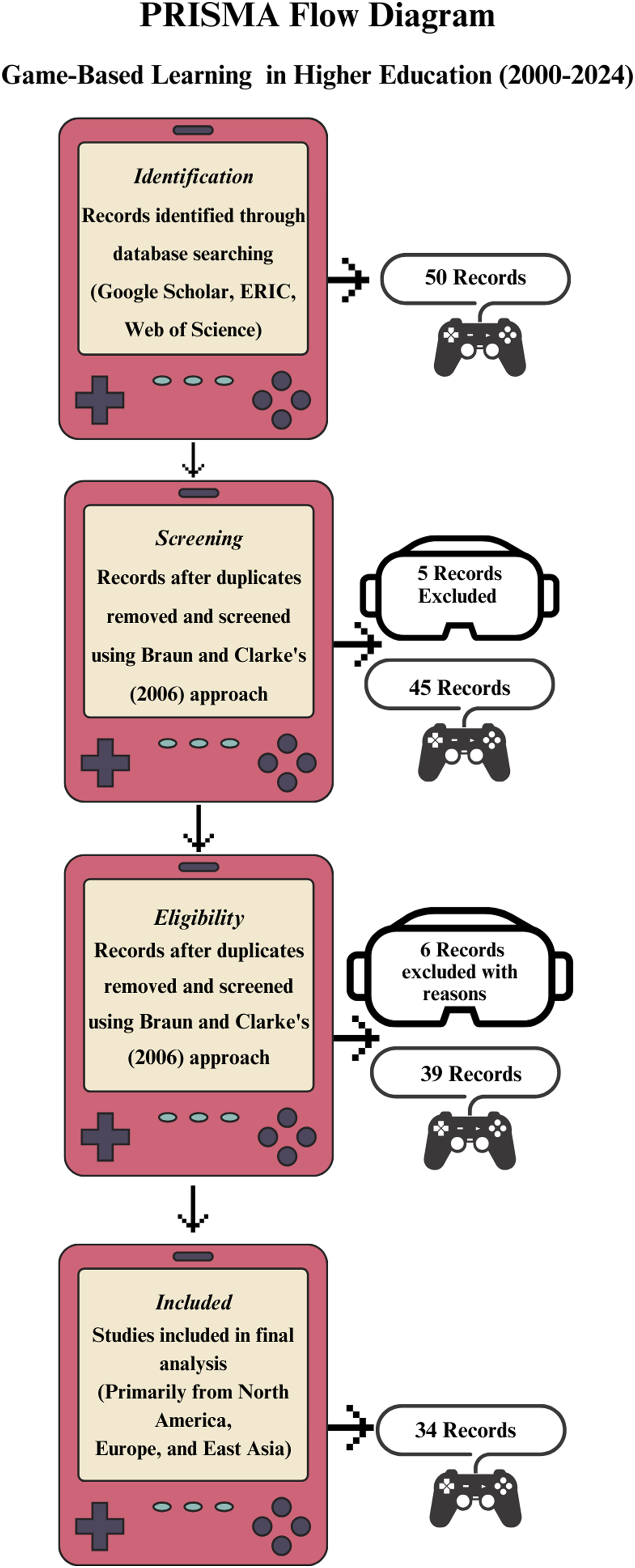
Footnotes
Authors’ note
The author completed her PhD at the University of Greenwich and previously served as an Assistant Professor in Computing at the same institution. She is currently seeking to join an academic institution in Cyprus.
Author contributions
Asegul Hulus: Conceptualization, Methodology, Investigation, Writing - Original Draft, Writing - Review & Editing.
Declaration of conflicting interests
The author(s) declared no potential conflicts of interest with respect to the research, authorship, and/or publication of this article.
Funding
The author(s) received no financial support for the research, authorship, and/or publication of this article.

Data Availability Statement
Not applicable. This study is a literature review and does not generate new data. All sources used are cited in the references.