Abstract
This article examines Swiss educational information and communication technology (ICT) coordinators (‘Pädagogischer ICT-Support’; PICTS) in Swiss compulsory schools in their ambivalent role between active agents of change and mere facilitators for their colleagues. Using a qualitative research design, it explores the history, self-perception and current roles of PICTS in the canton of Zurich and their interaction with other actors in the education system and the cantonal authorities. This paper draws on science and technology studies to understand the unique role of educational ICT coordinators. The results show that the perceptions and self-understanding of PICTS have remained consistent since their establishment, even though the digital technologies they deal with have evolved rapidly. Their dual role allows PICTS to be both active agents of change and part of a school’s teaching staff. Working at the frontier, they are ambiguous figures, embodying the contradictions of digital transformation in education without necessarily making them explicit.
Introduction
Since school computer labs were first established on a large scale in the 1980s in many countries of the industrialized world (Flury and Geiss, 2023; Howard and Mozejko, 2015; Koivisto, 2014), the question of who should oversee the technical maintenance of the equipment and provide educational support has arisen (Zandvliet, 2006). As a result, a large number of different professional profiles for computer, technology or information and communication technology (ICT) coordinators emerged in schools (Strudler and Hearrington, 2008). Often, however, computers were simply ‘oversold and underused’ (Cuban, 2001), gathering dust in labs. To prevent this from happening and to ensure the use of digital technologies in the classroom, governments began to institutionalize educational ICT support on a larger scale. This was also the case in Switzerland. At the beginning of the millennium, several cantons experimented with a new educational ICT profession as part of a national public-private partnership programme to bring schools online. In the canton of Zurich, this resulted in extensive further training and a separate job profile that still exists today: ‘Pädagogischer (pedagogical) ICT-Support’, the so-called ‘PICTS’. PICTS are teachers who have usually attended additional training and are responsible for ensuring the meaningful and sustainable integration of digital technologies in the classroom.
This article focuses on the extent to which educational ICT coordinators such as the PICTS should be understood as active agents of change. Drawing on the distinction between ‘mediators’ and ‘intermediaries’ in actor-network theory (ANT; Latour, 2005), we understand PICTS as caught between two roles. On the one hand, they are supposed to actively mediate between state authorities, companies and schools and thus actively promote digital transformation in classrooms. Since their introduction, PICTS have been viewed as ‘agents of change’ to help transform schools. They thus represent an external claim on them. This implies that schools, as they are currently organized, are not able to keep pace with technological change. On the other hand, the educational support they provide should remain in the background and even become redundant once their colleagues have been sufficiently trained and their ideas implemented in schools. The mediators are intended to become intermediaries. PICTS are therefore designed as part of the common school environment. They are ordinary teachers with a special assignment. This is reflected in their specifications and in their self-image. In order to be successful, they must not appear as external agents of change, but as particularly dedicated colleagues who can be approached on a daily basis. They are thus not external ‘brokers’ (Williamson, 2016), but are part of the school staff and have the same basic training and professional experience as their colleagues.
We refer to PICTS as ambiguous figures – they can be seen not only as mediators, but also as intermediaries. Historically, they were implemented as active agents of change who were intended to bring new technical elements into schools from outside. From the outset, their role was to transform technological approaches pedagogically. They therefore had and still have an official translation function which makes them mediators. At the same time, politicians and administrators assumed that they needed to be invisible in order to be effective. They should act as colleagues among coworkers in schools. In the medium term, they were even supposed to become redundant. PICTS were initially designed to have a transitional function that would no longer be needed once the digital mode became a natural part of everyday school life. However, that never fully happened. Instead, a frontier worker has emerged who is supposed to work as quietly as possible and still have an impact. As our research shows, it is their – perceived – ability to fade into the background and transmit something beyond themselves that makes them not only mediators, but intermediaries.
Our argument is based on a qualitative research project investigating the role of PICTS in compulsory schools in the Swiss canton of Zurich. Historical document analysis, problem-centred interviews and group discussions were used to examine the genesis, self-image and current responsibilities of PICTS in Switzerland. Special attention was paid to cooperation with other social groups in their municipality, as well as with the cantonal authorities.
In the next part, we present the state of current research and show that there has been little empirical work on educational ICT coordinators that embeds it in the functional fabric of schools. We then describe our qualitative research design that builds on historical document analysis, problem-centred interviews and focus groups to investigate the role of PICTS in the canton of Zurich and draws on an analytical distinction between mediators and intermediaries. The empirical analysis in the main part of the article is devoted, first, to the historical genesis of PICTS in the context of political action programmes to promote public-private partnerships in education. Then, based on interviews and focus groups, different configurations are analysed that characterize the functions, main responsibilities and self-images of PICTS. The paper concludes with a discussion of the main findings and directions for further study.
The current state of research
With the emergence of the computer coordinator as a new educational profession in the US (Moursund, 1985, 1992), the first related empirical studies addressed the topic of educational technology support. In schools, computer coordinators were deployed as ‘change agents’ (Strudler, 1995) and had a wide range of tasks, without a clear profile having emerged. Their main task was to create structures for the use of technology in the classroom and to train their colleagues. Support for educational technology was not intended to be a permanent function. The coordinators were expected to become redundant in the medium term. However, the task of implementing technological change in schools remained challenging and made educational ICT support an ongoing task (Strudler, 2010).
In 1992, Moursund defined the ‘technology coordinator’ as an ‘educator at the school level or the district level who works to facilitate the effective use of a wide range of computer-related information technologies in instruction’ (Moursund, 1992: 2). Computer, technology or ICT coordinators remained relevant with the advent of the Internet in the 1990s. In this context, the International Society for Technology in Education even attempted to set standards for school technology coordinators to meet (Platte, 1997).
The role of school technology coordinator has been established in many locations in the industrialized world. In a German study in the 1990s which was part of a national programme to bring schools online, computer coordinators were directly contacted for data collection (Schulz-Zander, 2001; Weinreich and Schulz-Zander, 2000). In an international literature review, Strudler and Hearrington (2008) identified coordinators in the US, UK, Australia and Germany. The new educational job profiles were intended to complement expertise in technical procurement and the maintenance of equipment. The coordinators had a pedagogical mission and were intended to support teachers in their use of digital technologies and to promote staff development. However, Strudler and Hearrington (2008) also show that the professional profiles of educational ICT support and the conditions of employment varied considerably among countries.
Over the past two and a half decades, roles and tasks have remained the central focus of research on ICT support in education (Lai and Pratt, 2004; León-Jariego et al., 2020; Lynch et al., 1999; Rodríguez-Miranda et al., 2014). Under the persistent premise that coordinators act as ‘change agents’ (Lai et al., 2002), they are considered a central component of quality control in digital education (Strudler and Hearrington, 2008). Recent works considering German coordinators (Schulze et al., 2022) emphasize that they are most effective when they act in a mediating role between schools and administrators, without taking sides. The range of possible roles for technology coordinators is relatively constant between responsibility for technical maintenance and pedagogical expertise that even includes curriculum development (see, for example, McGarr and McDonagh, 2015; Reilly, 1999). Similarly, critical data studies in education (Grant, 2022; Williamson, 2017) have focused on the ambivalent roles of data stewards and other actors in the increasingly data-driven field of education. Lewis and Hartong (2021), for example, suggest that data stewards act as ‘shadow professionals’, actively ensuring the flow of data between schools and administration while remaining in the background themselves.
The numerous works over the past three decades on the roles, tasks and attitudes of computer, ICT or technology coordinators have been aimed at improving educational ICT support. Empirical research continues to focus on raising its professional profile. Studies that consider educational ICT support coordinators as a functional group among other stakeholders (Karadeniz, 2012) or even as policy-makers (Marcovitz, 1998) are still rare. The question of the broader historical, technological and social conditions and consequences of coordinators remains unanswered. No studies consider the historical dimension of educational technology coordination itself.
In Switzerland there are already some empirical studies that focus on the role and professional profile of technology coordinators. Prior to the creation of PICTS in the early 2000s, teachers who were responsible for ICT support typically performed their duties without hourly relief or additional compensation (Schweizerisches Bundesamt fur Statistik, 2002: 30–34) This was changed in a joint national effort in the early 2000s. In their evaluation, Hotz-Hart and Nacht (2007) place the Swiss federal government’s action programmes in their historical and comparative context, especially so-called ‘public-private partnerships’ (Hotz-Hart and Nacht, 2007). In fact, the situation of ICT support in education seems to have subsequently improved, although no breakthrough could be detected. This was probably too much to expect from a national stimulus programme focused on teacher training (Barras and Petko, 2007; Petko and Döbeli Honegger, 2011). Research on the city of Zurich has shown that ICT support in schools is currently in high demand and very time-consuming (Prasse et al., 2023). For both Germany (Herfurth and Fereidooni, 2022; Schulze et al., 2022) and Switzerland there is still a need for empirical works on the perspectives and working conditions of PICTS and similar professions (Educa, 2021: 111–114).
This article contributes to the need for a better understanding of the current form and function of ICT support in Swiss education. Based on a qualitative research project, it asks about the place of Swiss technology coordinators in schools in the canton of Zurich. Beyond this scope, we also contribute to a broader debate on the role of digital technology coordinators in schools. This paper systematically relates the historical emergence and current configurations and aims to contribute to theory regarding the role of mediators and intermediaries in so-called digital education.
Theory, methodology and data
In a research project partly supported by the canton of Zurich, we investigated the role of PICTS in primary and secondary education (Geiss et al., 2022). We conducted 15 problem-centred interviews (Witzel and Reiter, 2012) with PICTS via Zoom. The interviews were semi-structured using an interview guide. In contrast to narrative ones, problem-centred interviews have a distinctive feature – the explicit inclusion of the researcher’s preconceptions in the interview guide (Scheibelhofer, 2005; Witzel, 1985). These are organized around an identified ‘problem’ with different dimensions. In our study, these dimensions revolved around the roles and challenges that PICTS face in their daily interactions with colleagues and other stakeholders. The interview guide was developed with a focus on daily tasks and collaboration with actors both inside and outside the school. However, the interview guide itself also includes open questions, particularly at the beginning of the interview. Throughout the analysis, the problem constructs outlined in the interview guide are juxtaposed with the interviewees’ responses and their respective problem diagnoses. This implies that the comprehension of the problem undergoes negotiation within the dialogue during the interview. In interviews with experts in particular, a new understanding of the problem might take shape during the interview itself, evolving through an iterative process (Döringer, 2021).
The answers to the initial open questions already shed light on the interviewees’ perception of the importance of the study’s subject matter. The various facets of the identified problem within the interview guide serve as a means of identifying the extent to which interviewees present a problem diagnosis that differs from the predetermined constructs. This juxtaposition of preconceived notions and the interviewees’ own problem diagnoses allows for a more comprehensive, empirically based understanding of the challenges that interviewees perceive themselves to be facing.
In selecting interviewees, we drew on selection criteria used in case study research (Seawright and Herring, 2008). In particular, we sought diversity in terms of gender, school level (primary/secondary), school size (number of students enrolled) and the socioeconomic status of the municipalities. An initial coding scheme was developed according to our interests and later refined in dialogue with the material (Fereday and Muir-Cochrane, 2006). The main areas of the coding scheme were daily tasks (pedagogical, technical and organizational), collaboration with other actors, the context of work and training. Following the interviews, we conducted three focus groups (Barbour, 2007) with selected respondents and two to four members of their school teams. The aim of the focus groups was to shed further light on the role of PICTS in their local teams.
In order to better understand the expectations of the PICTS and the conditions under which they operate, we also carried out a short complementary document analysis (Morgan, 2022). We considered policy documents from national, cantonal and municipal authorities, as well as scientific publications on the PICTS and government reports between 2000 and 2023. The work of PICTS over the last 20 years is not very well documented. The sources show that the field of educational ICT support in the canton of Zurich is only weakly regulated. We have therefore examined all documents we found in online library catalogues and Internet search engines that mention the genesis and changes as well as the current requirements of PICTS.
Following the thematic scope of this special issue, we approach the material with a conceptual distinction between mediators and intermediaries. This distinction serves as a ‘sensitizing concept’ (Blumer, 1954) that informs the way we look at our data. In this we follow the idea that ‘theory is more about interpretation and explanation, seeing something as something, rather than corresponding to or mirroring ‘reality’’ (Trondman, 2008: 130). In that manner, we adopt the distinction between mediators and intermediaries that features prominently in ANT (Latour, 2005). An intermediary ‘transports meaning or force without transformation’ (39). Mediators, on the other hand, ‘transform, translate, distort, and modify the meaning or the elements they are supposed to carry’ (ibid.). These concepts do not distinguish a priori between entities, but acknowledges that things can be viewed from two different standpoints. In that regard, ANT promotes increasing ‘the relative share of mediators over intermediaries’ (Latour, 2005: 61) in our accounts. Even though one can opt to treat something as intermediary, there is always some kind of transformation and translation involved. Yet, the notion of an intermediary makes us aware that this translation can be less apparent. With this in mind, the coding scheme of our interviews as well as the document analysis was revisited. We identified several areas where PICTS are ambiguous figures in terms of their mediating role. Accordingly, both their concrete work in schools (ascertained from interviews) and their historical emergence (derived from document analysis) reflect this.
Educational ICT support in Switzerland as both an intermediary and mediator
In the following section, we will argue that PICTS are ambiguous figures inhabiting two conflicting roles. On the one hand, they are envisioned by policy-makers and members of the educational authorities as facilitators who intentionally bring about change in schools. On the other hand, they are often seen as mere vessels for policies developed elsewhere and should not intervene in them themselves. As the historical genesis of PICTS shows, their work can be described as oscillating between mediating and intermediating practices. This ambiguous position is also evident in the interviews when it comes to the self-perception of PICTS. Accordingly, we identify several tensions that inhabit the work of PICTS owing to their double role as mediators and intermediaries of the digital transformation of education to date.
An ambiguous form of professionalization
To grasp the emergence of PICTS in Switzerland, one must delve into the historical developments of the last third of the 20th century. With the introduction of school computers since the late 1970s, the question arose as to how many devices were actually available in schools and how they were being utilized. Accordingly, research focused on equipment, the competence of teachers in using the new so-called ‘communication and information technologies’, the available software, and the frequency and type of use of hardware and software (Barras and Petko, 2007; Niederer, 1992; Petko and Frey, 2007). In this context, various studies showed that many schools in Switzerland had entrusted individual teachers with ICT support. However, in the early 2000s, there were still many schools in Switzerland without any form of computer or ICT coordinator. At the primary level in particular, many schools often did not even have a contact person for computer issues. Furthermore, where a teacher was assigned to provide some form of ICT support, in half of the cases this did not involve additional compensation (Swiss Federal Statistical Office, 2002: 30–31). At the turn of the millennium, an analysis of the responsibilities of ICT coordinators in the canton of Zurich revealed a strong emphasis on technical issues (Lüscher and Wirthensohn, 2001: 42–43). It seemed necessary to establish a broader understanding of educational ICT support in schools. The canton attempted to raise the professional profile of computer coordinators in Zurich schools by creating appropriate qualification programmes. In 1998, a pilot course was launched for computer officers who were to develop concepts for the educational usage of computers in the municipalities (Bildungsplanung, 1998).
The Swiss education system is highly decentralized. The federal government has no authority over compulsory schools. However, the emergence of PICTS or similar professional profiles in many Swiss cantons cannot be understood without considering the national level. At the turn of the millennium a new political dynamic arose from the need to provide schools not only with the appropriate hardware and software, but also with sufficient Internet connections. In this context, the Swiss government set out to adopt an ICT strategy that would include education (Schweizerischer Bundesrat, 1998). As in the United States and many European countries, Switzerland wanted to rely on public-private partnerships to provide schools with sufficient Internet connections. By working with businesses, schools should be provided with access to the World Wide Web as quickly as possible. But this Internet action programme was only the more technical side of the package. As part of the public-private partnership initiative, the forerunners of today’s PICTS were also created in various cantons. Although this part of the programme was also called a public-private partnership, private industry was hardly involved. Rather, the initiative was about providing national subsidies to qualify educational ICT coordinators in the cantons (Hotz-Hart and Nacht, 2007). In the canton of Zurich, this led to a qualification programme that was later consolidated and is now based at the Zurich University of Teacher Education (in cooperation with the University of Applied Sciences and Arts in Northwestern Switzerland). The original form of educational ICT support at the turn of the millennium was designed as a stimulus, not a long-term commitment. However, a pattern is repeated here that has continuously accompanied the political responses to the digital transformation in federalist Switzerland since the end of the 1970s (Geiss, 2020): in a temporary national programme, qualification offers were created that were to become obsolete in the medium term. This then led to the creation of structures that required longer-term funding because the demand for skills in the labour market did not disappear of its own accord. The same development happened with the PICTS, who are still qualified in many Swiss cantons today.
Since the predecessor of today’s PICTS was introduced in the canton of Zurich 20 years ago, the issues and challenges of digital transformation in the classroom have changed continuously. As a result, PICTS training at so-called universities of teacher education (‘Pädagogische Hochschulen’) is still in demand today. At the same time, interest in PICTS in education policy has only recently begun to grow again. This is partially due to the emphasis on digital media and informatics education in public schools since the implementation of an intercantonal curriculum (‘Lehrplan 21’). The topic is on the political agenda. This also increases the demands on PICTS.
Given the long history of PICTS and their introduction in many Swiss cantons, it might be expected that there would be clear conditions of employment and standardized specifications for them. However, even within the canton of Zurich, this is only partially the case. The canton has only indirect means to control and harmonize educational ICT support for public schools. The municipalities are required to draw up a local digital media and ICT plan, for which the canton provides support. But the municipalities are at very different stages of development and are expected to find their own local solutions (Volksschulamt, Bildung und ICT, 2023).
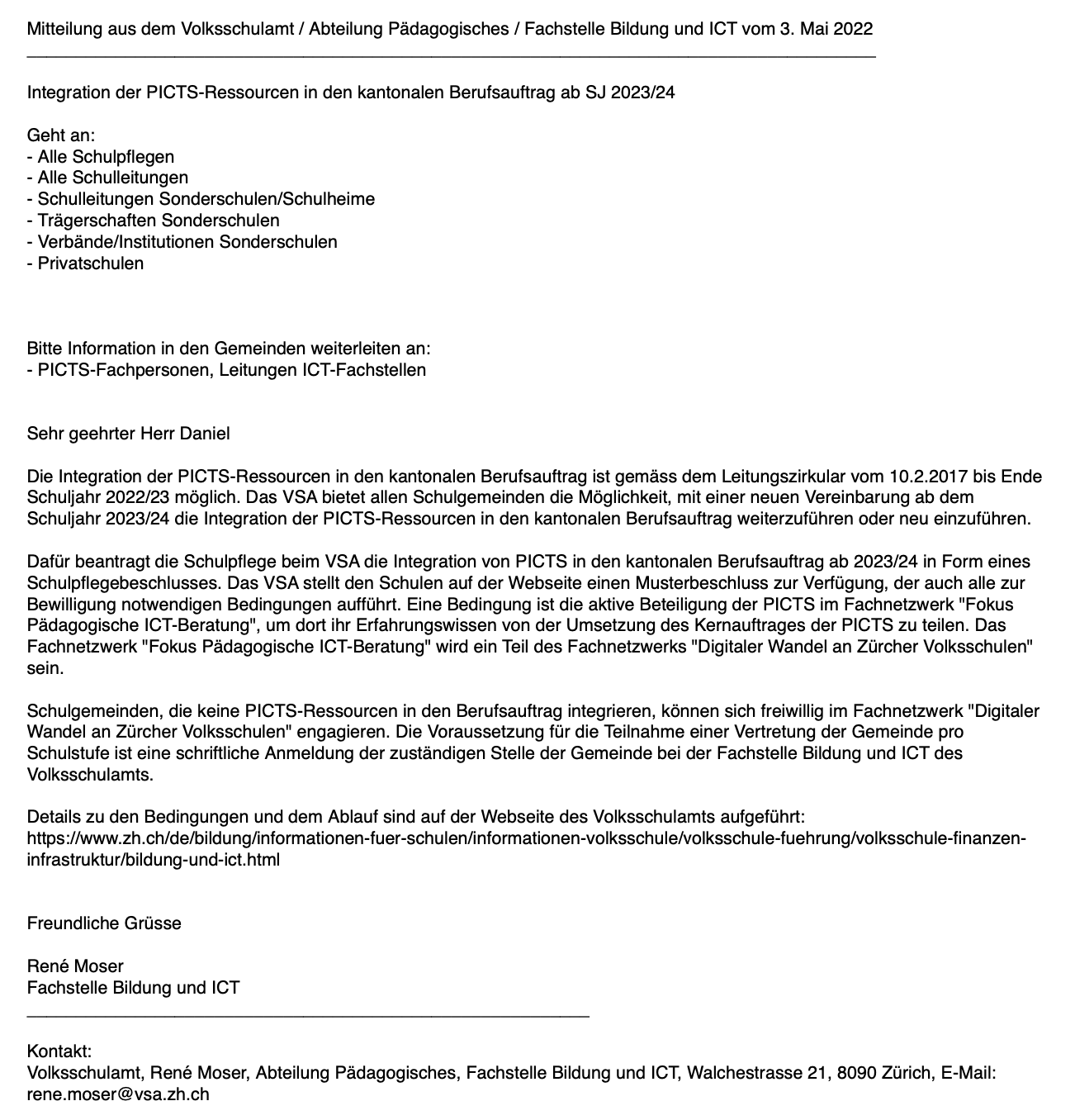
Another way of harmonizing educational ICT support could be accomplished through teachers’ working conditions: in Zurich, elementary school teachers are employed by the canton. Cantonal laws and ordinances apply to their professional duties and their working conditions. The recruitment of teachers and personnel management, however, are the responsibility of the municipalities, which act as employers together with the cantons. Nevertheless, municipal resources can be integrated into the cantonal professional mandate for some specific tasks. In this case, the local school authority must submit an application to the cantonal education authority. This also applies to educational ICT support (Feller et al., 2020: 16), but it is still possible that the municipalities will not make use of this option (Leitungszirkular, 2022).
By using the lever of integrating communal resources into the cantonal professional mandate, the canton could try to ensure a gentle harmonization of educational ICT support. It defined, for example, a resource key, encourages the participation of PICTS in cantonal networks and provides online resources for PICTS, school boards and other local stakeholders. Even in these cases, however, the canton does not contribute financially to the salary costs of the PICTS. The advantage of integrating communal resources into the cantonal professional mandate is that the cantonal regulations also apply to the teachers here and they do not need two working contracts. The predefined resource key and an upper limit for PICTS resources in the cantonal professional mandate should ensure that rich municipalities do not build up large ICT support apparatuses under cantonal regulations. However, they can still set up additional ICT support services at any time, outside the cantonal mandate (Schrackmann, 2022: 15–16).
More recently, the canton has been pushing for a more consistent separation of educational and ‘technical ICT support’ (TICTS), greater exchange between PICTS beyond schools and more advanced internal responsibilities in digital matters in the schools. The technical support tasks should not be integrated into the cantonal professional mandate, but should be remunerated under communal employment conditions, as they do not require a teaching licence (Moser, 2023). A need for change is also evident in the municipalities, some of which work with their own job titles or profiles and a historically evolved communal PICTS structure (Stadt Bülach, 2023; Winterthur, 2021).
These historical experiences and current structures form the basis for the work of PICTS in the canton of Zurich. PICTS are confronted with very different expectations of their professional role. At the turn of the millennium, they were implemented as mediators to bring an external function into Zurich’s schools and classrooms. At the same time, as fellow teachers, they were expected to work as smoothly as possible as part of a team and to act as intermediaries. The hinge that holds these two conflicting functions together seems to be the only vaguely defined ‘educational’ mandate.
Consulting colleagues
Our interviews and group discussions suggest that the functions and professional profiles of PICTS have remained remarkably stable despite all the changes in technologies and political contexts. They are in clear continuity with the founding phase at the beginning of the millennium and the developments in other countries. The ambivalent expectations placed on them from the outside are also reflected in their self-perception. The introduction of PICTS was originally based on the premise that teachers needed ‘pedagogical support’ in the appropriate use of the then new information and communication technologies, but that they would most effectively obtain it from their peers.
This ambivalent role, on the one hand holding an external function as a coordinator, and on the other being part of the teaching staff, remained and can be seen today, as expressed in the following quote from one of the interviews. First of all, the teacher emphasizes that some external pressure is needed to make a difference: Yes, I’m also the one who has to put a bit of pressure on and say, don’t we want to do this or that? And especially the people who don’t get along with IT, they like to dismiss it like that: yes, no, I can’t right now, I have more important things to do right now.
1
Then, just two sentences later, in the same response, the teacher emphasizes her own membership of the school’s faculty: Which I also feel myself as a classroom teacher. And it’s not a problem for me, because I have such an affinity for these things and also like doing them. My biggest part of the work is actually also to pull the teachers along, to be able to show them how easy it is to integrate something, how small it can be, but how effective.
The teacher here views herself as someone who has already managed to integrate technology appropriately into her teaching. She sees her task as convincing others. She legitimizes the pressure she has to build up by saying that she is a teacher herself: if it worked for her, it must work for others. She resolves the supposed contradiction between pedagogical freedom and technological coercion by integrating it into practice. This positioning as part of the teaching staff also allows for an outside perspective on one’s work as a PICTS, as the following quote from another interview illustrates: Sure, there are teachers who, well, of course we’re always in competition with a hundred other subjects. I see that myself as a teacher. I don’t want anyone to suddenly come and say, I want to look at music lessons with you and how can we continue there?
PICTS are aware that their work can be seen as an imposition or a threat to other teachers. They also forbid themselves to interfere too much in their subject teaching. This reflexive distance is only possible because they themselves still teach regularly and have to reconcile this role as ordinary teachers with their special mission as educational ICT support.
As both intermediaries and mediators, PICTS tread a fine line between colleagues and consultants. As agents of change they are required to be persistent and visible figures disrupting daily practices in their schools. Their acceptance in such a transformative role can only succeed because they act as peers and colleagues, minimizing their perceived status as an external force. If they are successful, they can speak to the other teachers with both the authenticity of a peer and the authority of an expert.
Educational janitors
This affiliation with teachers is also reflected in the official mission of PICTS. Formally defined, PICTS are responsible for educational issues related to digital technologies and media in schools. They are usually teachers themselves with additional qualifications. They have a larger workload as a regular teacher and an additional one as an educational ICT coordinator. Their role is to support their colleagues with pedagogical scenarios and teaching methods in the use of digital media in the classroom and to provide pedagogical advice on digital media, addressing topics such as for what purposes a teacher should use educational videos, or how tablets can be utilized effectively in the classroom. However, they often have to convince their colleagues of the educational benefits of digital media and allay their doubts and fears: The largest part of my job is to inspire teachers by showing them how easy it is to integrate something, how little they need to be effective. Yes, that’s the biggest challenge, to take away fears. And I realize that it is very difficult taking away someone’s fears and to simply say ‘Hey, just try it for yourself!’
While these attempts to promote the use of digital media go beyond the core task of developing digital education, they are still viewed as relevant tasks. However, PICTS often have assignments that deviate from their formally assigned role. Even though they are perceived as pedagogical rather than technical experts, they often deal with technical issues such as assisting with logins, adjusting and calibrating tools, installing software and so on.
The extent to which they are responsible for such tasks in their school depends largely on the availability of additional technical staff. Some schools provide in-house staff (‘technical ICT support/TICTS’) or contract external IT companies to deal with such issues. In these schools, PICTS can focus on their main task of providing educational services related to digital media to their colleagues. This becomes particularly clear when they describe the division of tasks with the actual school janitor or the internal or external technical ICT support. Here it is evident that for PICTS there are educational tasks with a technical component that should be distinguished from purely technical ones: We simply have the janitor. And we also have a custodian, a schoolhouse administrator. (…) With them you sometimes have something like that in technical matters. That’s more like (…) could you install the access point for me? And stuff like that.
While the teacher in this quote downplays technical tasks as menial, another highlights the extent to which technical and pedagogical expertise can be intertwined: We have two easy-going young men who work in the municipality but are really only responsible for us schools. That’s just great. So really everything technical. And they also have a lot of know-how, of course, and if anything happens, they help you relatively quickly and so on. And I find that very supportive.
This teacher is glad that he is not left alone with the technical challenges that come with his job as a PICTS. The actual technical expertise is outsourced, and he can rely on it. This allows him to focus on his educational mission, which depends on a functioning technical infrastructure.
In smaller schools especially, such a division of labour is, however, not possible, and PICTS also act as technical support. But even when TICTS and other technical experts are present and formally assigned, PICTS are often approached with technical problems: Although we have TICTS here, I am asked about technical matters. And the challenge is to say: ‘No, please approach the TICTS!’ But, of course, I am plugging things in from time to time. But having TICTS reduced that to a large extent, obviously.
PICTS are accessible to their colleagues in the classroom. They are usually teachers themselves. PICTS are present in the teachers’ lounge and are perceived as colleagues who share the same professional outlook and speak the same language. But this intimacy also creates problems for them. In daily school life, it is often impossible to make a clear distinction between technical and pedagogical issues. As a result, PICTS are caught between the two competing roles of ‘curriculum leader or electronic janitor’ (Reilly, 1999).
The mission of PICTS is to digitally transform education at the local level of their schools. To accomplish this, PICTS interact not only with other people, but also with technical devices. They literally plug things in and work on the smooth integration of digital media. By also fulfilling the demands of their colleagues to ‘plug things in’, PICTS can act as intermediaries of the digital transformation. They minimize technical hurdles that otherwise would obstruct their mission of educationally supporting other teachers with digital media in their classrooms. Technicalities and technical problems that force themselves into the foreground are relegated to the background, allowing issues that matter to become more pronounced. In schools that employ TICTS or have access to other forms of technical support this work is (at least partially) delegated.
Local policy-makers
Finally, PICTS can be viewed as important local policy actors in their schools and beyond. They not only train their colleagues in the use of digital media, but also give meaning to a technology-enhanced education and try to convince teachers, principals and other stakeholders of the benefits of digital tools. As such, they negotiate what and how tools can and should be used and act as agents of digital transformation in education (see also Steinberg, 2021). They deal not only with their colleagues and technical staff, but also with a range of other stakeholders such as parents and, at least in some cases, the local school authorities.
The PICTS deal with parents, for example, when tablets are distributed in class and children are allowed to take them home. This immediately raises questions about values regarding education and digital media use in the home, as the following quotes illustrate: It is then somehow also immediately from the parents: ah, now they have a device. And oh no, there are dangers here! But the idea would actually be to learn how to deal with it. You see, the topic is suddenly in a completely different place. It has nothing to do with the device at all, but in general, like parenting and so on.
The PICTS here represent the digital transformation of everyday practices, which also poses challenges for parents. Enforced usage of digital devices in schools affects parents’ self-image and challenges domestic practices. The PICTS themselves take the parents to task and require them to teach the children about appropriate digital media use at home. Even though this issue is not very dominant in the interviews, it shows how the PICTS are involved in the local everyday politics of digital change and must assert themselves here.
This becomes even clearer when it comes to local school authorities. PICTS rarely deal with them directly. Most of the time, contact is made through the school principals. Sometimes, however, there are direct negotiations: PICTS then often have an ambiguous relationship with representatives of local school authorities. In the canton of Zurich, the so-called ‘Schulpflege’ are elected representatives of their communities who are responsible for the local schools. For example, they make financial decisions regarding the purchase of additional equipment. PICTS therefore depend on their willingness to spend money on digital media that they deem valuable for their schools. They thus must convince the local representatives of the educational benefits of such tools. One PICTS described his attempts to introduce interactive screens in his school: Well, I cannot just take a noisy video projector. And I studied interactive screens intensively. And the local school board was quite some obstacle. You need to collaborate well with them and you need good arguments and so on. Initiating this was a large part of my work in the last few months.
Another PICTS states that she works closely with the local representative and is on good terms with them. This allows her to avoid lengthy justifications in the procurement process. The local school board trusts the PICTS to make sound decisions and is therefore willing to approve the purchase of new tools proposed by the PICTS. Such a close relationship is more common in small municipalities, whereas in larger cities, processes tend to be more formal and relationships more distant.
The cantonal authorities responsible for the more general PICTS guidelines are further away. There is sporadic contact with them, at network meetings or training courses, or through personal contacts. In some cases, the exchange is only mediated through other persons or bodies. This also reinforces the impression that PICTS are local agents of change, working as policy-makers in schools and communities. As teachers who are only PICTS for part of their workload and teach the rest of the time, the focus is primarily on the school and the local community. This is where they get involved, help others adopt digital media and fight their battles.
PICTS are actively working on the digital transformation of education by selecting aspects that they deem worthwhile. In that regard, they are mediators advocating a certain vision of education in the digital era to different stakeholders. Again, educational aspects are highlighted by the PICTS: using digital tools both at school and at home requires digital media education, and to ensure a pedagogically sound integration of digital media in the classroom their procurement should not hinge on bureaucratic constraints.
Conclusion
When computer technology arrived in schools, someone had to look after it. Almost by accident, a job profile emerged in the industrialized world that would later become an important factor in the technological transformation of education. In Switzerland as well there was an increasing number of computer coordinators in public schools. At the turn of the millennium, the state authorities and teacher training institutions set about professionalizing schools’ ICT support. The intention was that some teachers should be trained to coach their colleagues until this was no longer necessary.
However, as history shows, the need for more specialized colleagues in schools remained or even increased. The educational ICT coordinator became an ambiguous professional figure, sometimes acting as an active mediator or agent of change in the foreground, but more importantly, often working most effectively when they became almost silent facilitators in the background.
Our analysis shows how ICT coordinators in Switzerland position themselves in the context of other actor groups. Their function as ‘consulting colleagues’ appears to differ from the transformative power sometimes called for in public debates on educational technologies. Rather than being a disruptive force, they understand themselves as colleagues in the same environment. Even if they have a political mandate to change schools, they are first and foremost teachers who advise their colleagues. This seems to give them the necessary professional credibility and prevents them from appearing as intruders in schools.
As ‘educational janitors’, they are supposed to take care of the educational side of technology support in Zurich’s public schools. However, if there is no practical support available, they are also responsible for many technical tasks. The educational and technical sides of ICT support are generally not easy to separate. Here, in particular, PICTS often appear to act not as mediators, but as intermediaries who keep the digital infrastructures in schools running.
Finally, PICTS work with a range of actors beyond the confines of their teachers’ lounges and schools. They are part of the wider community in which their school is located. In smaller municipalities they act as ‘local policy-makers’, in dialogue with other stakeholders. They not only help to adapt technologies to educational needs, but also to local or regional circumstances and financial constraints.
Educational ICT coordinators have existed in many countries for decades now. The social and technological conditions in which they work have changed radically during that period – and continue to do so. At the same time, their job profile is remarkably stable. ICT coordinators should have technical expertise but at the same time focus on the pedagogical aspects of the digital transformation of education. They work with their teacher colleagues on the ground, but are also expected to inspire from the outside. This dual requirement makes them an ambiguous group of actors which can function both as mediators and intermediaries.
Historical continuity against a backdrop of rapid technological change makes it likely that ICT coordinators will continue to play an important role in the digital transformation of education. At the local level, they seem to resolve the contradictions and conflicting interests that accompany digital change. It is their mission to mediate between the proliferating and sometimes ignorant digital agenda and the realities on the ground. They appear to be here to stay.
Footnotes
Declaration of conflicting interests
The author(s) declared no potential conflicts of interest with respect to the research, authorship, and/or publication of this article.
Funding
The author(s) disclosed receipt of the following financial support for the research, authorship, and/or publication of this article: This work was supported by the Volksschulamt des Kantons Zürich, Switzerland.