




Abstract
Unprecedented global temperatures have brought the question of how to teach sensitive issues of climate change to the fore. In this paper we suggest that a refocusing on adaptation productively shifts the debate to climate justice and practical solutions to building community resilience. The paper examines a practice-led project that sought to innovate and test the use of participatory storytelling with young people to explore climate adaptation. Our insights relate to two areas: first, the benefits of mutual learning through engaging in dialogue with frontline communities; second, how participatory storytelling supports emotionally intelligent sensemaking, agency and leadership by providing both ‘connections’ and ‘containers’ for engaging with climate.
Keywords
Introduction
How to approach the climate crisis is one of the most challenging pedagogical questions facing schools today. The topic is urgent and necessary – as one of the teachers involved in the project discussed in this paper puts it, ‘that is just not up for negotiation’ – but raises a number of sensitivities and concerns. These range from fears of exacerbating young people’s already existing climate anxiety, to warnings from politicians about not teaching ‘partisan’ positions (Crandon et al., 2022). As a consequence, there can exist a lack of confidence in schools, with 75% of UK teachers feeling they haven’t received adequate training to educate students about climate change (Oxfam/UKSCN, 2019). In this paper, we also propose that climate education is too often ‘technocratic’, being caged within specific disciplines and frequently focusing on a narrow range of mitigations. Youth-led campaigning organisation Teach the Future, for example, have criticised the confinement of climate education to small sections of the science and geography curricula in the English National Curriculum, which specify merely that students should learn the geophysics of climate change and a range of mitigating actions (Teach the Future, 2020). In contrast, we follow Kirby and Webb in seeing the subject-matter of climate change as ‘intrinsically unbounded’ (2021), reaching into every aspect of life and learning, and therefore suited to teaching approaches which allow students to engage with it through experiential, participatory and relational learning.
Facing these realisations, there exists a growing drive to reinvigorate climate education, drawing on vibrant work within the climate media sphere, the creative arts and beyond. It is within these frameworks that this paper is located, presenting insights from a practice-led project that sought to innovate and test alternative approaches to climate education. In ‘Suitcase Stories’ we used participatory storytelling with young people to explore climate adaptation, placing emphasis on engaging with lived experiences of climate change through mutual learning and story-exchanges between the Global South and the Global North. We propose that through this approach young people engaged in learning that transcended traditional curricula boundaries and increased their understanding of their own potential agency and leadership within climate justice. Namely, recognising the need for solutions which simultaneously mitigate climate change, build community resilience, and tackle other layers of social and economic injustice (Center for Climate Justice, n.d).
The paper begins with an exploration of the current politics and practice of climate education. This focuses on the context in England, a limitation that enables a more granular analysis but which will need transposing to different circumstances in other contexts. We then present our practice-led methodology, providing an insight into the how and why of what we sought to undertake through the Suitcase Stories project. The second half of the paper then presents our primary insights, which relate to two areas: first, the benefits of mutual learning through engaging in dialogue with communities on the climate frontlines; second, how participatory storytelling can support emotionally intelligent sensemaking, agency and leadership around climate.
Context: Current politics of climate education in England
In the aftermath of COP26, and in response to growing demands from environmental organisations for more comprehensive climate education, the then UK Education Secretary Nadhim Zahawi advanced a new climate strategy for 2023 (Department for Education, 2022a). The strategy promotes voluntary initiatives such as greater pupil engagement in biodiversity and sustainability in school sites, a new GCSE in Natural History, school sustainability leads and a national Climate Award for individual pupils to work towards.
Organisations campaigning for improved climate education, such as Teach the Future (2022), welcomed the suggestion of a more integrated climate education curriculum, but also highlighted that the government’s proposed approach primarily consisted of options to be taken up only where time and resources permit. In this respect, it may add little to the existing educational landscape, which already includes numerous well-established third sector schemes for schools to enhance their climate education such as Eco-Schools (Eco-Schools, n.d), EduCCate Global (EduCCate Global, n.d), or the Green Schools Project (Green Schools Project, n.d). The core curriculum remains largely unaffected, excepting an enhanced primary science curriculum. Strong commitments to teachers’ continuing professional development around climate education, present in early drafts, were removed in the final version (Teach the Future, 2022). In conclusion, Teach the Future declared itself ‘underwhelmed’: This strategy commits us, for the next eight years, to an outdated and inadequate national curriculum which does not require the in-depth study of issues relating to the climate emergency or ecological crisis and does not enable young people to explore their roles in working with others to create solutions to our problems. (Teach the Future, 2022: 2)
There is in addition a particular quietness in the English National Curriculum around the issue of climate adaptation. The distinction between climate mitigation and adaptation is summarised by the European Environment Agency as follows: In essence, adaptation can be understood as the process of adjusting to the current and future effects of climate change. Mitigation means making the impacts of climate change less severe by preventing or reducing the emission of greenhouse gases (GHG) into the atmosphere. (EEA, 2022)
While almost all UK students are exposed to mitigation measures to a certain extent, such as renewable energy in the GCSE Science curriculum, only those students that take GCSE or A Level Geography (see for example AQA, 2022) are likely to undertake any significant exploration of how people already experiencing the impacts of climate change are adapting, or could adapt, to them. A certain reluctance to focus too heavily on adaptation in education is perhaps not very surprising. Krasny and DuBois (2019) raise provocative questions about how and whether adaptation education can be compatible with the ‘traditional values’ of environmental education, with its focus on empowering individuals and groups to contribute to mitigating human-induced climate change. While acknowledging that the immediate risks posed to human communities by climate change mean that environmental education must ‘venture into climate adaptation education’ (2019: 884), they suggest that environmental educators are faced with a dilemma. On the one hand, a focus on adaptation could divert attention from important consumption reduction and other pro-environmental behaviors consistent with climate mitigation. On the other hand, a focus on mitigation alone, and in particular changing individual behaviors, might paint a false sense of optimism about our capacity to protect ecosystems – and ourselves – in light of the magnitude and immediacy of climate change. (2019: 884)
Furthermore, for classroom teachers, engaging honestly with young people about the range of impacts which climate change is having and will have during their lifetimes, and the lack of progress in achieving concerted action to prevent these, may be deeply challenging. Verlie (2019) suggests that this perhaps even strains against some of the core unspoken tenets of education – such as the belief that by working hard young people can obtain a bright future. This may be compounded by a reluctance to cause or exacerbate students’ anxiety; by teachers’ reticence to discuss problems to which they do not have simple answers; or a perception that adaptation is too scientifically, economically or politically complex to explore with young people. Further, recent restrictions on the inclusion of perspectives deemed to be politically partisan (Department for Education, 2022b) may lead teachers to shy away from questions of climate justice which are unavoidable in discussing adaptation: the disproportionate impact of climate change on those of colour, those in poverty and in the Global South, and the sensitive postcolonial questions around what financial reparations (known as ‘loss and damage’) may be due to these communities. Indeed, Dolšak and Prakash suggest hesitancy is precisely because adaptation raises ‘issues of power, conflicting policy preferences, resource allocation, and administrative tensions’ (2018).
As UNICEF (2012) has been highlighting in its own calls for a greater emphasis on adaptation in climate education for a decade or more, the impacts of the changing climate have long been a daily lived reality for the most marginalised or resource-poor communities of the Global South. Educating for this is not a luxury but a practical necessity, and this is increasingly the case for the Global North as much as the Global South (Sanson et al., 2019). It stands to reason that in adapting to climate change, there is much to learn from the strategies developed by those on the climate frontlines who have ‘got there first’. A focus on adaptation and community resilience can therefore contribute to decolonising learning, as well as acknowledging the tendency of climate change to act as a multiplier of existing inequalities by affecting the poorest and more marginalised first and worst. In this we were inspired by the discourses developing in online climate media, such as the Mothers of Invention (Mothers of Invention, 2024) and Hot Take (Heglar and Westervelt, 2022) podcasts, the Project Drawdown (Project Drawdown, n.d) and Climate Reframe (Climate Reframe, n.d) initiatives, all of which celebrate the socially and environmentally innovative practices of women, communities of colour and other under-represented people. We wondered whether a similar focus on preparedness and justice-focused practical solutions might also answer some of educators’ concerns about climate anxiety, by holding young people’s fears up to the light of others’ experience and showing them the positive roles they can play even in difficult situations. Rather than the caricatured doomsday scenarios of dystopian fiction or disaster movies, these true stories reveal that community-based adaptation can entail surprising benefits – greater equity, social connection, self-determination or sense of purpose.
Unsurprisingly, it is educators in the Global South who have been more focused on adaptation than those in the North, echoing UNICEF’s calls for ‘an approach to adaptation that encompasses current risks and uncertainties, and also fosters the adaptive capacity of the most vulnerable’ (2012: 6). Kabir et al. (2015) evaluate the effectiveness of the ‘Climate Change and Health Protection’ manual for school children in Bangladesh, the country ‘ranked highest on the risk index of climate victims’. Kabir et al. find that the project provides evidence for the importance of working with young people in schools in the Global South, stating that ‘the key to building resilience and adaptive capabilities in children lies with preparing them at the school levels’. An example of climate adaptation education from the Global North is Bofferding and Kloser’s (2014) study comparing the understanding of middle and high school students in the California Bay area about climate change mitigation and adaptation strategies before and after school curricula interventions. The lessons aimed to ‘develop students’ system and action knowledge by focusing on topics such as climate science, the energy budget, mitigation, and adaptation, all with a focus on data analysis and making evidence-based claims’ (2014: 281). Bofferding and Kloser note that ‘students were more likely to identify adaptation strategies that were personally relevant to their own contexts’ (p. 283), and conclude that because of this, ‘climate change curricula should be tailored for different regions of the world by emphasizing geographically relevant adaptations’ (p. 290).
Our critique of current approaches to climate education, therefore, is that they are primarily technocratic, often overlook learning about adaptation, and fail to equip teachers or young people with the resources and capacity they need to take seriously the challenge of the environmental crisis. This betrays, at root, a failure to engage with how the climate crisis requires not just new thinking but more fundamental engagement with new ways of thinking. The research of Tokyo-based Hikaru Komatsu and colleagues provides evidence that educating young people for sustainable futures may call upon teachers in primarily individualistic societies, such as the UK, to challenge their pedagogical approaches at quite a deep level, to influence students’ self-construal. Komatsu et al. (2019) suggest that students may need to develop more collectivist understandings of their selves; Komatsu et al. (2022) demonstrate that the degree to which students construe themselves as connected to nature is key to their readiness to contribute to environmental solutions. This call to interconnectedness is also expressed, in different terms, by veteran UK environmental educationalist David Orr, who calls for the development of an ecological democracy, which ‘requires a high level of understanding and ecological literacy by which enough citizens can see the world as one evolving system’ (2020: p.272).
The corollary of this, for Orr, is that climate change cannot be pigeonholed into single (usually scientific) subjects, but needs to be investigated in all its cultural, economic and political complexities: ‘all environmental and sustainability issues, from local to global, are unavoidably political, having to do with “who gets what, when, and how”’ (Orr, 2020: p.273). Climate change is Timothy Morton’s (2016) quintessential example of a ‘hyperobject’ – a complex phenomenon that is viscous (‘stuck’ to our very beings and selves), nonlocal (global in origin but affecting us where we are), temporarally undulated (existing over long timescales), phased (impossible to grasp as a whole) and interobjective (intertwined through intricate, unpredictable webs of cause and effect). Thus, as Kirby and Webb put it, ‘the subject-matter of climate change is intrinsically unbounded, reaching into every fissure of human experience, including our co-existence with the non-human’ (2021). Teach the Future express this more succinctly by stating that ‘every career and life is going to be massively implicated by the climate emergency and ecological crisis’ (2022: 1).
This is a call for an educational approach that is similarly unboundaried; one which recognises the myriad ways climate change already intersects with young people’s lives, and which explores and rehearses a wide diversity of social, economic, and technical solutions – both adaptive and mitigative. Kirby and Webb (2021) call for educators to develop a pedagogy of uncertainty, in which young people and teachers together ‘gather around’ the hyperobject of climate change – accepting its vastness and complexity, mourning and raging at its injustices and tragedies, and investigating its solutions together in a spirit of shared learning and action. The widespread climate anxiety evidenced by Hickman et al. (2021) among young people worldwide seems to demand an emotionally literate and comprehensive response. Specifically, Hickman et al. (2021) found that young people particularly struggled if they perceived influential adults to be avoiding taking action with regard to climate change. Yet school students remain unlikely to encounter climate fiction in English, ecologically engaged practice in Art, regenerative agriculture in Biology, climate anxiety in Psychology, circular economy and zero-waste design in D&T, or climate justice in Politics. They may very well not have the opportunity to discuss the contentious relationship between growth and environmental degradation in Economics, or to explore different discourses on transport and energy in newspapers in Media Studies. There is a sense of keeping the ‘beast’ of climate change in a cage.
The reorientation of the education system that would be required to engage with climate change with breadth, depth and emotional literacy does not seem to be forthcoming at national UK level. However, even within the current curricular constraints, there do exist some more flexible areas of school life which offer teachers opportunities to provide ‘islands’ of unbounded, exploratory learning. Arts-led approaches might seem to offer one of the most promising avenues for teachers to build confidence in a ‘pedagogy of uncertainty’ (Kirby and Webb, 2021) - to explore the complexity around climate crisis without feeling the need to have all the answers. Within artistic disciplines, meanings can be multiple and do not need to be pinned down, allowing some degree of scope for exploration of political dimensions of climate justice without risking allegations of political bias. Working from the stimulus of a story, poem or artwork allows educators to introduce issues for discussion in an emotionally engaged, experiential, holistic and contextualised form. Jeanne McNaughton (2014) argues convincingly along these lines for a greater role for drama in Global Citizenship Education and Education for Sustainable Development. However, the existing English National Curriculum for arts subjects such as Drama, English Literature and Art is almost completely silent on climate issues.
Methods: Suitcase stories and innovation in climate education
‘Suitcase Stories: Exploring Climate Education through Participatory Storytelling’ was a FUNDER funded FUNDING CALL public engagement project. It was delivered in 2021/22 by an interdisciplinary team including researchers from geography and theatre. The project was practice-led, meaning that it was driven by on-the-ground delivery and reflective learning through experimentation and working with young people. This included two strands, one within the context of secondary schooling, which is the focus of this paper, and the other in informal contexts of holiday and theatre clubs for young people. The project sought and received ethical approval from the School of the Arts ethics committee at UNIVERSITY.
The school-based form of the project was delivered as an after-school club running over 12 weeks. This was offered to pupils from across all years, with 25 young people aged between 11 and 17 participating, from school years 7–12. As the school was an all-girls’ school in a highly ethnically diverse area working-class area, all participants were female and the majority from families of first- or second-generation Pakistani, Turkish, Nigerian or other backgrounds. Enabling cross-age group collaboration was a deliberate design strategy to mimic community participation rather than school interactions. Working with this school was partly a choice arising from existing relationships (one member of the research team having worked with it on a previous project). However, we also considered this school of particular interest in that it offered the opportunity to meet the project funder’s requirement that we engage communities not usually well represented in climate debates. The students’ links to diaspora communities also meant the project could draw on a diverse range of first- and second-hand experiences of the impact of climate on different regions and communities.
The delivery had two distinct phases:
Phase 1: exploration
Working with the researchers, the young people were invited to explore the theme of climate adaptation. A primary vehicle for this was storytelling, listening to stories from the frontlines of climate adaptation, of community resilience and of change. Each of the researchers told a true story on this theme and in addition the young people were introduced, via remote technology, to two other sources of experiential knowledge. The first of these was climate journalist Thimali Kodikara (producer and presenter of the Mothers of Invention feminist climate solutions podcast) and the second was a series of video calls with pupils from a secondary school in Nigeria. The objectives here were to introduce young people to lived experiences of climate change and climate adaptation from both the Global North and Global South, and to instil in them a sense of the importance of listening, hearing and learning from these lived experiences, as we expand upon below.
Phase 2: making
The young people then worked with the project storytellers to develop their own short storytelling performances that engaged with climate adaptation. Two main parameters were placed upon these. The first was that the story should be told orally and through the use of props that could pack into a small suitcase. This was at once both a dramaturgical device and a reference to travel and migration; it was also the origin of the project title. The second was that they should be orientated around a geographic place or ‘destination’ - the reasons being to provide a focus for background research and a dramaturgical ‘hook’ for the stories that would emerge. Working in groups, the young people selected, researched and developed their stories. In most cases they used raw material and themes from the Exploration phase of the project to invent their own stories. A particular focus here was that we were working in the form of story – rather than say that of the report, the essay or other more traditional education frameworks. The impacts of working in this manner are expanded upon in terms of learning through participatory storytelling below.
The making phase concluded with the filming of the stories, which were then shared through assemblies with all the young people in the school.
The project sought to achieve a number of objectives: 1. Young people develop their abilities to articulate issues surrounding climate justice and climate adaptation as leaders within their communities; 2. Young people are confident in using storytelling approaches to express experiences of climate injustice and adaptation; 3. Young people possess a sense of agency around climate adaptation and climate justice, contributing to improvements in feelings of anxiety linked to climate change; 4. Teachers experience professional development in relation to climate education practice; 5. School communities (local and international) gain exposure to learning on climate justice, climate adaption and techniques related to climate education.
The degree to which Suitcase Stories met these objectives was independently evaluated by Students Organising for Sustainability-UK, utilising ‘spectrum of opinion’ exercises recorded at the beginning and the end of the project, alongside participant diaries and transcribed discussions in which the young people were invited to reflect upon and evaluate what they had learnt. Nigerian students sent in their reflections via email. Transcripts from these discussions are drawn upon in this paper below; student voices are cited anonymously as ‘UK/Nigerian Student Reflection’ and staff as ‘UK/Nigerian Staff Reflection’. Stories are cited as ‘UK Student Story’ (the Nigerian students did not create any stories of their own as we were unable to fund a facilitator to work with them and their teachers). In addition to this report, and a project documentary, the project also produced two teachingresources aimed at different age ranges, that sought to provide an accessible model for teachers toadopt this approach within their own practice.
Insights 1: Mutual learning through lived experiences of climate adaptation
The focus on climate adaptation was built into Suitcase Stories from its initial conceptualisation. Specifically, we hoped it might forefront the ecological justice concerns that have often been underplayed in mainstream environmental education in favour of a focus on individual behaviour change.
The focus of Phase 1 of Suitcase Stories, therefore, was exploration, in the form of stories of adaptation from the front lines of the climate crisis. More than this, we had the objective of producing convivial circumstances in which mutual learning could take place between all the participants in the research: young people, researchers, teachers, international partners. As climate podcaster Thimali Kodikara articulated as one of the strategic goals of her Mothers of Invention podcast, building a ‘community’ is essential in facilitating the circumstances in which this kind of mutual learning can occur: Climate crisis is an absolutely terrifying subject to talk about, so people don’t want to think about it […] So the humour aspect is the way that we overcome that – inviting people to come, listen to these stories, very heartwarming stories, relatable stories, but doing it in a way that women so often do – getting together, talking, laughing, supporting each other. (Kodikara and Heinemeyer, 2021)
An aspect of community building resulted from the multi-cohort approach in which students from different year groups were brought together to interact within a shared process. There was a demonstrated sense of openness whereby students shared inner thoughts, personal values and emotions on issues relating to climate change. In the words of one of the more senior students, ‘being able to work with students younger than me, was really inspiring’. The sense of community within the UK school group was further exemplified by the low drop-out rate of students; it seemed nobody wanted to step out of the community that had been created. This type of community-building pedagogic approach has been identified as helping young people develop skills needed to shape behaviours but also mitigate the impacts of climate anxiety (Bingley et al., 2022; Crandon et al., 2022). This underscores the need to create space for multi-cohort interactions to discuss climate change, which may not be available in traditional classrooms where students are separated into grade levels (Sergiovanni, 1994).
There was also evidence of a sense of connection and emerging community between the students in UK and Nigeria. According to one of the students from Nigeria: ‘Getting to meet students of [school name] was a thing of joy to me, though online, but I really enjoyed the time with them’ (Nigerian Student Reflection). Furthermore, a look at some of the topics of discussion (see Figure 1) during online interactions gives credence to the sense of community. Although some of these topics – such as questions about music tastes, school costs, single-sex versus mixed-sex schools etc – would suggest that the students were engaged in discussions not directly related to the subject of climate adaptation, which could appear as a distraction, the humour in these interchanges undoubtedly established the conditions for learning by helping to build a sense of community. In this it resembled, the Narrative 4 project, which brings groups of young people from either side of cultural divides together for personal storytelling exchanges, and which also found that their participants brought similar opening questions, regardless of the ostensible theme of the exchange (Moss, 2018). Questions and discussion topics between Yorkshire and Nigerian students.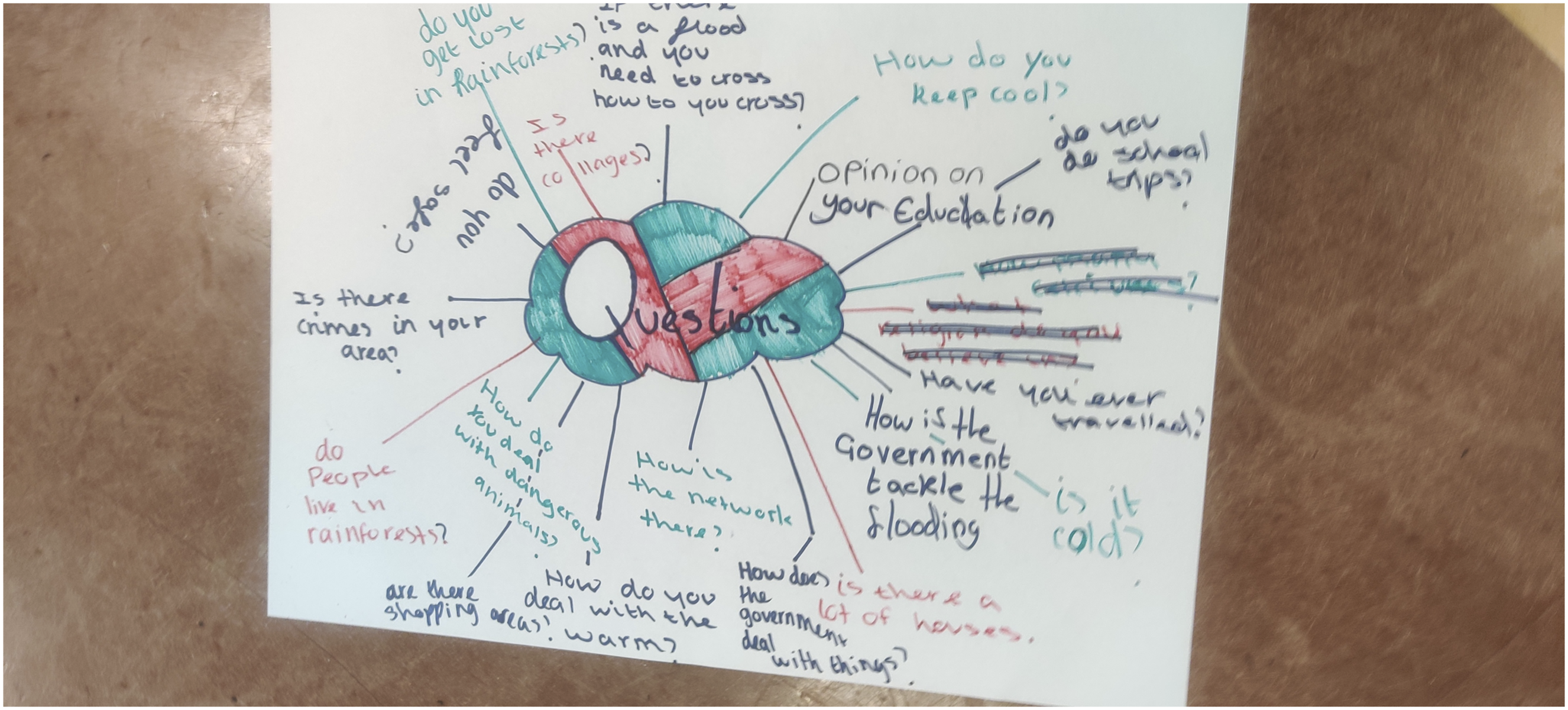
We found that there was value in having a heterogenous group (i.e. students of different age groups and in another context), as this opened space for dialogic engagements and provoked evaluation of ideas, and explorations of different perspectives. One of the students alluded to this, describing their appreciation of The development of the stories and like how you got everyone’s advice and everything and then kind of took it on board and slowly shaped it. Before we had a couple of characters that we were going to showcase like all in one go but then we narrowed it down to just the fisher woman and her story. Yeah, I think that was like really good. (UK Student Reflection)
Philipson and Wegerif (2017) describe such inter-pupil communication as ‘exploratory talk’, a tentative reaching towards organisation of thoughts which is highly valuable for sense-making. Such exploratory talk, they say, can be distinguished from ‘presentational talk’ (the ‘final draft’ of someone’s thinking), ‘disputational talk’ (competitive or argumentative communication) and ‘cumulative talk’ (uncritical agreement aiming for social harmony). The traditional structure of formal learning may reduce the possibility for students to have this kind of dialogic exchange; the looser and more egalitarian structures of an after-school club in contrast enhanced it, as everyone was able to share their own stories from their own lived experiences. Within this relatively unstructured context, each student had a chance to contribute to the conversation in a way that enhanced dialogic practices. The discussions were rich and not short of the diversity of perspectives that provoked students to share, listen to, question, and reconcile contrasting ideas. This is highlighted in students’ evaluations, which reveal that ‘disputational talk’ too was present: Sometimes it was, like, easy, but most of the time, it was difficult because we all had different ideas about what is our opinions, but obviously, we had to go with whatever was best, which wasn’t always what everyone wanted. (UK Student Reflection) And listening to everyone’s ideas, and kind of, like, adapting and knowing that, like learning that the first answer and best idea is not always going to be the last one. It’s just like the base of it. You can build on it after (UK Student Reflection).
Two important points to note are the value of having external experts (project researchers) mediate the dialogue and the cumulative nature of the dialogues. The mediation can also create a rich learning environment and opportunities for teachable moments that can potentially shape a positive learning culture. For example, in one of the student’s reflections: I really liked Thimali’s story about the, you know, how she got to be where she is now in terms of doing a podcast from New York and being a journalist because I aspire to be a journalist in the future. And I really liked the seed story as well. I know a lot of people brought up the seed story, but that was really interesting to see how one seed could become so many other different types. (UK Student Reflection).
This indicates that in sharing stories about climate change, students are learning much more than simply ‘facts’. There is in addition a series of relational encounters, that intrigue, build empathy, and give the stories told the power and significance of the first-person witness.
The discussion here – supported by the young people’s reflections – suggests that a mutual learning environment is not devoid of disagreements, but the young people were able to develop a sense of mutual respect for the ideas of others, see the bigger picture and work toward a common goal. In this process, everyone’s opinion becomes important in the learning process, everyone can learn from others and help others to learn. In the context of climate change, such mutual learning may help young people to develop the skills required to become ‘creative and collaborative knowledge builders’, a critical skill young people will need to address the climate change crisis (Facer, 2020). Jensen and Schnack (1997) situate such collaborative skills in the centre of their ‘action competence’ approach to environmental education. More broadly, studies have shown that mutual learning promotes productivity and creativity among student groups (Coates and Pimlott-Wilson, 2019; Mueller and Fleming, 2001).
The community, dialogic practice and mutual learning environment helped students appreciate the gaps in their knowledge of each other’s environment. One of the Nigerian students said they ‘learnt that the effects of climate change in Africa are little different from its effects in the UK’ (Nigerian Student Reflection).
There was evidence that students’ sense of having learnt problem-solving, teamwork or leadership skills contributed to a greater sense of agency in the face of anxiety-provoking phenomena. The participants’ mean Likert score for the statement ‘I know about some things I could do or get involved with to tackle climate change or help people adapt to it’ rose substantially from 6.1 before the project to 8.1 after it (SOS-UK, 2022). Individual participant reflections also homed in on this theme of agency: I think I’ve learned how to pick up on issues. Like how they can be solved. Looking at it more into kind of what can be done and the people around it. So I think now I’d look more into what can be done, and how can we solve it, more than like being upset about it. And I think I’ve also picked up on this skill of being able to identify what we can use to tell a story. (UK Student Reflection). I feel like I’ve really worked on actually working on my leadership skills. So, you know, by enabling myself to think of this issue in Australia, and influencing that, and students younger than me, and actually being able to work with students younger than me, was really inspiring. (UK Student Reflection).
Beyond conveying information, this approach provided students with the encounters that helped them develop values and virtues that open spaces in their minds and hearts so they could see climate change, adaptations, and the people most impacted in broader terms. Through the process of Suitcase Stories, the participants realised that climate change is not something happening in a faraway place, generating feelings of empathy and a realisation of the gendered dimension of climate change. The following samples of the story transcripts are representative of the range of expressions and understanding by the students (the majority of the stories are available on the project website).
On group focused their story on Australia, motivated by one student with a family connection to that country. They created a story around the impact of bushfires on the life and career of one young man: […] No one saw it coming. It was a normal occurrence, just another fire. How could anyone know that this fire will destroy millions of homes and take away so many lives, including the life of his father and sister. The fire had got to James’ house and destroyed everything that remained there. He will always remember that day how the smoke singed his nostrils and burned his throat, how he closed his eyes as the house collapsed. The overwhelming guilt seems to consume him, he should have gotten back to help. […] (UK Student Story)
Another group set their story in Brazil and comprised pupils who enjoyed creative writing. Their main character, an indigenous girl called Kaya who experienced brutal deforestation, gained power through her poetry: […] Kaya grew up to be a very inspiring activist and poet who wrote about her experiences in deforestation and climate change, and how she made a change just with her words instead of violence. And she wrote quite a few poems and this is one of the most famous. In the Amazon, I stand. The one you can’t destroy. Hot, humid rain dripping melodically on leaves. That doesn’t happen anymore. Mad monkeys and proud parrots up in the lush green canopies. That doesn’t happen anymore. Sky high trees reaching into canopies, reaching up into the skies. No, that’s not right. No, now to trees, animals and rain, those three million species are gone. And those trees are your tables and chairs. The temperature and agriculture don’t mix. It’s been abandoned apart from those greedy businessmen who still think they haven’t stolen enough. You can blame those businessmen for what they’ve tried to do with the Amazon rainforest. (UK Student Story)
Insights 2: Participatory learning through storytelling
The practice of learning through participatory storytelling was integral to the aims and objectives of Suitcase Stories, in particular the development of emotionally intelligent sensemaking, agency and leadership. By listening to others talk of their experiences of climate injustice, researching stories from around the globe, and using practical, creative drama exercises to devise storytelling performances participants were invited to become storytellers of climate adaptation. Some of the greatest before-to-after gains revealed by the independent project evaluation were in young people’s confidence in themselves as storytellers and communicators, as judged by themselves on a Likert scale from 1 to 10. The mean score for ‘I consider myself a storyteller’ rose from 6.6 before to 8.2 after, and mean score for ‘I am confident in talking to other people about my feelings about environmental issues and climate change’ rose from 5.3 to 6.7 (SOS-UK, 2022).
This methodology centralised the voices of the people ‘experiencing the harm being inflicted’ by the climate crisis (Coolsaet, 2021), thus allowing participants to consider complex issues on a nuanced emotional and physical level; empathising with the lived experiences of those on the climate frontline and exposing their embodied knowledge of climate injustice.
While Bofferding and Kloser (2014) found young people to be more interested in adaptation approaches relevant to their own geographical context, the experience of Suitcase Stories was that students had a high level of willingness and engagement with the stories of others from geographically diverse contexts. This was undoubtedly facilitated by the live contact with Nigerian students and with the climate journalist Thimali Kodikara, who could bear witness to different regions’ experience. This enabled the students to form (albeit fleetingly) social relationships which brought geographically distant experience emotionally close. As Walter Benjamin highlighted in his seminal essay on storytelling (1969), storytellers may be of the ‘farmer’ type (located within their own community) or ‘sailor’ type (bringing stories from distant shores), but in both cases their stories can be clearly distinguished from simple ‘information’. While information, for Benjamin, is selected, framed and interpreted by an external authority, such as the media or the school curriculum, stories are experience crafted into something that has meaning and ‘counsel’ for their particular listeners. When the students chose stories to tell each other, in response to each other’s questions, they were shaping their life experience into something of relevance to young people like them, who were gathered together and ready to listen. For example, a Nigerian student saw how many UK student questions asked about dangerous animals and how wildlife was being affected by climate change, and chose to tell about how the hot weather was luring out cold-blooded animals like scorpions and snakes.
This meant that creating stories was a deeply personal process for the students, and assisted them in making connections between global issues and their own stories and lived experiences. And like, we showed how it affects other people’s homes in a way that would maybe make people think, what if it comes to my home? Or wherever it affects where I live? To make them do more about it? (UK Student Reflection).
The above student reflection also, however, confirms Bofferding and Kloser’s (2014) claim that students’ imaginings related to their own situation remain of prime importance – that awakening a sense of global concern depends on developing a sense of local vulnerability and agency. This suggests that when it comes to learning about climate change, dialogic engagements with those whose experience is radically different may paradoxically be a powerful way for young people to learn about their own locality, and vice versa, through the personal power of someone else’s story. The power of learning through these means of engagement/exchange was considered by the school’s vice-principal to have far surpassed the learning opportunities schools usually offer students in relation to climate change: We think that climate change is crucial, we think it is a major priority that needs to be addressed in education […] the students have enjoyed looking at something that is a very important and serious issue but in a creative way and thinking outside of the box way. The idea that they’ve got a visual like the suitcases, they’ve really bought into it […] they’ve taken ownership, it is their project and it will go on in an organic way. And that is what I think has been missing in education over the last couple of years, so not only the topic is important […] But the way it’s been approached has been absolutely enjoyable […] I think the students have got a lot out of this project. (UK Teacher Reflection)
Communicating through stories is a fundamental way in which humans make sense of themselves and each other. As evolution scientist Wendy Wheeler argues in Expecting the Earth: Life, Culture, Biosemiotics, ‘art, especially art in language, remains the best place [for] our hopes of self-understanding’ (2016, 276). Through storytelling we can communicate the complexity of conflicting and contrasting emotions felt towards the impact of the climate crisis through multiple voices and perspectives. It is for this reason that participatory storytelling is increasingly been utilised to explore complex issues that require empathetic engagement across difference and engage with conflict or contradiction. Our project team had experience of working with storytelling in a diversity of contexts, but specifically with young people in relation to complex issues such as mental health, the refugee crisis, and social injustices (Heinemeyer, 2020). Elsewhere, a project that utilises the storytelling aspect of dialogical work in this way was The Withernsea Project, led by the University of Hull in 2021, which encouraged climate literacy in young people ages 12–14 by listening and retelling local stories about how people have been affected by climate change, making it into a short film. The hope of this project was to bring the issue of climate change, usually explored at a global level, closer to home, in an effort to highlight that the effects of climate change are already changing lives in the UK. Katie Parsons and colleagues (2021) explain the project’s aim to build climate literacy, which they define as ‘the ability to identify, understand and explain information associated with climate science’, as well as give young people the agency to understand and articulate climate injustices.
Like the University of Hull’s Withernsea Project, Suitcase Stories similarly contained phases of exploration and of making, but crucially in both elements utilised the form of the story as a distinct way in which we both know about and speak about the world and our experiences. In previous work we have termed this ‘storyknowing’ (Reason and Heinemeyer, 2016), expressing the ability of a story to hold alive different perspectives and experiences without need to automatically devolve towards a conclusion. As Michael Wilson describes it, this narrative turn in research represents the Rediscovery of an age-old way of dealing with contradictions, multiple contradictory truths, and distinguishing between truth and lies, redeployed to help us navigate through our rapidly changing and liquid lives. (2014)
The ability of storytelling to represent a form of knowing was intuitively recognised by participants who commented: I like the elements of storytelling and being able to like talk about the different like things that are happening to like our world like right now and how that was different people’s stories like people that have been affected by climate change. (UK Student Reflection)
This participant expresses how the ‘elements of storytelling’ helped them to connect with current, lived experiences of multiple people around the world. As one student explains: ‘I feel like people should be more respectful of what’s happening in other countries, just because you’re not affected by doesn’t mean they’re not either’ (UK Student Reflection). There is a stark contrast here to the emphases on technocratic approaches and propositional knowledge typically found within the national curriculum.
Through becoming storytellers the participants in Suitcase Stories were able to attune themselves to an embodied understanding of climate injustice. As phenomenological philosopher Maurice Merleau-Ponty writes, embodied knowledge is the notion that the body is a knowing thing, as well as the mind. Participants demonstrated that they knew how a character would feel and behave, if their home was at threat of flooding, or forest fire. This was essential in regards to ensuring the subject matter remained relevant and intuitive to the participants. I see myself as a storyteller but more of like an acting storyteller because like [name] said it gets like the message out and it’s also a bit easier to do than with words, because you know, actions speak louder than words. (UK Student Reflection)
Concluding reflections: Connections and containers
One of the objectives of Suitcase Stories was for young people to become confident in using storytelling approaches to express experiences of climate injustice and adaptation – or more assertively, we wanted them to become storytellers. Becoming storytellers entails the developing of various kinds of ‘soft’ skills – of confidence, public speaking and collaboration. As one young person commented, ‘The skills I’ve learned are like, how to tell a story and like how to tell a story to a big audience and not to be shy’ (UK Student Reflection). Becoming a storyteller, however, entails both this and more than this, particularly in terms of the relationship that it constructs with knowledge and experience. Specifically, it involves establishing connections and creating containers.
The role of storytelling in forging connection is perhaps well understood. In his discussion of storytelling, Walter Benjamin asserts the relationship between teller and listener as being mutual, more akin to a continual baton relay than the one-directional communication of presentational forms such as the novel. Benjamin writes that a storyteller takes what they tell from experience and ‘makes it the experience of those who are listening’ (1969: 87). In other words, the act of listening always implies an invitation – perhaps even an evocation – to become a teller and re-teller. In the context of mutual learning, this oral relationship describes something beyond the transmission of knowledge but of a gaining and internalising of others’ experience.
Becoming a storyteller represents a temporary taking control of the narrative – temporary, because as an oral form there will always be another re-telling. Within this we assert the young people gained not only soft skills of confidence and public speaking, but also hard and impactful skills of leadership and agency. As one participant put it: The entirety of storytelling just brings much more than just information can, it really like draws you in with the emotions, and really makes you feel what that person feels, which sort of makes you understand it better. (UK Student Reflection)
Rather than seeing the young people’s storytelling as a precursor to ‘taking action’ on climate change, therefore, we see it as a form of action in itself, one which has the potential to build and strengthen connective tissue within their communities. The growth of a sense of community within the group was evidenced by a substantial leap in participants’ mean Likert scores before (5.3) and after (8.1) the project for the statement ‘I know other people who share my feelings about environmental issues and climate change’ (SOS-UK, 2022). Beyond the school, some of the young people went on to participate as storytellers in at least one local community event.
Even in connected communities, however, a sustained engagement with the hyperobject of climate change is difficult – thus the equal importance of transforming knowledge into forms which allow people to ‘stay with the trouble’ (Haraway, 2016; Boal, 2005; Ganz, 2009) rather than becoming overwhelmed by it. As Ursula K Le Guin proposed, a story can act as a container or ‘carrier bag’: ‘Words hold things. They bear meanings. A novel is a medicine bundle, holding things in a particular, powerful relation to one another and to us’ (Le Guin, 1989, 34). Learning through the researching, composition and sharing of stories can therefore be understood as a process of creating containers for the powerful and unbounded issue of climate emergency. Such containers do not force the subject into narrow or technocratic channels; through opening up an exploratory research process they allow students to consider how climate change intersects with their lives; but crucially, they offer a way for them to hold their learning in their hands. In the drive to develop emotionally literate approaches to climate education, we propose mutual learning through storytelling as a possible starting point for educators.
Research limitations and directions for further research
This was a practice research project working in a small range of contexts: the schools discussed in this article, as well as some informal youth provision settings which for reasons of focus are not discussed here. The process was shaped as much by the particular participants with whom we worked, as it was by ourselves. Our findings are thus strongly influenced by the characteristics of the schools involved and particularly the UK school: a girls’ secondary school with a predominance of Muslim pupils, in a working class area of Northern England. The project was able to draw on the resource of the students’ diasporic connections to Pakistan, Turkey and other countries, and the experiential knowledge this gave them of climate change at both first and second hand. Running the same project in a more monocultural context might require creative adaptations to identify other connections to the issue within students’ experience, or perhaps a heavier reliance on the facilitators bringing a broader range of stories from other cultures. Students from more privileged backgrounds might bring yet another set of experiential resources and knowledge gaps to the process.
A further significant limitation was the degree of engagement and interaction with the Nigerian students. Although a new internet connection was funded for the Nigerian school from the project budget, the connection remained unreliable and the time which the Nigerian teacher could allocate to the project was limited. This perhaps created a power imbalance between the Nigerian and UK partners; strategies to mitigate this would be worth pursuing. It would be valuable to develop future iterations of the project with a greater emphasis on international creative collaboration, for example by hiring a Nigerian-based drama facilitator as a counterpart to the UK facilitators, who could deliver workshops with the Nigerian students and their teachers.
The relative brevity of the project (6 months) limited our ability to monitor any long-term impact on students’ understanding, agency and sense of leadership on climate. As older students involved mentioned the sense of leadership the project gave them, it would be interesting to co-produce a second-year project with these students. On the other hand, it would equally be of value to trial the project within a single age cohort, as a complement to the mixed-age approach we took in this first iteration.
In sum, the initial potential demonstrated by the ‘Suitcase Stories’ project could be fruitfully researched through more extensive practice research in a broader range of educational contexts. We would suggest that this could be guided by exploring different routes to experiential knowledge, and different relationships between the schools involved. For example, a pairing of two rural schools in the Global North and Global South might enable a thematic focus over issues faced in agriculture, which might foster close connection and knowledge sharing.
Footnotes
Declaration of conflicting interests
The author(s) declared no potential conflicts of interest with respect to the research, authorship, and/or publication of this article.
Funding
The author(s) disclosed receipt of the following financial support for the research, authorship, and/or publication of this article: This submission is based on a Natural Environment Research Council funded Creative Climate Connections public engagement project titled ‘Suitcase Stories: Exploring Climate Education through Participatory Storytelling.’
Data availability statement
In accordance with the confidentiality arrangements detailed in our ethics policy, we cannot make all qualitative feedback received from participants publicly available. However the website ( • All the stories created and filmed by young people • An independent evaluation report containing extensive quantitative and qualitative data relating to the project. ) contains the following: