




Abstract
This paper introduces the concept of infrastructure into discussions on climate change and education. We focus on the links between the increased use of digital data and the central role of data infrastructures in education, and the energy infrastructure needed to support their growing use in schools and school systems. We elaborate a need for a greater accounting of the climate and related social costs of these interwoven digital and energy infrastructures of schooling. We suggest this is part of the ‘disposition’ of the infrastructures of schooling that should be weighed into decisions on whether and how to continue with digital technologies in schools. By acknowledging the climate and environmental incommensurability of digital infrastructures, education leaders and young people can more fully understand their dispositions and their costs. We propose three implications for education governance that entail greater consideration of the limits of current school climate change infrastructures such as ‘eco school’ programs and EdTech ‘AI for good’ initiatives, pushes for ‘computing within limits’ without substantial changes, and current school governance practices which unnecessarily rely on digital infrastructures. Instead, what is needed may be a reversal of the extensive use of digital infrastructures by schools and education governance bodies.
Keywords
Introduction
Schools and school systems are increasingly operating within policy environments that support mobilising both digital skills and platforms in education, and climate change and sustainability action (OECD, n.d.; UNESCO, 2022). Digital and climate change priorities are typically addressed in separate policy frameworks and as distinct areas of education policy making within government ministries and local school authorities, without recognition of their incommensurability. Education research has also tended to focus either on addressing climate and sustainability issues, or digital education technology, without in-depth consideration of their challenging intersections.
This focus is overdue for a shift, in part due to the recent rapid increase in datafication in education, understood as the process of converting things and events in quantitative and digital data, that are added to growing education databases. Accompanying datafication is an uptake of artificial intelligence (AI) at a system level in automated education governance and decision-making, and at a classroom level through teaching platforms, such as Google Classroom (Perrotta et al., 2021). The expansion of AI accelerated due to the growth in schooling at a distance during the COVID-19 pandemic (Gulson et al., 2022; Williamson et al., 2021). Alongside this is an increasing awareness of the environmental costs of digital technologies, including extraction and shipping aspects of procuring the hardware, as well as the subsequent emission costs of computation and data storage (Brevini, 2022; Crawford, 2021). Schools and education systems are also under pressure to address climate change, not only through curriculum change, but also in relation to accounting for the emissions and other environmental costs of school facilities, operations and governance (Bieler et al., 2018; UNESCO, 2021). As a result of these convergences between the use, and climate implications of, digital technologies in schools and school systems, there have been increasing calls to consider climate and environmental implications of education technologies (e.g., Gauthier, 2022; Selwyn, 2018; 2022a; Tiernan, 2022).
This paper engages with these implications through exploring what infrastructure studies can offer to understandings of the intersections of climate change and digital considerations in education. Infrastructures can be understood as ‘built networks that facilitate the flow of goods, people, or ideas and allow for their exchange over space’ and over time (Larkin, 2013: p. 328). Infrastructure studies consider not just the physical ‘things’ or ‘systems’ of which they are comprised (rail tracks, roads, school buildings), but also the associated social and technological processes that enable, or disable, certain kinds of action (Graham and McFarlane, 2015). A focus on infrastructure, broadly conceived, enables an articulation between the technologies of politics and the politics of technology (Appel et al., 2018: p. 14).
In this paper, our political concern is with the continued and growing reliance on infrastructures of what Urry (2007) termed ‘carbon modernity’ in education governance, even in schools and jurisdictions that aim to further sustainability and climate action. We link, or ‘twin’, the increased use of digital data and the central role of data infrastructures in education, with the energy infrastructure needed to support these data infrastructures – an underlying ‘infrastructure of infrastructure’ that is operating in schools (Jensen, 2017). In what follows, we first outline what we mean by infrastructure and digital infrastructures in education. We then look at the direct and indirect use of energy by the digital infrastructures of schooling in the areas of extraction, logistics, and computation. In highlighting the twinning of digital and energy infrastructures, we conclude with three implications for education governance.
Analysing infrastructure
As introduced above, infrastructure studies emphasise not only the physical aspects of built systems, but also the ‘shared standards and ideas’ that fashion and control their use (Easterling, 2014: p. 11). Infrastructures include the underlying arrangement of technical objects and systems, as well as more intangible habits of thought, subjectivities, and social practices (Gulson and Sellar, 2019). The networks of infrastructure and the sociotechnical processes that surround them in part shape and delineate the ‘structures of feeling,’ or what is possible culturally in a time and place (Graham and Marvin, 2001; Williams, 1973). As Appel and colleagues (2018) suggest, attention to the materiality of infrastructure indicates how it is central to our ‘sensory, somatic, and affective’ habitation of the world (p. 25). Infrastructure elicits affect and sentiment: producing belonging, accomplishment, and loss, ‘as polities are constantly being unmade and remade through not only the things that infrastructures carry, but also the semiotic and sensory ways in which they shape belonging’ (Appel et al., 2018: p. 26).
However, experiences of infrastructure vary considerably, given that infrastructures play key roles in establishing and sustaining ‘sociotechnical geometries of power’ (Massey, 1993). In other words, building infrastructures of mobility and access for some, always involves the establishment of barriers for others (Graham and Marvin, 2001). It is thus critical to also consider how infrastructures manifest and advance particular social, economic, and environmental understandings that benefit some more than others (Crawford, 2021).
One way to examine the implicit aspects of infrastructure is through Easterling’s (2014) concept of disposition, which draws together a range of social and technology theories. Easterling contends that some of the most impactful political outcomes of infrastructure remain unspoken in the dominant stories through which infrastructures are represented. By reading not only the technology itself, but also the ‘declared intent or story,’ as well as other unspoken factors and impacts, one can gain a better understanding of the fuller ‘disposition’ of the infrastructure (Easterling, 2014: p. 71). Easterling (2014) provides a possible analytic for doing so, drawing attention to a shifting range of ‘active forms’ that can be markers of disposition – such as infrastructure components that are multipliers, as in the introduction of elevators that enabled the building of skyscrapers; or a social story which carries meaning and affect in relation to an infrastructure. The ‘disposition’ of an infrastructure can then be viewed as depending on the complex interplay of these and other types of active forms.
In what follows we investigate the twinned digital and energy systems of schooling through this infrastructural methodological lens, to better understand how their respective dispositions are co-implicated, as well as incommensurable, in relation to sustainable life on the planet.
Digital infrastructure in education governance
The infrastructures of school systems encompass the built environment of schools, including associated water, sewage, and energy infrastructures; school grounds and surrounding community infrastructures; and digital infrastructures. Digital infrastructures in schools and school systems entail the hardware and software used by students, teachers, and school and system administrators, that enable the monitoring and assessment of the activities of schools. Data infrastructures are a particular type of technological infrastructure underpinning digital education governance, where education is governed through the use of digital data-driven decision making (Williamson, 2017). Supported by the devolution of schooling globally, education systems now derive much of their cohesiveness through a common set of data infrastructures, such as national or global digital assessments or the use of platforms such as Google classroom (Lawn, 2013). The increasing use of algorithms is also introducing new domains of knowledge into data analytics in forms of ‘education data science’ with predictive and prescriptive applications, such as the use of facial recognition in schools to track student attendance or emotions (Gulson et al., 2022). These types of data infrastructures enabling digital education governance can be understood as combining the collection, storage, analysis, and visualisation of data through algorithms with the materiality required to undertake these functions. This includes both local and dispersed materials - people, software, and hardware (computers, cables, including network materials).
These infrastructures enable and intensify datafication, the process of converting things and events in quantitative and digital data, that are added to growing education databases. Increasingly, digital education governance is undertaken using proprietary systems, from small scale EdTech that provides student information systems, to the digital platforms of global technology companies such as Google, Amazon, and Microsoft. These proprietary infrastructures and their databases enable the measurement, ranking, and comparison of students and schools through the growing range of platforms and dashboards that track and share information on student engagement, student attendance, and teacher feedback. With education data systems and software developed by computer scientists and corporations, and partial decision making by AI and automation, educational human expertise is a less significant contributor to what happens in schools. Indeed, schools can be understood as increasingly operating through forms of ‘synthetic governance’ as an amalgamation of human classifications, values, and practices on one hand, and ‘new algorithms, data infrastructures, and AI on the other’ (Gulson et al., 2022: p. 132). If as Larkin (2013) suggests, infrastructure is the foundation that enables something else to happen, then in education, data infrastructures are the enablers of the digital and synthetic governance that have become increasingly central to what happens in schools.
The data infrastructures of school share a main arterial infrastructure of hardware, wifi, and electricity; with varied connections to software and platforms that enable specific modes of information and governance (e.g., Google Classroom as a teacher-student interface, attendance and grade tracking platforms for use with families, facial recognition algorithms, etc). The ‘active forms’ (Easterling, 2014) of the infrastructures thus vary to an extent, though with others having consistency – for example, with computers as multipliers in student and family access to data, school electricity switches which modulate access to operating technology (e.g., when schools are powered off to save energy), or the internet and electricity cables as wiring connecting across the school community and beyond. The stories that attend the mobilisation of particular forms of data infrastructure may vary in their specificities, though with an overarching theme of belief in education data science, as the ‘study of the generalizable extraction of knowledge from data’ (Liu and Huang, 2017: p. 2). This includes affective aspirations of policy and governance towards more orderly, successful, or productive students and schools (Pitton and McKenzie, 2020). Also circulating are some understanding of the ways that digital and data-based processes and platforms are biased by the people and data used to create them, such as the lack of racial diversity in the datasets used, and the engineers employed, to build facial recognition programs or the cultural knowledge embedded in digital assessment methods (Benjamin, 2019).
In what follows, we elaborate on a largely underexamined aspect of the ‘disposition’ of the data infrastructures of schooling, that being the planetary impacts of the creation and operation of the technology itself.
The planetary impacts of twinned infrastructures
In her ‘Atlas of AI,’ Crawford (2021) writes: AI then, is an idea, an infrastructure, an industry, a form of exercising power, and a way of seeing; it’s also a manifestation of highly organised capital backed by vast systems of extraction and logistics, with supply chains that wr around the entire planet. All these things are part of what AI is – a two-word phrase onto which is mapped a complex set of expectations, ideologies, desires, and fears. (p. 19)
Accompanying the increasing use of AI and other data infrastructures across domains of society is a growing need to recognize the high carbon costs embedded in their disposition. As such, we also need to attend to the underlying energy infrastructure of digital infrastructure. In this section, we examine both direct and indirect uses of energy for digital infrastructure to (i) access materials (extraction), (ii) build infrastructures (logistics), and (iii) operate infrastructures (computation). We discuss how dependencies on energy entail a range of material and affective experiences and impacts that should be included in calculating the costs and opportunities of maintaining, and expanding, the digital infrastructures of schooling.
Regarding extraction, following Parikka (2015), we can think of data infrastructures in education as extensions of earth. The components of data infrastructures such as chips and semiconductors depend on precious, rare metals. Mining for these metals involves energy intensive processes that produce extensive pollution, or ‘tailings’ from ore extraction. Lithium is key to the development of AI, with enormous mines and a low ratio of usable minerals to waste toxins, resulting in devastated landscapes. As Crawford (2021) explains, ‘The cloud is the backbone of the AI industry, and it’s made of rocks and lithium brine and crude oil’ (p. 31).
The logistics that underpin building a data infrastructure are extensive, and span land and sea. A central part of infrastructures to allow data flow are the submarine telegraph cables that cross the ocean floors between continents. To produce these cables requires latex, resulting in the stripping of forests of south-east Asia, also with climate costs (Crawford, 2021). Additionally, building data centres requires clearing large areas of land, and their running requires extensive water for cooling (Brevini, 2022). As Crawford (2021) outlines, the majority of data centres are far removed from major population hubs, which ‘contributes to our sense of the cloud being out of sight and abstracted away, when in fact it is material, affecting the environment and climate in ways that are far from being fully recognized and accounted for’ (p. 45). In addition, the global logistics of moving minerals, fuel, hardware, workers, and digital devices around the planet takes huge numbers of shipping cargo containers. One container ship is estimated to produce as much pollution as 50 cars, with thousands of containers sinking to the ocean floor and releasing toxins every year (Crawford, 2021).
Lastly, the environmental costs of computation and storage for data infrastructure are also high. While the use of AI and data infrastructures in education pales in comparison to fields like finance, mining, or agriculture, it still takes an enormous amount of energy to run its computational infrastructure. Already the carbon footprint of global computational infrastructure has reached that of the aviation industry at its height, and is growing at a faster rate (Crawford, 2021). The dependence on proprietary products such as server farms and computation support from Google and Amazon, means that one can get a sense of the energy implications of computation. These two companies have massive data centres which combined average 200-Terawatt hours each year, or equivalent to 1% of the global electricity demand (Brevini, 2022: pp. 70-71). The growing use of AI by these and other companies, including for education uses, means that the carbon footprint of computation is growing. For example, running a single natural language processing model (the branch of AI focused on giving computers the ability to understand and process text and spoken word), has been found to produce more than 660,000 pounds of carbon dioxide. This is the equivalent of five petrol powered cars during their full lifetimes (including manufacturing), or 125 round trip flights from New York to Beijing (Strubell et al., 2019; in Crawford, 2021: p. 42). Even scrolling of news feeds causes carbon emissions equal to a short vehicle journey each day (Derudder, 2021).
These direct and indirect climate costs of infrastructures also raise serious issues of energy justice on multiple scales. These include questions of: Who is most affected by extraction (e.g., ‘conflict minerals’) for data infrastructures in schools? Which schools have access to sustainable energy infrastructures (e.g., which can afford solar panels or other forms of renewable energy) (Zhou and Noonan, 2019)? And what are the intergenerational justice considerations of school data infrastructures? As Brevini (2022) notes in relation to AI, but a point that can be expanded to all forms of data infrastructures in education, nearly a third of humanity has no access to electricity. When it comes to accounting for the benefits and costs of computation, we need to do this ‘specifically in relation to marginalised communities that don’t contribute to or benefit from AI’ (Brevini, 2022: p. 66).
Accounting for the benefits and costs of computation includes paying more attention to ‘those at the receiving end of infrastructure’ (Edwards et al., 2009: p. 371), which in the case of the twinned digital and energy infrastructures of schools includes children and youth in many parts of the world. Young people are already experiencing high rates of climate anxiety and loss, and will be those who suffer most from our current slow global pace of climate action. A recent survey of 10,000 youth around the world found that over half said they believe ‘humanity is doomed’ due to anthropogenic climate change (Marks et al., 2021). The global scope and extent of the pre-pandemic school climate strikes is another indication of student concern and their calls for increased climate action; with education viewed not as the solution, but as part of the problem (Verlie and Flynn, 2022). These considerations put into relief the issue of who and what is driving ever-increasing digitalization in schools, and to what extent the learning and well-being of students are central to decision making on the development and use of data infrastructures in schooling. At very least, understanding the environmental and related social costs complexifies the ‘disposition’ of data infrastructures, and should compel consideration of the climate incommensurability of digitalised 21st century schools, at least in their current form.
Implications for education governance
As we have suggested, there is an inherent challenge for education systems that rely on data infrastructures as a central mode of governing. This may seem inescapable and inevitable, as education decision-making and practice have increasingly come to depend on data and data systems, despite their social and environmental costs. But schools and school systems have a competing desire and imperative to be leaders in taking climate action, as prompted by their students and given the urgent imperative of the climate crisis. These digital and climate priorities are currently in deep conflict and grappling with their incommensurability needs to be a priority for education governance. We propose this tension can be in part addressed through the following implications for education governance.
Implication one: The current limits of school climate change infrastructures
The twinning of digital and energy infrastructures is relevant for education policy making across a range of scales - at international, national, state, local, and school levels. In all these jurisdictions there is an increasing, though still inconsistent, focus on climate and sustainability action in education - such as through inclusion in national curricula, Climate Action Plans with emission targets for schools, or climate emergency declarations (Bieler et al., 2018; UNESCO, 2021). Reflected in these examples is the importance of addressing climate change across ‘whole school’ domains of institutional activity, including in governance, teaching and curriculum, community engagement, and in the carbon footprint of school facilities and operations, including digital infrastructures (Hargis, McKenzie, & LeVert-Chiasson, 2021).
Policies have begun to be developed to support reduced energy usage by schools and school systems, including in relation to the digital infrastructures within schools – for example through energy audits, monitoring of energy usage, and policies on electricity use or vehicle idling (Beveridge et al., 2019). These policies are ad hoc. For example, innovation in energy procurement, such as solar panels providing the energy for schools is often driven at the school level, rather than supported by broader policy and resources to ensure equal access regardless of neighbourhood demographics or other factors (McKenzie and Aikens, 2021). A contrasting example is the Victorian School Building Authority (VSBA) in Australia. VSBA has followed broader state policy to develop policy supports and renewable for Victorian schools to have net zero greenhouse gas emissions by 2025. However, while direct energy costs of running the on-site infrastructures (i.e., classroom computers) are included in this ‘net zero’ accounting, the offsite aspects of extraction, logistics, and computation (as detailed above) are not, an absence common to date across school systems globally. We suggest that education systems at all levels should have data procurement and use policies that consider (i) the hidden energy and related social costs of data infrastructures used in schools and school systems, and (ii) make provisions to provide equal access to more sustainable digital and energy infrastructures.
A related aspect of multiscalar policy making is the work of non-governmental organisations (NGOs) that support schools and education systems in addressing climate change and sustainability, including a global network of eco school programs. These NGOs typically take a whole school approach to sustainability, including a focus on the operations and facilities actions to reduce carbon emissions. For example, Figure 1 shows possible ‘affordable and clean energy’ actions schools can take as part of their participation as an ‘EcoSchool,’ including switching off digital devices (EcoSchools Canada, 2022). Not included in this list, or elsewhere in the ‘action library’ are any actions related to the emissions and other environmental costs of the data infrastructures of schools. These include attendance and grade sharing applications, use of Google Classroom, or other digital assessment and tracking platforms that may be in use in the school undertaking the EcoSchools certification assessment. The EcoSchools Canada organisation itself uses a digital ‘dashboard’ to support schools in tracking their actions and school ‘eco data’ towards EcoSchool certification (Figure 2). From initial ‘participation’ to ‘bronze,’ ‘silver,’ ‘gold,’ and ‘platinum’ levels, schools can progress to being recognized for having ‘environmental learning and action’ as a defining element of their school culture (EcoSchools Canada, 2022: p. 11). The ‘affordable and clean energy’ portion of the EcoSchools Action Library (EcoSchools Canada, 2022: p. 8). Explanation of EcoSchools Canada certification dashboard (EcoSchools Canada, 2022: p. 5).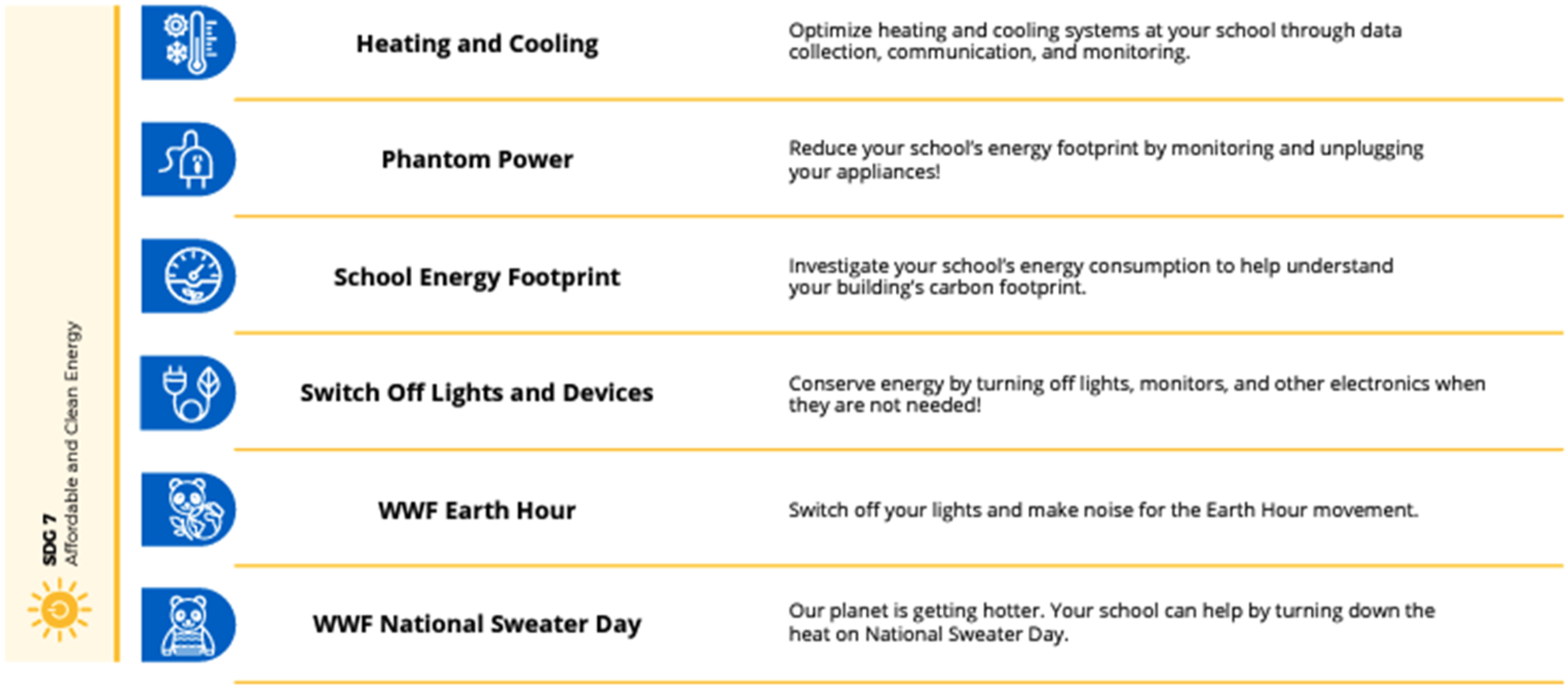

As part of the climate or environmental ‘infrastructure’ of schools, such eco assessment processes commonly have their own ‘active forms’ of certification levels, dashboards, stories, and accolades that comprise the ‘disposition’ of their infrastructural role in aiming to advance more sustainable schools (Easterling, 2014). As Appel et al. (2018) articulate, infrastructures carry affect and sentiment, and in the case of eco certification programs, activate belonging and accomplishment in some schools and school members (see Pitton and McKenzie, 2020). However, in our twinned investigation of digital and energy infrastructures, it is clear that there is scope for further consideration of both how schools can reduce the energy and other environmental costs of their data infrastructures, as well as how such programs themselves have a digital energy footprint with which to grapple. Through collaboration with data infrastructure experts, eco school programs could help school and related NGO systems further consider and address the emission costs of the digital infrastructures of education.
Additionally, it seems most likely that the NGOs who are in the best position to effect change are tech company-supported NGOs and foundations. It has become common for global technology companies to have philanthropy divisions, such as Microsoft’s AI For Good Lab, or Google’s AI for Social Good program. These divisions typically work with external partners to apply their AI technologies and staff resources towards addressing ‘societal challenges,’ including sustainability in the education sector (Microsoft, 2022). Microsoft has a subsection of their philanthropy called, AI for Earth, which includes activities such as building a global environmental network (a ‘planetary computer’) and awarding grants to assist in ‘modelling and protecting natural systems,’ including providing access to their cloud computing infrastructure (Microsoft, n.d.). Projects in education include a Climate and Sustainability Subject Kit available through ‘Minecraft Education,’ as well as Microsoft FarmBeats for Students, which will ‘provide students a hands-on experience to explore how big data, AI and machine learning apply to real-world sustainability challenges’ (Microsoft, 2022, np). These and other industry initiatives are often linked to political pressure, and corporate self-interest, to encourage the data infrastructure industry to become part of global efforts to address social and sustainability challenges. However, without addressing the significant emissions and other environmental costs of the data infrastructures themselves, these activities may be perceived as green washing as the public becomes more aware of the climate costs of digital infrastructures (for example, see the ‘Mobile Carbonalyser’ app from the French think tank, the Shift Project, which allows the public to assess the energy consumption of digital activities).
Implication two: The limits of optimism and digital technologies
Selwyn (2022a) proposes that we can take optimistic and less optimistic views of the use of data infrastructures in education and associated digital technologies like AI. The optimistic view will see the use of AI as aligning with ‘green-tech principles’ (p.627). We might see this as part of what Selwyn et al. (2020) identify as the: ‘Computing Within Limits’ movement that is growing within various areas of academic computer science... . This attempts to identify and promote forms of computing that are best suited for a resource-constrained planet. (np)
In the political arena, there are suggestions that regulation should force companies to transparently declare the emissions of computation. There are new ideas to reign in tech company emissions. These include both technical and political solutions, becoming especially apparent in the AI related industries. In the technical area, there are pushes for different kinds of computation to be used. For example, companies like Google depend on massive computation and data sets to undertake their AI related tasks, such as deep learning. Groups like fast. ai are putting forward alternatives that work on smaller data sets and less computation, with similar results to machine learning models produced on massive data sets. To make visible these costs of compute, Brevini suggests each AI application should account for a carbon footprint, to be produced as part of pushes for ‘green algorithm accountability’ (Brevini, 2022: p. 103).
Conversely, the less optimistic view of digital technologies is what Selwyn (2022a) calls a ‘radical reassessment of the entire educational technology project’ (p.627). This view concludes that AI technologies are ‘irredeemable’ (p. 627) regardless of technical tinkering or carbon accounting. This notion of irredeemability leads to our last implication.
Implication 3: The limits of education based on data infrastructures
In accounting for the energy infrastructure underlying data infrastructures in education, we need to acknowledge that there are limits to the action possible without changing the overall accountability and performativity focus of education. That is, reducing the energy footprint of schooling more significantly is not possible without engaging with and transforming the current modes and purposes of formal education. This is the political ramification of understanding infrastructures in education as twinned - as both energy and digital infrastructures.
This political view is central to seeing infrastructures as connected to issues of justice. As Crawford (2021) proposes, rather than seeing AI and data infrastructures as inevitable and only alterable through small legal and technical adjustments which are partial and incomplete responses, we could ask: what happens if we reverse this polarity and begin with the commitment to a more just and sustainable world? How can we intervene to address interdependent issues of social, economic, and climate injustice? Where does technology serve that vision? And are there places where AI [and EdTech] should not be used, where it undermines justice? (p. 226)
Similarly, in the face of rising sea levels and increasing climate migration and loss of life, as Selwyn (2018) poses ‘much of the current hype that surrounds EdTech is likely to quickly seem inappropriate if not obscene’ (np). To ask, ‘where and how can we intervene in these infrastructures?’ requires a stance that is critical (Gulson et al., 2022: p. 136).
For example, the Shift Project calls for ‘lean ICT’ and ‘digital sobriety’ as its response to help curb the growing and significant climate impacts of the digital turn (Shift Project, 2018, 2020). Taking this up in education would mean scaling back or reversing the shift to increased datafication and automation in education governance – saying no to new platforms which monitor and assess student behaviour, ‘social learning’ platforms that provide families with extensive access to classroom and grading processes, unnecessary learning management systems, or various other digital technologies being brought into schools to monitor and track students (Selwyn, 2022b; Williamson, 2017).
It also can mean engaging students and families in considering the footprint of ‘leading a digital lifestyle,’ and supporting young people in playing a leadership role in calling for reversing current excessive digital consumption (Selwyn, 2021; np). Gauthier (2022) provides a list of strategies educators can use to ‘reduce digital pollution’ related to pedagogical practices, including weighing the educational versus environmental costs of digital tools and platforms in making pedagogical decisions, using paper instead of digital devices, reducing video use, limiting cloud storage, reducing search engine use, and turning off devices when not in use. To focus on the interdependent issues of social, economic, and climate justice, an additional possibility is to govern education in decolonizing, just, and future-oriented ways through ‘land-informed’ or place-based policy and pedagogy education (e.g., Bang et al., 2014; Tuck et al., 2014; McKenzie and Wilson, 2022).
Conclusion
In this paper, we have suggested three implications for education and education governance: addressing the limits of each of: current school climate change infrastructures, pushes for ‘computing within limits,’ and current school governance practices which unnecessarily rely on digital infrastructures. Like Selwyn (2022c), we have aimed to address the question: ‘is digital education a realistic part of a ‘liveable future’ or even just a ‘survivable planet’…and, if so, in what form?’ (np). This question is poised to become central to discussions of digital technology in education, and as we suggest can be investigated through a focus on infrastructure.
Appel et al. (2018) suggests, ‘infrastructures are important not just for what they do in the here and now, but for what they signify about the future’ (p. 19). They convey and signal the desires and aspirations of a society and its leaders. As Crawford (2021) outlines in relation to AI systems, infrastructures are ‘ultimately designed to serve dominant interests’ and thus function as registries of power (p. 8). Focusing on the dispositions, or ‘poetics’ (Larkin, 2013) of infrastructure can open up space for a ‘politics of refusal’ (Crawford, 2021: p. 226), as we realise the range of active forms and desires embedded in largely taken for granted digital infrastructures. By acknowledging the climate and related climate injustice incommensurability of digital infrastructures, we more completely understand their dispositions and costs. This enables a fuller consideration of a future that educational leaders and young people might want: a future with a habitable planet for them and their children.
Footnotes
Declaration of conflicting interests
The author(s) declared no potential conflicts of interest with respect to the research, authorship, and/or publication of this article.
Funding
The author(s) disclosed receipt of the following financial support for the research, authorship, and/or publication of this article: This work was supported by the Social Sciences and Humanities Research Council of Canada (895-2020-1019).
