




Abstract
In Western societies, school pedagogies tend to be biased in favour of talk and emphasise the links between talking, thinking and learning. Thus talk is often privileged over silence as the basis for learning activities in classrooms, sustained by theories of learning which afford priority to talk. Such cultural bias towards talk means that by contrast, silence can be perceived negatively and construed as a form of ‘non-participation’. Through a systematic literature review of journal articles relating to silence as a pedagogical approach published between 2000 and 2021, this article reappraises the role and value of silence in school education. Some of the apparent paradoxes of silence as a pedagogical approach, different types and uses of silence in the classroom, cultural dimensions of silence and the relationships between silence, power and critical pedagogy are examined. The pedagogical importance of silence as a participatory approach to learning emerges as a significant point for educators and the paper offers some suggestions for potential applications in classroom practice.
We need not fear these silences, we may love them. This is a composed talk. (Cage, 1978:109-110)
This paper is concerned to examine the role and uses of silence as a positive pedagogical strategy in schools. To borrow a term from Glenn (2004:18), in our “talky culture”, silence is often thought of in negative ways, as passive, a form of ‘non participation’ and ‘non engagement’. We contrast a positive pedagogical approach, which is our key concern, with negative and oppressive uses of silence to exert power and control over others and as a denial of agency. Using a systematic review methodology and drawing on a selection of published articles relating to silence as a pedagogical approach, a range of understandings of the location of silence in pedagogic practice and classroom approaches in schools are explored. The importance of understandings developed in different cultural contexts is discussed and, through the lens of critical pedagogy, political dimensions of power and agency are examined, as for example in the practice of ‘silencing’ as an oppressive act. Silence as a form of learner participation and deep engagement is a ‘hidden’ form of participation, disavowed in the market-driven, performative logics of education where what counts is what is measurable and amenable to forms of ‘evidence’. Picard’s (1948) thoughts about the positioning of silence as ‘outside the world of profit and utility’ appear prescient: “Silence is the only phenomenon today that is ‘useless’. It does not fit into the world of profit and utility; it simply is” (18). The rationale for this paper was developed from concerns for a recalibration of these logics through an exploration of the affordances of what we have referred to as a ‘positive pedagogy of silence’, for active participation in learning. The idea of a ‘positive pedagogy of silence’ is informed by Picard’s idea of silence as ‘more than the mere renunciation of language’ (15), by emphasising its creative, integrative and affirming possibilities.
The contested nature of silence may be attributed in part to the apparent ambiguity of the different meanings attributed to it. For example, it can be conceptualised as a presence, a ‘something’, or as what exists when there is an absence of speech. However, Picard (1948:15) suggested that silence ‘does not begin because language ceases. The absence of language simply makes the presence of Silence more apparent’. Therefore rather than an absence, Picard (1948) considered silence to be ‘an autonomous phenomenon’ and ‘a positive, a complete world in itself’ for ‘Silence contains everything within itself’ (15-17). In Picard’s thought, ‘silence is not simply what happens when we stop talking’ (1948: 15). Setting up a strong binary distinction between ‘silence’ and ‘speech’ can be unhelpful and ‘their bifurcation in the modern West is an expression of culturally specific social, ethical, and political views about the place of silence’ (Zembylas and Michaelides, 2004: 201).
Silence takes different forms and has many functions and these functions vary from culture to culture (Glenn, 2004:15). For example, Zembylas and Michaelides (2004:201) refer to the argument that ‘Native American children may learn better by silently observing the world in contrast to European-American children whose cultures privilege speech as a medium of interaction’. There are apparent contradictions and contrasts in the uses of silence, for example it can be chosen or imposed, and as Glenn (2004:18) discusses ‘whether choice or im/position, silence can reveal positive or negative abilities, fulfilling or with-holding traits, harmony or disharmony, success or failure. Silence can deploy power; it can defer to power. It all depends’. With reference to Glenn’s words, Fidyk (2013:116) suggests that “”It all depends” acknowledges and respects the complexity of the factors relevant to silence, such as distinguishing between types of silences, especially those that can be unfamiliar, uncertain, and paradoxical”. This serves to highlight some of the apparent contradictions, ambivalences and complexities in the development of understandings of silence.
A distinction between ‘strong silence’ and ‘weak silence’, is drawn by Lees (2012:59), the latter considered to be ‘nonsilence’, whereas “to qualify to be a silence the form must be strong”. Lees’ takes the view that “silence in schools should be the strong kind because only the strong kind is positive and is truly silence. The weak form is voice-lack, shutting-up, power-abuse, asymmetrical-voice, waste, oppression, refusal … There are other ways to name these situations than by using the world ‘silence’” (67). Arguably, the use of silence in its ‘weak’ form, used as an oppressive, disciplinarian tool, is in evidence in ‘the growth of authoritarian models of schooling, involving ‘zero-tolerance’, ‘no-excuses’ disciplinary approaches’ (Clarke, et al., 2021:187). For instance, the use of isolation or ‘inclusion’ units in schools for withdrawal of students for infraction of the rules ‘While some isolation rooms contain rows of desks, some contain isolation booths, separated from each other by solid wooden panels, at which pupils sit in silence on their own, often for many hours’ (p.195). This is silence imposed from the outside and a very different form of silence to silence as participatory, agentic, positive pedagogic practice. Spyrou (2016) has argued for childhood researchers to pay attention to and be respectful of children’s silences in the analysis of children’s voices, noting that ‘far from being absences or lack of data, children’s silences are pregnant with meaning and a constitutive feature of their voices’ (p.7). Thus in research exploring children’s voices, it is also important to attend to their silences (p.19).
Noting that ‘all silence has meaning’, Glenn (2004:11) examines the meanings carried by ‘expected’ and ‘unexpected silences’. The former includes the sorts of settings where respectful silence is expected. The latter, unexpected silences, can be unsettling, ‘often making us anxious about the specific meaning’ (11). Relating this to pedagogic practice in schools, expected silence could be a type of silence often required by students when gathered in a formal school assembly, or in the classroom when the teacher is talking. Used as a pedagogic tool, planned opportunities for silence and stillness may open up fertile time and ‘nourishing space’ (Fidyk, 2013) for reflection and creativity. However, arguably this would require a shift in classroom culture, a reassessment of the priority usually afforded to the spoken word in classroom pedagogy and the perception of silence as ‘awkward’ and ‘embarrassing’, and as a passive, non-participatory state.
Method
This study adopted a systematic literature review as a methodological approach. Systematic reviews use explicit inclusion and exclusion criteria, as well as transparent search strategies and data extraction processes, to produce a synthesis of all the available evidence in answer to a focused research question (Bearman et al., 2012). Google Scholar was used as the database for the search and selection of the relevant literature for this study. The following keywords were used for the literature search - ‘silence*', ‘pedagogy*' AND ‘school*' OR ‘classroom*’. The selection of these keywords was determined by the overarching research aim which was to study the role and value of silence as a pedagogical approach to learning in schools. These keywords were therefore selected as likely to focus the database search on literature most relevant to our purposes. The key criteria were - (a) peer reviewed research articles published between 2000 and 2021; (b) research published in English; and (c) research published in a peer-reviewed academic journal. Since we were particularly interested in the use of silence as a pedagogical approach in school classrooms, we searched only for articles where ‘silence’ appeared in the article’s title, abstract or keywords. Articles were excluded from the results if the research was not school education focused.
Journal articles included in the review.
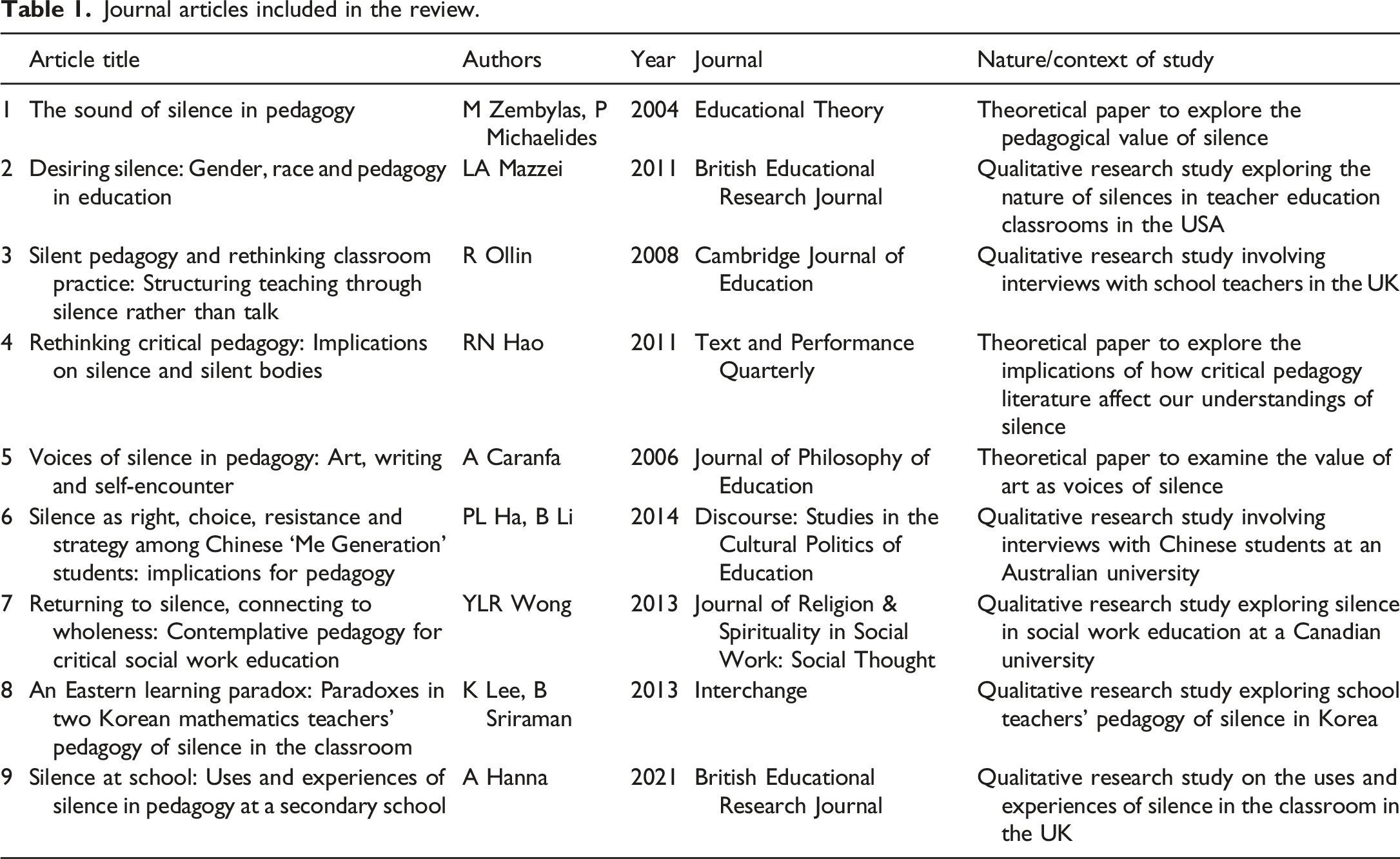
For this systematic review, the seven stages suggested by Cooper (2016:16) were followed in order to ensure the study was systematic and transparent. These seven stages are as follows: formulating the problem; searching the literature; gathering information from studies; evaluating the quality of the studies; analysing and integrating the outcome of the studies; interpreting the evidence; and presenting the results.
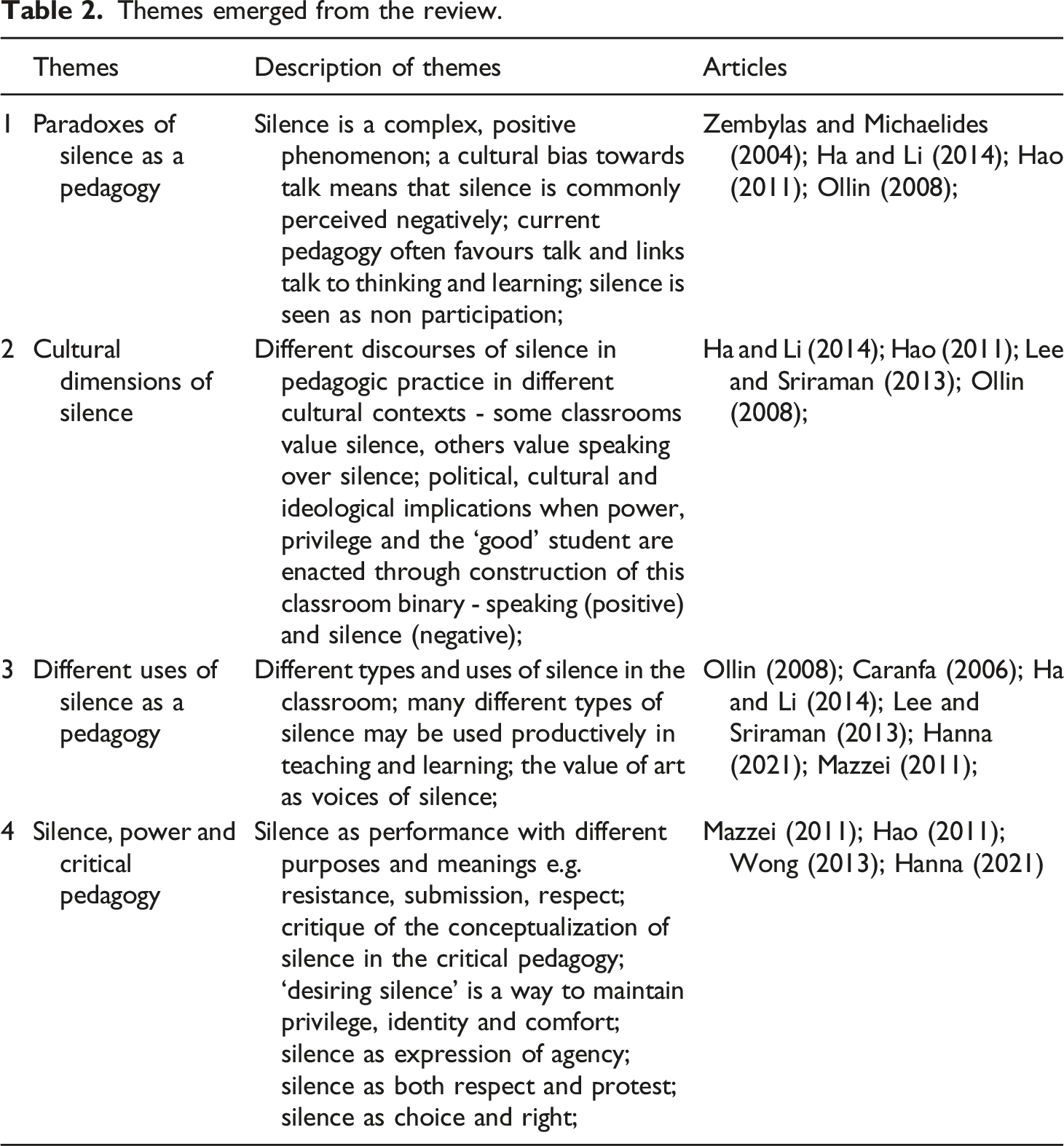
At the stage of analysing and integrating the outcome of the studies, we adopted a thematic synthesis involving the systematic coding of data and generating of descriptive and analytical themes. This was an inductive approach, which allows ‘research findings to emerge from the frequent, dominant, or significant themes inherent in raw data, without the restraints imposed by structured methodologies' (Thomas, 2006:238). The process used can be characterised as an inductive approach in that the ‘emergent’ themes were generated from the data although arguably the process involved ‘abductive reasoning’ through the interaction of our experiences, our reading of the papers and previous knowledge base even though with hindsight our awareness of this during the process may have been limited. Indeed, as Mason (2002:181) has argued, ‘researchers with widely differing theoretical orientations do actually engage in the practice, associated with abductive reasoning, of moving back and forth between data, experience and wider concepts, whether or not they always explicitly recognize this as part of their research strategy’.
Themes emerged from the review.
Findings
Examination of the term ‘pedagogy’ must necessarily precede an exploration of the pedagogical value and use of silence in schools. As a term which is ‘seldom clearly defined’ (Ireson, Mortimore and Hallam,1999:228), and different understandings are possible, ‘pedagogy is likely to mean different things to different people, with teachers, researchers and policy makers approaching the notion of pedagogy from very different perspectives and conceptual understandings’ (Waring and Evans 2015:26-27). Pedagogy can be understood as ‘any conscious activity by one person designed to enhance learning in another’ (Watkins and Mortimore, 1999:3). It is defined as ‘both the act of teaching and the discourse in which it is embedded’ (Alexander, 2001:507).This paper explores a positive pedagogy of silence which we differentiate from oppressive uses of silence, for example ‘silencing’ as a tool to discipline and a means of imposing limits on people’s freedom to speak. Zembylas and Michaelides (2004:201) discuss this ‘disciplining function’ of silence and note that “Paulo Freire used the term ‘culture of silence’ to describe oppressed people. On this view, ‘silencing’ has a negative connotation and amounts to the lack of agency”.
Critical pedagogy has a lineage with roots in the work of Paulo Freire (1972), Henry Giroux (2011) and others, and has a commitment to agency and democracy, in the important function of education in enabling learner agency, helping learners to navigate the structures of power and empowering oppressed groups to actively challenge unfairness and inequities. The conceptualisation of a positive pedagogy of silence in this paper constructs this as a form of pedagogic practice to enable student agency. This is in the context of an education policy climate redolent with neo-liberal rationalities based on narrow prescription, instrumentality and market-logics, manifest for example in the tightening of centralised control of a mandated curriculum, high stakes testing and performativity (see Clarke, 2021). The rationale for the functions of positive silence, in terms of critical pedagogy, is student agency in learning and a recognition of the importance of teachers and students actively transforming knowledge rather than simply consuming it (Giroux, 2011:7). Through a positive pedagogy of silence students can experience freedom from the expectations that learning must necessarily be demonstrable and quantifiable. A positive pedagogy of silence is conceptualised as a ‘nourishing’, fertile space for active, creative participation in learning.
The value and importance of silence for learning ‘because it can provide opportunity for contemplation and reflection, amongst other things’ is affirmed by Alerby (2020:48), who argues that ‘silence is both essential and indispensable in various pedagogical settings. Silence can, for example, be used as a teaching strategy, where it is important to understand the value of allowing silent pauses and providing opportunity for giving and taking silence’ (Alerby, 2020:49). Zembylas and Michaelides (2004: 200-201) make a similar point about the opportunities silence offers for time to reflect on teaching and learning, noting that “research has indicated that ‘wait-time’, which is essentially a moment of silence within the realm of speech, benefits both learning and teaching”.
Paradoxes of silence as a pedagogical approach
Silence, as an absence of speech, is often problematised in a classroom situation, ‘with the underlying implication that classrooms are for talking - as long as the talking is under the control of the teacher’ (Ollin, 2008: 267). It could be argued that if classrooms are for talking, the role of silence is seen as antithetical to this and therefore potentially, adversely and punitively. Zembylas and Michaelides (2004) suggest that silence is a complex and positive phenomenon. Silence is a useful learning mechanism in school (Ha and Li, 2014). However, there is a cultural bias towards talk, and in the literature silence in formal learning settings may be construed in negative, deficit ways (Ollin, 2008).
Performativity and performative pedagogy in the classroom in Western settings expects verbal participation. “For instance, expecting students to participate verbally in the classroom is a performative classroom act that has been normalized in western academic settings. Therefore, students’ performances of silence are often considered inappropriate behavior in the classroom” (Hao, 2011:271). Zembylas and Michaelides (2004:208) suggest that ‘the current educational system in the West is rooted in “fear of silence”, which is one reason that the understanding of silence in negative terms prevails’. At the same time, Zembylas and Michaelides have discussed some conditions for understanding silence as an act of caring for one’s self and the other, rather than as an instrumental or technical act. A sense of the “sound of silence” in education could open possibilities to transform how we think about education in three important ways. First, creating spaces for embracing silence in educational settings is an act of encouraging self-criticality without ignoring the dangers of normalization that come with that. Second, respecting silence would recover a sense of the Other; a philosophy of education based on silence and unknowability could help teachers and students respect otherness, and, third, rethinking the value of silence in the classroom might restore in both students and teachers a lost sense of humility and wonder. (ibid)
A dominant notion arising from the findings of Ha and Li’s study of a group of Chinese students' learning experiences is that only talk can enhance learning, yet silence ‘in many circumstances’ can ‘say as much or even more than talk’ (Ha and Li, 2014:245). They cite Bao (2014) and suggest that: Silence as pedagogy should develop new ways to exploit types and uses of silence, assess silence, and increase sensitivity to the relationship between silence and talk … Teachers’ neglect of students’ silence may amount to an oppressive act … In the classroom where power dynamics about speaking and silence is produced and where the greater amount of space is claimed by talkative students who assert their voice excessively, the reinforcement and misunderstanding of silence ignorantly erases students’ agency (Ha and Li, 2014:246).
Ha and Li's study (2014) shows that current school pedagogical practice in western societies often favours talk and links talk to thinking and learning. Silence is seen as non-participation.
Different types and uses of silence in the classroom
This study shows that there are different types and uses of silences in different learning and teaching contexts. Ollin’s study (2008) observed thirteen different uses of silence in the classroom, such as visual silence and spatial silence. Her study further suggests that different types of silence are used in the classroom to achieve particular aims and to aid learning. Silence meant more than an absence of talk and included wider multimodal aspects of human communication, including visual and spatial as well as vocal. The links between silence and time were of relevance here, with a strong equivalence between certain types of silence and ‘time to think, as in Bruneau’s ‘slow-time’. The relationship between silence and time to think was characterised as private time or private space, free from intrusion or the demand for an immediate response or interaction with others. (2008: 276)
On the value of art as voices of silence, Caranfa (2006) suggests that in an aesthetic of silence pedagogy, silence and solitude are important in learning and teaching – this includes contemplation and silence for teachers rather than too much talk and ‘endless explanations’. Hanna’s study (2021) shows that silence is a crucial dimension of student voice. It is hugely important to understand student silences as part of a pedagogy of respect for students.
Drawing on Deleuze and ‘desire’ as the theoretical framing, Mazzei (2011) explores how silence is used as a means to maintain white privilege and power in an educational setting. ‘Desiring silence’ is a way to maintain privilege, identity and comfort. She highlights the importance of teacher educators understanding ‘desiring silence’ and how it works in order to challenge privilege and power.
Cultural dimensions of silence
Discourses of silence in pedagogic practice differ in different cultural contexts - some classrooms value silence, others value speaking over silence. As discussed earlier, western societies often favour talk and link talk to thinking and learning. Silence is seen as non-participation. However, it is not the case in many eastern cultures.
Lee and Sriraman (2013) suggest that eastern philosophies of education such as Confucianism and Taoism advocate the use of silence in the teacher-pupil tradition of pedagogy. They have offered an example of silence in Korean culture - ‘silence precedes speech and so silence may not be perceived as negative’ (148). They further suggest that there is a strong connection between silence and thinking in Eastern culture. Confucius philosophy places more value on silence than on speech. Even today, Koreans hold tight to the belief that it is more virtuous to express one’s thoughts politely after having mulled over an idea for some period of time than to impulsively speak incomplete thoughts (153).
Ha and Li’s study (2014) focuses on the Chinese student studying in the Australian context. They argue that pedagogic practice needs to accommodate different uses and meanings of silence. The dominant notion is that only talk can enhance learning, yet silence can ‘say as much or even more than talk’ and there is a need to ‘pedagogise’ silence ‘in ways that are as effective meaningful, and complex as talk’ (245). The Western cultural orientation towards talk becomes more apparent when it is contrasted with Eastern philosophy where different types of silence may be positively construed. Ollin (2008:266) argues that ‘the value and underlying purposes of the dominance of talk within Western formal learning settings represents a particular cultural construct, which gives primacy to the roles of vocal communication in the teaching and learning process and exists relatively unchallenged’.
Silence, power and critical pedagogy
This study also shows that silence can be conceptualised as an expression of agency, choice and right. It can be seen as both respect and protest. Hannah (2021) suggests that silence is a crucial dimension of student voice. Student voice, silence, power, and a pedagogy of respect are all interwoven. She further suggests that an oversight of silence in the student voice has obscured the power dimensions. Students overwhelmingly experienced silence as a medium of respect; an aspect of silence which is often omitted in considering student voice in school. Students responded to this experience by employing silence both as a defence mechanism and as a form of resistance; a means of avoiding or concealing both information, behaviour and fear and embarrassment. (1170)
Hao (2011) conceptualises silence as performance with different purposes and meanings, e.g. resistance, submission, and respect. Hao argues that performativity and performative pedagogy in the classroom in western settings expects verbal participation. There are political, cultural and ideological implications when power, privilege and the ‘good’ student are enacted through construction of this classroom binary - speaking (positive) and silence (negative). Hao further critiques how silence is constructed in critical pedagogy literature and challenges assumptions and understandings in critical pedagogy about dominant values and beliefs, agency and dialogue.
In relation to critical pedagogy, Wong (2013) highlights the importance of silence for contemplative pedagogy and critical social work education in higher education. Critical social work education involves analysis of power against a neoliberal climate of consumerism, productivity and a competitive culture in university and professional environments. As mentioned earlier, Mazzei (2011: 668) conceptualises ‘desiring silence as an investment in whiteness and its attendance privileges’. Teachers need to understand ‘desiring silence’ and how it works in order to challenge privilege and power in their pedagogic practice.
Discussion: Implications of the findings and recommendations for the use of silence in pedagogic practice in schools
The findings of this study have potential implications for the uses of silence as a pedagogical approach in schools. In this section, four specific implications are identified and examined.
Firstly, the importance of educators recognising and harnessing the uses and value of silence as a positive pedagogic approach to learning, with benefits for both students’ learning and their general wellbeing. In contemporary times, school life is dominated by an ‘endless’ audit culture and pressure to meet external expectations and benchmarks. A positive pedagogy of silence may help educators and students to ‘slow down’ in the learning process and provide times for stillness, reflection and recalibration. The findings of this article may stimulate and support teacher reflections on how they use silence and how silence is perceived by students. In order to achieve this aim, educators may benefit from appropriate training and experience of this silence pedagogy first hand. This could feature within ongoing professional development programmes and we suggest it might form a part of the initial teacher education course curriculum so that silence as positive pedagogical practice could be studied and explored in depth. Also, getting students used to positive silences from the very start of their school lives is important so that these become an accepted staple of classroom practice.
Secondly, this study has found that there are different types of silence that could be potentially utilised productively in school education. For instance, the use of pauses by the teacher after questions or during a discussion, so that students are given time and opportunities for thinking, absorbing and reflecting; or students working reflectively and silently on a learning task. It is recommended that teachers should not shy away from positive silence in their pedagogic practice. Perhaps ‘silent time’ could be built into lessons and staff may benefit from peer-observation to ascertain how others develop silent times in their classes and share and learn from each other’s practices. The important matter here is to allow educators to assess and choose the most appropriate way to adopt silence in a particular context. The most effective uses of silence appear to come from students having opportunities to experience this regularly, whether for example through the conscious practice of mindfulness or as a democratic shared process. Using silence as a pedagogy requires courage for educators to experiment with what may be an unfamiliar approach in their classroom practice. This also requires educators to know their students so that their positionality with regard to silence can be better understood. This will in turn lead to a more appropriate use of silence and an understanding of student contexts in which silence is utilised. Institutional support is essential, for example by recognising the place of positive silence in the learning and teaching strategy, to enable educators to practise it in the learning and teaching process.
Thirdly, this study has shown the need to create nurturing and positive silent places and spaces in schools for young people just to be themselves and to be open to their inner lives. For instance, Wood and Tribe (2016) researched formal assembly in a Quaker school setting where silence shared together by the school community was an established practice. They characterised this expected silence as an active, creative experience of calmness and silent time as an opportunity for freedom from intrusive ‘noise’ of everyday life and its demands. In the Quaker setting the students became accustomed to silence and grew in their use of it. Schools could develop their assemblies to include times for silence and reflection and focus on making these shared experiences. If conditions are permissible, within lessons or class spaces students could be given opportunities to ‘break out’ into designated areas of the classroom. Where staffing allows, students could work in quiet areas away from other students. In artistic pursuits, fieldwork and outdoor activities, silence can encourage the use of other senses to gain a wider perspective, or to wonder at that which is beyond words. Experiential learning should not just focus on that which can be vocalised.
Lastly, this study has pointed to the importance of approaching silence from a critical pedagogy perspective, by recognising silence as part of student agency and also the potential misuse of silence as a form of repression. In the current education system, silence tends to be portrayed in a negative, passive light, and silence rather than verbalisation in the learning process interpreted as ‘inactive’, ‘unresponsive and disengaged. Whereas this study suggests that on the contrary, it can be a potent form of ‘hidden’ participation and engagement in the learning and teaching process. Student agency is often overlooked in their choice of using silence for their preferred learning mode or as a form of resistance for certain punitive pedagogical approaches. For instance, schools have long been known for using silence punitively, as a way of exerting control or for the exercise of authority or power and in these ways student voices are silenced and denied.
Conclusion
This study has highlighted the importance of developing understandings of the role of silence as a positive pedagogical approach offering freedom from the expectations that learning must necessarily be demonstrable and quantifiable. Challenging the emphasis on oracy for learning, this approach requires that in the classroom learning environment the pedagogical importance of silence is also recognised. We need to ‘dare to be silent’ (Zembylas and Michaelides, 2004:200) as eponymously referred to in the title of this paper. This is a call for action to re-conceptualise and reclaim the place of silence in education and to recognise it as a positive pedagogical approach and a productive learning and teaching ‘activity’. This suggests an alternative reading of silence, for ‘silence is too often read as simple passivity in situations where it has actually taken on an expressive power: when it denotes alertness and sensitivity, when it signifies attentiveness or stoicism, and particularly when it allows new voices to be heard’ (Glenn, 2004:18). For silence to be recognised as a positive pedagogical approach, educators should guard against an assumption that a student choosing to be silent is not actively participating (Zembylas and Michaelides, 2004).
The study has raised awareness of the dominance of talk in the classroom environment. It has pointed to the need to rebalance the emphasis on talk with an understanding of the role of silence within active participatory classroom approaches to learning. It has also emphasised the importance of respecting students’ choices to be silent. In this we might learn from other cultures and philosophies to challenge some of the dominant Western expectations of verbal participation and fear of silences which are seen as ‘empty’ rather than fertile. This study calls for greater recognition that within pedagogic practice silence can be a positive form of participation, which contrasts with a dominant view of silence construed as passive, non-participation and disengagement.
Footnotes
Acknowledgements
We would like to thank Dr Andrew Pennington for his valuable comments and suggestions on an earlier version of the paper. We would also like to thank the two anonymous reviewers who commented on the original submission of the paper. The ethical approval for this study was given by the lead author’s institution.
Declaration of conflicting interests
The author(s) declared no potential conflicts of interest with respect to the research, authorship, and/or publication of this article.
Funding
The author(s) received no financial support for the research, authorship, and/or publication of this article.
