




Abstract
This paper reports the findings of a small-scale study seeking to investigate how student teachers, within a three-year undergraduate programme, understand feedback. Feedback has been central to debates and discussion in the assessment literature in recent years. Hence, in this paper, feedback is positioned within the often-contradictory discourses of assessment, including perspectives on student and teacher feedback. The study focused on two first year undergraduate student teachers at a small university in England and considered the relationships between their understanding of feedback as a student, their understanding of feedback as an emerging teacher, and the key influences shaping these understandings. A phenomenological case study methodology was employed with interviews as the prime method of data collection. Themes emerged as part of an Nvivo analysis, including emotional responses, relationships and dialogue, all of which appear to have impacted on the students’ conceptual understanding of feedback as indelibly shaped by its interpersonal and affective, rather than purely cognitive or ideational, dimensions. The paper therefore seeks to contribute to the wider feedback discourse by offering an analysis of empirical data. Although situated within English teacher education, there are tentative conclusions that are applicable to international teacher education and as well as higher education more generally.
Introduction
For students in an Initial Teacher Education (ITE) programme, their engagement with, and understanding of, feedback is significant, not only to their own progress as learners, but also to their emerging identity as teachers, who will be accountable for giving feedback to the children in their care. As such, programme content about assessment, as well as programme assessment and feedback procedures, need to fulfil a triple purpose: supporting the students as learners; modelling effective practice for them to apply professionally as teachers; and assessing feedback as a core competence by which the students will be judged to be qualified (DfE, 2012). As Schmulian and Coetzee (2019) argue, feedback is significant in any competency-based education and none more so than teacher education. In light of this, the key research questions were: How do student teachers develop understanding of feedback as students? How do student teachers develop understanding of feedback as emerging teachers? What are the relationships between their developing understanding as a student and a practising teacher? These questions are necessarily situated within the wider literature on assessment and feedback, which are the focus of the following section.
Assessment and feedback – Concepts and contexts
This section will discuss theoretical, empirical and policy related literature. It will begin by situating feedback within assessment before examining the literature regarding conceptions of feedback across the three contexts that the Initial Teacher Education programme that provides the context for this research straddles: Higher Education, Primary education and Initial Teacher Education. As such, the discussion will allow for differing context specific conceptions to be identified and also gaps in knowledge revealed that this paper seeks to address.
Given that feedback is a dimension of assessment, it is pertinent to consider the broader literature of assessment for learning (AfL) before focusing on feedback itself. As a model, formative assessment can be traced back to ‘formative evaluation’ proposed by Scriven (1967) and later adapted by Bloom (1969). This was furthered by Black and Wiliam’s seminal work (1998) and the resulting Assessment Reform Group which developed assessment for learning significantly, both conceptually and in practice. Black and Wiliam suggested that ‘assessment becomes ‘formative assessment’ when the evidence is actually used to adapt the teaching work to meet the needs’ (Black and Wiliam, 1998: 2). As such, assessment for learning was conceptualised as a consequence-based process in that judgements about learning influenced future learning and teaching; assessment was seen as a ‘prerequisite for learning, rather than simply a measure of it’ (Sambell, 2013: 380). However, the translation of formative assessment into practice since then has often resulted in a systems- or strategy-based reinterpretation of the term by many educators and policy makers (Torrance, 2012). This could be because the move to formative assessment was battling with the arguably more powerful (or at least higher stakes) moves to accountability-drive forms of performativity. As Vattøy argues, ‘the identification of a hidden testing paradigm that went alongside the implementation of assessment for learning provides an important backdrop (2020:8). With high stakes comes power, value and focus. Summative judgments impact on a school’s league table position and inform performance relate pay. It is hardly unsurprising that this ‘backdrop’ would influence the way assessment and feedback are understood and prioritised. Possibly as a result of these two conflicting movements, Assessment for Learning has also become positioned in clear opposition to summative assessment (Lau, 2014) as essentially ‘good’ versus ‘bad’ assessment. As McDowell et al. (2009: 57) state, Sadler’s definition of formative assessment ‘is very widely used and accepted as a basis for good practice.’ Indeed, Taras (2008: 395) states that the ‘current discourse emanating from assessment for learning portrays formative assessment as the ethical face of assessment.’ However, critics argue that despite its significant presence in education policy and practice, formative assessment is relatively under-researched and indeed its effects have been ‘over-sold’ (Skovholt, 2018: 143). Although formative conceptions of assessment within both the primary sector and higher education have been influenced by the same seminal works, particularly Black and Wiliam (1998), it appears that ‘multiple and conflicting conceptions’ (Brown, 2011: 47) remain and these have subsequently resulted in misconceptions, or at least differing definitions (McDowell et al., 2009), of assessment (and feedback). Furthermore, when value judgments are attached to these conceptions, the resulting separation leads to further misinterpretation (Lau, 2014). Valued principles are reinterpreted and translated into strategies (Torrance, 2007), enabling practice to change quickly in, line with policy imperatives, therefore reducing formative assessment to a ‘shopping list of things to do which teachers could be trained to operationalise’ (Boyle and Charles, 2010: 287), thereby becoming little more than a collection of tokenistic ‘gimmicks’ (Ward, 2008). In summary, ‘assessment illiteracy abounds’ (Stiggins 2010 cited in Xu and Brown, 2016: 149).We will now explore the influence of this assessment illiteracy on feedback, particularly in the contexts studied.
Given the changing understanding of assessment over the least twenty years, it is not surprising that feedback has also suffered from rather jarring contradictions. As Clarke states, ‘feedback is the central theme of formative assessment, yet it is the element most laden with a legacy of bad practice and misguided views’ (2003: 3). As feedback has become to be viewed more formatively, it too has fallen victim to an over simplified, strategized approach that has beset assessment for learning. Reflecting issues with formative assessment, and despite some literature stating, rather uncritically (Crisp, 2007), that feedback is central to learning (Black and Wiliam, 1998; Hattie, 2009; Hattie and Clarke, 2018; Kahu, 2008; Mutch, 2003; Orrell, 2006), it has been recognised that the potential for feedback to contribute to learning remains, more often than not, unrealised (Clarke, 2003; Crisp, 2007; Johnson et al., 2016; Molloy and Boud, 2013; Wiliam, 2011; Winstone and Carless, 2019). It seems that there is a difficulty closing the gap between the potential and the reality of feedback, leaving ‘considerable room for improvement’ (Sambell, 2016: 1). Historically, a criticism has been that despite the perceived value of feedback, as a subject it was under researched (Yang and Carless, 2013). The last decade, however, has seen significant research interest in the area, albeit focused on particular sectors and disciplines of education and the use of specific approaches or strategies within these sectors or disciplines. So, is the picture any clearer now? Probably not, other than the literature now recognising that feedback is much more complex than previously thought (Wisniewski et al., 2020). Indeed, Dawson et al. (2018) noted that although literature suggests that theoretical understanding of feedback has developed, it is not clear whether the key protagonists involved (teacher and learner) feel, understand or act any differently. As Sadler states, ‘at the risk of glossing over the complexities of what is known about feedback, the general picture is that the relationship between its form, timing and effectiveness is complex and variable, with no magic formulas’ (Sadler, 2010: 536). This does not augur well for student teachers developing coherent understandings of feedback, either within or between the three contexts considered in this article, namely, higher education, primary schools and initial teacher education. The supporting literature for each of these contexts will now be discussed before the project itself is introduced.
Student teachers’ conceptions of feedback as learners in higher education
The first context of relevance to the development of student teachers’ conceptions of feedback is higher education given that they are students as well as practising teachers The majority of literature in the field examines learner and tutor understanding of feedback and is largely theoretical rather than enacted. In particular, actual conceptions of feedback from the learner’s perspective have been under researched. However it is worth noting that student conceptions of feedback within Higher Education cannot be seen as totally distinct from other educational contexts given that most students will have already developed understandings through their time in the school system. Earlier conceptions of feedback in HE are based on the work of Ramaprasad (1983) who defined feedback as ‘information about the gap between the actual level and the reference level of a system parameter which is used to alter the gap in some way’ (1983: 4). Sadler (1989) developed this further arguing that an effective model of feedback requires three conditions: an understanding of the next learning goal, an awareness of current learning and an understanding of the gap between the two and how to close it. The action of closing this gap is key as without it there is no consequence and, as such, true feedback does not occur. In Higher Education, there appears to be general agreement about the closing of the gap- the purpose of feedback is improvement (Dawson et al., 2018) and the learner’s role is significant in this as it is dependent on ‘conceptual change’ that ‘must evolve from the learner’s pre-existent understanding’ (Black and Wiliam, 2014: 28) Sadler’s (1989) work signified an important shift from the more acquisition ‘teacher-centric’ understanding of feedback – the view of feedback as being delivered by a more knowledgeable other, or feedback as ‘telling’ (Boud and Molloy, 2012: 14). Placing the student at the centre of this process, therefore, represented a pedagogical shift and a consequential change to the role of the teacher. It is somewhat ironic that this theoretical move to learner focused feedback has not been supported by learner focused empirical evidence. The role of the learner is further centralised in Nicol and Macfarlane-Dick’s (2006) theoretical model which synthesises feedback and self-regulated learning, or ‘learnacy’. Here, the learner is ‘actively involved in monitoring and regulating their own performance, both in relation to desired goals and in terms of the strategies used to reach these goals (Nicol and Macfarlane‐Dick, 2006: 201; see also, Han and Xu, 2020; Espasa and Martinez-Melo, 2019). Self-regulation is therefore a consequence of effective feedback but also students who are better at self-regulation are more likely to use feedback to close the learning gap (Nicol and Macfarlane-Dick, 2006). Hence feedback could be repositioned altogether as ‘assessment as learning’ (Earl and Katz, 2006) in that it is ‘an active process of cognitive restructuring that occurs when individuals interact with new ideas’ (Earl and Katz, 2006: 41). This seems to indicate that learnacy (and not always necessarily academic standards) is the crucial goal of feedback.
More recently, Winstone (2018) extended the discussion by identifying two generalised paradigms of feedback in Higher Education: the old and new. The old paradigm is viewed as reflecting a’ transmissive model of feedback as telling whereas the new is defined as ‘learner-centric’. Evans supports this stating that ‘the emphasis of feedback should be on supporting learners to drive feedback for themselves’ (Evans, 2016: 5). Indeed, the new paradigm is understood to be more sustainable (Boud and Molloy, 2013), as it encourages a self-regulatory approach. Of course, just how central a learner can ever be in a top-down education system is open to debate. Furthermore, there is increasing evidence that, despite the developing understanding of feedback, feedback practice remains resolutely transmissive and summative (Ali et al., 2017; Nicol, 2010; Winstone, 2018).
Student teachers’ conceptions of feedback as emerging primary school teachers
The second context of relevance to student teachers’ conceptions of feedback is primary schools. The primary education discourse appears to agree that feedback is key to progress. In addition to the claims made by Black and Wiliam (1998), Hattie (2003) reported that feedback resulted in a significant effect size. This has been echoed by influential meta-analyses such as the Education Endowment Foundation (2020). Using Sadler’s analogy of closing the gap, feedback is positioned as formative and leading to consequence (Hattie and Clarke, 2018). However, this is not necessarily a consequence for the learner. Indeed, Clarke states ‘the most powerful form of feedback is that given to the teacher by the student’ (2014: 145); this is a key difference to the models represented in Higher Education where the gaps only appear to be for the learner. The reality of this in practice is more difficult to ascertain.
Much of the existing primary education feedback research tends to focus on the impact of strategies. Although there is relatively little focus on teachers’ conceptions of feedback (Brown, 2011), and what there is often highlights a mismatch between espoused beliefs and actual practice (Dixon et al., 2011), an exploration of the existing literature does establish other themes. Existing conceptions of feedback within the school sector tend to recognise (in espoused form at least) that both teacher and pupil have a role to play. The two roles are not necessarily equal though; literature frequently reinforces the view that feedback is a ‘gift from teacher to pupil’ (Hargreaves, 2005: 6) rather than pupil to pupil. It is the teacher who assumes ultimate responsibility. This is supported in England by the national Teacher Standards (DfE, 2012), which include ‘give pupils regular feedback, both orally and through accurate marking, and encourage pupils to respond to the feedback’ as a key requirement (DfE, 2012: 12). Feedback therefore seems to be constructed as having joint responsibilities but with teachers taking a larger role in the fulfilment of these responsibilities. Atjonen (2014) extends this somewhat democratic view further by conceptualising feedback as a three-way process – pupils to teacher, teacher to pupils and pupil to pupil. Again, this may not necessarily be balanced, with most of the feedback being one-way, i.e. teacher to pupils.
Primary education focused literature also supports the development of independent and self-directed learners (Hargreaves, 2013; Kirton et al., 2007) through feedback (Black and Wiliam, 1998; Butler and Winne, 1995). However, many school-based practices further reinforce the conception that the teacher is central and in control. Brown (2011) argues that teachers’ conceptions are developed through their own experiences of the particular phenomenon. In other words, how teachers understand feedback, and the role they take, will depend on how teachers have experienced feedback as a learner. If experiences have emphasised that the teacher has ultimate responsibility for feedback, this is the role they will inhabit as a student teacher. This consequently makes the feedback practices within Initial Teacher Education particularly significant.
Developing a more learner-centric view of learning does require a developed understanding by the teacher. If the learner is to reach ownership of the process, they will require careful training, support and scaffolding along this continuum (Brown, 2012); too much support and their autonomy will be undermined, too little and they won’t develop the appropriate autonomous skills (Hargreaves, 2013). Gamlem and Munthe (2014) expand this further, stating ‘students may be unaware of its [metacognition] importance unless the processes are explicitly emphasized by teachers’ (2014: 78). England’s Teacher Standards imply the teacher is somehow responsible for learner independence and autonomy, stating that teachers need to ‘encourage pupils to respond to the feedback’ (DfE, 2012: 12). It is not difficult to see the confusion between a learner and teacher-centric model of feedback within the primary sector.
Relationships and influences in developing understanding as a student and as an emerging teacher
The third context of relevance to student teachers’ conceptions of feedback is Initial Teacher Education. Specifically, if student teachers need a developed understanding of feedback as both learners and teachers, Initial Teacher Education providers need to recognise how these differing perspectives influence one another and develop. As learners, students can find the transition to Higher Education a challenge; the demands of academic literacies including understanding feedback are certainly part of this. These attitudes tend to adjust over time, as students form their identities as learners and realise ‘the unwritten rules about how to interpret feedback.’ (Tett et al., 2012: 20). McLean et al. (2014) have suggested that these understandings can subsequently be positioned on a continuum from novice to experienced learner. However, in this case, the students studied were not student teachers so only experienced feedback from the perspective of a learner. It may be that there is a parallel continuum between novice and experienced feedback giver.
Existing research into the development of student teachers from a range of international contexts looks at broader pedagogical understanding (Cheng et al., 2014; Donche and Van Petegem, 2009), although, of course, feedback is positioned within this. Research also exists on the development of self-regulation (Endedijk et al., 2014) but this does not explicitly deal with the role of feedback within such regulation and the dual role of the student teacher. There is no literature which looks at the unique position student teachers are in and how this develops their understanding; they require a developed understanding of feedback as a learner and as a teacher and indeed are judged against a competence related to feedback if they are to qualify. As Endedijk and Vermunt state, ‘studies on how student teachers regulate their learning during teaching practice and on how they regulate learning from both theory and practice in parallel, are almost absent (2014: 1119).
Hawe et al. (2008) concluded their Australian feedback study by identifying that if feedback in primary schools is to reach its potential, teachers (and presumably student teachers) ‘will need sustained opportunities through professional learning to examine their understanding of feedback and their practice’ (2008: 56). van den Berg et al. (2013) support this further, recognising that ‘teachers’ own practices and knowledge of’ feedback is an ‘area worthy of further study particularly teachers’ knowledge, concerns, and beliefs with regard to the feedback they give‘(2013: 357). Alongside this, feedback is a key component of the English Early Career Framework (Department for Education, 2019a) and the Core Content Framework (Department for Education, 2019b) which outline curriculum content for both student teachers and Newly Qualified Teachers (NQTs) all of which further justify the current study.
The research design
A phenomenographic case study approach was used to explore student teacher experiences of feedback. The intention was to develop a clearer understanding of (the phenomena of) feedback by focusing on participants’ own individual perception of their lived experience of it (Lester, 1999). A phenomenographic approach recognises that phenomena can be experienced and understood in many different ways and is particularly suited to the small-scale nature of the project, and limited number of participants.
Existing research in the field, highlight common approaches to data collection as well as the caveats worth consideration. Specifically, although some studies make use of quantitative data, largely using questionnaires (Glover and Brown, 2006; Löfström and Poom-Valickis, 2013; Price et al., 2010), many acknowledge that this is somewhat limiting when examining feelings and beliefs in this area, preferring a more mixed approach (Kane et al., 2002; Krause and Coates, 2008; Richardson, 1996) such as semi-structured interviews and observation/videoing of practice. However the majority of similar projects have used interviewing as the prime data collection strategy (Brown, 2004; Brown and Wang, 2013; Burnett and Mandel, 2010; Cheng et al., 2014; Christie et al., 2008; Cree et al., 2009; Hargreaves, 2013; McLean et al., 2014; Price et al., 2010; Tett et al., 2012; Treglia, 2008; Vattøy, 2020), whereby responses are transcribed, coded and then analysed. This particular research project required such an approach, in that the goal was ‘to construct as complete a picture as possible from the words and experiences of the participant’, and ‘this can only be accomplished when the qualitative interview is open ended enough for the participant to provide a depth of knowledge on the research topic.’ (DeMarrais, 2004: 52)
This project went beyond conventional interviews, however, using video as a prompt to unpick the meaning attached to experiences. Marshall and Drummond (2006; see also Hargreaves, 2013; van den Bergh et al., 2013) highlighted an additional advantage to video in that it allows for re-watching and as such ‘increases the reliability of the analysis because behaviours can be interpreted, discussed and re-interpreted with reference to the primary data’ (Marshall and Drummond, 2006: 136). However, these studies assign the selection of clips for watching and discussion to the researcher, albeit in consultation with the participant. This could be viewed as methodologically compromising in that meaning (and value) has already been attributed by this very selection and this may not necessarily reflect the understanding of the participant. For this reason, the videoing used within this study was planned for and selected by the participant. An alternative to video as an interview prompt is the use of an artefact such as a marked piece of work (Treglia, 2008), written reflection (Deakin Crick, 2007) image (Brown and Wang, 2013) or metaphor (Bullough and Stokes, 1994; Löfström and Poom-Valickis, 2013). These allow a degree of flexibility for the participant (who selects their own artefact) but still seek to unpick understanding of an experience or phenomenon.
Taking these previous studies into account, the following data collection strategies were used for the project: 1 × open ended interview following an academic assessment period with an artefact selected by each participant used as a prompt for discussion; 1 × open ended interview following a School Experience assessment period using a videoed lesson selected by the participant as a prompt
An interview schedule was used to provide a structure to the interviews. This provided core questions related to the choice of artefact, the links to feedback and the experience of giving or receiving the feedback itself. Supplementary questions were then asked to probe, clarify and explore participants’ responses further. Because the interview questions and discussions were focused on the artefacts and associated experiences the participants selected, it was hoped that understandings would more likely represent theory in use based on what actually happened rather than espoused ideals of what could happen. Furthermore the alignment with University and School based assessment periods meant that the phenomena of feedback could be explored as both practising teacher and learner at university.
In line with established good practice (Creswell, 2012; Denscombe, 2010), ethical approval was gained prior to the study. The BERA (British Educational Research Association, 2011) ethical guidelines were also used to inform ethical decisions. Researcher positionality, informed consent and privacy/confidentiality of data were all considered in order to protect the participants and ensure a robust approach.
The participants
Daisy was a 1st year female student on a Primary Education degree leading to Qualified Teacher Status (QTS). The interview took place at the end of her academic studies for the year and just before she began her school experience. She was asked to bring an artefact as a prompt for discussions and she selected an example of written feedback from a lesson appraisal. During the interview Daisy discussed how the artefact related to feedback, her experience of receiving it and her developing understanding of feedback over the year both in school and university. The themes identified from the discussion were largely focused on her role as a learner rather than as a practitioner. This may have been because of the early positioning of the interview within the programme.
Fred was a 1st year male student on the same programme. His interview was based on school practice and was situated at the end of his first school placement. In preparation for the interview, Fred videoed a short sample of his feedback practice in the classroom and then selected an appropriate clip to use as the focus for the discussion. During the interview Fred initially focused on how and why he gave feedback to the children in his placement school before discussing his experiences of engaging with feedback across the year so far. Although academic and practice-based feedback were largely seen as separate, there were also occasions towards the end of the discussion when Fred articulated his realisation of how the two were connected.
Findings: The interpersonal nature of feedback
Analysis was an iterative process (Goh, 2013; Khan, 2014; Marton and Pong, 2005). The first stage of the analysis included an initial consideration of the interview transcripts where key questions, ideas and possible conceptions were identified. Further analysis took place using NVivo several times where the tentative emerging themes were used as codes before revisiting and recoding. As a result several finalised themes were identified: dialogue; roles and relationships; emotional responses; and the value of constructive feedback. These key themes were derived from both participants although understanding within these themes differed. Each of these will be discussed in turn with reference to evidence from the interviews.
Theme 1: Dialogue
Both participants made reference to the dialogic nature of feedback and how it was a feature of effective feedback both as a learner and a practising teacher.
Daisy: well I think I probably should have mentioned the fact that like I've enjoyed being appraised because you do, you do have dialogue and it's not just like here I've written all this stuff.
Fred: guess it comes with, because you can get across tone a lot easier so it then comes even with a tone of encouragement….I knew that it was still an encouraging thing, so I’d be like do you know what, that’s fine no that’s done. ….Because I guess with written feedback, not all of them are your actual tutor, obviously you do see week in week out, some of them, some of the modules. And so it’s instantly there’s that cold front, whereas just with one step removed.
Theme 2: Roles and relationships
Both participants indicated that the relationship between the feedback giver and receiver could influence whether there would be an openness to constructive advice. When asked what made feedback of value, she responded, “It depends on the person doing the appraisal”. For Daisy it was important that she respected the ‘giver’s’ knowledge and experience: “because he's been teaching for years and years and years and clearly has a lot to … I have a lot to learn from him”. If this is not the case, for example if peers provided the feedback, she tended to block any engagement with the advice, no matter how useful.
Fred extended this theme by linking relationships to dialogue in that it was only through discussion that an effective relationship was established. For Fred, knowing the learner well subsequently meant that the feedback could be personalised to the specific strengths and weaknesses. Fred: if you’re looking at somebody’s [children’s] potential then that only comes through getting to know them and seeing what they’ve done before and um, and the best way to do that I think is through talking with them. Fred: Because I feel like that person [tutor or mentor] at least knows me a bit and so it comes right round to they don’t know what I am capable of and my potential. And so even if they’re being critical it’s because they want me to obviously do better. And that other person who doesn’t know me wants that as well but, you don’t, I don’t know maybe I just don’t read it like that as much …. So somebody who doesn’t really know me there is then writing feedback so perhaps that’s a barrier for how I take it.
Daisy: whereas at University, you should be over 18, you've had loads of experience in how to learn what works for you, it's all about personal learning, independent learning at higher education, which we do promote at primary. But you should be taking responsibility of learning - no-one should have to be encouraging you, and if you're struggling with it, then maybe it's not for you.
Fred: I think yes, definitely takes responsibility. I think it’s quite a key attribute and personal attribute to have to be able to reflect on your own practice/work and then go to improve it, um particularly like in this kind of context …. and trying to make that kind of process happen. I think it definitely starts with me and the feedback but then I’m trying to make him [child] think that way as well so that he’s doing it himself. So that hopefully next time he doesn’t need me to come and sit there.
Fred: Yes, there’s not actually it didn’t feel like there was much teaching, much more reminding, … And so it’s more kind of coaching or may be facilitating … Because I totally believe he’s got the capability there to do it. … And so it’s like drawing that out I guess from him.
Theme 3: Emotional response
Both participants indicated that the receiver’s emotional reaction to feedback could influence whether or not it was used constructively.
Daisy: So it depends, yes, so I definitely think someone being critical of you can be taken either way.
Fred: …So somebody who doesn’t really know me there is … writing feedback, so perhaps that’s a barrier to how I take it….Or it’s going to make it a very nice emotional block like in terms of emotional response. Like, oh this person’s for me, so I’m gonna listen to what they’ve got to say.
Theme 4: The value of constructive feedback
Several comments were made about how feedback can and should be constructive. This appears to be defined by Daisy as an honest evaluation of current attainment with specific pointers for future learning.
Daisy: But in the appraisal I think he was pretty fair, like he is very critical and he'll just … but he'll just say it as it is which I think I like - I can't be dealing with people telling me stuff either that's not true, that they don't believe, or they're doing it because they think oh she can't handle it or something. I'd rather he was like, no you did this wrong and you need to change it, and next time don't do it.
Daisy: Because it's whether you take criticism constructively, so taking feedback and using it and setting your targets and changing everything that he told you not to do again, don't do it again.” … “so I definitely think someone being critical of you can be taken either way, and it's either constructive and helps you or it doesn't, it just makes it worse.
Discussion and future steps
The themes identified within the interviews allow for some tentative analysis regarding conceptions of feedback and the perceived blocks and accelerators that influence these.
The role of the learner and teacher
Both participants indicated an understanding of the central role of the learner within the feedback process, certainly within the university context. Indeed, there was evidence to suggest that if high quality feedback results in constructive action, this is the responsibility of the receiver of feedback rather than the giver. In other words, it is the engagement of the learner that ultimately determines whether or not the feedback was of good quality. This echoes the work of Black and Wiliam (1998) and Sadler (1989), in that feedback requires a consequence and the learner has ultimate responsibility for this consequence. Both participants indicated a personal responsibility as a learner in terms of engaging with feedback. However, this may not be indicative of a larger group. Careful consideration needs to be given to the fact that these were two participants who had already expressed an interest in feedback by responding to the call for volunteers.
There was also evidence of similar conceptual understanding within school practice but with an important distinction. Although the learner (child) had a responsibility to engage with the feedback, it was viewed as the teacher’s responsibility to promote this deferred responsibility. This links to the work of Black et al. (2006) concerning teachers’ responsibility for developing learner capacity. The distinction could also indicate that the participants view the role and responsibilities of the learner differently depending on whether they are in the role of learner or teacher; they generally focused on their role in whatever relationship and context was being discussed. This could possibly be a consequence of the programme’s focus on the ‘reflective practitioner’ (Schön, 1983), which encourages self-analysis. Examining this apparent distinction is worthy of closer study within future projects.
The existing conceptual models tend to be polarised into those that are teacher centric (the learner is passive) or learner centric (the learner self-regulates). This project seems to indicate that student teachers view feedback rather more flexibly, particularly when considering their own dual role as learners and teacher. Consequently, Figure 1 is proposed as an initial model of feedback. Here the continuum between passive engagement and active self-regulation is a sliding one rather than a distinct separation, where learners move across or back. Importantly, the role of the teacher does not reduce when learners self-regulate; the teacher still has significant responsibility at all stages. Fred is quite explicit about this, acknowledging his shifting role in attempting to develop learner independence or ‘learnacy’ (Butler and Winne, 1995). The findings from this project therefore suggest a more distributed view where both teacher and learner are significant but are not fixed with roles continually open to adaptation.
Blocks and accelerators
The themes from the data also indicate another point of interest; feedback can be influenced by the learner’s emotional response. This was evident when participants described experiences of receiving feedback; one participant labelled his emotional reaction as a ‘block’ to responding meaningfully to the feedback he received. This resonates with evidence within the literature which finds that feedback is capable of evoking negative and/or defensive affective reactions, which have far reaching consequences (Carless and Boud, 2018; Molloy et al., 2012; Naismith and Lajoie, 2018). In this context, affect refers to ‘feelings, emotions and attitudes’ (Carless and Boud, 2018: 1317) all of which, Carless and Boud (2018) argue, can be mediated by good relationships between teacher and learner.
However emotional reactions (even negative ones) do not always block engagement (Johnson and Connelly, 2014); they can also accelerate engagement with feedback and act as a motivator. The participants spoke vividly about emotional blocks/accelerators as powerful influences which they felt somewhat powerless to resist. Arguably feedback as self-regulation should also necessitate learner emotional resilience. The consequence would be that an additional task of the teacher to facilitate the related dispositions within learners. Emotional resilience could be included within Boud and Molloy’s (2013) sustainable assessment (2013) as a learning habit.
The project data around emotional reactions focuses on the participants as learners rather than teachers. There was little explicit reference to the impact of their feedback (as teachers) from the children’s (learners) perspective and this too is worthy of further study.
Relationships
A related observation from the initial data was the perceived value of relationships within the feedback process. This appears to directly impact on the emotional response of the learners. Both participants were clear about how knowing the feedback giver and feeling known by the feedback giver influenced whether their judgements were trusted and valued. It appears that the presence of a relationship determined whether the emotional response would either block or accelerate engagement. For one participant, peer assessment was unsuccessful because she did not have the necessary relationship with the feedback giver. For another, the presence of a known tutor who he had an established relationship with, prompted a sense of personal support. The quality of the relationship therefore seems to influence the learner’s motivation to respond.
There was also evidence within this theme of participants acknowledging the power of the relationship when they were in the role of teacher. Fred spoke about the need to personalise the feedback for the children in his care and how this was dependant on him getting to know the children through plenty of talk. Dialogue allowed for relationships to develop which in turn influenced the quality of the feedback. As Ajjawi and Boud state, ‘feedback is a communicative act and a social process in which power, emotion and discourse impact on how messages are constructed, interpreted and acted upon’ (2018: 1108) and as such it is difficult to conceptualise feedback without reference to relational aspects
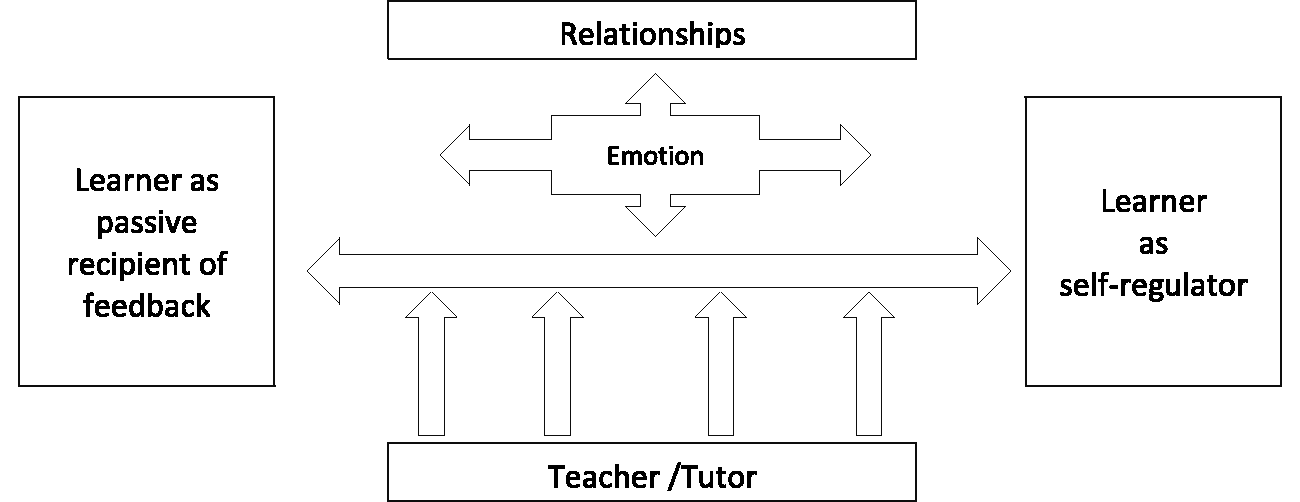
The identification of blocks and accelerators therefore leads to a further tentative reconceptualization (see Figure 2); the quality of the teacher/learner relationship informs whether any emotional response to the feedback blocks or accelerates active engagement with feedback.
This further supports the proposition that, within this small-scale project, the participants understanding of feedback positions both the teacher and learner as central and the exchange between the two is flexible.
Conclusion
Although this small-scale project used data from a limited number of participants in just one institutional context, it does raise some interesting questions about student teachers’ conceptions of feedback. Acting as both receivers and givers of feedback places them in a unique position and, as such, allows opportunity for the process to be experienced from both perspectives. The data collected based on these experiences identifies particular themes and explores how these in turn could be related to conceptions of feedback. Most significantly, the study highlights the interrelatedness of roles of the learner and teacher and their need to engage in dialogue, the importance of their emotional responses and the critical significance of the quality of their relationships, all of which are worthy of further examination with a larger group in a wider range of settings. The contextual complexity of teacher education means that such future work will have implications for Higher Education, Primary Education and Initial Teacher Education. Model of feedback 1. Model of feedback 2.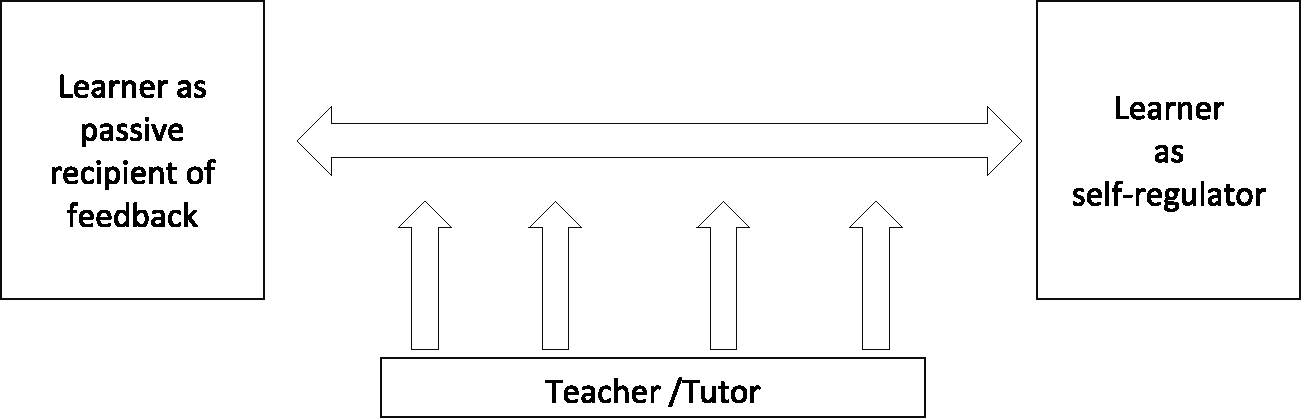
Footnotes
Declaration of conflicting interests
The author(s) declared no potential conflicts of interest with respect to the research, authorship, and/or publication of this article.
Funding
The author(s) received no financial support for the research, authorship, and/or publication of this article.
