




Abstract
Blended learning is growing at a tremendous pace transforming higher education. This means that more and more universities integrate online and face-to-face components into their courses. Previous studies have indicated that students may find it hard to be motivated in the blended environment, while the leadership approaches make their way into traditional higher education classroom, positively affecting students’ motivation. However, relatively little attention has been paid to teachers as leaders in the blended classroom. Therefore, the main motivation behind this article is to explore the assumption that an educator in blended learning can play a crucial role in students’ motivation. Using a qualitative research design, this small-scale study collects rich data comprising 8 interviews with higher education teachers from one large university in the UK. The results show contrasting views of participants on the level of learners’ motivation in the blended context. Furthermore, drawing on the theory of situational leadership, the discussion suggests that educators may adopt the delegating style of leadership while teaching quite motivated students who mostly need autonomy and challenging materials. Whereas, students who lack motivation particularly require a supporting leadership style involving two utterly important factors such as online presence and the development of student-teacher relationships.
Introduction
Blended learning has become an increasing trend in higher education. Bonk et al. (2006) surveyed lecturers at some universities in the USA. According to the results, a majority of academics now practise various blended learning approaches. McGee and Reis (2012) defined the blended format as learning where online and face-to-face elements are integrated in to university courses. For the purpose of this study, the two main approaches to blended learning were taken (Park et al., 2016). The first approach is mainly online learning with a few face-to-face meetings. These meetings can be workshops or group meetings between a lecturer and students. The second type is presented as predominantly face-to-face learning with online activities and resources. Online resources and activities may include short video lectures, online discussion forums, peer reviews of assignments, readings, and the use of websites (Cundell and Sheepy, 2018). As a result, blended learning radically alters the perspective where learning can happen and what tools can be used to stimulate the process of learning (Littlejohn and Pegler, 2007).
There are some benefits of blended learning approaches that were identified by researchers. For instance, Littlejohn and Pegler (2007) emphasised the advantage of a lower cost of travel expenses for students compared to the traditional format of learning. Additionally, Schroeder (2008) pointed out the flexibility of work schedule and location for academics in the blended format.
However, the other side of the coin shows some problems of students’ motivation, also known as desire to learn, to take part and engage in learning activities (Klein et al., 2006). Students’ motivation in learning has been extensively discussed in higher education studies in the UK and across the globe for a while (Assiter and Gibbs, 2007; Theall and Franklin, 1999). A body of research literature (Gregory and Kaufeldt, 2015; Theall and Franklin, 1999) scrutinised various theories and models emerging to address the perennial problem of students’ motivation, for example, theories of self-efficacy (Bandura, 1986) and self-determination theory (Deci and Ryan, 2004). Another widely discussed issue is the lack of learning motivation. It can lead to university dropouts and negative outcomes for students (Assiter and Gibbs, 2007; Rump et al., 2017). It has been shown that online and blended learning environments have high dropout rates as well (Vanslambrouck et al., 2018).
The high dropout rates may be linked to the misconception among students that online learning is easier (Nash, 2015). Although, they might also experience isolation, the lack of social support and frustration with online discussion forums and this could be a considerably demotivating practice (Noour and Hubbard, 2015; The Community College Research Center, 2013b). Research studies confirmed the students’ concern to stay motivated in the online environment (Jones and Blankenship, 2017) and their expectations for an educator who inspires and motivates them through active participation in teaching and learning (The Community College Research Center, 2013a). Blended learning is not devoid of these challenges. According to Saltan (2016), students from blended courses experienced the problem of motivation while completing online tasks, which affected their learning performance. Furthermore, technologies associated with blended learning could enhance students’ motivation for a short period of time, but this effect declined afterwards (Keller and Suzuki, 2004; Schober and Keller, 2012). Martens et al. (2004) added that online tasks might demotivate learners’ because of technological issues. Therefore, the aforementioned body of research raises awareness of the importance of students’ motivation in the blended classroom. Also, it would be worthwhile exploring the lecturers’ views on learners motivation in view of the fact that lecturers’ awareness about students’ motivation is a first crucial step to resolve motivational issues (Nehme, 2010). Thus, as a first research objective, this paper attempts to:
Discover higher education teachers’ perspectives on students’ motivation in blended learning.
There is relatively wide agreement in the scientific community that student-teacher relationships are of great importance in higher education (Hagenauer and Volet, 2014; Komarraju et al., 2010). These relationships are also crucial in the development and enhancing students’ motivation. Interestingly, students are more likely to interact with lecturers showing leadership (Gecer, 2013; Komarraju et al., 2010). For this reason, the author of this article suggests that the concept of leadership can be helpful to keep students engaged and motivated. Leadership can be thought of as a way to accomplish a common goal through the interactive process between a leader and his/her followers (Northouse, 2010). Moreover, Mumford et al. (2000) stated the ability of leaders to analyse a situation and people’s needs, and thus adapt their behaviour to influence others.
The last statement leads to the question of how leaders can adapt their behaviour. There are many leadership approaches. The situational approach (Hersey and Blanchard, 1988), the path-goal theory (House, 1996), and transformational leadership (Bass and Riggio, 2006) are well-researched theories to be considered. For example, the leaders in the situational approach adapt their leadership depending on a situation and the leadership is based on the mixture of supportive/directive behaviour (Northouse, 2010). Path-goal theory describes how leaders can adopt leadership styles based on a work situation and people’s needs (Northouse, 2010). Transformational leaders set higher expectations and encourage followers to achieve their goals (Bass and Riggio, 2006).
Prior studies have applied some of the aforementioned leadership theories to higher education and distance education courses. Higher education teachers’ behaviour was analysed using the path-goal theory framework (Baker et al., 1990), several studies concluded the benefits of transformational leadership on students’ satisfaction and enthusiasm during online modules (Bogler et al., 2013; Harrison, 2011) and it was suggested that blended-learning teachers may adapt their behaviour according to the situational leadership theory (Meier, 2016).
Furthermore, Sethi and Reddy (2011) noted that successful leaders apply various leadership styles depending on the level of people’s motivation. For example, several studies (Bolkan, 2015; Bolkan and Goodboy, 2014; Noland and Richards, 2014) investigated the connection between transformational leadership and students’ motivation. In particular, they showed a positive correlation between the behaviour of the transformational leader and the level of students’ motivation. For instance, the interactivity in teaching, challenging tasks, and support of independent thoughts were related to high levels of student’ motivation (Bolkan, 2015). However, these studies were conducted in traditional higher education and the results might be different in the blended environment. Thus, this study strives to:
2. Explore how lecturers’ leadership can enhance students’ motivation in the blended format.
It can be summarised that this area of research is important because of the growing pace of blended learning transforming higher education. Universities redesign their courses to take on more blended approaches. Alongside, lecturers’ awareness of the problem of students’ motivation should be taken into account (Keller and Suzuki, 2004; Martens et al., 2004; Saltan, 2016; Schober and Keller, 2012). Previous studies (Bogler et al., 2013; Dewan and Dewan, 2010; Harrison, 2011; Meier, 2016) have confirmed the positive correlation between the behaviour of a leader and students’ performance outcomes in online learning. In addition, transformational leadership has been found useful in addressing students’ motivation in traditional higher education (Bolkan, 2015; Bolkan and Goodboy, 2014; Noland and Richards, 2014). However, the question of how lecturers as leaders can affect students’ motivation in the blended format has not been investigated yet.
Therefore, the aim of this research is to explore this scarcity in scholarly literature. It can be achieved by the following research objectives:
Discover higher education teachers’ perspectives on students’ motivation in blended learning; Explore how lecturers’ leadership can enhance students’ motivation in the blended format.
Methodology
It is noticeable that the research objectives are aimed to explore people’s views and social behaviour. The philosophy of interpretivism focuses on people behaviour and endeavours to explain it (Bryman, 2012). Taking this fact into account it seems logical to adopt the interpretivist perspective, which is connected to the qualitative research strategy.
For this investigation, the factor of feasibility was taken into account, and the case study research design was chosen as an achievable one. Case study aims to explore social processes in a specific context and provides “a unique example of real people in real situations” (Cohen et al., 2011: 289). Furthermore, this research design allowed the researcher to collect rich data about a specific higher education organisation (Hartley, 2004).
A large single higher education organisation in the UK called “University A” was chosen for the presented research. Purposeful sampling was employed to recruit participants with the blended learning experience. Firstly, one employee with the specialist background in digital learning was contacted from “University A”. The employee was invited for a 30-minute interview to outline the situation with blended learning in this particular university. Moreover, this specialist helped to identify lecturers who practice the blended format of teaching in “University A”. Two different schools within this university were approached by the researcher to be able to contrast perspectives from different academics. Eight lecturers agreed to participate in this research: three from one school, and five from another. The sample may be relatively small; however, the fewer number of people might facilitate the process of thoughtful analysis (Onwuegbuzie and Collins, 2007). It is important to mention that all participants are variated in gender and age and they also teach different degree levels, namely undergraduate and postgraduate courses.
The data was obtained from the qualitative method of interviewing. Semi-structured interviews were employed for this study. This type of interview includes core questions that should be covered (Bryman, 2012). At the same time, semi-structured interviews are quite flexible and a researcher can add new questions during interviews and modify existing ones (Yin, 2003). In terms of interview structure, a research instrument was initially created in the form of a list with questions. For instance, participants were asked to share their experience with blended learning, describe how they usually interact with students and their thoughts about students’ motivation and demotivation. Thereafter, the concept of grounded theory was involved. If a new appealed question was considered important by the author, the question was used in further interviews (Charmaz, 2006). Interviews were arranged by email and conducted in quiet places such as participants’ offices or study rooms. They generally lasted between 20 and 30-minute, which was a sufficient amount of time to explore the research objectives. In addition, all interviews were digitally recorded.
Regarding ethical issues, the questions of privacy, anonymity and confidentiality were the main concerns for this study. To prevent public disclosure, participants were given pseudonyms and there was no mention of their work position/title or age. Moreover, the participation in this research was voluntary and participants were notified about their right not to take part in it.
The method of thematic analysis was used to analyse the data derived from interviews. The multi-staged approach to thematic analysis was adopted using the guidance provided by Nowell et al. (2017). Firstly, the interviews were repeatedly listened to until the researcher became familiar with the data. In the second stage, an initial list of codes was created. Codes might be represented as labels which are allocated to a specific part of data (King, 2004). To illustrate the process, twenty-seven codes were identified during the multiple listening to recordings. In the third stage, the researcher combined the codes into broader themes. As a result, six major themes were recognised. The fourth stage involved the review for overlap and the meaningful segments related to the research objectives. As a consequence, some adjustments were made. In particular, the six themes were collapsed into three main themes and additionally, two subthemes were created below one of them. In the fifth step of thematic analysis, the researcher named the major themes in order to provide clear information about the included data. The themes generated were: Personal experience with blended learning; Role of the educator; Motivation (two subthemes: what motivates students? and what demotivates students?). As a result of the fifth stage, the interviews’ summaries were designed. This format was chosen because of its convenience. Apart from the date of interview and pseudonym of the participant, each summary contained some interviews’ fragments which were transcribed for further presentation of results. Lastly, the final analysis was completed. Particularly, different themes in the summaries were compared by noticing similarities and differences in participants’ opinions (Ryan and Bernard, 2003).
It is crucial to mention before delving into findings that the case study presented in an exploratory way and without any claims of generalisation to other educators. The study is aimed to draw attention to the problem of motivation in blended learning and the possible implications of leadership theories for higher educational practice.
Students are motivated
Turning to the results, the data that emerged from the interviews showed contrasting views of educators related to the first research objective.
On the one hand, some participants clearly indicated that blended courses are aimed at postgraduate students with profound experience in their field and therefore, students are reasonably motivated to learn: They [students] have got a lot of experience they can bring to the course … I would say that students were very motivated. (Sophie, pseudonym) Students want to be there, and they are very motivated to be here and to be learning … they are quite driven … There is no real issue; there is no real chasing students up trying to get them engage with the course. Ultimately they are quite motivated and all I can do is essentially increase that motivation. (Victoria) The first reaction is trepidation … Once they got started they enjoyed it [blended learning] and feedback I get is that they really enjoyed the online tutorials. Actually on this 6-weeks module I only originally started with 3 online tutorials but the feedback from students was they wanted more of them. (Alicia)
Thomas (pseudonym) also highlighted another reason for students’ motivation in blended learning: A benefit is to give students a range of ways to be able to learn because some students absolutely love classroom time, some students absolutely hate it because you can see them in the lectures sleeping. Some students love tutorials, some do not find them useful so I think a blended approach then gives students a range of other channels to engage your materials and your learning and the subject matter. (Thomas)
Challenges of motivation
On the other hand, some educators indicated that students experienced difficulties with their motivation. For instance, Sebastian (pseudonym) reported that students were demotivated by learning online in the blended format: Students said they struggled to learn and they did not enjoy learning that way. They wanted an interactive aspect of face-to-face teaching. (Sebastian)
In addition, Natalie (pseudonym) recognised that the blended approaches are challenging for students and the role of a lecturer is to motivate students to see the benefits of this type of learning: We did a proper evaluation and at the beginning, they absolutely hated it [blended learning] … they all thought “oh new technology we do not need to learn this” but then, motivationally, that is what educators have a role helping the students see even need to use this. Learning is not so much fun for you [students] anymore, you all have to do twice amount of work because you are getting ten big word document … We started to point out to them the real value of this blended digitalised approach. After they have done two circles of enquiry based learning they absolutely took to it. (Natalie) I think if things are difficult to understand they need face-to-face and they expect face-to-face because you have better chance to assess how fast they are learning and how they are responding to it … it has to be face-to-face because of the nature of content. I think content needs to determine wherever we use face-to-face or wherever we use digital. (Natalie) I think it is more difficult to engage undergraduate students in relation to that. They come to class and say I did not have a chance to look at that … This lecture is online and they think that week is off. (Sophie) It depends on the number of students. Last year I run a module and it only had five students. So online was nonsense, online did not work … there were not enough students and they asked for more face-to-face content. (Jessica)
Influence of leadership on students’ motivation
As it appears from the interviews’ data, there can be the challenge of motivating students in blended learning. As a result, it seems as a cogent step to explore educators’ perspectives around strategies that they practice to keep students’ motivated and engaged. It is worth highlighting that these perspectives also relate to how educators show leadership and moreover, how their responses reflect the model of situational leadership by Hersey and Blanchard (1988), which will be explored in detail in the discussion section.
Regarding the lecturers’ strategies, some tutors emphasised the role of compulsory online activities at the beginning of modules. Furthermore, the participation in these activities contributed to students’ final mark and it seemed to be a powerful motivator. Participants explained it as: I post questions on case studies and they [students] have to post one hundred and fifty words and comment on each other posts … .The big motivator is that is compulsory. They have to post or they do not pass. So that is your first motivator. (Jessica) Most of these activities I made compulsory … It motivates students if it is worth their final mark … even if just 10% of their final mark is down to their attendance then that motivates students. Dictated a bit but what you have to do to get that … Also, their marks are boosted because they are engaging more, they are learning more. (Alicia) For a tutor, if you want to keep momentum in a group you have to be very present online. If they [students] think you are not there … they are not interested. (Jessica) I am checking it throughout the week to make sure they are engaging and responding to them as well because that demotivates them. If they do not see you interacting with them throughout that week of learning this would definitely demotivate them. (Alicia) As a lecturer, you are really accessible. Students can message at any time and ask a quick question … I like that they do not see you as a figure they are not really allowed to speak to. We talk all the time. (Victoria) I always started with “Dear, Jane … or dear, Bob” whatever their name is and I always sign off my name. So my feedback is like a private letter to them [students]. I tell them exactly what they did really well, I never say here you did not do well, I always say here are three or four main things that if you target the next time you would see even a better mark. This is how you can get even better … If you never give them the feedback they never realise they are actually growing. They will just disengage. (Natalie) Everybody loves someone to say “That was really good. That is a really good point you made”. I give a lot of praise and encouragement saying “Really appreciate your comments”. (Sophie) One student who was not motivated and I think it was her personal issues … Then I would spend time with that person one-to-one. They would come and see me and we would talk through their weeks learning. (Alicia) The feedback is always they would like to more face-to-face content. The reality is wherever I set up the extra sessions they said they wanted them but then they do not come because they are working. (Jessica) I have a webinar in the first week. We can all see each other’s faces. I think webinars are really important in terms of getting to know students, hearing about their own experiences and bring that in and it also helps to motivate them. That contact is really important. (Sophie) Our students use … the ability to go out and find information, bring it all back and create their own knowledge. That is what I really want them to do … it most motivates them in terms of learning … To generate their own knowledge with the guidance or parameters set by their educators. (Natalie) Somebody starts a process and it works really well and students end up supporting each other … everybody joins in. Tutor in the background. (Sebastian) You do not have a direct instant understanding when somebody does not understand well … when someone is not sitting in front of you it is very difficult to say who is engaged and who is not. (Victoria) In the traditional classroom, I can see students who are quiet, who are struggling … in the blended environment you cannot control that. (Thomas)
Discussion
Regarding the first research objective, the findings reveal divergent views of participants on students’ motivation in the blended approach. While looking at the collected data it is striking how results are divided by the level of study. Participants argue that postgraduate students are mostly full-time-employed adults who are perfectly aware of the nature of blended learning and this format suits their needs. A similar conclusion has been reached by Kim and Frick (2011) regarded online learning. As a consequence, mature students are highly motivated to learn this way and the role of an educator is to simply boost their motivation. As has already been highlighted by Rovai et al. (2007), more motivated students tend to choose fully and partially online classes. However, it is somewhat surprising that the number of students also plays a role in the blended mode experience. A few participants have observed that a small group of postgraduate students does not interact effectively and find the blended delivery disappointing. This result seems different from that of Morton et al. (2016) who suggest that a small number of students would engage better with learning material and as a result of this engagement, the level of learners’ motivation would increase (Maenpaa et al., 2018). The current finding may be explained by the fact that participants from this research described a group of local students who could meet face-to-face and they did not see the meaning of interacting online.
By contrast, participants recognise that blended learning can be challenging for undergraduate students. It appears that difficult material delivered online might demotivate novice students, but it is worth highlighting that blended learning may provide the necessary flexibility for educators to present the learning content in multiple ways. As participants state, complicated material can be delivered face-to-face to make the process of learning easier for students and avoid their demotivation. The finding is in agreement with the earlier study which showed that students prefer to study difficult information in the face-to-face environment (The Community College Research Center, 2013a). Furthermore, Nash (2015) suggests that students should be self-motivated in the online environment, yet undergraduate students might not know how to teach themselves and as a result, struggle to learn online. In this case, as pointed out by participants, the role of higher education teachers is to support students and to help them to realise the value of blended learning. Likewise, the Community College Research Center’ findings (2013a) confirm that students also expect lecturers to motivate and encourage them in online settings.
The current study shows that educators generally feel that blended learning limits the time of face-to-face engagement with students; some argue that supporting and motivating online can be difficult and as such, they are worried this may affect students’ motivation and their capacity to identify potential periods students are disengaged. Additionally, lecturers provide various strategies to motivate students, revealing in essence perspectives on leadership. Thus, with respect to the second research objective, the situational model of leadership by Hersey and Blanchard (1988) seems to provide useful lenses to consider participants’ perspectives around motivation in the blended approaches. This model suggests that the situational leader needs to provide a range of directive or supportive strategies and requires the leader to adopt various leadership styles taking into account the context and importantly, the different needs of followers. Blanchard et al. (1993) classified the followers’ needs into four development levels depending on two factors: competence and commitment. For instance, if followers are high in commitment but low in their competence the leader is supposed to provide a high level of directive behaviour, providing clear instructions and guidance. If followers are high in competence but have a variable commitment, they may need support and facilitation of decision making (Northouse, 2010).
The situational leadership model outlines four broad styles: directing, coaching, supporting and delegating. They are linked to four development levels of followers. The directing style is characterised by leaders who clarify goals and carefully supervise followers because they are not competent enough but ready for a challenge (Northouse, 2010). The coaching style involves the blend of supportive and directive behaviours from a leader because followers are not sufficiently committed to a task but have some competence to do it (Blanchard et al., 1993). Then, if followers are quite competent and have moderate commitment the leader in the supporting style of leadership supports their intentions and skills in order to complete the mutual tasks (Northouse, 2010). Lastly, the delegating style implies less support and supervision from a leader because followers are relatively competent and committed (Hersey and Blanchard, 1988).
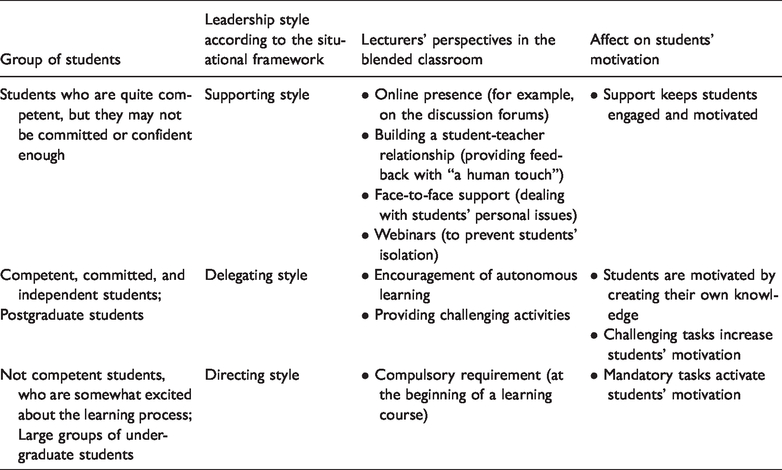
A majority of participants talk about adopting the supporting leadership style to keep students motivated and engaged. Students are quite competent to learn but they are uncertain if they can learn on their own. Hence, lecturers support students in their learning journey encouraging them to learn and giving advice. This concurs well with the results discovered by Maenpaa et al. (2018) and the Community College Research Center (2013b), which have shown that students primarily need support from a leader in the online settings. Interestingly, the lecturers point out that the online presence is utterly crucial in blended learning. Some participants describe a highly visible online presence at discussion forums through engagement and encouraging comments. Yet, a few educators believe that a simple “that was really good” is also appreciated by students. Some participants touch upon the question of the accessibility of a lecturer. It seems clear that higher education teachers believe that being approachable online is a key to students’ motivation. Thus, the question arises how accessible a tutor can be because it is simply not possible to be “on call” all the time, particularly on weekends. Therefore, the question of online accessibility seems to be debatable. Additionally, it may oppositely lead to students’ disappointment if they believe that an educator is not available enough (Nash, 2015).
Significantly, participants underline the importance to develop student-teacher relationships in the online environment as another indication of the supporting style. Some mention feedback as “the private letter” to students, while others refer to webinars as a way to meet and get to know students. It can, therefore, be assumed that these student-teacher relationships might add a necessary “human touch” to blended learning. Nevertheless, some educators prioritise face-to-face support over online when students face some personal issues. Participants mention the value of one-to-one meetings where they can talk to students in person. Additionally, face-to-face support is quickly adaptable to diverse students’ needs and as a result, it should be an essential part of the blended courses (Morton et al., 2016). The face-to-face settings may be also beneficial for dealing with students’ isolation as one of the issues of blended learning and e-learning generally. The meetings face-to-face can potentially provide more support; however, the interviewees comment that it is not always possible to meet in person, specifically with students working full-time. It may be suggested that webinars can be helpful to provide such support to students, but these meetings can be interrupted because of technical issues ( Hu, 2012). Another suggestion is short videos recorded by educators, but made in such a way that they create the feeling of a lecturer speaking directly to students (Glenn, 2018).
By way of contrast, the delegating style is indicated by the higher education teachers when they believe that students are competent and quite motivated to learn. This could be applied to postgraduate students because participants argue that mature students are highly driven to study in the blended environment, and the role of the lecturer is to essentially increase that level of motivation. Therefore, the lecturers avoid unnecessary supportive or guiding behaviour, giving only parameters for students’ learning (Blanchard et al., 1993). They particularly encourage autonomous learning and provide challenging activities to students, while staying in the background. Participants believe that this strategy motivates students the most. It is therefore likely to connect these results with the self-determination theory by Deci and Ryan (2004), who have claimed that there is a link between the spectrum of needs such as autonomy, competence and relatedness and people’s motivation. Furthermore, participants are worried that blended learning reduces in-class time, and it can challenging to identify who is engaged and who is not motivated enough and needs more support instead.
Perspectives around the importance of the directing leadership style are also expressed by participants. Regarding this style of leadership, higher education teachers are goal-oriented and provide clear instructions to students on how to achieve their learning goals. Educators may introduce the compulsory requirement at the beginning of modules as the first step to students’ motivation. Students know that the engagement in online activities contributes to their final mark, and it truly sparks their motivation. Keeping in mind that directing style is particularly suitable for followers who are not competent and confident enough (Blanchard et al., 1993), it is possible to suggest that this style may be effective to motivate large undergraduate classes as it has been pointed out in the earlier studies (Morton et al., 2016) and by interviewees. As a result, it would be an essential initial motivator to engage a big class from the outset. Furthermore, the students might do better academically as well because of the intensive engagement and learning.
Summary of the discussion points regarding the students’ motivation, the situational leadership model and the blended learning mode are presented in Table 1.
Summary of the findings.
Main messages of the study
The article gives fresh attention to the theory of situational leadership contributing to its theoretical development. The situational leadership approach seems to be applicable to blended learning settings and it might be an effective motivational tool for higher education teachers.
Furthermore, drawing from the findings and discussion sections the paper might offer some practical implications for lecturers in blended learning to keep their students engaged and motivated:
Postgraduate mature students are usually quite motivated to learn. However, a small number of local students might not interact well in the blended environment. Blended learning is challenging for undergraduate students because they might not know how to teach themselves yet. The role of lecturers is to show the value of the blended mode. Nevertheless, difficult material is better learned in face-to-face settings. Compulsory tasks are especially effective if there is a large class of undergraduate students and they are not sufficiently competent and knowledgeable. This requirement is effective if, for example, the completion of online tasks or attendance to online webinars is worth of the student’s final mark. If students are moderately competent but have problems with confidence or learning commitment they primarily need a supportive environment from a higher education teacher. Student-teacher relationships can be strengthened by providing, for instance, personal feedback, active online presence, video webinars, and face-to-face support. First, personal feedback can be achieved by providing specific individual recommendations and signing off students’ names. Second, an online presence can be accomplished by actively engaging in discussions forums, providing comments and encouragement. Third, video webinars may be a useful method to combat students’ isolation in view of the fact that lecturers and students can meet, see each other faces and share their experiences. Finally, whenever it is possible face-to-face support is a great way to address students’ personal challenges. If students are quite competent and confident with their learning, they can learn autonomously with a lecturer staying on in the background. In addition, challenging materials can be valuable to enhance students’ motivation. This is especially relevant for postgraduate students who are often adults.
Limitations and suggestions for future research
This study contributes to the growing literature on blended learning and leadership approaches. The problem of students’ motivation in the blended learning environment has emerged from the current findings, as well as, it has been discussed in a few earlier studies (Keller and Suzuki, 2004; Martens et al., 2004; Saltan, 2016; Schober and Keller, 2012). Although, there is no silver bullet that will motivate students in blended learning, this paper opens up some leadership strategies to address students’ motivation in the blended approaches, and it may be beneficial for educational practitioners. However, the current study is not devoid of limitations. The author is cognisant that this research is a small-scale case study which involved only one UK higher education organisation, and therefore, the findings should be interpreted with caution and may not be generalised to other educators. More rigorous research with a larger number of participants from different schools and organisations is warranted. Also, more research needs to be undertaken before the association between the situational leadership and students’ motivation in the blended environment is more clearly understood.
This is the first attempt of the author to investigate the challenges of motivating students in blended learning; hence it could be improved in several ways. First and foremost, this paper addresses the problem of motivation through the lenses of lecturers. The author does not measure students’ motivation in the blended classroom, it only draws conclusions from participants’ teaching experience and their assessment of learners’ motivation. Nevertheless, it seems necessary to explore the students’ point of view and to measure their motivation as well, in order to draw more data-supported arguments. It can be also suggested that future research may attempt to involve both undergraduate and postgraduate students and compare the level of their motivation in the blended format of learning. Secondly, the model of situational leadership is adopted by the author to approach students’ motivation. However, the findings can be considered using the different theory of leadership and it would be interesting to see such results. Finally, the surprisingly debatable question of educators’ online accessibility has been raised during the data analysis. Should higher education teachers be fully present online to support students, and to what extent is it possible to take some time off while not demotivating learners? The question of “magical balance” may be also addressed in future research.
Footnotes
Acknowledgments
I would like to express my sincere appreciation to the two anonymous reviewers for their valuable comments and suggestions on the manuscript.
Declaration of Conflicting Interests
The author(s) declared no potential conflicts of interest with respect to the research, authorship, and/or publication of this article.
Funding
The author(s) received no financial support for the research, authorship, and/or publication of this article.
