




Abstract
This study problematizes becoming early childhood teachers’ possibilities to develop knowledge relevant to teaching dance. The aim was to analyze the presence and position of dance in Swedish early childhood teacher education syllabi. Discourse analysis was used to identify patterns, regularities, hierarchies and gaps in the steering documents. The empirical material consisted of syllabi of twelve Swedish early childhood teacher programs. The results show that according to syllabi, dance as a subject has a rather weak or non-existent position in Swedish early childhood teacher education. Instead, dance often functions as a tool for learning other subjects, e.g. language and mathematics. The concept “aesthetic” was more frequently mentioned in the syllabi, but it did not explicitly explain what dance knowledge was included in the syllabi content, learning outcomes and examination forms. The frequency of dance differed between the syllabi, which might lead to unequal early childhood teacher education. Further, the potentially weak function and position of dance in early childhood teacher education might limit children’s social democratic life, bodily knowledge and experience of mind-body connection in a holistic sense.
Introduction
Play, aesthetic expression and creative learning are important parts in early childhood practices around the world. Blank (2012) argues that aesthetics should be an integral part of early childhood education. Aesthetics was a mandatory part in the earlier teacher programs in Sweden that were implemented 2001 (Lindgren and Ericsson, 2013; Lindqvist, 2019). In the current teacher program, aesthetics are no longer mandatory for the students and can be seen as marginalized. The Swedish teacher programs have been further academicized during the years (Carlgren, 2018). Nevertheless goals with respect to aesthetic expression are mentioned in the Higher Education Ordinance (2020: 881) that guide universities when creating their syllabi for early childhood teacher education. According to those goals, early childhood teacher students should demonstrate knowledge of practical and aesthetic learning processes and develop in-depth ability to meet children's needs including through play and creative activities.
Even if the early childhood teacher education offers courses that include aesthetics, it is not uncommon that the same course will embrace several aesthetic subjects (Lindgren and Ericsson, 2013). According to Lindqvist (2019) there is a risk that learning outcomes become fragmented. The content within the early childhood teacher education that include aesthetic subjects and knowledge that is expressed through performance can be challenging to articulate because knowledge tends to be tacit. Thus, the design and the execution of the teaching as well as assessing the students can be challenging in these cases (Andersson, 2016).
Different forms of knowledge can be divided into four aspects; fact, understanding, skill and conversance (Carlgren, Forsberg and Lindberg, 2009). These four aspects of knowledge should be seen as a typology without being hierarchic (Carlgren, Forsberg and Lindberg, 2009, 2012). All aspects are involved simultaneously and should therefore not be seen as dualistic, even if they are more or less in the foreground. This view of knowledge also includes non-cognitive aspects that are perceptible to the senses. Knowledge cannot be limited to something cognitive in order to be used in a meaningful way (Carlgren, 2012).
As Swedish early childhood tradition is influenced by for example Fröbel, Montessori and Malaguzzi (Ahlquist et al., 2015; Dahlberg and Åsén, 2015; Lundgren, 2017) it aims to educate children in creative learning areas. This article focuses on the presence and position of dance in Swedish early childhood teacher syllabi as future early childhood teachers are important for facilitating high quality education for all children in Sweden. Early childhood education in Sweden should give children opportunities to experience, portray and communicate through different aesthetic forms of expression, such as image, form, drama, movement, singing, music and dance. This includes giving children the possibilities to design, shape and create by using different materials and techniques, both in digital and other forms. (Lpfö18)
Why dance?
Dance is an artform that involves performing and creating bodily movements, which are known to be important for children’s development, wellbeing and communicative skills (Anttila, 2013/2019; Gard, 2003; Lindqvist, 2015a, 2015b; Palmer, 2010; Pramling Samuelsson et al., 2015; Svendler Nielsen, 2009; Svendler Nielsen and Burridge, 2015; Stinson, 1989, 2005a, 2005b; Winner et al., 2013). Louppés understanding of poetics in relation to dance is relevant here as she writes that poetics can be defined as what touches us and is at the same time knowledge, affect and action (Louppe, 2010: 4). In other words, dance can be transformative in an ontological sense for the mover, not just an aesthetic experience for the viewer. Dancing involves the whole body and is a dialogue between the subject and the social context. Louppe (2010) argues that the dancing body is interpreting the world as an instrument revealing the presence but sometimes a weapon to question injustice or stereotypes. Dance can therefore be valuable for growthing children in a democratic sense to use the whole body as a language for communication. Informed by Louppe, we argue that it is important for early childhood teachers to have opportunities to practice dance themselves and dance cannot simply be subsumed under other arts and their discourses (Lindqvist, 2007). Dance is the making of movement significant in and of itself according to Stinson (1989), as dance offers more than just developing motor skills and bodily awareness. It also involves a kinesthetic aspect that includes an inner awareness of the moving body and an ambition to pay attention to dance movements, and how the sensations of the movement are recognized in the body (Anttila, 2019/2013). Dance can be understood as both physical activity and expression (Gard, 2006; Mattsson, 2016; Mattsson and Lundvall, 2015). Not only is movement important for the body but also the mind and social aspects benefit from specific forms of movements in dance (Duberg, 2016; Svendler Nielsen, 2009). Smith-Autard (2002) highlighted the importance of combining the creating, performing and viewing of dance to develop an ability to appreciate dance in a holistic sense.
Every child has the right to freedom of expression according to the UN Convention on the Rights of the Child. That statement includes the freedom to seek and experience ideas in dance. The conventions also emphasize the right of the child to participate fully in cultural and artistic life and shall encourage the provision of appropriate and equal opportunities for cultural, artistic, recreational and leisure activity (Unicef, 2019). The OECD report Art for Art´s Sake argues for dance and other artforms in education, for their own sake (Winner et al., 2013).
There is little evidence for developing academic skills through arts subjects, but the intrinsic value of art for developing skills in critical thinking, creativity, social interaction and meaning making are pointed out as valuable (Winner et al., 2013). It has been emphasized that dance and other artforms are part of all cultures and human experiences, and therefore have an intrinsic value, important for how we understand and view the world and ourselves in it (Bamford, 2009; Winner et al., 2013). Research has shown that dance in western contexts is closely connected to femininity (Gard, 2003, 2008; Lindqvist, 2010, 2019; Pastorek Gripson, 2016; Risner, 2009; Stinson, 2005a, 2005b), which may affect the presence and position of dance in educational systems around the world (Sansom, 2011). Pastorek Gripson (2016) problematized how children’s involvement in different dance genres impacts their understanding of possibilities from a gender perspective. Furthermore, teachers’ knowledge of dance or other aesthetic subjects is important for their ability to communicate core aspects of the subject to learners and provide high quality education (Andersson, 2016; Bamford, 2009; Zandén, 2010).
Dance educational activities within the early childhood education context could offer children to experience dance as an aesthetic expression. As stated in this section above these experiences of dancing offers children to both develop subject content that are specific for dance as a knowledge domain but also generic abilities.
Swedish early childhood context
Sweden has been successful in meeting quality standards for early childhood education and care on an international standing (Sheridan and Pramling Samuelsson, 2013). The early childhood teacher's role is not only to care for children's wellbeing but also develop their knowledge by offering learning possibilities in the early childhood education setting. The early childhood teacher should embrace the child’s initiative and develop it by introducing concepts or aspects of fields not yet known to the child, for example dance related concepts such as shape, effort and space. Even more important is the act of learning, focusing on how something is learnt, and the object of learning, focusing on what is learnt (Pramling Samuelsson and Johansson, 2007, Pramling Samuelsson et al., 2015). These researchers, among others, have influenced the debate, the practice and the early childhood education in Sweden and paved the way for the new curriculum Lpfö18. Regarding aesthetic and creative knowledge, aesthetic expressions, such as dance, music and art, are mentioned in the curriculum (Lpfö18, 2018). However, Pramling Samuelsson, Sheridan and Hansen (2013) have stated that children's possibilities to engage in aesthetic learning in early childhood differ widely.
By contrast Billmayer et al. (2019) analyze the preschool child in Lpfö18 and find a picture of the child as someone who should learn to care for his/her body in order to become a productive adult citizen. This implies that the child's experience of the body as such, here and now, is not of intrinsic value and this can be seen as problematic in a practice engaging very young children. Children understand and communicate with their whole body, in a holistic way that is challenging in a neoliberal educational system where the body is separated from the mind (Fredriksen, 2015).
The meaning of improvisation and learning in and about dance for children in early childhood education has also been studied, and shows that creating in dance is facilitating children’s possibilities to express themselves and communicate through dance movements (Ferm, 2005; Sjöstedt and Wigert, 2005; Sjöstedt, 2015, Pastorek Gripson, 2015, 2016). However, Lindqvist (2019) raised concerns that early childhood teacher students do not experience bodily learning in dance during their education and that their lack of ability may affect children’s learning possibilities in early childhood education. Overall, to date, little research has been conducted on dance in a Swedish early childhood context. Therefore, the present study adds new insights into early childhood teachers prerequisites for facilitating children’s possibilities of expression and learning. To develop children’s ability to create and shape dance early childhood teachers need to be able to design learning situations involving not only movement, music, drama or eurhythmics but specifically dance.
Aim and research questions
The aim of this study is to examine and problematize the presence and position of dance as a subject in Swedish early childhood teacher education. The following research questions are considered: To what extent is dance mentioned in the content, learning outcomes and examination forms in Swedish early childhood teacher education syllabi? What position has dance in Swedish early childhood teacher education syllabi?
Theoretical framework and methodological considerations
In this study it was important to highlight the ways that dance is described and linked to other concepts and content in the Swedish early childhood education syllabi. Discourse analysis was used to identify patterns, regularities, hierarchies and gaps in steering documents but also reveal what is not mentioned (Börjesson and Rehn, 2009; Winther Jørgensen and Phillips, 2002). Drawing on Foucault (1972) this approach can provide insights into what is regarded as less important, valued or appreciated in the syllabi text. Discourse analysis is not an objective form of method and theory, as emancipatory ambitions underlie the research work. Interests of oppressed groups, subjects etc. are always advocated and it directs our interpretation of the material (Fairclough and Wodak 2004). Also, Fairclough (2000) describes how neoliberalism is connected to the use of language, capitalism and market orientation and shifts power relations in a less democratic way. The educational system, including early childhood teacher education, is part of this process.
Syllabi are documents (texts) that are constructed by governing parts of institutions to stipulate executive parts of practice (discursive practice). Governing documents, such as syllabi, encapsulate the ideas and values of the society and institutions that construct them, (Fairclough, 2000; Foucault, 1972) and, at the same time, guide practice in a way that bridges micro and macro levels of discourse (Börjesson and Palmblad, 2007; Fairclough, 1992, 2000). Fairclough (2000) describes how neo liberal ideologies influence and limit institutions abilities to act, and this is an overarching understanding in this study. The limitations are crucial for what can be communicated in documents such as syllabi. Although, as the results show, the universities have chosen different ways to handle dance, body, movement and aesthetic. University teachers and students will interpret the text in practice, but the possibilities to expand outside the steering documents are limited as the resources provided are linked closely to learning outcomes and examination forms in the syllabi. The steering documents specify what students should learn, for example, in the form of goals and grading criteria. Therefore, formulations in the steering documents have consequences for the content and structure of what is taught (Andersson and Thorgersen Ferm, 2015). The ambition to expand the practice beyond the syllabi documents can also be limited as teachers are part of the context that have produced those documents. Challenging syllabi documents may involve risk taking as neo-liberal ‘managers’ may not questioning of dominant discourses.
Discourse is language and the articulation of ideas, values and norms in different modalities (Kress, 2010; Kress and van Leeuwen, 2001; Potter, 2008; Potter and Wetherell, 2007). Language constitutes how we get to know and understand the world in a wide sense and our own position and abilities in it. As governing documents, syllabi draw on existing discourses within society, institutions and organizations (Fairclough, 1992). But practice also impacts the production of syllabi to differing extent, as text, discursive practice and social practices are inter-connected (Fairclough, 1992). Discourse analysis utilizes interwoven theory and methods that shed light on power relations and their consequences for individuals, groups and societies (Börjesson and Rehn, 2009; Potter and Wetherell, 2007; Winther Jørgensen and Phillips, 2002). Discourse analysis, and especially inspiration from Fairclough (1992), were considered valuable for examining and problematizing the presence, and position of dance in Swedish early childhood teacher education syllabi and the neoliberal aspects involved. We have used Fairclough's model both as an analytical inspiration but also as a theoretical frame for understanding how the context and the syllabi are constructing each other.
Following the Bologna process (SFS 2016: 276; UHR, 2019), syllabi of early childhood education teacher educations were organized in similar ways in all Swedish university courses, with headings communicating the following aspects: course content, goals to achieve and examination forms (e.g. seminars, papers, tests and presentations). According to Biggs and Tang (2011), the concept of constructive alignment, where content, goals to achieve and outcomes are subcategories, illustrate how dance knowledge is facilitated in different ways within the course syllabi.
Empirical material
We studied the mandatory course syllabi at twelve universities in Sweden that offer an early childhood teacher education. The following universities were included in the study; Dalarna University, Halmstad University, Karlstad University, Kristianstad University, Linnaeus University, Luleå University of Technology, Malmö University, University of Borås, University of Gothenburg, University of Gävle, Stockholm University and Umeå University. These programs were selected to represent both major and minor universities spread geographically across Sweden. The early childhood teacher educations consisted of seven semesters of full-time study with a scientific base comprising educational core subjects, teaching practice and profession-specific courses.
Analysis phases
As the empirical material consisted of existing documents related to early childhood teacher education syllabi, a descriptive method was used initially to evaluate the occurrence of dance in steering documents, followed by a more critical analysis drawing on Fairclough (1992, 1995).
The first phase of analyzing
The concept of dance and number of courses that it appeared in was evaluated by using a computer search function. However, as Börjesson (2003) pointed out, relationships between concepts are important as they shed light on power relations. Therefore, words recognized as “close” to dance were incorporated in the analysis: body, movement and aesthetic (estet, rörelse, kropp in Swedish) were used to assess the presence of dance in the syllabi. It might be the case that dance knowledge is developed when working with body, aesthetic or movement, but of this we cannot be sure. Aesthetic can consist of other expression forms such as music or art. Movement can be more related to outdoor activities such as biking, climbing or playing in the sand. The body is crucial for carrying out dance, as the body is involved in all activities that children carry out as sleeping, eating or taking on jackets. This illuminates the broadness of those concepts (body, aesthetic and movement) and the importance of specifically addressing dance in the syllabi to be sure of its presence. We counted the number of courses in the syllabi where dance, body, movement and aesthetic occurred. We also counted how many times each word appeared and how many credits were connected to dance.
The second phase of analyzing
To explore the position of dance in the Swedish early childhood teacher education syllabi the analysis was informed by Fairclough’s (1992) three-dimensional model including the text, discursive practice and social practice.
In the model, the text itself is closely linked to the discursive practices in which it is produced. The wider social practice is defined as mutually interconnected with the discursive practice. In this sense, the text is informed by the discursive and social practice as well as part of constituting them. Leaning on Fairclough (1992, 1995, Janks, 1997), the text in this study consists of the syllabi documents. Both the syllabi that include dance and those that do not were described. The discursive practice is the institutions where the texts are constructed and those institutions are influenced by neoliberalisation as they are part of recreating global capitalism (Fairclough, 2000). The values and norms in the discursive practices are expressed in the texts (i.e. syllabi). We do not study the institutions in any other way than analysing their Early Childhood Teacher Education syllabi. Fairclough´s model (Figure 1) shows that the dimensions are connected and when analysing we mainly focus on the text (syllabi) and whether or not the concepts dance, aesthetic, body or movement occurred. This is illustrated, or to use Fairclaughs terms, described, in Table 1. We then interpreted how dance was pictured, as an effect of values dominating the discursive practice. For example if dance was described as skills, a form of understanding or conversance (Carlgren, Forsberg and Lindberg, 2009). This analysing process was, as the model illuminates, a movement forward and backwards between the text and the discursive practice, where we interpreted the text.
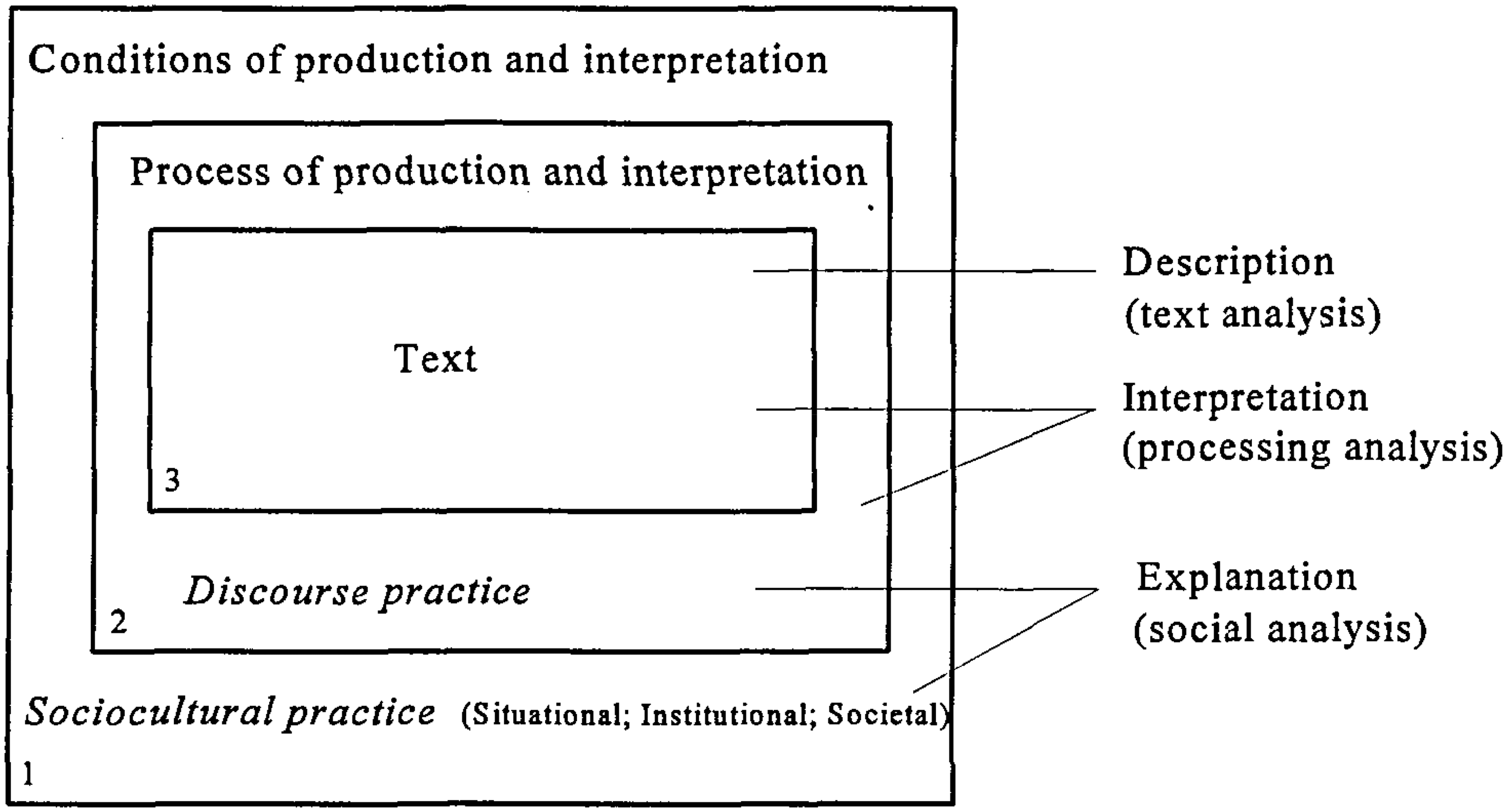
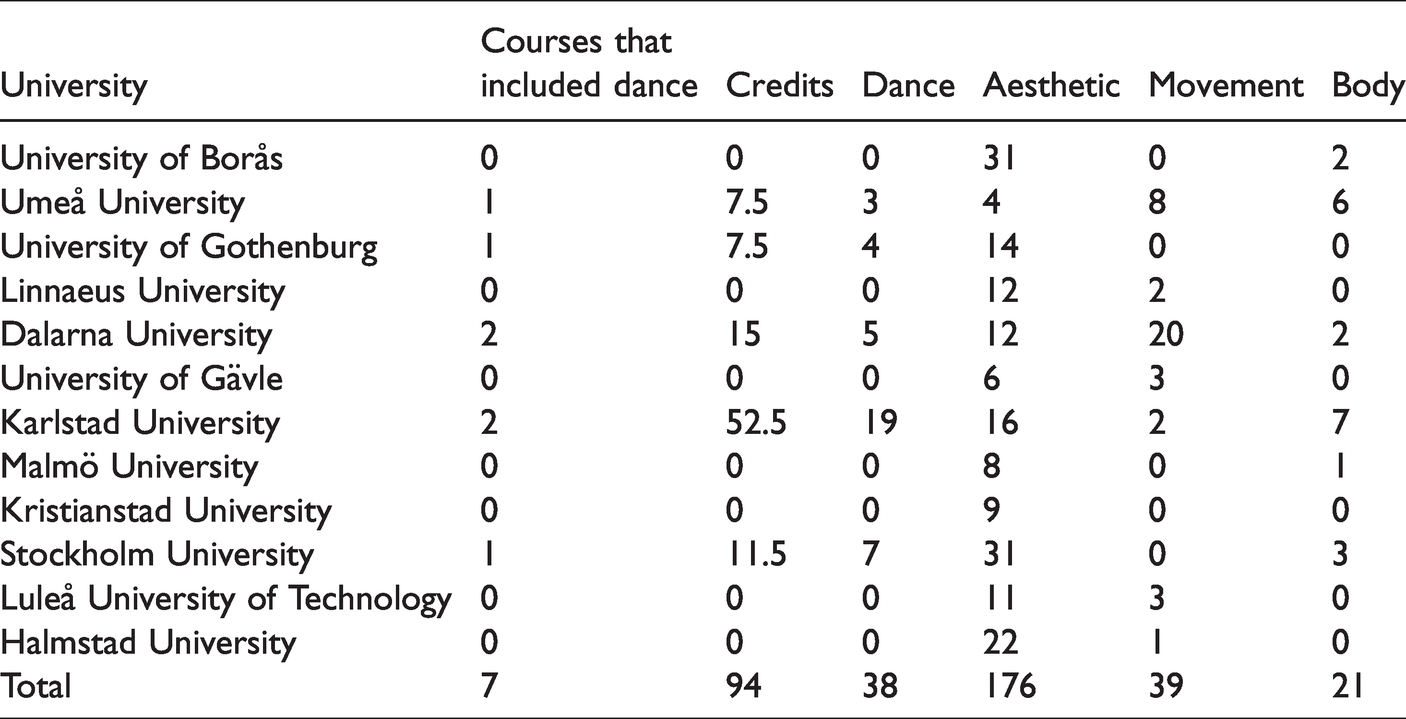
Overview of the occurrence of dance, aesthetic, movement and body in selected university preschool education syllabi.
In discourse analysis the concept of power is crucial for understanding dominant or marginalized knowledge, values and norms (Börjesson and Rehn, 2009; Howarth, 2007; Potter and Wetherell, 2007; Winther Jørgensen and Phillips, 2002). When the word dance occurred in the text, we paid attention to where and how it was positioned. We also observed “as what” dance was described. For example how dance could be described as a subject of its own or as a part of another subject. The present study cannot describe how dance in practice is carried out and understood by teachers and students and further research with this specific focus is desirable. The present study, however, contributes the structural prerequisites for understanding the presence and position of dance in early childhood teacher education, and to problematize how this might impact dance education within early childhood education.
Results
The study showed that at seven out of twelve examined universities, the syllabi did not mention dance specifically even if they sometimes mentioned body and/or movement. Not surprisingly, the term ‘aesthetic’ appeared in all examined syllabi, as aesthetic is a stated goal in the early childhood teacher education exam. Depending on where in Sweden students take their degree, they receive unequal prerequisites to develop knowledge in and about dance, movement and body, which can ultimately affect children’s democratic possibilities and health. This is interesting as the general goals in early childhood teacher education are the same on a national level, but it seems as the institutions interpret them differently. There was a strong academic discourse in the examined syllabi that might explain why bodily knowledge, such as dance, is not present in the content, learning outcomes and examination forms of the syllabi, as skills in dance (Carlgren, Forsberg and Lindberg, 2009) were often left out in the syllabi. The findings will be presented in two parts: first, a quantitative table showing the occurrence of dance followed by description of the function and position of dance in different parts of the early childhood teacher education syllabi at the examined universities.
To what extent does dance appear in Swedish early childhood teacher education syllabi?
Table 1 shows the occurrence of the search categories: the main category dance and subcategories aesthetic, movement and body. More than half of the universities did not offer content, goals and examination forms that specifically mentioned dance.
The results in Table 1 show that dance appeared in seven courses at five universities in the study, in total representing 94.5 ECTS out of a total of 2520 ECTS (12×210 ECTS). The courses consisted of a wider content than dance, e.g., play, mathematics, music or special education. Karlstad University offered 52.5 ECTC courses that among many other kinds of specified content, included dance to some extent. Karlstad University with 19 occurrences accounted for nearly half of the identified dance concepts (in total 38). Movement had 39 occurrences in the study, with Dalarna University having the most (20) occurrences in their syllabi. Body occurred 21 times in the syllabi. Aesthetic was the most frequent word in the examined syllabi, occurring 178 times. The results (Table 1) showed that dance had a very modest position in the early childhood teacher education syllabi at most of the selected universities, with the exception of Karlstad University. More than half of the programs (7 out of 12) did not provide any content, goals or examination forms that involved dance. This indicates that most early childhood teacher students do not get any training in dance or dance didactics according to the syllabi. There might be dance training provided but the low frequency of dance in the syllabi indicates that this probably is not the case. Karlstad University, University of Gothenburg, Stockholm University, Umeå University and Dalarna University all offered dance knowledge but to differing extent.
The findings indicated that some of the universities that did not specify dance in their syllabi. Instead, they specified movement as explicit content. However, the University of Borås, Malmö University and Kristianstad University did not offer either dance or movement in their syllabi. On the other hand, Umeå University, Dalarna university and Karlstad University offered both dance and movement. This indicates an understanding of dance and movement as separate learning areas, even if they can be intertwined. The occurrence of the word body in the syllabi was also limited (6 out of 12), which indicates that it is not considered an important aspect of early childhood teachers’ understanding of the child and early childhood practice. All universities did, to different extent, offer aesthetic aspects in their syllabi. The word aesthetic in some cases occurred frequently, e.g. in syllabi from the University of Borås, Stockholm University and Karlstad University. Interestingly, Stockholm University and Karlstad University used the word aesthetic frequently and also specified dance and other aesthetic subjects, but the University of Borås used the word aesthetic often without specifically connecting it to any aesthetic subject, content, outcome or goal. Whether the universities sees it as important to specify an aesthetic content or not seems to differ and this might be related to intrinsic versus instrumental use of aesthetic subjects, or aesthetic subjects as methods versus content. The findings indicate that the occurrence of dance varied a lot between the studied universities and this must be regarded as problematic from an equivalence perspective. The reasons behind how and why dance appeared will be discussed below.
To what extent is dance mentioned in the content, learning outcomes and examination forms in Swedish Early Childhood Teacher Education syllabi?
As presented in Table 1, dance was mentioned in five of the universities’ syllabi. Below, we show how dance was represented in the content, learning outcomes and examination forms and also discuss the implications.
Content in course syllabi referring to dance
In five of the examined universities (Karlstad University, University of Gothenburg, Stockholm University, Umeå University and Dalarna University) dance was mentioned in the syllabi content but in different ways. The combination of content and relation between dance and other learning areas were investigated and this part of the analyzing process involves an interpretation of the text and the discursive practice, as the discourses within those institutions becomes articulated and expressed in the texts. Three different themes emerged from the empirical material in which dance was mentioned: Dance presented together with other aesthetic forms. Dance grouped with learning areas mainly connected to language and mathematics. Dance presented as a subject of its own.
Dance presented together with other aesthetic forms
Dance was mentioned together with other aesthetic forms such as music, drama or art e.g. at Dalarna University. “In the module, the meaning for learning and development of movement, music, dance and play is studied and experienced”. Here, dance was linked to other artforms, play and movement and there was no hierarchical relation between them. Another example is how early childhood teacher students experience different forms of music, dance, art and drama. “Didactic models and theories around children’s aesthetic learning in relation to course member’s own experiences of music, dance, art and drama and the cultural life of society” (University of Gothenburg). Here, both children’s learning and the student’s own experiences of different aesthetic subjects as well as cultural life in society is connected. Dance becomes embedded in an aesthetic framing where cultural life, art, music and drama are connected to each other and to learning.
Dance presented with learning areas mainly connected to language and mathematics
At Karlstad University, dance was merged with other learning areas, e.g. mathematics, language and literature. “The module consists of an introductory statement of selected theories within the field and application and examination of practical and formative parts in language and communication, literature, mathematics, dance and music” (Karlstad University). Here, dance is connected to aesthetic learning areas as well as communication and mathematics. The syllabus was open to different interpretations: either a non-hierarchical organization of language and communication, literature, mathematics, dance and music, or an implicit idea of dance and music as vehicles for other learning areas. In line with the findings at Karlstad University, verbal language was mentioned together with aesthetic learning areas in a syllabus of Dalarna University. “In the module, children’s communication through different aesthetic expression forms, for example verbal language, craft, music, dance, drama and bodily language, is studied” (Dalarna University). As many different forms are mentioned, this gives a broad aesthetic and communicative framing to the content, but since the words “for example dance” are used rather than “and dance”, dance occurs as an exchangeable form of expression. Dance is connected to other (non-aesthetic) subjects such as mathematics and language, and positioned as a method to support learning in those subjects.
Dance presented as a subject of its own
To a small extent, dance emerges in its own right as content and a learning area not defined in symbiotic relation to other learning areas. Both at Stockholm University and Karlstad University, there were modules in the syllabi that focused specifically on dance. Karlstad University had the most distinct writings about dance in the content. “Dance pedagogy and theory with a focus on children’s dance, dance didactics for early childhood practice and dance performance with a focus on the teachers’ own experience” (Karlstad University). Here, it is stated that dance as a form of expression is closely connected to one’s own experience (whether it is the child's or student’s experiences is not clarified). Dance pedagogy is separated from theory and the focus on children’s dance but dance didactics for early childhood education is presented as something different from dance pedagogy and theory with a focus on children’s dance. This implies that it is important to make the distinctions clear, tailor dance pedagogy into an early childhood context and frame dance in a holistic, child-centered way. It also represents dance experience and performance in line with Smith-Autard’s (2002) ideas of appreciation of dance. Another example shows a double ambition of using the subject of dance as a method and content. “Exploring the aesthetic work, expression and communication within the subject dance and reflecting dance as content and method in early childhood education” (Stockholm University). In this course, dance was regarded as a subject, not only as a method for understanding other subjects. The text promotes experimental forms, expression and communication which frame the dance subject as part of an aesthetic discourse but with content of its own. Moreover, it implies that dance can be used as a method for teaching (other subjects), but the intrinsic aspect is in line with the new Swedish early childhood education curriculum (Lpfö18, 2018). The majority of the syllabi (eight out of twelve) did not include dance in the description of course content.
Goals in course syllabi referring to dance
The results showed that only four out of 12 universities stated goals that included dance that the student needed to achieve to pass examination. The overall impression was that most syllabi tried to bridge academic learning aspects, such as reflection, explanation, leading and reporting on dance, to bodily and aesthetic aspects, such as application, participation, exploration and creating dance. In one learning outcome at Stockholm University, this bridging was clearly visible: “Using dance as expression by participating in dance workshops and reflecting on dance as expression in early childhood education” (Stockholm University).
But even when ambitions to intertwine body/mind in syllabi were present, it was evident that there was a division resting on Cartesian dualism, where the immaterial mind and material body are ontologically separated. Two categories therefore emerged: academic aspects of learning outcomes, and bodily and creative aspects of learning outcomes.
Written and spoken aspects on knowledge building
In the analysis, words such as reflect, plan and lead, report on, and explain were identified in the syllabi as verbs linked to knowledge building implying use of the mind and modalities including written or spoken language (word based). The mentioned words, in line with (Carlgren, Forsberg and Lindberg, 2009) do include aspects as facts, conversance and understanding but not skills. In the goals, there were learning outcomes that included these words: “Report on and compare central theories and concepts that refer to play and children’s aesthetic learning in language and communication, literature, mathematics, dance and music” (Karlstad University). Here, the ambition focused on pedagogical aspects, such as facilitating children's learning in dance (music, mathematics, literature, language and communication). Being able to compare central theories and concepts related to play and aesthetic learning was seen as important. Another example of academic aspects was shown at Dalarna University: “After completing the course, the student will have acquired basic skills in music to be able to lead music making activities in terms of song, playing instruments and dance in early childhood education” (Dalarna University). This implies that the student should have basic knowledge in music. Interestingly, the University of Dalarna stated that knowledge in music was important for the ability to teach music and dance, while knowledge in dance does not seem to be needed to teach dance or music. Dance and music are considered as a single entity, where music includes singing, playing an instrument and dance. Dance does not seem to be a subject in its own right, and therefore no specific knowledge in dance is demanded.
Bodily and creative aspects of knowledge building
In the analysis, words such as apply, express, create, show, explore and participate were identified in the syllabi as verbs linked to artistic knowledge building, implying use of the body and language in a wider sense including non-verbal modalities. According to (Carlgren, Forsberg and Lindberg, 2009), skills in dance are more in foreground in the parts of syllabi using the words stated above. In the goals, there were learning outcomes that included these words. The University of Gothenburg stated that early childhood teacher students should. “Apply skills in craft, dance, drama and music based on artistic approaches” (University of Gothenburg).
To apply skills in dance (music, drama and craft) with an artistic approach shows an intrinsic appreciation of all artforms. As they were all mentioned in this syllabus, no hierarchical positioning occurred and dance had a place within an artistic framing. In a learning outcome at Karlstad University, it was mentioned that students should be able “to express oneself in dance and create dance activities from the perspective of the youngest early childhood education children” (Karlstad University). Therefore, students at Karlstad University possibly develop abilities to express themselves in dance according to this goal. This indicates that dance needs to be integrated in a person’s body and mind to be able to develop those skills. The student does not only have to be skillful in her/his expression but also in creating dance activities for the youngest children. This implies that Karlstad University prepares students with dance creating skills as a necessity for them to teach children dance aspects according to the syllabus.
To be able to express oneself in dance, participate in dance workshops and reflect on dance as a form of expression in early childhood were pointed out as important by Stockholm University. The syllabus at Stockholm University showed an ambition to unite the academic, bodily and creative aspects of dance knowledge, as both bodily and mental aspects were combined in the same goal.
Examination forms in course syllabi referring to dance
Dance was rarely mentioned when examination forms were analyzed. Only two (Stockholm University and Karlstad University) of the 12 universities explicitly mentioned dance in the criteria students needed to pass examinations. Those universities also specified dance as a subject throughout the syllabi. At Karlstad University, the examination form stated: “Learning outcomes 1, 2, 3 and 4 are examined through a shaping group presentation in music, dance, art and drama and a written individual submission assignment” (Karlstad University).
At Karlstad University, students shape ideas in music, dance, art and drama. This indicates that knowledge in all the mentioned artforms was regarded as equivalent without any hierarchical order. At the same time, it was not clear what dance skills and knowledge each student had to perform as the examination was conducted in groups. The learning goals 1–4 put dance in a frame where aesthetic learning processes and thematic work were regarded as ways to inspire children to learn mathematics and language skills. This implies that there is a hierarchical order where all art-based subjects are vehicles for outcomes that primarily are not art based, such as mathematics and language.
At Stockholm University, students had to “perform a practical and aesthetic task” in dance. However, the criteria needed to pass the exams were not specified. The organization of the course implied that each artform was evaluated separately, but the method for this was not specifically mentioned in the syllabus. Ten out of the 12 universities did not mention dance in their evaluation forms. Even if some of the universities offered exams that included expression and performing/shaping (gestaltande in Swedish), generally knowledge in dance was not specifically evaluated according to the syllabi.
What position has dance in Swedish Early Childhood Teacher Education syllabi?
The findings revealed that dance had a modest and sometimes non-existing part of early childhood teacher education at the universities in this study. Still the findings showed that aesthetic is regarded as an important part of early childhood teacher education as it was mentioned in the syllabi of all the universities (in total, 178 times in the empirical material). Notably, movement and body occurred to a limited extent at most of the investigated universities, except Dalarna University, Karlstad University and Umeå University. Two main discourses emerged from the empirical material when analyzing how our concepts, dance, movements, aesthetic and body, were juxtapositioned with other subjects in the syllabi: the aesthetic discourse and the non-bodily discourse. The quantity and frequency of the concept “Aesthetic” in the syllabi argues for our definition of an aesthetic discourse, and the lack of dance defined as a skill (Carlgren, 2018) argues for our definition of a non-bodily discourse. Furthermore, the position of dance in the syllabi was highlighted by analyzing what the students were supposed to know and how they were expected to show their knowledge.
The aesthetic discourse
The findings showed that dance is part of an aesthetic discourse mentioned in close connection to other artforms, creativity, expression and the shaping of ideas. The overall ambition is to develop an understanding of aesthetic expression as ways to communicate, get involved and understand oneself, peers, concepts and ideas in different ways.
All the universities in this study offered aesthetic content according to the syllabi headings. For example, Early Childhood Education 2: Children’s Creative Play and Aesthetic Learning 30 credits (University of Gävle); Education, Aesthetic Learning Processes in Language, Communication and Mathematics 1 and 2, 15 + 15 credits (University of Borås); Aesthetic Learning Processes 15 credits (Luleå University of Technology); Aesthetic Learning Processes and Cooperation, including 4.5 credits VFU 22.5 credits (Halmstad University). Courses that involved activities in aesthetic learning processes (rather than intrinsic aesthetic goals), or where aesthetic was connected to, e.g. language and mathematics suggested that aesthetic subjects were exchangeable. The relevance of meeting all forms of aesthetic expression was not a dominant part of the aesthetic discourse. For example, the University of Gävle provided content that involved drama, art and music. This implies that the latter artforms are regarded as relevant core subjects in the aesthetic course but not dance. The University of Borås also mentioned aesthetics, not only in two specific courses (Education, Aesthetic Learning Processes in Language, Communication and Mathematics 1 and 2) but also in several other syllabi. Aesthetic learning processes seemed to have a strong position as they were mentioned often, even if the (aesthetic) knowledge developed was not clarified. At Dalarna University, dance was mentioned in close connection to music, as music was described as the ability to sing, play instruments and dance. An interwoven aspect of dance, as part of other subjects, might also take place at other universities, e.g. when students are studying rhythmic or movement. However, the frequency, variety and quality of dance were not specifically mentioned in those cases (if any). Another aspect of this discourse seems to be the close connection between aesthetic and overall educational ambitions, such as expression of oneself, knowing aspects of content through different modalities, cooperation, increased self-esteem and encouragement. The benefits of aesthetic education do not preferably develop aesthetic abilities but human beings in a more general sense.
Within the aesthetic discourse, dance was viewed as either a subject of intrinsic value, part of an aesthetic learning area or, more commonly, non-existent. This implies that dance can be exchanged in some cases by movements or, more commonly, other aesthetic forms, e.g. drama, music and art. Thus, dance in early childhood teacher education can be described as “nonessential”, since it is not a prescribed learning area in teacher education, i.e. only some universities offer it. Since dance is not clearly stated in the examination forms of the syllabi, it can easily be removed or replaced by other content.
The word based, non-bodily discourse
University education draws on a word-based, non-bodily discourse that focuses on mental abilities and skills. Thus, the body was not mentioned in 6 of the 12 syllabi. This indicates that the body, bodily knowledge and bodily knowledge construction are not emphasized in early childhood teacher education. There is a bodily aspect when dance is performed, expressed or created, but often the student is also required to analyze, explain or report on dance or dance didactics. The latter aspects of learning are linked to an academic discourse, where the body and bodily knowledge are not valued and acknowledged in their own right. Generally, the syllabi always expressed the bodily aspect of dance in relation to more non-bodily aspects that can be carried out while sitting still without moving the body at all. Karlstad University was an exception where dance and movement were mentioned as something to develop knowledge in. Stockholm University was another example where dance as a method as well as content was studied, but a hierarchical organization of knowledge was present that marginalized the body in the early childhood teacher syllabi. The non-bodily discourse was clearly visible in learning outcomes and examination forms in the studied syllabi. Examinations involving the body seem to be difficult to evaluate as the criteria mentioned were unclear.
Discussion
The aim of this study was to examine and problematize the presence and position of dance in Swedish early childhood teacher education. Discourse analysis (Fairclough, 1992, 1995, 2000; Foucault, 1972) was used, both as a theoretical frame and as inspiration for our analysis, to categorize content, goals and examination forms related to dance and evaluate aspects of power impacting the relation between different levels and learning areas outlined in Swedish early childhood teacher education syllabi (Börjesson and Rehn, 2009; Potter and Wetherell, 2007; Winther Jørgensen and Phillips, 2002). This study was limited to the appearance of dance in syllabi of early childhood teacher education, but the results can be seen in the light of global neoliberalization (Fairclough, 2000). However, in future research, it would be interesting to investigate whether dance is actually included in educational practice in early childhood teacher education, and how it is argued for in relation to other learning areas. The study was limited to 12 Swedish universities. Therefore, other aspects may have been revealed if the remaining universities had been included in the study. Another limitation might be that even if dance was not mentioned in the syllabi, it may still have been carried out in practice. However, we only focused on the occurrence of dance specifically in early childhood teacher education syllabi as this gives an idea of what is valued and communicated in a formal way to students, teachers and the surrounding society. To examine the actual teaching of dance, and qualification of professors in higher education teaching dance content, other methods must be used, such as interviews or observations involving professors and students. However, the limited occurrence of dance in the early childhood teacher education syllabi demonstrates the values and understanding of knowledge within university organizations that lie behind the lack of evaluation of students´ performance in dance and knowledge about dance for children.
This study showed that dance was rarely mentioned in early childhood teacher education syllabi. The function of dance is mainly to decorate other, non-aesthetic learning areas. It appears as an “ornament” to make other subjects, such as language and mathematics, more interesting and colorful, and to give new dimensions to aspects of the core learning areas. The concept poetics (Louppe, 2010) could be a way of distinguishing possible ontological meanings and values of dance from more instrumental neo-liberalised practices. The study showed that dance in the syllabi often was described as an aesthetic activity. However, according to the OECD report Art for Art’s sake (Winner et al., 2013), there is little evidence for developing academic skills in non-arts subjects by singing, dancing or engaging in other artforms. The report justifies art for its own sake as an intrinsic value for human experiences and meaning making. However, Anttila (2019/2013) emphasizes the importance of sensing the body and stresses the awareness of the lived body independent of whether dance is of intrinsic or instrumental value. We argue that the body-mind dualism (Fredriksen, 2015) does not contribute in a way that facilitates a holistic awareness of the lived body. Also Antonsen (2020) argues for paying attention to the corporeal in early childhood education and considering how bodies might search for the meaning in the world. But, it was clear that dance was treated as “nonessential” in the aesthetic discourse because it can easily be omitted without any obvious disadvantages as no examination form assesses students’ performance in dance. If dance is omitted the possibilities to sense the lived body, in a poetic way (Louppe, 2010) might be limited. Aesthetic learning processes can involve a choice of aesthetic subjects and no specific aesthetic subject is ensured. Notably, in the syllabi of the University of Borås, Kristianstad University and University of Gävle, aesthetics occurred frequently, but they did not offer any content, goals or evaluation criteria involving dance, movement or body. In the majority of the syllabi that included the word aesthetic, the type of aesthetic knowledge was not specified.
Dance was considered replaceable, as many course titles in the empirical material that included “aesthetic” offered content of other art forms, such as art, drama and music. This study did not explore the reasons behind the selection of aesthetic areas in each early childhood teacher education syllabi, but they may relate to the competences and ontological understanding of personnel at each institution. This raises questions of the frequency of personnel with knowledge in creative dance pedagogy and dance as artistic expression at the early childhood education. This gives dance a weak position in early childhood teacher education on a general level, as well as in comparison with other aesthetic subjects. That dance is specifically weak can be seen in relation to power, especially from a gender perspective, as dance is a bodily artform that is often connected to femininity in western contexts (Gard, 2003, 2006, 2008; Lindqvist, 2010; 2019; Pastorek Gripson, 2016; Risner, 2009; Stinson, 2005a, 2005b). Since the majority of students and staff in early childhood teacher education are female, this stands out as surprising.
An explanation of the weak position of dance in early childhood teacher education may also reflect the concept of knowledge and knowledge construction in higher education (Biggs and Tang, 2011). Aiming to organize higher education in a linear way, constructive alignment, where the ambition is to measure knowledge precisely, redefines power relations within the academic landscape. This also creates a hierarchical organization of knowledge forms as course content, literature and other resources connected to university studies, where the use of words and/or numbers are the dominant modalities. This can be understood as an instrumental way of understanding, measuring and creating knowledge. This is in contrast to Carlgren, Forsberg and Lindberg (2009) and Carlgren (2012) typology of knowledge with four aspects; facts, understanding, skill and conversance as non-hierarchical and interwoven.
Within an early childhood context, the emphasis on children's possibilities to express themselves through different modalities is strong. However, this study raises questions about how qualified future early childhood teachers are in developing children's possibilities in all aesthetic forms, especially dance, as not all universities offer opportunities to develop dance knowledge during the education, according to syllabi. From a democratic point of view, this may limit children's possibilities to not only dance (as an activity) but also engage in learning, designed by early childhood teachers, that guides children to create, perform, view and appreciate dance (Smith-Autard, 2002). Pramling Samuelsson et al. (2015) showed the importance of early childhood teachers for identifying specific learning objects, drawing children's attention toward them and engaging in meta discussions with children using dance (and other artforms) to connect with other aspects of life on a general level (Gard, 2003; Lindqvist, 2010, 2015a, 2015b; Pastorek Gripson, 2016; Stinson, 1989, 2005a, 2005b; Svendler Nielsen, 2009).
Early childhood teacher education should provide the best prerequisites to develop professional knowledge for the future profession within the field. This includes, e.g. handling challenges, developing systematic quality work and equipping early childhood children with skills to develop and learn in a holistic sense. The absence of mentioning of the body in teacher education syllabi indicates that future early childhood teachers may not have sufficient competences in and about poetic, bodily learning, in dance. This is in line with Lindqvist’s (2019) findings drawing on empirical material from one university, which showed that students’ experience of bodily knowledge was limited. Our results are in line with Lindqvist’s as we illuminate that bodily knowledge is not prioritized in early childhood teacher education syllabi. To teach and care for a child’s needs involves bodily aspects to a large extent (Lpfö 98 revised 2016; Lpfö18, 2018). However, according to the syllabi, these competences are not currently practiced in the majority of early childhood teacher education.
Pramling Samuelsson and Johansson (2007) pinpointed the importance of identifying learning objects that early childhood teachers can draw children's attention toward. The findings in the present study showed that learning objects within the subject dance are not developed in most early childhood teacher education. Dance might in practice occur frequently, but according to most syllabi examined in this study, dance knowledge is not considered a subject worth mentioning. It is therefore not likely that dance educated university teachers teach early childhood student teachers dance knowledge and dance content. Bamford (2009) pointed out that when education involving arts is of bad quality, it can be more damaging than useful. Therefore, it is important to offer high quality dance education to future early childhood teachers so that they may in turn teach dance of high quality to children attending early childhood education. However, according to the results of this study, the current quality of dance education carried out by early childhood teachers might be questionable.
The effect of the lack of support for dance for early childhood education might be that children will not be offered learning situations that help them to develop dance knowledge in a systematic sense but merely carry out a dance activity (Lindqvist, 2010, 2015a, 2015b; Pastorek Gripson, 2015; Pramling Samuelsson et al., 2015; Sjöstedt Edelholm and Wigert, 2005; Smith-Autard, 2002; Stinson, 1989, 2005a, 2005b; Svendler Nielsen, 2009). The UN Convention on the Rights of the Child (Unicef, 2019), that since January 2020 is law in Sweden, states the importance for children to be able to express themselves, and this is also emphasized in the early childhood curriculum (Lpfö98, 1998, revised 2016; Lpfö18, 2018). It is also mentioned that aesthetic learning processes not only involve methods but also content (Lpfö18, 2018). To express oneself effectively, tools are required that develop a richer vocabulary and improve communication with others through dance (Mattsson, 2016; Pastorek Gripson, 2015, 2016; Smith-Autard, 2002; Stinson, 2005b). The consequences of the current weak position of dance in early childhood teacher education might limit children’s social and democratic life, bodily knowledge and experience and positioning from a gender perspective.
Concluding remarks
This study revealed that the presence of dance in Swedish early childhood teacher education syllabi vary a lot and that dance as a subject, or content, in general has a weak position. “Aesthetic learning processes” may tend to replace dance with other aesthetic subjects, such as music, art and drama. Thus, dance is seen as replaceable or even nonexistent and is only mentioned at two universities as a subject in its own right. This must be seen as challenging for children's freedom of speech, according to the UN Declaration of the Right of the Child (Unicef, 2019). Hence, dance seems to have a nonessential function in early childhood teacher education syllabi, even though dance is specified as content in the curricula (Lpfö18, 2018). The reasons for this might be complex but may involve the assumption that dance is almost the same as movement, rhythmic, drama or gymnastics.
The limited competence of personnel within an institution may be one explanation for the presence and weak position that dance has in some early childhood teacher education syllabi. Informed by Fairclough (1992, 1995), the practice, i.e., personnel, at early childhood teacher education influence the construction of syllabi, as the text, discursive practice and social practice are interlinked. As Fairclough (2000) describes a neo-liberal global order provides less democracy, and therefore the presence and position dance has in early childhood teacher education is a result of neo-liberal discourses dictated by the market. The same government authority evaluates all institutions, and their financial resources are connected to their capacity to deliver education that correspond with national goals. All the studied universities have to design their syllabi in accordance with goals in the Higher Education Ordinance (2020: 881), but the outcomes specifically connected to dance vary. Appreciation of dance as an important part of children's lives (Sansom, 2011; Svendler Nielsen and Burridge, 2015; Stinson, 2005b) on a policymaking level may explain why dance is considered a subject in its own right, mentioned both in content, goals and examination forms in the syllabi in some institutions. Those institutions that mention dance in both content, learning outcomes and examination forms may be orientated more towards prevailing democracy than adapting to the market, as according to Carlgren (2018) they offer students possibilities not only to develop knowledge about aesthetic learning processes in general but also skills in dance specifically.
The ideas of knowledge and knowledge construction that are linked to academic landscapes contribute to the marginalization of dance and bodily knowledge, experiences and modalities. In a world that assumes knowledge should be measurable, controlled and usable, dance and other art forms are difficult to define and value in an academic landscape. This has implications for inclusion, gender and meaning making in general, both for the individual and the society. Factors such as constructive alignment, the academic environment and discourses connected to aesthetic learning processes as tools for learning other subjects, such as language and mathematics, position dance as an ornament rather than a knowledge area of intrinsic value.
Even if dance is emphasized as important for children’s learning and development in the curriculum (Lpfö18, 2018) there are no guarantees that all early childhood teachers are facilitating children’s possibilities to engage in dance, as the results in this study indicates limited possibilities to develop skills (Carlgren, 2018) in dance during their education. Early childhood teachers need to develop knowledge and skill and understand dance not only as a method for learning something else than dance but also as subject specific content according to the curriculum (Lpfö18). This implies that early childhood teachers need to be able to teach dance, and therefore chose learning objects to guide children's attention toward typical dance elements e.g. contrasts, dynamics, bodily sensations and spatial orientation (Ericson, 2000; Pastorek Gripson, 2016; Pramling Samuelsson et al., 2015; Smith-Autard, 2002). This study indicates the importance of strengthening the presence and position of dance in early childhood teacher education syllabi. This is necessary to improve children's possibilities to play, engage in aesthetic expression and creative learning, under supervision by early childhood teachers.
Footnotes
Declaration of conflicting interests
The author(s) declared no potential conflicts of interest with respect to the research, authorship, and/or publication of this article.
Funding
The author(s) received no financial support for the research, authorship, and/or publication of this article.
