




Abstract
This study investigated the role of core self-evaluations (CSE) as a mediating factor between posttraumatic stress disorder (PTSD) symptoms and well-being among veterans and examined gender as a moderator of the indirect effect of PTSD on well-being through CSE. Participants comprised 205 U.S. veterans (Mage = 29.3, SD = 8.0). We evaluated a simple mediation model to assess the potential influence of PTSD symptoms on well-being and the role of CSE as a mediator in this relation. Furthermore, we introduced gender as a moderator variable into the model and tested for moderated mediation. Our study demonstrates that CSE mediates the relationship between PTSD symptoms and well-being, and gender moderates the relationship between PTSD symptoms and well-being through CSE in a sample of veterans. Our findings suggest that female veterans are more prone to lower CSE. Addressing gender differences may be imperative to support veterans. Limitations and clinical implications are discussed.
Military veterans are a significant and growing segment of the U.S. higher education population, enriching campus diversity (Umucu, Lee, et al., 2021; Umucu, Moser, & Bezyak, 2020; Umucu, Wu, et al., 2020; Wang et al., 2024). More than 900,000 Veterans received education benefits from the U.S. Department of Veterans Affairs (V.A.) between 2000 and 2012 (National Conference of State Legislatures [NCSL], 2014). These numbers are likely to increase, given recent modifications for more flexible V.A. educational benefits for student Veterans (NCSL, 2014). However, Veterans also face unique challenges, particularly regarding mental health, such as posttraumatic stress disorder (PTSD; Umucu, 2022; Umucu, Brooks, et al., 2018; Umucu, Grenawalt, et al., 2019; Umucu, Lo, et al., 2022).
Due to combat exposure and deployment, veterans may experience mental health concerns and disabilities, which eventually affect their overall well-being and quality of life (Grenawalt et al., 2023; McGuire et al., 2023; Rumrill et al., 2024; Umucu, 2021; Umucu, Reyes, et al., 2021). Posttraumatic stress disorder is one of the most common mental health disabilities associated with military service (Tanielian et al., 2008). The prevalence of PTSD has been estimated at 23% among returning Veterans (Fulton et al., 2015). As many as 30% of Veterans will experience PTSD at some point in their lifetime (U.S. Department of Veterans Affairs, 2023). Veterans with PTSD report greater levels of social anxiety and lower levels of quality of life, gratitude, hope, and optimism than Veterans without PTSD, resulting in poorer well-being (Kashdan et al., 2006). According to Rudd et al. (2011), 45.6% of student Veterans experience PTSD symptoms. Although the prevalence of PTSD symptoms is high among student Veterans, there is a lack of data on whether student Veterans with PTSD seek professional mental health services.
Veterans with disabilities may also experience a range of disabilities secondary to their military service that are associated with academic problems (Umucu, Castruita Rios, et al., 2024; Umucu, Chan, et al., 2024; Umucu, Chan, Lee, et al., 2022; Umucu, Ghosh, et al., 2022; Umucu, Villegas, et al., 2021). For example, previous research revealed that student Veterans were found to have lower college grade point averages (GPA) and lower levels of sense of belonging compared to civilian peers (Durdella & Kim, 2012). Besides, research suggests that student Veterans experience high rates of psychological distress that affect their overall quality of life and well-being (Williston & Roemer, 2017).
Research on gender and disability disparities in veterans with PTSD offers crucial insights. Recognizing PTSD symptoms is critical, as they often co-occur with anxiety and depression. Studies by Vogt (2011) highlight the higher prevalence of PTSD and related conditions in female veterans, suggesting a need for gender-specific care approaches. Furthermore, disabilities can exacerbate these symptoms (Sayer et al., 2011). This underscores the importance of early and accurate diagnosis, as undiagnosed PTSD can lead to a cascade of adverse outcomes, including worsened physical health and impaired social functioning. In addition, the stigma surrounding mental health in the military context often results in underreporting and underdiagnosis of PTSD, particularly among male veterans who may be less likely to seek help (Kashdan et al., 2006). Therefore, a comprehensive understanding of how PTSD symptoms manifest across different genders and among those with disabilities is essential for developing targeted interventions that address the full spectrum of mental health issues in veterans, ultimately enhancing their overall well-being (Umucu, Lee, et al., 2023; Umucu, Rumrill, et al., 2022).
Core Self-Evaluation
Researchers have investigated core self-evaluation (CSE) as a predictor of well-being across various life situations (Judge et al., 1998, 2005). Core self-evaluation, defined as the overall central perception of people’s worth and capability as human beings, is a higher-order construct composed of four lower-order evaluative traits: self-esteem, self-efficacy, locus of control, and emotional stability (Judge et al., 1998). Specifically, self-esteem is a global appraisal of one’s self-worth (Rosenberg, 1979), while self-efficacy is an individual’s belief in their ability to produce a desired outcome when pursuing a particular goal (Bandura, 1977). Emotional stability can be defined as the tendency to feel calm and secure (Eysenck, 1990). Finally, locus of control is an individual’s belief that they have personal control over events in life rather than being controlled by others (Rotter, 1966).
Core self-evaluation has been positively linked to subjective well-being (Judge et al., 2005), with a strong, positive association with life satisfaction (Chang et al., 2012). Studies also show that CSE mediates the effects of some environmental factors on positive outcomes. For example, CSE mediates the impact of social support on well-being and life satisfaction (Liu et al., 2016) and the effects of social stressors on job satisfaction (Harris et al., 2009).
Researchers suggest that individuals with higher CSE are better at coping with stressors and life situations as CSE provides them with a sense of control and competency (Harris et al., 2009; Hobfoll, 2001). Judge et al. (2005) further suggest that self-evaluations influence beliefs about life, leading to different responses to adversity based on perceived competence. Therefore, we hypothesize that CSE mediates the relationship between Veterans’ PTSD symptoms and well-being, with Veterans high in CSE coping better with symptoms and experiencing higher well-being.
Given the increasing number of female Veterans, it is crucial to understand how factors impact male and female Veterans differently. Research on the impact of gender on CSE and its moderating role in the PTSD well-being relationship through CSE is scarce. Researchers have found that some personal and situational characteristics are significant moderators of CSE, such as age and collective efficacy (Ng & Feldman, 2010).
In a meta-analysis, Chang and colleagues (2012) found that personal factors, such as sample characteristics and cultural background, are significant between-study moderators of the impact of CSE on job satisfaction. Researchers have also found that male and female Veterans demonstrated different stress response patterns (e.g., coping) related to deployment length (Adler et al., 2006). The relationship between CSE and academic outcomes was also examined among students with disabilities. Smedema et al. (2015) investigated the connection between CSE and life satisfaction in students with disabilities. Their study revealed that students with higher CSE experienced greater life satisfaction. This was attributed to their enhanced ability to cope with stress, maintain a positive mood, and build social support, compared to those with lower CSE. Another study (Chen et al., 2022) examined the influence of college students’ CSE on job search outcomes. They reported that CSE positively impacted job search outcomes among college students.
Purpose of Study
The first aim of this study is to investigate the potential influence of PTSD symptoms on the well-being of Veterans. Based on the literature above, PTSD symptoms are likely negatively correlated with well-being. Next, we will assess the role of CSE as a mediator of the relationship between PTSD symptoms and well-being. Finally, we will evaluate whether the mediating role of CSE varies as a function of gender.
We hypothesize that Veterans with lower PTSD symptoms will experience higher well-being and that higher CSE will be associated with higher well-being. In addition, we hypothesize that CSE mediates the relationship between PTSD and well-being, suggesting that well-being partially stems from increased CSE in Veterans with lower PTSD. Finally, we examine whether this mediation relationship differs based on Veterans’ gender.
The study hypotheses are summarized as follows:
Method
Study Procedures
This study used a quantitative descriptive design (Heppner et al., 2008). We recruited participants from universities across the United States upon approval from the Institutional Review Board (IRB). Directors of Veteran programs disseminated information about the research project electronically to Veterans on each affiliate’s mailing list to recruit research participants. Data were collected via an online survey platform. All participants completed the online consent form before they started the survey.
To be eligible for inclusion in the study, participants had to meet the following criteria: (a) at least 18 years or older; (b) retired from active duty service or a National Guard or Reserve member of the United States Armed Services with active duty service; and (c) currently enrolled in a college or university. Participants received a $15 U.S. gift card upon completion of the study.
Measures
Demographic Questionnaire
The demographic questionnaire consisted of items that gathered participants’ personal (e.g., age, gender, race/ethnicity), school (e.g., class standing, first-generation student status), employment (e.g., employment status), and military service (e.g., branch served, entry and exit years) characteristics. Participants were asked what their gender was in the study.
PTSD Symptoms
Posttraumatic stress disorder symptoms were measured by the four-item version of The Primary Care PTSD Screen (PC-PTSD; Prins et al., 2003). The scale measures four dimensions of PTSD (i.e., reexperiencing, avoidance, numbing, and hyperarousal) with yes–no response options (Yes = 1, No = 0). For this study, we used the PC-PTSD as a continuous scale and summed each item score as the total score. The total score ranges from 0 to 4, with higher scores indicating higher PTSD symptoms. The PC-PTSD demonstrated good test–retest reliability (r = .80; Kimerling et al., 2006). Prins et al. (2003) reported that the PC-PTSD outperformed the PTSD symptom checklist in predicting PTSD diagnosis by structured clinical interviews, providing valid evidence of the PC-PTSD scores. The scale also demonstrated a strong internal consistency (α = .86) in this study.
Well-Being
Well-being was measured by the PERMA-Profiler (Butler & Kern, 2016). The PERMA-Profiler consists of 23 items; however, in this study, 15 items were used to measure the five pillars of well-being (i.e., positive emotion, engagement, relationships, meaning, and accomplishment). Each item is rated on an 11-point scale ranging from 0 (never) to 10 (always) or 0 (not at all) to 10 (completely). The total well-being score was created by summing all five pillars. Higher scores indicate greater levels of well-being. Cronbach’s alpha of the PERMA-Profiler in this study was .95.
Core Self-Evaluation
Core self-evaluation was measured by the Core Self-Evaluation Scale (CSES; Judge et al., 2003). The CSES consists of 12 items rated on a 5-point Likert scale ranging from 1 (strongly disagree) to 5 (strongly agree). Higher scores reflect more positive CSE. The CSES demonstrated good reliability evidence, with Cronbach’s alphas ranging from .81 to .87 (Judge et al., 2003). Cronbach’s alpha of the CSES in this study was .91.
Data Analysis
First, descriptive statistics were computed for all variables. Second, a correlation analysis was applied to examine the relations among variables. Next, we evaluated a simple mediation model to assess the influence of PTSD symptoms on well-being and the role of CSE as a mediator in this relation. Finally, we introduced gender as a moderator variable into the simple mediation model and tested for moderated mediation (See Figure 1).
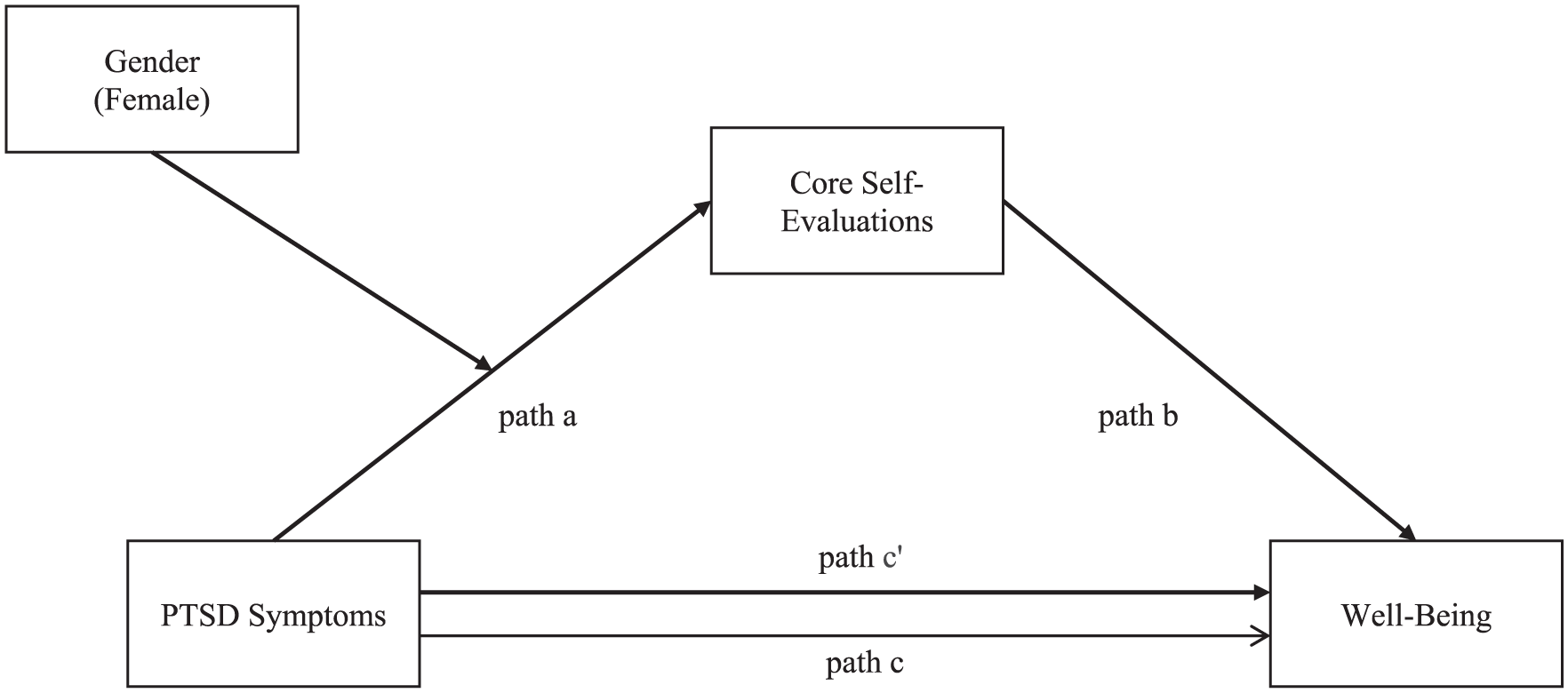
Moderated Mediation Model Predicting Well-Being From PTSD Symptoms via Core Self-Evaluations Moderated by Gender.
All analyses were conducted using PROCESS macro for SPSS 24.0 (Hayes, 2013). We used 10,000 bootstrap samples to assess 95% confidence intervals of indirect effects. If the confidence intervals of the indirect impact do not include zero, it is concluded that there was a statistically significant indirect effect (Hayes, 2013). Once the mediating impact of CSE in the relationship between PTSD symptoms and well-being was established, we tested the moderating effect of gender on the first path of the mediating process (i.e., PTSD-CSE path).
We used 10,000 bias-corrected bootstrapping to estimate the conditional indirect effects of CSE. We were also able to probe the significance of conditional indirect effects at different values of the moderator variable. To test and graph the simple slope for the moderator variable, we used the recommended levels as one standard deviation below the centered mean, the mean, and one standard deviation above the centered mean of the predictors (Aiken & West, 1991).
Results
Sample Characteristics and Descriptive Statistics
In this study, a diverse sample of 205 veterans participated, with a mean age of 29.3 years (SD = 8.0). Most participants were male (71.7%) and identified as White (80.5%), reflecting the demographics of the veteran population. The employment status varied, with 59% of participants reporting being employed. Army veterans constituted the largest proportion (40%) among the branches of service represented in the study.
Regarding marital status, a significant portion of participants were single (45.4%), followed closely by those who were married or cohabitating (43.4%). A smaller percentage reported being divorced (8.3%) or separated (2.0%). Notably, 39% of participants reported having service-connected disabilities, highlighting the prevalence of such conditions among the veteran population.
The distribution of participants across universities demonstrated a varied recruitment strategy, with the Ohio State University contributing the most significant number of participants (33.2%), followed by the University of Wisconsin (21%) and the University of Arizona (20.5%). These findings suggest a collaborative effort among multiple institutions to research veterans’ experiences and well-being. In addition, the presentation of means, standard deviations, and intercorrelations among the variables in Table 1 provides a comprehensive overview of the dataset, laying the groundwork for further analysis and interpretation of the study findings.
Descriptive Statistics and Bivariate Correlations Among Variables.
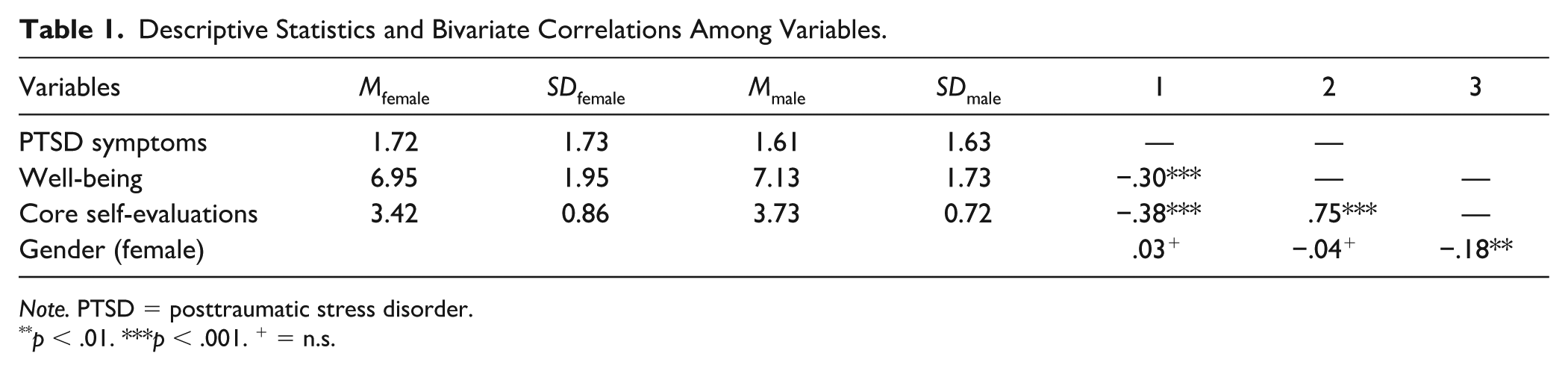
Note. PTSD = posttraumatic stress disorder.
p < .01. ***p < .001. + = n.s.
Correlation Analysis
The correlation analysis conducted in our study unveiled significant associations between PTSD symptoms and various psychosocial factors. Specifically, we found negative correlations between PTSD symptoms and well-being (r = −.30, p < .01).
Mediation Analysis
To test our Hypotheses 1 and 2, we conducted a simple mediation analysis. The overall model with CSE as a mediator accounted for 56% of the variance in well-being, R2 = .56, F(2, 202) = 130.03, p < .001. As expected, PTSD symptoms were negatively correlated with well-being (Path c; B = −.32, SE = .07, t = −4.48, p < .001, 95% confidence interval (CI) = [−.47, −.18]). Posttraumatic stress disorder symptoms were negatively correlated with CSE (Path a; B = −.18, SE = .03, t = −5.89, p < .001, 95% CI = [−.24, −.12]). Core self-evaluation was positively correlated with well-being after controlling PTSD symptoms (Path b; B = 1.72, SE = .12, t = 14.78, p < .001, 95% CI = [1.49, 1.95]). The direct effect of PTSD symptoms on well-being was not significant after controlling for the effect of the CSE (B = −.02, SE = .05, t = −.32, p = .75, 95% CI = [−.12, .09]), indicating that CSE fully mediates the relationship between PTSD and well-being (Path c′). Using the PROCESS macro procedure with 10,000 bootstrap samples revealed a significant indirect effect of PTSD symptoms on well-being through CSE (point estimate = −.31, 95% CI = [−.43, −.19]), as the 95% CI does not contain zero (Hayes, 2013). Results are presented in Table 2.
Mediation and Moderated Mediation Analyses Results.
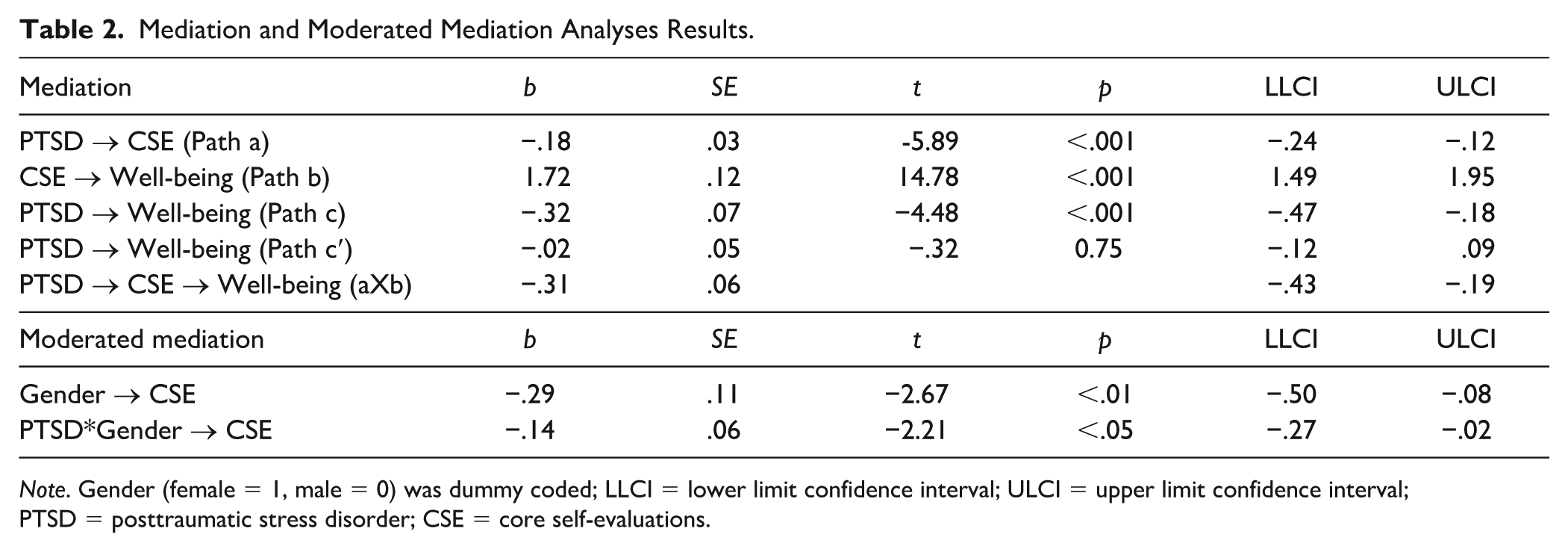
Note. Gender (female = 1, male = 0) was dummy coded; LLCI = lower limit confidence interval; ULCI = upper limit confidence interval; PTSD = posttraumatic stress disorder; CSE = core self-evaluations.
Moderated Mediation Analysis
The simple mediation analysis yielded evidence of a negative indirect effect of PTSD symptoms on well-being through CSE, with higher levels of PTSD symptoms linked to more negative CSE and higher levels of CSE related to increased well-being. To test our Hypothesis 3 that the mediational relation between CSE, PTSD symptoms, and well-being may differ by gender, we conducted a moderation mediation analysis. Gender (female = 1, male = 0) was added to the simple mediation model (see Figure 1), with female being associated with lower CSE (B = −.29, SE = .11, t = −2.67, p < .01, 95% CI = [−.50, −.08]). The interaction between PTSD symptoms and gender was significant (B = −.14, SE = .06, t = −2.21, p < .05, 95% CI = [−.27, −.02]). There were significant conditional indirect effects of PTSD symptoms on well-being through CSE for both females (B = −.28, SE = .05, t = −5.13, p < .001, 95% CI = [−.38, −.17]) and males (B = −.13, SE = .04, t = −3.77, p < .01, 95% CI = [−.20, −.06]). The index of moderated mediation testing the difference between conditional indirect effects was significant (B = −.25, SE = .12, 95% CI = [−.49, −.01]), which revealed a significant moderated mediation effect. Figure 2 plots the simple slopes for the interaction term.
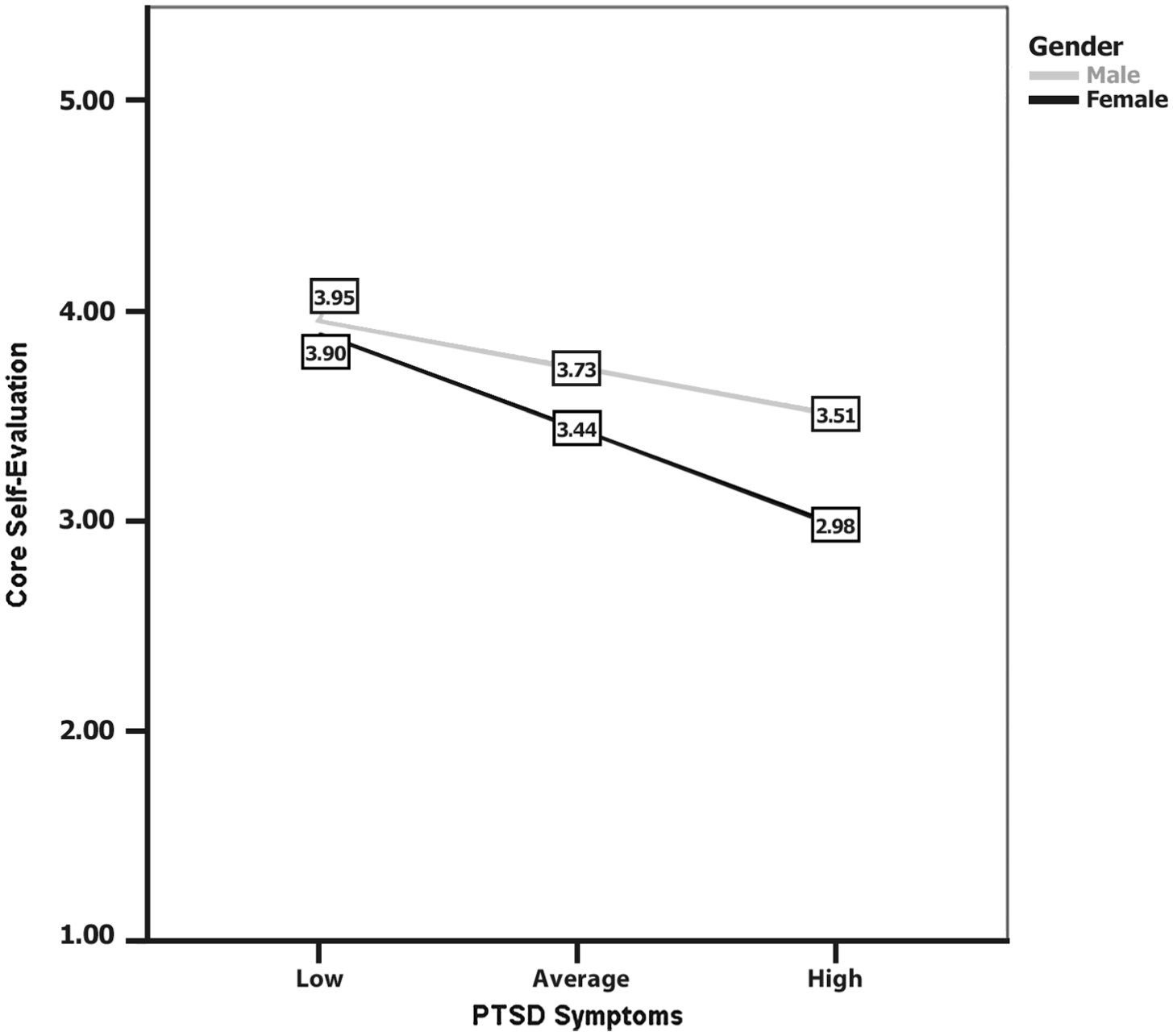
Interaction of PTSD and Gender in Predicting Core Self-Evaluations.
Discussion
This study investigated the role of CSE as a mediating factor between PTSD symptoms and well-being among veterans and examined gender as a moderator of the indirect effect of PTSD on well-being through CSE. Consistent with previous research (Kashdan et al., 2006; Schnurr et al., 2009), our results demonstrated a negative association between PTSD symptoms and well-being among veterans. Furthermore, results indicated that CSE fully mediated the relationship between PTSD and well-being.
According to our mediation analyses, veterans who exhibited higher CSE were more likely to cope with their PTSD symptoms adaptively, leading to increased well-being. In contrast, those who demonstrated lower CSE were more likely to succumb to their symptoms, resulting in poorer well-being. Our findings are consistent with existing literature suggesting that individuals with high levels of CSE appraise themselves and situations positively, view themselves as capable, worthy, and having a sense of control, and have higher subjective well-being (Judge et al., 2004, 2005). Our findings are also compatible with previous studies in that people with higher CSE perceive fewer stressors and experience less psychological strain than those with lower CSE (Kammeyer-Mueller et al., 2009). Consequently, promoting the development of CSE may be an effective way of helping veterans to manage their PTSD symptoms and to enhance their well-being.
Although there are limited evidence-based interventions for promoting the development of CSE, helping professionals may adopt existing treatment protocols that address the four lower-order evaluative traits of CSE. Specifically, a recent meta-analysis found that cognitive behavioral therapy, art therapy, and mindfulness approaches demonstrated medium to large effects on promoting self-esteem (Niveau et al., 2021). Rehabilitation and mental health professionals can provide psychoeducation to their veteran clients about the cognitive process connected to negative self-beliefs and help modify those core beliefs about themselves. Rehabilitation and mental health professionals may also incorporate creative processes (e.g., painting and dancing) and mindfulness into the counseling process to help clients be aware of, express, and transform their negative self-evaluation and feelings. Rehabilitation and mental health professionals can boost their clients’ self-efficacy by attending to the four sources of self-efficacy: vicarious learning, social persuasion, physiological feedback, and mastery experiences (Bandura, 1977). Rehabilitation and mental health professionals can also teach emotional regulation strategies to enhance their clients’ emotional stability.
As hypothesized, gender moderated the indirect effect of PTSD on well-being through CSE. Our findings suggest female veterans are more prone to lower CSE. This is the first study to evaluate the moderated mediation role of gender among CSE, PTSD, and well-being in veterans; however, our results are consistent with previous research: females may experience lower self-confidence, lower self-efficacy, and greater feelings of inadequacy (Damaske, 2011). Furthermore, females are more likely to experience PTSD than men (Breslau et al., 1997; Kimerling et al., 2013) and are more likely to experience increased chronicity (Saxe & Wolfe, 1999). Lang et al. (2003) suggest that PTSD may be more pronounced among military women due to greater exposure to harassment than non-military counterparts (Merrill et al., 1998). Rehabilitation professionals should adopt a trauma-informed approach when working with veterans, as veterans are more likely than not to experience traumatic events, create a safe and predictable space that allows their clients to rebuild control, and help them identify their strengths and build upon them (Kelly et al., 2014). It is also imperative that rehabilitation and mental health professionals tailor their interventions to the unique circumstances of their clients, as clients’ CSE and types of traumatic experiences may vary by their gender.
Implications
Given our population consists of student veterans, it is important to highlight clinical implications for student veterans. Although there is not a specific intervention aiming to increase CSE among veterans, clinicians may consider interventions that boost student veteran’s self-esteem, self-efficacy, locus of control, and emotional stability, the components of CSE. Positive self-esteem has been regarded as a protective factor that helps people buffer against stressors (Mann et al., 2004). Enhanced self-esteem may promote positive changes and positive traumatic growth (Prati & Pietrantoni, 2009). Self-efficacy may serve as the foundation of human agency and influences one’s cognitive, motivational, emotional, and decisional processes when facing adversity (Benight & Bandura, 2004). Research has suggested that recalling self-efficacy-related autobiographical memories may increase veteran’s perceptions of self-efficacy because it facilitates cognitive processes that draw upon his or her personal beliefs (Brown et al., 2016). Greater perceptions of control may help individuals cope with stressful events and react more calmly (Harris et al., 2009). Fostering student veterans’ sense of control can promote better transitions in college life experiences (Griffin & Gilbert, 2015). Last, emotional stability is associated with coping styles (Contractor et al., 2016; Dunkley et al., 2014). For instance, fewer levels of emotional stability are related to maladaptive coping styles (Contractor et al., 2016), and higher levels of emotional stability are related to resilience (Isaacs et al., 2017). Trainings on positive coping skills and relaxation strategies may help veterans with low emotional stability respond to stress (Clark & Owens, 2012).
It is also important to highlight that the Department of Veterans Affairs has identified evidence-based therapies for effective PTSD treatment. Cognitive processing therapy (CPT), for example, assists Veterans in recognizing the impact of traumatic experiences on their thought processes, assessing those thoughts, and implementing changes. Cognitive processing therapy aims to help Veterans cultivate healthier and more balanced beliefs about themselves, others, and the world. Another approach is prolonged exposure (PE), supporting Veterans in progressively confronting and dealing with traumatic memories, emotions, and scenarios. Through direct engagement with these challenges, Veterans may observe a reduction in symptoms associated with PTSD. Finally, cognitive behavioral conjoint therapy (CBCT) helps couples in comprehending the impact of PTSD on their relationships, fostering improved interpersonal communication. Veterans undergoing CBCT may also witness shifts in their thoughts and beliefs concerning both PTSD and the challenges within their relationships.
Limitations
This study has several limitations that warrant consideration. First, the cross-sectional nature of this study limits our ability to infer causal relationships among PTSD symptoms, CSE, and well-being. Longitudinal studies are needed to examine whether similar relationships can be observed across different time points to establish causality more robustly. Second, our convenience sample predominantly comprised Caucasian student veterans, which may limit the generalizability of our findings. Future research should include a more diverse sample to enhance the representativeness of the veteran population. Moreover, it is important to note that student veterans may exhibit different characteristics and outcomes than non-student veterans. Using a random sample in future studies would help mitigate sampling bias and provide a more accurate depiction of the broader veteran population.
Last, we used the PC-PTSD-4 scale despite the availability of the more recent PC-PTSD-5. Future studies should consider employing the updated scale to ensure greater accuracy and relevance in measuring PTSD symptoms. We believe that addressing these limitations in future research will contribute to a more comprehensive understanding of the relationships among PTSD symptoms, CSE, and well-being in veterans.
Future Research Directions
In future research, we plan to focus on several key areas to expand upon our current findings. First, we recognize the importance of conducting longitudinal studies to explore the causal relationships between PTSD symptoms, CSE, and well-being. Such studies would provide a deeper understanding of how these factors interact over time. In addition, we aim to enhance the demographic diversity of samples by including various ethnicities and non-student veteran populations. This approach will help ensure that the results are more generalizable. Random sampling techniques will also be a priority to mitigate sampling bias and better represent the broader veteran population. To improve the accuracy and relevance of PTSD symptom measurement, future research should employ the PC-PTSD-5 scale. Investigating the role of other potential moderators and mediators, such as social support and coping mechanisms, could provide a more comprehensive understanding of the factors influencing well-being in veterans. Finally, employment and psychosocial health are important for veterans (Umucu, 2023; Umucu & Lee, 2024; Umucu, Lee, et al., 2024; Umucu, Reyes, et al., 2022); therefore, we believe that employment and its positive impact on well-being should be further investigated by examining if CSE interventions can help veterans secure and retain employment.
Conclusion
Taken together, gaining a deeper understanding of CSE may help explore individual differences in coping processes and cognitive appraisals (Kammeyer-Mueller et al., 2009). It can guide clinicians in counseling settings, and Veteran centers when teaching strategies and coping skills to augment Veterans’ overall CSE. Developing higher CSE may help individuals interpret and react to stressful events more positively.
It may encourage them to approach situations with more confidence, self-assurance, and a feeling of control (Extremera et al., 2018). By providing support and resources tailored to Veteran’s needs and goals and facilitating the development of CSE, Veterans can better cope with their PTSD symptoms and place more emphasis on positive aspects of life, which can further promote their well-being.
Footnotes
Declaration of Conflicting Interests
The author(s) declared no potential conflicts of interest with respect to the research, authorship, and/or publication of this article.
Funding
This work was supported by the National Institute on Disability, Independent Living, and Rehabilitation Research (NIDILRR), Grant Number [H133B13001].
