




Abstract
The purpose of this study was to examine the outcomes of customized employment via an analysis using the U.S. Rehabilitation Services Administration Case Service Report (RSA-911) from Federal Fiscal Years of 2017 through 2020. The independent variables were demographics, barriers to employment, and types of state vocational rehabilitation agency (SVRA) services, and the dependent variables were competitive integrated employment status and weekly earnings at exit. Descriptive analyses, multiple logistic regression, and hierarchical multiple regression comprised data analysis. The study sample (N = 2,280) was 57.9% male and 42.1% female and had a mean age of 32.69 years (SD = 12.83). Seventy-seven percent identified themselves as White and 46.7% had a cognitive disability. The results of this study indicated that consumers who have cognitive disability and cultural barriers; are migrant farmworkers and/or dependents; and receive job placement assistance, short-term job supports, maintenance services, benefits counseling, and supported employment are more likely to get competitive integrated employment at exit (R2 = .34). Multiple variables were found to be significantly related to weekly earnings at exit and explained 24% of the variance. Rehabilitation counselors should take into consideration the findings of this study to determine from which supports consumers may benefit to attain successful employment goals, particularly for customized employment.
Keywords
Customized employment (CE) was introduced two decades ago in the Federal Register (Federal Register, June 26, 2002, Vol. 67, No. 123, pp. 43154–43149). Publishing a document in the Federal Register provides the public official notice and, in this case, announced the availability of $3.5 million for competitive grants from the U.S. Department of Labor (DOL), Office of Disability Employment Policy (ODEP). The grants were for strategic planning and activities designed to improve the employment and career advancement of people with disabilities through the availability and delivery of CE under the Workforce Investment Act of 1998 (WIA; Pub. L. 105–220, 29 U.S.C. 2801 et seq.). This ODEP initiative helped identify and define CE support strategies to generate employment opportunities for individuals with disabilities.
In 2014, WIA was reauthorized as the Workforce Innovation and Opportunity Act (WIOA), and CE was added to the Rehabilitation Act’s definition of supported employment. The CE is defined as Competitive integrated employment (CIE) for an individual with a significant disability that is based on the unique strengths, needs, and interests of the individual with a significant disability; designed to meet the specific abilities of the individual with a significant disability and the business needs of the employer; carried out through flexible strategies such as (a) job exploration by the individual; (b) working with an employer to facilitate placement, including (i) customizing a job description based on current employer needs or on previously unidentified and unmet employer needs; (ii) developing a set of job duties, a work schedule and job arrangement, and specifics of supervision (including performance evaluation and review), and determining a job location; (iii) representation by a professional chosen by the individual, or self-representation of the individual, in working with an employer to facilitate placement; and (iv) providing services and supports at the job location. (29 U.S.C § 705(7), p. 1634)
Prior to the passage of WIOA, the empirical basis for CE was slowly being established. Riesen and his colleagues (2015) conducted a review of CE literature and identified 15 non–data-based and 10 data-based articles on CE published between 2006 and 2013. The authors found that published research on CE at that time did not include experimental or quasi-experimental research designs. However, positive outcomes associated with CE were consistent among the studies reviewed. Reported outcomes included increased quality of life, wages higher than minimum wage, attainment of part-time or full-time employment, and consistency in wage earnings and hours worked up to a 2-year follow-up period. A subsequent literature review on CE by Riesen and colleagues (in press) concluded that there remain gaps in research to establish the operationalized evidence for effective and consistent implementation.
The lack of operationalized evidence clearly demonstrates the ongoing need for rehabilitation practitioners to understand and implement evidence-based practices with fidelity to improve employment outcomes for individuals with significant disabilities (Leahy et al., 2014). Several published articles have described the essential structure of CE. Inge and her colleagues (2018) conducted a series of focus groups with 28 national experts and implementers of CE to define strategies that the experts and implementers viewed as activities associated with CE implementation. After the analysis of the focus group data, 12 core CE practices were identified by these national experts and implementers. Riesen and his colleagues conducted three studies for developing CE fidelity scales (Riesen et al., 2019, 2021a, 2021b). In the first study, Riesen and colleagues (2019) used a modified online Delphi process to generate consensus among CE experts regarding acceptable and unacceptable indicators for the CE Discovery Fidelity Scale (DFS) developed by Hall and colleagues (2018). After expert consensus on DFS constructs was established, Riesen et al. (2021a) conducted a follow-up study on the DFS to examine the internal consistency of the scale. The authors also collected 90-day outcome data on the customized job seeker engaged in discovery and reported their preliminary findings. The preliminary results suggest the DFS has acceptable internal consistency; however, the small sample size limited the authors’ ability to conduct a robust analysis of the outcome data. Finally, Riesen et al. (2021b) conducted a three-round Delphi study to build consensus among CE experts regarding 52 customized Job Development Fidelity Scale (JDFS) descriptors developed by Hall and Keeton (2019). The three-round Delphi process helped confirm whether experts believed the JDFS descriptors had value when measuring fidelity to customized job development practice. The research outcomes presented that the majority of JDFS descriptors showed reliability and consistency through achieving consensus. However, there were some items that did not meet the consensus. Specifically, many of those were related to system-level issues such as funding and accessibility to transportation services.
Inge and her colleagues (2020) conducted a survey to describe the current status of CE service delivery as viewed by rehabilitation providers. They found that service providers generally agree about the CE discovery and job development activities that are critical to service delivery. The high respondent agreement on the criticality of CE discovery and job development activities suggest that service providers are accessing information to inform practice and how to implement provisions of CE. This finding is not surprising given the existing literature about CE (i.e., Inge et al., 2018; Keeton et al., 2015; Riesen et al., 2019; Workforce Innovation Technical Assistance Center [WINTAC], n.d.) and the general availability of consultants and subject matter experts who provide training on the topic (i.e., Griffin-Hammis Associates, Marc Gold and Associates, Office of Disability Employment Policy). However, the data also indicated that there is a significant gap between what respondents identify as critical CE activities and the quality of implementation of those activities. These gaps raise questions about (a) the capacity of service providers to implement elements of CE with a high degree of fidelity that maximize outcomes for persons with disabilities in terms of obtaining CIE and (b) the quality and durability of this prime outcome in vocational rehabilitation services.
A contemporary review of the CE literature from 2015 to 2021 (Riesen et al., in press) expanded the work conducted by Riesen et al. (2015). In this review, a total of 18 manuscripts were identified and reviewed: 10 from the original article and eight from a database literature search. Riesen et al. (in press) raised questions regarding whether CE meets current thresholds to be established as an evidence-based practice. These researchers concluded that from a practitioner perspective, more research is needed that operationalizes what elements of the CE process produce desirable outcomes. Furthermore, Riesen and colleagues (in press) stated that if CE procedures are implemented without fidelity to those procedures, there is a greater risk that the strategy will not produce consistent, desirable employment outcomes.
The CE holds promise as an intervention, but it is clearly time to examine the use of CE by state vocational rehabilitation agencies (SVRAs) as well as the employment outcomes being achieved by participants who receive this service. This study focuses on outcomes in CE through an analysis of data drawn from the Rehabilitation Services Administration Case Service Report (RSA-911) from Federal Fiscal Years (FYs) 2017 through 2020. The RSA’s case service report is the administrative data collected by each SVRA on individuals with disabilities exiting in an FY. The research questions for the study are as follows:
Method
Participants and Data Source
Data for the current analysis was extracted from the RSA-911 database, a federal data source regarding state SVRA services and clients served by state SVRA agencies. The data used in our analysis were deliberately selected based on these criteria: (a) clients who were served by state SVRA agencies and exited from FY 2017; through FY 2020 and (b) were identified as receiving CE services through the agencies or by agency staff/providers. Based on these criteria, 2,280 individuals with disabilities were selected for the present analysis.
Variables
For the current study, researchers pulled four general types of variables: demographics, potential barriers to SVRA services, employment status at the time of exit, and types of SVRA services provided. The independent and dependent variables included in this study were as follows:
Independent variables
Three sets of predictor variables were utilized for the current study: the demographic characteristics of the participants, barriers to SVRA services, and types of SVRA services. The first set of predictors included demographic variables such as age, gender (male or female), primary disability type (cognitive disability or noncognitive disability), and race/ethnicity (African American, American Indian, Asian, Native Hawaiian or Other Pacific, White). Potential barrier variables included the status of significant disability, dislocated worker, migrant farmworker, single parent, displaced homemaker, ex-offender, foster care youth, cultural barriers, basic skills deficiency (including a low level of literacy), low income, long-term unemployment, exhausting Temporary Assistance for Needy Families (TANF), and recipient of Supplemental Security Income (SSI), Social Security Disability Insurance (SSDI), and TANF benefits. Under the RSA-911, basic skills deficiency is used for (a) youths who have English reading, writing, or computing skills at or below the eighth-grade level on a generally accepted standardized test or (b) a youth or adult who is unable to compute and solve problems or read, write, or speak English at a level necessary to function on the job, in the participant’s family, or society.
Types of SVRA services included assessment, basic academic remedial or literacy training, benefits counseling, disability-related skills training, diagnosis and treatment of impairments, extended services, 4-year college or university training, information and referral services, interpreter services, junior or community college training, job placement assistance, job readiness training, job search assistance, maintenance services, miscellaneous training, on the job training, other services, occupational or vocational training, personal assistance, registered apprenticeship, reader services, Randolph-Sheppard entrepreneurial training, rehabilitation technology, short-term job support, technical assistance services, transportation service, and vocational rehabilitation counseling and guidance.
The descriptive statistics are presented for demographic characteristics and potential barriers of participants who received CE services and have exited the SVRA program. The reference category for all SVRA services was consumers who did not receive the specific service (No) compared with those who received the service (Yes).
Dependent variables
The dependent variables were employment status and weekly earnings at exit. The CIE status was coded as “yes” with a value of 1 and “no” with a value of 0. Weekly earnings were a numerical variable ranging from $0 to $2,000.
Data Analysis
For this research, a quantitative correlational design (Shadish et al., 2002) was adopted to investigate the relationships between the independent and dependent variables. Statistical analyses were conducted using Statistical Package for Social Scientists (SPSS) 26.0. All variables except for age were dichotomized to be examined as predictors in the regression analyses. Descriptive analysis and a frequency test were conducted to identify (a) demographic information for recipients of the CE service and (b) common barriers experienced by recipients of the CE service. This study also employed multiple logistic regression to examine the relationships between predictor variables (demographic variables, potential barriers, and SVRA services) and the status of CIE at exit for those who received CE service. Finally, hierarchical multiple regression was conducted to identify significant predictors of the amount of weekly earnings among demographic variables, potential barriers, receipt of benefits, and SVRA services.
Results
Demographic Variables
Descriptive analysis was used to identify the demographic characteristics of consumers referred to CE services. The demographic variables included age, gender, race/ethnicity, primary disability type of impairment, and primary disability source of impairment. The mean age of this sample was 32.69 years old (SD = 12.83, range = 18–84 years.). The sample consisted of 1,321 (57.9%) males and 959 (42.1%) females. Regarding race/ethnicity, 1,756 (77.0%) were White, followed by 325 (14.3%) Black or African American, 60 (2.6%) Asian, 56 (2.5%) multiracial, 23 (1.0%) American Indian, and 10 (0.4%) Native Hawaiian or Other Pacific Islander. Fifty participants (2.2%) did not identify their race/ethnicity. The primary disability type of impairment in this sample was cognitive impairment (n = 1,065, 46.7%), followed by psychosocial impairment (n = 606, 26.6%), and remaining mental impairment (n = 93, 4.1%), other physical impairment (n = 90, 3.9%), and other remaining impairments across 19 categories constituted approximately 19% of the sample. The primary disability source of impairment in this sample was intellectual disability (n = 482, 21.1%), followed by autism (n = 387, 17.0%), depressive and other mood disorders (n = 218, 9.6%), specific learning disabilities (n = 190, 8.3%), congenital condition or birth injury (n = 150, 6.6%), attention-deficit/hyperactivity disorder (n = 129, 5.7%), cerebral palsy (n = 96, 4.2%), anxiety disorder (n = 93, 4.1%), and schizophrenia (n = 89, 3.9%). The other remaining sources of impairments accounted for approximately 18% and included physical disorders, traumatic brain injury, and epilepsy.
Potential Barriers
Results from another descriptive analysis indicated that consumers who received CE services are associated with potential barriers. Specifically, out of a total of 2,280 consumers, 1,179 (51.7%) had a status of low-income, 1,007 (44.2%) were long-term unemployed, 776 (34.0%) had a basic skill deficiency, 135 (5.9%) experienced cultural barriers, 130 (5.7%) had exhausted TANF, 102 (4.5%) were migrant farmworkers or their dependents, 98 (4.3%) were ex-offenders, 70 (3.1%) were foster care youth, 54 (2.4%) were single parents, 29 (1.3%) were dislocated homemakers, 25 (1.1%) were veterans, 25 (1.1%) were homeless, and 11 (0.5%) were dislocated workers. Regarding disability significance, 1,865 (81.8%) individuals were reported to be significantly disabled, 359 (15.7%) individuals had a significant disability and 56 (2.5%) individuals reported no significant disability. In the RSA-911 dataset, significant disability means (a) an individual has physical or mental impairment(s) that seriously limit functional capacities, (b) provision of multiple VR services over a long-term period is expected, and (c) the individual has one or more physical or mental disabilities resulting from certain health conditions/disabilities. Finally, 850 (37.3%) people were recipients of SSI, 475 (20.8%) received SSDI, and 35 (1.5%) received TANF benefits.
Predictors of Competitive Integrated Employment at Exit
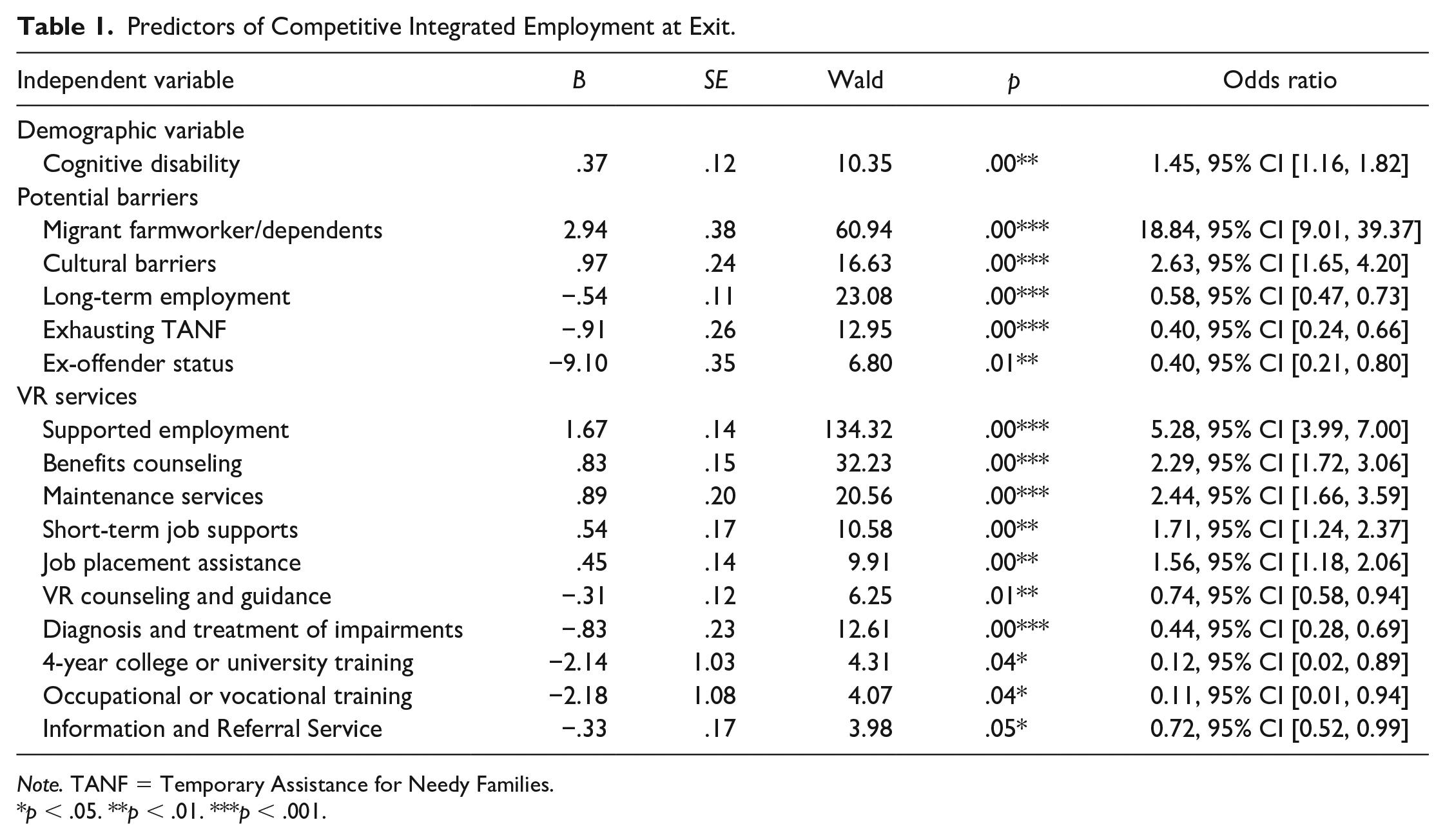
Multiple logistic regression analysis was conducted to examine the significance of demographic characteristics, potential barriers, and SVRA service associated with exiting the SVRA program in CIE status for the people who received CE services. The omnibus test of model coefficients showed that the independent variables were significantly related to CIE status at the exit of SVRA program, χ2(53, N = 2,280) = 636.023, p < .001. The model explained 34.4% of the variability of the outcome variable (Nagelkerke R2 = .34). The Hosmer and Lemeshow test indicated that the model fit was not poor, χ2(8, N = 2,280) = 11.89, p > .05 (Kleinbaum & Klien, 2010). The model classified 45.2% of clients who achieved CIE status at exit and 91.6% of clients who did not achieve CIE.
As can be seen in the multiple logistic regression model (see Table 1), among demographic variables, consumers who have a cognitive disability (odds ratio [OR] = 1.45; 95% confidence interval [CI] = [1.16, 1.82]) are more likely to achieve CIE status compared to those who have noncognitive disabilities. Among potential barriers, consumers with cultural barriers (OR = 2.63; 95% CI = [1.65, 4.20]), migrant farmworkers, and dependents (OR = 18.84; 95% CI = [9.01, 39.37]) are likely to achieve CIE status at exit. On the other side, long-term unemployment (OR = 0.58; 95% CI = [0.47, 0.73]), exhausting TANF (OR = 0.4; 95% CI = [0.24, 0.66]), and ex-offender status (OR = 0.40; 95% CI = [0.21, 0.80]) are variables associated with less likelihood to achieve CIE. In the SVRA service variables, consumers who received job placement assistance (OR = 1.56; 95% CI = [1.18, 2.06]), short-term job supports (OR = 1.71; 95% CI = [1.24, 2.37]), maintenance services (OR = 2.44; 95% CI = [1.66, 3.59]), benefits counseling (OR = 2.29; 95% CI = [1.72, 3.06]), and supported employment (OR = 5.28; 95% CI = [3.99, 7.00]) are more likely to get CIE at exit, but consumers who received vocational rehabilitation counseling and guidance (OR = 0.74; 95% CI = [0.58, 0.94]), diagnosis and treatment of impairments (OR = 0.44; 95% CI = [0.28, 0.69]), and 4-year college or university training (OR = 0.12; 95% CI = [0.02, 0.89]), information and referral services (OR = 0.72, 95% CI = [0.52, 0.99]), and occupational or vocational training (OR = 0.11; 95% CI = [0.01, 0.94]) are less likely to get CIE at exit.
Predictors of Competitive Integrated Employment at Exit.
Note. TANF = Temporary Assistance for Needy Families.
p < .05. **p < .01. ***p < .001.
Predictors of Weekly Earnings at Exit
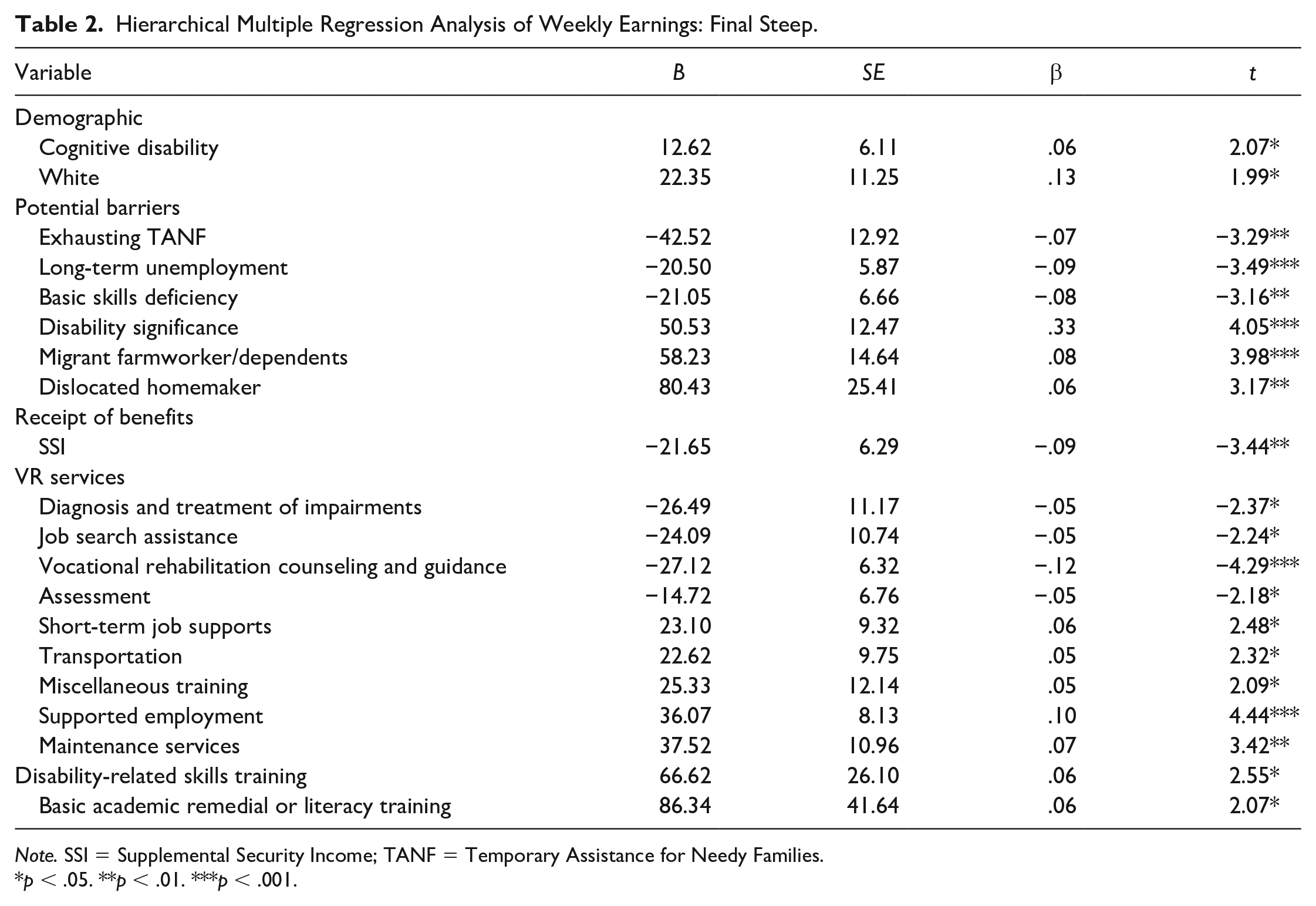
Finally, hierarchical multiple regression (HMR) analysis was conducted to identify predictors of weekly earnings at exit by entering four sets of variables in the following order: (a) demographic characteristics, (b) potential barriers, (c) receipts of TANF, SSI, and SSDI benefits, and (d) SVRA service variables. In the final model (see Table 2), the results indicated that the variables explained 24% of the variance in weekly earning of the sample: R = .49, R2 = .24, F(53, 2,280) = 13.27, p < .001. Examination of partial regression coefficients indicated that there are multiple variables significantly associated with weekly earning in each set of variables.
Hierarchical Multiple Regression Analysis of Weekly Earnings: Final Steep.
Note. SSI = Supplemental Security Income; TANF = Temporary Assistance for Needy Families.
p < .05. **p < .01. ***p < .001.
After all the variables were entered, cognitive disability (β = .06, p < .05) and race/ethnicity were the demographic characteristics that had significant effects on weekly earning. Specifically, White (β = .13, p < .05) is the variable positively associated with the outcome variable. Among potential barriers, exhausting TANF (β = -.07, p < .01), long-term unemployment (β = −.09, p < .001), and basic skills deficiency (β = −.08, p < .01) were significant predictors of a lower level of weekly earning. On the contrary, disability significance (β = .33, p < .001), being a migrant farmworker and dependents (β = .08, p < .001), and being a dislocated homemaker (β = .06, p < .01) were significant predictors of higher weekly earning. The SSI receipt (β = −.09, p < .01) was the only significant variable predicting a lower level of weekly earnings among the service receipt variables. Finally, multiple SVRA service variables were found to be significant predictors associated with the outcome variable positively and negatively: diagnosis and treatment of impairments (β = −.05, p < .05), job search assistance (β = −.05, p < .05), vocational rehabilitation counseling and guidance (β = −.12, p < .001), assessment (β = −.05, p < .05) were negatively associated with the outcome variable. Short-term job supports (β = .06, p < .05), transportation (β = .05, p < .05), miscellaneous training (β = .05, p < .05), supported employment (β = .10, p < .001), maintenance services (β = .07, p < .01), disability-related skills training (β = .06, p < .05), and basic academic remedial or literacy training services (β = .06, p < .05) were positively associated with weekly earnings at the time of exit.
Discussion
Even though research related to the development and efficacy of CE predates WIOA, CE remains an emerging practice within SVRAs. This analysis provides insight into variables such as demographic characteristics of SVRA clients, barriers to SVRA services, and SVRA services as predictors of CIE as an outcome. The findings in this study suggest a particular profile of individuals who are most likely to receive CE services. To a great extent, individuals were White, were of low income, had long-term unemployment, and had basic skill deficiencies. As these variables are not consistent with the federal guidelines for the receipt of CE service—considering the history of VR service utilization, functional impairment, and severity and nature of disability altogether—further inquiry is needed to understand the selection criteria being implemented to identify candidates for CE. In addition, individuals with a cognitive disability were the most frequent recipients of CE. They were more likely to exit with employment and were associated with earning higher wages compared to those with other types of disability. This finding is consistent with previous research outcomes presenting supported employment as an effective employment service for people with cognitive disabilities. Given CE is an extension of supported employment, such research findings can also be interpreted as CE services being efficient for employment outcomes for people with cognitive disabilities. Nevertheless, the specific elements of CE still need to be developed to support persons with other types of disabilities to further promote the utilization of CE services. For instance, people with psychiatric disabilities such as posttraumatic stress disorder (PTSD) can benefit more from an alteration of the work environment to help minimize any potential triggers. This adjustment can effectively be achieved through the discovery activities and job development process of CE characterized by assertive collaboration with employers as well as consumers. Regarding outcomes, the study identified several facilitating factors and barriers to exiting CIE. Rehabilitation counselors should pay attention to this profile resulting from the current study when considering supports that may be needed by individuals to be successful in their vocational goals when referring for CE. However, RSA-911 data are limited in providing other contextual data regarding variables that may limit CE utilization and outcomes, such as state policies, funding, community rehabilitation agencies’ capacity to deliver the services, and the level of fidelity of implementation of CE.
Based on the RSA-911 data from FY 2017 to FY 2020, CE has yet to be fully realized as an intervention for increasing the CIE outcomes of individuals with significant disabilities. During this time period, the 2,280 clients with disabilities exiting SVRA services after receiving CE under an Individual Plan for Employment (IPE) represent a paucity of all persons served. Even more concerning is that less than half of this number (n = 692; 30.4%) exited after an IPE in CIE. The reasons for the low utilization of CE services and the limited employment outcomes of SVRA clients who receive CE services are not known. For example, the COVID-19 pandemic may have impacted these outcomes by suppressing both the number of individuals receiving or exiting services from services in CIE after receiving CE. Alternatively, the capacity of SVRAs regarding the development of the implementation of CE consistent with federal guidance, conceptual overlap with supported employment, or even community-based providers’ preparedness to provide CE services consistent with SVRA policies or contracts may have affected the utilization of CE over the last several years. However, a recent national needs assessment of SVRAs and their affiliates indicated that CE was a relatively lower priority in regard to technical assistance and training relative to greater needs of SVRAs in areas such as customized training, business outreach, and even the highly associated service area of supported employment (Tansey et al., in press). CE may be viewed as less of priority among the range of challenges and opportunities that SVRAs have in relation to increasing participation of persons with disabilities in their services (Lee et al., in press; Tansey et al., in press), particularly looking at transition-age youth with disabilities (Friedman et al., in press); increasing the quality of employment outcomes through services such as customized training, work-based learning, and apprenticeships (Tansey et al., in press); and ultimately, engaging and supporting businesses as part of a larger dual-customer approach in the recruitment (Iwanaga et al., 2018), hiring (Grenawalt et al., in press), and retention of people with disabilities in the workforce (Chen et al., in press; Wu et al., in press). Even the task of working to address system issues impacting SVRA outcomes, such as transportation (Bezyak et al., in press), may represent the greater existential threat to CIE and be identified as a higher priority than the development of CE services.
To understand CE as a priority within SVRAs, additional research is needed to determine which agencies are achieving the best outcomes (e.g., numbers exiting in CIE, wages, hours) after receiving CE services under an IPE. Once these states are identified, research is needed to include an analysis of the states’ policies and how these policies affect the impact of access to CE, including how funding may facilitate or limit the delivery of services. Another concern is the capacity of agencies to provide CE that adheres to the fidelity of implementation (Riesen et al., in press). Inge and her colleagues (2020) found that there is a significant gap between what rehabilitation professionals identify as critical CE activities and how well they report the activities are being implemented. These gaps raise questions about the capacity of service providers to implement elements of CE with a high degree of fidelity. Research is needed to determine if states with higher CIE outcomes have training and mentoring guidelines for employment specialists who provide CE services.
Competency-based training has been an area of focus for the Association of Community Rehabilitation Educators (ACRE) since 2005. The ACRE is a national membership organization that reviews and approves curriculum. Members who have their curriculum approved by ACRE may issue a Basic Certificate in Employment Services (BCES) to participants who complete the training requirements. In 2018, ACRE began approving training curriculum for CE. Nationally, only 2,794 employment specialists have received a basic certificate of completion with an emphasis on CE (Association of Community Rehabilitation Counselors, n.d.). This number represents all employment specialists in the United States who have completed the approved curriculum, pointing to a need to expand access to training and mentoring for employment specialists nationally. Research also is needed to confirm both the essential practices and procedures for CE by using the developed CE fidelity scales. In other words, the scales can be utilized to identify which practices impact the CIE outcomes of individuals with disabilities and whether agencies with higher fidelity to practice have better CIE outcomes. These fidelity scales can be used as an objective measure of performance to assist SVRAs in determining which community rehabilitation agencies provide CE that aligns with best practices and to determine the efficacy of outcomes.
There are several limitations to this study that should be noted. The limitation of the ex-post-facto design used is that causal inference cannot be made between the independent and dependent variables. Furthermore, the RSA dataset is usually generated by rehabilitation professionals in SVRAs. Although the manual and training for data entry are available, there could have been incongruency in the way each staff coded and entered the information, which may have affected the ensuing data collection and analysis. The fidelity issues of CE should be considered as well. Although there are discrepancies across SVRAs in operationalizing and implementing CE, the fidelity of CE is not measured in the RSA dataset. The lack of fidelity information might lead to limited validity of the research results as predictors of CE outcomes. Regarding the category of race/ethnicity, 77% of participants identified themselves as White. The rest of the racial/ethnic groups thus were only 23% of the sample. Such a large difference in race/ethnicity makes it difficult to generalize the research outcomes to racial/ethnic minority groups. The primary disability variable consisted of more than 20 types of disability. The current research included only cognitive disability—which constituted 47% of the sample—as a predictor to improve the conciseness of the research models. For future research, the association of other disability types with CE utilization needs to be explored. Finally, most of the variables included were dichotomized for the analysis. This caused a loss of information that had been expressed in multiple categorical and continuous variables.
Conclusion
Despite CE being a recognized practice for two decades, and its inclusion as a fundamental service in WIOA, vocational rehabilitation providers have been slow to broadly implement this intervention to promote competitive integrated work among those individuals with the most severe disabilities. By increasing the capacity among SVRAs to conceptualize, develop, implement, and evaluate CE, this service may increase the efficacy of vocational rehabilitation counselors to support persons with the most severe disabilities in their participation in one of the fundamental components of society and adult identity: work (Strauser et al., 2021).
Footnotes
Declaration of Conflicting Interests
The author(s) declared no potential conflicts of interest with respect to the research, authorship, and/or publication of this article.
Funding
The contents of this paper were developed under a grant (H264K200003) from the Vocational Rehabilitation Technical Assistance Center for Quality Employment, U.S. Department of Education, and support from the National Institute on Disability, Independent Living, and Rehabilitation Research (Grant 90RTEM0001). However, those contents do not necessarily represent the policy of the U.S. Department of Education or U.S. Department of Health and Human Services, and you should not assume endorsement by the Federal government.
