



Abstract
Oral presentations are widely adopted by language teachers in EFL classrooms to test language learners’ speaking capability. This study aims to explore how five psychological factors, including motivation (ideal L2 self and ought-to L2 self), L2 grit, anxiety, plus two strategies (pronunciation-oriented strategies and social-affective strategies), predict EFL learners’ oral presentation performance. The participants were 316 second-year Chinese students attending a university-level EFL listening and speaking course. They delivered a two-minute Pecha Kucha presentation in public, and data were collected via a test battery of the seven predictive factors, which was validated by the researcher. Results revealed that L2 grit predicts oral presentation performance with a moderate effect. Ought-to L2 self, ideal L2 self, self-efficacy and anxiety predict oral presentation performance with a weak effect, with anxiety having a negative impact, and the two strategies predict oral presentation performance with a very weak effect. The qualitative data supported the quantitative data by adding student-centred perceptions of these relationships. These results highlight the importance of nurturing positive psychological elements such as grit for students’ oral task performance.
Keywords
Introduction
Oral presentations are widely adopted by language teachers in EFL classrooms and have therefore attracted considerable research interest (Mak, 2019). The ability to give an effective oral presentation in English fluently and accurately is a highly desired goal for many EFL learners (Soureshjani and Ghanbari, 2012). For decades, scholars have investigated what factors may contribute to an effective EFL oral presentation. After reviewing literature, seven factors were found to be associated with EFL oral presentation performance, which include ideal L2 self and ought-to L2 self (Amoah and Yeboah, 2021; Wu, 2024), L2 grit (e.g. Jun and Lee, 2021), anxiety (e.g. Soomro et al., 2019; Amini, 2019), self-efficacy (e.g. Amirian and Tavakoli, 2016; Zhang et al., 2020), and pronunciation-oriented strategies and social-affective strategies (Duklim and Musigrungsi, 2018).
Although the above-mentioned studies have indicated a relationship between each of the seven factors and EFL oral presentation performance, it remains unclear how they are jointly related to language performance. Moreover, mainstream theories guiding the above-mentioned studies have been primarily about general English learning, rather than specific real-classroom performance tasks. To tentatively address the issues mentioned above, this empirical study developed and validated our questionnaire as a test battery of these measures and employed structural equation modelling (SEM) to examine how the seven factors affect EFL oral presentation performance. A secondary contribution of the study was to explore learner factors associated with the specific pedagogical task of Pecha Kucha. While this is a widely used task by English language practitioners for teaching timed presentation skills, we lack research on students’ psychological and strategic engagement with the task.
Literature Review
The variables discussed in this literature review, including motivation (L2 motivational self system), L2 grit, anxiety, self-efficacy, and communication strategies, are each grounded in established theoretical frameworks. However, this study does not aim to consolidate all these variables into a single overarching theoretical model. Instead, the variables were selected based on their highlighted importance in previous literature on speaking performance, as well as based on the professional knowledge of the first researcher (who was also the students’ teacher) as to what variables he saw as relevant to his students when engaging in Pecha Kucha oral presentations. This approach emphasizes the importance of investigating how different individual differences factors dynamically interact within each learner. Rather than viewing these variables as isolated entities, this consolidated investigation of multiple variables supports the exploration of their interdependencies and synergies, reflecting the inherent complexity of language learning and performance tasks such as oral presentations.
L2 Motivation
Motivation is considered an essential variable in developmental and educational psychology and an essential factor for successful second language learning outcomes. L2 motivational self system (L2MSS) comprises three main components: ideal L2 self, ought-to L2 self, and L2 learning experience (Dörnyei, 2005). In L2 oral presentations, ideal L2 self refers to one's vision of becoming a proficient speaker, which includes personal goals such as achieving fluency, gaining a sense of accomplishment, and receiving positive feedback from peers and instructors. Ought-to L2 self is influenced by external pressures, such as fulfilling academic requirements, meeting societal or institutional expectations, or avoiding negative outcomes such as failure or criticism. Successfully completing an oral presentation helps students meet these external expectations. In this sense, the presentation itself is not the goal, but a means of achieving both personal and external motivational goals.
Recent research has suggested that ideal L2 self is a significant motivating factor related to L2 learning achievements (Khuong, 2022). For example, Tort Calvo (2015) found a strong positive correlation between ideal L2 self and L2 learning achievements (r = 0.737, p < 0.05). Similarly, Kim and Kim (2014), using structural equation modelling, found that ideal L2 self had a total effect on language proficiency among 2239 Korean EFL students ranging from grades 3 to 12 (γ = 0.29, p < 0.01). However, it is important to note that L2MSS has faced increasing scrutiny. Al-Hoorie and Hiver (2024) argue that L2MSS is experiencing a validation crisis, with concerns about its empirical consistency and theoretical robustness. These critiques suggest that while ideal L2 self has been widely supported in motivation studies, its significance may not be as universally applicable in every educational setting.
Compared with ideal L2 self, ought-to L2 self was considered to be a factor that yielded limited or even negative effects on L2 learning achievements (Khuong, 2022). To illustrate, Kim and Kim (2020) revealed that ideal L2 self was significantly correlated with L2 learning achievements (r = 0.28, p < 0.01), while no significant correlation was found between ought-to L2 self and L2 learning achievements (r = 0.10, p > 0.05). Contrary to Kim and Kim (2020), Zhao et al. (2022) found that ideal L2 self did not have an effect on English proficiency (r = 0.096, p = 0.217), while ought-to L2 self had a negative effect on English proficiency (r = −0.145, p = 0.045). Regarding the latter result, the researchers attributed it to English major students’ level of fierce competition in China, high expectations from parents, and excessive stress given by teachers.
L2 Grit
First introduced by Duckworth et al. (2007: 1087–1088), grit refers to perseverance, tenacity and enthusiasm for long-term and higher-level achievements and the efforts one would make to overcome failure, difficulties and setbacks in the process. While the original definition emphasizes long-term and higher-order achievements, grit can also be relevant in shorter-term tasks when these tasks contribute to a larger long-term goal. In the context of L2 oral presentations, grit can be operationalized as learners’ consistent efforts to prepare and perform successfully in public speaking, despite the difficulties they may encounter along the way. Teimouri et al. (2020) developed and validated a language-domain-specific measure of grit in L2 learning (the L2 grit scale), measuring perseverance of effort and consistency of interest. They found that L2 grit was correlated with self-reported English proficiency (r = 0.31, p < 0.001) among 191 university-level L1-Persian students majoring in English translation. When exploring the two components of grit, they further discovered that only perseverance had a significant predictive effect on proficiency. This finding is also in line with explorations of the predictive effect of grit on other learning outcomes, such as in Takezawa's (2022) study, which found perseverance to be the only dimension of grit to have a predictive effect on students’ scores in a finance course taught through the medium of English in Japan. In terms of this definition, L2 grit in L2 oral presentations can be operationalized as learners’ consistent efforts to prepare for a successful public delivery despite the difficulties they may encounter.
Anxiety
Anxiety is defined as a feeling of uneasy suspense (Rachman, 2002) that is accompanied by worry and negative conceptions. As a branch of anxiety, oral presentation anxiety, or public speaking anxiety, describes individuals’ feelings of humiliation, embarrassment, shame and negative estimation of speech delivery in public (Blöte et al., 2009). Some researchers consider anxiety to be negatively correlated with L2 speaking performance. For instance, Ritonga et al. (2020) in a mixed-methods study (observation, interview, questionnaire) concluded that language anxiety in speaking presentations might hinder learners’ idea delivery and clarification, which negatively impacts their speaking performance. Likewise, Hasibuan and Irzawati (2020) found that learners’ speaking anxiety and speaking performance were significantly correlated (r = −0.358, p < 0.001). Recent studies, such as Sparks and Alamer (2024), suggest that while anxiety can be a weak predictor of proficiency, it may also have positive effects when present in moderate levels, such as enhancing focus and preparation. This highlights the importance of critically examining anxiety not only as a hindrance but also as a potential facilitator of performance.
Self-efficacy
Self-efficacy is a personal judgment of the extent to which one can confront a task or an event based on their abilities and the circumstances they are in. As a subjective cognitive factor and prominent element of social cognitive theory, self-efficacy impacts people's thinking, feelings and actions. By this definition, L2 oral presentation self-efficacy measures learners’ personal judgment of the extent to which they can complete the presentation task, such as faith in successful delivery, confidence in clear pronunciation, self-assurance in convincing the audience via verbal and non-verbal information, and the ability to confront the difficulties and challenging circumstances during speech delivery.
Research into students’ self-efficacy in EFL speaking classrooms has found self-efficacy is significantly correlated or can even predict L2 speaking performance. Leeming (2017) developed a questionnaire measuring 77 first-year college students’ English speaking self-efficacy and administered it on eight occasions in a course over an academic year. Results showed that their self-efficacy grew, especially when they became accustomed to the class and learning context. Atayeva et al. (2019) indicated that group presentations can improve students’ English speaking self-efficacy and even their English language speaking fluency. However, in a recent study, Zhang et al. (2020) came to the opposite conclusion. Results of the quantitative data showed that English public speaking self-efficacy was not a significant predictor of English public speaking performance. The authors attribute this contradiction to individual differences exacerbated by the small sample size and encouraged further research with a larger sample.
Communication Strategies
Oral communication strategies refer to learners’ strategic behaviours and decisions in interactional tasks and how they cope with difficulties in the process. A study by Nakatani (2006) introduced the Oral Communication Strategy Inventory (OCSI) as a theoretical framework to measure learners’ speaking strategy use. Specifically, social-affective strategies measure how learners control their anxiety, how much they are willing to encourage themselves to take the challenge of delivering an oral presentation, and how much they enjoy the process of an oral presentation event. Pronunciation-oriented strategies measure the extent to which learners pay attention to the rhythm, intonation, pronunciation and clarity of their speech.
Pecha Kucha Presentations
There have been calls to ensure that applied linguistics research focuses on tasks and issues that are relevant to teachers and everyday classroom tasks (McKinley, 2019). For this reason, the current study was built around a teaching-informed classroom task that is increasingly used in the instruction of oral presentation skills: Pecha Kucha, also referred to as Pecha-Kucha or PechaKucha. Pecha Kucha presentations consist of 20 slides, which are fixed to move on automatically every 20 s (20 slides x 20 s = 6 min 40 s). Empirical research, such as Fahmi and Widia (2021), has shown that Pecha Kucha presentations improved EFL learners’ public speaking performance and attitudes compared with traditional methods. Pecha Kucha presentations have both pedagogical value (they allow the researcher to cultivate students’ ability to deliver well-prepared academic content in given time with acceptable fluency, coherence and accuracy) and methodological value (due to an ability to control for aspects of the presentation length and complexity in a structured format). Within the context of this real-classroom task, seven psychological variables and two strategic variables were explored.
Methodology
This study was designed to explore and validate the multidimensional factors hypothesized to affect Chinese EFL students’ oral presentation performance in English as L2. It adopted a mixed-methods approach to achieve triangulation of evidence. Based on the literature reviewed, the following research question drove this study: Which factor(s) predict EFL oral presentation performance?
Participants
The participants were 316 second-year students who attended an EFL listening and speaking course at a university in Eastern China. They all spoke Chinese as their L1 and were over 18 years old when they participated in the study. Among them, 63.3% were male (n = 200), and the average age was 19.70 (SD = 1.08); 36.7% were female (n = 116), and the average age was 19.82 (SD = 1.19). They had learned English for at least six years before entering university and one year at university level. Based on the first-year placement test, the participants’ average English proficiency level is B1.
Context and Procedure
The participants attended an English listening and speaking course in two batches. The first batch of 146 students attended the 2021 spring semester, and the second batch of 170 students attended the 2021 autumn semester. Figure 1 summarizes the study timeline.
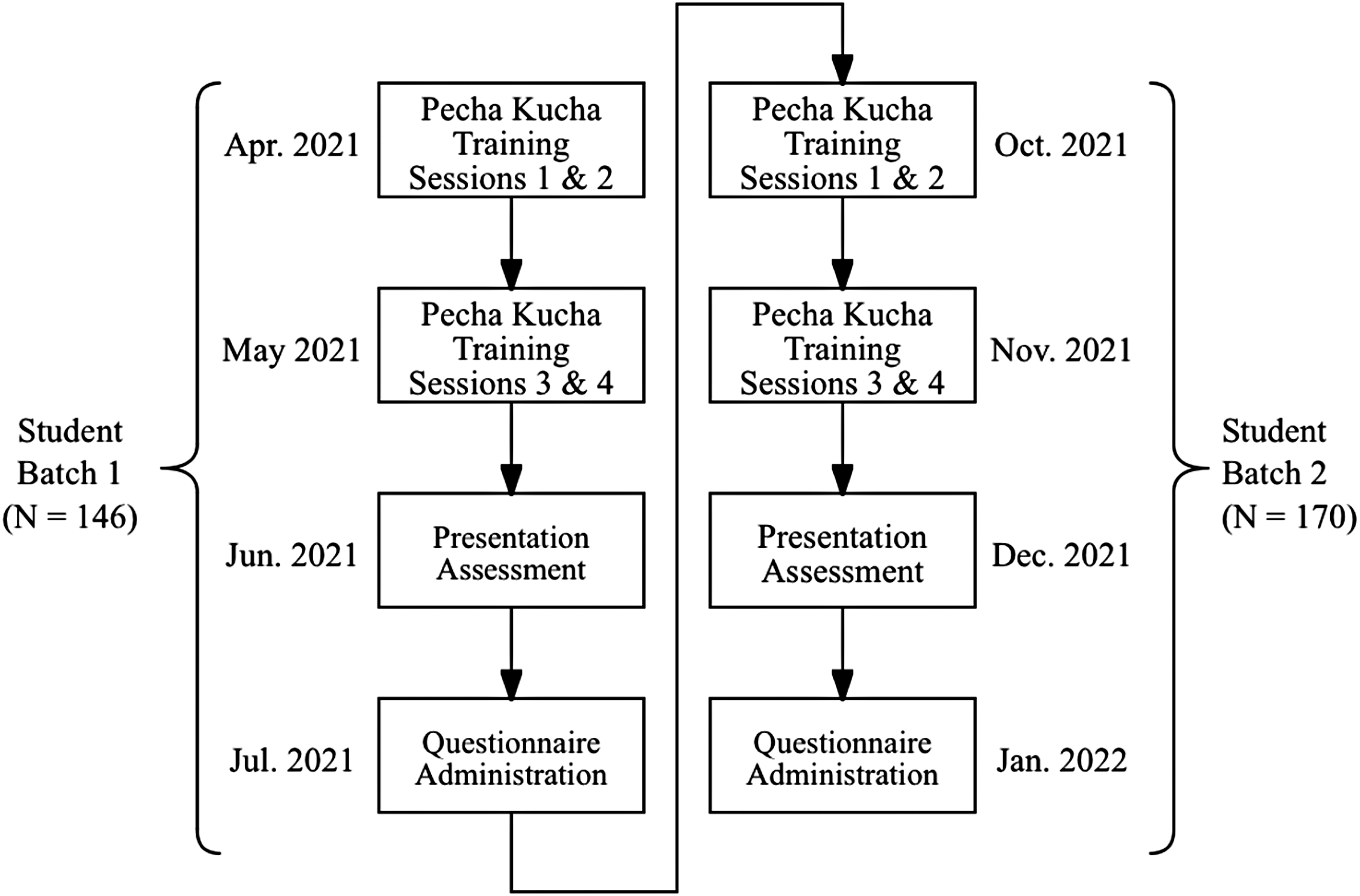
Research procedure.
Although the students were enrolled in different semesters, the teaching content remained equivalent. In each semester, there were four training sessions and an assessment session. In the first session, the students picked a topic related to their major. Then, the teacher introduced the requirements and the rating method of this oral presentation event. In the second and third sessions, the students learned how to compose a persuasive essay as the script for the oral presentation. Then, the students submitted the first draft. This step not only scaffolded the composition of their script but also ensured that their argument did not stray from the topic. In the fourth session, computer skills were introduced, and the student participants were given time to rehearse in class on their own or with their peers. The fifth session was the assessment session.
Quantitative Data Measures
Oral Presentation Assessment
Based on the lead researcher's previous use of Pecha Kucha in the research setting, 6 min 40 s was deemed to be too challenging for non-English major students. Therefore, an adapted version of Pecha Kucha was adopted in this study. It consisted of six slides, which were fixed to move on automatically every 20 s, so the length for each participant was 2 min (6 slides x 20 s). Speakers had to give a speech without a script. The outcomes of the presentation were evaluated via a 100-point analytic assessment rubric, including technical completion and delivery 25%, pronunciation 25%, fluency 25% and content 25%. The rubric can be retrieved from https://sites.google.com/view/saqop/. Analytic assessment scales were adopted because they were seen to have high construct validity and reliability and can provide more diagnostic information to teachers and students (Wu, 2021). They were also the assessment tools used in the presentation course, so were deemed to have high ecological (i.e. real-world) validity. Two raters were invited to rate the students’ oral presentation performance. Both raters hold a Master's degree in applied linguistics and English teaching and have at least five years’ EFL teaching experience at university level. They also have extensive experience in holding L2 oral presentation events in EFL courses and using analytic assessment scales to evaluate students’ performance.
The Questionnaire (Test Battery)
Seven constructs were included in a test battery and delivered in questionnaire format: ideal L2 self, ought-to L2 self, L2 grit, self-efficacy, anxiety, pronunciation-oriented strategies and social-affective strategies. The exploratory factor analysis (EFA) and full questionnaire can be retrieved from https://sites.google.com/view/saqop/ and will be made permanently available on the IRIS database after publication, alongside a full explanation of item exploration and reduction via exploratory factor analysis (EFA). The items were taken from existing questionnaires with good psychometric properties: ideal L2 self and ought-to L2 self from Taguchi et al. (2009); L2 grit from Teimouri et al. (2020); anxiety from McCroskey (2005); self-efficacy from Zhang et al. (2020); and pronunciation-oriented strategies and social-affective strategies from Nakatani (2006). The questionnaire was administered in Chinese to facilitate the participants’ understanding of the items. EFA and correlation analysis were conducted by SPSS 28.0, and confirmatory factor analysis (CFA) and SEM analysis were performed by SPSS Amos 28.0. Only CFA results are included in the results of this paper.
Qualitative Data Collection
Five open-ended questions were also included in the questionnaire, which aimed to elaborate on information that could not be observed from the quantitative data. The open-ended questions were closely linked to the study's research question. The five questions were:
What difficulties have you met in the Pecha Kucha preparation and delivery phases? How did you overcome those difficulties you have just mentioned? What aspect do you like most in the Pecha Kucha presentation? What aspect do you dislike most in the Pecha Kucha presentation? Are you satisfied with your performance? If so, why? If not, how do you think you can improve?
The coding procedures, conducted by NVivo version 1.6, adopted iterative, open, axial and selective strategies, including structuring (creating main categories), generating (creating the subcategories for each main category), segmentation (dividing the qualitative data into smaller units in a way that each unit matches its (sub)category) and main analysis (Selvi, 2020: 446–447).
Results
Quantitative Results
Confirmatory Factor Analysis and Correlation Analysis
CFA was conducted to validate the proposed model. As shown in Table 1, the composite reliability (CR) and Cronbach's alpha values for each construct were calculated to check the construct reliability. The value of each construct was above 0.80, indicating that all the scales had acceptable reliability. The average variance extracted (AVE) values of all constructs were above 0.50, indicating that the convergent validity was acceptable. Table 2 demonstrates the correlation coefficients (all p < 0.05) between the seven variables. The square roots for AVE are placed on the diagonal in parentheses of Table 2. They are above the correlation coefficients of each construct, indicating that the discriminant validity was acceptable at the construct level, and all constructs could be considered distinct constructs. As such, CFA confirmed that the reliability and validity of the questionnaire were acceptable.
The validity and reliability values of the measurement model.
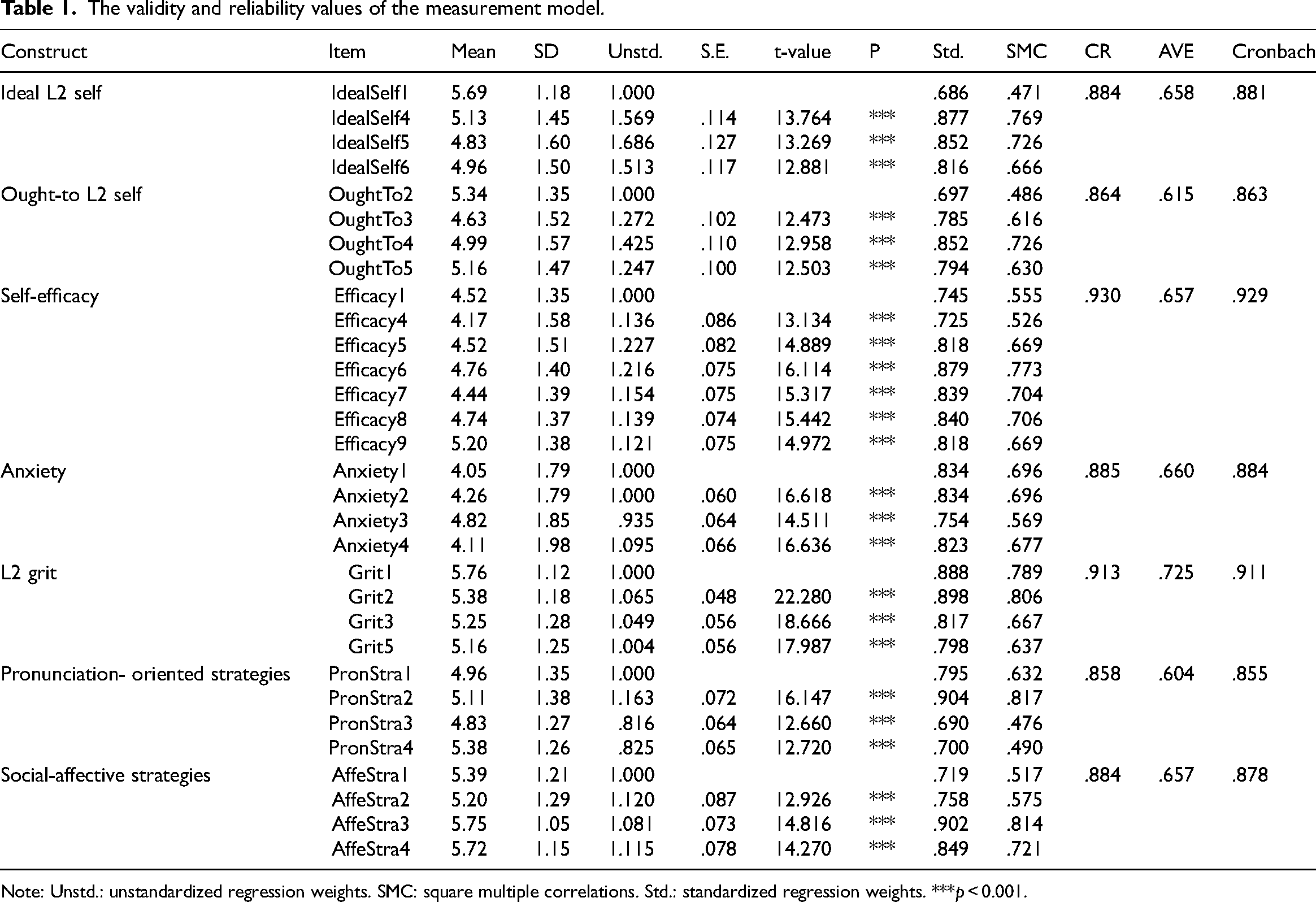
Note: Unstd.: unstandardized regression weights. SMC: square multiple correlations. Std.: standardized regression weights. ***p < 0.001.
Correlation matrix of the seven variables.
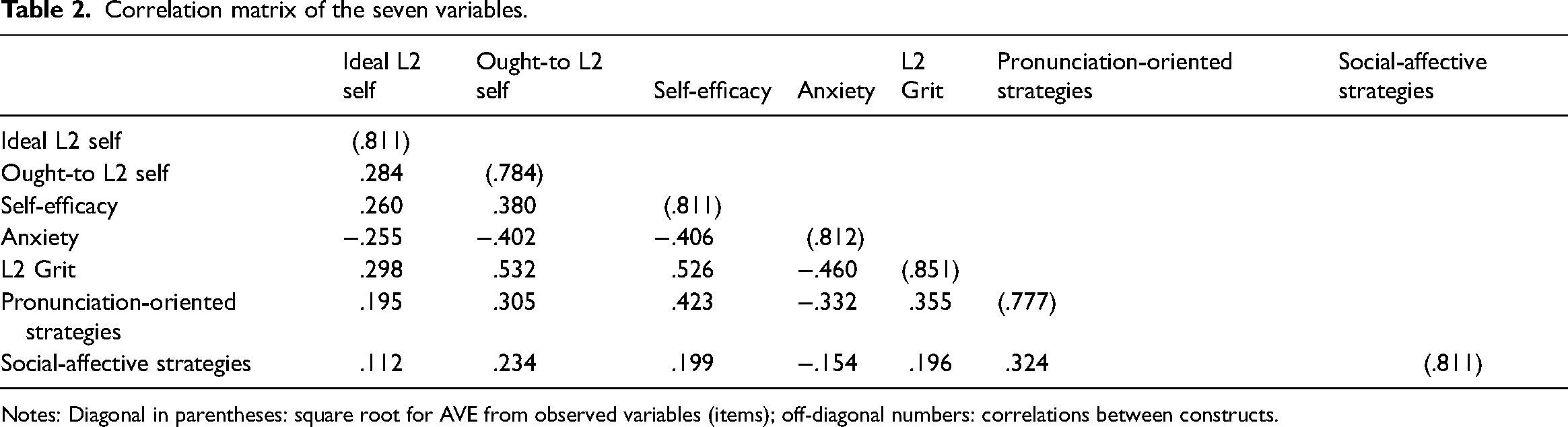
Notes: Diagonal in parentheses: square root for AVE from observed variables (items); off-diagonal numbers: correlations between constructs.
The Structural Equation Model: What Factors Predicted Oral Presentation Performance?
According to the recommended values (Whittaker and Schumacker, 2022), the SEM analysis of the hypothesized model obtained a satisfactory model fit, as is shown in Table 3. The final model explained 80% of the variation in how the seven factors influenced the participants’ oral presentation performance. Figure 2 illustrates the finalized structural model.
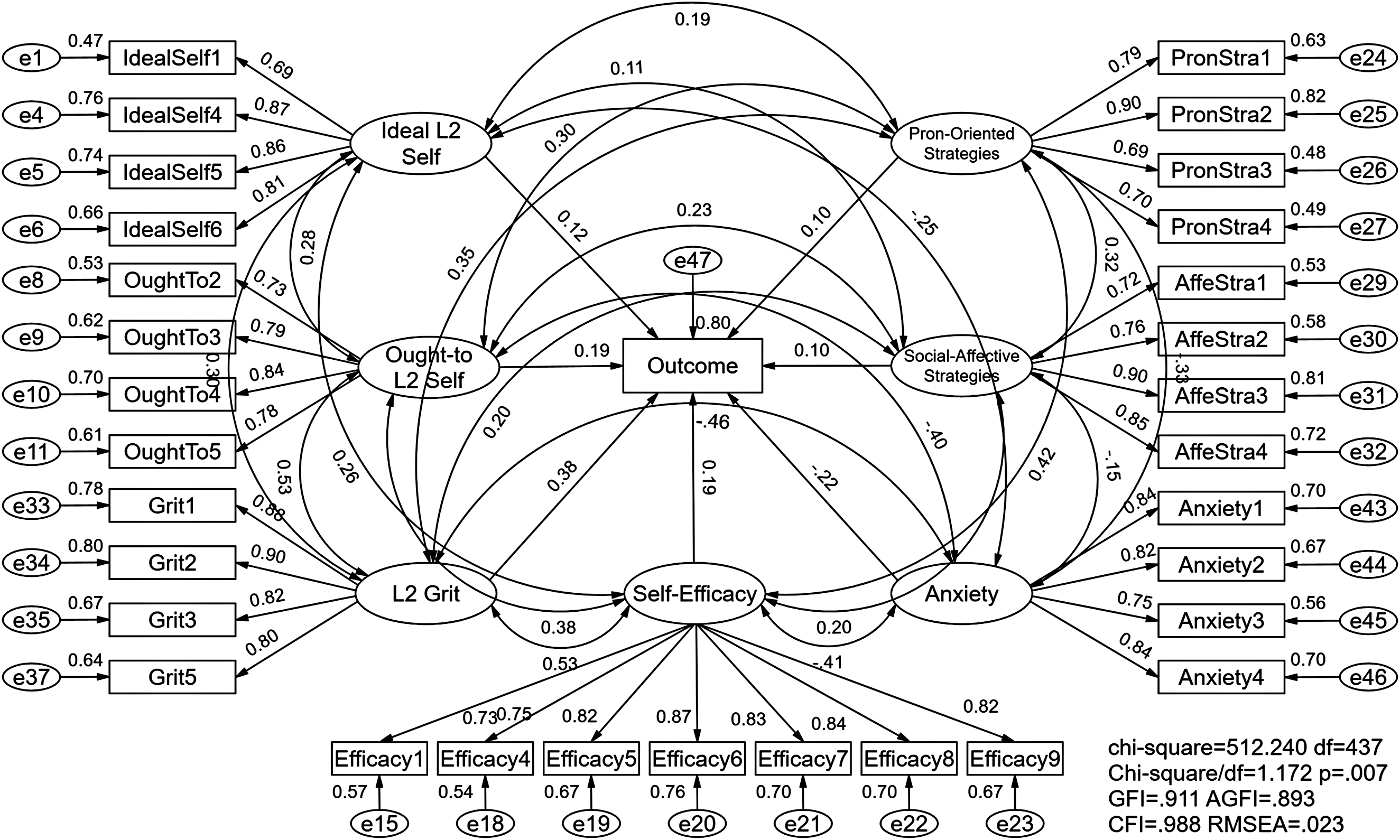
The structural model of the relationship between the seven factors and the oral presentation performance.
Model fit measures for the final model.

The findings depicted in Figure 2 reveal that the seven factors jointly determined the participants’ oral presentation outcomes. The findings suggest that the influence of L2 grit on the outcomes was moderate, and constituted the largest predictor of performance in the Pecha Kucha task. This indicates that the level of grit of students was seen to be directly related to higher scores on the oral presentation task, even when accounting for all other variables in the model. In comparison, the influence of ought-to L2 self, self-efficacy and anxiety on the outcomes was weak. In the case of anxiety, the association was negative (i.e. higher levels of anxiety were associated with lower scores on the oral presentation task). The influence of ideal L2 self, pronunciation-oriented strategies and social-affective strategies on the outcomes of the presentation task were very weak.
Qualitative Results from the Questionnaire Open-ended Responses
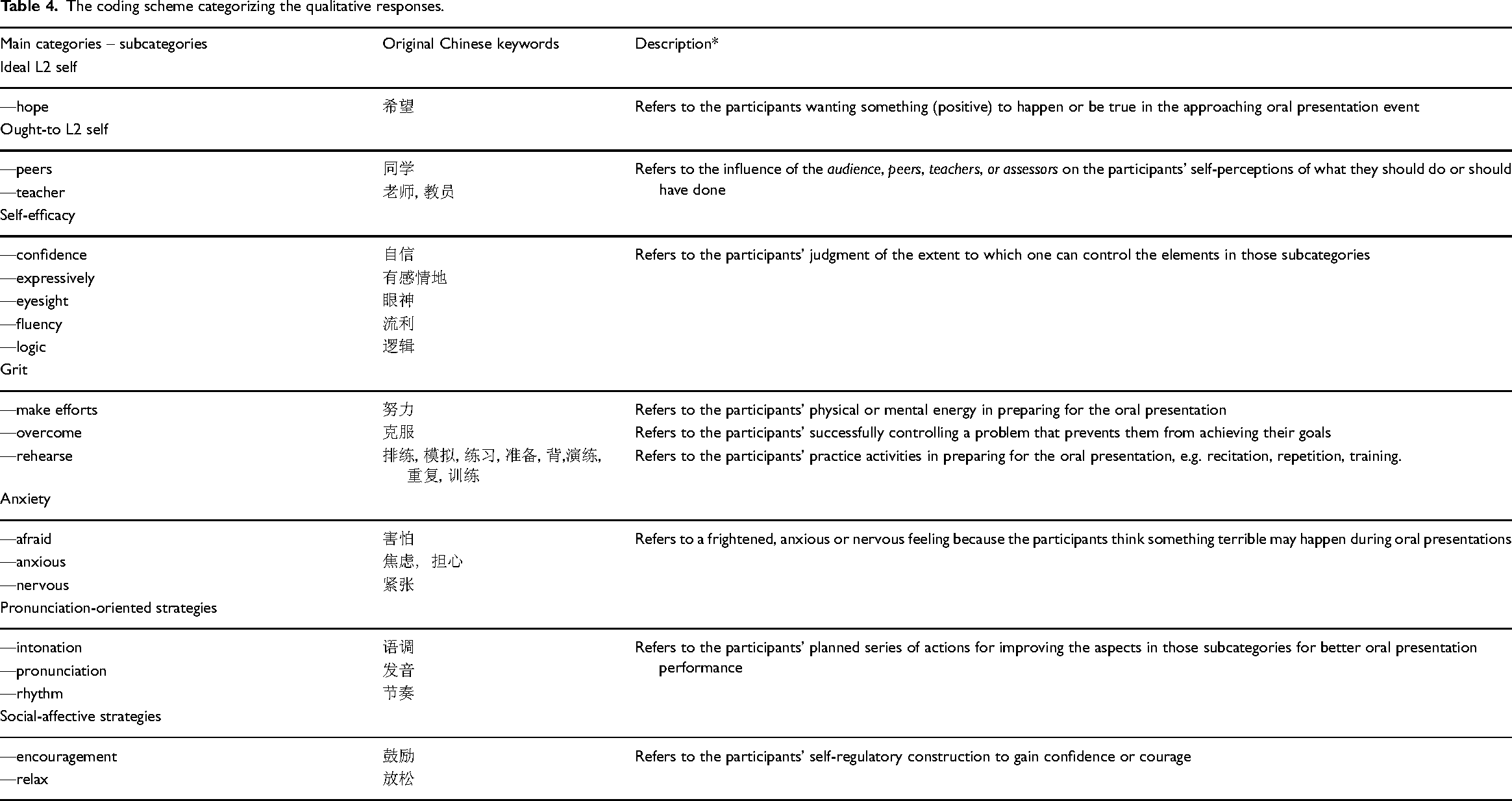
Qualitative data helped elucidate additional and in-depth insight into the factors contributing to satisfactory or unsatisfactory oral presentations. After multiple rounds of reviewing, screening and revising, 19 valid inductively derived subcategories, which semantically sat within the seven deductively informed main categories, were devised. This coding scheme is presented in Table 4.
The coding scheme categorizing the qualitative responses.
Excerpts were tagged as to whether the student was in the top third of the class, the middle third, or the bottom third to explore patterns related to task performance. This analysis revealed that the high performing group discussed ideal L2 self, ought-to L2 self, L2 grit, self-efficacy, anxiety, social-affective strategies usage, and pronunciation-oriented strategies usage, in qualitatively different ways than the other two participant groups. Some examples of the most predictive factors are shown in Table 5, alongside the participant number and overall presentation score.
Illustrative excerpts from the qualitative data, presented according to code and task performance.
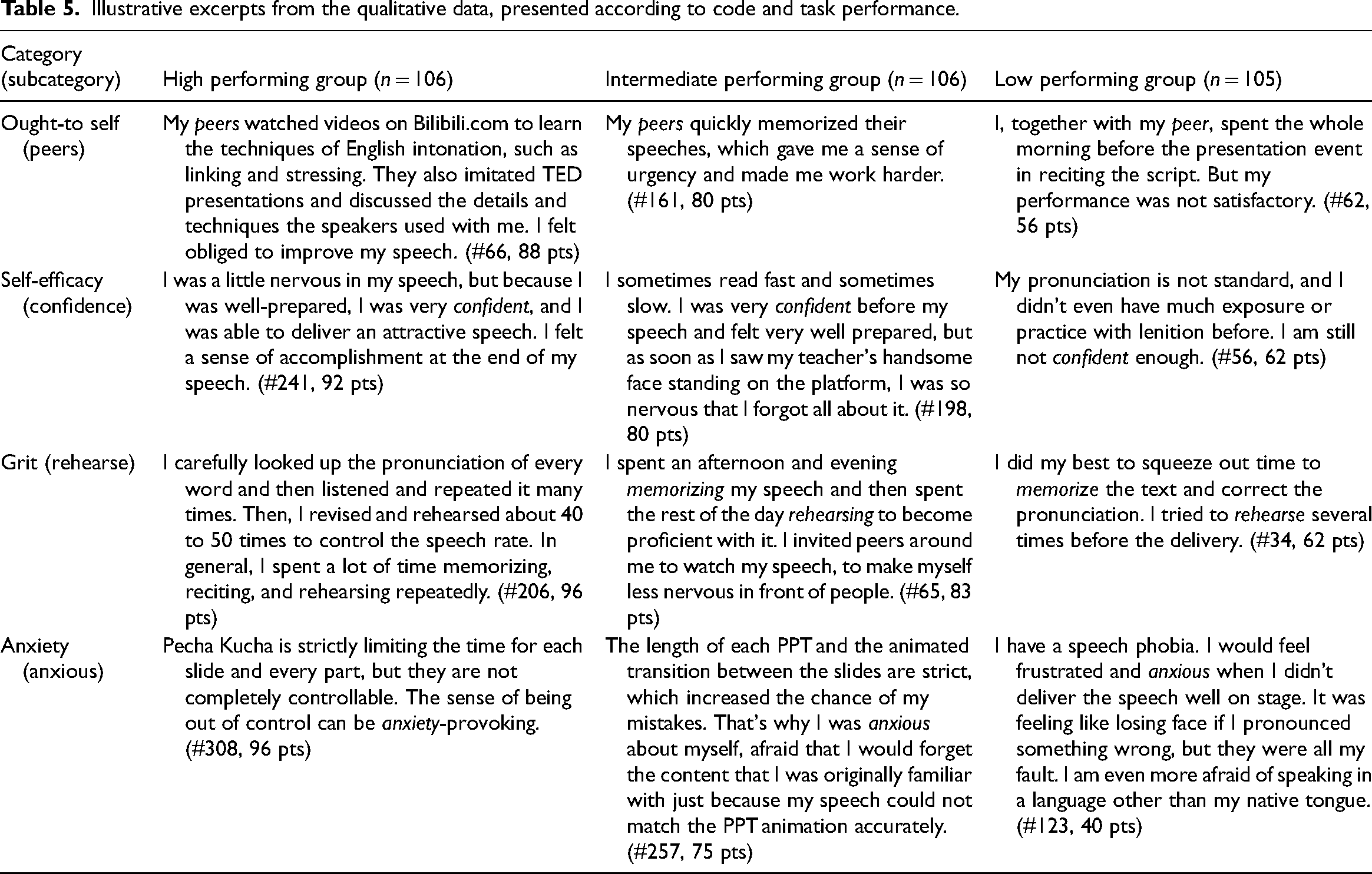
From these examples, the high performing participants chose good exemplars to chase after, were more self-efficacious, described anxiety in a more containable manner, and invested much more time in the rehearsal. In contrast, the low performing participants did not choose competent peers as exemplars, expressed a lack of confidence in pronunciation, were afraid of speaking in English, and rehearsed only ‘several’ times. These results help to qualitatively unpack the differences underpinning performance in the oral presentation task.
Discussion, Implications and Conclusion
Discussion of Findings
Motivation and Performance
The mixed picture of the impact of motivation on oral performance requires a degree of unpacking, as it contradicts some assumptions that motivation is a strong predictor of language learning. The results revealed that ideal L2 self had only a very weak effect on scores in the oral presentation task. While the significance of these findings is still consistent with previous literature, such as Kim and Kim (2014), Khuong (2022) and Tort Calvo (2015), which reported that ideal L2 self is correlated with L2 learning achievements, our study did not highlight it as the primary factor in a multidimensional model.
Our study also suggests that ought-to L2 self serves as a significant predictor of oral presentation performance, albeit with a weak effect. The qualitative data also support this finding, highlighting that the high performing students were strongly motivated by identifying more capable peers, but the low performing students did not identify anyone who could drive their ought-to L2 selves. This outcome is contrary to most research that reports little effect of ought-to L2 self and learners’ English learning achievements (e.g. Kim and Kim, 2020; Moskovsky et al., 2016), or in some contexts a negative effect (e.g. Khuong, 2022). This may be explained by the specificity of the dependent variable in this study (EFL oral presentation performance as a particular aspect of English learning). The second possible reason may be relevant to the curriculum, where students are told that oral presentation skills are vitally important to their futures, and their future supervisors and colleagues will expect them to excel at delivering public speeches. This might explain the stronger relationship between ought-to L2 self and actual performance.
As a pedagogical implication of these findings, teachers could guide students to develop their L2 selves so as to achieve better performance. Teachers can help the less satisfactory students build achievable ideal L2 selves by showing them what good oral presentations are like. Regarding ought-to L2 self, we recommend that teachers communicate the importance of oral presentation skills and help students to identify suitable peers to use as benchmarks to drive their own learning.
L2 Grit and Performance
L2 grit emerged in this study as the most powerful predictor of oral presentation performance with a moderate effect size. Previous literature, such as Teimouri et al. (2020) and Jun and Lee (2021), also reported the significant correlation between L2 grit and L2 learning achievement in a way that higher achievers are grittier than lower achievers. This study consolidates their argument and contributes to a growing picture that L2 grit influences oral presentation performance across diverse researched contexts. Furthermore, the qualitative data support the above-mentioned findings. The high performing students and intermediate performing students spent a great deal more time in the rehearsal and pronunciation optimization than the less satisfactory students.
Self-efficacy and Performance
The results showed that self-efficacy plays an important role in influencing oral presentation performance, and thus contributes to a growing literature that points to the centrality of this construct in language learning. These results accord with Rød and Calafato (2023) and Zhang et al. (2019), who reported that EFL learners’ speaking self-efficacy is correlated with speaking achievements. Similarly, recent studies have explored the connections between grit, self-efficacy and language achievement. For example, Derakhshan and Fathi (2023) found that grit and foreign language enjoyment were significant predictors of EFL learners’ online engagement, with self-efficacy acting as a mediator. Additionally, Fathi et al. (2024) identified that self-efficacy, along with growth mindset and L2 grit, positively influenced foreign language achievement.
In line with these studies, the current research found that the high performing students and intermediate performing students were better prepared, more self-efficacious, and more confident in delivering an attractive speech than the low performing students, who had low self-efficacy and might consider the presentation task more challenging than it actually was.
Anxiety and Performance
Both the quantitative and qualitative data support the notion that anxiety influences oral presentation performance negatively. The participants who felt higher-level anxiety performed worse than those who felt lower-level anxiety, which is an unsurprising finding that concurs with previous literature (e.g. Hasibuan and Irzawati, 2020; Tugan, 2015; Baş, 2014). What is surprising is that when anxiety is considered alongside other variables, the predictive ability is weak. Qualitative data found that the high performing students also felt anxiety, but not to such a severe level as lower performing students. This finding gives additional qualitative support to Hasibuan and Irzawati (2020), who assumed that higher performing participants are better at dealing with anxiety. Taken together, the results suggest that anxiety may be tempered via a combination of other positive psychological traits such as grit, motivation and self-efficacy in seeing a reduced effect on actual oral performance. Nonetheless, given the negative influence of anxiety, teachers should construct a supportive, encouraging atmosphere rather than a stressful, tense classroom on the day of the oral presentation delivery event, which may reduce students’ anxiety levels (Zhang et al., 2020).
Conclusion
Some limitations exist in this study that might potentially undermine its generalizability. It used intact classrooms, had low levels of randomization, was in a single discipline (medicine-related specialities), and did not observe the impact of instruction on EFL oral presentation performance. Nonetheless, this study adds to our understanding of performance in EFL oral presentations. Methodologically, the SEM approach identified the predictive power of the seven variables on oral presentation performance, and qualitative data were used to provide underlying information and in-depth interpretations. Theoretically, this study has narrowed measures of ‘English learning’ to ‘EFL oral presentation’ and established new models regarding the interplay of relevant theoretical frame works associated with learner psychology in this domain. Some of the findings are consistent with previous studies, while others indicate unexpected outcomes, probably because the operationalization of the dependent variable is specific to the oral presentation task. Therefore, the findings of this study not only contribute to the generalizability of the studies in the fields of L2MSS, anxiety, L2 grit, self-efficacy, and speaking strategies but also deepen our understanding of how learner psychology influences performance when constructs are explored within one model.
Supplemental Material
sj-docx-1-rel-10.1177_00336882251339287 - Supplemental material for Exploring the Factors Predicting EFL Learners’ Oral Presentation Performance: Why ‘Gritty’ and Self-efficacious Students Perform Well
Supplemental material, sj-docx-1-rel-10.1177_00336882251339287 for Exploring the Factors Predicting EFL Learners’ Oral Presentation Performance: Why ‘Gritty’ and Self-efficacious Students Perform Well by Hao Wu and Heath Rose in RELC Journal
Footnotes

References
Supplementary Material
Please find the following supplemental material available below.
For Open Access articles published under a Creative Commons License, all supplemental material carries the same license as the article it is associated with.
For non-Open Access articles published, all supplemental material carries a non-exclusive license, and permission requests for re-use of supplemental material or any part of supplemental material shall be sent directly to the copyright owner as specified in the copyright notice associated with the article.
