




Abstract
Action research is a form of inquiry that allows language educators to understand and improve their own practice. The literature suggests that language teachers can employ it as a self-led and self-directed source of professional development and enhancement of their professional identity and agency. However, little is known about its impact on the development of identity of language teacher educators who teach and support action research. Against this backdrop, this article aims to explore the experience of three language teacher educators regarding the influence of action research on the construction of their professional identity. Drawing on verbal and visual data sets, findings show that when teacher educators teach and mentor action research in language teacher education programmes, they can become guiding knowers, reflective practitioners and agents of change. The roles that teacher educators enact may lead to a reflective process that enhances their professional development. These identities connected to agentic growth demonstrate the relevance of including action research in language teacher education programmes as it can help teacher educators nurture their professional identity, particularly concerning their professional knowledge. This study suggests that teaching and supporting action research can become a meaningful entry point for language teacher educators to reflect on their own practice and to carry out action research themselves in language teacher education programmes.
Introduction
In the field of language education, identity has garnered exponential attention over the years given its relevance in understanding the psycho-social factors embedded in the ecology of language learning and teaching (Douglas Fir Group, 2016). Over time, scholars have particularly documented language learner identity (e.g. Lee, 2023), and to a lesser extent language teacher identity (e.g. Kayi-Aydar, 2019; Nazari et al., 2023). More recently, language teacher educator identity, as synthesized in Barkhuizen (2021), has also gained traction given the vital role that teacher educators’ practices play directly in the preparation and development of future teachers, and indirectly with language learners across educational settings.
In this article, we aim to contribute to the conversation around language teacher identity construction through what we may call a zooming in approach – that is, the examination of our own professional identities-in-practice (Lave and Wenger, 1991) in relation to supporting and teaching action research (AR) (Dikilitaş and Burns, forthcoming) in language teacher education programmes. We believe that AR is a powerful tool through which (reflective) practice and language education research amalgamate. For example, researchers have investigated the impact of AR on teachers’ professional development (e.g. Dikilitaş and Yayli, 2018) and learners’ language improvement (e.g. Banegas and Lowe, 2021). More recently, Nazari (2022) studied language teachers’ identity construction through the process of carrying out AR and concluded that teachers may experience different emotions and increased agency and professional growth in their AR journey.
In this paper we extend the scholarly conversation by delving into the identity construction of three language teacher educators involved in the teaching and supporting of AR in teacher education. The distinguishing feature here is the exploration of how AR teaching can contribute to language teacher educators’ reflective practice (RP) and identity development.
Conceptual Background
Language teacher educators – that is, educators who have the role of supporting the professional learning of (future) teachers in language teacher education programmes – play a vital role in the teacher knowledge base (Johnson and Golombek, 2020). As reviewed in Barkhuizen (2021), language teacher educators can combine many roles such as lecturers, tutors, mentors, researchers, administrators and programme directors, among others. Therefore, who they are, what they do and how they are influenced by teaching, supervision and participation in AR projects constitute core elements in the critical understanding and enhancement of language teacher education across contexts. For this purpose, it is important to understand how language teacher educators’ identities are constructed through their own professional practice. In this paper, we centre on the exploration of language teacher educators’ identity through teaching and supporting AR (Dikilitaş and Burns, forthcoming).
From sociocultural and post-structuralist perspectives, we understand teacher educator identity as a dynamic and multifaceted construct which refers to teacher educators’ self-image and others’ perceptions of them (Sinha and Hanuscin, 2017), and how this dialogic process is negotiated and constructed in social interaction in institutional and broader contexts (Barkhuizen, 2021; Zhang and Yuan, 2019). As this professional identity merges personal and professional lived experiences, trajectories and imagined selves, this blend could become a site of struggle in which language teacher educators need to grapple with different tensions that are connected to discourses at individual, institutional, community and societal levels. Such tensions are also associated to teacher educators’ ability to engage in courses of action which will allow them to align their goals, visions and situated practices. In other words, teacher educator identity synergistically coalesces with investment (Darvin and Norton, 2023) and agency (Kayi-Aydar, 2019; Tao and Gao, 2021) since their professional identity drives them to commit to and perform activities that will feed back into their ideal and in constant ‘under construction’ professional self.
Although the literature on language teacher educators is strong (Yuan et al., 2022), in this study we centre our attention around recent empirical studies on teacher educator identity and RP in language education. RP is one of the ways to develop professional identity, and doing/supporting AR can provide ‘insider views of reflection or doing RP’ (Mann and Walsh, 2013: 296). Teacher research for RP can assume different forms such as exploratory practice (e.g. Dikilitaş and Hanks, 2018), self-study (e.g. Fraser, 2022; Yazan, 2022), autoethnography (e.g. Sarasa, 2022) or narrative inquiry (e.g. Sarasa, 2021). These studies suggest that teacher educators who support student-teachers while problematizing their dual identities as teacher educators and researchers (of their own practice) can harness their ability to consider critical reflection a core feature of their negotiated professional identity. Such investigations confirm that language teacher educators share the ultimate goal of bringing about improvements in language learning. Hence, they engage in developing a professional identity supported in certain agentic moves that will help them legitimize their professional status as teachers of teachers in tandem with ‘their professional work as well as who they are, for themselves and for their students and colleagues’ (Barkhuizen, 2021: 47).
Recent studies reveal that language teacher educators display a wide range of identities such as being a practical expert (someone experienced with practice-orientated knowledge in language teaching) or a model of good teaching and/or research depending on the nature and location of their posts (Yuan, 2019). Dikilitaş and Yayli (2018) explored identity construction in relation to AR and identified four different identities – that is, sensitive teacher, active seeker of informed practice, self-reflector, and empathy builder and collaborator. Although educators may have become language teacher educators without necessarily having planned it (Yuan, 2016), there is agreement that language teacher educators are aware of the leadership role their job entails in the architecture of any education system. In relation to leadership, drawing on a narrative inquiry-based study carried out with Colombian teacher educators, Barkhuizen (2021) suggests that the identity work of teacher educators, what we may call agentic identity (i.e. professional identity premised on a sense of agency), comprises four interconnected domains: (a) language teacher education pedagogy (see also Johnson and Golombek, 2020); (b) institutional service and leadership; (c) research and scholarship; and (d) community service and leadership. These areas illustrate that language teacher educators’ agentic identity is not only circumscribed to their affiliation/programme; it also extends to the partner schools and organizations (e.g. local teacher associations) they engage with.
As language teacher educators work towards constructing a professional self-image, continuing professional development becomes a powerful resource to sustain and enhance their agentic identity. Based on Dewey's (2015 [1938]) articulation of growth, education and scientific inquiry, Banegas et al. (2021) reason that the triad composed of professional development, teacher education and teacher research can become the ground to nurture a spiralling process through which language teacher educators read into their practices, systematize experiences and generate knowledge as they support their student-teachers’ professional learning journey. From this triad, teacher research is a field that emerges as a potent opportunity for self-led and usually self-initiated professional development as teacher educators examine their own teaching practices (Dikilitaş and Hanks, 2018; Edwards, 2021) while negotiating their professional identity (e.g. Sarasa, 2022). As Banegas et al. (2021) note, supporting (and conducting) AR is a conducive entry point to language teacher educators’ growth and identity development as reflecting and examining their own practices may allow them to position themselves as agentive, reflective, competent professionals with a clear sense of purpose.
As noted above, there is a solid symbiosis between language teacher educators’ identity and AR. As language teacher educators participate in AR programmes, they may enhance their professional identity and agency by reflecting on their practice as teacher educators and researchers themselves. Although this professional dimension positions teacher educators in their identity as researchers, we believe that this conversation can be extended by investigating the relationship between their identity and their supporting of future teachers with AR. This association may throw light on how language teacher educators negotiate their identity in the space of language teacher pedagogy for AR in teacher education programmes. Given the powerful interplay between identity, AR and practice, we also rely on the notion of identities-in-practice (Lave and Wenger, 1991) to acknowledge how ‘identity and practice are mutually informing’ (Nazari, 2022: 674).
In the present trioethnography, we explore the negotiation of language teacher educators’ identity as professionals involved in teaching and supporting AR. For this purpose, in 2022, we agreed to examine the ways in which teaching and supporting projects on AR in English language teaching has contributed to our own identity construction as language teacher educators. Thus, we set out this research question: In what ways does teaching and supporting action research in language teacher education influence language teacher educators’ professional identity development?
Methodology
To address the research question, we positioned ourselves within an interpretivist paradigm as it is conducive to the qualitative understanding of multiple realities and lived experiences (Creswell, 2014). Given our motivation to engage in a sustained dialogic encounter, we adopted a trioethnographic approach.
Trioethnography can be conceptualized as the combination of three collaborative autoethnographic accounts which allow the participating researchers to ‘draw from their own life histories and experiences in order to explore personal manifestations of social and cultural phenomena’ (Lowe et al., 2021: 433). This methodology is informed by the work of duoethnography (Sawyer and Norris, 2013), which prioritizes conversation as the space through which the researchers share, reflect on and make sense of their personal experiences in interaction. Collaborative autoethnographic accounts designed as duoethnographies (e.g. Banegas and Gerlach, 2021) or trioethnographies (e.g. Fajardo-Dack et al., 2022) have gained traction among scholars in language education as they place researchers as the protagonists of their own research inquiries, and have the potential to become a collaborative form of situated RP (Rose and Montakantiwong, 2018).
Data Collection and Analysis
In a trioethnography, dialogue is the primary source of data collection; the researchers’ personal experiences become the main content of that dialogue. In this study, dialogue was enacted both orally and in the written format. In its oral form, we held two meetings (July 2022 and February 2023). The first meeting was supported by visual artefacts. Before that meeting, we agreed that we would visually represent how we saw ourselves when teaching/supporting AR and how we thought our student-teachers see us. In the meeting, we shared our representations and engaged in collaborative reflection. Prior to the second meeting, we agreed that we would revisit our oral and written dialogues to make an overall assessment of our collaborative journey. Both meetings were held on Zoom as we were based in three different countries. They were videorecorded and orthographically transcribed for data analysis purposes.
In terms of written dialogue, we maintained an online collaborative Google document in which we discussed our professional experiences around: (a) aspects/stories of teaching/supporting AR that impacted on our professional identity; (b) how our identities were repositioned in relation to our student-teachers’ voices; and (c) what makes AR appropriate for language teacher educators’ identity development. We became engaged in written dialogue over six months, particularly between July 2022 and January 2023.
Data were imported into Atlas.ti version 8, a programme for qualitative data analysis, to conduct the analysis following grounded theory (Cohen et al., 2018). While previous literature on teacher identity served as a starter to code data (Barkhuizen, 2021), we, individually, engaged in inductive coding that was then discussed by the three researchers, and ambiguous categories were revised. These codes were then arranged into topics to describe the impact of AR as well as our student-teachers’ voices on our language teacher educator identity. Based on an agreed codebook, we carried out a second iteration of axial coding and thematization, the latter in response to our research question. The themes identified in the process have been used to structure the ‘Findings and Discussion’ section.
Below, we offer brief first-person-singular descriptions of ourselves with the aim of situating the dialogue that ensued. Author 1: My name is Darío, and I’ve been working as a teacher educator since 2001 (part time, while I was mostly working as a teacher of English in secondary schools). I think I discovered AR in 2005 as part of a diploma, and since then I’ve carried out different AR projects. I moved to Scotland in 2019 and I’m currently working at the University of Edinburgh. The experiences I’m sharing come from my time in Argentina where I taught a mandatory course called Research in English Language Teaching, which included the design and implementation of an AR project. I usually had around 10–20 student-teachers. The course ran in tandem with another course called Professional Practice, which included the practicum, and which the student-teachers used to carry out their AR projects. Author 2: My name is Vicent. I have been working as a language teacher since 2013 at different universities in Spain on a part-time basis. I got a full-time position at Universitat Jaume I in 2017, and I have been recently promoted. My first approach to AR was in 2018 when I was asked to teach a postgraduate module within a master's degree in education. This is a practice-oriented course in which the students must carry out an AR project (although not implemented). For this purpose, the students are asked to think of a problem they have encountered during their internship. Then, they devise the design and implementation of an AR to address the problem. I have never done research following an AR approach, but I’m certainly willing to do so in the future. Author 3: My name is Araceli. I have been a language teacher for a long time in different institutions and companies in Mexico. I got a job as an EFL [English as a foreign language] teacher at the Benemérita Universidad Autónoma de Puebla (BUAP) in 2008. In 2016, I got a full-time position at the BA and MA in ELT [English language teaching] in the School of Languages of BUAP as a teacher-educator and researcher. As most of my students are pre-service teachers or in-service teachers who are studying an MA, the research projects they propose and carry out have the language classroom as the main context, AR seems to be the most appropriate methodology to follow. During the Research Methodology course, I introduce AR. When they have to start writing their research projects for their final research document (undergraduate or MA thesis), most of them select AR for their projects.
Findings and Discussion
Based on our analysis, the influence of teaching and supporting AR on language teacher educators’ professional identity development orbited around: (a) our reflections on our individual experiences with teaching/doing AR; and (b) the role of our student-teachers’ voices. The combination of these two dimensions led to the identification of three interwoven identities: (a) guiding knower; (b) reflective practitioner; (c) agent of change. In addition, our data also revealed some challenges for language teacher educators guiding AR, which in turn can have an impact on identity construction. As shown below, these identities are primarily connected to our role as researchers and tutors. However, as suggested in Barkhuizen (2021), the role of tutors in the context of teaching and supporting AR integrates other roles such as those of mentors and researchers given our professional engagement with AR within and beyond teacher education. Albeit marginally articulated, we also noted some challenges associated to these three identities.
Language Teacher Educators as Guiding Knowers
We understood that despite our unique career trajectories, professional knowledge of AR legitimized our teacher educator identity. Knowledge about AR not only came from external sources (i.e. declarative knowledge when involved in direct teaching or supporting student-teachers, about the theoretical underpinnings and identifying procedures and features of AR). It also came from the following three sources: (a) experience of doing AR ourselves (procedural knowledge); (b) experience as teachers; and (c) student-teachers’ projects. As in Yuan's (2019) study, we positioned ourselves as practical experts who employ our professional knowledge to enable student-teachers to understand, plan and implement AR. This theme is captured in Dialogue 1: Araceli: I believe that education has to transform reality to achieve equity, and so my role when teaching AR is to guide the student-teachers as they draft their AR projects. It takes effort and time, but I don’t mind because first I grow a lot professionally as I help them explore their issues, some of which are new to me. I’m confident about all my years of teaching experience, all my years of doing AR, and my commitment to social change. And the students note this. When I ask them for feedback, they tell me that they find my guidance is clear and context-responsive because I bring together my teacher identity and my researcher identity. I believe that AR drives me to combine them as AR is firmly rooted in practice. Darío: That's very similar to my own views. I’d say that the most impactful aspect has been my experience as a teacher researcher. Teaching and supporting action research has portrayed me as an experienced teacher educator-researcher. Experience of doing AR makes me identify myself as someone close to teachers’ professional lives and practices. By supporting them, I’ve gained a more nuanced understanding of the challenges and puzzles they may find in their contexts. I have conceptual knowledge of AR (Banegas and Consoli, 2020), but I’d say it's 50–50 with my experience of it. Vicent: I totally agree with the idea that experience is what contributes to shaping our identity as teachers in AR. As you suggest, AR has also made me more knowledgeable as I gain more theoretical and practical knowledge as I teach and support my students with their AR plans. They grow, and I grow too with them.
Language Teacher Educators as Reflective Practitioners
We agreed that supporting AR could often become a catalyst for RP. Dialogue 2 may serve to illustrate this theme: Vicent: Sometimes the student-teachers ask me questions that I don’t know how to answer myself, and I see that as a challenge that affects my identity of an experienced educator. I wouldn’t know how to grapple with such an issue as a teacher, so I embark on reflecting on what I know, on what I do, on what other colleagues do, and I think about my own teaching and how I can improve it. I guide my student-teachers through questions, like ‘Are you sure of doing this?’ and at the same time I’m thinking ‘How could I support you?’ And sometimes their answers seem to exhibit very traditional forms of teaching and that makes me think of the grey areas between traditional and innovative approaches in language teaching. Araceli: When I ask them those questions, I want them to convince me so that they develop their critical thinking, but I use those opportunities to reflect on my own teaching. And so, I see that AR helps me combine theory and practice. When I reflect on my practice, I see that I am capable of supporting my student-teachers because I believe in AR. I believe in this transformative way of generating knowledge and supporting teachers. Darío: It's like when we teach there's a lot of internal listening. I mean, like I use the very same questions I asked the students to problematize something in my own head and try to think about it and at the end of the day I realize that I’ve been doing reflective practice triggered by a question the student-teachers asked me about their AR project.
The multiple facets of our identity as guiding knowers and reflective practitioners also emerged from the visuals we made in order to represent how we see ourselves while we engage in the AR teaching process. For example, Vicent created an avatar to depict his different feelings and attitudes as he supports AR over the course (Figure 1).
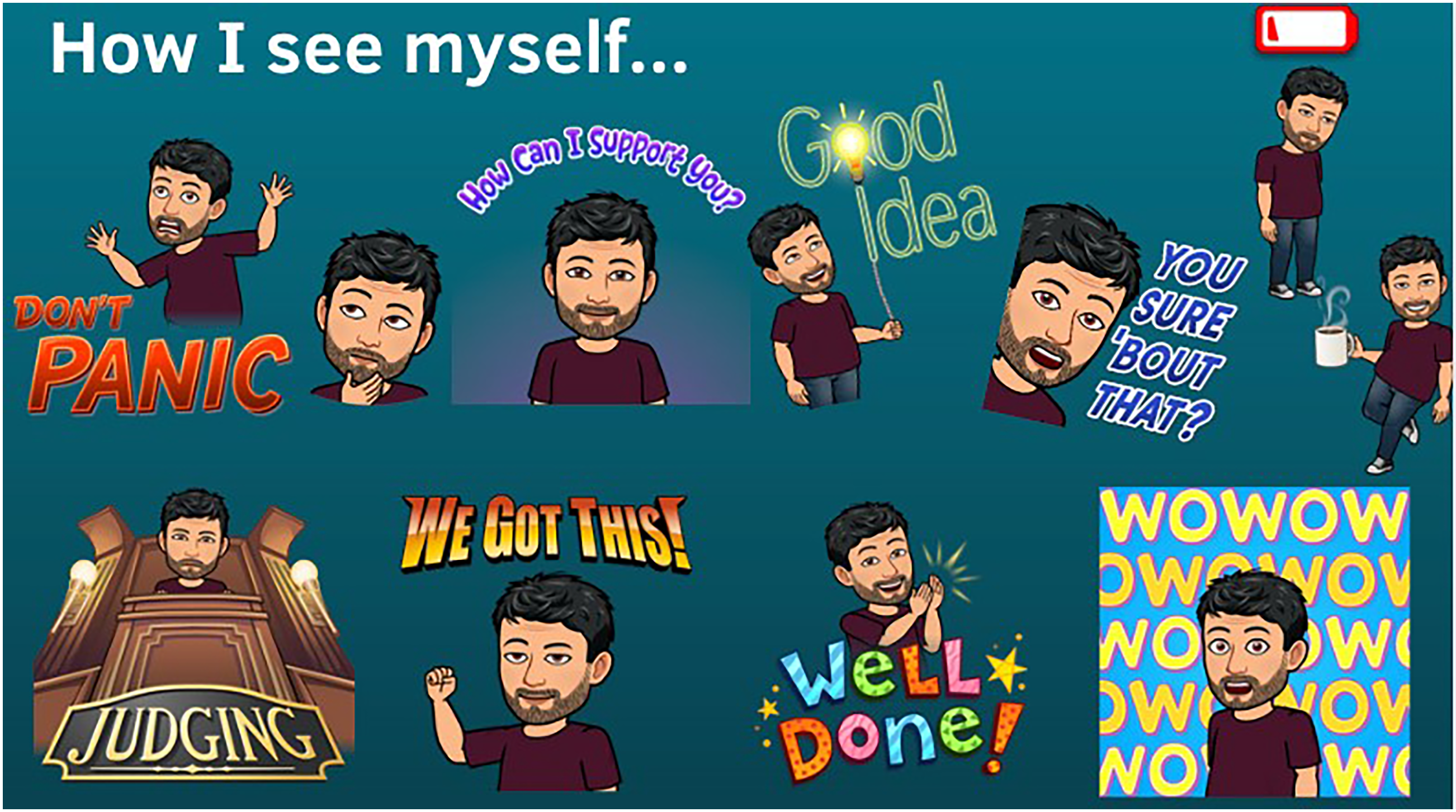
How Vicent Sees Himself.
In his explanation of Figure 1, he recognized that initially he and the student-teachers experience confusion (don’t panic!), which became an initial challenge; therefore, his role is to help them reflect on their ideas and provide indirect as well as direct feedback to encourage and enable further creative and critical thinking. He also acknowledges that supporting AR projects could be challenging as it can be energy-draining (avatar with an icon of a battery above), but, finally, the reward comes (Well done! and Wow! avatars) when the student-teachers present their projects, which is a core component of the course assessment. Vicent stresses the temporal dimension embedded in his identity development and the roles he plays over time. However, the dominant role seems to be that of a supporter who, as shown before, has the confidence to guide student-teachers by drawing from a plan in which procedural, declarative and experiential knowledge rooted in RP converge. Vicent's informed practice of language teacher education pedagogy (Dikilitaş and Yayli, 2018) and the investment supporting his professional identity are core elements in the overall architecture of the language teacher education knowledge base (Johnson and Golombek, 2020).
Araceli portrayed her self-image (Figure 2) highlighting, similarly to Vicent, the state of uncertainty that her student-teachers explore (unhappy face with a question mark) when making their first steps with AR and how she becomes involved (cycle) in supporting them. The stairs represent her learning as she reflects on what worked and did not work in previous iterations of the course and how RP helps her improve. In this regard, Araceli highlights that her identity is linked to her aim of seeing herself as a capable teacher educator.

Araceli's Representation of Her Identity Supporting Action Research.
In turn, Darío employed what he called a teachorama – that is, a three-dimensional representation of his teacher educator identity (Banegas, 2023). In his explanation, he wished to highlight the horizontal teacher educator–student-teacher relationship and reflection he seeks to achieve (round table with a reflective surface) (Figure 3). He also assigned great importance to his professional knowledge. He pictured himself carrying a backpack (Figure 4) containing his teacher education experience (E), research (R) and teaching experience (T) in secondary education. He also sought to see himself at the intersection of theory (purple tiles) and practice (yellow tiles). In other words, in his self-portrayal, his historically accumulated declarative, procedural and experiential knowledge, which could be equated to the domain of research and scholarship suggested in Barkhuizen (2021), plays a vital role as sources of legitimacy in his professional identity. In that representation, his research, often rooted in AR, has been visually included, underlining the influence of AR in his professional identity construction.
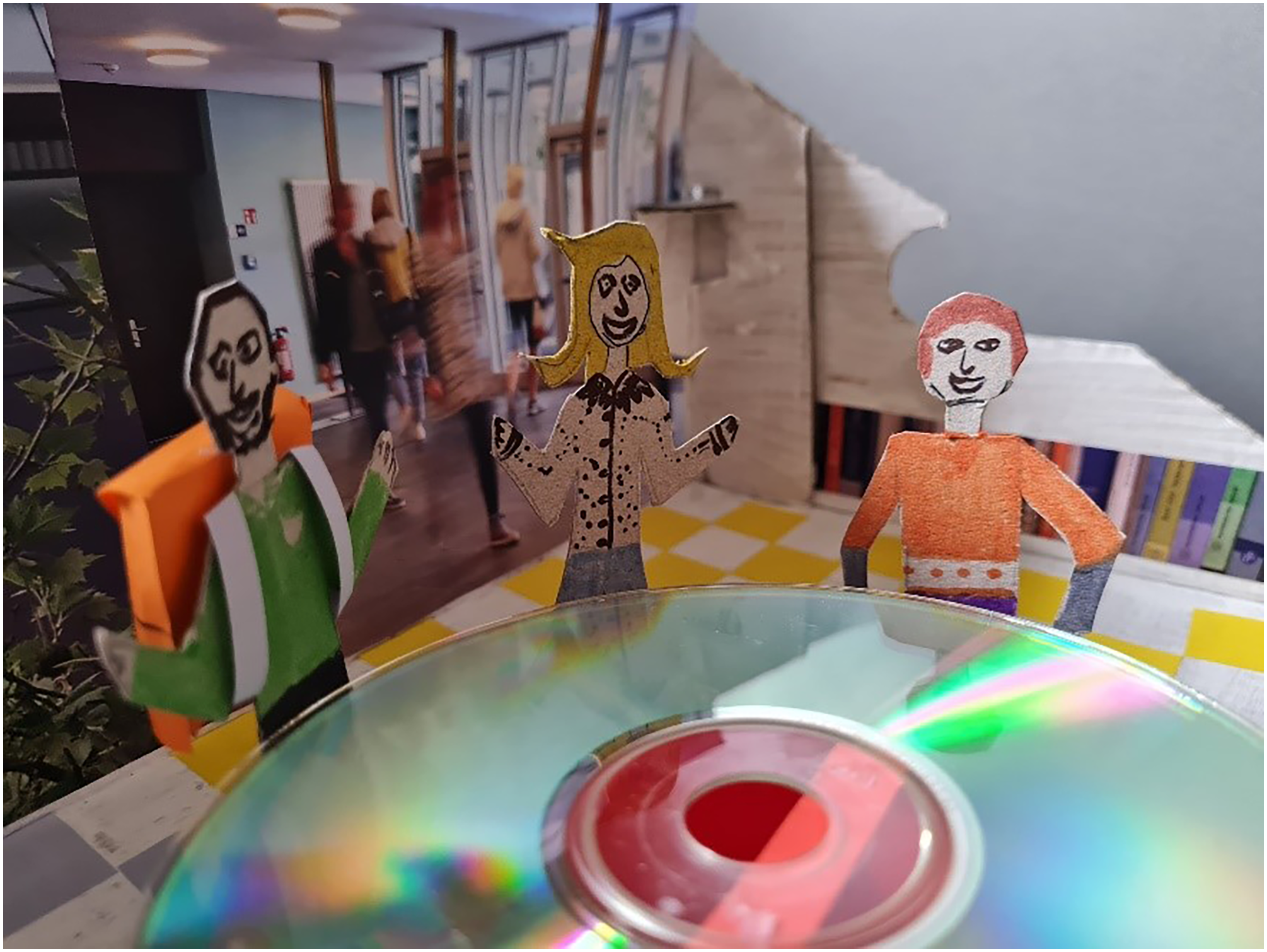
Darío's Teachorama.
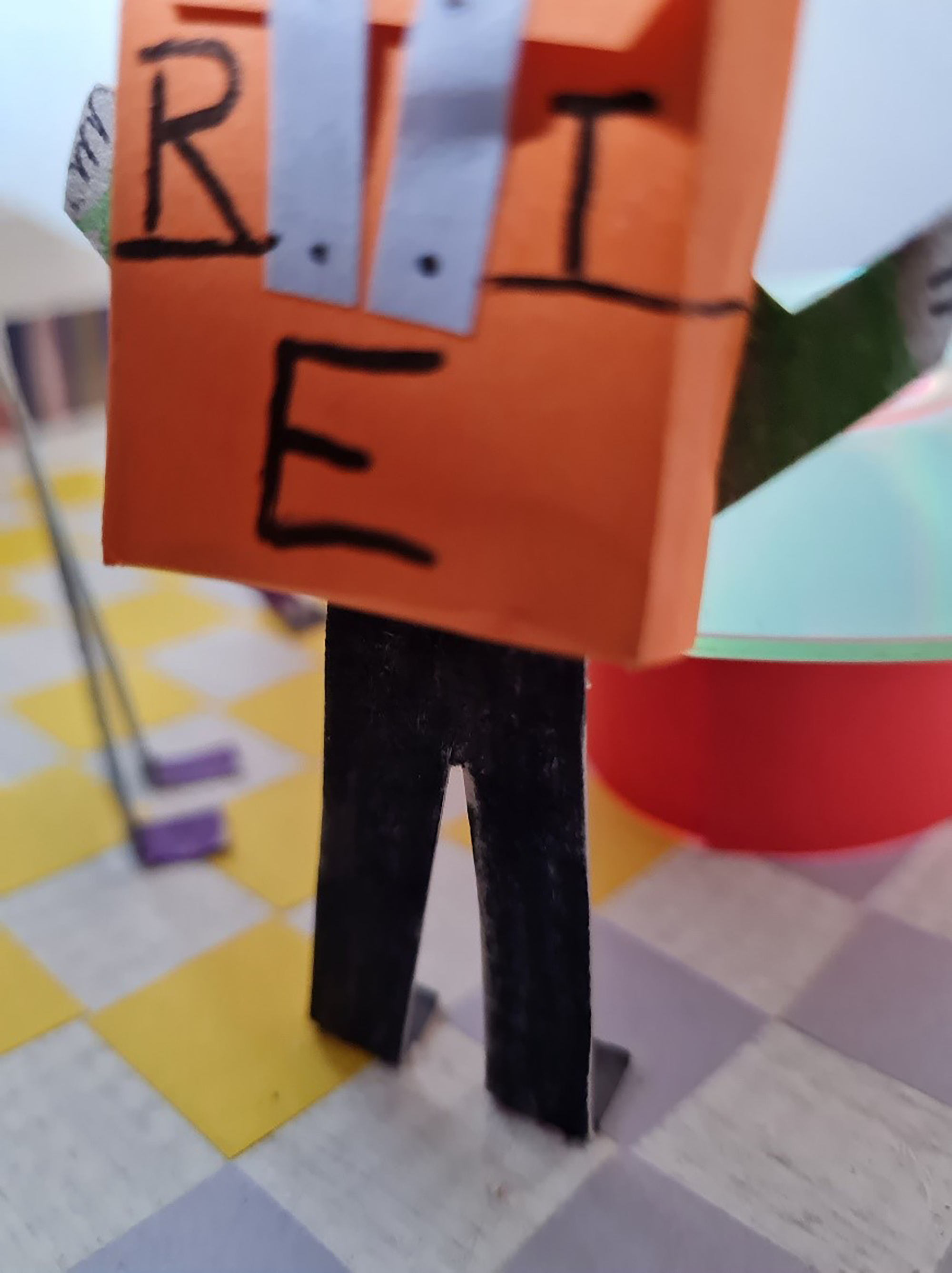
Darío's Identity Backpack.
Language Teacher Educators as Agents of Change
Through AR we positioned ourselves as agents of change, particularly when reflecting on our student-teachers’ feedback. We agreed that our student-teachers’ voices, which includes how they see us, were critical in the construction of our agentic identity. This theme was particularly encapsulated in Dialogue 3: Araceli: Our identities are definitely affected by the voices of our student-teachers. In my institution, students can choose thesis supervisors according to their preference, interest or knowledge. This puts a big responsibility on professors who can be research supervisors. Students recommend some tutors over others even on social media (Facebook) with comments like: ‘this professor helped me a lot’, ‘I could finish my research project thanks to him/her’, ‘that teacher knows how to guide you’ and sometimes their comments are not nice. Then, word of mouth is very powerful among students because they come to me/us with high expectations. What I have seen is that students’ voices have shaped my own identity as a teacher-educator and a research-educator if that is possible to say. We both, student and teacher, grow together and learn from each other. I have seen myself getting excited because I think that a research project is good, but I need to force myself to listen, before I give him/her my own opinions and try to convince them to do an AR. Not easy to do when your researcher antennas turn on. Darío: Agreed! By listening to my student-teachers, I’ve repositioned myself as an agentive, culturally situated AR advocate. At the same time, their voices have helped me develop a more critical and reflective identity. Vicent: I think I’m also learning from my students’ voices and views, which in turn impact my positioning within the classroom and towards AR. The first thing we do is to ask our students to think of an area that requires improvement. As expected, in the beginning, the students struggle to come up with ideas. Yet, little by little they start to reflect on what they face in their classroom, and ideas just begin to emerge. They share with us their classroom experiences, worries and feelings. Through dialogic exchange with the students, I have the chance to better understand their classroom reality and professional interests. In a way, I feel there is a sort of distance between us (students and teacher) if I position myself as a researcher, while closer to them when they see me as their teacher/monitor guiding and listening to their voices. Over the years, their voices have been very influential in the way I approach AR and talk about it in class. I try to see myself as someone who guides them to develop their professional profile as teachers who can problematize situations and deal with them. Araceli: Agreed, but in this guiding I think a challenge is that we need to take some distance. I mean, we want to support them, but it's their AR, not ours. So, I think we need to be these agents of change by enabling them to explore their own practices and problematize teaching without us being so directive.
The three themes discussed above suggest that language teacher educators’ teaching and supporting AR in language teacher education can boost their RP while exerting a powerful influence on their professional identity development even when there are some concomitant challenges. First, it may enable teacher educators to legitimize their status as they can combine professional knowledge coming from teaching experience, scholarship and their own research, often framed in AR. Similar to the cases included in Banegas et al. (2021), supporting AR in language teacher education may contribute to sustainable personal and collective agentic growth which can enhance teacher educators’ activity across pedagogical, institutional and community domains of practice (Barkhuizen, 2021). In this landscape, our trioethnography stresses that supporting AR in language teacher education programmes can become an entry point for teacher educators’ RP. More importantly, it can also turn into a potent space for language teacher educators to be educational enablers as AR allows the conflation of praxis, agency and professional growth (Nazari, 2022). According to Edwards (2021), AR provides the opportunity for practice-directed horizontal work among teacher educators and student-teachers through mentoring and reflective critical teaching. We shall call such an opportunity situated proximity as language teacher educators may approach it to enhance their identity as practical experts (Yuan, 2019). As our trioethnography shows, this identity could be extended by adding an agency-oriented layer that teacher educators seem to nurture to identify themselves as reflective agents of change within and beyond the institutional domain of their posts.
Conclusion
This trioethnography could be regarded as a form of self-study (Fraser, 2022) as it contributed to the exploration of our own trajectories and the influence of teaching and supporting AR in our RP and professional identity development. Although it is true that our professional identity can be constantly shaped and reshaped by AR practice as researchers, teaching and supporting AR also gives us the opportunity to grow as reflective and agentic professionals and in turn to define our identity. This is largely due to the roles we adopt in the classroom, which allow us to reflect on practice, primarily based on the student-teachers’ learning experience and project design.
In terms of challenges, we recognize that the study is based on teacher educators who willingly became involved in AR and reflected on their practices retrospectively, which may have led us to present a picture that appears to be ‘too positive’. Perhaps our intention of highlighting what we achieved made us lose process perspective and disregard the problems we have encountered. This might explain the lack of criticality articulated during the exchanges. To mitigate this limitation, future studies of a similar ethnographic nature could adopt a longitudinal and processual perspective instead of the retrospective approach we used. With a processual perspective in mind, teacher educators can maintain, for example, a journal that would allow them to record positive as well as challenging experiences and perceptions of AR in tandem with their teaching and supporting AR in language teacher education.
In terms of implications, this study lends support to the inclusion of teacher research or AR in language teacher education programmes in the form of courses since they appear to be beneficial not only for student-teachers but also to teacher educators involved in them. As noted above, AR can be a powerful entry point for teacher educators to engage in RP which can impact on their professional (identity) development. In addition, AR can also be an entry point for teacher educators to exercise a teacher educator-researcher identity. The inclusion of such AR-oriented courses could lead teacher educators to conduct a form of helicoidal practice as they can set up an AR study through which they investigate their own teaching and tutoring or mentoring of AR. Differently put, teacher educators can engage in meta-AR that examines the teaching and tutoring processes as well as their outcomes. As acknowledged above, recording in real time all experiences (energizing or frustrating lessons learnt and reflections) has the potential of adding criticality and breadth to the enactment and examination of teacher educators’ helicoidal practice. Such practice may offer invaluable information for course evaluation and self-directed continuing professional development. We believe that further research on AR in language teacher education as well as the impact of AR on the construction of a language teacher educator identity is needed so as to strengthen the presence of congruent practices in student-teachers’ journey.
