




Abstract
There are grounds for believing that prompting language learners to infer the meaning of new lexical items is beneficial because inferring the meaning of lexical items and verifying one's inferences invites more cognitive investment than simply being presented with the meanings. However, concerns have been raised over the risk that wrong inferences interfere with later recall of the correct meanings. The present study examines the effect of inferencing on language learners’ retention of idiomatic expressions (e.g. jump the gun, pull your weight and stay the course). In a counter-balanced within-participant design, 26 advanced learners of English were presented with 21 idioms in contexts either with their meaning clarified from the start (k = 7) or with the instruction to try and infer their meaning before receiving the clarification. The latter condition was designed so that accurate interpretations were more likely for some idioms (k = 7) than for others (k = 7). The learners’ responses at the inferencing stage were collected for analysis. One week later, the participants took an unannounced meaning-recall test. Recall was the most successful in the learning condition where the likelihood of accurate inferences was high. Items that had been inferred accurately stood a better chance (odds ratio 1.22) of being recalled than items whose interpretation had needed to be rectified. Approximately 13% of the wrong or imperfect inferences re-emerged in the post-test, suggesting that the learners did not readily discard them despite the corrective feedback. The findings indicate that, for inferencing procedures to be optimally useful, they need to be implemented in ways that ensure a high success rate.
Introduction
There are grounds for believing that prompting language learners to infer the meaning of new lexical items they encounter is beneficial not only because it fosters learner autonomy but also because it promotes cognitive engagement. Inferring the meaning of lexical items and verifying one's inferences when the actual meanings are subsequently clarified invites more cognitive investment than simply being presented with the meanings. Learning procedures that require a certain degree of cognitive effort are known to be beneficial for retaining the learned material in memory (Bjork and Bjork, 2014). Despite compelling arguments in support of instructional approaches that encourage language learners to train and apply their inferencing skills (e.g. Nation, 2022, chapter 9), there is to date no abundance of empirical evidence to demonstrate that this leads to better vocabulary retention than a procedure where learners are given the meanings from the start. The present study contributes to this line of inquiry by examining the effect of meaning inferencing on language learners’ retention of idiomatic expressions.
Background
The available body of research on the benefits of inferencing for vocabulary learning shows rather mixed results. Mondria (2003) compared ‘meaning inferred’ and ‘meaning given’ procedures for Dutch students learning sets of unfamiliar French words embedded in sentences. In the meaning-inferred condition, students were asked to first infer the meaning of the words using contextual clues and then compare their inferences to the correct translations. The meaning-given condition presented students with the translation of the words alongside the sentences from the start. Students in both conditions were next asked to study the words and their meaning. A two-week delayed recall test found no differences between the two conditions. Similarly, a study by Carpenter et al. (2012) revealed no difference in vocabulary retention between learners who were presented with first-language (L1) translations from the start and learners who were asked to infer meanings and then verify their inferences.
However, there are also studies which did furnish evidence in favor of inferencing. Huang and Lin (2014) had Chinese students of English read a text in which the same unfamiliar target words were incorporated three times. In one reading condition, students were not required to infer the meanings of words because L1 translations for these words were provided with all three of their occurrences in the text. In another reading condition, the first instance of the words was not accompanied by a translation and the students were invited to guess its meaning before reading on. They could then verify their interpretation when they met the same word again but this time with its translation given. Meaning-recall tests showed better retention after the latter reading condition. It needs to be noted, however, that the explicit inferencing task likely turned the reading activity into a deliberate vocabulary-learning activity, whereas the participants who were not given this task probably experienced the glosses as mere support for text comprehension. A more recent study, by Elgort et al. (2020), compared two procedures which were both clearly presented to the participants as vocabulary-focused activities. Chinese learners of English were presented with new words three times in supporting passages. In one condition, the participants were explicitly asked to infer the meaning of the word after reading the passages, and they were then shown the definition of the word to verify their interpretation. In another condition, the participants were first presented with the definition of the word before they read the passages, and then they were asked to recall its meaning. A meaning-recall post-test showed better results after the inferencing procedure.
Interestingly, Mondria (2003), Huang and Lin (2014) and Elgort et al. (2020) all noted that the inferencing procedures brought about relatively good results in the post-tests, especially when learners had been successful at inferring the word meanings. Recall tended to be poorer for items whose meaning participants had failed to guess, despite having been presented with the correct meanings afterwards. In an earlier evaluation of the inferencing procedure that was included in Elgort et al. (2020), Elgort (2017) also found that the odds of accurate recall were greater after accurate inferences than after wrong inferences, suggesting that learning from feedback after failed inferences is less beneficial for retention.
What the above body of research suggests is that there may be a downside to inferencing when inaccurate interpretations need to be replaced in memory by the correct meanings. It seems plausible that failed inferencing slows down learning because it delays the establishment in memory of the correct form–meaning correspondence. If a correct meaning is given from the start, then each contextualized encounter that follows has the potential to entrench it more deeply in memory. If a learner fails to figure out the meaning of a word despite encountering it in contexts, then the entrenchment in memory of the correct meaning only starts happening after it is clarified. Still, the inferencing activity may pique the learners’ curiosity and may make them engage more with the word meanings when these are subsequently given to them, thus benefiting the learners even if their inferencing effort failed. This scenario presupposes that inaccurately inferred meanings are readily replaced in memory by the correct meanings when these are provided as feedback.
It is also conceivable, however, that wrong interpretations linger in memory and can slow down the acquisition of correct meanings. This possibility was examined in a recent study regarding the learning of figurative idioms (Wang et al., 2022). In this study, Chinese learners of English were prompted to guess the meaning of idioms (e.g. pull your weight; throw in the towel) first without any hints and then assisted by information about the situational contexts in which the expressions were originally used literally (e.g. rowing for pull your weight; boxing for throw in the towel). The actual meanings of the idioms were subsequently clarified to the participants. When the learners were presented with the same idioms one week later and asked to recall their meanings, recall turned out significantly less successful when the learners had proffered incorrect interpretations the previous week. Interestingly, about half of the incorrect responses in the test closely resembled the learners’ earlier interpretations, suggesting that corrective feedback had failed to override or to finetune these inaccurately inferred meanings in memory. However, there was no comparison condition in Wang et al. (2022) where the meaning of the idioms was given directly to participants. It is therefore impossible to tell if inferencing trumps a meaning-given procedure even if the inferencing fails. Besides, the participants were presented with idioms in a decontextualized fashion, unlike a more realistic scenario where idioms are encountered in discourse and where contextual clues may be available to direct learners to a plausible interpretation. That said, one should certainly not overestimate learners’ success rates as they try to infer the meaning of lexical items from context (e.g. Bensoussan and Laufer, 1984; Nassaji, 2003; Paribakht and Wesche, 1999), and this holds true also for idioms (e.g. Carrol and Littlemore, 2020; Kim, 2016; Martinez and Murphy, 2011).
The Present Study: General Design and Research Questions
In the present study, we presented second-language (L2) learners with short text passages, each incorporating an idiom. In a counter-balanced research design, the learners were either given the meaning of the idioms or they were invited to infer their meaning after which it was given as feedback. Because we were interested in the question of whether successful and unsuccessful inferencing bring about different learning outcomes, we created two inferencing conditions, with one more likely to lead to accurate inferences than the other. Research has demonstrated that the meaning of many figurative idioms becomes easier to infer when one is made aware of the situational context in which the expression was (or still is) originally used in a literal sense. For example, Boers et al. (2007) first asked learners to guess the meaning of idioms from supporting contexts, and then again with the addition of a note about the original, literal meaning of the expressions. The accuracy of the inferences improved from 24% to 66%. To increase the chances of correct meaning-inferencing in one of the conditions in the present study, we therefore created a learning sequence where the learners were told about the ‘literal underpinning’ of the idioms before they were asked to infer the figurative, idiomatic meaning with the text passage at their disposal.
Research has also indicated that informing learners of the literal underpinning of an idiom can make it more memorable (e.g. Boers et al. 2004), which is in keeping with Dual Coding Theory (Paivio, 1986, 2010) because the literal underpinning makes the expressions more imageable (i.e. easier to picture in the mind). 1 Adding this information to only one of the learning conditions in the present study would have made it impossible to separate the effect of inferencing from that of applying a given mnemonic technique. To avoid this confounding variable, we incorporated the same information in all three conditions, but at a different point in the respective learning procedures (see Materials).
The study addressed the following questions:
Does meaning inferencing followed by feedback lead to better retention of the meaning of idioms than a meaning-given procedure?
Does it matter for learners’ retention of the correct meaning of idioms if their inferences were not accurate in the learning stage?
For the first research question, our hypothesis was that meaning inferencing followed by feedback would lead to better retention in memory, owing to the cognitive effort that is invited by inferencing tasks (e.g. Elgort et al., 2020; Huang and Lin, 2014). Regarding the second research question, we hypothesized that this benefit of inferencing would be compromised in the case of failed inferences, as suggested by the results of some previous studies (Wang et al., 2022; Elgort, 2017).
Methodology
Participants
Twenty-six graduate students enrolled in applied linguistics, curriculum studies, or Teaching English to Speakers of Other Languages (TESOL) programs at a Canadian university participated in this study and completed all the activities. Participation was voluntary and all the participants gave informed written consent for their data to be used for research purposes. They received a $20 gift card in return for their time. The majority (n = 22) were students from China with Mandarin as their L1. The others were from Iran (n = 2), South Korea (n = 1) and India (n = 1). To be admitted into their graduate program, the students needed an International English Language Testing System (IELTS) score (or an equivalent score on another proficiency test, such as Test of English as a Foreign Language (TOEFL)) of at least 6.5 out of 9 at the time of applying to their program. However, their actual proficiency in English at the time of the study most probably varied. A within-participant study design was therefore used instead of a between-participants design to eliminate the potential confound of unbalanced proficiency levels between participant groups. The learning materials were also counter-balanced in case some target idioms were easier to learn than others.
Target Idioms
Every participant engaged with a total of 21 English idioms (Appendix 1). All the idioms were verb + noun expressions (e.g. jump the gun; stay the course), occasionally including a preposition (or adverbial particle) as well (e.g. fly off the handle; throw in the towel). Idioms were chosen as learning targets because research has shown that international students are exposed to a lot of metaphorical expressions such as figurative idioms and very often fail to comprehend them (e.g. Littlemore et al., 2011). We therefore felt a focus on idioms would be of practical use for our study participants. To determine that the selected idioms were useful targets for learning, we consulted the second edition of Collins Cobuild Dictionary of Idioms (Sinclair, 2002), which marks idioms that according to corpus data occur relatively frequently in discourse. All the target idioms are made up of words that almost certainly looked familiar to the participants considering their proficiency level. None of the idioms contained words from beyond the 4000 most frequent word families of English, according to Nation's (2012) word lists based on the combined British National Corpus (BNC)/Corpus of Contemporary American English (COCA) corpus. That said, some of the idioms contained words whose specific meaning in the idioms may have been new to participants. For example, grade and course were undoubtedly familiar to the participants as terms in the domain of education, but their use in the idioms make the grade (grade = top of an uphill slope) and stay the course (course = travel route) may not yet have been familiar to them. This is also one of the reasons why information about the literal underpinning of an idiom can be helpful – it disambiguates such key words.
Materials
The 21 idioms were semi-randomly grouped into 3 sets (i.e. 7 per set). Because some of the idioms originated from the same domain and because learning semantically related lexical items in a single set may influence learning outcomes (e.g. Nakata and Suzuki, 2019, for a review) we distributed the idioms so that each set consisted of items without such shared domains. For example, bite the bullet and stick to your guns (both derived from battle) were assigned to different sets.
Three learning sequences were created for all the idioms (see Appendix 2 for examples, and https://osf.io/7cqnf/ for all the study items):
Meaning given: participants were presented with the meaning of the idiom and an example of its use in context. To ensure the participants would process the information, they were asked to rate how well the context illustrates the meaning of the idiom. Then they were asked to indicate if they already knew the idiom before this learning session. As a final step, they were informed about the original, literal use of the expression from which its figurative meaning is derived. Inferencing based on context: participants were presented with a contextualized use of the idiom and asked to provide their interpretation of the expression. They were then given the actual meaning of the expression and asked if they already knew it before this learning session. Then they were informed about the literal underpinning of the idiom. Inferencing based on context and literal underpinning: participants were informed about the literal underpinning of the expression and shown a contextualized use of the idiom. They were asked to provide their interpretation of the expression, after which the actual meaning was presented to them. Again, they were asked if they already knew the idiom before this learning session.
In all three learning sequences, each idiom occurred five times in total. The meaning definitions, example contexts and information about the literal underpinnings of the idioms were identical across the three learning conditions. In all three conditions the information about the literal underpinning of the idioms could serve as a mnemonic (through enhancing the imageability of the expressions), but in the third condition it also served as a clue for inferencing, intended to improve the chances of accurate interpretation of the expressions. The three learning sequences included the same amount of input overall and the same number of ‘tasks’ (see Appendix 2). The definitions and the notes about the literal origins were taken mostly from the second edition of Collins Cobuild Dictionary of Idioms (Sinclair, 2002). The short contexts incorporating the idioms were inspired by examples from the same dictionary. Apart from proper nouns, all the words used in these contexts belong to the 3000 most frequent word families of English (Nation, 2012).
We refrained from administering a pre-test, because taking a pre-test would have prompted inferencing attempts, thus compromising the comparison of the inferencing and meaning-given conditions. Instead, we asked the participants to state whether they already knew the meaning of the idioms. There was no reason for the participants to misrepresent their prior knowledge, because they had been assured both verbally and in writing that the study was unrelated to their graduate programs and that their results would have no impact on their course grades. We also expected that few of the idioms would be known, because a pilot study 2 with a previous cohort of students in the same programs had revealed very limited knowledge.
The post-test was a meaning-recall test which presented the participants with the 21 idioms without context and invited them to recall the meaning. The participants were given the choice to give their responses in English or in their L1.
Procedure
The study was conducted in two sessions. The first was the learning session, and the second (one week later) was the post-test session. The participants were not told in advance that they were going to be tested on the idioms. Instead, they were led to expect a second learning session.
Each participant experienced all three learning procedures, but applied to different sets of seven idioms, as shown in Table 1. Both the learning session and the test were administered on an online survey platform, Qualtrics, which the participants accessed from their physical classroom (with the researchers present) through their electronic devices. Showing a slide with a QR code and a link, the researchers guided the participants to access the materials they were assigned to according to the counterbalanced design. The participants typed their interpretations of the idioms in a response box. They were told this could be done in English or in their L1. They could not return to previous screens once they had moved on to the next. No strict time limits were imposed to complete the activities. Inevitably, some individuals worked faster than others, but the learning session took most participants around 20 minutes (i.e. about 1 minute per idiom).
Counterbalanced, Within-Participant Design.
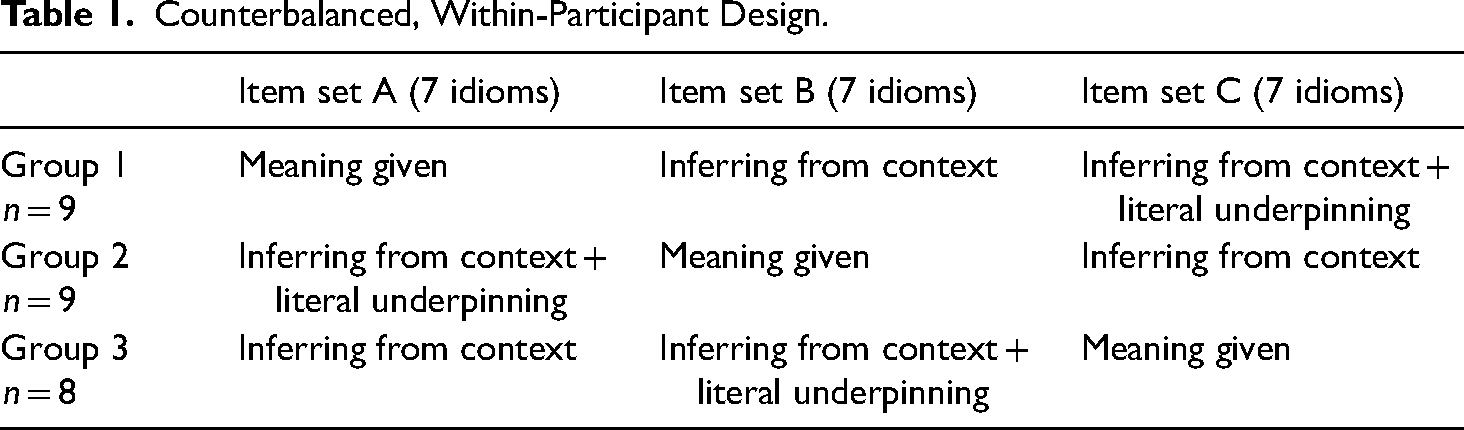
The post-test was administered one week later and used the same online platform, accessed by the participants from a classroom with the researchers present. The post-test presented the participants with the 21 idioms one at a time (but without context) and invited them to type the meaning into a response box. It took participants 5 to 10 minutes to complete the test. They were free to use their L1 to express their comprehension of the idioms. Only a handful of responses were in an L1 (Farsi) that was not familiar to the researchers. These were translated into English by an L1 user of the language, a PhD student in applied linguistics.
Analysis
As each of the 26 participants was presented with 21 idioms, there was a total of 546 responses to be supplied in the post-test. After excluding responses regarding idioms which participants had indicated during the learning session as already known, as well as a few missing inferences owing to students’ accidentally skipping a response screen, 511 post-test responses (i.e. 93.6%) remained for examination. Because the full meaning of each idiom had been explained in the learning session, the post-test responses were scored in a strict fashion, with a point awarded for responses that captured all semantic components of the definitions. For example, to pull your weight means working as hard as other people in a group. Post-test responses such as ‘to work hard’ did not capture the semantic component of ‘teamwork’ (i.e. working as hard as other members), and so were not given a point under the strict scoring criteria. Three assessors were involved in scoring the responses. Two of them were blind as to the learning conditions from which the responses were drawn. The third assessor – the first author of this article – had been responsible for the data collection and so was aware of the respective learning conditions. The three assessors independently scored all the responses of six participants. Intercoder agreement between the first author and the two other assessors was 88% and 91%. All cases of disagreement were resolved through discussion, with reference to the definitions in the learning materials presented to the participants. The first author then scored the remaining test responses, using the criteria established during the discussions.
The same intercoder agreement procedure was used to assess the participants’ interpretation of the idioms at the inferencing stage of the learning session, but in addition to scoring these responses in the strict manner described above, we also applied more lenient criteria in the case of responses that approximated the meaning of the idiom. In the case of pull your weight, for example, a response such as ‘work hard’ was given partial credit although it lacked the precision of the dictionary definition. Similarly, take the edge off something means reducing the intensity of an unpleasant situation according to the dictionary definition, but the less precise interpretation ‘make something better’ was given partial credit. Giving partial credit to loosely correct interpretations at the learning stage was considered useful to address the research question of whether successful inferencing predicts accurate recall, because inferencing can be successful to varying degrees. Intercoder agreement between the first author and the other two assessors for all the inferred meanings proposed by six participants was 88% and 94% respectively. Again, cases of disagreement were resolved through discussion, and then the first author coded the remaining responses.
To investigate if meaning-inferencing leads to better retention than a meaning-given procedure, a multilevel logistic regression model was built using the Jamovi (2021) software (https://www.jamovi.org/). Items and participants were entered as random effects. The different learning procedures constituted the fixed effect. We initially included the total amount of time spent by individual participants on the set 21 idioms during the learning session, but this factor was removed from the final model as it did not help to predict test performance. We also checked if there was a difference in learning outcomes for the three sets of seven idioms that had been created for the counterbalanced study design, but no such effect was discerned.
To address the question of whether successful inferences are particularly beneficial for the retention of meaning, we compared the odds of correct post-test responses after successful and after failed inferencing. Within the category of successful inferences, we distinguished between entirely correct and partially correct responses. To explore whether incorrect or imperfect interpretations made at the inferencing stage might linger in memory, we compared each of these interpretations with the participants’ post-test responses for the same idioms.
Findings
Recall that we created two inferencing conditions, where one was expected to bring about a higher rate of accurate interpretations than the other. Given previous research, we expected inferencing to be more successful when learners had at their disposal not only a supporting context but also information about the literal underpinning or origin of the idiom. This was confirmed by the data: inferences based on both clues were more often accurate (46.4%) than those based on context alone (32.4%), and the difference was significant (χ2 = 7.03; p = .008; odds ratio (OR) = 1.81).
We will return to the role of successful inferences below, but we turn first to a comparison of the post-test scores obtained after the three learning procedures. Table 2 shows the descriptive statistics of the post-test (Cronbach's alpha = .524) and Table 3 shows the output of the logistic regression analysis.
Means (M) and Standard Deviations (SD) for the Meaning-Recall Test.
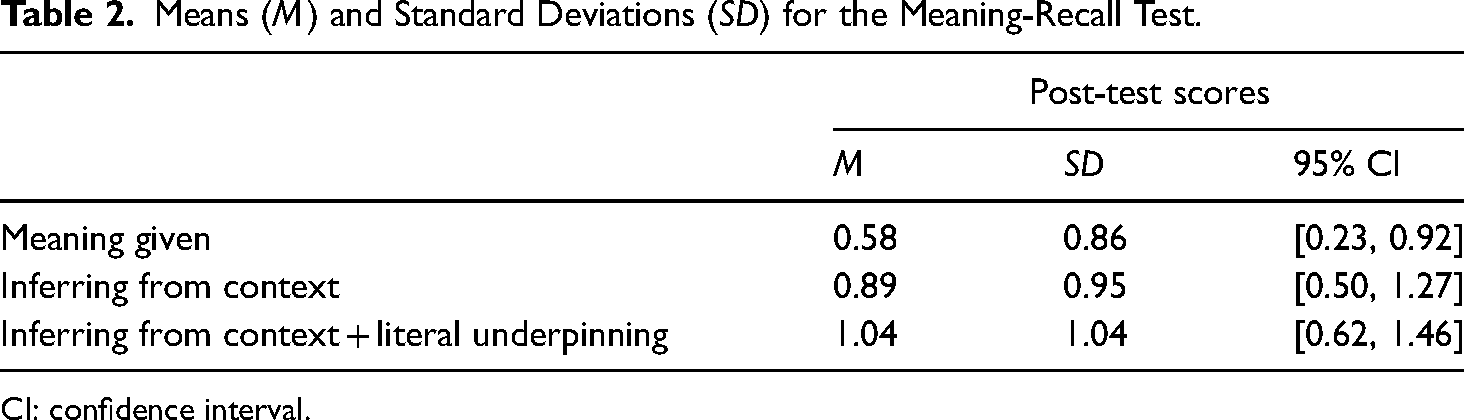
CI: confidence interval.
Performance on the Meaning-Recall Test: Estimates of Fixed and Random Effects.
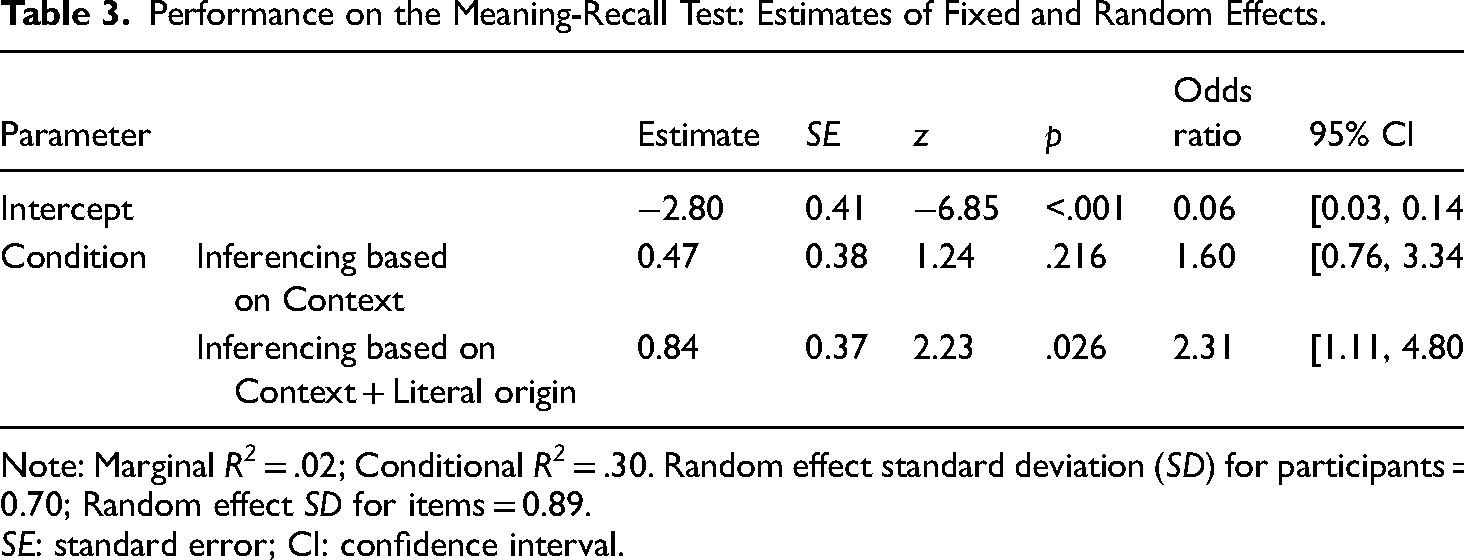
Note: Marginal R2 = .02; Conditional R2 = .30. Random effect standard deviation (SD) for participants = 0.70; Random effect SD for items = 0.89.
SE: standard error; CI: confidence interval.
The post-test scores after inferring from context alone did not differ significantly from those after the meaning-given procedure (p > .05), but the scores after inferring from the combined clues (literal underpinning plus context did (p = .026). This suggests that it takes a procedure where the likelihood of accurate inferences is relatively high to obtain learning gains that are significantly greater than a meaning-given procedure.
We subsequently investigated the role of successful inferences by exploring whether accurate inferences are more often followed by accurate recall than interpretations that need to be rectified. Recall that the scoring of the responses at the inferencing stage distinguished between correct interpretations (according to strict scoring) and partially correct ones (according to a more lenient assessment). The tallies of correct post-test responses given one week after (a) correct inferences; (b) partially correct inferences; and (c) failed inferences show different proportions across the meaning-inferencing conditions. The odds of entirely correct post-test responses were better after accurate meaning inferences (44%) than after failed inferences (34%) and after partially correct inferences (22%). However, according to the multilevel logistic model with participants as random effects, inferencing success was not a statistically significant predictor of post-test performance. The OR in favor of accurate inferences (relative to failed and partially correct inferences) was 1.17 (z = 0.416).
Interestingly, if participants were only partially successful at inferring the meaning of an idiom, they were less likely to produce an entirely accurate post-test response than if their inferencing had failed altogether (OR = 0.87). Although this trend fell short of statistical significance, it suggests that the learners in this study did not make optimal use of the explanation of the meaning of an idiom when their initial interpretation was already loosely correct but would have benefited from greater semantic precision. Wang et al. (2022) also noted this trend and suggested that learners may consider the clarification given after their own loosely correct inference as mere confirmation of their understanding of the expression (‘Yes, that's what I thought’) rather than as an incentive to finetune their understanding. It is conceivable that learners are more interested in finding out the meaning of an expression when they realize their own interpretation was wide of the mark (‘Oh, I see now; that's what it means!’). Naturally, this account must remain speculative for now, and should be taken as an invitation for further research, possibly including think-aloud or stimulated-recall procedures, to gain insight into how individual learners deal with language study materials.
Given that meaning retrieval was especially poor after wrong or imperfect inferences, we explored if any inaccurate interpretations made at the inferencing stage re-emerged in the meaning-recall test. Of the wrong inferences (k = 109), 10.1% were duplicated in the meaning-recall test. For example, a participant interpreted the expression Win hands down (‘win very easily’) as ‘getting support’ (possibly through association with expressions such as handouts and lend someone a hand) and reproduced this interpretation in the recall test. In the case of partially correct inferences (k = 72), as many as 15.3% were duplicated in the recall test. For instance, a participant interpreted Take a back seat (‘allowing others to make the decisions’) as ‘refusing to get involved in a task’ and reproduced this interpretation in the recall test. These cases suggest there may indeed be a downside to procedures that push learners to make meaning inferences, because wrong and imperfect interpretations may linger in memory despite feedback.
Conclusion and Limitations
Because meaning inferencing invites more cognitive engagement than a meaning-given procedure, we hypothesized that the two meaning-inferencing groups would outperform the meaning-given group in a meaning-recall test. We also hypothesized that participants would benefit more from meaning inferencing if the likelihood of accurate inferences was high, because previous studies have indicated there may be a downside to wrong inferencing (e.g. Wang et al. 2022; Elgort, 2017). In this study, we created a condition in which the likelihood of correct inferences was comparatively high. We did this by presenting the learners with an extra clue (the literal underpinning of the idiom) which they could use in combination with a contextualized example of use. Inferencing accuracy was indeed better in this condition than in a condition where only the contextualized example was available to support inferencing (akin to findings in Boers et al., 2007).
This ‘enhanced’ inferencing condition led to significantly better retention, according to the one-week delayed meaning-recall test, than the meaning-given condition. The meaning inferencing based on context only, however, did not lead to significantly better retention than the meaning-given condition (reminiscent of the findings of Mondria, 2003). Altogether, the results therefore suggest that inferencing procedures are recommendable especially if the conditions for accurate inferences are favorable. This is supported by the positive association we found between accurately inferred meanings and their recall – although it needs to be acknowledged that this association was not statistically significant. Interestingly, it was when inferencing had not failed entirely but had instead been loosely correct that recall of the precise meanings of the idioms was most unlikely. The re-emergence of wrong and imperfect inferences in the recall test reveals that these were not readily replaced in memory by corrective feedback. To avoid this downside of inferencing procedures, it seems advisable to design such procedures in ways that ensure a high rate of accurate inferences.
Several limitations of this study need to be acknowledged. One is the relatively small sample size. Using a counterbalanced, within-participant design reduces the impact of individual differences and item-related variables, but this does not rule out a risk of sampling bias. Replication studies with more participants from various linguistic and cultural backgrounds are recommended. A second limitation of this study is that it involved only exercise and test responses. We do not know, for example, how the participants interacted with the input and information they were presented with, and what thought processes led to their proposed interpretations of the idioms. As already mentioned, triangulation with think-aloud and/or stimulated-recall data would be useful in this regard.
Finally, we also need to recognize that this study only recorded the total time that participants spent on the set of 21 idioms during the learning stage. It is possible that the inferencing activities took longer than the meaning-given condition. In the latter condition, we did add a task for the participants to rate how well the examples of contextual use illustrated the given meaning of the expressions, but we cannot be sure if this led participants to spend as much time on these idioms as in the inferencing conditions. It would therefore have been useful to record the time spent on individual activities during the learning procedure, to be able to evaluate the role of time investment and thus to distinguish between the effectiveness and the efficiency of the approaches (e.g. Mondria, 2003). If learning outcomes are no different between a meaning-given procedure and an inferencing procedure if the inferencing has a poor accuracy rate, as was observed in the present study, then the procedure where meanings are clarified to learners straightaway may in fact be considered more efficient.
Footnotes
Acknowledgements
We would like to express our gratitude to the TESOL students at Western University's Faculty of Education who volunteered to participate in this study. We also wish to thank Liwen Situ for assisting with the data processing.
Funding
The author(s) disclosed receipt of the following financial support for the research, authorship and/or publication of this article: This work was supported by the Faculty Research Development Fund, Faculty of Education, University of Western Ontario (grant number R5814A05).

Notes
Appendix 1: Target Idioms in the Study.
Set A: Jump the gun; win hands down; stay the course; make the grade; take the edge off something; throw in the towel; put on the back burner.
Set B: Get into gear; fly off the handle; stick to your guns; go out on a limb; toe the line; give someone their head; show someone the ropes.
Set C: Clear the deck; pull your weight; take a back seat; go against the grain; give someone a leg up; bite the bullet; pass the hat.
Appendix 2: Examples of the Three Learning Procedures.
Meaning-given:
The expression ‘jump the gun’ means doing something too soon Example of jump the gun: ‘She jumped the gun by announcing they were going to get married, while Jeff hadn’t proposed to her yet.’ Does this example illustrate the meaning of the expression well? Not at all a little rather well very well Did you already know this expression before this project? YES / NO Origin: This expression comes from the context of racing contests. An athlete who starts running before the starting pistol is fired is said to jump the gun. Expression: Jump the gun Read the following sentence and try to guess the meaning of the expression: ‘She jumped the gun by announcing they were going to get married, while Jeff hadn’t proposed to her yet.’ What do you think the expression means here? The expression ‘jump the gun’ means doing something too soon Did you already know this expression before this project? YES / NO Origin: This expression comes from the context of racing contests. An athlete who starts running before the starting pistol is fired is said to jump the gun. Expression: Jump the gun Origin: This expression comes from the context of racing contests. An athlete who starts running before the starting pistol is fired is said to jump the gun. Please keep this hint in mind, read the sentence on the next screen, and guess the meaning of this expression. ‘She jumped the gun by announcing they were going to get married, while Jeff hadn’t proposed to her yet.’ What do you think ‘jump the gun’ means here? The expression ‘jump the gun’ means doing something too soon Did you already know this expression before this project? YES / NO
Inferencing based on context:
Inferencing based on context and literal underpinning:
Note: The complete learning materials have been uploaded to OSF in the form of a pdf document: https://osf.io/7cqnf/.