




Abstract
One of the driving forces for a wider adoption of English as a Medium of Instruction (EMI) in higher education is that students may demonstrate improvements in English language proficiency through an increased English exposure from content learning. However, to what extent previous English exposure has an impact on students’ learning experiences remains unanswered. This paper contributes to filling this gap by analysing quantitative data of 73 undergraduate science students from Hong Kong, classified by their prior English language exposure. Students completed a survey exploring their perceptions of their (1) exposure to EMI prior to university admission and the actual language use in classrooms; (2) English abilities in different learning activities; (3) English language challenges; and (4) learning strategies. Results showed that students’ perceptions of EMI learning varied with their levels of English exposure prior to university admission. Despite encountering more difficulties in using English among first-year students with lower-level English exposure, all students perceived the importance of English skills in science education and adopted different learning strategies to overcome the EMI study challenges.
Introduction
English as a Medium of Instruction (EMI) refers to the use of English in teaching and content learning in situations where English is not the dominant language (Ducker, 2018). One reason for the rapid increase of EMI programmes globally is its potential benefits to students’ English language proficiency (Galloway et al., 2017). EMI is also able to usher in advantages at both the institutional and national levels as seen in employment opportunities and social mobility (Macaro, 2018; Macaro et al., 2018). Therefore, governments worldwide have advocated the implementation of EMI programmes at tertiary level as ways to raise international profile, to build English proficiency of their nation, and to strengthen students’ global competitiveness (Dearden, 2014).
Students generally believe learning through the English language under EMI education helps promote their English proficiency (Chapple, 2015; Galloway et al., 2017, 2020; Mauranen, 2018; Tatzl, 2011), yet little empirical research supports the causal relationship between EMI and improvements in English language proficiency. Meanwhile, the existing literature has pointed towards the significance of prior exposure to English for students’ transition to and success in EMI education at tertiary levels. In Lin and Morrison’s (2010) study on the academic performance of university students with different secondary school backgrounds, those who received English-medium education at secondary level outperformed their counterparts who were from Chinese-medium secondary schools in terms of their performance in content subject exams. Wong (2010) similarly found a positive correlation between the extent of students’ past EMI exposure and their level of English proficiency that could be seen in their confidence in English usage, the degree of class participation and their English results. As such, the current study aimed to explore the impact of English exposure prior to university on students’ EMI learning at tertiary level. The findings will shed light on the EMI learning experiences of university students with various levels of prior English exposure and, hence, obtain insights into the potential pedagogical approaches and strategies for teaching students with varied abilities for EMI content subject educators.
Background
Perception Toward EMI
With the potential advantages of EMI, relevant stakeholders in the education sector generally welcome and support the implementation of EMI programmes (Zhao and Dixon, 2017). Galloway et al. (2017), from their qualitative data on students’ attitudes toward EMI, pointed out that participants desired to only allow use of English in EMI classes, implying that students perceived EMI as a tool for improving their English proficiency. In fact, a majority of the students in Galloway et al.’s (2017) study expressed satisfaction with their EMI programmes and perceived an improvement in their overall English language competency with the appropriate level of EMI. These findings are corroborated by Kong and Wei’s (2019) study, in which over 70% of the total of 282 Chinese student respondents indicated that EMI helped improve their proficiency of English. From the teachers’ perspective, the teacher participants from Asia and Europe in Galloway et al.’s (2017) and Dearden and Macaro’s (2016) research, respectively, showed favourable attitudes toward EMI and believed that EMI offered positive impacts on both students’ language and subject knowledge.
Difficulties with English
Despite the positive outcomes found in previous research, EMI could become an obstacle instead of a means to boost students’ English proficiency if it is not implemented and executed appropriately (Byun et al., 2011; Chan, 2014). To maximize the benefits from EMI programmes, both students and instructors must reach a certain level of prior English proficiency, and additional language support programmes are essential for the success of non-native English speakers (Dearden and Macaro, 2016; Kym and Kym, 2014). However, fulfilling the ideal EMI conditions is difficult, particularly for those whose native language is not English. As a result, a number of challenges have been identified in EMI teaching and learning among teachers and students with various levels of prior English exposure (Corrales et al., 2016; Pun and Thomas, 2020).
Encountering difficulties in the transition to EMI tertiary studies is common for students who are identified as learners of English as a second/foreign language (ESL/EFL), and such difficulties are limited not only to adapting to the English learning environment but also content learning (Richards and Pun, 2021; Kamaşak et al., 2021). Berman and Cheng (2001) found that language proficiency level was positively associated with academic performance. The ESL/EFL students with lower English competency, potentially due to little prior English exposure, could thus encounter disadvantages in their learning – for instance, experiencing difficulties when giving oral presentations in English, comprehending writers’ attitudes and purposes, and understanding vocabulary of their subject area (Berman and Cheng, 2001). Furthermore, considering the relatively limited vocabulary and understanding of English academic writing style of ESL/EFL learners, they may encounter more challenges in reading and writing (Pessoa et al., 2014). Consequently, the language-related difficulties can lead to an overall poorer academic performance for students with lower English competence in EMI classrooms (Rose et al., 2020).
For teachers, despite the recognized benefits of EMI teaching training for enhancing teachers’ practices in the pedagogical and language aspects (Dang et al., 2013), teachers around the world were shown to receive insufficient or even no training on teaching in EMI classrooms (e.g. Airey, 2011; Sah and Li, 2018; Tsui, 2017). In addition, due to their inadequate competence in implementing classes through EMI, which, for example, could be observed in a higher level of hesitations, certain teachers felt ashamed of their own English proficiency and regarded the correction of students’ English usage as the responsibility of language teachers (Aguilar, 2017; Airey, 2011). As a consequence of the teachers’ general unfamiliarity with EMI teaching and lower proficiency in English, they reported requiring more time to prepare for teaching in English such as searching for phrases to explain concepts, illustrating disciplinary details in a less precise manner, changing their pedagogical style, and adopting fewer examples and jokes in EMI classrooms, for instance (Airey, 2011).
Strategy Use in EMI
In light of the potential challenges that may hinder students’ content subject learning in EMI classrooms, the gap between students’ understanding and their ability to express in English through the conceptualization of scientific knowledge in both L1 and L2 should be addressed to ensure the effectiveness of EMI programmes for students (Pun and Cheung, 2021; Pun and Tai, 2021). Previous literature showed a range of strategy use among teachers and students to overcome the challenges that emerge from the EMI context. With the language challenges arising in EMI teaching, teachers would adopt strategies from English language teaching (ELT) (Pun, 2021), for instance, using L1 to consolidate students’ knowledge acquisition (Pun and Macaro, 2019). To evaluate students’ comprehension and identify their misconceptions, educators would also ask questions, which could in turn facilitate students’ conceptualization (Yip, 2004).
In addition, nominalization – a process for forming nouns from verbs – often causes frustration in students, whereby ambiguity and imprecision can prevent them from gaining a full understanding of scientific concepts through retrieving the hidden meaning of nominal phrases (Fang, 2005). It can also hinder students’ presentation of scientific knowledge and development of logical arguments in writing tasks if they overlook the role of nominalization in a scientific passage (Schleppegrell, 2004). Therefore, students would have to learn to use the unique features of scientific English as a strategy to construct and express scientific knowledge in L2 effectively (Derewianka and Christie, 2008; Halliday and Martin, 2003; Martin and Rose, 2007).
Unique Context of EMI in Hong Kong
In Hong Kong, which is the study site of the current research, secondary schools can be mainly divided into early-full and late-partial EMI schools: in early-full EMI schools, students receive full EMI instruction from Grades 7–12 whereas for late-partial EMI schools, EMI is implemented in Grades 10–12 and teachers code-switch between Chinese and English when teaching content subjects, with the teaching before Grade 10 conducted entirely in Chinese (Pun, 2017). Consequently, the English proficiency levels of students who graduate from early-full EMI secondary schools likely differ from those who studied at late-partial EMI schools, given the differing exposure to English before university admission (Poon, 2013).
With the declining general English language proficiency of university students resulting from the shift from meritocracy to mass education in Hong Kong, the issues of EMI listed above appear to be worse (Yeung, 2020). Currently, eight government-funded institutions are full English-medium universities, where all courses at various levels are taught in English. There has been, however, a mismatch between EMI and actual practice among local higher education institutions; some university educators use a mixed-code of English and Cantonese to facilitate tertiary students’ comprehension, and depending on students’ year of study and their English capabilities, teachers adjust the medium of instruction accordingly (Li et al., 2001; Yeung, 2020). Since EMI is not holistically executed at secondary level, students’ English abilities vary widely at the commencement of tertiary education, given the different levels of English exposure prior to university admission.
Despite the relatively lax implementation of EMI policy in higher education in Hong Kong, students from Chinese as a Medium of Instruction (CMI) educational backgrounds tend to possess lower confidence and competency in English as a consequence of the limited prior English exposure (Evans and Morrison, 2018). Comparing with EMI students, CMI students reported facing more language-related difficulties in all four aspects (writing, reading, listening and speaking) of English (Evans and Morrison, 2011a). Due to CMI students’ limited vocabulary, they experienced greater challenges in formal writing at university compared to students attending EMI secondary schools (Evans and Morrison, 2011b). The little exposure to reading English text, which stemmed from the use of Chinese textbooks at secondary level, also contributes to their weaker reading skills. One characteristic in academic English reading is verbosity, which further exacerbates the difficulties in reading tasks for students who are less exposed to the English language prior to university admission (Phakiti and Li, 2011). Since CMI students were taught mainly in Cantonese at secondary level, their limited exposure to and unfamiliarity with listening to academic discourse in English impacts their listening skills when entering university (Pun and Xina, 2021). Their habitual use of L1 in academic exchange and daily communication also contributes to a lower speaking ability at tertiary level. Additionally, students with lower English competence were found to be less efficient in utilizing learning strategies to resolve language-correlated difficulties compared with their counterparts (Thomas and Rose, 2018). Hence, the low English competency of students with less prior English exposure, compounded by the ineffective use of learning strategies, creates disparity in English proficiency between students with high/low-level prior English exposure.
Importance of English in Science
Currently, English is the preferred language of publication in the field of science regardless of the author's background (Li, 2012). Furthermore, university educators and researchers progressing through the tertiary level of education rely more on English terminologies when teaching their students and in their own research work (Li, 2012). Hence, following the global trend, there has been a growing number of EMI tertiary science programmes offered in Hong Kong to increase students’ competitiveness (Yeung, 2020). Unlike courses in the humanities and social sciences where real-life examples are often used and bilingual professors have a choice of code-switching to enhance the learning experience of their students, science lessons are more often unidirectional and students are not encouraged to engage in scientific discussion with their professors. The language choice here is simple: English only; hence, science subjects may be clearer and freer from the influence of the medium of instruction (Flowerdew et al., 1998).
Meanwhile, a meta-analysis of the efficacy of EMI conducted in Hong Kong showed that EMI students tended to be less proficient in learning academic subjects (e.g. mathematics, science) in general compared to their counterparts who attended non-EMI courses, due to the insufficient language support regarding content knowledge in EMI classrooms (Lo and Lo, 2014). Yet, the scope of research focusing on Hong Kong EMI science students is limited. Specifically, the learning status and language challenges this population encountered has receive little attention in previous literature. Given the increasing number of EMI science programmes in Hong Kong, exploring how students could benefit from prior English exposure in their university education is important for EMI researchers. This study thus aims to address the gap in the literature with the following research questions:
What is the effect of English language exposure prior to university on EMI tertiary science students’ perceptions of EMI learning? How do the learning strategies of EMI tertiary science students differ by their prior exposure to the English language in terms of language preferences?
Methods
Participants
A convenience sample of 73 university science students, including 50 males (68.5%) and 23 females (31.5%), was recruited during two compulsory science lectures from two Hong Kong government-funded universities, respectively, for a survey study regarding EMI education at higher education in Hong Kong. The inclusion criteria were: (1) studying at one of the EMI universities in Hong Kong; (2) enrolling in a full-time bachelor degree; (3) majoring in science (e.g. engineering, natural sciences); and (4) being a non-native speaker of English. A majority of the respondents (n = 70; 95.8%) reported Cantonese as their L1, and the remaining 4.1% (n = 3) speak Mandarin as their L1.
Instruments
The questionnaire to explore EMI students’ perceptions of learning activities was adapted from the previous scales used by Evans (2000), Yip et al. (2007) and Tatzl (2011). The respondents were asked to indicate their responses on a 5-point Likert scale for the survey. The measurement tool consists of 149 items, with seven items on demographic information and 142 items on students’ self-reported individual perceptions toward EMI learning (e.g. ‘I now feel confident my level of English meets the demands of using EMI to study science’; higher scores indicate greater agreement), language usage in class (e.g. ‘Taking part in whole-class discussions’; higher values correspond to a greater use of the L1), perceived challenges (e.g. ‘Reading my English science textbooks’; higher scores indicate greater challenges), and the use of particular learning strategies (e.g. ‘The frequency and effectiveness of checking the Chinese translation of scientific vocabulary’; higher values reflect more frequent/effective). Since the survey targets science students, adjustments on the items were made accordingly based on the participating population.
Three experienced academic researchers in the fields of education and educational linguistics formed a discussion panel to establish content validity. The research team was involved in evaluating the modified survey items, commenting on the clarity and accuracy of word choice in the survey and including any possible questions that were relevant in the context of EMI. Any discrepancies in the evaluative comments from the first and second experts were resolved by negotiating with the third expert. In addition, the validity of the adapted items in the final version of the questionnaire was constructed in a previous study by the author (Pun and Xina, 2021). The adjusted questionnaire has been pilot-tested with a small group of undergraduate volunteers in the scientific disciplines (n = 48) to identify any potential problems that might hinder the comprehension and completion of items.
Data Collection and Analysis
The questionnaires were completed in a pencil-and-paper format. There was no time limit set for finishing the questionnaires, and the completed surveys were collected by the researcher directly. Only complete questionnaires were included (n = 72). Incomplete entry of questionnaires was discarded (n = 1). All collected data was analysed using SPSS 21.0. To address the research questions set in this study, 50 related items were selected for analysing the dependent variables – namely, students’ perceptions of academic communication and content learning, and the learning strategies they adopted. The assessing items were classified into four categories and are presented in later sections as Figures 1 to 4: (1) Difficulties in speaking English; (2) Challenges of studying science in English; (3) Importance of English skills for learning science; and (4) Frequency of learning strategy use. In terms of the independent variable, which is the English exposure of the student, average scores were calculated of the eight items on language use in learning science from primary school to senior secondary school (e.g. ‘Which language did you generally speak when learning science at secondary level?’, with a score ranging from 1 = always English to 5 = always Chinese). Mean scores in the range from 1 to less than 3 were categorized as higher English exposure, as they were exposed to the English language more than half of the time during their secondary studies (i.e. they might be using English all or most of the time, or code-switching between English and Cantonese when learning science subjects). Mean scores above 3 were defined as lower English exposure as their exposure to English was less than 50% of the time (i.e. they usually or even always use Cantonese in science classrooms). Forty-three (60%) students belonged to the low exposure group; the remaining 29 (40%) students were categorized as the high exposure group. To examine if participants with different degrees of English exposure prior to university admission (i.e. high exposure vs low exposure) demonstrate differences in their perceptions of academic communication and content learning, as well as the learning strategies, a series of independent t-tests were run for group comparison in each case. A significance level of p = 0.05 (2-tailed) was used in this study; and both skewness (0.43) and kurtosis (1.87) were less than 2.0, which met the statistical assumption of normality (George and Mallery, 2019). Effect size and the analysis of Cohen's d values alongside 95% confidence intervals (CIs) for the effect sizes were reported. The effect size is reported accordingly to the criteria used in the field of education, with ≤ 0.2 defined as small effect size, 0.2–0.5 as medium effect size, and ≥0.5 as large effect size.
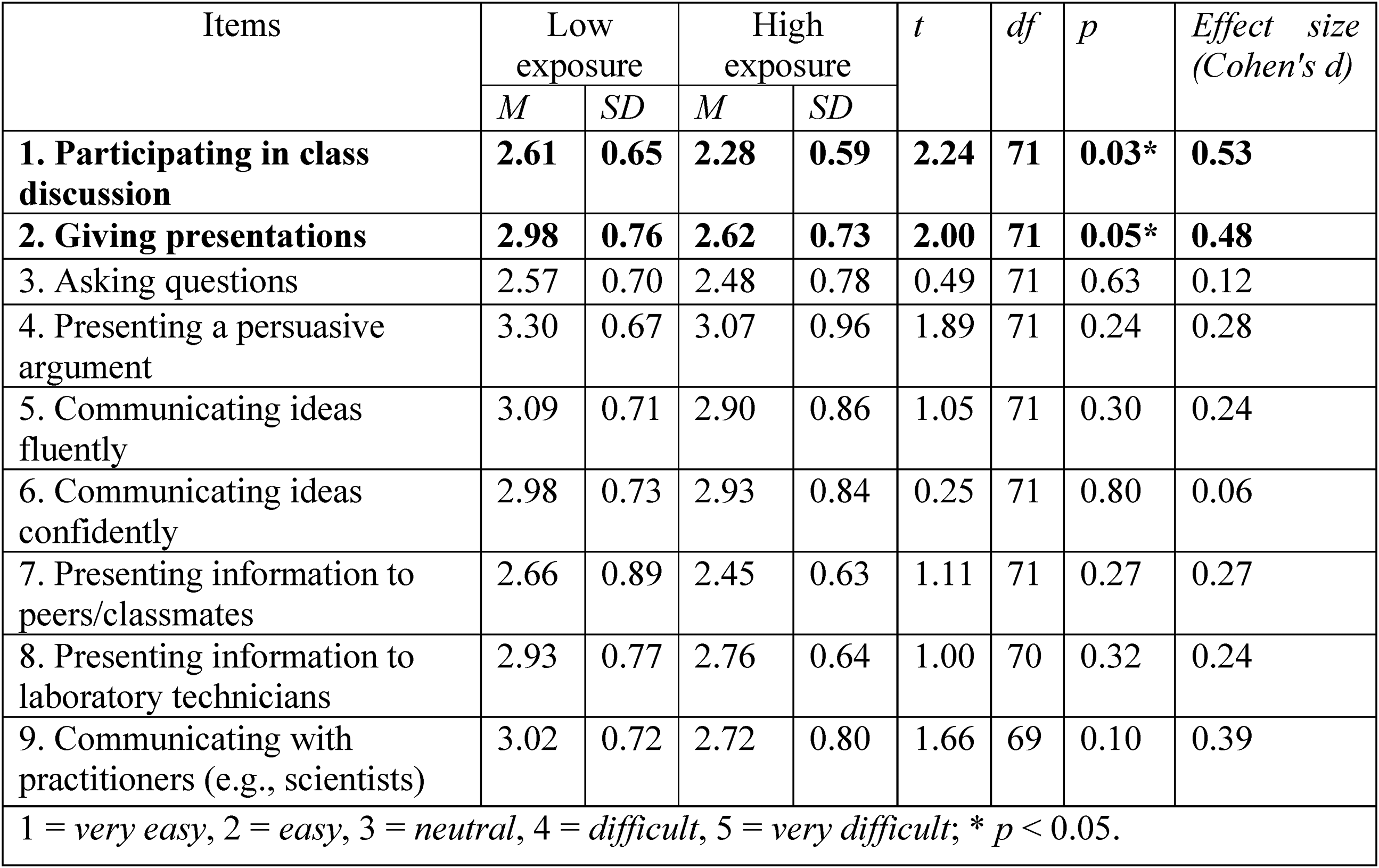
Difficulties in speaking English.
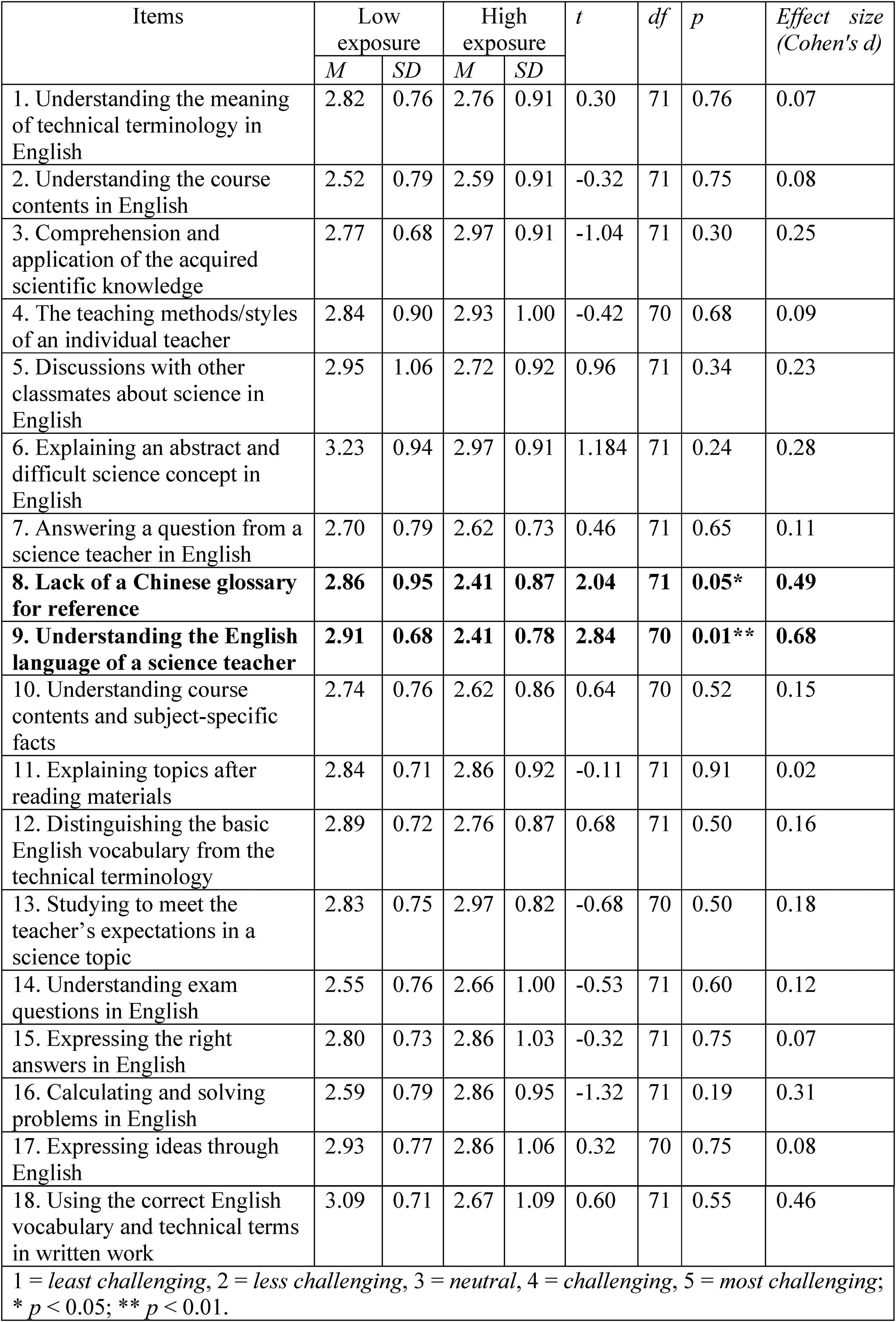
Challenges of studying science in English.
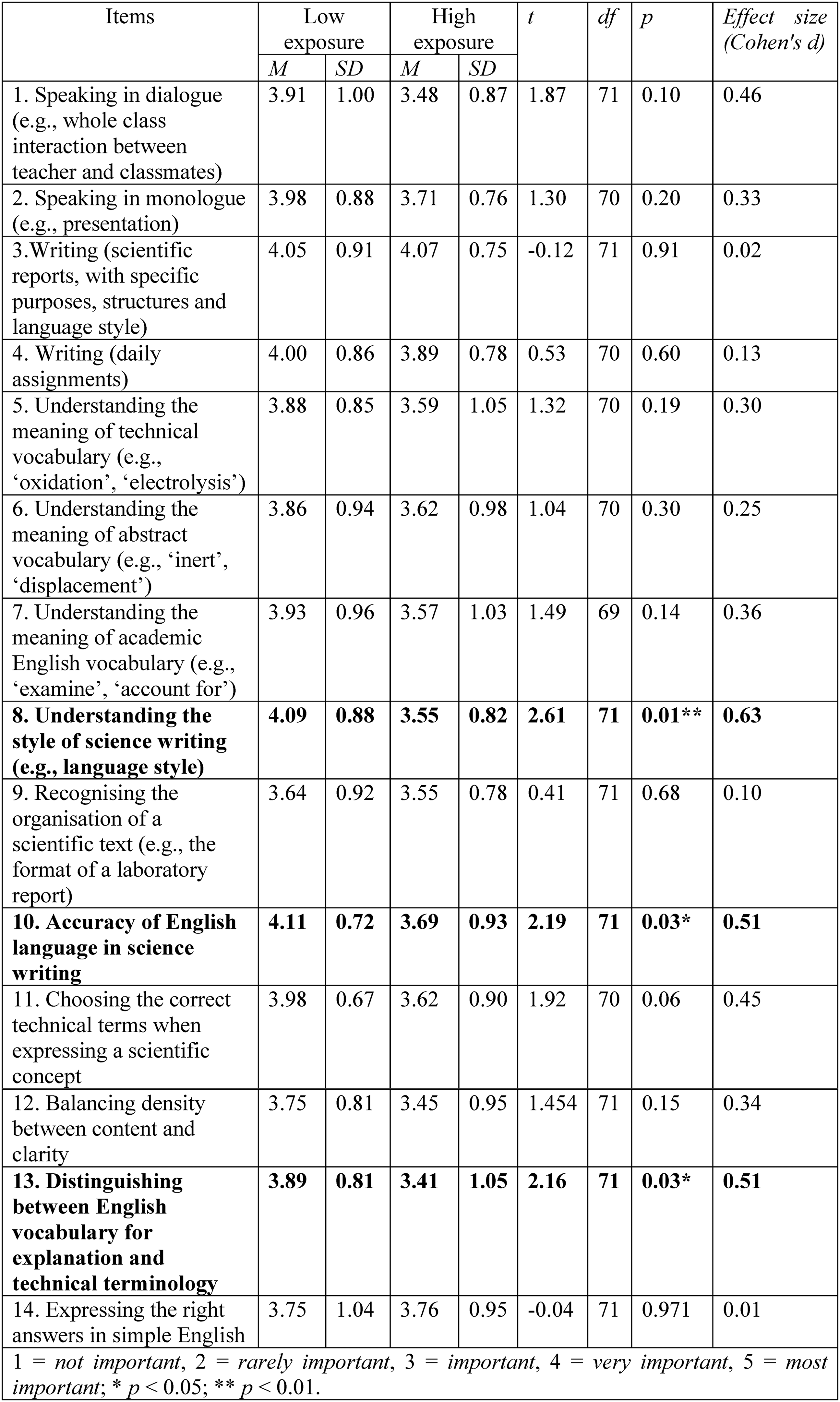
Importance of English skills for learning science.
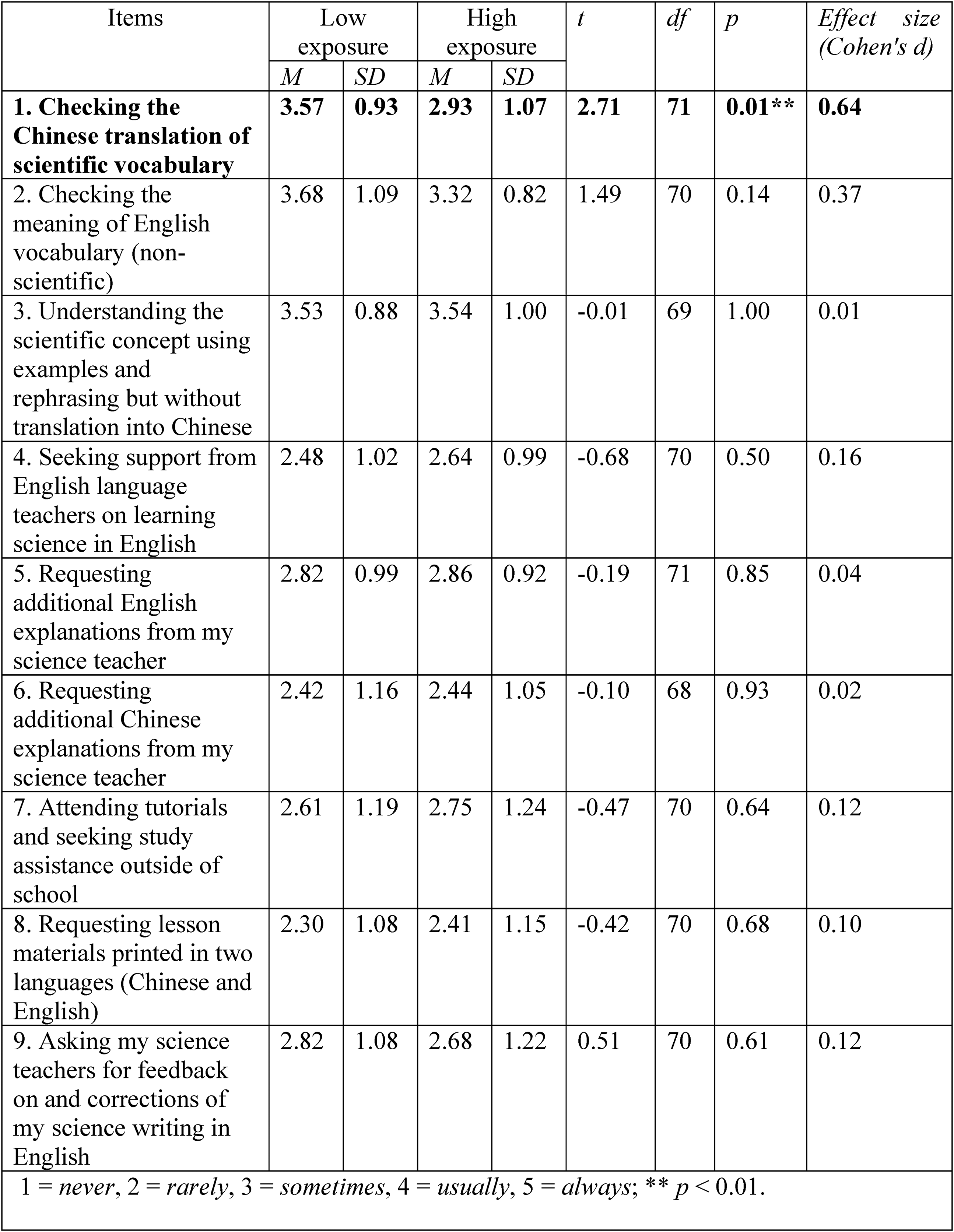
Frequency of learning strategy use.
Findings
Figure 1 shows the descriptive statistics and t-test results for the science students’ perceived challenges in English speaking. Overall, there were no major differences between the challenges faced by the two groups, the low and high English exposure groups, in their academic communication. The mean scores indicate that the respondents felt they were generally able to handle interpersonal communication in English in the classroom/laboratory without experiencing a great obstacle. However, there were statistically significant differences between the low and high English exposure groups in the challenges of joining class discussions, t(71) = 2.24, p < 0.05, with Cohen's d = 0.53, 95% CIs [0.05, 1.00], indicating a medium effect size, and giving class presentations, t(71) = 2.00, p < 0.05, with Cohen's d = 0.48, 95% CIs [0.002, 0.96], indicating a medium effect size. However, the degree of students’ perceived difficulties was relatively low, implying that neither group encountered major challenges in verbal interactions with peers and academic staff.
Figure 2 displays the descriptive statistics and t-test results for the students’ perceived challenges in studying science in English. Given that the means of most individual items were below 3, the challenges faced by the students in the EMI setting appear to have no significant impact on their actual learning acquisition. The challenges regarding content comprehension and learning adaptability revealed in Figure 2 are likely to be surmountable by students with different degrees of English exposure prior to university. The t-test results between the two groups revealed only two statistically significant differences out of the 18 items. Students in the low English exposure group perceived the lack of a Chinese glossary in most of the learning and teaching materials as a greater challenge, t(71) = 2.04, p < 0.05, with Cohen's d = 0.49, 95% CIs [0.01, 0.97], indicating a medium effect size, than their counterparts in the high English exposure group. In addition, understanding teachers’ English was found to be less of a challenge among students with high English exposure prior to university, t(70) = 2.84, p < 0.01, with Cohen's d = 0.69, 95% CIs [0.21, 1.18], indicating a large effect size.
Figure 3 presents the descriptive statistics and t-test results for the 14 items corresponding to the perceived importance of learning science through English. Regardless of their English exposure prior to university, participants considered English skills to be important for their academic achievement, particularly, for who lacked experience in the EMI context. The mean of students in the low English exposure group was significantly higher than their counterparts in the importance of the following English skills: (1) understanding the style of scientific writing (i.e. the language style and language choice in a laboratory report), t(71) = 2.61, p < 0.01, with Cohen's d = 0.63, 95% CIs [0.15, 1.11], indicating a large effect size; (2) English accuracy in scientific writing, t(71) = 2.19, p < 0.05, with Cohen's d = 0.52, 95% CIs [0.04, 1.00], indicating a large effect size; and (3) distinguishing between everyday vocabulary and technical vocabulary, t(71) = 2.16, p < 0.05, with Cohen's d = 0.53, 95% CIs [0.05, 1.00], indicating a large effect size. Of all these items, students considered English skills in academic writing to be the most important for their academic output.
Figure 4 presents the descriptive statistics and t-test results for the items related to students’ frequency of using different learning strategies. Students in both groups rarely deployed particular learning strategies to overcome language barriers, except for occasionally looking up the Chinese translation of scientific vocabulary, checking the definitions of English non-scientific vocabulary, and using examples and rephrasing to understand scientific concepts. Among the learning strategies, students in the low English exposure group reported looking up Chinese translations of scientific vocabulary significantly more often than students in the high English exposure group, t(71) = 2.71, p < 0.01, with Cohen's d = 0.65, 95% CIs [0.16, 1.13], indicating a large effect size. The results suggest that science students tend to address language issues by themselves simply through looking up the meaning of vocabulary in both Chinese and English, rather than relying on assistance from others.
Discussion
The overall aims of this study are twofold: first, to examine the effect of previous English exposure on the EMI tertiary science students’ perceptions of EMI learning; and, second, to investigate how students with high levels of English exposure prior to university admission differ from the low exposure group in terms of learning strategies adoption. Generally, students in both high and low English exposure groups indicated no major difficulties in speaking English. Regarding the challenges of studying science in English, significantly more students in the low English exposure group reported challenges with a lack of Chinese glossary in learning and teaching materials and understanding the teachers’ English. The two groups perceived English skills to be integral for their academic achievement, while both groups reported deploying minimal learning strategies when language-related learning barriers arise.
Difficulties in Speaking English
Both high and low English exposure groups reported no major challenges in English speaking, implying that all participants were capable of using English for communication in the academic context. However, in Jackson’s (2002) research on EMI undergraduate students in Hong Kong, students were reticent to participate in class discussions, the main reasons being their inability to speak English proficiently and the Chinese cultural factor of avoiding ‘losing face’. However, our participants appeared to be willing and able to communicate orally in English with relative ease. The current findings might be explained by Kim’s (2014) study on the speaking motivation of Korean students under EMI policy, where EMI was found to serve as a mediating factor to motivate and facilitate students’ achievement in English speaking.
Meanwhile, statistically significant differences were found in the two measured items between the high and low English exposure groups, where participants in the latter group perceived classroom discussion participation and giving English oral presentations to be more difficult. Our results cohere with those of Gan (2013), where Chinese students were found to be most concerned about partaking in class discussions, among the activities that comprise academic and conversational English skills. Gan (2013) suggested that certain academic speaking skills, including participating in class discussions and delivering oral presentations, require a broader spectrum of vocabulary knowledge, grammatical sophistication and discourse proficiency. The low English exposure group might be less competent in those skills due to having less prior exposure to the English language at secondary level, thereby experiencing more challenges in the two subcategories in English speaking compared to their counterparts.
Educators should take account of students’ confidence in speaking English. For example, they can facilitate the verbal responses of students with lower English-speaking competency by providing language frames to support students’ production of language and including think-pair-share time to allow students to spend some time discussing their ideas with a classmate before sharing their responses in the EMI classroom (Richards and Pun, 2022).
Challenges of Studying Science in English
Our sample on average expressed a neutral attitude towards the challenges arise in EMI science learning. Both groups of students in our study did not express particular challenges in content comprehension, as opposed to the study of Evans and Morrison (2018), which examined the adjustments to EMI higher education among Hong Kong university students. First-year students with CMI background were found to experience greater difficulties in understanding lecture content than those with EMI background, as CMI students were unaccustomed to listening to academic discourse in English (Evans and Morrison, 2011a). It is noted that the study population of the current study was not limited to only first-year students (i.e. participants varied from Years 1 to 4). Those who were at more senior years might gradually adapt to the demands of tertiary-level listening and their listening abilities might be strengthened throughout their studies. Although our findings suggested that prior English exposure did not appear to pose significant effects on students’ content comprehension capabilities, educators may adjust their pace of delivery and recapture the main points of the class, specifically during first-year university courses, to promote the understanding of students with varied English exposure and proficiency levels.
For the questionnaire items of ‘lacking a Chinese glossary for reference’ and ‘understanding the English language of science teachers’, a statistically significant difference was found between the high and low English exposure groups. As suggested by Evans and Morrison (2018), since CMI students were used to reading textbooks in Chinese at secondary level, the lack of Chinese definition and text annotation for both general academic words (e.g. ‘determine’) and specialized terminologies (e.g. ‘glutamatergic neurotransmission’) could impede their university-level English passage reading. University teachers may take students’ diverse reading abilities into consideration and provide additional definitions for the general academic words and specialized terminologies in students’ first language as reference.
The Importance of English Skills for Learning Science
Both groups of participants emphasized the significance of English skills for their learning and academic achievement in science education. Meanwhile, higher ratings were devoted to the following items among students in the low English exposure group, namely ‘the accuracy of English language in science writing’, ‘distinguishing between English vocabulary for explanation and technical terminology’, and ‘understanding the style of science writing’. The two groups of participants demonstrated awareness of the importance of word choice, which aligns with the attributes scientific writers with high calibre should possess, including the reflection of lexical richness and lexical appropriateness in scientific writing, as suggested by Lin and Morrison (2010). However, a statistically significant difference exists in the item of ‘understanding the style of science writing’ between the two groups; participants in the low English exposure group expressed a stronger belief in the importance of mastering the language style as a contributing factor to their success in science learning. Scientific writing comprises a unique form of argument that enables authors to depict existing truths independently and to relay observable facts (Hyland and Salager-Meyer, 2008). Educators should focus on teaching the appropriate writing style for specific scientific genres, such as a laboratory report, to cultivate students’ writing ability in producing a piece of informative and precise scientific essay (Christie and Derewianka, 2008; Halliday and Martin, 2003; Pun, 2019; Matthiessen and Pun, 2019).
Frequency of Learning Strategy use
Minimal use of learning strategies to overcome language barriers in EMI education was reported by both groups of participants. Among the learning strategies listed, all participants self-indicated a higher frequency of use for the self-regulatory items, for instance, ‘checking the meaning of non-scientific English vocabulary’ whereas external assistance such as attending tutorial was minimally employed by both groups of participants. Our findings are in line with a growing body of evidence in the field of language learning strategies; the uptake of strategies and their degree of self-regulation – the autonomy of language learning and strategic learning – can be illustrated by the strategic language-learning behaviour (Thomas and Rose, 2018). In the context of EMI, learners would consciously deploy actions to facilitate their English language usage and content learning to be more efficient when language-related learning difficulties emerge (Thomas and Rose, 2018).
A statistically significant difference was found between the two groups for one subcategory; students with less English exposure reported searching for the Chinese translation of scientific vocabulary more frequently than their counterparts. This result may be explained by Chen and Wong’s (2015) study, which examined the influence of Chinese mindset on academic achievement among Hong Kong university students. They revealed that East Asian students are performance-oriented in their academic studies, and their performance-approach goals make a positive contribution to adaptive learning and academic achievement. The participants with lower-level English exposure in our study might have perceived themselves as being at a disadvantage in EMI classrooms and hence, actively adopt self-regulatory learning strategies to overcome barriers in their studies so that they could achieve their performance goals.
Conclusion
Despite encountering minimal difficulties when speaking English, students in both high and low English exposure groups reported experiencing various challenges in EMI education, and students with different degrees of prior exposure to English tended to adopt different learning strategies to overcome the barriers that arise in their studies. Although students with less prior English exposure reported facing more difficulties in using English, all participants acknowledged the importance of English skills in EMI science education and thus adopted different learning strategies to overcome the study challenges.
This study sheds light on the implementation of EMI in science education, particularly in the Hong Kong context. The pedagogical implications of these findings are first, due to students’ various levels of input into science learning activities, there is a need to provide more English learning environments to encourage the participation of students of all English exposure and proficiency levels, such as through implementing a task-based medium of instruction policy. Second, considering the academic self-perceptions of Hong Kong EMI science students may be a reflection of numerous broader educational and practical issues in EMI education domestically and globally, relevant stakeholders in the education sector such as schools and policy makers should address the following issues: (1) students’ inadequate levels of English proficiency for learning science in English; (2) students’ difficulties in expressing scientific ideas in English; and (3) the investments in the courses of English for Academic Purposes (EAP)/English for Specific Purposes (ESP), which are shown to assist students to master subject-specific terminology, textual structure and common genre features in science education (Jiang and Zhang, 2017).
The current study adopted the instrument of survey to evaluate the academic self-perceptions of participants. This data collection method allows breadth of coverage in the finding patterns; however, it fell short of permitting a richer and more nuanced picture of students’ actual use of English in EMI classrooms. The findings should hence be interpreted with caution. Future studies can supplement this limitation by collecting data via focus group interviews and classroom observation (Pun and Curle, 2021). Also, given the relatively small sample size in the current study, the reliance on p-values for data analysis potentially leads to Type-II errors. Despite the report of effect size using Cohen's d to supplement this limitation, the findings must be interpreted with a high degree of scepticism given the range of error. Third, the population of the current study is based on a convenience sampling, with students across all years at university (i.e. Years 1–4); although the data presented the correlation between English competency and prior English exposure level, the potential change of English proficiency level as a result of the increased English exposure over the course of EMI study at university in non-first year students was not controlled, possibly resulting in an inaccurate reflection of the exposure effect. Lastly, this is a cross-sectional design study; it is unable to document the longitudinal perception of the science learning journey at university towards EMI learning at different stages of the same group of participants. Future research can obtain a baseline measurement of students’ perception of EMI and examine the learning strategies used by students pre- and post-EMI learning at tertiary level.
Footnotes
Acknowledgement
The author would like to thank all the participants in this study.
Author's Contributions
The author is responsible for literature review, data collection and analysis, and manuscript writing.
Code Availability
No data available online. All supporting data can be provided upon request to the author.
Declaration of Conflicting Interests
The author(s) declared no potential conflicts of interest with respect to the research, authorship, and/or publication of this article.
Funding
The author(s) received no financial support for the research, authorship and/or publication of this article.
