




Abstract
This article reports on a study of policymaking at transnational and local universities in China concerning English Medium Instruction (EMI) provision, and the impact this has on stakeholder experiences. It explores policymaking at two transnational universities, which are compared and contrasted with data collected at six other Chinese universities that offer EMI programmes. Data were collected via individual and group interviews with 26 key policy stakeholders during fieldwork at the eight universities and centred on language-related policy diffusion surrounding admissions, language support, and language use. Findings revealed a reliance on foundation year studies at transnational universities versus the Gaokao (national college entrance examination) at other universities to ensure students had the requisite proficiency upon admissions. Findings also revealed transnational universities were more likely to offer language support to their students and have language policies governing language use. Overall, the findings reveal a range of affordances and caveats associated with each institution’s contextualized policy making, causing ease and conflict for EMI stakeholders.
Keywords
Introduction
The exponential global growth of English Medium Instruction (EMI) has occurred in parallel with the rapid internationalization of higher education. As universities have sought different ways to internationalize, many have turned to policies that have Englishized programme curricula as a means to attract English-using international students, as well as to prepare local students to apply their disciplinary knowledge in English within a global workforce. While the definition of EMI is highly debated (see Pecorari and Malmstrom, 2018), for this article, we adopt Macaro’s (2018:19) widely cited definition, that EMI is the ‘use of the English language to teach academic subjects (other than English itself) in countries or jurisdictions where the first language (L1) of the majority of the population is not English’. We have selected this definition due to its relevance to the context of our study’s investigation of Chinese higher education.
A co-occurrence with the Englishization and Internationalization of higher education has been the growth of transnational higher education (TNHE), which comes in a variety of forms from branch and replica campuses of international affiliate universities, to off-shore programmes which offer degrees in collaboration with international partners, to virtual campuses in which the physical presence of the university may be as simple as an operating office (Miller-Idriss and Hanauer, 2011). Despite the growth of transnational universities and campuses since the late 1990s, Knight and Liu (2017) recently queried why little research has been conducted on them. They do not mention notable TNHE research such as investigations in the Middle East by Miller-Idriss and Hanauer (2011) and Phan and Barnawi (2015). But we agree that although much had been written on TNHE (e.g. Healy and Michael, 2007; McBurnie and Pollack, 2000; McBurnie and Ziguras, 2007) there has been substantially less published research on TNHE. Since Knight and Liu’s query, Phan (2017) has provided a recent overview of investigations into EMI and TNHE across greater Asia, and some investigations into TNHE in China have been conducted (e.g. Ou and Gu, 2021).
Despite the fact that transnationalism in Chinese higher education has been growing rapidly in the past two decades, it still remains under-researched. This is especially true from the perspective of research of issues at the crossroad of transnational education and EMI. To address this gap, this article explores policymaking at transnational universities in China in terms of EMI provision, and the impact this has on stakeholder experiences. It takes a case-study approach by exploring policymaking at two transnational universities, which are compared and contrasted with data collected at six other Chinese universities that offer EMI programmes.
Literature Review
The Growth of EMI in China
English medium instruction (EMI), which is often termed as bilingual education in Chinese higher education policy (Rose et al., 2020), has witnessed unprecedented expansion at the tertiary education level over the last two decades (Hu, 2019; Tong et al., 2020). The rapid growth, on the one hand, is catalyzed by support from national policies (MOE, 2001, 2007), which recognize EMI as an important component of internationalizing the nation’s higher education sector and gaining access to cutting-edge science and technology (Hu et al., 2014). On the other hand, the initiative has also gained popularity from HE institutions due to its perceived benefits of boosting the rankings of the universities, attracting high-quality academics, and enhancing the employability of graduates (Hu, 2019). As a result of the dual driving forces, Wu et al. (2010) reported that by 2006, 132 out of 135 universities surveyed offered EMI courses nationwide. More recently, Rose et al. (2020) observed a subtle tendency in policy from 2003 to 2019 that has shifted away from bilingual models of education towards English-only programmes. This observation was based on an analysis of 93 EMI-related policies from 63 universities in China. This trend is in line with the bidirectional purposes of EMI policies, which aim to not only cultivate domestic students with English competence, but also attract international students to study in Chinese universities (Zhang, 2018).
An issue that has perplexed EMI practitioners is the English proficiency of the students (Beckett and Li, 2012; Han and Yu, 2007; Hu et al., 2014). Han and Yu (2007) speculate that the majority of students in Chinese universities (75% of the leading universities and 80% of the ordinary ones) do not arrive at a proficiency level deemed adequate for EMI, even after two years into their university studies. The scenario is even more worrying since the general English education that students receive may leave them ill-prepared for the field-specific academic English required for learning in an EMI environment (Galloway and Ruegg, 2020). Concerns over students’ English competence has raised some researchers’ doubts over the quality of learning of subject content as well as the presumed language gains (Hu and Duan, 2020; Hu et al., 2014; Hu and Li, 2017). In this respect, Fang (2018) calls for appropriate language support to minimize the negative impact on students’ discipline and language learning – an issue that has been scarcely investigated in Chinese EMI contexts. The important questions here are what policies are in place in transnational universities to ensure students have the requisite English language to cope with the demands of an English medium education, and how these policies compare with other universities in China.
The Growth of Transnational Higher Education in China
The expansion of transnational higher education (TNHE) in China initially gained momentum in the 1990s, driven by both an urgency of the Chinese government to internationalize its tertiary education and an accelerating neoliberal trend at universities in developed countries to export knowledge-based products (Huang, 2007). In China, TNHE, also commonly known as 中外合作办学 (zhong wai he zuo ban xue) (De Costa et al., 2020), refers to higher educational services in China jointly run by Chinese and foreign institutions which are offered mainly to Chinese students (State Council, 2003). The China-foreign partnerships can be operated at the level of joint universities (e.g. the University of Nottingham Ningbo), affiliated colleges (e.g. Sydney Institute of Languages and Commerce at Shanghai University), or degree programmes (e.g. Joint MA Programme of International Trade between Nankai University and Flinders University in Australia).
The provisions of TNHE in China has enjoyed strong policy support from the education ministry (see MOE 1995, 2004; State Council, 2003). As a result, over 600 universities in China offered TNHE services partnering with more than 800 foreign institutions from about 40 nations and regions worldwide, leading to 2,238 joint institutions and programmes in total by the end of 2019 (China Education Online, 2020). However, the rapid development of TNHE is not without its concerns, of which quality assurance remains a top challenge (Hou et al., 2014; Hu et al., 2019; Yang, 2008). Since TNHE usually adopts an EMI policy (De Costa et al., 2020), students’ insufficient English competence has become a major impediment to successful learning, as they struggled to understand English texts and English-only taught lectures, and to achieve good scores on standardized international language exams (Hu et al., 2019). To deal with language proficiency issues, some universities in recent years have planned on raising the minimum English requirement in the Gaokao (national university entrance exam in China), yet the efforts are usually restricted by pressures to recruit an adequate number of students (Hu et al., 2019). Further to the rising English requirements, the absence or underdevelopment of relevant learning support or scaffolding mechanisms makes the situation even more alarming.
Another common concern in implementing TNHE is the potential attrition of national identity, culture and character (Yang, 2008; Hu et al., 2014; Huang, 2007). Yang (2008: 283), for example, cautions that the local values and experiences could be ‘overshadowed by the dominant, hegemonic global perspective’ when students are eager to absorb a decontextualized globalized curricula. In a similar vein, Ou and Gu (2021) found that some Chinese students invest in an English identity while limiting Chinese to engage with international students. When the hegemonic status of English is received among local students, they often position themselves as vulnerable language learners and are inhibited from participating in intercultural communication. In this respect, De Costa et al. (2020) have called for more research that explores affordances in the TNHE curricula concerning the use of English as a lingua franca and developing a critical intercultural awareness in students that embraces the multilingual backgrounds of students and faculty.
Research on Policy Diffusion of EMI and Stakeholders ‘caught within’
A recurring finding of much higher education research is that EMI as it is planned in educational policy differs from EMI provision in practice. A study by Aizawa and Rose (2019) at a bilingual Japanese university found stark differences in EMI policy diffusion by stakeholders. For example, interviews with EMI managers and teachers revealed that English proficiency admission requirements to enter EMI courses, which were set out by the university, were not enforced in practice. As a result, students were entering EMI courses under the recommended proficiency threshold, and teachers were resistant about future plans to further enforce the threshold. The study also revealed some resistance to policies that required EMI courses to be taught entirely in English, and a preference for more multilingual pedagogical practices such as translanguaging, which could be applied according to the needs of the students and subject matter.
As highlighted earlier, the policy scan by Rose et al. (2020) indicated a growth in English-only policies at Chinese universities. However, subsequent questionnaires with 561 students and 152 EMI teachers across multiple universities revealed that bilingualism was still the main form of instruction at the classroom level. This finding echoes studies elsewhere that also report on the co-existence of English and Chinese in the classroom discourses (e.g. Beckett and Li, 2012; Hu et al., 2014; Tong and Tang, 2017). Indeed, code-switching to Chinese frequently happens during interactions, or when complex concepts are introduced and explained (Hu et al., 2014). A survey of 243 EMI students in China revealed fewer than 30% of EMI students reported that their EMI lectures were ‘always in English’, indicating that bilingual approaches to pedagogy were still the norm (Galloway et al., 2017).
While such bilingual EMI practices embrace use of the local language, they ultimately favour those students who already have a higher proficiency in English, perpetuating socioeconomic inequalities. Codo (2018) views higher education institutions in general as relying on a meritocratic status quo on the surface to hide conflicting goals and struggles with social inequalities concerning knowledge and power. Extending this idea, Ricento (2018) raises questions concerning English as the global lingua franca instead of, for example Mandarin Chinese, which serves as a first language for a much larger population. English, he argues, offers advantages such as mobility opportunities only for the privileged who are not systemically discriminated against and can afford to learn English. An exploration of differences in admissions and language policies in Chinese EMI might shed light on systematic inequalities in TNHE in light of these arguments.
Differences between policy and practice raise the need to investigate stakeholders who are ‘caught within’ levels of policy diffusion; that is, how policy arbiters interpret policies from above to their own practices and to those below. The further complexities brought about by additional layers of governance in transnational universities also necessitate a need to explore whether policies and their diffusion differ between these universities and other EMI universities within the same context. In this study, we focus our investigation on these differences.
Methods
The main methods of the current study were fieldwork interviews with two arbiters of EMI policy at two transnational universities in China, and an additional 24 interviews with policy arbiters at six Chinese universities to explore commonalities and differences in policy diffusion. The specific research questions are:
How do admissions requirements for transnational universities differ from those for EMI programmes in Chinese universities?
How does English language support for EMI in transnational universities differ from EMI programmes in Chinese universities?
How does language use in EMI in transnational universities differ from EMI in Chinese universities?
Sampling and Research Context
In total, data were collected from 26 participants at eight universities which were purposively sampled according to university type. These included two C9 League universities (China’s Ivy League); two language-specialist universities (one highly ranked and one not); two Class A universities funded under the double first-class university scheme that aims to internationalize Chinese higher education; and two transnational university (one established and one emerging). The two transnational universities form the main data set for this study and are benchmarked against the policies and practices of the larger pool of universities.
While previous research has situated policy arbiters at an institutional level (e.g. De Costa et al., 2020), in our study an EMI arbiter is defined more broadly as any person whose perspectives or actions have influence in their immediate sphere of EMI implementation. Accordingly, our final sample included four senior managers (e.g. heads of divisions or faculty deans), four senior staff of faculty development units, two senior managers of international programmes, four EMI programme directors, and 12 EMI professors and lecturers. At the transnational universities, interviews were conducted with a senior manager and programme director, who were the only non-Chinese participants in our study. These participants are outlined in Table 1.
List of EMI Arbiters.
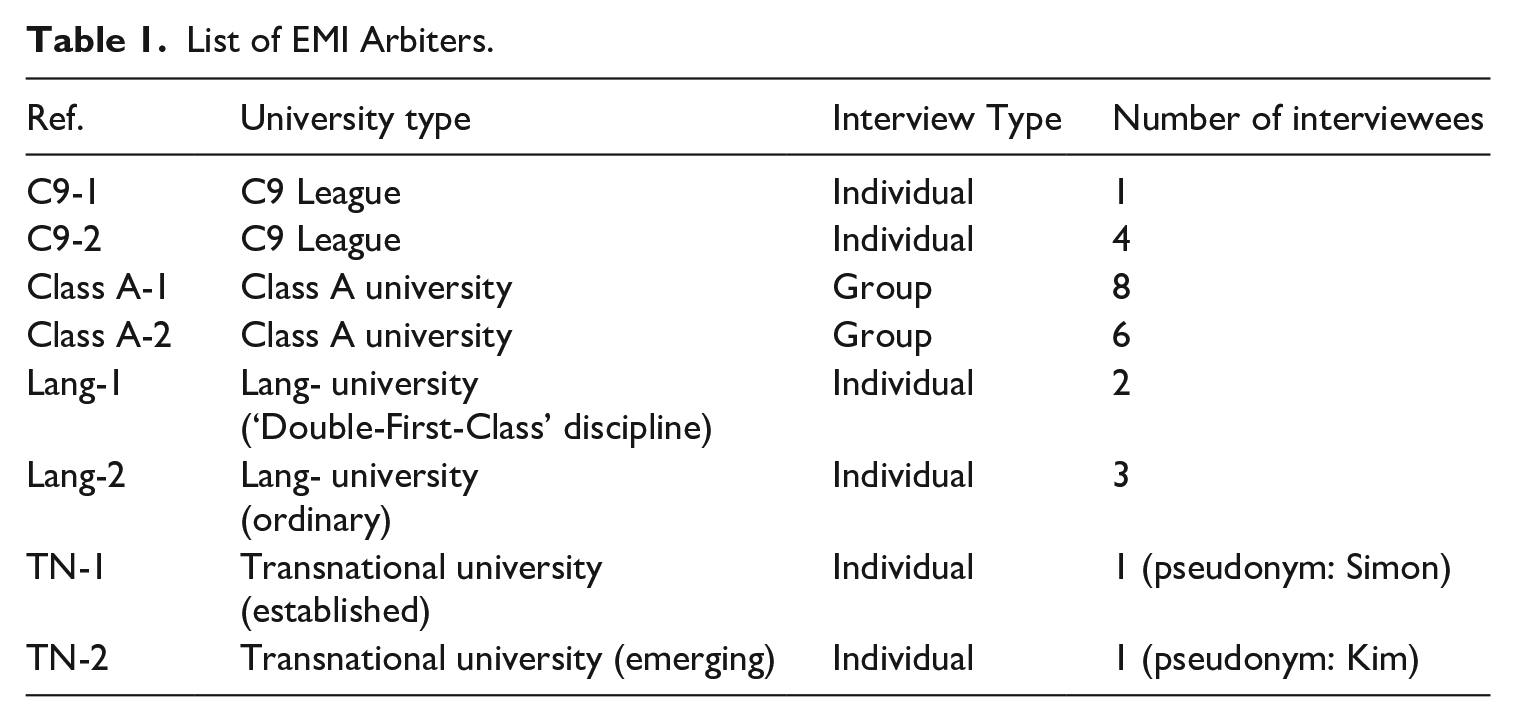
Due to the ethical needs to maintain anonymity among a small pool of transnational universities in China, we are unable to provide a detailed description of each research context. We can report that both transnational universities are best described as ‘New turnkey–foreign style affiliated institutions’, which are based on a foreign model of higher education and founded by a local university in collaboration with a foreign affiliated university that also accredits and recognizes degrees awarded (see Miller-Idriss and Hanauer, 2011). TN-1 is well-established, has more than 10,000 students, and offers programmes across a full range of university disciplines. The arbiter at this university was in a very senior management position at the university (i.e. above the level of a faculty dean) but had also worked in a range of director roles. We refer to this participant using the pseudonym Simon. TN-2 is only recently established, has fewer than 2,000 students, and offers programmes in a more limited range of majors in the liberal arts and sciences. The arbiter at this university was a programme director. We refer to this participant using the pseudonym Kim.
Data Collection and Analysis
Interviews were conducted by all three researchers on visits to each of the eight universities on a research trip to China in September 2019. The interviews followed the format of semi-structured interviews to allow for flexibility and adaptation to differences within each context. At the time of data collection, The People’s Republic of China was preparing for its 75th anniversary, and it was a time of enhanced national security and reduced access for international researchers, resulting in a challenging data collection environment. As a result, the methods of data collection and participant recruitment needed to be adapted to the requirements of each university. At two of the research sites (both the Class A universities), group interviews were organized instead of individual interviews; and at many universities it was only possible to interview a single contact. While this was not ideal for consistency, it did grant the researchers access to a range of people at each university type. The research team included both English- and Chinese-speaking researchers, and while most interviews were conducted in English, some of the group interviews were conducted bilingually according to the preference of each interviewee.
We coded the interview data via repetitive rounds of qualitative content analysis, which Selvi (2020: 244) defines as an ‘analytical method used for the subjective interpretation’ of qualitative data and is ‘concerned with providing a comprehensive and nuanced description of the data’. A deductive approach was taken to extract the requisite data according to each of the research questions. Thus, the following themes informed data coding: 1. Language admission policies in practice; 2. Language use policies in practice; and 3. Language support policies in practice.
Findings
A key consideration discovered in the responses of our participants at transnational universities is that they are ‘caught within’ the implementation of EMI and multiple policies – from the Chinese Ministry of Education (less so) and Chinese society (more so), and from the affiliate university culture (less so) and policy (more so). Certainly, language is at the centre of these multiple factors that, with varying influence, create a complex system for transnational university managers to navigate. In some cases, conflicts between these factors arise, as noted in our interview with Simon: Here [at TN-1] what’s driving EMI is not necessarily English itself but a philosophy of how education should take place. . . The underlying philosophy of this university [is] also a Chinese philosophy. . . [but] we aren’t really preparing students to work in a Chinese society. We ask students to question the Chinese society. I think we need to be creative to make students that can function in dual systems, not just one.
We note that Simon used conflict to generate an important learning objective: one in which students should gain the ability to pursue future endeavours both in China and overseas. Simon went on to explain a further conflict: When the students graduate. . . they benefit from learning a second language, from how they learn. However, these come at a cost for the university. Studying in a second language at a degree level is difficult. We have probably the largest language centre, we have 200+ English teachers teaching varieties of EAP and study skills. We need to support them throughout their journey, but there’s a financial burden to the university.
Having students that can be cultivated in such a way concerns our three key considerations, which all centre around language: language requirements in the admissions process, and then in their EMI studies, language support, and language use.
Admissions Requirements
For the Chinese universities in our study, admissions requirements were generally met through the Gaokao (national entrance exam), although some also described an option of early-selection recommendations (with institutional or program-specific exams). One of the participants explained that the national entrance exam is problematic, as ‘different provinces have different levels of English. . . [and] we can’t do a nationwide oral English test, so that’s a problem’ (Lang-1). She stated this was especially troubling since students who receive offers based on Gaokao scores amount to 50-70% of their enrolment, and applicants from western provinces, who do not need to meet the same language requirements, make up about 15%. There was a general assumption that students who achieved a good score on the Gaokao were good students with sufficient proficiency to study in English, and although there was no department-specific language requirement for students to enter programs, the students were ‘quite good at English’ (Lang-1).
Our C9 league university participants reported that students’ language ability was good because they have the top students in the country, so they could choose EMI courses without any further admissions requirements. At Class A-1, one participant stated a similar assumption. While students had to sit an interview to enter an EMI programme at this university, it was assumed ‘students’ language ability is good enough when they take EMI courses [and have] no difficulty listening to standard English’ (Class A-1). At the ordinary language-focused university (Lang-2), for admission to particular programmes, there were no language proficiency requirements – students could choose any programme, creating the challenge of teaching mixed-level students.
For the transnational universities, there seemed to be more awareness of a need for a policy governing admissions processes surrounding language, such as a requirement to complete a foundation course, and a requirement for international students to score a minimum of IELTS 5.5 1 to enter Year 1. Simon explained that at TN-1, they did not use language as a barrier for entry because they had faith in the EAP programme in the foundation year, which comprised a large portion of language courses, taken alongside introductory EMI courses in Year 1. Upon entry, all students took the Oxford Online Test to stream them by level into their foundation course. For Year 2, students could choose to continue in China or study at the affiliate university, for which they were expected to demonstrate a CEFR high B2 2 level in all four skills. Simon believed that the foundation year helped students to accomplish this.
Kim explained that at TN-2, while they currently did not require IELTS, they were considering using it as the Gaokao did not reflect students’ academic language abilities. Instead, the application consisted of an essay (for Chinese mainland students), a campus visit, attending mock classes, and an interview with a panel of two: one faculty and one academic language staff member. The interview was designed to evaluate the applicant’s language ability, meaning multiple layers of language checks were part of the established admissions process. Similar to TN-1, Kim’s university also required most students to take a year of academic English upon admissions. It was expected that students would improve their academic English skills by completing the programme; neither university required students to pass a proficiency test at the end of the year. However, if the students did not pass the core English skills courses, they were required to repeat the whole year, and could not progress to content classes.
Thus, the awareness of the role of concrete language policies surrounding admissions was clearer in transnational universities than the others in our sample. However, some stakeholders were ‘caught within’ policy and implementation – the different admissions processes resulted in pressure on the EAP systems to provide language support and bring students’ academic English proficiency up to the desired level. At the other Chinese universities (except Lang-2), a level of proficiency was mostly assumed, which was based on Gaokao test performance, coupled with either self-selection in EMI programmes, or ad hoc language checks.
Language Support
Participants at most of the Chinese universities in our study described their students as highly proficient and not requiring language support. One participant pointed out that the language support available depended on students’ undergraduate or postgraduate status, with postgraduate students needing more support. He stated, ‘Both of them get support, but not so much. Support is not the priority of the programme because the students are good’ (Lang-1). At Class A-1, EMI students were required to take two EAP courses, while non-EMI students took four, and there was no subject-specific English support provided. At Class A-2, it was stated that final year undergraduates and postgraduates could take EAP courses, but they were not compulsory. In some programmes, students were expected to learn English in EMI courses: ‘Students choosing EMI expect language training from their EMI courses; the teacher has to balance between content and language – 30 minutes to help with language – in class’ (Class A-2). Thus, at this university, EMI teachers were expected to help students with language learning outcomes. In terms of how they dealt with this expectation, the university did offer professional development to support teaching in general, but not specific to the dual role of teaching content and language. While our participants at Lang-2 recognized that students did not all have a high level of English language proficiency, there were no language support courses offered for EMI students. One participant explained ‘students who don’t know something in class, they’ll ask in Chinese or ask teachers after class’ (Lang-2).
Our transnational university participants expressed more about the importance of both general and discipline specific language support. Kim explained that language support was embedded at TN-2. In their first year, students mostly focussed on EAP writing, but also speaking and presentation skills. When they take these courses, students already work within their chosen discipline, so the academic English language support is designed to address both their general academic writing and reading needs, as well as discipline-specific teaching. At the time of data collection, this university was trialling a credit-bearing discipline-specific writing intensive course led by academics in each discipline ‘with the understanding that it’s their job to support writing within the particular field’ (TN-2). Further support was available through a learning support centre modelled on what might be offered in a North American university writing centre along with independent language learning in the form of facilitating study skills and reading guides.
At the established transnational university (TN-1), Simon described a mandatory introduction to EAP module in the first semester taken by all students, regardless of how they were streamed into one of three bands of EAP classes: high level, standard, and foundation. Depending on the level, the number of hours spent in EAP classes varied: more for foundation students and less for high level students, spending more time with subject specialists who also provided some language support 3 . This comprised most of the first-year programme of which 150 hours (60% of their credits) were dedicated to English study. Students were permitted to fail the first year and take it a second time. Simon also reflected on the large size of the university’s language centre with its hundreds of EAP teachers offering both general and subject-specific English language support. In subsequent years of study, students who undertook EMI courses at the China-based campus could experience a ‘joint delivery. . . [where] there will be an English language expert in the class with a subject lecturer.’ This way, the instructor did not need to be both a subject and language expert. TN-1 also offered drop-in sessions, although these were described as ‘not so successful. . . [with] peaks just before the exams’. This was because the students saw the sessions as an editing service for their writing rather than an opportunity to develop their language skills.
Thus, we found a stark difference between language support provided mainly by EAP teachers in the transnational universities, and language support less clearly defined by the Chinese universities in our sample. By embedding the English support into the programmes and making them credit-bearing, the transnational universities addressed student learning needs through targeted language courses, which had tailored elements to cater to disciplinary needs. Our Chinese universities tended to rely on general English courses and an assumption that the students did not require additional support beyond the foundations provided by their high school curricula, and the university’s general English courses or, more rarely, elective EAP courses.
Language Use
Our participants’ descriptions of policies governing language use varied across institutions. Most of the universities included EMI courses described as delivered 100% in English. However, our participants reported that Chinese was used in many contexts where local students were enrolled to aid understanding. One EMI teacher described situations when sometimes she would apologize to the class so she could ‘explain this a little bit more to the Chinese students’ (C9-2). She stated that the Chinese students would appreciate this, and the international students who understood Chinese also appreciated the use of Chinese as they could practice it. In another example, EMI teachers reported switching to Chinese whenever it seemed students were struggling, noting that students ‘feel more confident and relaxed in Chinese’ (Lang-1). Class A-2 and Lang-2 participants reported that students codeswitched when having trouble following in English, or when there were no international students or the teacher present in discussions: ‘When I’m around they’ll talk in English and if not, they will switch to Chinese’ (Class A-2).
Another participant described the conflict of needing to adapt their language and pedagogy in an English-only environment: [When] all lectures are delivered in English, we cannot explain in Chinese, so sometimes we explain simply in English. We need to cover a lot of materials on a tight schedule [so we] end up decreasing students’ talking time, as we need to incorporate theory and practice. It’s a dilemma – we need to focus on content, but we need to sustain students’ comprehension. (Class A-2)
The EMI teacher participants all seemed to struggle to resolve their practices of occasionally using Chinese (or having to remind students to use English) with the language use policies they attempted to follow, and the content-learning outcomes they needed to meet. Even if policies stated instruction was 90-100% English or those identified as ‘bilingual’, intended for around 40-60% English use (Class A-1) or 60-70% English use (Lang-2), teachers reported difficulties in adhering to these benchmarks.
The transnational university participants cited different expectations concerning the language use policy. Kim explained that while they maintain a primary impetus to use English and English materials, they do not have an English-only policy, including in EAP courses. She stated that student engagement was most important: [One teacher] noticed a lot of Chinese students were quiet with the texts that they’ve been engaging with, which, up to that point had all been English, so she had this brilliant idea of bringing in some Chinese texts that students could access in either translation or Chinese original, and she said the Chinese students just came to life. (TN-2)
TN-1 was the only university in our sample to report an explicit language policy. Simon described the process they used to develop a policy for language use that involved talking with three groups: academic staff, students, and professional service staff. He described a policy that reflected the realities of these groups, noting that while the working language of the university was English, Chinese could be used in particular circumstances identified by the three groups.
Assessment issues were only raised in interviews at the transnational universities. Kim commented: ‘There’s been discussion about assessing writing, like are international students held to a higher standard than their Chinese peers’ (TN-2) because of their assumed language abilities? Simon also raised the issue of language use policy and assessment in relation to the standard of English: [We] need to be realistic about the standard, needless to be a native-speaker standard which is alien to most, and how that plays into assessment; [we decided to] focus on intelligibility rather than perfect English. (TN-1)
However, transnational universities were not without conflict between top-down expectations and on-the-ground realities: these universities had a larger portion of English language courses within programme structures, language policy was more regulated, and there were expectations that courses should be run like an Anglophone university. In practice, however, Chinese was used in reportedly controlled ways within certain contexts and circumstances, such as in the examples above. This compared to programmes at the Chinese universities in our study where language use policies were loosened as needed by teachers, but this was often done in resistance to implicit regulations underpinned by required percentages of instructional English-language content.
Discussion, Implications and Conclusions
In the previous section, we highlighted data that directly responds to our three research questions. In light of these findings, we extend the discussion into three key areas by raising new questions for EMI policy makers and the stakeholders who are ‘caught within’ conflicting policy and practice.
Discussion Point One: Are Admission Benchmarks Necessary?
A primary area of conflict across universities involved admissions benchmarks and students’ language capabilities to undertake EMI after matriculation. Most of the participants at the Chinese universities in our study put a great deal of faith in Gaokao scores, equating them to highly competent students who could handle their studies with little difficulty. This basic assumption about students with high Gaokao scores leaves EMI teachers in a difficult situation, as admitted students then do not need to provide any evidence of English language proficiency to register for EMI courses. At the transnational universities, it was acknowledged that Gaokao scores were insufficient for EMI studies. TN-1 required additional language checks at admissions, while TN-2 placed faith in its foundation year to address language needs of incoming students, thereby selecting students on their academic, rather than language, merits.
Language admission benchmarks have their benefits and caveats for stakeholders. Previous research has shown that higher proficiency students, especially at the IELTS 6.5 or CEFR B2/C1 level, perform better in EMI environments in terms of their ease of study (Aizawa et al., 2020) and content test scores (Rose et al., 2020). Benchmarks would allow those students with higher English language proficiency a better chance of being admitted to university and therefore students would be better positioned to meet study and assessment expectations, thereby lessening tensions faced by EMI teachers to deliver their curricula. The biggest caveat centres on the exclusionary nature of such admissions benchmarks, whereby students who have had opportunities for language development in high school are placed in a privileged position to access EMI courses, which are often run at prestigious universities. A study by Hu et al. (2014: 33) previously found ‘that access to EMI and its potential benefits was largely restricted to the elite, such as students who were already good at English and whose families could afford double tuition fees’. Admission benchmarks that favour students with already proficient English, or who come from wealthy families who invest heavily in their children’s language education, would perpetuate such inequalities in Chinese higher education (see Codo, 2018; Ricento, 2018). Thus, despite the benefits of admissions benchmarks to alleviate pedagogical concerns in EMI courses surrounding proficiency, they may result in ‘perpetuating and accentuating inequalities in Chinese society’ (Hu et al., 2014: 21).
Discussion Point Two: What is the Most Effective Model of Language Support for Transnational Universities?
Research into EMI has shown the benefits of discipline-specific language support in achieving educational outcomes (e.g. Rose et al., 2019) and boosting students’ academic confidence (e.g. Thompson et al., 2019). These types of discipline-specific support were embedded in the programme structures of both transnational universities: a foundational programme, which students complete first, accompanied by a language support centre throughout their studies (TN-1); and an embedded language unit where students take compulsory language courses at the same time as their content courses (TN-2). At the Chinese universities in our sample, participants reported little to no EMI-specific language support beyond general English and non-discipline-specific EAP courses. This may be problematic in meeting students’ language needs, especially since a recent study of EMI universities (including four universities in China), found students and faculty were critical of the relevance of these general classes to EMI (Galloway and Ruegg, 2020). We conclude that the type of integrated support offered at transnational universities may better reflect best practice as reported in the EMI literature.
Discussion Point Three: How Does the Use of Other Languages Work in Practice in EMI Courses? Do Language Policies Actually Have Any Effect on Language Use?
TN-1 benefited from having an explicit language policy that was developed by gathering ideas from academic staff, students, and professional service staff. Rather than being a directive to use English-only, it recognized that there are certain circumstances in which Chinese can and should be used in EMI. Without a specific policy at other universities, EMI stakeholders became ‘caught within’ policy and practice, conflicted by a sense that they were breaking policy rules when using Chinese, which they justified on improving student understanding of content. Certainly, all the participants in our study acknowledged the importance of flexibility around the use of Chinese in EMI courses, and such practices sit within a rich literature showing the benefit of students’ L1 in content classes that are delivered in an L2 (e.g. Ferguson, 2009; Lin and Lo, 2017; Sahan, 2020; Tarnopolsky and Goodman, 2014). This raises significant implications about how to develop policies that more accurately reflect language use in practice. As Simon explained concerning the English standard in language policy at TN-1, an emphasis on intelligibility over native-speaker aspirations serves as a viable policy guide.
While promoting a 100% (or 90-100%) English policy, or a 40-60% English bilingual policy, may be desirable from a management perspective, these policies do not address the realities that language choice is often determined by topic, circumstance, or pedagogical function. Rather than setting language use policies according to percentages, these policies may be better prescribed according to circumstances; including policies for assessment or materials, or pedagogical functions, such as delivering lecture content versus small groupwork. Such finely tuned policies might help stakeholders who are conflicted in terms of applying language policies that they feel contradict the pedagogical needs of their students. Collaboratively developed policies, like in TN-1, may also provide greater research-informed and practice-informed guidance on language use in EMI.
Conclusion
To conclude, our study has pointed to a number of commonalities and differences between transnational and other universities in China that offer EMI. Commonalities include a shared agreement among EMI stakeholders that EMI need not be English-only, despite differences in how this is communicated in actual policy. Differences were found in the role of admissions and language support, with transnational universities requiring students to enter foundation-style courses, albeit in different formats (i.e. led by language specialists as well as in collaboration with subject-specialists at TN-1, or within-discipline writing courses being trialled at TN-2) to prepare students for EMI. Even if such programmes come at a substantial financial cost to the university, other Chinese universities may want to consider adopting such practices to lessen the language-related challenges encountered by students. The adoption of preparatory courses to prepare students for EMI also circumvents a need to have language admissions benchmarks, which can lead to educational and social inequalities.
As our study only explored stakeholder opinions at eight institutions, often with a single arbiter as a knowledge source, future investigation is needed to expand on our results and confirm our observations and recommendations. Further to this, our two transnational universities were both ‘new turnkey–foreign style affiliated institutions’ which placed them with one foot in each country’s educational culture, affording them some degree of autonomy, but also additional layers of policy oversight. Future research into other types of transnational institutions may reveal further differences still among transnational universities and campuses in China.
