




Abstract
While a surge of research has investigated the use of reformulations and models as positive evidence feedback (PEF) in second language (L2) writing, so far no research synthesis seeking to review the status quo of this particular topic has been published. To fill the gap, the present study synthesized 23 studies on reformulations and models as PEF in L2 writing and examined the salient findings regarding three major research strands: (1) students’ noticing and incorporation from reformulations; (2) students’ noticing and incorporation from models; and (3) effects of PEF on L2 writing. Informed by the study findings, we suggest L2 teachers vary their feedback decisions with flexibility, consider individual and contextual factors in PEF practices, combine PEF and corrective feedback to maximize student learning, and provide guidance to support student actions in response to PEF. We also propose three areas for further research, namely going beyond linguistic issues to explore the potential of PEF, systematically investigating factors influencing students’ engagement with PEF, and collecting longitudinal data to examine the long-term effect of PEF. This study enhances our understanding of this emerging research area and provides implications for L2 pedagogy, as well as suggestions for future investigations.
Introduction
In the field of second language acquisition (SLA), two types of knowledge input can be provided to second language (L2) learners: positive evidence and negative evidence (Bruton, 2000). Positive evidence contains information about what is acceptable in the target language and is provided through naturalistic or modified language input, whereas negative evidence refers to information about what is not acceptable in a given language and is mainly obtained through feedback on errors (Bitchener and Storch, 2016). Although both types of evidence can be made available to learners, the bulk of L2 writing research has investigated negative evidence in the form of written corrective feedback (WCF), specifically feedback strategies and scope (e.g. direct versus indirect WCF, focused versus comprehensive/unfocused WCF). In recent years, there has been a growing interest in positive evidence feedback (PEF) as an alternative to WCF (Cánovas Guirao et al., 2015), which is typically manifested in two forms: reformulations and models. Reformulations involve a native/near-native speaker's attempts to rewrite a student's draft, maintaining its original meaning while correcting the student’s writing errors (Thornbury, 1997). Rather than being contingent on learners’ previous drafts, models are samples of well-written texts “tailored to the learners’ age and proficiency level as well as to the content and the genre of the writing task” (Coyle and Roca de Larios, 2014: 453). In contrast with the itemized nature of WCF, PEF intends to promote students’ noticing through the provision of good writing samples, guiding their attention to multifarious sets of expressions, alternative ideas, and content (Hanaoka and Izumi, 2012; Kang, 2020).
PEF is a topic of both theoretical and pedagogical significance in L2 writing. Informed by various interrelated theories under the umbrella term Focus on Form (e.g. noticing hypothesis, output hypothesis, interaction hypothesis), research has argued that PEF helps L2 learners notice the gaps in their L2 knowledge, enables them to make hypotheses about the L2, and facilitates learner uptake of target forms/structures (Bitchener and Storch, 2016; Han and Gao, 2021). These theories and hypotheses provide theoretical grounds for investigating the potential of PEF to facilitate L2 learning. Pedagogically, researching PEF could generate valuable information about how written feedback can be implemented to maximize student learning. Despite the growing attention to PEF in L2 writing, so far no research synthesis seeking to review the status quo of this topic has been published. To fill this gap, the present study aims to synthesize empirical studies on PEF in L2 writing (specifically reformulations and models) and discuss their implications for L2 pedagogy and research.
Review Methods
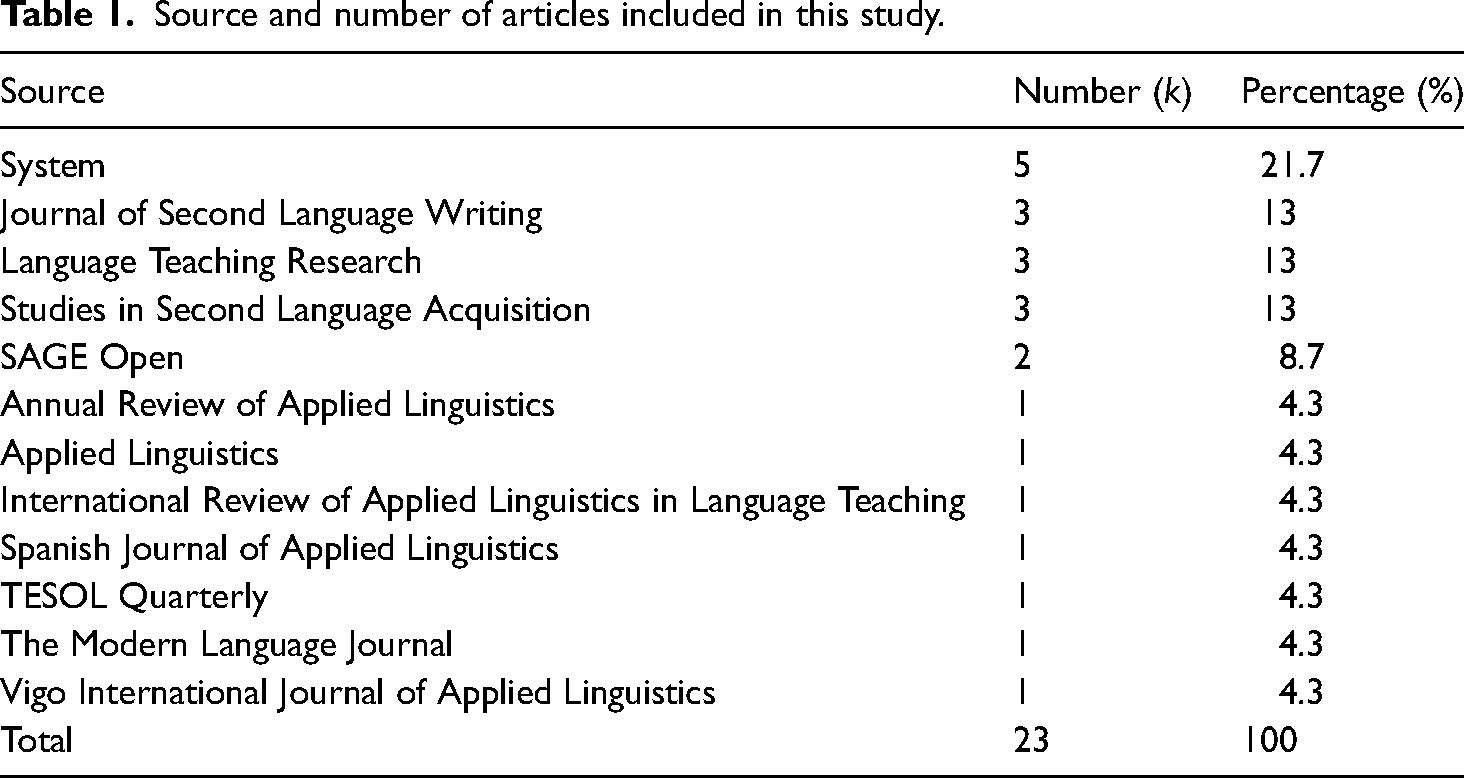
To synthesize research on PEF in L2 writing, we conducted a systematic review to identify, select, and critically appraise relevant studies. Four criteria must be met for a study to be included: (a) positive evidence is provided as feedback after writing; (b) PEF is provided by a teacher/researcher; (c) the study is conducted in L2 contexts; and (d) the study is written in English. A study was excluded if it (a) examines positive evidence as a pre-writing prompt, (b) is not conducted in L2 contexts, or (c) is not written in English. To obtain relevant studies, we consulted four academic databases (i.e. Linguistics and Language Behavior Abstracts, Education Resources Information Center, Web of Science, and Scopus) using the following combination of keywords – model, reformulation, positive evidence, feedback, second/foreign language, and written/writing, and then searched Google Scholar to locate studies unavailable in the databases. The final sample contained 23 primary studies that met our inclusion requirements (see Table 1). Drawing on instruments used in previous synthesis of L2 feedback (e.g. Mao and Lee, 2020), we extracted relevant information about the studies including identification, research context, participants, methodology, and major findings.
Source and number of articles included in this study.
Students’ Noticing and Incorporation of Reformulations
The 23 studies were classified into three major research strands with a few research foci under each strand (see Table 2). One strand of research investigated what features students noticed from reformulations and the extent to which they incorporated these features into subsequent revisions (k = 8). In these studies, reformulations were provided in a three-stage task involving a composition stage (individual or pair/group writing), a comparison stage (comparison between original draft and reformulations), and a revision stage (individual rewriting), with students’ noticing and incorporation performances examined at the comparison and revision stages, respectively.
Research strands, research foci, and key findings of the primary studies.
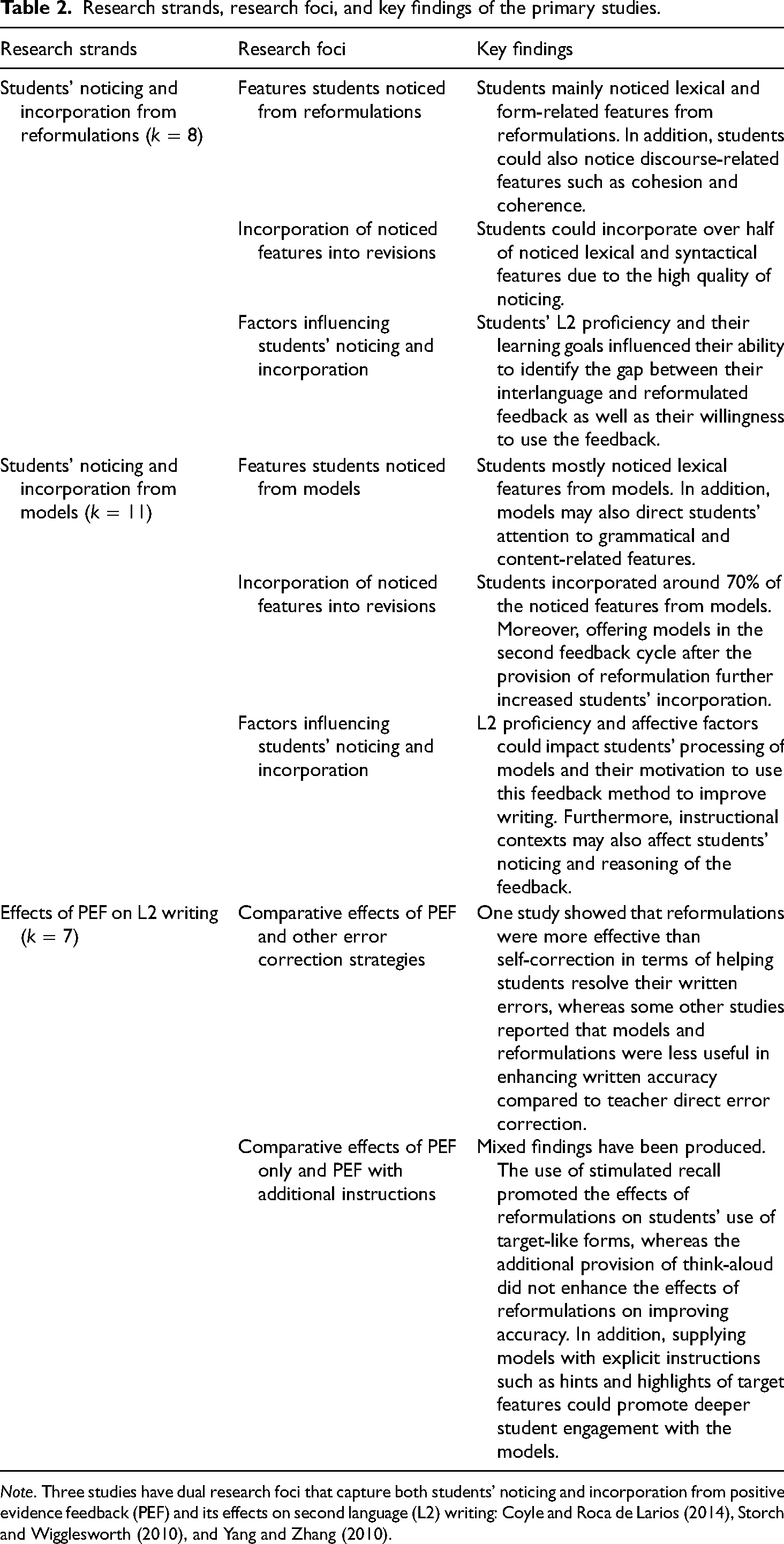
Note. Three studies have dual research foci that capture both students’ noticing and incorporation from positive evidence feedback (PEF) and its effects on second language (L2) writing: Coyle and Roca de Larios (2014), Storch and Wigglesworth (2010), and Yang and Zhang (2010).
Generally, results have shown that students mainly noticed lexical and form-related features from reformulations. Qi and Lapkin (2001) was the first study that examined the aspects of language L2 writers noticed and incorporated from reformulations. Drawing on two English as a second language (ESL) learners’ think-aloud data and written texts, the study revealed that students mainly noticed vocabulary and verb form from reformulations. Subsequent studies conducted in English as a foreign language (EFL) or other contexts, including South Korea, Canada, Iran, and Spain, corroborated the findings that lexis and form were the foci of students’ noticing from reformulations (Lapkin et al., 2002; Yang and Zhang, 2010) and also provided some evidence that reformulations could direct students’ attention to discourse-related features such as cohesion and coherence (Coyle et al., 2020; Sanavi and Nemati, 2014).
To further uncover the effects of noticing on students’ uptake of reformulations, some studies also examined the extent to which the noticed features were incorporated into revisions. It was reported that students successfully incorporated over half of the noticed features from reformulations, which resulted from the high quality of noticing (Allwright et al., 1988; Kim and Bowles, 2019; Lapkin et al., 2002; Qi and Lapkin, 2001). Nonetheless, there were individual differences in students’ incorporation performances, as low-proficiency students often failed to provide reasons for the noticed differences and make appropriate revisions.
The variations in students’ noticing and incorporation may be attributed to several learner factors, such as students’ L2 proficiency and learning goals. For instance, in the two studies by Qi and Lapkin (2001) and Storch and Wigglesworth (2010) carried out in ESL contexts, high-proficiency students were more capable of identifying the gaps between their interlanguage and the feedback, and making successful revisions, than their low-proficiency counterparts. Moreover, students driven by a goal to improve text accuracy could adopt strategies (e.g. memorization) to process and use the feedback, leading to a high level of feedback uptake (Storch and Wigglesworth, 2010). Despite these valuable findings, it should be noted that research on the factors influencing students’ noticing and incorporation of PEF remains rare.
Students’ Noticing and Incorporation of Models
Another research strand looked at students’ noticing and incorporation from models (k = 11), which were also provided in three-stage tasks. While students could notice both lexical and form-related features from reformulations, this line of research suggested that models largely directed students’ attention towards lexical issues (e.g. Cánovas Guirao et al., 2015; Hanaoka, 2007; Lázaro-Ibarrola, 2021; Luquin and Mayo, 2021; Montealegre Ramón, 2019). Such differences might be explained by the diverse populations in that participants in reformulation studies were mainly secondary/undergraduate students, whereas model research was primarily conducted with children whose limited L2 proficiency prevented them from noticing content and discourse-related features (e.g. García Mayo and Loidi Labandibar, 2017; Lázaro-Ibarrola, 2021).
As for students’ uptake of model feedback, results revealed that more than 70% of noticed lexical features were successfully incorporated into revisions (García Mayo and Loidi Labandibar, 2017; Hanaoka, 2007), especially when models were offered in the second feedback cycle after the provision of reformulations (e.g. 80% in Hanaoka and Izumi, 2012, and 77% in Yang and Zhang, 2010). These findings point to the promising value of integrating reformulations and models in feedback practices, given that the two types of PEF could help students attend to different aspects of writing and thus be combined to promote learning. While reformulations mainly provide students with solutions to overt problems (forms that learners directly tried out for problematic features noticed) through sentence-level feedback, models could help students address both overt and covert problems (noticed but partially addressed features) by offering writing samples for the whole discourse (Hanaoka and Izumi, 2012; Yang and Zhang, 2010).
A range of learner-related and contextual factors were found to influence students’ noticing and incorporation from models. Similar to the findings from reformulation studies, the quality of noticing and student uptake in model tasks were also related to L2 proficiency (Cánovas Guirao et al., 2015; Coyle and Roca de Larios, 2014; Hanaoka, 2007). In addition, students who showed positive attitudes and beliefs about the usefulness of models were motivated to use this feedback method to improve writing, which resulted in deep noticing and processing of feedback (García Mayo and Loidi Labandibar, 2017). Although reformulation studies focused largely on individual factors, one study on models (Coyle and Roca de Larios, 2020) indicated that the educational setting influenced students’ noticing and use of linguistic features. As noted by Coyle and Roca de Larios (2020), in the content–language integrated language class, the classroom interactions between students and teachers were jointly constructed through a process of dialogic inquiry, which guided students’ attention to both ideas and lexis and shaped their metalinguistic reasoning of the feedback. However, classroom discussions in the mainstream EFL class revolved around language itself, resulting in students’ limited noticing of vocabulary and linguistic structures.
Effects of Positive Evidence Feedback on Second Language Writing
To date, only a handful of investigations have examined the effects of PEF on L2 writing (k = 7). As research in this area is relatively scant, in this section we present the findings concerning reformulations and models in an integrated manner.
A few experimental studies have compared the writing performance of two student groups either receiving reformulations/models or WCF (k = 3). One study compared the effectiveness of reformulation and self-correction with a group of 16 Spanish EFL learners, demonstrating that both strategies could reduce students’ written errors and that reformulation outperformed self-correction as regards error detection (Lázaro-Ibarrola, 2013). The other two studies, conducted with Spanish EFL children (Coyle and Roca de Larios, 2014) and four pairs of ESL students (Storch and Wigglesworth, 2010), reported that models/reformulations were less useful in enhancing L2 written accuracy compared to teacher direct WCF. Worthy of attention is that research in this area is scarce and mainly involves a small number of students (e.g. children with low proficiency), and therefore generated findings with limited generalizability.
Researchers also investigated whether additional classroom instruction may enhance the effects of PEF on students’ individual writing (k = 4). These studies were also conducted in experimental settings and compared different student groups where additional instruction was or was not given, with mixed findings produced. For example, the use of stimulated recall promoted the effects of reformulations on students’ use of target-like forms (Adams, 2003), whereas think-aloud did not bolster the impact of reformulations (Sachs and Polio, 2007). As for models, evidence suggested that explicit instructions such as highlights and underlines could promote students’ use of rhetorical devices (Abbuhl, 2011), and that students guided through class discussion followed more beneficial learning trajectories and demonstrated a higher level of feedback incorporation (Coyle et al., 2018).
Implications for Second Language Writing Practice and Future Research
Based on the findings from the review, we provide a number of pedagogical implications concerning the use of PEF in L2 classrooms.
When constructing and administering PEF, teachers should vary their feedback decisions (e.g. feedback choices and strategies) with flexibility. Given that providing reformulated feedback requires a massive amount of time and workload as well as the findings that the effectiveness of models may not pale in comparison to reformulations concerning students’ incorporation, it is possible that teachers deploy carefully selected model texts for the majority of students in the class, and offer reformulations to those who have difficulties or show little interest in using models to improve writing. Making adaptions in PEF practices could not only make PEF accessible to learners but also reduce teachers’ workload. PEF has to be sensitive to individual needs and pitched at students’ level so that students know exactly what to do to act upon such feedback. For instance, teachers can encourage students to make individual feedback requests so that models or reformulations could be specific to them. In addition, the provision of model texts should be attuned to the learner's zone of proximal development, taking into consideration their current and potential level of performance. Such individualized and purposeful feedback is more likely to involve students in active learning (Lee, 2017) and help them make improvements in writing. It is also recommended that PEF and error correction strategies (e.g. teacher/peer WCF) be integrated in feedback practices for different teaching and assessment purposes. Instead of seeing PEF and WCF as a dichotomy, teachers can combine both feedback methods in accordance with the focus of teaching and assessment (e.g. form-focused or meaning-oriented). For instance, teachers can provide PEF on students’ first draft, drawing their attention to various aspects of writing and offering opportunities for self-editing. Teacher/peer WCF could then be given to revised drafts for students to fix the remaining errors and produce more accurate texts. Students should be involved in purposeful practices in making judgments about PEF and receive support in understanding teacher expectations concerning students’ action. To do so, teachers may provide coaching and modeling to support student action during the feedback processes, and create collaborative environments (e.g. peer discussion, post-feedback conferences) to offer students more opportunities to use feedback. These pedagogical approaches and practices are conducive to developing students’ capacities to act upon feedback and actualizing the learning affordance of PEF. Go beyond linguistic issues to explore the potential of PEF. While the bulk of research has examined the use of PEF for improving written accuracy, such narrow research scope falls short of uncovering the full potential of PEF. Given that linguistic accuracy is only a small part of teaching L2 writing and students’ responses to feedback is not confined to linguistic errors (Mao and Lee, 2021; Song et al., 2017), further research may go beyond the language dimension to explore the value of PEF for enhancing the content and organization dimensions in L2 writing. Systematically examine individual and contextual factors that influence the effects of PEF. Although current studies identified some learner factors influencing students’ noticing and incorporation of PEF in a piecemeal manner, the limited investigations provide an incomplete picture of the underling mechanisms of PEF. For future investigations, qualitive methodology is encouraged to help researchers gain an in-depth understanding of myriad individual and contextual factors promoting or hindering student engagement with PEF as a whole system. Collect longitudinal data to reveal the long-term effects of PEF. Performed within a short time frame (e.g. one feedback–revision cycle), most existing studies have not captured the longitudinal effects of PEF on L2 writing. However, as noted by Coyle et al. (2018), learners might follow multiple trajectories that have differential impacts on the quality of their written output. To gain a more comprehensive understanding of the potential of PEF for promoting L2 development, further longitudinal research is encouraged to track students’ progress in using PEF to improve writing.
Finally, we propose three research areas to expand current research scope and spur further research on this topic.
Cumulatively, these implications feed into current concerns with how the empirical findings of extant research can be brought to bear on the classroom, and provide further empirical impetus to research on PEF in L2 writing.
Conclusion
This review synthesized 23 empirical studies on PEF in L2 writing, focusing on students’ noticing and incorporation of reformulations and models respectively, and the effects of PEF on L2 writing. Drawing from the review, we offer a number of pedagogical implications concerning the use of PEF in L2 classrooms and propose three research areas in the hope of broadening the current research scope. Admittedly, our review has certain limitations because studies outside of the databases were not included, such as conference papers and master's and doctoral dissertations. Nonetheless, with a focus on high-impact research from our selected databases, the review could advance our understanding of this emerging research area and provide implications for L2 pedagogy, as well as suggestions for future investigations.
Supplemental Material
sj-docx-1-rel-10.1177_00336882211072905 - Supplemental material for Studies on Positive Evidence Feedback in Second Language Writing: Status Quo and Implications
Supplemental material, sj-docx-1-rel-10.1177_00336882211072905 for Studies on Positive Evidence Feedback in Second Language Writing: Status Quo and Implications by Zhenhao Cao and Zhicheng Mao in RELC Journal
Footnotes

References
Supplementary Material
Please find the following supplemental material available below.
For Open Access articles published under a Creative Commons License, all supplemental material carries the same license as the article it is associated with.
For non-Open Access articles published, all supplemental material carries a non-exclusive license, and permission requests for re-use of supplemental material or any part of supplemental material shall be sent directly to the copyright owner as specified in the copyright notice associated with the article.
