




Abstract
Objectives:
The rise in popularity of electronic cigarettes (e-cigarettes) among adolescents in the United States during the past decade is concerning because of the device’s novelty and potential long-term health effects. In response, a federal Tobacco 21 (T21) law was enacted in 2019 to raise the minimum age for purchasing tobacco products and e-cigarettes from 18 to 21 years. We examined changes in adolescent e-cigarette use after implementation of T21 during a period of broader federal tobacco control activity.
Methods:
We analyzed data from the 2019 and 2020 National Youth Tobacco Survey (NYTS) to assess changes in e-cigarette use among middle and high school students aged 9 to 19 years (most aged 13-17 y) following implementation of the federal T21 law. Weighted logistic regression models examined associations between policy implementation and current e-cigarette use, controlling for demographic characteristics and perceived harm and addictiveness.
Results:
The prevalence of current e‑cigarette use declined from 16% (95% CI, 15%-18%) in 2019 to 11% (95% CI, 10%-13%) in 2020. After implementation of the federal T21 law in December 2019, adolescents were significantly less likely to use e‑cigarettes, with a 24% reduction in the odds of current use (odds ratio = 0.76; 95% CI, 0.64-0.91; P = .003).
Conclusions:
Federal legislation such as increasing the minimum age for purchasing tobacco and nicotine products may be an effective strategy in reducing and preventing e-cigarette use among adolescents. Future research should assess the sustainability of the effects of T21 legislation over time and examine how federal policies interact with other public health interventions to influence adolescent e-cigarette use.
The prevalence of electronic cigarette (e-cigarette) or vape use among adolescents in the United States has increased since 2011 and reached a peak in 2019 of 27.5% of high school students and 10.5% of middle school students before declining in 2020 to 19.6% and 4.7%, respectively.1,2 However, these electronic products have remained the most popular tobacco products among adolescents since 2014.1,3 The appeal of e-cigarettes among young people is due to their novelty in design, high nicotine content, fruity flavors, price, safety claims compared with combustible cigarettes, and innovative marketing across media platforms.4,5
Despite the decline in prevalence rates of e-cigarette or vape use, the persistent popularity of e-cigarettes among adolescents raises concerns about nicotine addiction and its effects on the developing brain.6,7 Adolescence is a critical period for proper brain development, and nicotine exposure disrupts the process, affecting cognition and behavior.8-10 Furthermore, nicotine exposure in young people aged <18 years is associated with increases in substance use, and e-cigarette users are 3.6 times more likely than nonusers to progress to smoking combustible cigarettes, which have well-known health risks.11,12 In addition to concerns about nicotine exposure, e-cigarettes pose other health risks such as short-term respiratory effects and probable long-term risks for high blood pressure, stroke, cardiovascular disease, and metabolic dysfunction.13-16
Federal, state, and local policies have historically proven to be most effective in reducing smoking rates. 17 Measures such as smoke‑free policies and increased cigarette taxes have significantly lowered overall smoking rates in the United States and reduced cigarette use among young people.17,18 At the state level, indoor bans and smoke-free air laws have been associated with decreased tobacco use among young people, including adolescents and young adults.18-20 On college campuses, comprehensive tobacco-free policies have been associated with reduced rates of tobacco use. 21 Recently, similar approaches have been introduced to address the vaping epidemic among young people, aiming to replicate the success of past strategies to further reduce e-cigarette use among adolescents.22,23 In February 2020, the US Food and Drug Administration (FDA) introduced restrictions on the sale of fruit- and mint-flavored e-cigarette products, which are the most popular flavors used by children. 22 Prior to these restrictions, in December 2019, the Tobacco 21 (T21) federal law was enacted to increase the minimum age of legal access to tobacco products from 18 to 21 years to limit young people’s access to tobacco products. 23
Current literature on the effect of T21 laws indicates substantial reductions in tobacco and e-cigarette use among adolescents and young adults. State-level T21 polices have been shown to decrease smoking and vaping rates among children and adolescents.20,24 Research examining the federal T21 law has found similar outcomes, including a notable decline in the percentage of 6th to 12th graders who perceived it was easy to buy tobacco products in stores, decreasing from 67.2% in 2019 to 58.9% in 2020. 25 Additionally, studies on the effect of the federal T21 law on tobacco product use among 18- to 20-year-olds found considerable reductions in use. 26
Despite these promising results, data on the effects of the federal T21 law in reducing adolescent e-cigarette prevalence rates are limited. Because policy-oriented approaches have been shown to decrease prevalence rates of combustible cigarette use, more studies are needed to examine how federal age-restriction policies relate to changes in e-cigarette use among young people. We evaluated changes in adolescent e-cigarette use from 2019 to 2020 in the context of the federal increase in the minimum age of sale of tobacco products from 18 to 21 years.
Methods
Study Sample
This study used data from the 2019 and 2020 National Youth Tobacco Survey (NYTS), a cross-sectional, nationally representative cohort of middle and high school students (grades 6-12) from US public and private schools. 27 The NYTS is administered annually and provides population estimates of tobacco and e-cigarette–related knowledge, attitudes, and behaviors among US students. The NYTS uses a stratified, 3-stage sampling design clustered by county, school, and classrooms (students). Counties are stratified by ethnic status and urban versus nonurban designation. Schools are stratified by size (small, medium, large) and type (middle or high). Details on the design of the NYTS are available elsewhere. 27 The final student participation rates for the 2019 NYTS and 2020 NYTS were 85.8% (n = 19 018) and 87.4% (n = 14 531), respectively. We included the total analytic sample of 33 549 respondents in this study. This study involved a secondary analysis of publicly available, deidentified data from the Centers for Disease Control and Prevention’s (CDC’s) NYTS. In accordance with federal regulations (45 CFR 46), and as confirmed by the Florida State University Institutional Review Board (IRB) policies, this research did not constitute human subjects research and, therefore, did not require IRB review or approval.
Measures
The outcome variable of interest was current e-cigarette use. E-cigarette user status was assessed by the question, “During the past 30 days, on how many days did you use e-cigarettes?” Current use, defined as responses of between 1 and 30 days, was classified as a yes, while a response of “0” days was classified as a no. The primary explanatory variable was an indicator for the increase in the age limit, coded as 0 if the response was from 2019 and 1 if the response was from 2020.
Additional covariates used to control for confounding included age, sex (male, female), race (American Indian or Alaska Native [AI/AN], Asian, Black or African American, Native Hawaiian or Other Pacific Islander [NH/OPI], and White), ethnicity (Hispanic, non-Hispanic), perception of e-cigarette harm, and perception of e-cigarette addictiveness. Perceived harm and addictiveness were assessed by 2 questions: (1) “How much do you think people harm themselves when they use e-cigarettes some days but not every day?” and (2) “Do you believe that e-cigarettes are (less addictive, equally addictive, or more addictive) than cigarettes?” For the purposes of this study, we treated answers about harm and addictiveness as categorical variables with a reference group. Regarding perceived harm, responses were “some harm,” “a lot of harm,” “little harm,” and “no harm” (reference group). Regarding perceived addictiveness, responses were “more addictive,” “equally addictive,” “less addictive” (reference group), “never heard of e-cigarettes,” and “I don’t know enough about these products.”
Statistical Analysis
We prepared data and performed statistical analyses using SAS version 9.4 (SAS Institute Inc). For all analyses, we used SAS SURVEY procedures, which are required for producing appropriate weighted population estimates when analyzing data collected with a multistaged probability sampling design. 27 For descriptive statistics, we used PROC SURVEYFREQ to generate weighted frequencies and weighted percentages. In the main analytic model, after controlling for participant demographic characteristics, e-cigarette harm, and addictiveness perceptions, we used PROC SURVEYLOGISTIC to examine the association between current e-cigarette use and implementation of T21. In all analyses, we considered P < .05 to be statistically significant.
Results
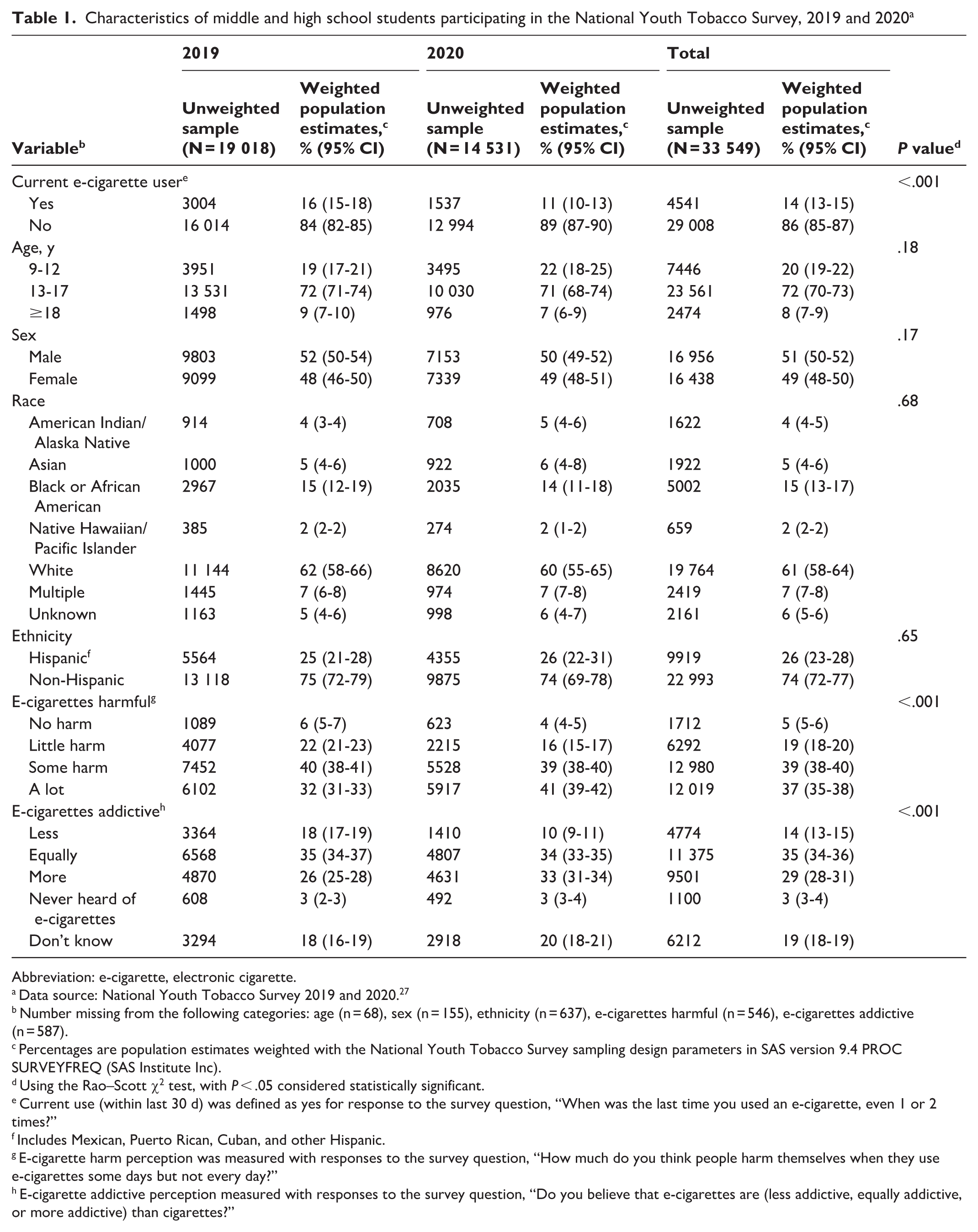
We present weighted frequencies and percentages for descriptive statistics (Table 1). Most respondents in 2019 and 2020 were aged 13 to 17 years (72%; 95% CI, 71%-74%). Slightly more participants were male (51%; 95% CI, 50%-52%) than female (49%; 95% CI, 48%-51%). Current e-cigarette users composed 14% (95% CI, 13%-15%) of the entire sample, with 16% (95% CI, 15%-18%) observed in 2019 and 11% (95% CI, 10%-13%) observed in 2020. Participant perceptions of e-cigarette harmfulness as “a lot” changed from 32% (95% CI, 31%-33%) in 2019 to 41% (95% CI, 39%-42%) in 2020. Participant perceptions of e-cigarettes as more addictive than tobacco cigarettes changed from 26% (95% CI, 25%-28%) in 2019 to 33% (95% CI, 31%-34%) in 2020.
Characteristics of middle and high school students participating in the National Youth Tobacco Survey, 2019 and 2020 a
Abbreviation: e-cigarette, electronic cigarette.
Data source: National Youth Tobacco Survey 2019 and 2020. 27
Number missing from the following categories: age (n = 68), sex (n = 155), ethnicity (n = 637), e-cigarettes harmful (n = 546), e-cigarettes addictive (n = 587).
Percentages are population estimates weighted with the National Youth Tobacco Survey sampling design parameters in SAS version 9.4 PROC SURVEYFREQ (SAS Institute Inc).
Using the Rao–Scott χ2 test, with P < .05 considered statistically significant.
Current use (within last 30 d) was defined as yes for response to the survey question, “When was the last time you used an e-cigarette, even 1 or 2 times?”
Includes Mexican, Puerto Rican, Cuban, and other Hispanic.
E-cigarette harm perception was measured with responses to the survey question, “How much do you think people harm themselves when they use e-cigarettes some days but not every day?”
E-cigarette addictive perception measured with responses to the survey question, “Do you believe that e-cigarettes are (less addictive, equally addictive, or more addictive) than cigarettes?”
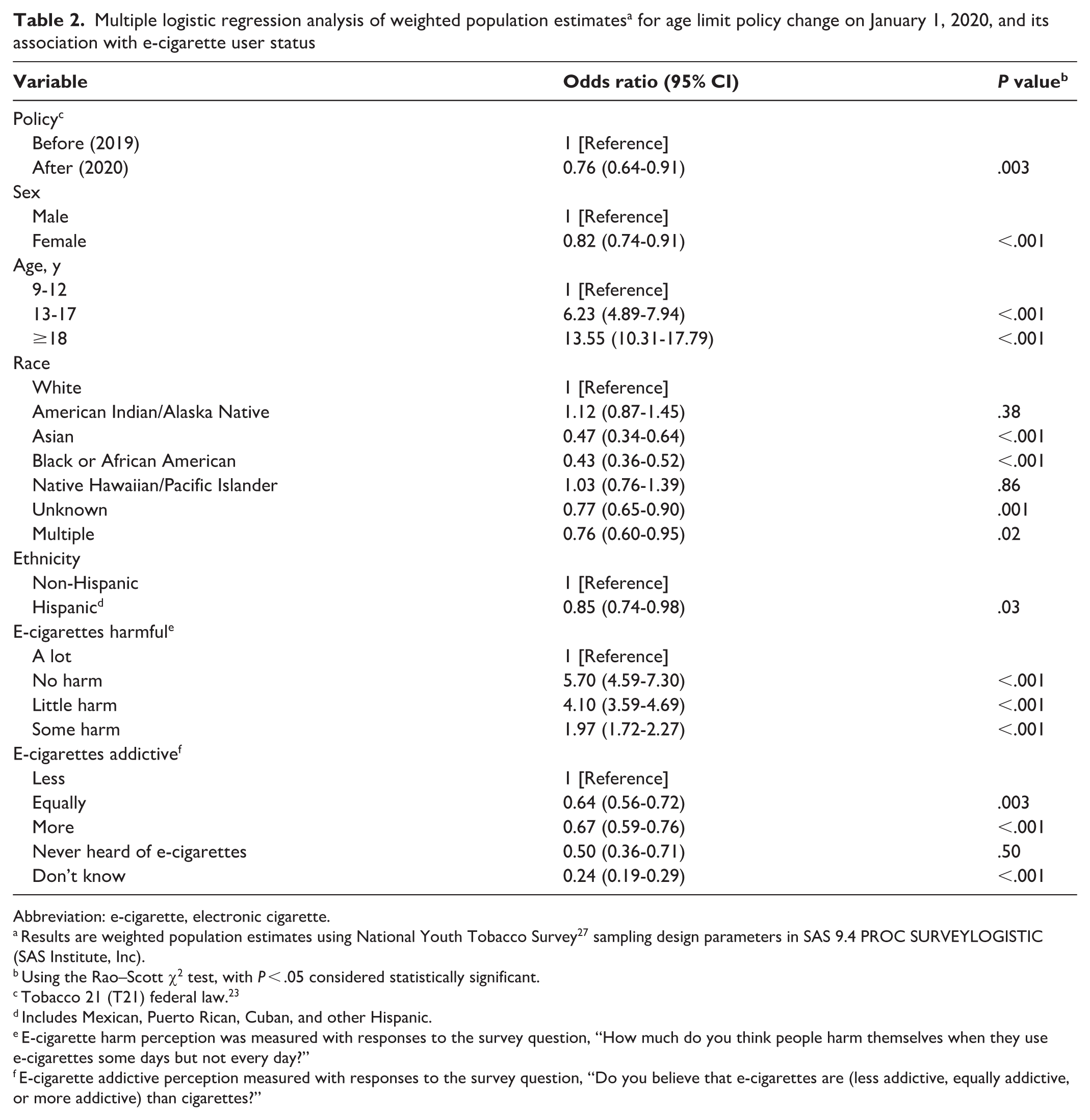
In the weighted multiple logistic regression model, after controlling for demographic characteristics, perceived harmfulness, and perceived addictiveness of e-cigarettes, we found a significant (P = .003) decrease in the odds of current e-cigarette use after implementation of the T21 policy (Table 2). The odds of current e-cigarette use decreased by 24% (odds ratio = 0.76; 95% CI, 0.64-0.91) from 2019 to 2020.
Multiple logistic regression analysis of weighted population estimates a for age limit policy change on January 1, 2020, and its association with e-cigarette user status
Abbreviation: e-cigarette, electronic cigarette.
Results are weighted population estimates using National Youth Tobacco Survey 27 sampling design parameters in SAS 9.4 PROC SURVEYLOGISTIC (SAS Institute, Inc).
Using the Rao–Scott χ2 test, with P < .05 considered statistically significant.
Tobacco 21 (T21) federal law. 23
Includes Mexican, Puerto Rican, Cuban, and other Hispanic.
E-cigarette harm perception was measured with responses to the survey question, “How much do you think people harm themselves when they use e-cigarettes some days but not every day?”
E-cigarette addictive perception measured with responses to the survey question, “Do you believe that e-cigarettes are (less addictive, equally addictive, or more addictive) than cigarettes?”
Discussion
The findings of this study indicate that the decline in adolescent e-cigarette use from 2019 to 2020 occurred during implementation of the federal T21 law alongside other federal regulatory actions, such as restrictions on flavored e-cigarette products. When participant demographic characteristics and perceptions of harm and addictiveness were controlled for, the odds of current e-cigarette use were 24% lower in 2020 than in 2019. These results are consistent with previous research that identified reductions in adolescent tobacco use associated with state- and local-level age-restriction policies implemented before the T21 legislation.20,24,28 Similarly, research examining the effect of the T21 legislation on tobacco product use among young adults aged 18 to 20 years also yielded considerable reductions in usage in this age cohort. 26 Research has primarily focused on state-level laws or assessed federal T21 effects among young adults. By concentrating on people aged <18 years, our analysis clarifies the implications of this national policy on a population at critical risk for nicotine initiation. Because our analysis cannot isolate the effect of T21 from other regulatory actions that occurred during the same period, the findings should be interpreted as reflecting the broader federal policy environment rather than the effect of T21 alone.
In addition to changes in e-cigarette use, our study highlights a notable shift in adolescents’ perceptions during the 1-year period, with more adolescents believing e-cigarettes were harmful (response of “a lot” increasing from 32% to 42%) and addictive (response of “more” increasing from 26% to 33%) in 2020 than in 2019. These changes in perceptions appear to influence behavior, as adolescents who perceived e-cigarettes to be harmful and more addictive than combustible cigarettes had substantially lower odds of using them. These findings align with previous research demonstrating an inverse relationship among harm perception, addictiveness, and tobacco product use.29-31 While our study did not explore the drivers of increased harm perception, research suggests that heightened public education efforts and extensive media coverage, particularly surrounding the 2019 outbreak of e-cigarette or vaping–associated lung injury, played a role in shifting attitudes and behaviors.32,33
Limitations
This study had several limitations. First, the observed decline in the prevalence of current adolescent e-cigarette use from 2019 to 2020 may have been influenced by factors beyond the scope of this analysis. Broader public health messaging, shifting societal norms, increased media attention, and federal actions affecting flavored e-cigarette products could have contributed to this trend.
Second, because the NYTS does not include measures that separate the timing or enforcement of individual federal actions, we could not differentiate the independent effects of the federal T21 legislation from other concurrent policies, such as restrictions on flavored products. These overlapping interventions may have acted synergistically, and future research should aim to examine their individual contributions.
Third, the 2020 NYTS data collection was cut 2 months shorter than expected due to widespread closures of schools during the COVID-19 pandemic. While cutting data collection short may have avoided the confounding effects of COVID-19, it also limited our ability to include additional years of data that would have allowed for a more robust trend analysis. Because administration of the NYTS changed after 2020, subsequent survey years are not directly comparable with pre-2021 data for trend analysis; therefore, we were unable to address the longer-term effect of the T21 legislation.
Taken together, these limitations highlight important directions for future research. Additional studies are needed to evaluate the long-term effects of tobacco control legislation and related educational initiatives, including whether the T21 law has a sustained effect on e-cigarette use and associated health outcomes. Further investigation is also needed to better understand the factors contributing to observed declines in use. Within this context, the present findings support the value of policy-oriented approaches that target adolescents to reduce the initiation and prevalence of vaping. Expanding tobacco control measures, such as implementing nationwide smoke-free laws that include indoor e-cigarette use, could further contribute to reducing prevalence rates.
Conclusions
This study provides nationally representative evidence that adolescent e-cigarette use declined from 2019 to 2020 during a period of federal regulatory change that included implementation of the federal T21 law. These findings suggest that stricter federal tobacco control policies may contribute to reductions in vaping among young people, although the observed trends likely reflect the combined influence of multiple factors, including broader public health efforts and shifting perceptions of harm. Strengthening and expanding tobacco control measures will be essential for preventing e-cigarette initiation, reducing use among young people, and improving public health outcomes.
Footnotes

Funding
The authors received no financial support for the research, authorship, and/or publication of this article.
Declaration of Conflicting Interests
The authors declared no potential conflicts of interest with respect to the research, authorship, and/or publication of this article.