




Abstract
Objectives:
Alcohol-associated liver disease (AALD) is a leading cause of liver disease. Alcohol use disorder is a growing public health problem in the United States. TikTok is a growing source of public health information; such information is not peer reviewed and often does not meet scientific standards. We assessed the quality of AALD information on TikTok.
Methods:
We conducted a retrospective observational study of TikTok videos obtained on March 8, 2024, by searching the phrase “alcohol-associated liver disease.” We analyzed video characteristics, engagement, and content. Three physicians independently assessed the reliability and quality of the videos by using the DISCERN tool and the Global Quality Score (GQS), scored from 1 to 5, with higher scores indicating better reliability and quality, respectively.
Results:
We included 139 videos in the analysis. Video creators/publishers were health care professionals (39.6%), patients and family/friends (35.3%), wellness coaches (22.3%), and others (2.9%). The median (IQR) DISCERN score was 2.0 (1.3-2.7); the median (IQR) GQS score was 2.5 (1.5-3.3), indicating the videos were of low quality. Videos by health care professionals had higher DISCERN and GQS scores (P < .001) than videos by other creators/publishers. Video characteristics did not differ significantly between creator/publisher types. Regression results indicated that videos from health care professionals correlated positively with higher DISCERN and GQS scores, especially when videos were longer.
Conclusion:
The quality and reliability of TikTok videos on AALD are poor. The public should exercise caution when accessing AALD-related information on TikTok. Health care providers and public health officials should strongly investigate the quality of health information on social media platforms and seek to improve it.
Alcohol-associated liver disease (AALD) is a leading cause of cirrhosis, liver cancer, and acute and chronic liver failure. 1 The mechanism is thought to stem from the direct toxicity of alcohol and acetaldehyde in combination with the host’s genetic risk factors. A major part of treating AALD lies in alcohol cessation. However, alcohol use disorder is a growing public health problem in the United States. By 2017, AALD became the leading indication for liver transplants in the nation. 2 Even a short-term increase in alcohol consumption, as seen during the COVID-19 pandemic, can substantially increase long-term AALD-related morbidity and mortality.3-5 Furthermore, not only are AALD-related hospitalizations increasing among young people in the United States, but disease severity is increasing at an accelerated rate among young adults compared with older adults.6,7 Considering the role of behavioral modification as a cornerstone of AALD prevention and the substantial influence of social media on the public, it is important to assess the quality of AALD-related information on major social media platforms such as TikTok. TikTok is a video-based social media platform and one of the most successful Chinese social media applications in the world. 8 It has approximately 30 million monthly users in the United States, most of whom are aged 10 to 29 years. 9 Top alcohol-related videos on TikTok are heavily viewed and show a propensity to promote consumption, often ignoring adverse health outcomes. 10
Given TikTok’s popularity and wide domain, this social media platform has the power to assert great influence over its predominantly young user base. Moorhead et al 11 noted that although social media offers a new dimension for health care as a medium to improve health care outcomes, the quality and reliability of the information exchanged need to be monitored astutely.
Furthermore, the health information on TikTok videos is not peer reviewed or fact checked and often does not meet necessary scientific standards. 8 Multiple studies have evaluated the quality of information available on TikTok related to various diseases, including gallstone disease, 12 metabolic dysfunction–associated steatotic liver disease, 13 and Helicobacter pylori infection, 14 to name a few. These studies described health care professionals, medical institutions, science bloggers, news agencies, and general users who publish videos pertaining to diseases and consistently found the quality of health information in these videos to be suboptimal.
Overall, the incidence of AALD is growing among young people in the United States, a group that is substantially influenced by TikTok.6,7 This study aimed to evaluate the quality of AALD-related health information on TikTok in the United States and discuss possible health implications.
Methods
The study was a retrospective observational study of TikTok videos obtained from a smartphone. We used a newly created TikTok account with no prior activity, followers, or interests for all searches. We performed all searches on the same device using a single US internet provider address to maintain consistency and minimize variation in recommended content. We performed no interactions (likes, shares, or prolonged viewing) before or during data collection.
We obtained all videos on a single day, March 8, 2024, to prevent prior content review or data from interfering with randomization and minimize temporal bias. We excluded videos published prior to July 1, 2021, because TikTok underwent changes in its content format and video length policies during 2020-2021. 15 Therefore, earlier videos would not be directly comparable with more recent TikTok content. We obtained videos by searching for the key phrase “alcohol-associated liver disease” and collecting videos until no new videos were obtained. As in other similar studies,13,14,16 we intentionally used a single search term to (1) reduce TikTok’s algorithmic variability with recurrent searches, (2) ensure videos obtained were related to AALD, and (3) allow for reproducibility of results. We obtained a total of 268 videos. We then excluded videos if they were not in English (n = 9), were duplicate videos (reposts or identical content) (n = 7), or were unrelated to AALD, had commercial/promotional content, or lacked audio/visual completeness (n = 113). We included 139 videos in our analysis.
Rating Process
Initially, 2 qualified physicians (K.L.P., K.V.B.) trained in the specialty of internal medicine at a tertiary hospital in the northeastern United States reviewed the data and independently categorized the videos according to study criteria. However, the initial interrater agreement according to Cohen κ was low (DISCERN score [Cohen κ = 0.18]; 5-item Global Quality Score [GQS] [Cohen κ = 0.17]), indicating poor rater reliability (eTable 1 in the Supplement). Therefore, a third physician (J.D.L.) repeated the analysis 5 months later. During the 5-month interval, 27 videos (19.4% of 139 videos) had been removed from TikTok and were unavailable for review by the third physician. We included these 27 videos in our analysis, but we used the ratings of 2 reviewers instead of 3 reviewers for analysis.
The 3 physician reviewers thoroughly read the guidelines on AALD from the American Association for the Study of Liver Diseases. 17 To standardize scoring, they participated in a 30-minute joint calibration exercise via video conference, during which they independently rated a subset of 5 videos and then reviewed and discussed discrepancies. Once the physician reviewers achieved consensus, they independently rated the videos. They also recorded the following basic information on each video: publication date, content creator/publisher (name and self-description), video duration (in seconds), and the number of likes, comments, favorites, and shares (ie, engagement) (eTable 2 in the Supplement).
Completeness
The physician reviewers generated concise analytic memos summarizing each video. They assessed the completeness of AALD-related information in each video by using a 5-point Likert scale across 6 educational domains: definition, symptoms, risk factors, testing, management, and outcomes. Scores captured the extent to which each video addressed these domains as follows: 1 = no content, 2 = little content, 3 = some content, 4 = most content, 5 = extensive content.
Reliability
The physician reviewers used the DISCERN scoring system to evaluate the reliability of each video (eTable 3 in the Supplement). DISCERN is a validated tool designed to help users of consumer health information assess the quality of written information describing their treatment choices. It was created by a panel representing a range of expertise in consumer health, tested by a national sample of health care providers, and found to be applicable to experienced users and providers of health information to discriminate between high- and low-quality publications. 18 The DISCERN tool consists of 16 items scored on a 5-point Likert scale, with higher scores indicating better reliability. The DISCERN criteria include clarity of aims, citation of sources, balance of information, description of treatment options, and overall reliability.
Quality
The physician reviewers used the GQS to assess the quality of the videos; this 5-point scale ranges from 1 (poor quality) to 5 (excellent quality) (eTable 4 in the Supplement).12-14
Statistical Methods
We first categorized the primary types of video creators/publishers and tabulated data on video characteristics: the number of videos produced, days since the video had been uploaded, duration of video (in seconds), and engagement (number of likes, comments, shares, and favorites) across creator/publisher types. For nonnormal distribution of continuous data, we reported the median (IQR). We then used counts and percentages to summarize data on content completeness by the 6 educational domains and the 5-point scoring system. Next, we calculated the mean (SD) for each video characteristic scored for completeness, reliability (DISCERN), and quality (GQS) and summarized these data according to type of creator/publisher. For the 27 videos rated by 2 reviewers, we calculated the mean of 2 reviewers; for the 112 videos rated by 3 reviewers, we calculated the mean of 3 reviewers. We used the Cohen coefficient (κ) to assess rating agreement. The interrater agreement was fair for the DISCERN score (Cohen κ = 0.23) and the GQS (Cohen κ = 0.26) (P < .001).
We then assessed the association between video characteristics and completeness, reliability, and quality scores by type of creator/publisher. We assessed differences in video characteristics by using analysis of variance and differences in scores by using the Kruskal–Wallis test because the scores were ordinal rating scales. We applied a threshold of P = .05 to determine statistical significance (hereinafter, significance). We conducted a multivariable regression analysis to assess how the characteristics of videos, creator/publisher, and engagement related to the quality of the videos.
Ethical Considerations
The study was not considered human subjects research because of the lack of interaction with or collection of identifiable information about human subjects and underwent approval by the Beth Israel Deaconess Medical Center Committee on Clinical Investigations under the protocol number #2024D000474.
Results
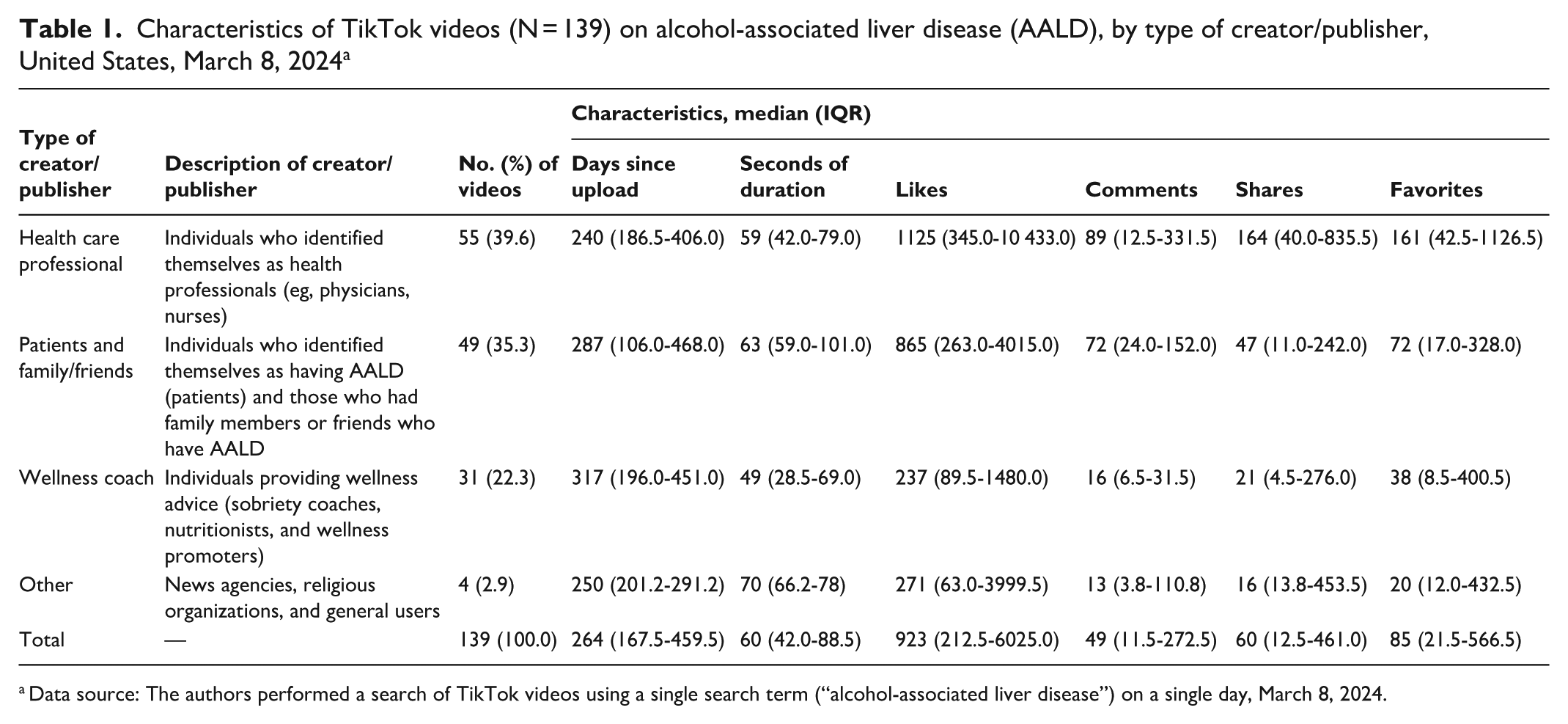
We identified 4 primary types of video creators/publishers: health care professionals, patients and family/friends, wellness coaches, and others. Health care professionals contributed to the greatest number of videos (n = 55; 39.6%), followed by patients and family/friends (n = 49; 35.3%) and wellness coaches (n = 31; 22.3%) (Table 1).
Characteristics of TikTok videos (N = 139) on alcohol-associated liver disease (AALD), by type of creator/publisher, United States, March 8, 2024 a
Data source: The authors performed a search of TikTok videos using a single search term (“alcohol-associated liver disease”) on a single day, March 8, 2024.
The 139 videos accumulated a total of 1 188 370 likes, 32 887 comments, 100 392 favorites, and 112 538 shares. The shortest video was 5 seconds, and the longest was 444 seconds. The median (IQR) duration was 60 (42.0-88.5) seconds (Table 1). The median (IQR) number of days since upload was 264 (167.5-459.5) days at the time of data collection. Median (IQR) engagement metrics were 923 (212.5-6025.0) likes, 49 (11.5-272.5) comments, 60 (12.5-461.0) shares, and 85 (21.5-566.5) favorites. On average, videos published by health care professionals had higher levels of engagement (likes, comments, shares, and favorites) than videos published by other groups.
Thematic Analysis of Video Content
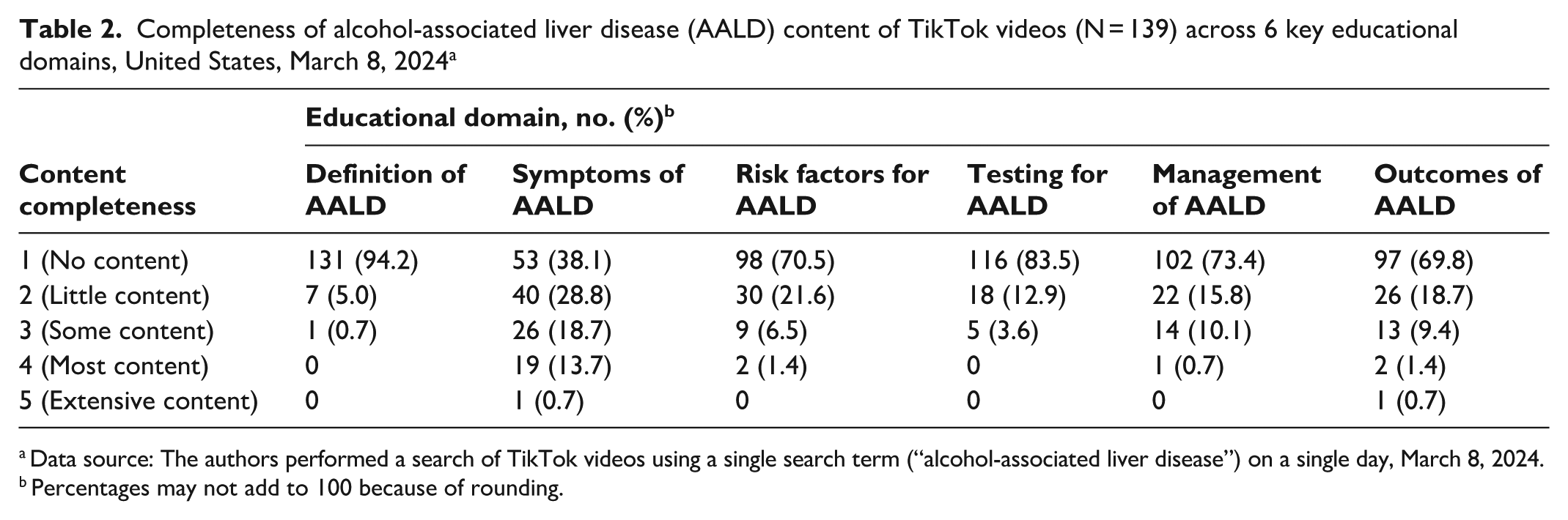
In our analysis of completeness, more than 85% of the videos contained little to no content on the definition, risk factors, testing, management, or outcomes of AALD (Table 2). Symptoms were the most comprehensively discussed content.
Completeness of alcohol-associated liver disease (AALD) content of TikTok videos (N = 139) across 6 key educational domains, United States, March 8, 2024 a
Data source: The authors performed a search of TikTok videos using a single search term (“alcohol-associated liver disease”) on a single day, March 8, 2024.
Percentages may not add to 100 because of rounding.
Definition and risk factors
The pathophysiology and definition of the disease were primarily addressed by videos published by health care professionals. Many videos discussed risk factors for cirrhosis and liver disease within the context of chronic alcohol use, fatty liver disease from poor diet and exercise, infection, and toxin-related disease.
Symptoms and testing
Health care providers offered details of symptoms and progression of the disease from clinical experience. Creators/publishers who had alcohol use disorder and AALD themselves mentioned jaundice and pruritus as common symptoms, but many noted that they were asymptomatic for many years. Testing for the disease was not commonly mentioned; rather, TikTok viewers were encouraged to see their health care providers for further care.
Treatment and outcomes
Most videos emphasized alcohol cessation, healthy dietary intake, and exercise to manage AALD. Publishers who were diagnosed with AALD or had a personal relationship with someone who had AALD provided words of encouragement and support for sobriety. The herbal supplement milk thistle was frequently described as having a hepato-protective effect. Many wellness coaches used their videos to advertise their liver-detoxifying products and lifestyle.
Reliability, Quality, and Completeness
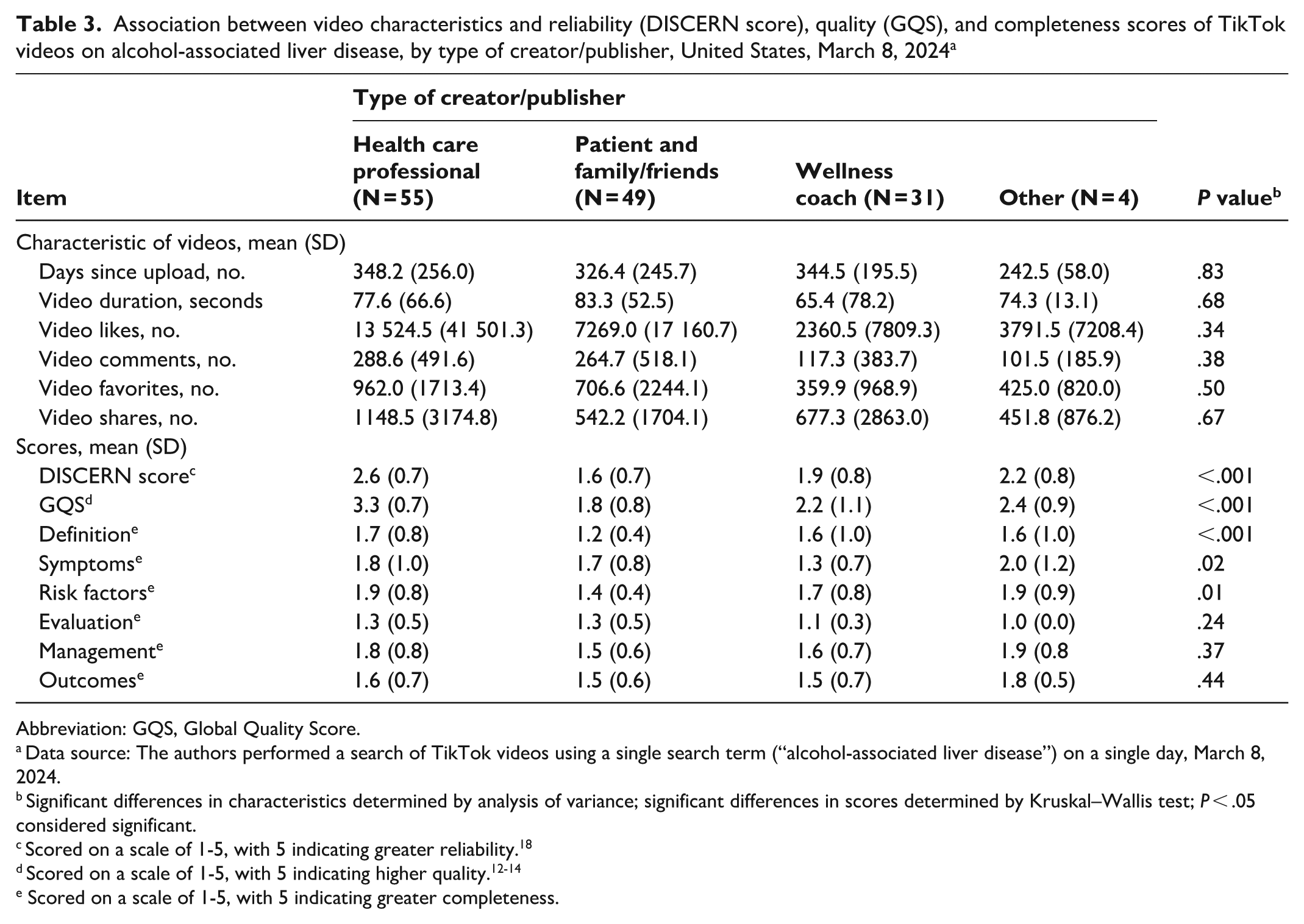
The general reliability and quality of the videos on AALD was poor. The median (IQR) DISCERN score overall was 2.0 (1.3-2.7), and the median (IQR) GQS was 2.5 (1.5-3.3). Videos published by health care professionals, compared with videos published by the 3 other groups, had significantly higher DISCERN scores (mean [SD] = 2.6 [0.7]; P < .001) and GQS (mean [SD] = 3.3 [0.7]; P < .001) (Table 3; eTable 5 in the Supplement). Compared with the other 3 groups, health care professionals also had more comprehensive videos on the definition of disease (mean [SD] = 1.7 [0.8]; P < .001), the symptoms of disease (mean [SD] = 1.8 [1.0]; P = .02), and the risk factors for disease (mean [SD] = 1.9 [0.8]; P = .01).
Association between video characteristics and reliability (DISCERN score), quality (GQS), and completeness scores of TikTok videos on alcohol-associated liver disease, by type of creator/publisher, United States, March 8, 2024 a
Abbreviation: GQS, Global Quality Score.
Data source: The authors performed a search of TikTok videos using a single search term (“alcohol-associated liver disease”) on a single day, March 8, 2024.
Significant differences in characteristics determined by analysis of variance; significant differences in scores determined by Kruskal–Wallis test; P < .05 considered significant.
Scored on a scale of 1-5, with 5 indicating greater reliability. 18
Scored on a scale of 1-5, with 5 indicating greater completeness.
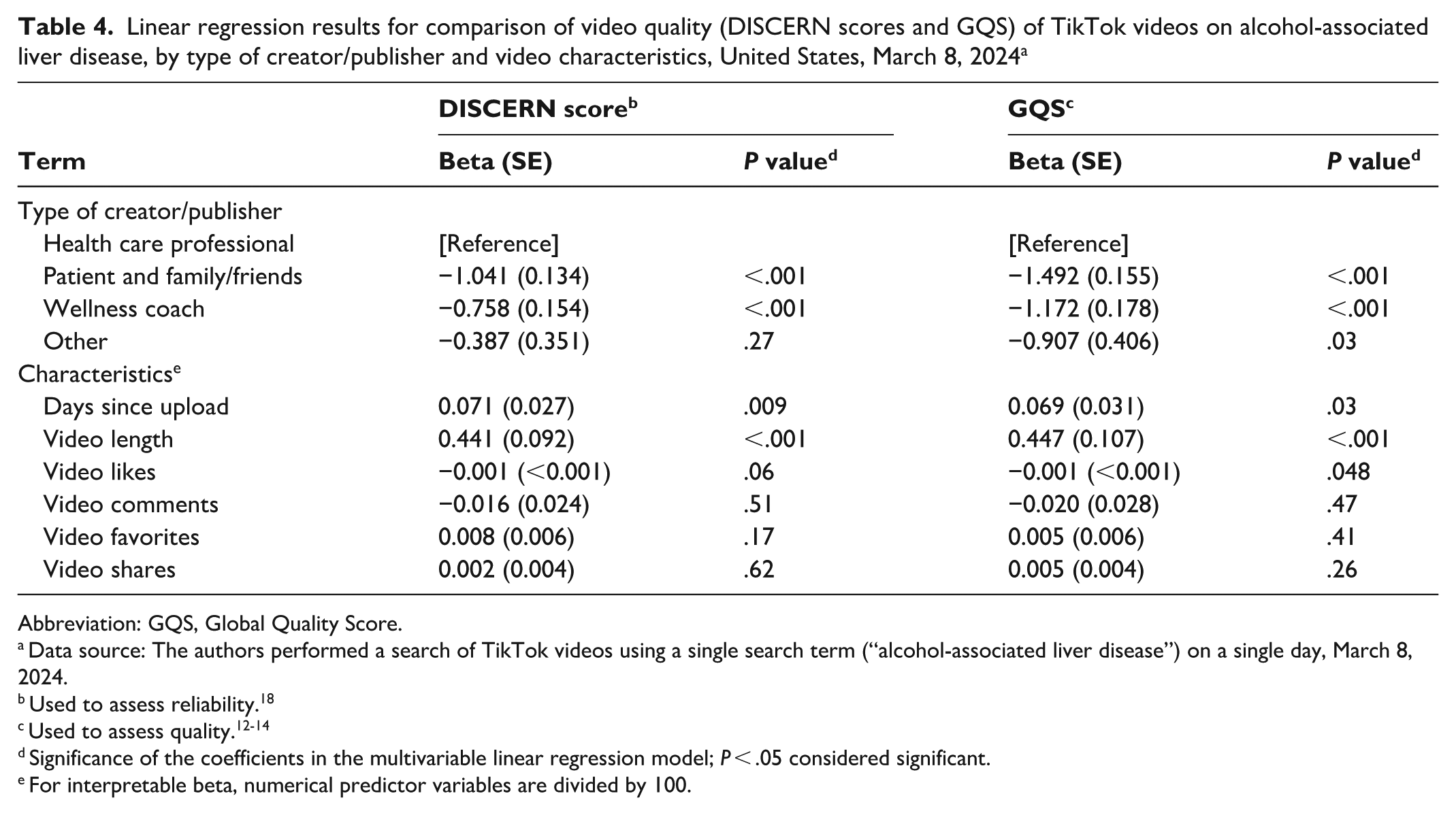
A multivariable linear regression analysis revealed that compared with videos by health care professionals, videos by patients and family/friends and wellness coaches were significantly associated with lower DISCERN scores and GQS (Table 4; eTable 6 in the Supplement). Notably, longer videos were associated with higher DISCERN scores (Beta [SE] = 0.441 [0.092]; P < .001) and GQS (Beta [SE] = 0.447 [0.107]; P = .001) scores. Lastly, as the number of video likes increased, the GQS declined (Beta [SE] = −0.001 [<0.001]; P = .048).
Linear regression results for comparison of video quality (DISCERN scores and GQS) of TikTok videos on alcohol-associated liver disease, by type of creator/publisher and video characteristics, United States, March 8, 2024 a
Abbreviation: GQS, Global Quality Score.
Data source: The authors performed a search of TikTok videos using a single search term (“alcohol-associated liver disease”) on a single day, March 8, 2024.
Used to assess reliability. 18
Significance of the coefficients in the multivariable linear regression model; P < .05 considered significant.
For interpretable beta, numerical predictor variables are divided by 100.
Discussion
Our results highlight the power of TikTok as a social media platform, as demonstrated by substantial user engagement, totaling more than 1 million likes, more than 30 000 comments, and more than 100 000 favorites and shares for the videos collected on a single day. This popularity and accessibility proves TikTok’s potential as an important tool for health care awareness and education, but it remains a non–peer-reviewed source of information.
Liver-related mortality has increased in the United States, particularly among younger people, further increasing during the COVID-19 pandemic. 19 This young population is the predominant user base of social media (especially TikTok) and is more likely than other age groups to be influenced by its content. In addition, 35% of videos included in our study were published by patients and family/friends, highlighting the widespread effect of the disease and the associated caregiver burden.
AALD is a complex disease that involves various disorders. 20 Thus, it is imperative that the public has access to quality health information and that misinformation is minimized. Despite these imperatives, the AALD-related videos have limited content and do not meet the information needs of patients. These shortcomings are evidenced by our study’s findings of low overall median DISCERN scores and GQS, in line with prior similar studies.13,16,21
Our results show that more comprehensive videos are warranted: most AALD-related videos in our study emphasized the symptomatic manifestations of AALD. However, we found little to no content about the definition, management, or outcomes of disease. Reassuringly, most of the videos discussed accurate healthy lifestyle changes, alcohol cessation, and cautionary tales. However, herbal supplements such as milk thistle were promoted, even though data are insufficient to recommend their use among patients with AALD.22,23 In addition, 22.3% of the video creators/publishers were wellness coaches, some of whom advertised their own non–evidence-based products and lifestyle. These gaps underscore the need for intervention to ensure an accurate, reliable information landscape for AALD on TikTok.
Higher DISCERN scores and GQS were associated with longer videos and those published by health care professionals, aligning with prior similar studies. 24 These videos accounted for 39.6% of those included in our analysis. They showcase the strong presence of health care providers on a public stage and demonstrate the rise in medical “influencership,” the use of social media platforms for content creation by health care professionals. These individuals are uniquely positioned to leverage their platforms to correct medical misinformation, advance public health literacy, and advocate for evidence-based care. 25 National health organizations can become involved in partnering with these reputable creators to promote accurate content.
Notably, our regression analysis showed the negative correlation between likes and GQS, suggesting that lower-quality videos tended to result in higher levels of engagement, and high-quality videos may not naturally achieve broad public reach. Thus, health care and public health professionals will need to curate their content in a way that incorporates strategies to engage users, including using appropriate channels to disseminate content, featuring highly visual images or videos, and constantly analyzing and reevaluating dissemination methods. 26
Concern is growing that current regulatory efforts struggle to keep pace with the rapid technological advancements in social media. 27 Consequently, calls are increasing for greater regulation, legislative reform, and oversight of social media practices. Targeted recommendations include legislative changes to hold social media companies accountable for user safety, expand the definition of online harms, and empower and equip regulators. 27 Further measures include mandating advertising and algorithmic transparency, enforcing content moderation, and implementing age restrictions. 27 In addition, given TikTok’s influence on adolescents and young adults in relation to AALD, our data highlight the need for further digital literacy training in this demographic group to help viewers better identify low-quality content.
TikTok even affects politics: the US government issued a ban on TikTok in the United States on January 19, 2025, which was temporarily reversed following the inauguration of President Donald Trump. 28 In the absence of TikTok, alternative social media platforms such as Bluesky 29 and RedNote (Xiaohongshu) 30 would likely fill the void and leave health care and public health professionals responsible for assessing the quality of information conveyed on public platforms to ensure safe dissemination of important topics.
Strengths and Limitations
This study had several strengths, including the use of validated scoring tools to describe a novel topic that, to our knowledge, has not been previously discussed in the literature. Our study is relevant to current public health practice in that it examines aspects of digital misinformation and alcohol-related harms, calls for multidisciplinary action, and has the potential to inform policy discussions.
This study also had several limitations. First, the study used a single-term search, rather than a snowball approach, which would have generated more videos. 31 Second, although TikTok is a global media source, its recommendation algorithms are region specific; thus, the study was restricted to US media content to ensure a consistent algorithmic environment and avoid linguistic inconsistencies. This regional focus limits the reproducibility of our data outside the United States; future studies should be conducted on the quality of information on AALD globally. Third, because the study was cross-sectional, it did not account for changes or trends over time. Research is warranted on changes in outlook and understanding of AALD over time, given the growing use of social media for health information. Fourth, we categorized creators/publishers based on self-identified professions, and false identifications may have been missed.
A fifth limitation was the subjectivity of the data collection method despite using a validated scoring tool. To increase the interrater reliability of the study, we recruited a third physician reviewer. However, due to the resulting delay, 27 videos were no longer available for public viewing. We included these videos in the data but analyzed them using the ratings from 2 reviewers instead of 3 reviewers. These missing videos may have represented a subset of content that was self-deleted or taken down by the platform, possibly due to low quality or misinformation. Their absence may have introduced selection bias in our results, potentially leading to an overestimation of the quality of the videos. However, the overall results were consistent with the results obtained by averaging the scores of 2 reviewers (Supplement), even though the presence of a third reviewer increased interrater reliability. This increase was likely due to the third reviewer resolving minor score discrepancies without substantially altering the ratings. The consistency of the overall results with 2 and 3 reviewers added to the reproducibility and reliability of the data.
Conclusion
The overall quality of health information videos about AALD on TikTok is poor. People should exercise caution when accessing AALD-related information on TikTok. We showed that health care professionals produce higher-quality content and engage users at higher levels than do patients, family/friends, wellness coaches, and general users. As the incidence of AALD grows and the popularity of social media rises, a call must be made for greater public scrutiny of the data available on social platforms. Similarly, health care providers need to expand their role in spreading awareness of health-related misinformation on social media and dispelling mistruths on public platforms.
Supplemental Material
sj-docx-1-phr-10.1177_00333549261438081 – Supplemental material for Quality Assessment of Health Information on Alcohol-Associated Liver Disease on TikTok, United States, 2024
Supplemental material, sj-docx-1-phr-10.1177_00333549261438081 for Quality Assessment of Health Information on Alcohol-Associated Liver Disease on TikTok, United States, 2024 by Kalaila L. Pais, Khushboo Vijay Bhatia, Xinyuan Zhang, Jessica D. Lee and Michelle Lai in Public Health Reports®
Footnotes
Declaration of Conflicting Interests
The authors declared no potential conflicts of interest with respect to the research, authorship, and/or publication of this article.
Funding
The authors received no financial support for the research, authorship, and/or publication of this article.

Supplemental Material
Supplemental material for this article is available online. The authors have provided these supplemental materials to give readers additional information about their work. These materials have not been edited or formatted by Public Health Reports’s scientific editors and, thus, may not conform to the guidelines of the AMA Manual of Style, 11th Edition.
References
Supplementary Material
Please find the following supplemental material available below.
For Open Access articles published under a Creative Commons License, all supplemental material carries the same license as the article it is associated with.
For non-Open Access articles published, all supplemental material carries a non-exclusive license, and permission requests for re-use of supplemental material or any part of supplemental material shall be sent directly to the copyright owner as specified in the copyright notice associated with the article.
