




Abstract
Public health devotes significant resources to address “wicked” challenges, a term coined nearly 50 years ago to distinguish complex problems from tame problems. Tame problems (eg, building a hospital) may be difficult, but known experts and agreed-upon processes exist to address them. Wicked problems (eg, the obesity epidemic) seem intractable, with no agreed-upon solution or cause. Broad agreement exists that wicked problems require collaboration, especially in periods of hyperuncertainty, marked by the rapid onset of multiple wicked problems and uncertainty. One example of a recent hyperuncertain period occurred in 2020, beginning with major political shifts, followed rapidly by COVID-19, widespread social unrest, and multiple crises from extreme weather events (eg, hurricanes). With collaboration increasing, collaboration scholars lament the lack of broad consensus on what distinguishes collaboration from other group work (eg, coordination). Without a common understanding of and roadmap to build collaboration, public health is limited to address wicked problems. To support effective collaboration, we synthesized 4 decades of scholarship to identify where scholars across 3 related areas of collaboration literature are coalescing on the unique elements required for collaboration. From our synthesis, we created a new definition to distinguish collaboration from other group work, including its requisite key elements that public health can use as guideposts to collaborate effectively. We found no explicit focus on these key elements in the public health collaboration articles reviewed, a gap this article seeks to fill. Longer term, public health agencies and schools can use this work to bolster transdisciplinary collaborative problem-solving capacity.
We live in increasing hyperuncertainty, or turbulent times, fueled by interrelated, multifaceted, systemic “wicked” challenges.1-5 Wicked problems are often called intractable, having no agreed-upon solution, unclear and multifaceted causes involving more than 1 sector or system, and often polarized, deeply held beliefs (eg, more extreme weather events, the COVID-19 pandemic, the obesity epidemic).1,3-5 Collaboration is broadly touted as the best approach to solve wicked problems, fostering the needed integrative ideation for more informed, innovative solutions, sharing diverse knowledge and resources across sectors.6-9 Additional benefits include increased democratization of information and decision-making, reduced redundancies, and more stable relationships and processes to allow rapid mobilization of collective action as new wicked crises inevitably arise during turbulent or hyperuncertain periods; hyperuncertainty is marked by the often unpredictable onset of multiple wicked problems in close succession.3,4,8-10 An example of a wicked public health–focused problem is the obesity epidemic, a problem that no country has solved despite having evidence-based solutions. 4 The multifaceted, interrelated causes and barriers to addressing this epidemic include the following 4 :
vested economic interests;
access to quality, culturally appropriate health care;
food culture and history;
climate;
access to quality food and physical activity, which are influenced by myriad sectors, including economic, education, business, zoning, and transportation sectors at federal, state, and local levels;
ideological differences; and
increasing hyperuncertainty from emerging crises (eg, extreme weather events, major political shifts, and the often-ensuing polarization) that exacerbates obesity and related health disparities.
Solving wicked problems such as the obesity epidemic requires collaboration across the myriad sectors that influence them, requiring that all relevant sectors agree on what is meant by and uniquely required for collaboration.8,11 Moreover, today’s increasingly turbulent context upends the periods of stability traditionally seen between major societal problems arising, leaving less time to engage people and build the required structures to address rapidly changing contexts and problems, a challenge collaboration can help address.12,13 Yet, broad agreement is lacking on the distinguishing elements of collaboration, thwarting its promise and leading to inconsistent practices and conclusions about its effectiveness.8,14 Many scholars and practitioners conflate collaboration with cooperation and coordination, even though each has different purposes and problems and requires different member interactions and commitments.8,10,11 Without agreement on the differences among these group work approaches, groups working to solve problems together risk continued costly mismatch between their selected approach and the problems they seek to solve.8,15-18
To support public health’s ability to achieve the promise of collaboration, we synthesized 40 years of collaboration and related scholarship to identify where consensus is growing on how collaboration is distinguished from other forms of group work. We anticipate that these findings will catalyze deeper dialogue and exploration by public health scholars and practitioners toward broader consensus on the types of problems for which to use collaboration and what elements are uniquely needed for effective collaboration. We used findings to (1) propose a new comprehensive working definition of collaboration toward gaining broad consensus on what distinguishes collaboration from other forms of group work (eg, coordination), (2) support public health with a potential shared language when building collaboration, and (3) establish a definitional framework that collaborators can use as a guidepost.
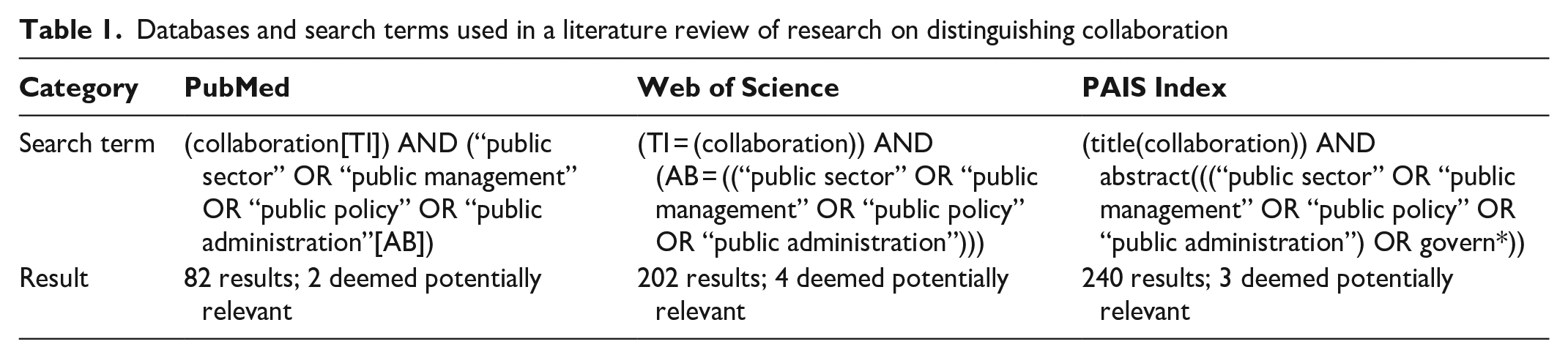
We describe the methods used to identify relevant scholarship (Table 1), the results of the literature review, a new proposed definition of collaboration, and a discussion of the findings and implications of the review.
Databases and search terms used in a literature review of research on distinguishing collaboration
Methods
The search focused on research by collaboration and related scholars across various fields (eg, public affairs/administration, public health, social work, business) to assess the arc of scholarship on distinguishing collaboration and common themes from recent systematic or comprehensive scholarship reviews. This search involved 2 steps: (1) hand searches of Google and Google Scholar and (2) research librarian–guided, search-string searches of 3 public-sector–relevant databases. We chose articles that were accessible and published in English, provided a holistic view of collaboration across myriad sectors, and focused primarily on understanding how to distinguish collaboration from other forms of group work. We did not include single case studies of collaborative work. The lead author (L.A.) first reviewed the title and abstract and, if they met the criteria, we reviewed the full article using the same criteria. We used citation tracing to help identify searches from multiple studies to provide more relevant results over keyword searches and because core concepts have various definitions and uses in the literature. This research did not involve human subjects or data and, therefore, received a non–human subjects research determination by Georgia State University’s institutional review board, which determined that the research met the institutional review board’s ethical standards.
Google/Google Scholar
We iteratively refined keyword searches based on results and also included the names of many of the public administration collaboration scholars deemed missing from Collaboration: What Makes It Work. 19 Search terms included “what is collaboration,” “defining collaboration,” “distinguishing collaboration,” “elements of collaboration,” “qualities of collaboration,” “collaborative governance,” “evaluating (and measuring) collaboration,” “integrative governance,” “public health (and PH 3.0) and collaboration,” “collaboration with community,” “Health in All Policies,” and “cross- and multi-sector collaboration.” This phase had no limit for publication year.
Research Librarian–Assisted Searches
A research librarian from Georgia State University helped create and run additional searches in 3 databases: PAIS Index, Web of Science, and PubMed, with a date range of January 1, 2015, through March 1, 2023, given Mayer and Kenter’s comprehensive collaboration scholarship review. 11 The primary focus was public affairs, because this field has focused on multisector collaboration more deeply and broadly than other disciplines 20 (Table 1).
Discussion
With increasing calls for collaboration,8,11,21,22 various fields have sought to build consensus on what distinguishes collaboration from other forms of group work. While scholars have made important strides, the diversity of scholars has increased the challenge of identifying broad consensus because of field-specific terminology.8,21 Despite these challenges, since 1985, scholars have advanced work to define collaboration more precisely in 2 main ways: (1) conceptualized and more specifically defined unique elements of collaboration, creating several frameworks and measures to better understand how to operationalize and measure collaboration, and (2) as scholars defined collaboration domains and processes more fully and precisely, they began to delineate more explicitly between macro- and micro-levels. 8 Macro-level refers to the overarching structures or domains for the work (ie, the “bones”); micro-level refers to the routinized, relational day-to-day interactions among group members that support and connect those structures (ie, the “connective tissue”). 8
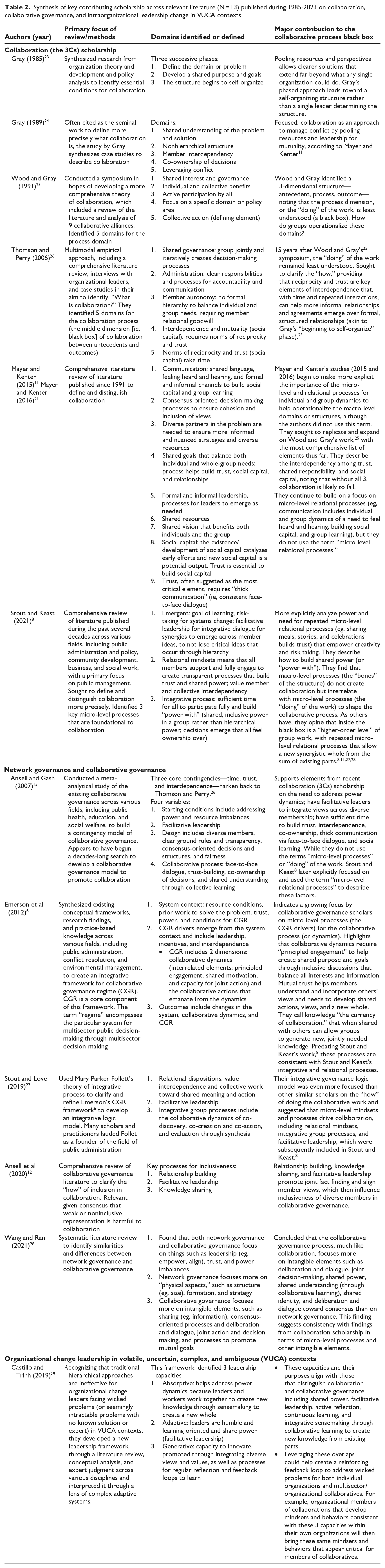
We explored these macro-level structures and micro-level processes through 3 complementary areas of scholarship and frameworks: the 3Cs (collaboration, cooperation, coordination), public governance (network and collaborative governance), and intraorganizational change leadership in volatile, uncertain, complex, and ambiguous (VUCA) contexts. The focus for the literature review and synthesis was on scholarship that sought to understand and reach consensus on the elements required for collaboration, which predominantly emanates from public management/affairs, management and business, and organizational psychology rather than public health. These 3 interrelated scholarship areas, in a quasi-triangulated manner, bolster the findings herein on key defining features of collaboration (Table 2). Synthesis revealed that these works followed a similar evolution: first, they focus on macro-level structures needed for collaboration, and, more recently, they more explicitly identify the micro-level relational processes that support those macro-level structures and distinguish collaboration from other forms of group work.
Synthesis of key contributing scholarship across relevant literature (N = 13) published during 1985-2023 on collaboration, collaborative governance, and intraorganizational leadership change in VUCA contexts
The 3Cs
The first 2 decades of the 3Cs scholarship, a prevalent typology of the continuum of group work intensity, focused on macro-level structures and conditions to define collaboration.11,21,23-26,30,31 Gray described the conditions needed for collaboration at each of 3 progressive stages of development: (1) identifying the domain area, (2) setting the direction (shared purpose defined), and (3) establishing the structure of the work that begins to self-organize.11,21,23,24,26,30,31 Four years later, Gray identified several additional collaboration elements: a shared understanding of the problem and solution, horizontal structure, member interdependency, co-ownership of decisions, and leveraging conflict.11,21,24,26 While, for Gray, power and self-interest were central, Kramer’s book review noted that Gray omitted how to balance power to allow full participation to create mutual gain. 32
In 1991, Wood and Gray held a symposium to identify defining elements of collaboration, assuming that a broadly agreed-upon definition existed, learning through the symposium that that was not the case.11,25 They identified 3 dimensions of collaboration—preconditions, processes, and outcomes—along with 6 elements of collaboration, 1 noted as defining (collective action). Wood and Gray charged scholars to more fully develop the defining elements for the middle dimension (the process, or “how” of collaboration), calling it a “black box” because it remained the least developed and understood.11,25
Fifteen years later, Thomson and Perry sought to illuminate the black box process by identifying 5 macro-level domains (eg, administration) and identified (not explicitly) key micro-level relational processes to support these domains.11,26 For example, they explained that the interdependence domain requires norms of trust that, with time and repeated interactions, can help more informal relationships and agreements emerge over formal, structured relationships. 26
The next substantial contribution, Mayer and Kenter’s 2015 comprehensive study, identified key elements for public-sector collaboration and catalogued the evolution of collaboration literature since Wood and Gray’s symposium. 11 Mayer and Kenter noted that scholarly thinking had evolved considerably since 1999 and identified 9 collaboration domains, with comprehensive definitions for each, including some micro-level relational processes (ie, “connective tissue”). For example, their communication domain must include both informal and formal channels, attention to quantity and quality of communication, and building social capital and group learning. 11 These processes help build cohesion, shared purpose, and buy-in. Without explicitly using the terms “macro” and “micro,” they found interdependency among many micro-level processes, especially trust, shared responsibility, and social capital, suggesting that if one is missing, collaboration will likely fail.11,21 Mayer and Kenter’s domain definitions were more comprehensive than definitions from previous collaboration scholars because they also included descriptions of micro-level processes they note as foundational to operationalizing the macro-level domains they identified and defined. In this way, they advanced a focus on micro-level relational processes for collaboration. 11
Compared with earlier collaboration scholarship, recent scholars have more explicitly named micro-level relational processes, including power dynamics as a lynchpin. A comprehensive literature review on how to include diverse members in collaboratives focused on addressing unequal power to build inclusiveness. 12 Power dynamics was also a central theme in Stout and Keast’s work to distinguish collaboration, referring to micro-level relational dynamics as the “verbs and adverbs” of collaboration. 8
Stout and Keast found that addressing power dynamics to build “power with” is likely the most critical defining process of collaboration, given its primary purpose of co-creating a new whole through repeated interactions requires shared power. 8 This conclusion is consistent with other recent studies, including Costumato’s systematic literature review on public management collaboration, finding a direct relationship between shared power and collaboration effectiveness. 33 Stout and Keast suggest that shared power requires relational practices that promote integration over deliberation to achieve cognitive bricolage of group member views and knowledge. 8
Stout and Keast also noted these micro-relational processes are built and reinforced through ensuring members have relational mindsets and behaviors that value authentic, trusted relationships. 8 Members must repeatedly focus on how to connect through relationship-building activities (eg, sharing meals, stories) and building mutual trust, respect, and understanding to develop capacity for innovation and risk taking.8,34,35 In contrast with other forms of group work, collaborative group members must value differences and ongoing relationships, reciprocity and shared power, and integrated new knowledge, expanding on findings by Mayer and Kenter and Salignac et al that relationships are the structure’s glue and where the “dynamics” happen.8,11,21,36 Thus, Salignac et al suggested assessing the progress of collaboration by measuring the strengths of member relationships and interconnections, where collaboration’s goal of systems change will not be measurable for years.8,36
Public Governance
Like conflation over the 3Cs, public governance scholars also note similar conflation concerns across 2 types of governance, network governance and collaborative governance, the latter more akin to the 3Cs scholarship.27,28,37 Scholars define collaborative governance as multiple government agencies working together toward a shared purpose through deliberative consensus-oriented decision-making6,33,37 to achieve what they could not achieve alone.2,6,12,28,38 Many collaboration scholars distinguish collaborative governance from broader collaborative efforts by noting that collaborative governance involves deliberate, often mandated, decisions for public agency collaboration, whereas collaboration may not be mandated nor must it include public agencies or public policy.39,40 While distinct, collaborative governance scholarship is heavily influenced by the 3Cs conceptual framework. 33
Like the 3Cs scholarship, governance research has increasingly recognized that collaborative governance can promote innovation and efficiency and democratize decisions.6,33,37 Similarly, systematic literature reviews during the past 20 years to distinguish collaborative governance from network governance found that collaborative governance requires facilitated leadership to integrate diverse member views to co-create a new whole (an entirely new collective group and approach that begins to self-govern organically and build new knowledge and solutions that did not exist before the group began to collaborate through its micro-level processes), shared purpose, motivation, and action.6,15,38 Moreover, like the shared leadership processes required of collaboration, collaborative governance requires nurturing leadership opportunities and roles across the group.6,41,42 Shared power and trust are also 2 important interdependent factors in both the 3Cs and collaborative governance scholarship that can catalyze the intended collective action.15,39,43-45 Some collaboration scholars suggest that shared power is a process (not an outcome) on a continuum, which can vary among groups and vacillate within a group. 45 Like 3Cs research, collaborative governance scholars have opined recently that collaborative governance will be more effective if groups focus on building relational processes toward shared power, especially when government and nonprofit entities are involved.38,46
Intraorganizational Change Leadership in VUCA Contexts
A third parallel area of scholarship is organizational change leadership as an alternative to traditional command and control structures to help organizations adapt in VUCA (aka, periods of hyperuncertainty). 29 This area is relevant because public health must adapt its structures and processes intraorganizationally to improve its internal capacity to address wicked challenges, especially because public health often works in silos based on specialized expertise, disease classification, and funding mechanisms. 29 In this regard, Castillo and Trinh developed a framework to help organizations address internally their wicked problems in VUCA contexts, identifying 3 foundational capacities: absorptive, adaptive, and generative. 29 Shared core elements across these capacities include facilitative and shared leadership, diversity, humility, active reflection and continuous learning, and integrative sensemaking of complex problems to create a new whole (Table 2). 29 Castillo and Trinh stressed the importance of relationship sustainability and power dynamics and for integrated and reflective learning to build the stability needed to adapt in VUCA contexts. 29 Castillo and Trinh’s VUCA framework is consistent with recent 3Cs and collaborative governance scholarship on the need to focus on micro-level relational processes to collaboratively address wicked problems in periods of hyperuncertainty. 29
Synthesis from all 3 aforementioned areas indicates that a key distinction lies in the black box of the collaborative process or how these domains are operationalized and sustained. As scholarship evolved to more comprehensive domains and domain elements, key micro-level relational processes to operationalize these domain elements began to emerge and grow (eg, “thick communication,” or sharing meals, stories, and celebrations to build trust). This work, therefore, proffers that collaboration and related scholars are converging on micro-level relational processes as the key defining processes of collaboration. To advance more informed and effective collaboration, the lead author (L.A.) of the present article used these findings to develop a new comprehensive definition of collaboration as a starting point for initial use and further refinement through commentary: Collaboration is an approach to bring together diverse people and organizations across and within relevant organizations, sectors, and communities, to solve wicked problems through policy or systems change. Members value difference and interdependence, trusted relationships, innovation, and address power differences. All members actively engage with each other to co-create and co-own processes that integrate and repackage diverse values and views into new shared knowledge, resources, goals, and strategies. These repeated day-to-day interactions help build shared power and leadership, group learning, mutual trust and respect, and connectedness, while promoting mutual benefit for each member and the whole group.
The findings and resulting definition provide a critical bridge for developing consensus on what distinguishes collaboration from other forms of group work. This definition offers immediate benefits to advance public health collaboration by providing an evidence-informed foundation for shared language on what collaboration is, requisite member characteristics, the “how” of operationalizing the domains, and macro-level domains or outputs expected. Importantly, we did not identify any public health scholarship exploring this 4-decade quest by dedicated collaboration scholars focused on building this consensus. Instead, public health scholarship appears to conflate the 3Cs, focus on health-centric case studies, suggest strategies that are counter to the broader collaboration scholarship (eg, outlining predefined health-specific goals versus developing shared, mutually beneficial goals), and do not explicitly nor consistently explore the “how” of operationalizing the macro-level strategies or domains they do identify.47-51
We bring these findings to public health decision makers to foster more intentional use of the deep and broad collaboration scholarship toward more intentional discourse to create broad consensus among public health and its partners on what is uniquely needed to collaborate and for which problems.
Public Health Implications
Consistent with growing calls for collaboration, Public Health 3.0 calls on public health practitioners to facilitate collaboration to solve wicked problems more sustainably than a sector-specific or a more hierarchical approach may produce.50,51 To change the system and reverse wicked problems, public health must foster intra- and interdisciplinary collaboration to reveal and address the myriad factors across sectors and interests that create and/or exacerbate wicked problems. Mutual, trusted relationships are critical to reveal often hidden motivations that various collaborators hold so that they are better able to co-create new shared motivations, goals, and innovative solutions, with goals broader than 1 sector, given the requirement of mutuality. In addition, building these collaborative partnerships can help public health practitioners respond more adeptly to new wicked crises because the structures and relationships needed to pivot responsively and responsibly already exist. Finally, given resource challenges and the undermining of public health, building trusted relationships across myriad sectors and views can bolster public health credibility through association with others and support access to more resources. Without building consensus on what is uniquely required to collaborate, practices and assessments of purported collaborative efforts will, otherwise, remain inaccurate, and public health’s (and other sectors’) ability to solve wicked problems and respond to urgent crises will remain limited.
These findings offer a process to build a shared approach to collaboration in the short term and help groups institutionalize and sustain their work for the long term to solve wicked problems. This research and any broad consensus built therefrom could affect how public health professionals, schools and programs of public health, and funders approach their work. Public health departments may revamp their professional development and recruitment processes toward developing collaborative leaders who are equipped to tackle wicked problems in periods of hyper-uncertainty. Schools and programs of public health may update their curricula to better prepare future public health professionals to facilitate effective collaboration. In this regard, schools and programs of public health might consider curricula that could include a deep dive into building critical collaboration-related skills and mindsets or a complete revamp of teaching approaches so that collaboration with diverse student cohorts becomes the pedagogy for learning core public health competencies. As important, many processes and outputs identified as key defining elements of collaboration (eg, addressing power dynamics) can help public health work with vulnerable communities.
By ensuring groups have the evidence-informed information needed to develop collaboration and a shared language to collaborate, this research can ensure existing collaboratives can work effectively and sustainably for the long term. In addition, this research can aid funders of collaboration to develop more informed funding and technical assistance policies toward more effective collaboration to increase funders’ grant-making impact.
The next step is to conduct additional pilot testing of a new collaboration assessment tool developed from these findings. We intend to publish findings after completing this pilot phase.
Footnotes
Declaration of Conflicting Interests
The authors declared no potential conflicts of interest with respect to the research, authorship, and/or publication of this article.
Funding
The authors received no financial support for the research, authorship, and/or publication of this article.
