




Abstract
Firearm injuries and violence are a leading cause of death and a public health crisis in the United States, where firearms were the leading method of suicide and homicide deaths in 2022. For nearly one-quarter of a century, the federal government did not fund research on firearm mortality and morbidity, but the field of firearm injury prevention is now seeing new federal, state, and foundation funding and infrastructure opportunities. The prior lack of funding has affected researchers and practitioners in firearm injury prevention, emphasizing the need for these 2 groups to now work collaboratively to understand the problem and develop, test, and scale solutions to this public health crisis. This case study describes ways in which University of Colorado researchers partnered with public health practitioners at the newly formed Colorado Office of Gun Violence Prevention to understand and address firearm injuries in Colorado. The partnership used a public health approach to firearm injury prevention focused on building infrastructure and activities in 3 key areas: (1) enhancing data infrastructure and public-facing access to data, (2) translating research evidence to practice approaches, and (3) evaluating state prevention strategies to inform quality improvement. This case study can be used to inform research–practice partnerships charged with building, implementing, evaluating, and scaling firearm injury prevention efforts.
Keywords
Firearm injuries and deaths are a substantial public health crisis in the United States. In 2022, firearms were the leading method of suicide (55%) and homicide (79%) deaths in the United States, and 3.6 times as many people were injured than died by firearms. 1 Those who survive a firearm injury experience mental health, cognitive, and physical health problems. 2 Moreover, family and community members experience a psychological effect from these shootings and deaths. 3
Despite the pervasiveness of the crisis, the US Congress passed legislation (the Dickey Amendment) in 1996, which effectively stalled firearm injury research 4 and resulted in only 1.6% of the funding necessary to address rising firearm mortality rates during this period. 5 This lack of funding resulted in nearly a quarter-century of disinvestment in research. In 2019, a bipartisan agreement allocated funds to the Centers for Disease Control and Prevention and the National Institutes of Health to invest in firearm injury research. 6 While research is hampered by inadequate data infrastructure to understand the problem,7-9 researchers are now building a comprehensive understanding of the risk factors for firearm injury across diverse populations and testing solutions to reduce firearm injuries in communities most affected by these injuries. 10 The gap in funding since 1996 has also affected infrastructure and investment for practitioners addressing firearm injuries, the workforce responsible for implementing programs and policies to prevent and respond to communities affected by this public health crisis. Practitioner communities, such as federal, state, and local governmental entities and community-based organizations, have long been charged with implementing effective solutions to address real-world, population-level challenges but have experienced similar decades of inadequate financial investment to support these solutions and, simultaneously, have been affected by limited data and research to guide and understand the problem and solutions. An opportunity and need exist for research–practice partnerships to support each other and save lives.
Purpose
In 2024, the US Surgeon General released an advisory declaring firearm violence to be a public health crisis and encouraged the use of a public health approach to address the problem. 11 A public health approach ensures that data-driven and evidence-informed solutions are used to address the problem and includes 4 steps: (1) define the problem, (2) identify risk and protective factors, (3) develop and test prevention strategies, and (4) ensure widespread adoption of these strategies. 12 To build federal infrastructure to address firearm violence, in 2023, the White House established the first-ever federal Office of Gun Violence Prevention (OGVP), which, as part of its mandate, encourages states to open similar offices. 13 Thirteen state agencies have gun violence prevention offices or an investment or focus on firearm injuries. 14 While federal government and state offices are committed to using a public health approach, only 5 of 13 states with state offices (California, Colorado, Michigan, Pennsylvania, and Washington) have identified a research partner with whom they can collaborate to implement this data-driven and evidence-informed approach. Research–practice partnerships are thus unique opportunities to collectively develop, implement, evaluate, and scale efforts to prevent firearm injury in the United States.
With the passage of HB21-1299, the Colorado Department of Public Health and Environment created its own OGVP. 15 OGVP initiated a contract with researchers at the University of Colorado Injury and Violence Prevention Center (IVPC). IVPC draws on subject matter expertise from the Firearm Injury Prevention Initiative and multidisciplinary experts in public health, medicine, policy, and implementation science. The objective of this case study was to provide an overview of the ways in which researchers from IVPC and practitioners from OGVP in Colorado collaborated to use a public health approach to prevent mortality and morbidity caused by firearms. We aimed to provide a model that can guide other research–practice partnerships and offer insights to advance similar collaborations.
Methods
The partnership was committed to advancing a public health approach to firearm injury prevention in Colorado. Collaborative efforts focused on activities beyond developing research evidence, aiming to improve practitioners’ use of data and evidence to support decision-making and implementation of effective solutions in communities affected by firearm injury. Informed by community and expert input, the partnership’s collaboration has focused on (1) enhancing data infrastructure and public access, (2) translating research evidence to practice approaches, and (3) evaluating state prevention strategies to inform quality improvement. We provide an overview of the activities in these focus areas and the roles of IVPC and OGVP (Table 1). These activities took place in approximately the first 18 mo (January 2023–June 2024) of the partnership and moved forward in parallel; completing these activities was possible because of the availability of funding, subject matter expertise, and capacity of staff.
Focus areas of a research–practice partnership in firearm injury prevention, by activity and partner roles, Colorado, 2023-2024
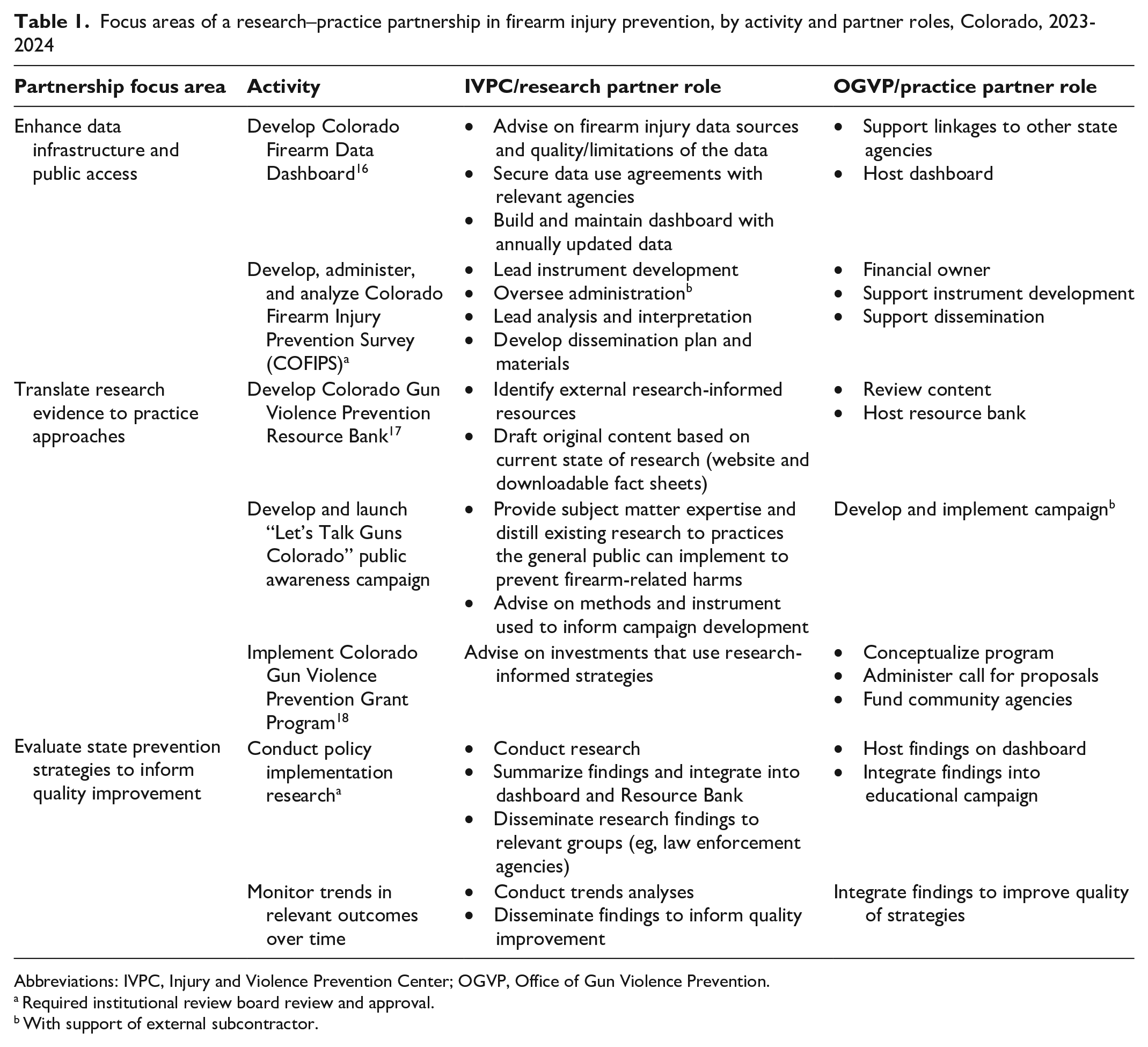
Abbreviations: IVPC, Injury and Violence Prevention Center; OGVP, Office of Gun Violence Prevention.
Required institutional review board review and approval.
With support of external subcontractor.
The Colorado Multiple Institutional Review Board (COMIRB) reviewed 2 of these activities. The policy implementation research was approved by COMIRB (#23-0995) under the 2018 requirements of the Federal Policy for the Protection of Human Subjects. COMIRB determined the statewide survey was exempt from institutional review board review because it involved survey research without personal identifiers (#23-0497). All other partnership activities were program development and evaluation; therefore, institutional review board assessment was not necessary per COMIRB policy.
Outcomes
Enhancing Data Infrastructure and Public Access
A key aspect of a public health approach is to make data-informed decisions; thus, the partnership was committed to enhancing and building infrastructure for firearm injury data in Colorado. We enhanced data infrastructure and access by creating a publicly accessible compilation of firearm-related data and administering a statewide survey on firearms and the perceptions of firearm injury prevention. The Colorado Firearm Data Dashboard 16 (hereinafter, dashboard) was created to enhance practitioner efforts to identify individuals and communities at highest risk for various types of firearm injury (ie, suicide, homicide, unintentional, legal intervention) across sociodemographic groups and geographic regions. While some data may be accessed by the public elsewhere, the dashboard compiles surveillance data most relevant to firearm injury prevention efforts and eases the burden of accessing and analyzing data for practitioners.
The dashboard was built using Tableau Public version 2024.1 (Tableau) and was launched on OGVP’s website, making it free and easy to access (Table 2). The partnership has a shared commitment to annually update data on the dashboard. Moreover, through continued partnership, additional datasets will be integrated, such as self-reported data from the Healthy Kids Colorado Survey 19 on access among adolescents to a loaded gun, data from hospitals on firearm injuries, 20 and summaries of Colorado laws on safe storage (child access prevention) 21 and lost or stolen firearms. 22
Data included in the Colorado Firearm Data Dashboard, by domain, 2024
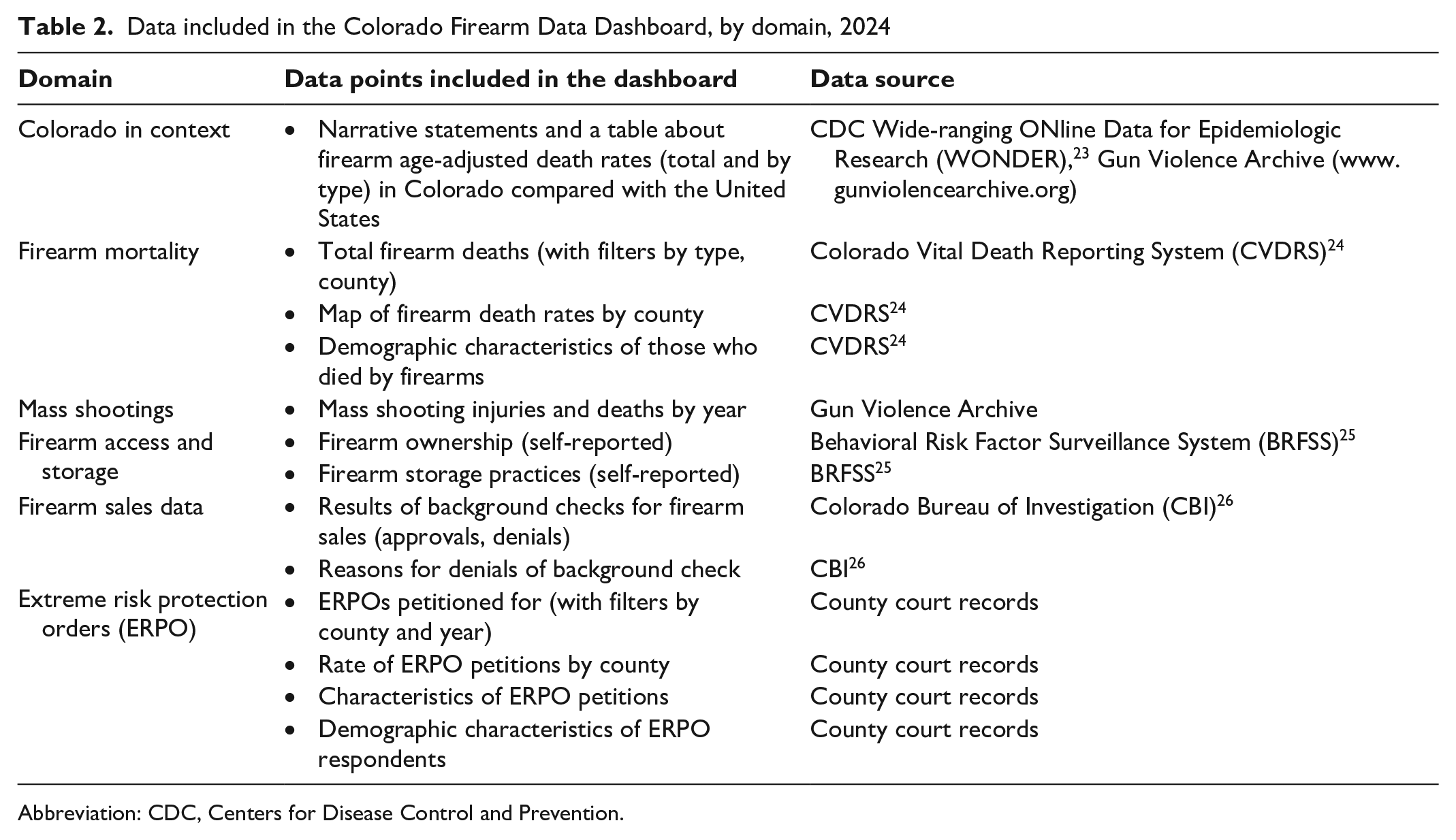
Abbreviation: CDC, Centers for Disease Control and Prevention.
While compiling existing, dispersed data is one step toward enhancing data infrastructure and access in Colorado, a lack of state-specific data exists on the perception of firearms and experiences with firearm injuries and violence. To address this gap, the partnership developed and administered the inaugural Colorado Firearm Injury Prevention Survey (COFIPS; cofips.org) in 2023. The COFIPS instrument included up to 45 questions across 5 main categories: (1) firearms culture (familiarity with and exposure to firearms), (2) perceptions of and concerns about firearm injury and violence, (3) knowledge and attitudes about firearms and injury prevention, (4) awareness of and opinions on practices and policies aimed at reducing firearm injuries, and (5) firearm access and storage behaviors in households that had firearms. The online survey was conducted by the research firm Ipsos, which recruited a state-representative sample of Colorado adults aged ≥18 years through its KnowledgePanel (random sample) blended with nonrandom respondents (using calibrated weights) to enhance the ability to report results representative of 4 geographic regions in Colorado and statewide. 27
The inaugural COFIPS administration provided—for the first time—comprehensive, Colorado-specific data and insight into the effect and prevention of firearm injuries and violence among Colorado adults aged ≥18 years. The partnership will use these data to inform investment in prevention strategies and monitor the effectiveness of other OGVP-led initiatives. Furthermore, the partnership agreed on the importance of disseminating the COFIPS data to Colorado communities. As a result, the COFIPS dataset and supporting resources are available publicly online. A commitment to dissemination, and parallel efforts to educate Coloradans on how to understand and use the COFIPS data, will further a public health approach throughout the state by equipping local communities and practitioners with evidence that defines the program regionally, supports the identification of risk and protective factors, and allows metrics to determine the effectiveness of the prevention strategy.
The partnership was equally committed to ensuring perceptions could be monitored over time to measure the effect of Colorado’s prevention strategies on Coloradans’ perceptions and behaviors related to firearms and to engage populations at risk or those more actively involved in firearm injury prevention, to better inform tailored approaches to prevention. As a result, the COFIPS core survey will be administered in odd-numbered years and will provide an opportunity to monitor changes in trends over time. A specialty survey will be administered in even-numbered years and tailored to populations of interest, such as groups at high risk of firearm injury or groups that support prevention efforts.
Translating Research Evidence to Practice Approaches
Beyond increasing the availability of and access to Colorado-specific data, the partnership also focused on increasing practitioner and public access to the evidence base on effective and promising solutions for reducing firearm injuries. These efforts were operationalized through (1) the development of the Colorado Gun Violence Prevention Resource Bank (Resource Bank) 17 and (2) research-informed development of 2 statewide primary prevention strategies. The Resource Bank is a publicly accessible website where individuals can explore types of firearm injuries and their effect on Colorado communities and research-informed solutions and approaches that can prevent and address firearm injuries. The general public is prioritized as the primary audience to inform individual- or community-based prevention strategies. The Resource Bank will be updated and expanded annually to ensure that research on the epidemiology, effect, and prevention of firearm injuries is current.
OGVP’s legislative statute charged the office with creating the Resource Bank, a public awareness campaign, and a grant program. OGVP was well-suited to develop and implement both the public awareness campaign and grant program given the state health department’s history of leading similar efforts across other public health areas. IVPC consulted with the developers of the educational campaign to ensure that the messaging for Let’s Talk Guns Colorado (letstalkgunscolorado.com) was aligned with research, integrated best practices for reaching and respecting communities most affected by firearm injuries, 28 and provided recommendations for state investment through the Colorado Gun Violence Prevention Grant Program. 18 The partnership will continue to update the public awareness campaign and state investment to reflect national and Colorado-focused research and data on firearm injury prevention.
Evaluating State Prevention Strategies to Inform Quality Improvement
Aligned with the public health approach, the partnership also collaborated to initiate evaluation of state prevention strategies to inform quality improvement and monitor and assess ways in which state investments affect Colorado over time. Partnership efforts in this area included policy implementation research and monitoring changes in trends over time. Colorado has several policies intended to reduce firearm injuries among those at increased risk of injury, including (1) extreme risk protection orders, 29 (2) safe storage of firearms, 21 and (3) lost or stolen firearms. 22 Conducting policy implementation research helps to understand the ways in which these laws are being used and/or enforced. IVPC collected data via abstracted court records from incidents citing these laws, effectively creating a database of their use, and used qualitative methodology to identify themes across court records. In line with previously discussed commitments to data accessibility and translation to practice, these summarized data were then integrated into the dashboard and Resource Bank so they can be used by other practitioners (eg, law enforcement agencies) to further inform education, awareness, and appropriate use of the laws. The partnership will continue these efforts annually and consider expanding to include additional policies as they are enacted.
Lessons Learned
The efforts of the partnership have advanced Colorado’s ability to monitor trends in morbidity, mortality, awareness, perceptions, access, and protective practices, which has allowed for detecting potential changes in these trends related to state investment and support in firearm injury prevention and supporting the implementation of effective solutions that reduce firearm injuries and violence throughout the state.
This partnership originated between an academic institution and a state agency with a long history of collaboration to advance data-driven, evidence-informed, equitable, and collaborative approaches to injury and violence prevention. A strong sense of trust and shared purpose thus previously existed, so we recommend that others exploring this model dedicate time and attention to developing a mutual respect for the values, directives, expertise, and assets of each partner. Based on our collective work to advance a public health approach to address firearm injury in Colorado, emerging research–practice partnerships with the goal of preventing firearm injury should consider the following lessons learned.
Develop Shared Goals and Language
In initial meetings, the partnership developed a shared goal that underscored collaboration of engaging communities affected by firearm injuries to advance equity in addressing disparate outcomes. IVPC leveraged previous experience working in the field and was able to share recommendations on ways in which it had established mutually respectful collaborations and communications with affected communities, particularly the firearm-owning community. Moreover, ensuring that all partnership activities used language that did not alienate communities most affected by firearm injury and violence was integral to the partnership’s approach. These shared goals and language supported resource development and may positively affect the long-term engagement of geographically, culturally, and socially diverse communities across the state.
Strategically Leverage Partner Expertise and Resources
IVPC and OGVP continually clarified partner strengths, assets, limitations, and barriers, which guided leveraging each partner’s expertise to achieve collective goals. While Colorado benefited from a state office dedicated to firearm injury prevention, financial and personnel resources remain limited, making early discussions essential to best align IVPC support with OGVP needs. For example, while IVPC initially created the firearm data dashboard given their knowledge and experience working with firearm data, the ongoing maintenance and plans for adding data have shifted to epidemiologists at the state level; researchers will advise on its maintenance moving forward. Leveraging partners’ diverse expertise allowed for effective use of limited resources to develop products that were most critical to advancing practice in Colorado.
Maintain Neutrality While Balancing Political Directives
While this research–practice partnership has strived to be neutral (ie, nonpartisan) and use data and evidence to inform the implementation of a public health approach to firearm injury prevention, the work is not immune to political pressures and directives. For example, while Colorado legislation noted the importance of research in its statute, it prescribed OGVP’s prevention activities (Resource Bank, public awareness campaign, and grant program). The attention to the subject of firearm injury prevention given the US social and political landscape also means considerable attention is paid to the office and its efforts. As a result, we strive to maintain this neutral approach to focus on preventing harms resulting from firearms and continue to build connections with all affected communities and diverse perspectives of groups interested in preventing firearm-related harms.
Our partnership continues to use these initial lessons learned to guide decisions on which partners should lead activities in the future as well as how best to involve and communicate data and evidence to affected communities, cross-sector partners, and the general public.
Footnotes
Acknowledgements
The authors thank additional colleagues who supported the development of this research–practice partnership and their invaluable contributions to the products developed: Leslie Barnard, DrPH, Virginia McCarthy, DrPH, MDiv, Kate Little, Megan McCarthy, MPH, Noelle Musgrave, Alex Bletz, MA, Joseph A. Simonetti, MD, MPH, Christoper Knoepke, PhD, MSW, Eric Sigel, MD, Shale Wong, MD, MSPH, Alison Reidmohr, MA, and Emma Gilchrist, MPH (University of Colorado Anschutz Medical Campus); Kristin McDermott, MA, Jonathan McMillan, Renu Gupta-Fitzgerald, Lena Heilmann, PhD, MNM, Lisa Ciazza, Maria Livingston, MPP, Reina Doyle, Barbara Gabella, MSPH, and Meg Hott (Colorado Department of Public Health and Environment).
Declaration of Conflicting Interests
The authors declared no potential conflicts of interest with respect to the research, authorship, and/or publication of this article.
Funding
The authors disclosed receipt of the following financial support for the research, authorship, and/or publication of this article: The Injury and Violence Prevention Center received funding from the Colorado Department of Public Health and Environment Office of Gun Violence Prevention to carry out activities described in this case study.
