




Abstract
Objectives:
Massachusetts signed into law An Act Modernizing Tobacco Control (hereinafter, the Act) in 2019, which restricted retail sales of flavored tobacco products, including menthol cigarettes. This study assessed differences in advertising exposure to flavored tobacco products among adolescents in Massachusetts compared with adolescents in 4 neighboring states after passage of the Act.
Methods:
We collected monthly cross-sectional survey data from April 2021 through August 2022 among a convenience sample of adolescents (aged 13-17 y) in Massachusetts and 4 control states: Connecticut, New Hampshire, Rhode Island, and Vermont. We measured self-reported past-30-day exposure to advertising for flavored electronic cigarette (e-cigarette) products and flavored cigarettes or other tobacco products across 9 channels.
Results:
After implementation of the Act, adolescents in Massachusetts, compared with adolescents in the 4 control states, reported significantly lower levels of exposure to advertisements for flavored e-cigarettes (convenience store: adjusted odds ratio [AOR] = 0.80 [95% CI, 0.66-0.96]; supermarket/grocery store: AOR = 0.66 [95% CI, 0.52-0.84]; gas station: AOR = 0.61 [95% CI, 0.51-0.75]) and flavored cigarette/other tobacco products (convenience store: AOR = 0.69 [95% CI, 0.57-0.83]; supermarket/grocery store: AOR = 0.63 [95% CI, 0.49-0.79]; gas station: AOR = 0.55 [95% CI, 0.45-0.66]) in retail channels, which were the intended targets of the Act. We found no significant differences in flavored tobacco product advertising exposure for non–retail channels (television, radio, posters/billboards, newspapers/magazines, social media, and streaming services/movies in a theater).
Conclusions:
Future research should further examine the effects of statewide flavored tobacco sales restrictions on the availability of and exposure to advertisements for flavored tobacco products.
Exposure to tobacco product marketing is common among young people 1 and is positively related to smoking susceptibility, 2 smoking initiation, 3 use of cigars, 4 use of different tobacco products, 5 and use of electronic cigarettes (e-cigarettes).6,7 Exposure to advertisements for flavored tobacco products may be particularly consequential to adolescents, as children and young adults exposed to advertisements for flavored e-cigarette products versus advertisements for nonflavored tobacco products have reported greater interest in trying flavored e-cigarettes.8,9 Therefore, exposure to advertising for flavored tobacco products may be an important risk factor for flavored tobacco product use among adolescents.
In 2019, state regulations were approved in Massachusetts to immediately restrict the sale of flavored e-cigarette products. Specifically, An Act Modernizing Tobacco Control (hereinafter, the Act) limits retail stores (eg, convenience stores, gas stations) to selling only nonflavored e-cigarette products with limited nicotine content.10,11 In addition, as of June 2020, menthol-flavored combustible cigarettes and other flavored tobacco products, such as flavored cigars, can be sold only at licensed smoking bars for on-site consumption.10,11 The Act also forbids retailers from marketing or advertising any tobacco products that they are prohibited from selling.10,11 Therefore, the Act’s regulations strictly limit the sale and promotion of flavored tobacco products in Massachusetts retail stores. Notably, flavored tobacco restrictions had been implemented at the local level in some Massachusetts towns and municipalities before passage of the Act. These restrictions at the local level were associated with beneficial effects on tobacco use among young people 12 and flavored tobacco product availability. 13
Research suggests that local bans on flavored tobacco products were negatively associated with the presence of flavored tobacco product advertisements in retail stores. 14 To our knowledge, however, no studies have examined differences in self-reported exposure to flavored tobacco product advertisements after passage of a statewide flavored tobacco control policy. While the presence of advertisements serves as a measure of opportunities for exposure, self-reported exposure allows us to measure whether individual adolescents were indeed exposed to and, thus, noticed and recalled such advertisements. Therefore, the primary aim of the present study was to examine whether young people in Massachusetts—compared with young people in neighboring states—reported lower levels of exposure to flavored tobacco product advertising after implementation of the Act.
A flavored tobacco product under the Act refers to a category of tobacco products with a “characterizing flavor.” 10 Under section 28a of the Act, a “characterizing flavor” refers to “a distinguishable taste or aroma, other than the taste or aroma of tobacco,” such as (but not limited to) cherry, grape, or chocolate. 10 Unflavored and tobacco-flavored tobacco products do not contain a “characterizing flavor,” and the latter is designed to taste like tobacco. The Act applies only to products with a “characterizing flavor.” We therefore would not expect to see any significant differences in advertising exposure to unflavored or tobacco-flavored tobacco products across the 9 communication channels assessed (eg, billboards, social media) among adolescents in Massachusetts relative to adolescents in neighboring states, assuming that the Act did not have indirect effects on the advertising of these products. In other words, finding that the significantly lower levels of advertising exposure occurred only for flavored (and not for unflavored or tobacco-flavored) tobacco products would provide stronger evidence that any observed differences in flavored tobacco product advertising exposure are attributable to the Act.
Methods
Study Sample and Data Collection
We conducted monthly cross-sectional online surveys through the online survey panel Prodege from April 2021 through August 2022 among adolescents aged 13-17 years in Massachusetts and 4 neighboring states (hereinafter, control states): Connecticut, New Hampshire, Rhode Island, and Vermont. Connecticut, New Hampshire, and Vermont did not have comprehensive statewide restrictions on flavored tobacco product sales at the time of our data collection. The Rhode Island state government had enacted permanent bans on the sale of flavored e-cigarettes, which did not include other tobacco products or menthol cigarettes. Local laws in Rhode Island (eg, in Providence) had passed restrictions on the sale of flavored tobacco products but had exempted menthol-flavored cigarettes, cigars, and other tobacco products. 15 A summary of flavored tobacco product policies and restrictions implemented across US states and localities is available elsewhere.16,17 Surveys were sent out to current Prodege panel members. Adult panelists with children aged 13-17 years were asked to give their device to their child to complete the survey. This study was approved by the University of Pennsylvania Institutional Review Board (IRB; protocol #844600). Study participants received an assent form as part of the online survey. To participate in the survey, participants had to agree to the form electronically. Because parental consent was waived by the IRB, parents were not required to provide consent for their child to participate in the survey.
The study’s sample size was informed by a power analysis designed to find a clinically meaningful effect size for the primary outcome (current tobacco use) from a larger study that did not include the advertising exposure measures. On average, 118 adolescents completed the surveys each month. Adolescents were allowed to respond to more than 1 monthly survey; therefore, if a respondent completed the survey 2 or more times, we included only their first survey response in our analysis. Our analytic sample size was 1858 responses after removing 155 repeat responses.
Measures
In 2 separate questions, we measured self-reported past-30-day exposure to advertisements for flavored e-cigarette products (yes/no) and flavored cigarettes or other tobacco products (yes/no) across 9 communication channels. Each question included a preamble that described and provided examples of flavors and types of tobacco products as applicable. Participants were then asked, “In the past 30 days, have you seen ads or promotions for [flavored cigarettes or other tobacco products/flavored vape products] in any of the following places?” The 9 channels included television, radio, posters or billboards, newspapers or magazines, social media (eg, TikTok, YouTube, Instagram, Snapchat, Twitter, Facebook), convenience store, supermarket/grocery store, gas station, and streaming services (eg, Netflix, Hulu, Amazon Prime) or movies in a theater. Three channels—the retail outlets, including convenience stores, supermarket/grocery stores, and gas stations—were regulated by the Act. These survey measures and channels were adapted from the International Tobacco Control 2020 survey 18 and the National Youth Tobacco Survey 2020. 19
Starting in May 2022 through August 2022, we also asked respondents to self-report their past-30-day exposure (yes/no) to advertisements and promotions for unflavored e-cigarette products, tobacco-flavored e-cigarette products, and unflavored cigarettes/other tobacco products for the same 9 channels (analytic sample: n = 422). These questions also included a preamble describing the tobacco product type and flavor (or lack thereof).
Our primary independent variable was a binary indicator for state of residence (Massachusetts vs control states). State of residence was determined by asking respondents to provide their zip code. We also controlled for a series of covariates, including the survey wave (survey wave was treated as a continuous variable ranging from 1 through 17 in the main analysis and refers to the month and year the survey was fielded from April 2021 through August 2022), age (in years), gender, sexual orientation, race, ethnicity, whether the participant spent time outside the home in the past 2 weeks, household tobacco use, ever use of an e-cigarette, ever use of a cigarette, and social media use. Social media use was measured as the total number of social media platforms used by each participant from a list of 12 popular platforms (eg, YouTube, Instagram, Facebook, Twitter); these platforms were adapted from a 2018 Pew Research Center survey among teens. 20
Main Analysis
Using a series of logistic regression models, we regressed advertising exposure to flavored e-cigarette products for each channel on indicators for state, survey wave, and the covariates described previously; parallel analyses were conducted for advertising exposure to flavored cigarettes/other tobacco products. We conducted all analyses in R version 4.2.2 (The R Foundation for Statistical Computing). We considered α = .05 to be significant. We used listwise deletion to handle cases of missing data.
Secondary Analysis
We used a series of logistic regression models to regress advertising exposure to each of the 3 unflavored or tobacco-flavored products on the same set of independent variables as in the main analysis, including indicators for state, survey wave, and the previously described series of covariates.
Results
Adolescents residing in Massachusetts accounted for roughly half (48.4%; 900 of 1858) of our total sample. Of the 1858 respondents, 27.9% (n = 518) were from Connecticut, 11.6% (n = 215) were from New Hampshire, 7.9% (n = 146) were from Rhode Island, and 4.3% (n = 79) were from Vermont. Forty-nine percent (n = 913) of survey respondents identified as a boy/man, 46.2% (n = 858) identified as a girl/woman, and 4.7% (n = 87) identified as nonbinary or opted to self-specify their gender identity. The mean (SD) age of participants was 15 (1.4) years. Seventy-four percent of the sample identified as White (n = 1377), 7.6% as Black (n = 141), 8.1% as >1 race (n = 150), 5.1% as Asian (n = 94), and 5.2% (n = 96) as another race. There were ≤3 missing values for each dependent variable and no missing values for the previously described demographic variables and covariates.
Adolescents in Massachusetts and the control states reported the most exposure to flavored e-cigarette advertisements in convenience stores (Massachusetts: 52.7%; control states: 59.7%) and gas stations (Massachusetts: 50.6%; control states: 63.3%); adolescents reported the least exposure to flavored e-cigarette advertisements on the radio (Massachusetts: 10.2%; control states: 10.4%) (Table 1). We found similar patterns for flavored cigarette/other tobacco products (convenience store: Massachusetts: 43.4%; control states: 53.7%; gas station: Massachusetts: 41.9%; control states: 57.5%; radio: Massachusetts: 8.9%; control states: 8.8%).
Percentage of adolescent respondents aged 13-17 years in Massachusetts and 4 control states (N = 1858) who reported past-30-day exposure to advertisements for flavored e-cigarette products and flavored cigarettes or other tobacco products across channels, April 2021–August 2022
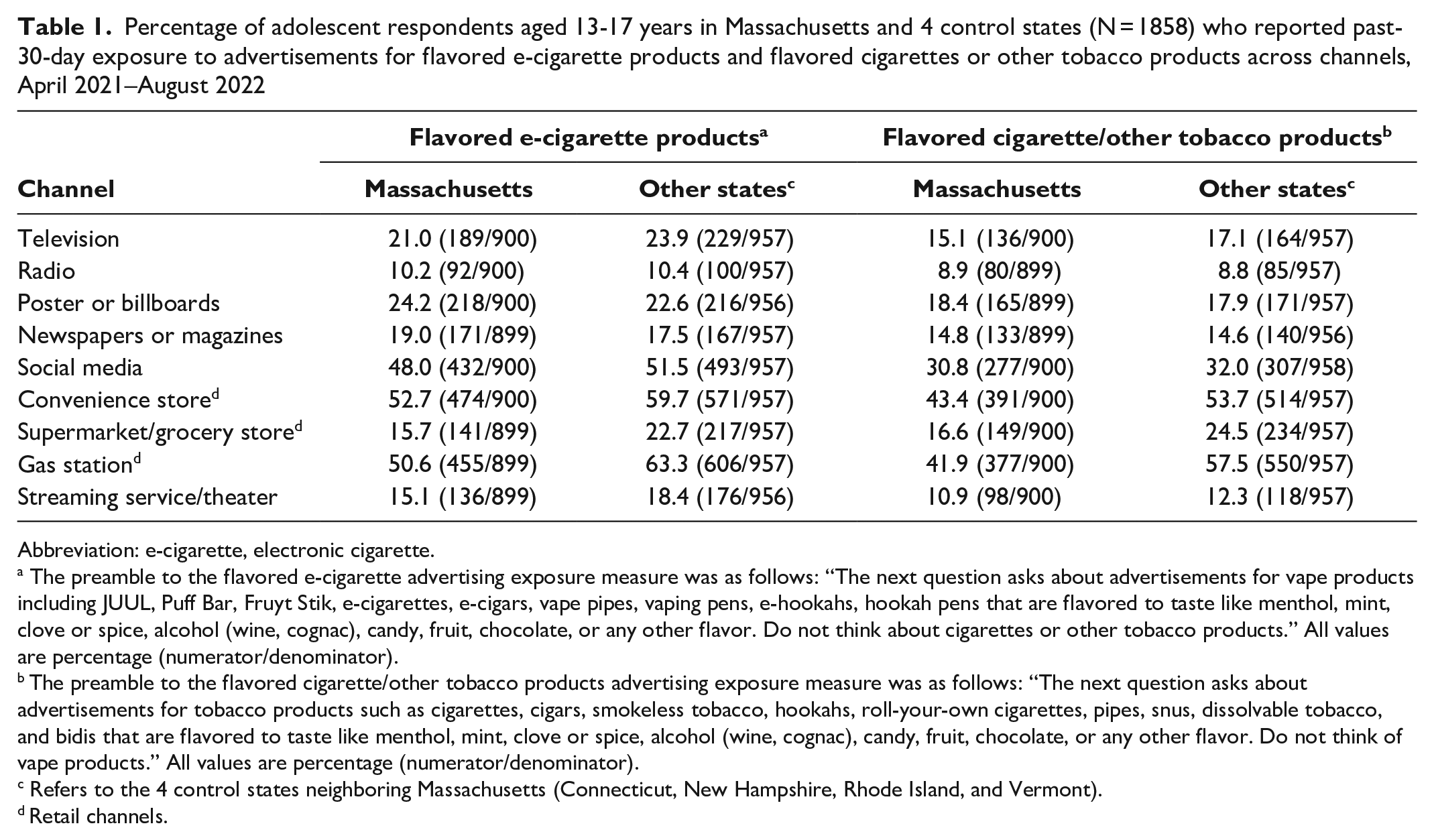
Abbreviation: e-cigarette, electronic cigarette.
The preamble to the flavored e-cigarette advertising exposure measure was as follows: “The next question asks about advertisements for vape products including JUUL, Puff Bar, Fruyt Stik, e-cigarettes, e-cigars, vape pipes, vaping pens, e-hookahs, hookah pens that are flavored to taste like menthol, mint, clove or spice, alcohol (wine, cognac), candy, fruit, chocolate, or any other flavor. Do not think about cigarettes or other tobacco products.” All values are percentage (numerator/denominator).
The preamble to the flavored cigarette/other tobacco products advertising exposure measure was as follows: “The next question asks about advertisements for tobacco products such as cigarettes, cigars, smokeless tobacco, hookahs, roll-your-own cigarettes, pipes, snus, dissolvable tobacco, and bidis that are flavored to taste like menthol, mint, clove or spice, alcohol (wine, cognac), candy, fruit, chocolate, or any other flavor. Do not think of vape products.” All values are percentage (numerator/denominator).
Refers to the 4 control states neighboring Massachusetts (Connecticut, New Hampshire, Rhode Island, and Vermont).
Retail channels.
Main Analysis Findings
In the unadjusted models, Massachusetts adolescents had significantly lower odds of exposure to flavored e-cigarette advertisements than adolescents in the control states did (convenience store: OR = 0.75 [95% CI, 0.63-0.90]; supermarket/grocery store: OR = 0.63 [95% CI, 0.50-0.80]; gas station: OR = 0.59 [95% CI, 0.49-0.71]). We found a similar pattern of results for exposure to flavored cigarette/other tobacco product advertisements in the retail channels (convenience store: OR = 0.66 [95% CI, 0.55-0.80]; supermarket/grocery store: OR = 0.61 [95% CI, 0.49-0.77]; gas station: OR = 0.53 [95% CI, 0.44-0.64]).
After adjusting for the previously described covariates, Massachusetts adolescents had significantly lower odds of past-30-day exposure to advertisements for flavored e-cigarette products in all 3 retail channels as compared with adolescents in the control states (convenience store: AOR = 0.80 [95% CI, 0.66-0.96]; supermarket/grocery store: AOR = 0.66 [95% CI, 0.52-0.84]; gas station: AOR = 0.61 [95% CI, 0.51-0.75]) (Table 2). Massachusetts adolescents also had significantly lower odds of exposure to advertisements for flavored cigarette/other tobacco products in all 3 retail channels compared with adolescents in the control states (convenience store: AOR = 0.69 [95% CI, 0.57-0.83]; supermarket/grocery store: AOR = 0.63 [95% CI, 0.49-0.79]; gas station: AOR = 0.55 [95% CI, 0.45-0.66).
Regressing self-reported advertising exposure to flavored e-cigarette and flavored cigarette/other tobacco products in retail channels among adolescent respondents aged 13-17 years (N = 1858) on an indicator for state of residence, survey wave, and a series of covariates, in Massachusetts and 4 control states, April 2021–August 2022
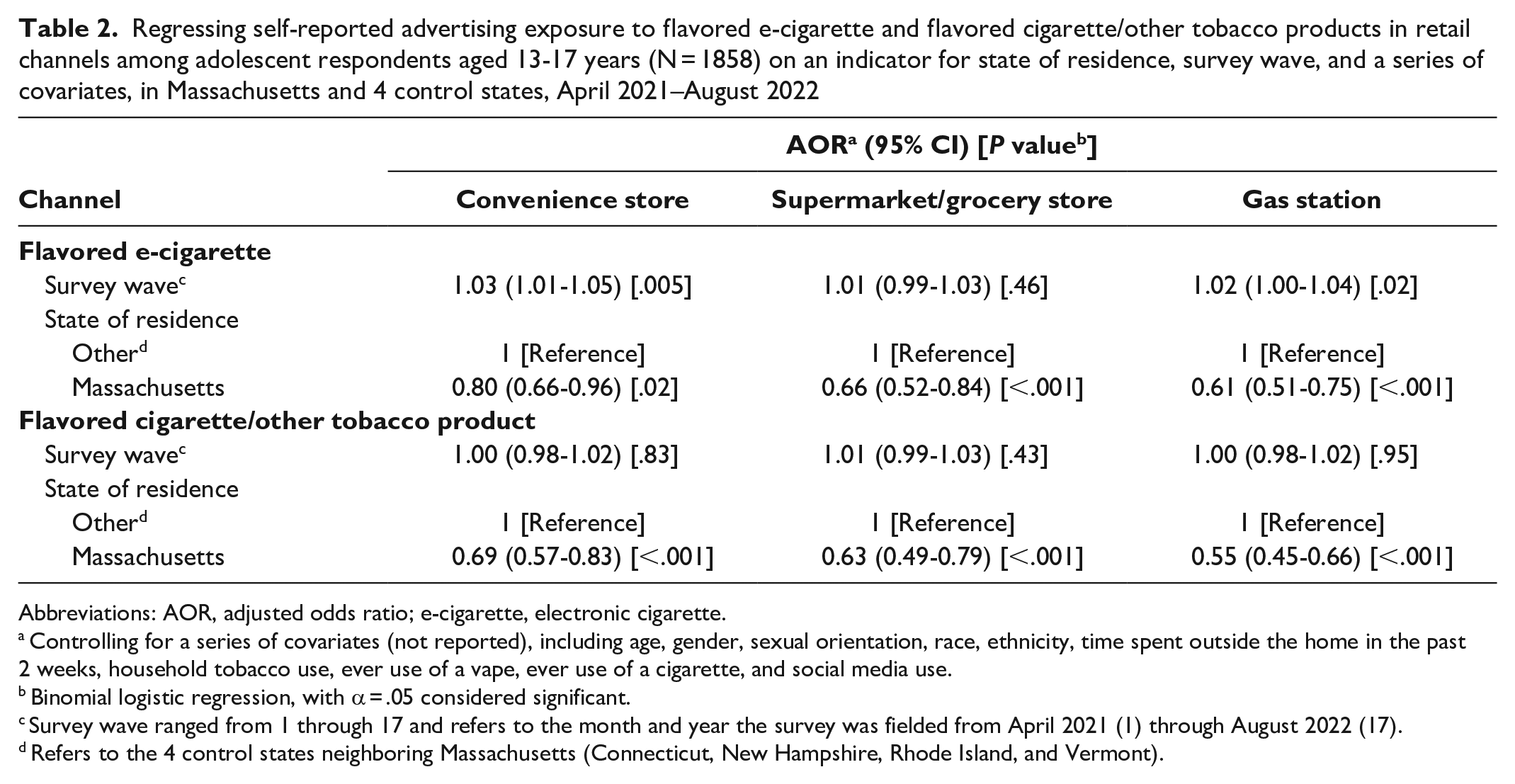
Abbreviations: AOR, adjusted odds ratio; e-cigarette, electronic cigarette.
Controlling for a series of covariates (not reported), including age, gender, sexual orientation, race, ethnicity, time spent outside the home in the past 2 weeks, household tobacco use, ever use of a vape, ever use of a cigarette, and social media use.
Binomial logistic regression, with α = .05 considered significant.
Survey wave ranged from 1 through 17 and refers to the month and year the survey was fielded from April 2021 (1) through August 2022 (17).
Refers to the 4 control states neighboring Massachusetts (Connecticut, New Hampshire, Rhode Island, and Vermont).
Among the 6 non–retail channels (television, radio, posters or billboards, newspapers or magazines, social media, and streaming services or movies in a theater), we found no significant differences in advertising exposure between adolescents in Massachusetts and adolescents in the control states both before and after adjusting for the series of covariates (Tables 3 and 4).
Regressing self-reported advertising exposure to flavored e-cigarette products in non–retail channels among adolescent respondents aged 13-17 years (N = 1858) on an indicator for state of residence, survey wave, and a series of covariates, in Massachusetts and 4 control states, April 2021–August 2022
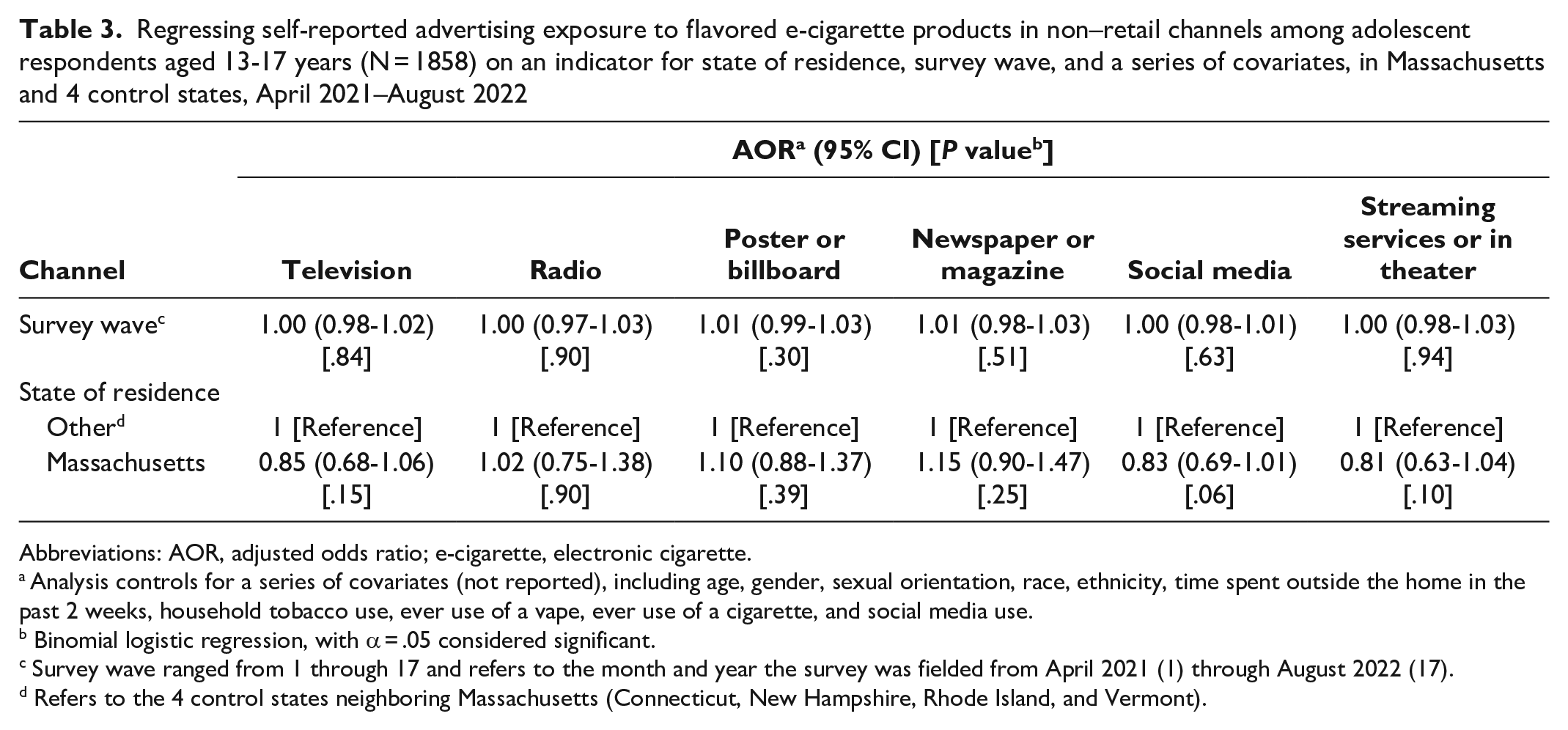
Abbreviations: AOR, adjusted odds ratio; e-cigarette, electronic cigarette.
Analysis controls for a series of covariates (not reported), including age, gender, sexual orientation, race, ethnicity, time spent outside the home in the past 2 weeks, household tobacco use, ever use of a vape, ever use of a cigarette, and social media use.
Binomial logistic regression, with α = .05 considered significant.
Survey wave ranged from 1 through 17 and refers to the month and year the survey was fielded from April 2021 (1) through August 2022 (17).
Refers to the 4 control states neighboring Massachusetts (Connecticut, New Hampshire, Rhode Island, and Vermont).
Regressing self-reported advertising exposure to flavored cigarette/other tobacco products in non–retail channels among adolescent respondents aged 13-17 years (N = 1858) on an indicator for state of residence, survey wave, and a series of covariates, in Massachusetts and 4 control states, April 2021–August 2022
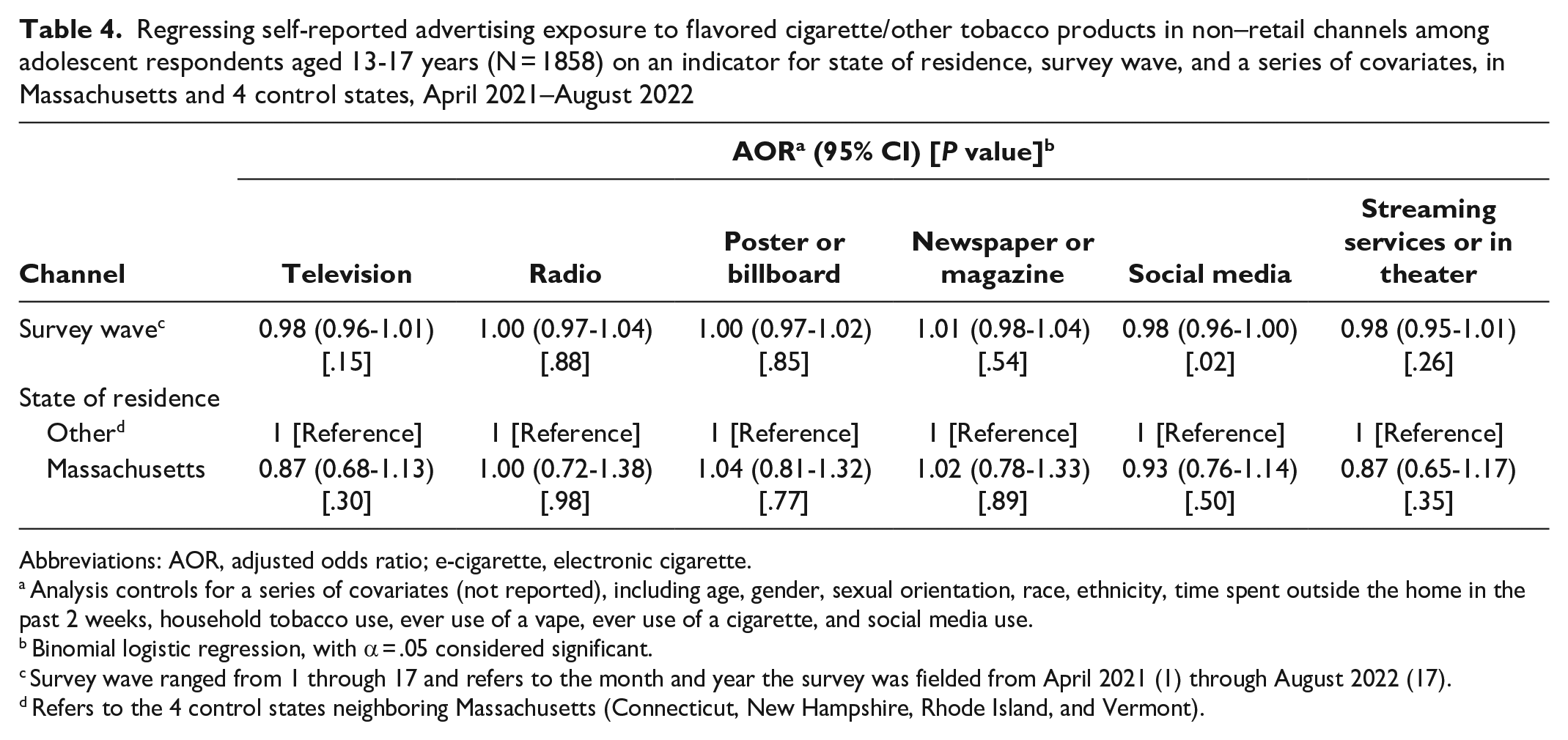
Abbreviations: AOR, adjusted odds ratio; e-cigarette, electronic cigarette.
Analysis controls for a series of covariates (not reported), including age, gender, sexual orientation, race, ethnicity, time spent outside the home in the past 2 weeks, household tobacco use, ever use of a vape, ever use of a cigarette, and social media use.
Binomial logistic regression, with α = .05 considered significant.
Survey wave ranged from 1 through 17 and refers to the month and year the survey was fielded from April 2021 (1) through August 2022 (17).
Refers to the 4 control states neighboring Massachusetts (Connecticut, New Hampshire, Rhode Island, and Vermont).
Secondary Analysis Findings
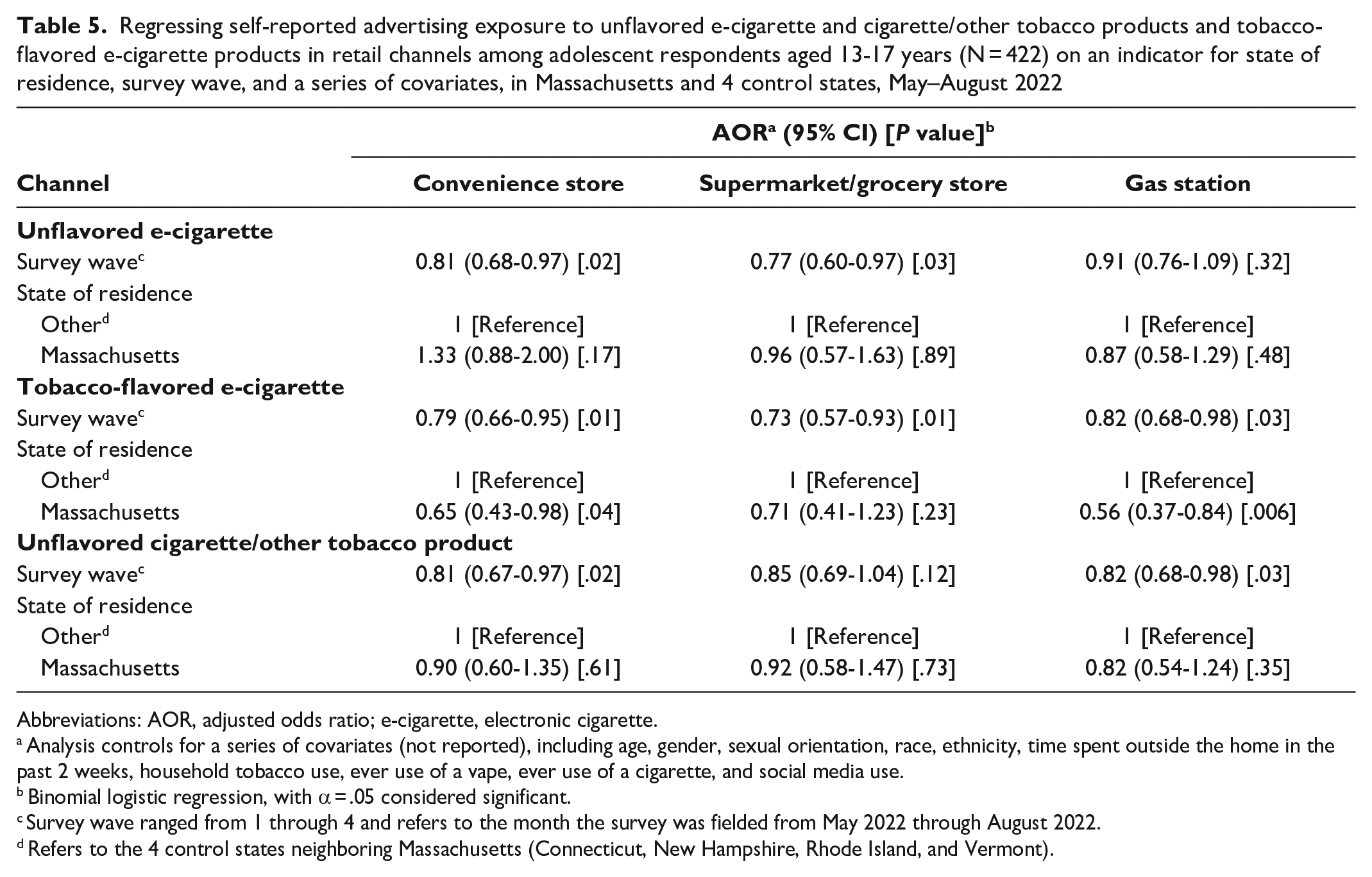
In 4 of the 27 statistical tests, Massachusetts adolescents had significantly lower odds of exposure to advertisements in some channels for unflavored e-cigarettes (streaming services: AOR = 0.51 [95% CI, 0.27-0.95]; P = .04 [data not shown]) and tobacco-flavored e-cigarettes (convenience store: AOR = 0.65 [95% CI, 0.43-0.98]; P = .04; gas station: AOR = 0.56 [95% CI, 0.37-0.84]; P = .006]; streaming services: AOR = 0.46 [95% CI, 0.24-0.85]; P = .01) (Table 5).
Regressing self-reported advertising exposure to unflavored e-cigarette and cigarette/other tobacco products and tobacco-flavored e-cigarette products in retail channels among adolescent respondents aged 13-17 years (N = 422) on an indicator for state of residence, survey wave, and a series of covariates, in Massachusetts and 4 control states, May–August 2022
Abbreviations: AOR, adjusted odds ratio; e-cigarette, electronic cigarette.
Analysis controls for a series of covariates (not reported), including age, gender, sexual orientation, race, ethnicity, time spent outside the home in the past 2 weeks, household tobacco use, ever use of a vape, ever use of a cigarette, and social media use.
Binomial logistic regression, with α = .05 considered significant.
Survey wave ranged from 1 through 4 and refers to the month the survey was fielded from May 2022 through August 2022.
Refers to the 4 control states neighboring Massachusetts (Connecticut, New Hampshire, Rhode Island, and Vermont).
Discussion
Following passage of the Act, adolescents in Massachusetts (vs adolescents in the control states) had significantly lower odds of exposure to flavored tobacco product advertising in retail outlets (convenience stores, supermarkets/grocery stores, and gas stations). We found no significant differences in exposure to advertising for flavored e-cigarette and flavored cigarette/other tobacco products for the 6 non–retail channels. This finding was consistent with our expectations, because the sales and marketing restrictions in the Act applied to retail channels. These findings also provide additional support of discriminant validity of our measures of exposure to tobacco product advertisements in retail versus non–retail channels.
Despite these findings, a meaningful proportion of Massachusetts respondents still reported past-30-day exposure to flavored e-cigarette and flavored cigarette/other tobacco product advertisements in convenience stores and gas stations after implementation of the Act. We offer a few potential explanations for this finding. First, if Massachusetts adolescents had crossed state lines in the previous 30 days, their reported advertising exposure could have encompassed retail channels both in and outside Massachusetts (the implication being that retailers in states that are not restricted by the Act may therefore promote flavored tobacco products in their stores). Second, compliance with and enforcement of the Act’s restrictions on flavored tobacco product advertising may have been slowly implemented, in which case retailers may have been slow to take down any flavored tobacco product advertisements. Finally, the seemingly sizeable proportion of Massachusetts adolescents exposed to flavored tobacco product advertisements in retail channels may be an artifact of our exposure measure. We did not assess the amount of exposure to flavored tobacco product advertisements among adolescents; instead, we used a binary exposure measure that asked adolescents whether they were exposed in the past 30 days to a given type of tobacco product advertisement in a particular channel. In other words, if only a few retail stores had kept any flavored tobacco product advertising, and Massachusetts adolescents recalled this exposure, they would count as being exposed in our analysis. A measure of amount of exposure may better capture differences in and degree of exposure among adolescents in Massachusetts relative to adolescents in the control states. Counts of directly observed flavored tobacco product advertisements via store audits could also serve as a useful method to measure opportunities for exposure more precisely.
Because the Act applied only to flavored tobacco products in retail channels, we did not expect to find significant differences in exposure to unflavored and tobacco-flavored product advertisements across any of the 9 channels. In our secondary analyses, 4 of the 27 tested channel outcomes were significantly different for Massachusetts adolescents as compared with adolescents in the control states. Two of these significant differences were found for streaming services (which were unlikely to be influenced by the Act), while the other 2 were for tobacco-flavored e-cigarette advertisements in convenience stores and gas stations. Therefore, the expectation that we would not observe differences in exposure for nonflavored tobacco products was only partially supported. Survey respondents may have found it challenging to distinguish between tobacco-flavored and flavored e-cigarette product advertisements when recalling their exposure. It is also possible that the Act indirectly affected the advertising of tobacco products that were not legally restricted under the Act. In other words, advertisers may have dedicated more resources to tobacco product marketing in states with fewer tobacco sales and advertising restrictions than Massachusetts. This alternative explanation should be addressed in future work.
Strengths and Limitations
This study had several strengths and limitations. One strength was that our study benefited from the collection of 17 waves of cross-sectional survey data from April 2021 through August 2022, following implementation of the Act. Another strength was that this dataset allowed us to measure differences in self-reported exposure to tobacco product advertising among adolescents in Massachusetts compared with adolescents in 4 control states. Third, results of our main and secondary analyses suggest that differences in self-reported advertising exposure were mostly (although not exclusively) specific to the intended targets of the Act: flavored tobacco products in retail channels.
This study also had several limitations. First, we collected data from a convenience sample; as such, it was not intended to be representative of adolescents in Massachusetts and the control states. Second, our measures of advertising exposure may have been subject to self-reporting bias. Adolescents may have found it challenging to distinguish and recall the difference between advertisements for flavored tobacco products and unflavored/tobacco-flavored products. Third, additional and unaccounted for differences between Massachusetts and the control states (ie, events operating outside the influence of the Act, such as prior local flavored tobacco product bans and regulations that predated the Act) could explain the reported differences in exposure to advertising for flavored tobacco products.
Despite our findings, which showed that adolescents in Massachusetts had significantly lower levels of self-reported exposure to flavored tobacco product advertising in retail channels than adolescents in control states after implementation of the Act, these reported effects may have nonetheless been underestimated. For example, Rhode Island localities previously passed restrictions on the sale of flavored tobacco products and, as of October 2019, the state banned the sale of flavored e-cigarettes. Our analyses did not account for such tobacco policies and other additional differences in state legislation and enforcement operating in neighboring states during the study period, which may have made it more difficult to detect differences in advertising exposure among adolescents in Massachusetts relative to adolescents in the control states.
Conclusions
Our study showed lower levels of self-reported exposure to flavored tobacco product advertising in retail channels among adolescents in Massachusetts than among adolescents in neighboring states after the statewide flavored tobacco control policy in Massachusetts was implemented. This finding is consequential for 2 key reasons. First, studies indicate that flavored tobacco product advertising is associated with a greater liking for and intent to try or buy flavored e-cigarettes,8,9 which suggests that less advertising exposure may protect against future flavored tobacco product use. Second, we provide evidence that adolescent exposure to unflavored and tobacco-flavored tobacco product advertising was either not significantly different, or was significantly lower, in Massachusetts than in control states. While we do not have the data required to compare changes in tobacco product advertising exposure before and after implementation of the Act, our findings suggest that after the Act, no compensatory increase in nonflavored tobacco product advertising occurred in Massachusetts relative to the control states. Therefore, policies on flavored tobacco product control may contribute to lower levels of adolescent exposure to flavored tobacco product advertising in retail channels.
Footnotes
Declaration of Conflicting Interests
The authors declared the following potential conflicts of interest with respect to the research, authorship, and/or publication of this article: J.W. has served as an expert witness in litigation against the tobacco industry.
Funding
The authors disclosed receipt of the following financial support for the research, authorship, and/or publication of this article: This work was supported by award R21DA052421 from the National Institute on Drug Abuse of the National Institutes of Health. Its contents are solely the responsibility of the authors and do not necessarily represent the official views of the National Institutes of Health.
