




Abstract
Purpose
To describe patterns of menthol/non-menthol cigarettes with flavored e-cigarettes (tobacco, menthol, sweet/spicy, and other flavorings) use.
Design
We used cross-sectional data from the 2018-2019 Tobacco Use Supplement to the Current Population Survey (TUS-CPS).
Setting
United States.
Subjects
Adults over 18 years old.
Sample
A nationally representative sample (n = 135 329).
Measures
We generated a 15-category variable of all combinations of cigarette and e-cigarette flavoring use.
Analysis
We estimated population prevalence (PP) for the 15-category flavored cigarette and e-cigarette use variable and proportion of flavored cigarette and e-cigarette use among adults who used cigarettes or e-cigarettes (PAU) by age, sex, race/ethnicity, and income.
Results
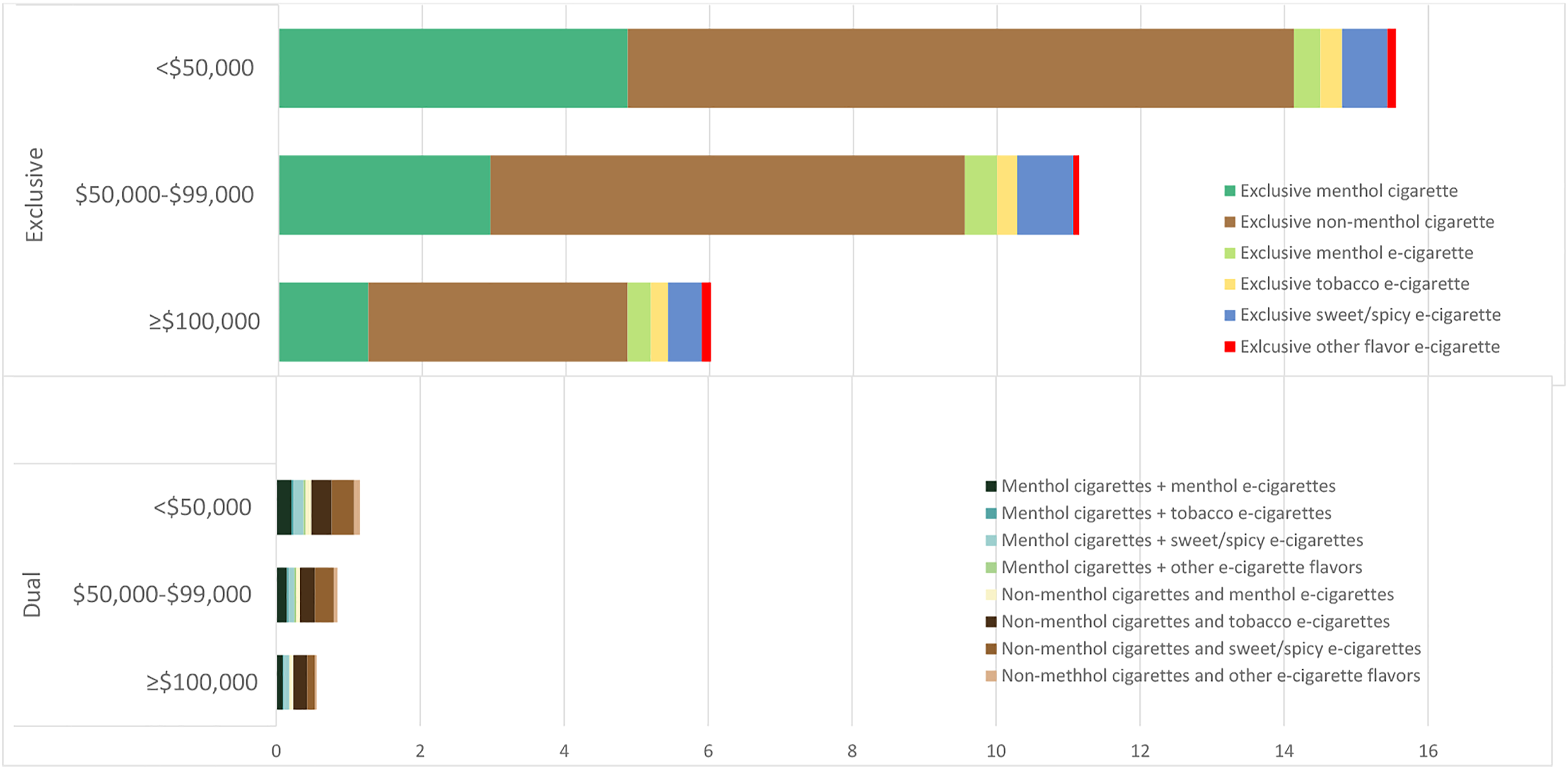
Exclusive menthol cigarette use was higher among NH Black (PP = 8.79%, PAU = 68.96%) and low-income (PP = 4.86%, PAU = 29.09%) compared to NH White (PP = 2.63%, PAU = 18.83%) and high-income participants (PP = 1.25%, PAU = 19.02%). Exclusive sweet/spicy e-cigarette use (PP = 1.32%, PAU = 10.22%) and exclusive menthol e-cigarette use (PP = .95%, PAU = 7.40%) was higher in younger (18-34) vs older (35+) adults (PP = .34% and PAU = 2.76%, and PP = .14%, PAU = 1.11%, respectively). Older dual users tended to combine the same flavor in both products (eg, menthol cigarettes + menthol e-cigarettes), while younger adults were more likely to combine menthol and non-menthol cigarettes with sweet/spicy e-cigarettes.
Conclusion
Findings suggest that a menthol cigarette ban might be most effective in conjunction with sweet/spicy e-cigarette flavor restrictions, given these flavors are attractive for younger adults.
Keywords
Purpose
Since 2009, the sale, marketing, and distribution of flavored cigarettes have been banned in the US. However, menthol cigarettes are exempt from this prohibition. 1 Previous studies found Non-Hispanic (NH) Black adults, young adults, adolescents, and females use menthol cigarettes at higher rates than their counterparts.2-4 Recent research concluded that a ban on menthol cigarettes would promote smoking cessation, reduce smoking initiation, 5 and result in considerable reductions in smoking-related mortality and disparities. 6
However, the emergence of e-cigarettes, with a wide variety of flavors, complicates flavoring regulations and the potential switching to other tobacco products under a menthol cigarette ban (i.e., substitutability or complementary). 7 To our knowledge, there are no studies describing joint patterns of use of specific flavors of e-cigarettes and cigarettes among US adults. This study explores patterns of use of menthol/non-menthol cigarettes with flavored e-cigarettes (tobacco, menthol, sweet/spicy, and other flavorings) among US adults, including differences by age, sex, race/ethnicity, and income.
Methods
Data and Study Design
We analyzed data from the 2018-2019 Tobacco Use Supplement to the Current Population Survey (TUS-CPS), which collects data on the US adult (18 years and older) civilian, non-institutionalized population to monitor tobacco use and evaluate tobacco control policies. 8 Of the 137 471 respondents, we excluded 2142 who had missing information on cigarettes, e-cigarettes, or covariates (1.6%), resulting in an analytic sample of 135 329.
Measurements
We defined current cigarette use as established (smoked 100 or more cigarettes in lifetime) every day or some day use and e-cigarette use as every day or some day use. With the question “Do you usually smoke menthol or non-menthol cigarettes?” we separated menthol from non-menthol use (including responses of “no usual type” as non-menthol). We classified e-cigarette flavors into four categories: menthol/mint, tobacco, sweet/spicy, and other flavors, using the following questions: “When you use an e-cigarette, is it usually menthol or mint-flavored? Or tobacco flavored? Or flavored like clove, spice, herb, fruit, alcohol, candy, sweets, or chocolate? Or some other type of flavor?” Because some respondents used more than one flavor, we used hierarchical coding to classify them into a single group to examine the proportion using flavoring most relevant to tobacco control policies. More details are provided in Appendix 1.
We combined menthol/non-menthol cigarette use with flavored (menthol, tobacco, sweet/spicy, and other) e-cigarette use to generate a mutually exclusive 15-category variable of flavoring combinations for exclusive and dual use of cigarettes and e-cigarettes. The variable included cigarette and e-cigarette non-use, six categories of exclusive use; four categories of dual use of menthol cigarettes with each flavor of e-cigarettes; and four categories of dual use of non-menthol cigarettes with each flavor of e-cigarettes.
Sociodemographic variables
We split age into two groups (18-34, 35 years and over), similar to age groupings in prior tobacco flavoring research, 9 to differentiate flavoring preferences between younger and older adults. We also examined differences in tobacco use patterns by sex (female, male), race/ethnicity (NH White, NH Black, NH Other, Hispanic), and annual household income (<$50 000 (low income), $50,000-$99,999 (medium income), $100,000+ (high income)).
Analysis
We estimated population prevalence for the 15-category flavored cigarette and e-cigarette use variable, as well as proportion of flavored cigarette and e-cigarette use among adults who used these products, by sociodemographic group. To adjust for the sample design, we conducted analyses using the balanced repeated replication method with Fay’s adjustment set to .4. We used 95% confidence intervals to assess statistical differences in prevalence estimates across sociodemographic strata. Statistical analyses were conducted using Stata V.16.
Results
Sample characteristics for the Tobacco Use Supplement to the Current Population Assessment of Tobacco and Health (2018-19).
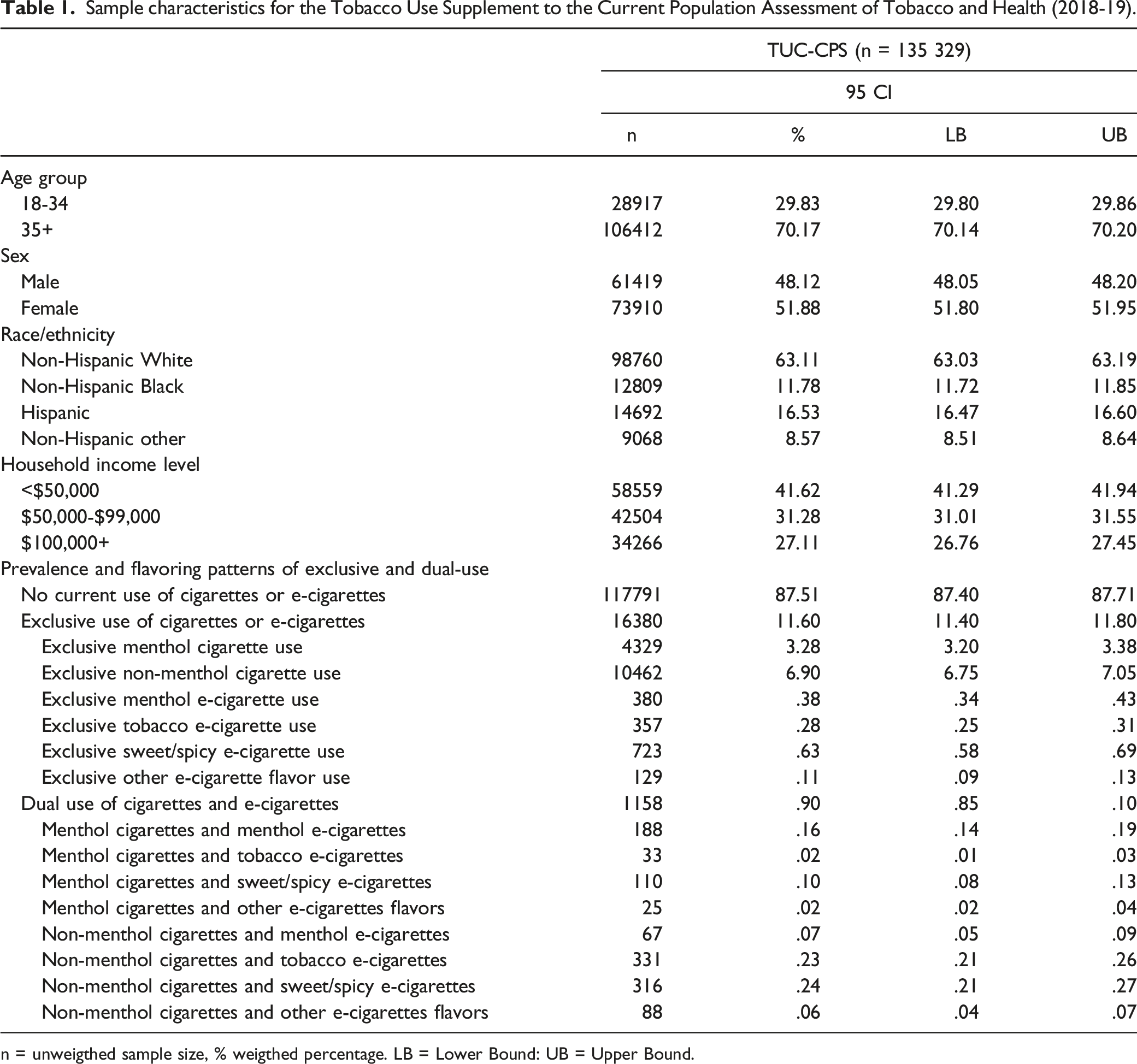
n = unweigthed sample size, % weigthed percentage. LB = Lower Bound: UB = Upper Bound.
The population prevalence (PP) of exclusive use of either product (e-cigarettes or cigarettes) was similar for groups aged 18-34 (11.52%), and 35 years and over (11.62%), but the proportion of exclusive use among users (PAU) was higher for adults 35 years and over (94.4%) than adults 18-34 years (89.2%) (Figure 1, Supplemental Tables 1-2). Patterns of exclusive flavored product use varied by age group (Figure 1, Supplemental Tables 1-2). Exclusive non-menthol cigarette use was higher for adults 35 years and over vs adults 18-34 years (PP = 7.64% vs 5.16%, PAU = 62.08% vs 39.95%). Conversely, exclusive sweet/spicy e-cigarette use and exclusive menthol e-cigarette use was lower in adults 35 years and over than in 18-34 year-old adults. Dual use was lower among adults 35 years and over vs. adults 18-34 years old (PP = .62% vs. 1.39%, PAU 5.62% vs. 10.77%). The most common dual use combination was non-menthol cigarettes with tobacco e-cigarettes (PP = .23%, PAU = 1.89%) among adults aged 35 and over and non-menthol cigarettes with sweet/spicy e-cigarettes among adults aged 18-34 (PP = .42%, PAU = 3.27%). Patterns of exclusive and dual use of cigarettes and e-cigarettes among U.S adults by groups of age. TUS-CPS 2018-19 (Population prevalence)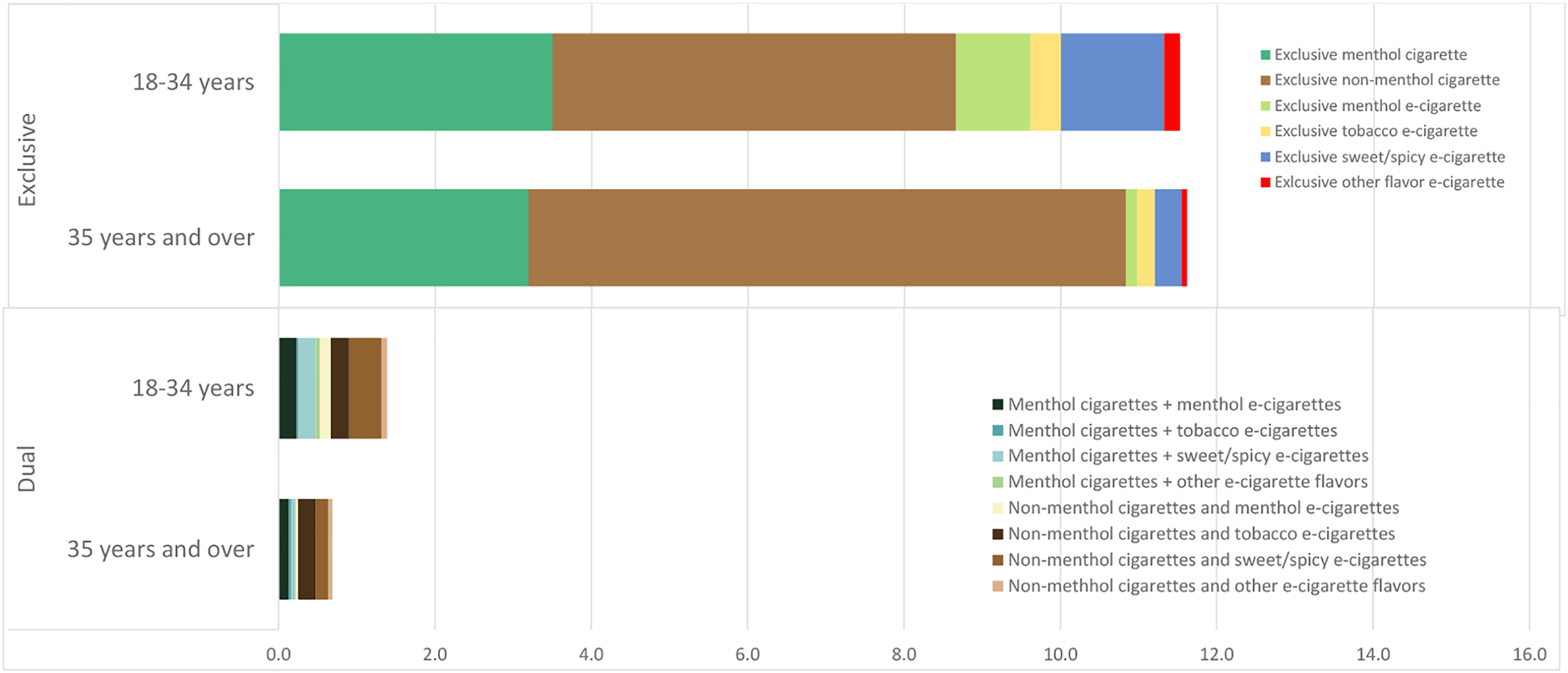
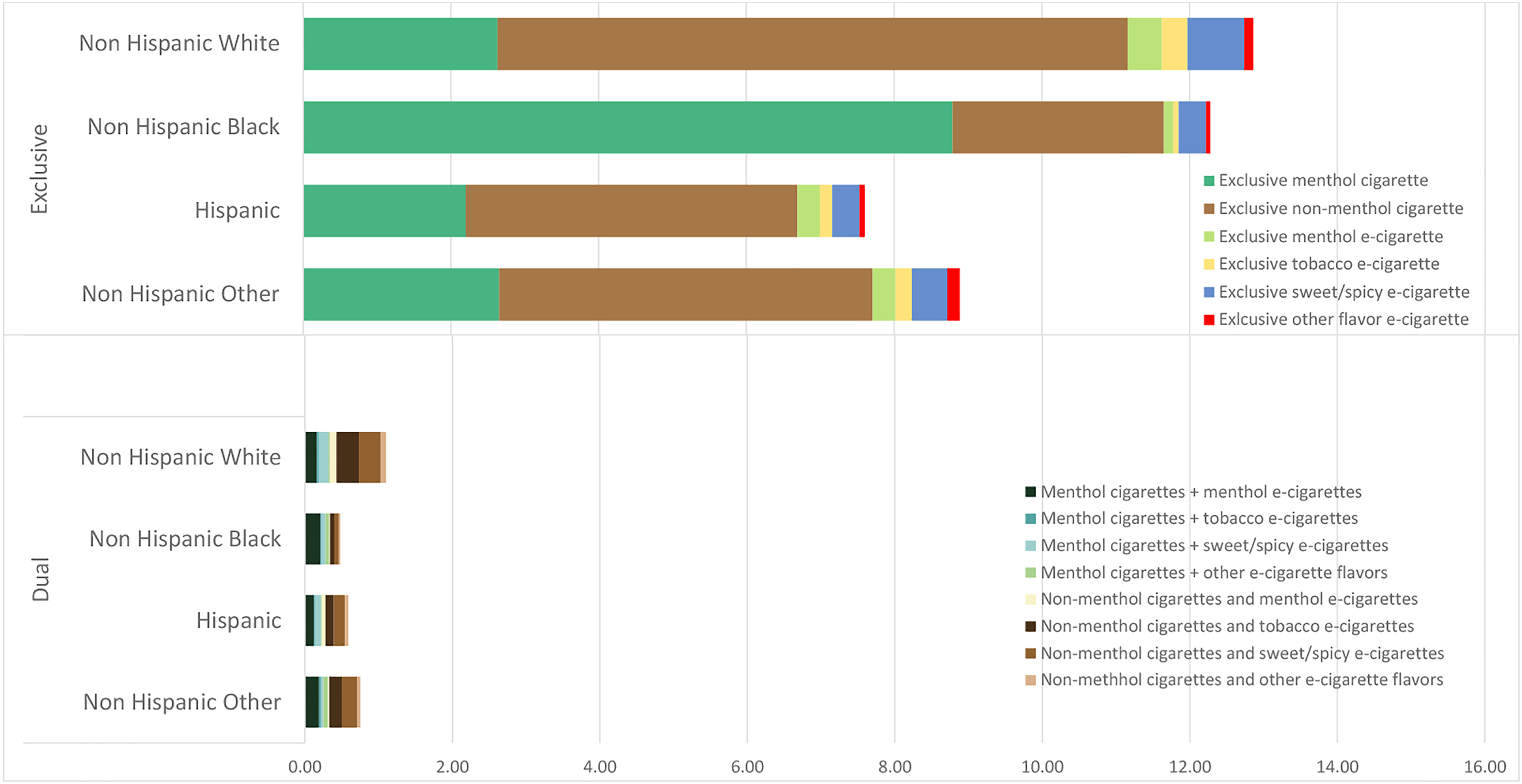
Exclusive menthol cigarette use was higher among NH Black adults (PP = 8.79%, PAU = 68.96%) than NH White adults (PP = 2.63%, PAU = 18.83; Figure 3, Supplemental Tables 5-6). Conversely, exclusive non-menthol cigarette use and dual use of non-menthol cigarettes and tobacco e-cigarettes was higher among NH White vs. NH Black adults. Additional results by race/ethnicity, as well as sex and income, can be found in Figures 2-4 and supplemental Tables 3-8. Patterns of exclusive and dual use of cigarettes and e-cigarettes among U.S adults by sex. TUS-CPS 2018-19 (Population Prevalence). Patterns of exclusive and dual use of cigarettes and e-cigarettes among U.S adults by race/ethnicity. TUS-CPS 2018-19 (Population prevalence). Patterns of exclusive and dual use of cigarettes and e-cigarettes among U.S adults by annual household income. TUS-CPS 2018-19 (Population prevalence).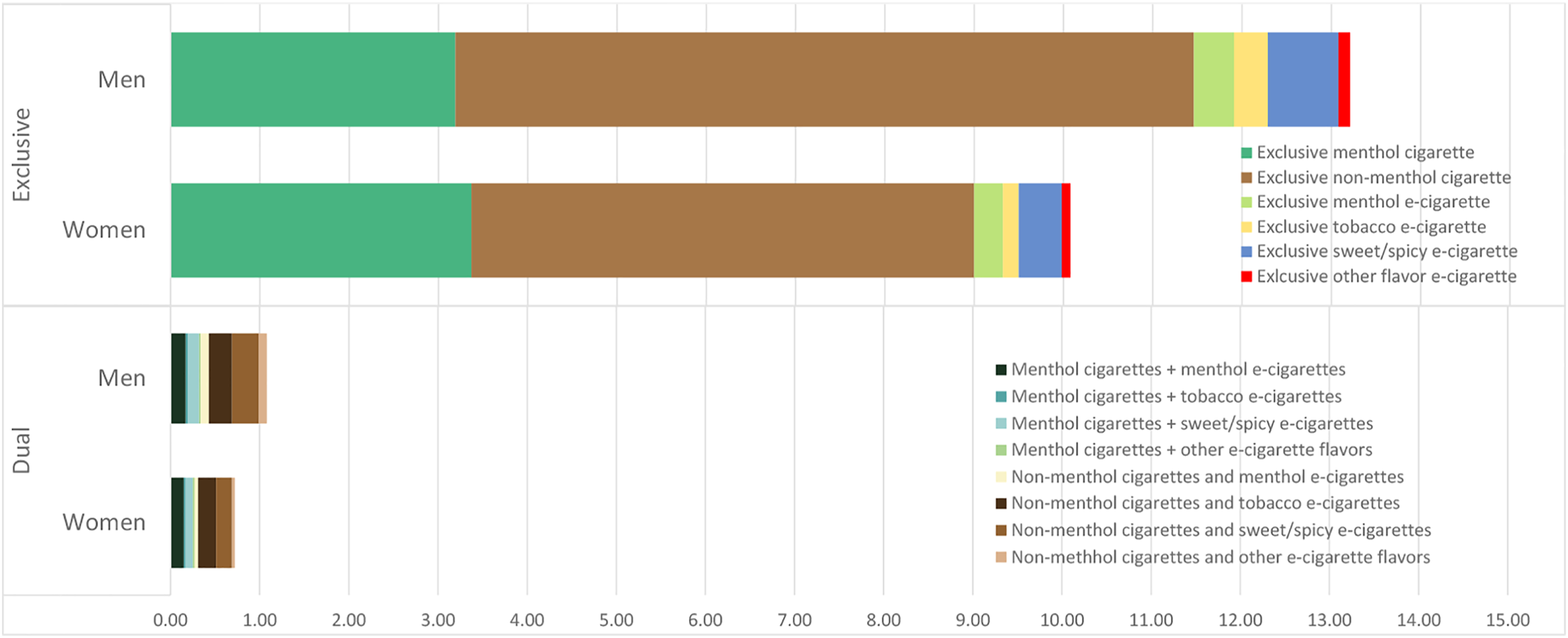
Discussion
We found that the prevalence of exclusive sweet/spicy e-cigarette use and exclusive menthol e-cigarette use was higher among young adults (18-34 years) and that flavor preference among dual users differed by age. Young adults were more likely to combine non-menthol or menthol cigarettes with sweet/spicy e-cigarettes, while adults 35 years and over tended to use menthol cigarettes with menthol e-cigarettes or non-menthol cigarettes with tobacco-flavored e-cigarettes. Our results highlight that menthol cigarette use continues to disproportionately affect Black Americans and young adults.2,3 The higher prevalence and proportion of sweet/spicy e-cigarette exclusive and dual use among young adults confirms previous studies that found that sweet/spicy flavors are attractive to youth and young adults and are associated with nicotine product initiation.10-12
The FDA is taking regulatory action regarding e-cigarettes and flavored e-cigarettes. FDA requires that all e-cigarette producers submit a premarket tobacco product application (PMTA) in which they must show that their approval is appropriate for the protection of public health. 13 In February 2020, the FDA initiated enforcement against some e-cigarette products in the market, prioritizing enforcement vs. cartridge-based flavored e-cigarettes (other than menthol or tobacco flavored) because of their popularity among youth. 14 The FDA also started reviewing e-cigarette PMTA applications in 2020 and to date, has only approved three tobacco-flavored e-cigarettes, denying or rejecting over six million e-cigarette applications. 13 An emerging challenge in this process is the rapid increase in the use of e-cigarette products using synthetic nicotine, such as Puff Bar, which some companies claim fall out Table 1 side the FDA’s tobacco product regulatory scope. 15 At this point, these products remain in the market, with some producers switching from tobacco-derived to synthetic nicotine with the intent to avoid FDA regulatory action. 16
In this context, our findings that younger e-cigarette users prefer sweet/spicy flavors and that older dual users prefer to combine the same flavor in both products, suggests that a ban on menthol cigarettes could be more effective if it is applied in conjunction with regulations that restrict access to sweet/spicy e-cigarette flavors, including e-cigarettes that use synthetic nicotine, while maintaining menthol/mint and tobacco e-cigarettes available as an alternative. 11 Given that users aged 35 and over tended to use the same flavor in cigarettes and e-cigarettes, it is possible that adults who smoke cigarettes and are trying to quit prefer e-cigarettes with the same flavor as their cigarettes (menthol or tobacco) as a cessation tool. These patterns of use could be particularly relevant for groups in which menthol cigarettes use is disproportionally high. For instance, although dual use is relatively low among Non-Hispanic Black adults, the most common combination of dual use in this group was menthol cigarettes with menthol e-cigarettes. Therefore, if a cigarettes menthol ban is enacted, one important consideration is whether menthol e-cigarettes can serve as an alternative or cessation tool. Findings from discrete choice experiments suggest that banning menthol cigarettes and allowing some flavored e-cigarettes would be more effective in reducing the prevalence of cigarette use, while a ban of flavored e-cigarettes alone with no prohibition of menthol cigarettes potentially could lead to an increase in cigarette use. 7
Limitations
We used the established current use definition for people who used cigarettes (i.e., 100 or more cigarettes in lifetime) but no established use criteria for e-cigarettes. Understanding differences in flavor use between experimental and established tobacco product use should be the focus of future research. Also, sample size restrictions limited our ability to further refine the analysis age groupings, which is relevant to evaluate flavored tobacco patterns among younger adults (i.e., 18-24 vs. 25-34 years old).
Significance
We found important differences in patterns of flavored cigarette and e-cigarette use by age, sex, race/ethnicity, and income. Our findings suggest that a cigarette menthol ban might be most effective in conjunction with a regulation that restrict access to sweet/spicy e-cigarettes. It is unclear if menthol e-cigarettes should be restricted, although there is a risk that younger adults and youth may initiate nicotine product use through menthol e-cigarettes. These findings will be directly relevant to tobacco control policies that maximize the potential of e-cigarettes for smoking cessation while reducing the likelihood of youth initiation.
Previous studies have evaluated flavored e-cigarette and cigarette use separately. However, there is limited research describing the joint patterns of flavored cigarette and e-cigarette use. We report the prevalence and proportion of exclusive and dual use for the 15-category flavored cigarette and e-cigarette use variable. Exclusive menthol cigarette use were higher among NH Black compared to NH White. Exclusive sweet/spicy e-cigarette use and exclusive menthol e-cigarette use was higher in younger (18-34) vs. older (35+) adults. Older dual users tended to combine the same flavor in both products. This study provides information to policymakers of current and potential future restrictions on tobacco product flavoring. Particularly, our findings suggest that a ban of menthol cigarettes could be more effective if it is applied in conjunction with a regulation restricting access to sweet/spicy e-cigarette flavors, including e-cigarettes that use synthetic nicotine.So What?
What is already known on this topic?
What does this article add?
What are the implications for health promotion practice or research?
Supplemental Material
sj-xlsx-1-ahp-10.1177_08901171221097682 – Supplemental Material for Flavoring Patterns of Exclusive and Dual-Use of Cigarettes and E-Cigarettes Among US Adults: Results from the TUS-CPS 2018-2019
Supplemental Material, sj-xlsx-1-ahp-10.1177_08901171221097682 for Flavoring Patterns of Exclusive and Dual-Use of Cigarettes and E-Cigarettes Among US Adults: Results from the TUS-CPS 2018-2019 by Luis Zavala-Arciniega, Jana L. Hirschtick, Rafael Meza and Nancy L. Fleischer in American Journal of Health Promotion
Supplemental Material
sj-pdf-2-ahp-10.1177_08901171221097682 – Supplemental Material for Flavoring Patterns of Exclusive and Dual-Use of Cigarettes and E-Cigarettes Among US Adults: Results from the TUS-CPS 2018-2019
Supplemental Material, sj-pdf-2-ahp-10.1177_08901171221097682 for Flavoring Patterns of Exclusive and Dual-Use of Cigarettes and E-Cigarettes Among US Adults: Results from the TUS-CPS 2018-2019 by Luis Zavala-Arciniega, Jana L. Hirschtick, Rafael Meza and Nancy L. Fleischer in American Journal of Health Promotion
Footnotes
Acknowledgments
Thanks to Dr Kirsten Herold for proofreading this manuscript
Author’s contribution
LZ-A, NF and RM conceived the research, LZ-A and JH conducted the statistical analyses, RM, JH and, NF assisted with data interpretation and critically reviewed the manuscript. All authors approved the submitted version for publication.
Declaration of Conflicting Interests
The author(s) declared no potential conflicts of interest with respect to the research, authorship, and/or publication of this article.
Funding
The author(s) disclosed receipt of the following financial support for the research, authorship, and/or publication of this article: This research reported here was supported by the National Cancer Institute of the National Institutes of Health under Award Number U54- CA229974. The content is solely the responsibility of the authors and does not necessarily represent the official views of the National Institutes of Health.

Supplemental Material
Supplemental material for this article is available online.
References
Supplementary Material
Please find the following supplemental material available below.
For Open Access articles published under a Creative Commons License, all supplemental material carries the same license as the article it is associated with.
For non-Open Access articles published, all supplemental material carries a non-exclusive license, and permission requests for re-use of supplemental material or any part of supplemental material shall be sent directly to the copyright owner as specified in the copyright notice associated with the article.
