




Abstract
Objective:
Interpreting during the COVID-19 pandemic caused stress and adverse mental health among sign language interpreters. The objective of this study was to summarize the pandemic-related work experiences of sign language interpreters and interpreting administrators upon transitioning from on-site to remote work.
Methods:
From March through August 2021, we conducted focus groups with 22 sign language interpreters in 5 settings, 1 focus group for each setting: staff, educational, community/freelance, video remote interpreting, and video relay services. We also conducted 5 individual interviews with interpreting administrators or individuals in positions of administrative leadership in each represented setting. The 22 interpreters had a mean (SD) age of 43.4 (9.8) years, 18 were female, 17 were White, all identified as hearing, and all worked a mean (SD) of 30.6 (11.6) hours per week in remote interpreting. We asked participants about the positive and negative consequences of transitioning from on-site to remote at-home interpreting. We established a thematic framework by way of qualitative description for data analysis.
Results:
We found considerable overlap across positive and negative consequences identified by interpreters and interpreting administrators. Positive consequences of transitioning from on-site to remote-at-home interpreting were realized across 5 overarching topic areas: organizational support, new opportunities, well-being, connections/relationships, and scheduling. Negative consequences emerged across 4 overarching topic areas: technology, financial aspects, availability of the interpreter workforce, and concerns about the occupational health of interpreters.
Conclusions:
The positive and negative consequences shared by interpreters and interpreting administrators provide foundational knowledge upon which to create recommendations for the anticipated sustainment of some remote interpreting practice in a manner that protects and promotes occupational health.
Keywords
The COVID-19 pandemic affected the provision of sign language interpreting services. Sign language interpreters were essential, working on the frontlines as medical interpreters, disseminating information at emergency press briefings, and interpreting remotely from home.1-6 This high demand garnered more attention to the known occupational hazards of role strain, burnout, and vicarious trauma among interpreters.7-9 Interpreting during the pandemic caused interpreters to experience greater-than-normal stress and adverse mental health.3,10 For educational, health and media, and governmental interpreters, the constant flux of measures to quell the spread of COVID-19, as well as the need to communicate the nature and progression of disease and interpret for local press briefings, contributed to stress. 3 In several studies describing the work of interpreters during the pandemic, among interpreters working remotely from home, 10% to 24% expressed some degree of stress, 17% to 30% had some degree of anxiety, 23% experienced some depression, and 13% reported seeking some form of mental health support because of changing professional demands.4,10,11 Little qualitative research has investigated how consequences experienced during the pandemic affected the health and well-being of interpreters and their longevity in the field. Data on some factors specific to the extreme conditions of the pandemic and the challenges of interpreting at public briefings during crises were gathered in previous research via interviews with Lithuanian 5 and British and Irish 6 sign language interpreters. However, much of the evidence on the benefits and challenges of interpreting remotely has been explored via survey.4,12
Many interpreters were unwilling to go out into the community for fear of exposure and shifted to working remotely from home when COVID-19 was declared a global pandemic in March 2020.12,13 Some 60% to 64% of interpreters had never worked remotely before the pandemic, and 46% reported not feeling comfortable or prepared for the transition to remote work.4,12 A scoping review published in 2022 addressed what is known about remote interpreting or what the authors described as “interpreted mediated interactions between people using a signed respective spoken language across distances in real time.” 14 Most of the studies included in the review described video relay interpreting in call centers (not from home), and all studies were conducted before the pandemic. 14 In the few studies on video remote interpreting in educational, legal, and medical settings, interpreters characterized the lack of travel time and the possibility of working from home as advantages and technological (access to stable WiFi), linguistic (2- instead of 3-dimensional), environmental (distracting backgrounds), and logistical (getting people’s attention) issues as challenges. 14
More qualitative work is needed to bolster our understanding of working remotely during the changing work conditions of the pandemic across interpreting settings. Not having to travel, better work environment, and flexibility have been recognized as benefits, while feelings of isolation, technical issues, lack of feedback from consumers and team interpreters, eye strain/computer fatigue, and billing have been identified as challenges.11,12 Other previous survey work found flexibility, less travel time, improved efficiency, and availability of interpreting services, including new opportunities to team with interpreters in different geographic locations, as benefits. 4 Furthermore, remote interpreting has been characterized as making a positive contribution toward work–life balance. The most frequently reported obstacles to remote interpreting were technical glitches, a suitable workplace setup, and children at home or other at-home distractions. 4 To our knowledge, no previous work has explored the organizational-level perspectives of interpreting administrators. Capturing data on the pandemic-related work experiences of interpreters and the perspectives of administrators is critical for protecting and promoting occupational health and sustaining the practice of remote interpreting.
In previous research, 41% of the variance in sign language interpreters’ perceptions of the determinants of remote interpreting implementation was explained by organizational-level factors (managerial support and insight, sufficient materials, resources, and training). 15 Eleven percent of the variance in interpreters’ experiences with the implementation process was explained by individual-level factors (interpreters’ skills and beliefs in their capabilities), and 7% was explained by social-level factors (problem solving with and support received from fellow remote interpreters). 15 The objective of our study was to summarize qualitatively the individual-level experiences of interpreters and the organizational-level perspectives of administrators upon transitioning from on-site to remote work from home during the COVID-19 pandemic.
Methods
The University of Rochester’s Research Subjects Review Board (RSRB) reviewed this study (STUDY00005893) and deemed it exempt under the US Department of Health and Human Services regulation 45 CFR 46.104; specifically, under exemption category 2 (surveys/interviews/educational tests/observation of public behavior) iii (information obtained is recorded in such a manner that human subjects can be identified, directly or through identifiers linked to the subjects, and the RSRB conducts limited institutional review board review).
Participants
From March through August 2021, we used semistructured focus groups to gather data on pandemic-related work experiences from sign language interpreters in 5 settings, 1 focus group for each setting: staff (federal or state government, agency, or medical center employees), educational (kindergarten through university), community/freelance (independent contractors), video remote interpreting (2-way connection between on-site participants and a remote interpreter), and video relay services (3-way telecommunication between deaf and hearing parties and an interpreter, all in separate locations). In addition, we conducted 5 individual interviews with interpreting administrators or individuals in positions of administrative leadership in each represented setting.
Focus groups with interpreters
In previous research, a collective survey was conducted from March through September 2021 to measure interpreters’ physical and mental health, 10 perceptions of the remote interpreting implementation process, 15 and experience with the technical aspects and personal impressions of working remotely during the COVID-19 pandemic. Educational institutions, interpreter referral services, nonprofit associations, and video relay service providers shared recruitment material via email listservs, social media, or websites. Respondents identified their primary interpreting setting (staff, educational, community/freelance, video remote, or video relay) and, at the end of the survey,10,15 the survey asked if they would consider participation in a focus group. We used purposive maximum variation (demographic and geographic) sampling 16 to invite survey respondents to participate in focus groups from June through August 2021. We included certified hearing and deaf interpreters from the United States and England, as well as interpreters with various ages, racial and ethnic backgrounds, sex and gender identities, and years of interpreting experience. We scheduled focus groups to meet the needs and availability of the interested interpreters across the 5 settings. Eligible interpreters worked remotely from home in their primary setting at least 10 hours per week. Twenty-two interpreters participated; the mean (SD) age was 43.4 (9.8) years, 18 were female, 17 were White, all identified as hearing, and they worked a mean (SD) of 30.6 (11.6) hours per week in remote interpreting (Table 1). One certified deaf interpreter who identified as hard of hearing was confirmed to join a focus group but was unable to attend at the last minute.
Characteristics of sign language interpreters in focus groups and interpreting administrators in individual interviews conducted to gather data upon transitioning from the delivery of on-site to remote interpreting during the COVID-19 pandemic, United States, March–August 2021
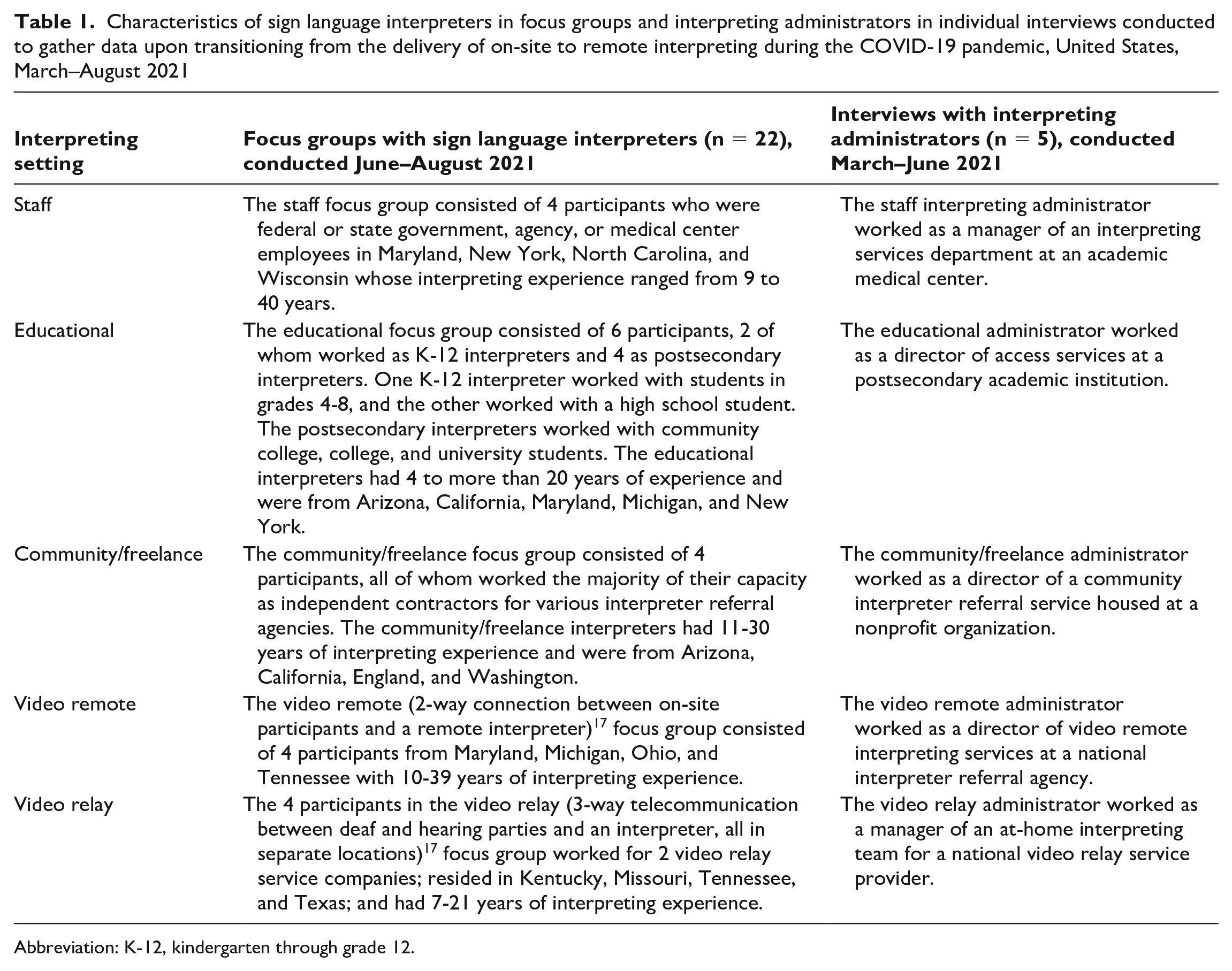
Abbreviation: K-12, kindergarten through grade 12.
Individual interviews with interpreting administrators
We used the contacts of study team investigators and snowball sampling among previous survey respondents10,15 to invite the participation of interpreting administrators across the 5 settings. We conducted 5 individual interviews, 1 for each setting, from March through June 2021 (Table 1).
Data Collection
One investigator (G.R.) collected the qualitative data from each focus group and interview, which were performed remotely, lasted 90 minutes, and were recorded by using video conferencing software (Zoom). For this study, we extracted focus group and interview data on transitioning from on-site to remote work from home during the COVID-19 pandemic. Interpreters were asked, “What did you feel were the positive and negative consequences of transitioning from on-site to remote-at-home interpreting?” Administrators were asked, “What did you feel were the positive and negative consequences of providing remote-at-home interpreting services?”
Data Processing and Analysis
One investigator (G.R.) processed the data by manually transcribing information from the focus groups and interviews. A thematic framework was established by way of qualitative description for data analysis18,19 using MaxQDA software (VERBI GmbH). One investigator (G.R.) initially coded the qualitative data. Thereafter, 2 investigators (G.R. and R.Y.N.) worked separately to identify and then together to triangulate common topic areas, themes, and subthemes relating to the positive and negative consequences identified by the interpreters and administrators. Saturation occurred when no new topic areas, themes, or subthemes emerged. Qualitative descriptive approaches provided straightforward description of the phenomena 20 ; thus, we deemed member checking unnecessary.
Results
Positive Consequences of Transitioning From On-Site to Remote-at-Home Interpreting
Positive consequences reported by interpreters and administrators were realized across 5 overarching topic areas: organizational support, new opportunities, well-being, connections/relationships, and scheduling (Table 2). Organizational support consisted of 5 themes: (1) job security (how organizations supported interpreters during the transition), (2) provision of equipment, (3) support with various ways to deliver interpreting services (to prevent “Zoom fatigue”), (4) internal information technology support, and (5) video relay–specific themes. Video relay–specific themes were use of voluntary time off (without reprimand), unlimited counseling through the employee assistance program, and listening groups because of civil unrest.
Positive consequences experienced by sign language interpreters and interpreting administrators upon transitioning from the delivery of on-site to remote interpreting during the COVID-19 pandemic, United States, March–August 2021
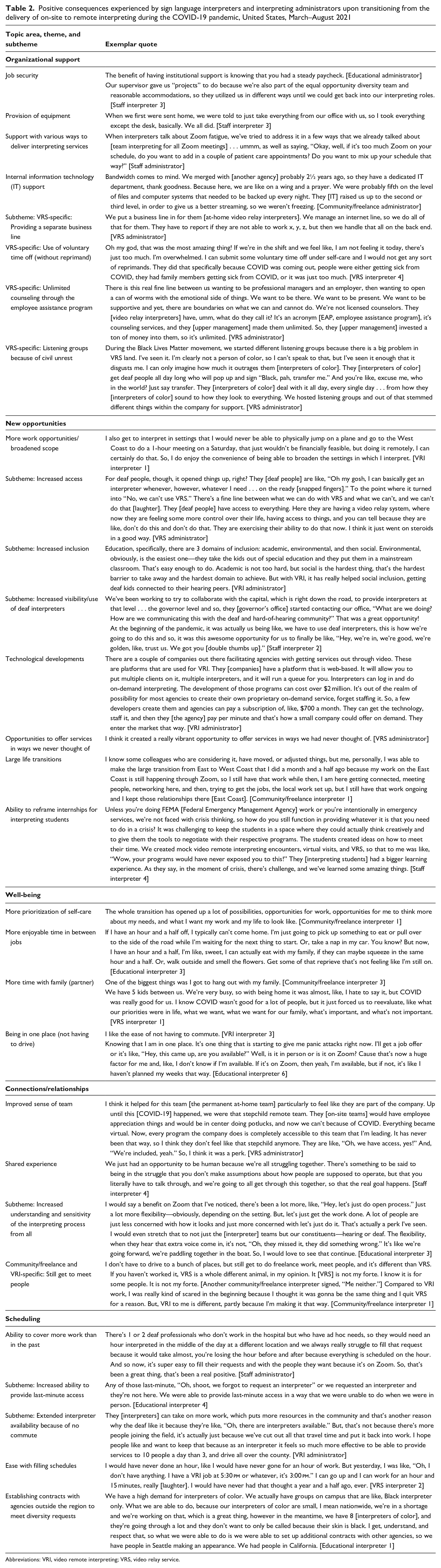
Abbreviations: VRI, video remote interpreting; VRS, video relay service.
The topic area of new opportunities also consisted of 5 themes: (1) more work opportunities/broadened scope, (2) technological developments (new software platforms), (3) opportunities to offer services in ways we never thought of, (4) large life transitions (eg, a relocation while maintaining work connections), and (5) ability to reframe internships for interpreting students.
The transition also provided opportunities for improved well-being. This topic area consisted of 4 themes: (1) more prioritization of self-care, (2) more enjoyable time in between jobs, (3) more time with family (partner), and (4) being in one place (not having to drive).
The fourth topic area, connections/relationships, consisted of 3 themes: (1) improved sense of team, (2) shared experience, and (3) still get to meet people (community/freelance and video remote interpreting–specific). Connections/relationships were fostered through the shared experience of navigating the pandemic together. Community/freelance and video remote interpreters indicated opportunities to still get to meet people in their work as part of making connections/relationships.
The fifth overarching topic area was scheduling, which consisted of 3 themes: (1) ability to cover more work than in the past, (2) ease with filling schedules, and (3) establishing contracts with agencies outside of the region to meet diversity requests. We found considerable overlap in positive consequences between interpreters and administrators and several differences (Figure A and C).
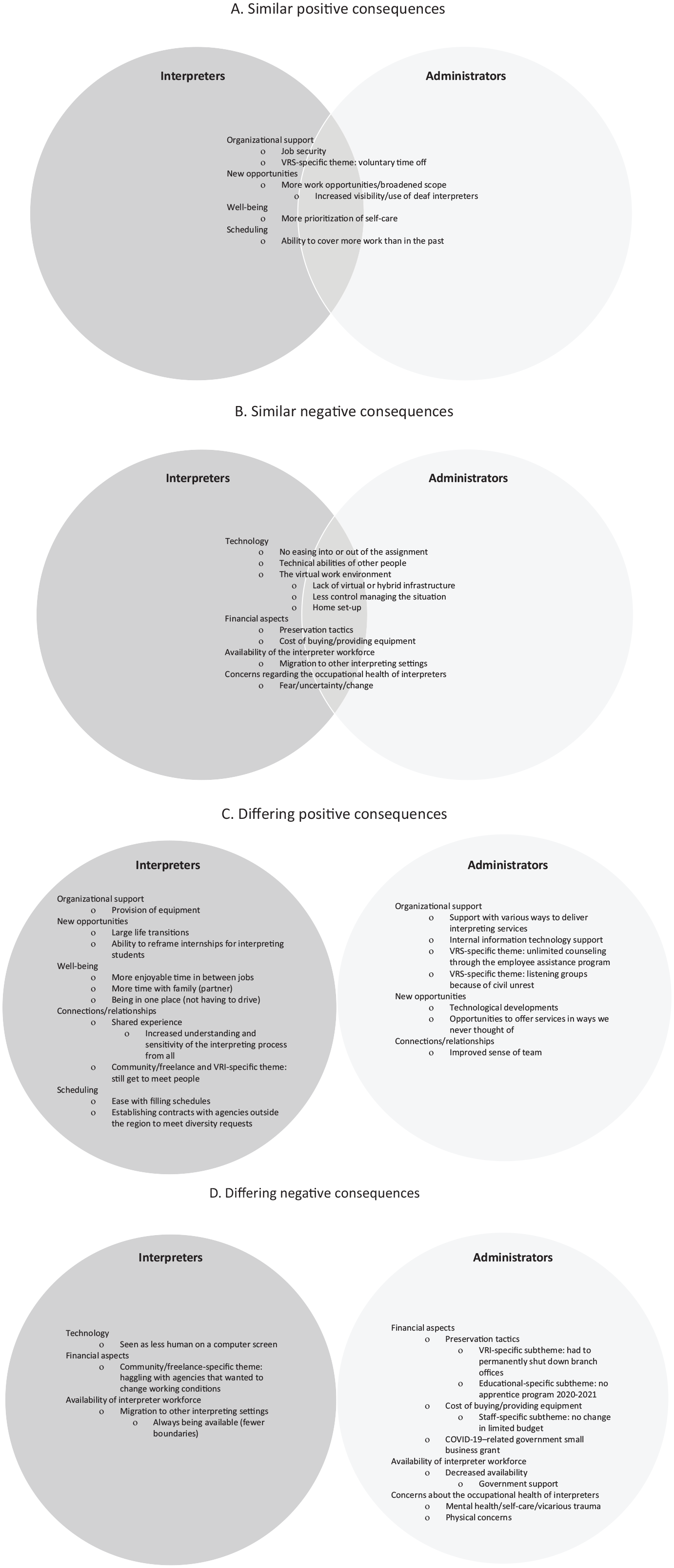
Similar and differing positive and negative consequences experienced by sign language interpreters and interpreting administrators when transitioning from the delivery of on-site interpreting services to remote interpreting services during the COVID-19 pandemic. Abbreviations: VRI, video remote interpreting; VRS, video relay service.
Negative Consequences of Transitioning From On-Site to Remote-at-Home Interpreting
Negative consequences incurred upon transitioning to remote interpreting across interpreters and administrators emerged across 4 overarching topic areas: technology, financial aspects, availability of the interpreter workforce, and concerns about the occupational health of interpreters (Table 3). Technology consisted of 4 themes: (1) no easing into or out of the assignment (no rapport building or debriefing), (2) seen as less human on a computer screen (interpreters as commodities), (3) technical abilities of other people, and (4) the virtual work environment.
Negative consequences experienced by sign language interpreters and interpreting administrators upon transitioning from the delivery of on-site to remote interpreting during the COVID-19 pandemic, United States, March–August 2021
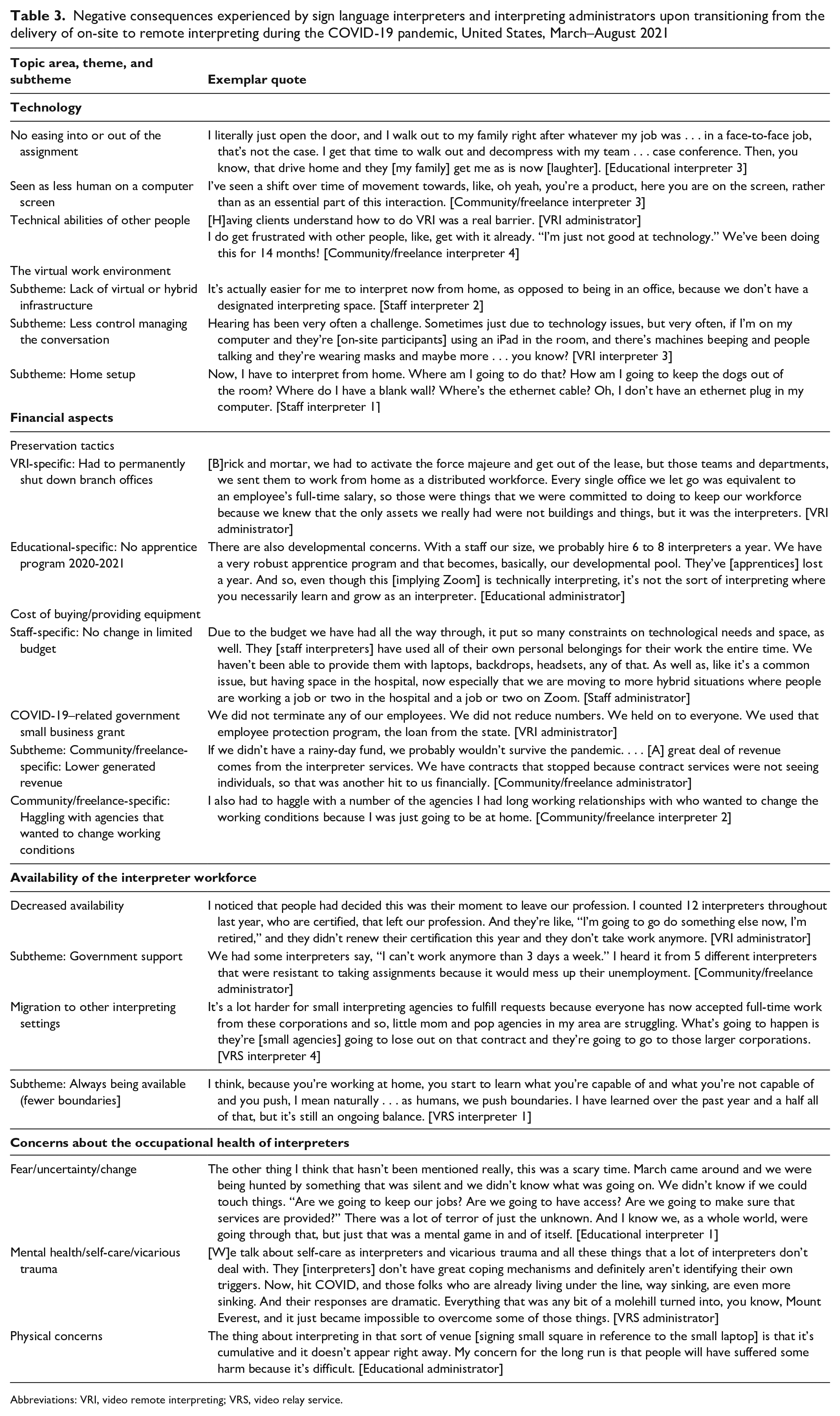
Abbreviations: VRI, video remote interpreting; VRS, video relay service.
The topic area of financial aspects had 4 themes: (1) preservation tactics (to keep the business viable), (2) cost of buying/providing equipment, (3) COVID-19–related government small business grant, and (4) a community/freelance-specific theme of haggling with agencies that wanted to change working conditions (less pay, no 2-hour minimum).
The third topic area for negative consequences of transitioning from on-site to remote interpreting was the availability of the interpreter workforce. This topic area consisted of 2 themes: decreased availability (because of government support) and migration to other interpreting settings (away from smaller agencies to corporations) because of increased demand.
Concerns about the occupational health of interpreters was another negative consequence. This topic area had 3 themes: (1) fear/uncertainty/change (not feeling safe, fear of the unknown), (2) mental health/self-care/vicarious trauma, and (3) physical concerns (eye strain, more sedentary). We found considerable overlap and some differences in negative consequences between interpreters and administrators (Figure B and D) and a few setting-specific themes that did not seem to fit within any of the topic areas already mentioned (Table 4).
Setting-specific themes that did not seem to fit within any of the topic areas already mentioned for the negative consequences experienced by sign language interpreters and interpreting administrators upon transitioning from the delivery of on-site to remote interpreting during the COVID-19 pandemic, United States, March–August 2021
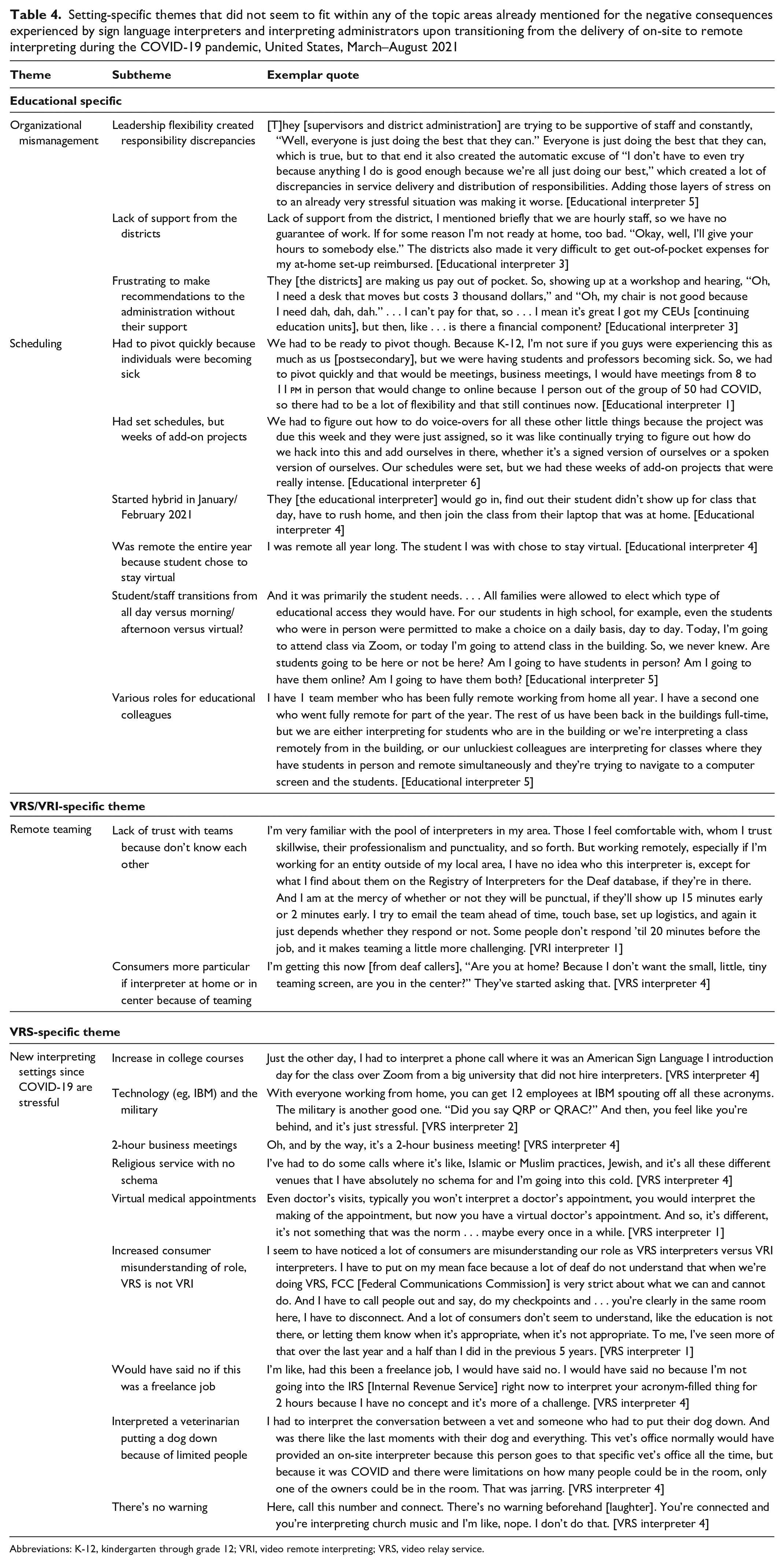
Abbreviations: K-12, kindergarten through grade 12; VRI, video remote interpreting; VRS, video relay service.
Discussion
This work summarized the consequences experienced by interpreters and administrators upon transitioning to remote work during the COVID-19 pandemic. Most previous data about interpreters working remotely were gathered via survey4,10-12,15 and compiled via a scoping review. 14 We used interviews to investigate the perspectives of administrators and then sequentially gathered the experiences of interpreters via focus groups for a qualitative description. This research adds to the literature by categorizing pandemic-related work experiences across interpreting settings and was the first work, to our knowledge, to gather the organizational-level perspectives of administrators. Findings can be used to foster the health protection and promotion of remote interpreters.
The consequences reported in this work were similar to the benefits and challenges of working remotely as an interpreter in the recent literature.4,11,12,14 The benefit of being in one place was mentioned in our work as well as in all previous studies.4,12,14 Other past reported benefits, such as flexibility, better work environment, improved efficiency, and availability of interpreting services, including new opportunities to work with interpreters from various geographic locations,4,12 were all echoed in our study. While interpreters in our study reported improved mental health, more opportunities to think about their needs, and fewer unique negative consequences and more unique positive consequences than administrators, they did not indicate experiencing a positive effect on work–life balance. 4 In contrast to maintaining a work–life balance, 4 interpreters in our study who migrated to other interpreting settings because of the increased demand had concerns about always being available as a negative consequence and were trying not to overextend themselves. Because many interpreters migrated to video remote and video relay settings during the pandemic, staff and educational employers should consider incentivizing their workforce, and community/freelance agencies should consider taking advantage of the technological developments now available to facilitate market entry into video remote interpreting for increased retention.
Technological or technical challenges or the many negative consequences of technology were mentioned in our study and in all previous studies.4,12,14 Other past reported linguistic (lack of feedback from the deaf consumer and team), environmental (suitable workplace setup), and logistical (education of participants on how to use software platforms) challenges, along with social and professional isolation and eye strain/computer fatigue,4,11,12,14 were echoed in our work as negative consequences. Interpreters expressed a desire for common standards and procedures for remote interpreting practice because of the lack of virtual or hybrid infrastructure. Thus, the Registry of Interpreters for the Deaf (the national professional association for sign language interpreters) might consider the creation of a standard practice paper for the dissemination of remote interpreting across settings. Because community/freelance interpreters felt the financial constraint of haggling with agencies that wanted to change working conditions, we recommend they rally together and collaborate with agencies to establish new community pay standards and working conditions that are in the best interest of all involved. While interpreters in our study reported environmental challenges (lack of environmental cues, ergonomic and developmental concerns), they did not mention children at home or other at-home distractions. 4 In contrast, they expressed how being in one place was particularly great for childcare, and administrators described how more prioritization of self-care allowed interpreters to enjoy doing things around the house in the middle of the day.
Setting-specific themes in our study were similar to the themes in educational, community/freelance, and video relay settings described in previous studies. 12 Organizational mismanagement reported by educational interpreters as a negative consequence in our study aligned with work by McKibbin 12 showing that educational interpreters received little to no support when transitioning to remote interpreting. In that study, 55% (12 of 22) of educational interpreters indicated they were not comfortable or prepared for working remotely; only 23% (5 of 22) received the necessary technical equipment, and 18% (4 of 22) received any technical support. 12 In our study, “still get to meet people” was reported as a positive consequence, and haggling with agencies that wanted to change working conditions was reported as a negative consequence by community/freelance interpreters. McKibbin 12 reported that because community/freelance interpreters are independent contractors or self-employed, they had no expectation of organizational support from an employer. Although these interpreters struggled with the remote transition, they were able to adapt and, unlike educational interpreters, most (7 of 12) felt comfortable or somewhat comfortable and prepared for working remotely. 12 In our study, voluntary time off (without reprimand), unlimited counseling through the employee assistance program, listening groups because of civil unrest, and company provision of a separate business line were reported as positive consequences, and remote teaming and new interpreting settings since COVID-19 were reported as negative consequences by video relay interpreters. In the McKibbin 12 study, video relay interpreters worked in call centers before working remotely from home; they were described as “tech savvy” and had access to social supports, such as problem solving with remote interpreting colleagues. Our study also found themes specific to staff and video remote interpreters; however, we were unable to compare these findings because no past work has categorized consequences to these settings.
Limitations
This study had a few limitations. First, the focus group analysis was limited to interpreters who had sufficient support and resources to work from home; we did not include interpreters who were unable to adapt to the remote interpreting context (likely another contributor to the decreased availability of the interpreter workforce). Second, the focus groups and interviews were conducted only with hearing interpreters and administrators. Future research should incorporate the perspectives of interpreters who were unable to adapt to remote interpreting, deaf and hard-of-hearing interpreters and administrators, and deaf, hard-of-hearing, and hearing consumers of remote interpreting services.
Conclusions
Implications for public health practice can be gleaned from the similar positive and negative consequences of working remotely shared by interpreters and administrators. These individual-level experiences and organizational-level perspectives provide foundational knowledge upon which to create recommendations for the anticipated sustainment of some remote interpreting practice in a manner that protects and promotes the health of this essential workforce. New ideas and initiatives should continue to be cultivated in support of the positive consequences found in our work. Specifically, other interpreting settings can now borrow from the video relay–specific theme of voluntary time off to allow for management of fear/uncertainty/change and more prioritization of self-care without penalty. The interpreting field should continue to advocate for increased visibility and use of deaf interpreters (a subtheme of more work opportunities/broadened scope), as deaf interpreters bring formative life, cultural, and linguistic experiences that offer nuanced communication access to a wide array of deaf audiences. 21 Organizational, individual, and social-level supports should be considered for holistically managing the negative consequences. Specifically, budgets and space should be reappropriated to account for the shift in the provisioning of services. This infrastructure should include any necessary equipment; information technology support; internet connectivity when at home, in the office, or working a hybrid schedule; and a designated virtual interpreting space when in the office. Efforts to increase interpreter retention should be closely examined across staff, educational, and community/freelance settings, and the national professional association for interpreters might consider generating a remote interpreting standard practice paper. In an effort to preserve the availability of communication access between hearing and deaf sign language users, the qualitative descriptions provided in our research can be constructively used to improve the health and well-being of sign language interpreters and their longevity in the field.
Footnotes
Acknowledgements
The authors thank the sign language interpreters and interpreting administrators who participated in this study for sharing their experiences upon transitioning from on-site to remote interpreting during the COVID-19 pandemic.
Declaration of Conflicting Interests
The authors declared no potential conflicts of interest with respect to the research, authorship, and/or publication of this article.
Funding
The authors disclosed receipt of the following financial support for the research, authorship, and/or publication of this article: The project described in this publication was supported by the University of Rochester Clinical and Translational Science Awards Program award number TL1 T-R002000 from the National Center for Advancing Translational Sciences of the National Institutes of Health (G.R.) and the University of Rochester Center for Community Health and Prevention Mini-Grant (G.R.). The content is solely the responsibility of the authors and does not necessarily represent the official views of the National Institutes of Health.
