




Abstract
Objective:
The COVID-19 pandemic has put unprecedented stress on essential workers and their children. Limited cross-sectional research has found increases in mental health conditions from workload, reduced income, and isolation among essential workers. Less research has been conducted on children of essential workers. We examined trends in the crisis response of essential workers and their children from April 2020 through August 2021.
Methods:
We investigated the impact during 3 periods of the pandemic on workers and their children using anonymized data from the Crisis Text Line on crisis help-seeking texts for thoughts of suicide or active suicidal ideation (desire, intent, capability, time frame), abuse (emotional, physical, sexual, unspecified), anxiety/stress, grief, depression, isolation, bullying, eating or body image, gender/sexual identity, self-harm, and substance use. We used generalized estimating equations to study the longitudinal change in crisis response across the later stages of the pandemic using adjusted odds ratios (aORs) for worker status and crisis outcomes.
Results:
Results demonstrated higher odds of crisis outcomes for thoughts of suicide (aOR = 1.06; 95% CI, 1.00-1.12) and suicide capability (aOR = 1.14; 95% CI, 1.02-1.27) among essential workers than among nonessential workers. Children of essential workers had higher odds of substance use than children of nonessential workers (aOR = 1.33; 95% CI, 1.08-1.65), particularly for Indigenous American children (aOR = 2.76; 95% CI, 1.35-5.36). Essential workers (aOR = 1.17; 95% CI, 1.07-1.27) and their children (aOR = 1.18; 95% CI, 1.07-1.30) had higher odds of grief than nonessential workers and their children.
Conclusion:
Essential workers and their children had elevated crisis outcomes. Immediate and low-cost psychologically supportive interventions are needed to mitigate the mental health impacts of the COVID-19 pandemic on these populations.
Keywords
Essential and frontline workers, such as health care professionals, law enforcement officers, sanitation workers, and food service employees, endured extraordinary circumstances during the COVID-19 pandemic. More than half of all essential workers experienced mental health issues during the pandemic, and more than 20% of essential workers considered suicide at the beginning of the pandemic. 1 Concerns about virus exposure, lack of paid sick leave, managing workload differences because of staffing shortages, isolation from family and friends, grief, and hazardous work conditions are but a few challenges faced by essential workers.2,3 Financial constraints further complicate stress among essential workers. According to the US Bureau of Labor Statistics, more than 90% of essential workers are in the bottom quartile of income and may not have the resources to stay home to protect their health and the health of family members. 4
Studies on workers during the early period of the COVID-19 pandemic found high rates of distress,2,5 depression,1,5 anxiety,1,6,7 sleep disturbance,2,6 and suicidal ideation. 1 However, most of these studies were limited to cross-sectional surveys administered to populations in the United States 1 and China.2,5 Crisis hotlines and other intervention services provide a unique dataset to monitor mental health and crisis events longitudinally throughout the pandemic. 8
Despite limited research seeking to understand the mental health impact of increased stress among essential workers during the pandemic, 9 little research has examined essential workers’ and their families’ mental health throughout the pandemic, particularly beyond the first few months of the pandemic. Children of essential workers may be at a much higher risk than children of nonessential workers for mental health effects from COVID-19 because they not only face school closures and sudden changes in their daily routine but may have the additional stress of a parent being exposed to COVID-19 or of not receiving parental supervision. 10 Our previous work showed that children of essential workers had more crisis conversations than children of nonessential workers did during the early months of the pandemic, with elevated rates of abuse and isolation, and essential workers had a higher risk of thoughts of suicide than nonessential workers. 11 The current study extends the previous analysis to the later stages of the pandemic, from March 2020 through August 2021. Our study includes a novel dataset from Crisis Text Line (CTL), a global nonprofit organization that provides free 24/7 text-based crisis intervention texting services for those having a mental health crisis (https://www.crisistextline.org). We examined changes in text patterns for 2 medically vulnerable groups, children of essential workers and essential workers, during 3 periods of the pandemic. To date, CTL provides the most extensive set of deidentified mental health data globally (https://www.crisistextline.org). Results from this study may inform how later stages of the COVID-19 pandemic further affected the mental health of essential workers and their children.
Methods
Data
The data for this project include anonymized text conversations from CTL aggregated at the area code level. The Appalachian State University Institutional Review Board (IRB) deemed our secondary data analysis of deidentified text conversations to be exempt from review (IRB-#19-0270).
Approximately 20% of CTL users completed an optional end-of-conversation survey that collects additional demographic information. Our sample included the following demographic characteristics of CTL users who completed the survey: age (≤13, 14-17, 18-24, 25-34, 35-44, ≥45 years), gender (female, male, nonconforming), and race (White, Asian, Black, Indigenous American, Middle Eastern, other mixed race, Pacific Islander, no response).
The dataset included CTL users in the United States who responded to the optional survey that included the following question: “At this time, are you an essential or frontline worker? What about your parents? (For example, health care, delivery, messenger, food worker, etc)?” Crisis information was included for users who answered (1) Yes, I am an essential/frontline worker, (2) Yes, my parent(s) is an essential/frontline worker, or (3) No/no one of my immediate family is an essential/frontline worker. Our sample consisted of 3 periods: April 14 through June 12, 2020 (period 1); July 27, 2020, through January 11, 2021 (period 2); and April 20 through August 27, 2021 (period 3). These dates correspond to periods when survey questions about frontline worker status were available to CTL users.
Crisis Concerns
CTL users texted CTL for the following crisis concerns: thoughts of suicide, emotional abuse, physical abuse, sexual abuse, anxiety or stress, grief, depression, isolation, bullying, eating or body image, gender/sexual identity, self-harm, mention of COVID-19, or substance use. Crisis concerns were identified by crisis counselors using issue tags (eg, thoughts of suicide, substance use) that relate to the conversation and the reason for engaging with a CTL crisis counselor. 12 Each crisis concern was included as a bivariate categorical variable (yes/no).
For conversations in which suicidal thought was a concern, crisis counselors performed a risk assessment to better understand the texter’s current experience with suicide. The suicide risk levels assessed included (1) suicide desire (“Are they having thoughts about suicide?”), (2) suicide intent (“Do they have a plan for how they would end their life?”), (3) suicide capability (“Do they have what they need to carry out their plan?”), and/or (4) suicide time frame (“Have they set a time to go through with their plan?”).
Analysis
We conducted descriptive statistics for all CTL users who responded to the question about essential workers (n = 76 740 conversations) using the Pearson χ2 test and t tests. We used generalized estimating equations (GEEs) to quantify the change in crisis events across the later pandemic stages (periods 2 and 3) compared with the first pandemic stage (period 1). These dates correspond to periods when survey questions about essential worker status were available to CTL users.
Our analysis builds on our prior work, which examined the early pandemic period (March 13 through July 20, 2020) for (1) children of essential workers (referent group was children of nonessential workers) and (2) essential workers (referent group was nonessential workers). 11 GEE is an extension of generalized linear models that allows for adjusting for the correlation between repeated text conversations at different periods using a correlation matrix. 13 We determined correlation structures using the smallest Quasi Information Criterion values for an ar1 structure to account for the clustering of repeated texting conversations over time using a unique identification number for each CTL user.
We constructed separate GEE modes to (1) compare groups of similar age for essential workers versus nonessential workers, (2) compare groups of similar age for essential workers versus nonessential workers across the 3 pandemic periods, (3) compare pandemic trends of crisis events for essential workers compared with the early pandemic period, and (4) compare demographic characteristics of essential workers by crisis event. We replicated all 4 types of models for children of essential workers. We conducted all analyses in R version 1.3.1073 (R Foundation for Statistical Computing) with the package geepack.14,15 We considered results significant at α = .05, unless otherwise indicated.
Results
Essential workers who responded to the survey had more conversations than nonessential workers did (essential workers: n = 21 895 conversations, n = 14 775 users; nonessential workers: 19 353 conversations) during the 3 periods of data collection (Table 1). Among children of essential workers who responded to the survey, 16 463 conversations occurred among 12 276 unique child users (Table 2).
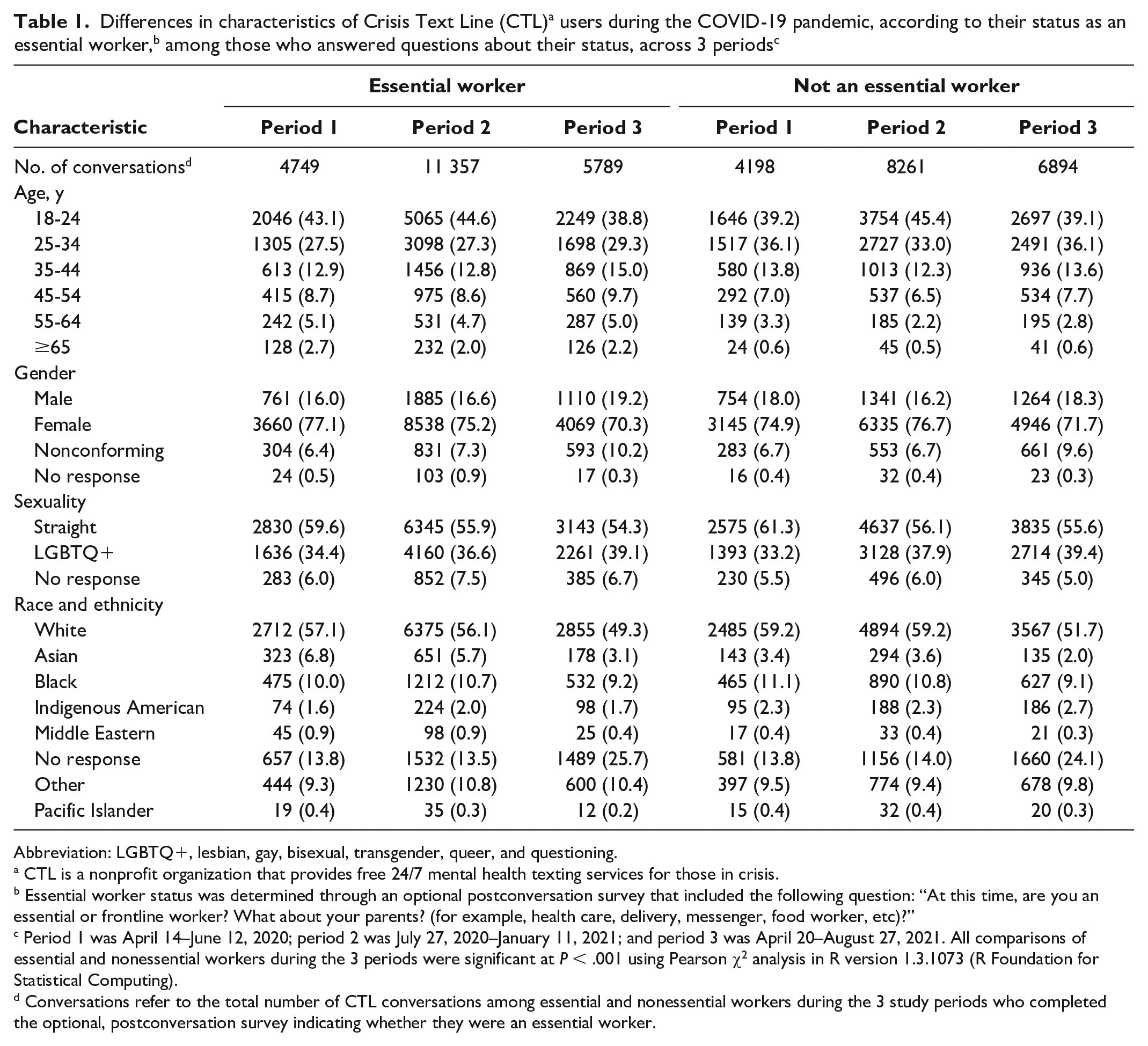
Abbreviation: LGBTQ+, lesbian, gay, bisexual, transgender, queer, and questioning.
CTL is a nonprofit organization that provides free 24/7 mental health texting services for those in crisis.
Essential worker status was determined through an optional postconversation survey that included the following question: “At this time, are you an essential or frontline worker? What about your parents? (for example, health care, delivery, messenger, food worker, etc)?”
Period 1 was April 14–June 12, 2020; period 2 was July 27, 2020–January 11, 2021; and period 3 was April 20–August 27, 2021. All comparisons of essential and nonessential workers during the 3 periods were significant at P < .001 using Pearson χ2 analysis in R version 1.3.1073 (R Foundation for Statistical Computing).
Conversations refer to the total number of CTL conversations among essential and nonessential workers during the 3 study periods who completed the optional, postconversation survey indicating whether they were an essential worker.
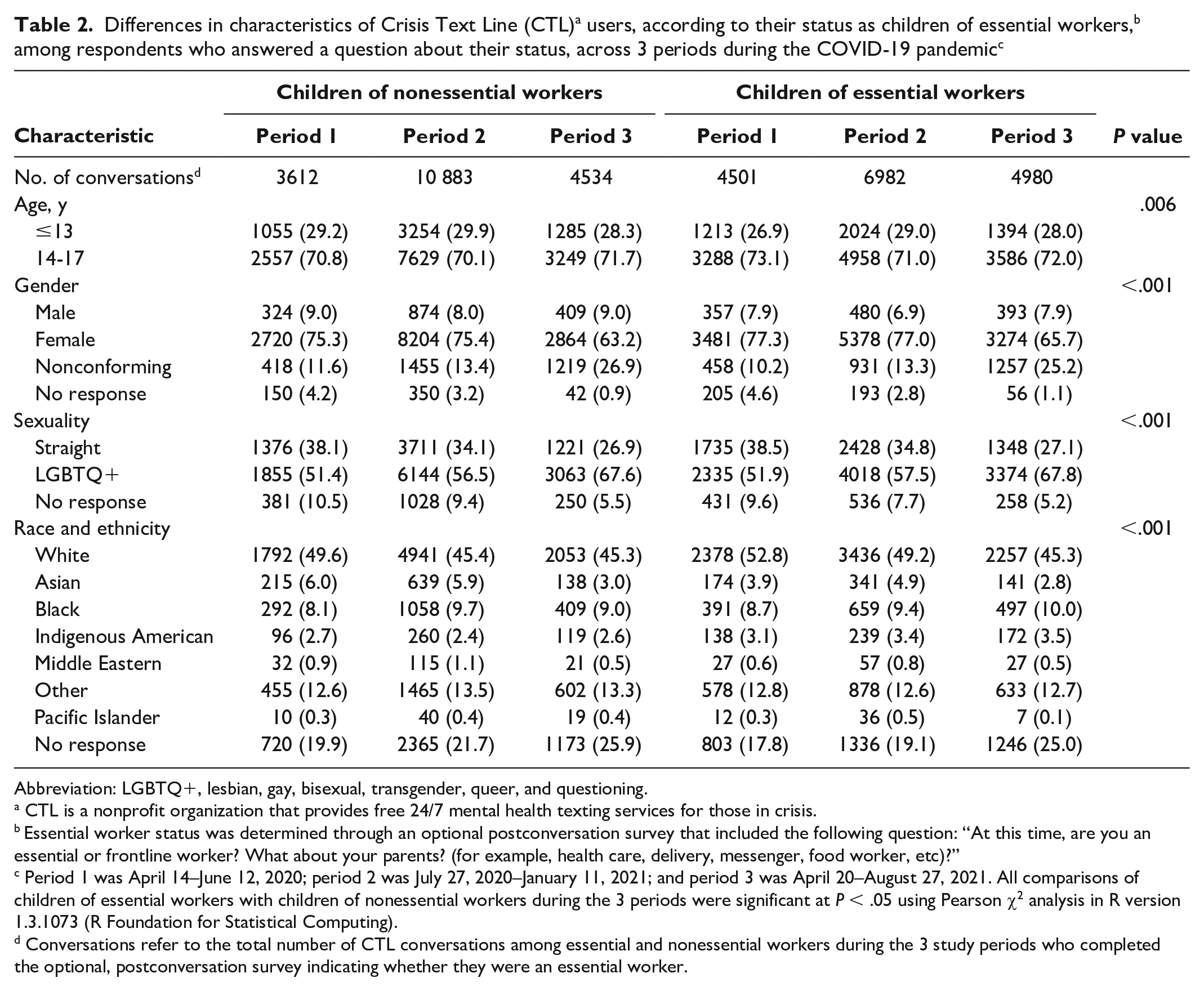
Abbreviation: LGBTQ+, lesbian, gay, bisexual, transgender, queer, and questioning.
CTL is a nonprofit organization that provides free 24/7 mental health texting services for those in crisis.
Essential worker status was determined through an optional postconversation survey that included the following question: “At this time, are you an essential or frontline worker? What about your parents? (for example, health care, delivery, messenger, food worker, etc)?”
Period 1 was April 14–June 12, 2020; period 2 was July 27, 2020–January 11, 2021; and period 3 was April 20–August 27, 2021. All comparisons of children of essential workers with children of nonessential workers during the 3 periods were significant at P < .05 using Pearson χ2 analysis in R version 1.3.1073 (R Foundation for Statistical Computing).
Conversations refer to the total number of CTL conversations among essential and nonessential workers during the 3 study periods who completed the optional, postconversation survey indicating whether they were an essential worker.
Essential Workers Versus Nonessential Workers
Essential workers had higher odds of grief (adjusted odds ratio [aOR] = 1.17; 95% CI, 1.07-1.27) and suicidal capability (aOR = 1.14; 95% CI, 1.02-1.27) than nonessential workers did (Figure 1). The odds of having thoughts of suicide were higher among essential workers than among nonessential workers but not significantly so (aOR = 1.06; 95% CI, 1.00-1.12; P = .06). Essential workers had lower odds of emotional abuse than nonessential workers did (aOR = 0.80; 95% CI, 0.71-0.91).
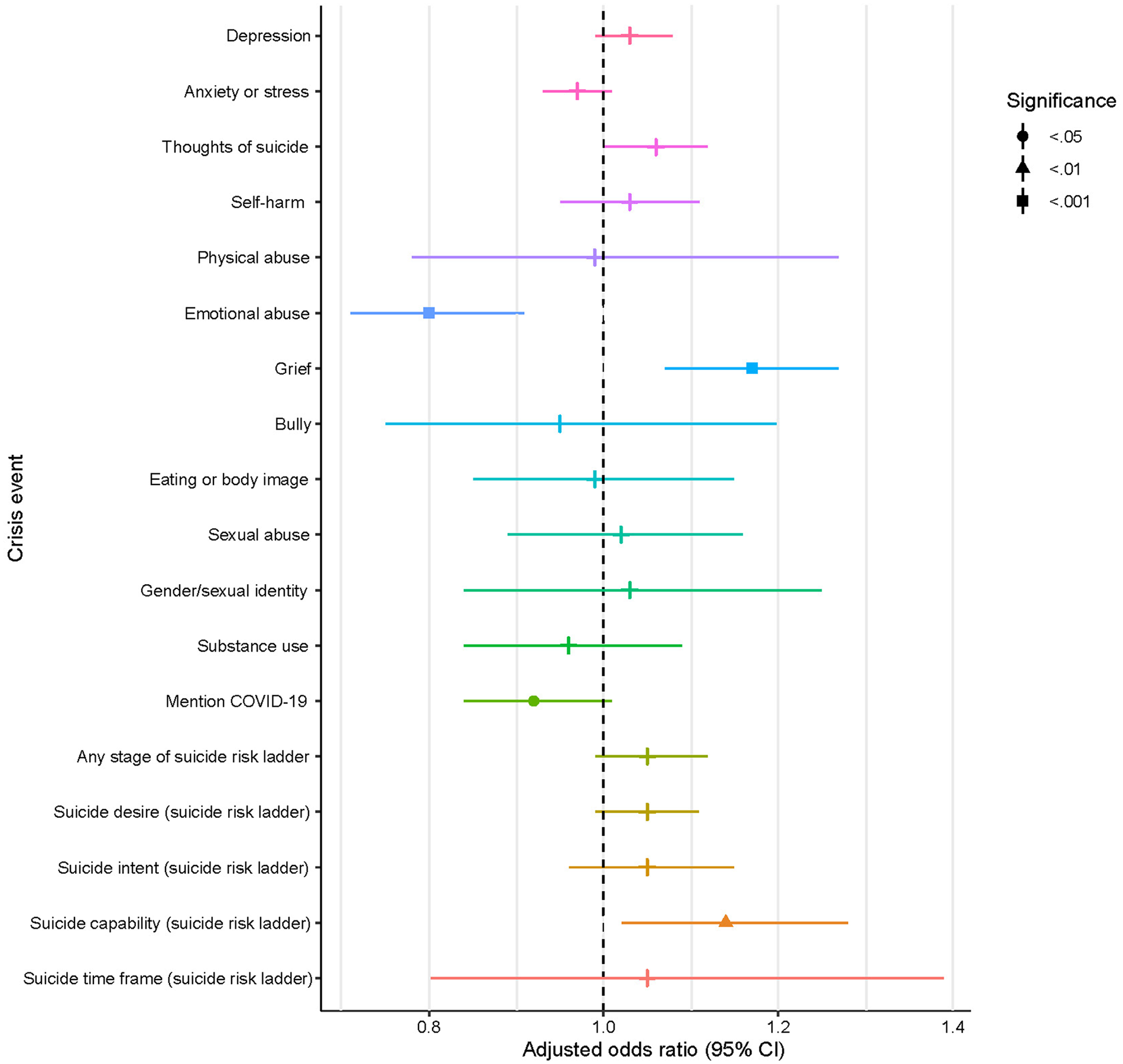
Adjusted odds ratios (aORs) of essential workers (n = 21 895 conversations) compared with nonessential workers (n = 19 353 conversations) aged ≥18 years seeking help from the Crisis Text Line (CTL) for crisis events during 3 periods of the COVID-19 pandemic. The 3 periods were April 14–June 12, 2020 (period 1); July 27, 2020–January 11, 2021 (period 2); and April 20–August 27, 2021 (period 3), using generalized estimating equations, with P < .05 considered significant. All models were adjusted for age, gender, and race. CTL is a nonprofit organization that provides free 24/7 mental health texting services for those in crisis. The suicide risk ladder assesses an individual’s suicide risk, ranging from suicidal desire (suicide desire), to a suicide plan (suicide intent), to suicidal means (suicide capability), and a time frame for suicide (suicide time frame).
Across the 3 periods, the odds of grief were highest among essential workers (vs nonessential workers) during the second (aOR = 1.18; 95% CI, 1.05-1.33) and third (aOR = 1.23; 95% CI, 1.06-1.43) periods compared with the first period (eFigure 1 in Supplemental Material). In addition, the odds of suicide intent (aOR = 1.16; 95% CI, 1.01-1.34) and capability (aOR = 1.24; 95% CI, 1.08-1.43) were significantly higher among essential workers (vs nonessential workers) during the second period. The odds of emotional abuse decreased during the first period (aOR = 0.75; 95% CI, 0.60-0.92) and the third period (aOR = 0.93; 95% CI, 0.71-1.23) among essential workers compared with nonessential workers (eFigure 1 in Supplemental Material).
Pandemic Trends and Demographic Characteristics of Essential Workers
Among essential workers, we found differences in crisis concerns during later periods of the pandemic compared with the start of the pandemic. Essential workers had higher odds of thoughts of suicide (aOR = 1.23; 95% CI, 1.07-1.41), suicide desire (aOR = 1.17; 95% CI, 1.02-1.36), and grief (aOR = 1.26; 95% CI, 1.00-1.58) during period 3 than during period 1. Text volume related to anxiety/stress (aOR = 0.73; 95% CI, 0.63-0.83), physical abuse (aOR = 0.32; 95% CI, 0.14-0.73), and isolation (aOR = 0.87; 95% CI, 0.76-1.00) among essential workers decreased in periods 2 and 3 compared with period 1 (eFigure 2 in Supplemental Material).
Compared with White essential workers, Black essential workers had higher odds of grief (aOR = 1.39; 95% CI, 1.15-1.68) and depression (aOR = 1.20; 95% CI, 1.07-1.33) and lower odds of anxiety or stress (aOR = 0.82; 95% CI, 0.73-0.91) and self-harm (aOR = 0.55; 95% CI, 0.44-0.68) (eTable 1 in Supplemental Material).
Children of Essential Workers Versus Children of Nonessential Workers
Compared with children of nonessential workers, children of essential workers had a higher risk of substance use (aOR = 1.33; 95% CI, 1.08-1.65) and grief (aOR = 1.18; 95% CI, 1.07-1.30) and a lower risk of emotional abuse (aOR = 0.84; 95% CI, 0.75-0.95) (Figure 2). Across the 3 periods, the odds of substance use were highest for children of essential workers (vs children of nonessential workers) during the first (aOR = 1.81; 95% CI, 1.14-2.88) and third (aOR = 1.43; 95% CI, 1.00-2.05) periods, grief was highest during the first period (aOR = 2.38; 95% CI, 1.28-4.45), and physical abuse increased during the third period (aOR = 1.49; 95% CI, 1.05-2.11) and decreased during the second period (aOR = 0.76; 95% CI, 0.60-0.97) (eFigure 3 in Supplemental Material).
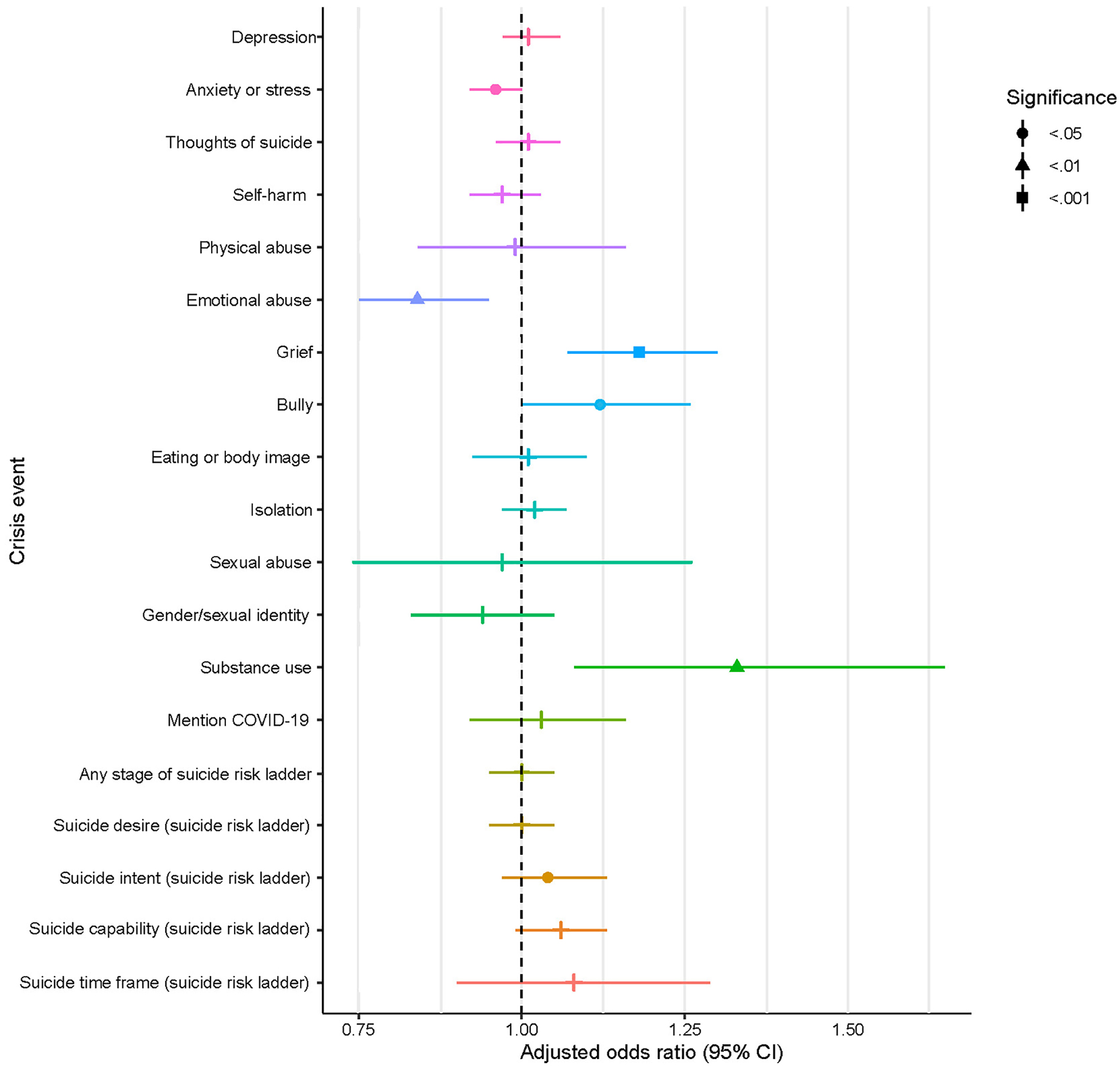
Adjusted odds ratios (aORs) of children of essential workers (n = 16 463 conversations) compared with children of nonessential workers (n = 19 029 conversations) aged <18 years seeking help from the Crisis Text Line (CTL) for crisis events during 3 periods of the COVID-19 pandemic. The 3 periods were April 14–June 12, 2020 (period 1); July 27, 2020–January 11, 2021 (period 2); and April 20–August 27, 2021 (period 3), using generalized estimating equations, with P < .05 considered significant. All models were adjusted for age, gender, and race. CTL is a nonprofit organization that provides free 24/7 mental health texting services for those in crisis. The suicide risk ladder assesses an individual’s suicide risk, ranging from suicidal desire (suicide desire), to a suicide plan (suicide intent), to suicidal means (suicide capability), and a time frame for suicide (suicide time frame).
Pandemic Trends and Characteristics of Children of Essential Workers
Children of essential workers had higher odds of thoughts of suicide (aOR = 1.16; 95% CI, 1.01-1.32), suicide capability (aOR = 1.23; 95% CI, 1.01-1.49), self-harm (aOR = 1.31; 95% CI, 1.12-1.54), suicide intent (aOR = 1.24; 95% CI, 1.03-1.47), and eating or body image disorders (aOR = 1.59; 95% CI, 1.19-2.12) during the third period than during the first period (eFigure 4 in Supplemental Material). The children of Black essential workers had higher odds of thoughts of suicide (aOR = 1.20; 95% CI, 1.04-1.39), suicide desire (aOR = 1.22; 95% CI, 1.05-1.42), suicide capability (aOR = 1.2; 95% CI, 0.95-1.50), and suicide intent (aOR = 1.27; 95% CI, 1.04-1.53) than the children of White essential workers. The children of Indigenous American essential workers had higher odds of physical (aOR = 2.03; 95% CI, 0.99-4.15) and emotional (aOR = 1.99; 95% CI, 1.23-3.22) abuse and substance use (aOR = 2.76; 95% CI, 1.35-5.63) than the children of White essential workers (eTable 2 in Supplemental Material).
Discussion
Our study found that children of essential workers had higher levels of mentioning substance use in their crisis conversations than children of nonessential workers. Essential frontline workers were more likely to experience thoughts of suicide and demonstrate suicidal capabilities than nonessential workers. Both essential workers and their children had higher odds of grief than nonessential workers and their children.
Similar to findings by Sugg et al, 11 thoughts of suicide were elevated for essential workers compared with nonessential workers. We further these previous findings by demonstrating significant increases in thoughts of suicide among essential workers during the later pandemic periods. However, these increases in help-seeking behavior related to thoughts of suicide were not significant compared with CTL users of similar ages (ie, nonessential workers). Our findings corroborate previous findings in the United States that the rate of suicidal ideation is higher among essential workers than among nonessential workers.1,8,11 We also found that White and male workers were more likely to experience thoughts of suicide than workers who were Black, Indigenous, and people of color and female, yet this finding diverges from the findings of Bond et al 16 from a smaller sample of essential workers.
Our findings also highlight increases in levels of suicide capability among essential workers and heightened suicide risk of this population as the COVID-19 pandemic progressed. Suicide capability can occur through repeated exposure to psychological trauma and painful life events and is defined by the Interpersonal Theory of Suicide—a feeling that a person does not belong and is a burden—combined with an acquired capability for suicide. 17 Thus, the COVID-19 pandemic may increase levels of suicide capability because of increased exposure to suffering and death. 17 In light of continued elevated suicidal thoughts and capability rates among essential workers, this finding demonstrates the immediate need for health interventions that limit access to lethal means and reduce levels of suicidal ideation among this population.
Unlike our previous work, 11 this analysis found significantly higher odds of substance use among children of essential workers compared with children of nonessential workers. We did not find increases in mentions of abuse or isolation, perhaps related to the lifting of restrictions and a return to school in some locations. In contrast to our previous work, our current study provided more information on types of abuse, including physical, emotional, and sexual abuse. With these new categories of types of abuse and a longer period, updated results show reduced discussion of emotional abuse among children of essential workers, particularly as the pandemic progressed.
As of October 2022, understanding of substance use among children and adolescents during the pandemic was still limited. Survey results from Canadian teenagers in the early part of the pandemic showed overall decreases compared with prepandemic levels in alcohol, cannabis, and vape use but increases in the mean number of substance abuse days for those who used substances. 18 Data on our sample of children of essential workers showed high levels of substance use among Indigenous American populations, with no significant trends across the various pandemic periods. Our results are troubling, particularly with new studies showing increased overdose deaths among adolescents in 2020 and 2021. 19 The drug death rate among teenagers has been rising exponentially because of increasing contamination from illicit fentanyl and other potent analogs rather than because of increased drug use. 19 Similar to the demographic trends in our CTL results of substance use patterns, overdose death rates were highest among Indigenous American people. 19
Grief was a significant help-seeking behavior among essential workers and their children compared with nonessential workers and their children. Among children, the death of a family member can lead to a reduction in stress resilience and increased mental health burden.20-22 Previous estimates suggest that nearly 9 million people have grieved or are grieving the loss of a loved one during the pandemic, 22 and grief can also occur from a loss of daily activities or a sense of routine. The elevated levels of grief among essential workers and their children highlight a potential reduction in coping behaviors and a heightened need for additional workplace or school-based support services (eg, mental health, financial) for this already vulnerable population.
In our study, among the texters who disclosed their racial identities, Black children of essential workers were more likely than White children of essential workers to experience suicidal behaviors (eg, thoughts, desire, capability, intent, time frame). Our results contrast with other survey-based analyses, which found a reduction in suicide risk among Black adolescent patients admitted to a children’s hospital; however, the analyses did not focus on children of essential workers or those seeking help through CTL services. 23 In our study, Black essential workers were also more likely than White essential workers to experience depression, grief, and physical abuse; however, they were less likely to mention COVID-19. These results contrast with other studies that found low levels of depression among Black people compared with non-Black people in the United States during the early stages of the pandemic (March–November 2020). 24 Disproportionate crisis outcomes among Black people may be attributable to other exposures and social risk factors that were present before the pandemic, and future CTL research should examine disparities in CTL use among racial and ethnic minority populations to further understand the complexity of racism, crisis concerns, and the COVID-19 pandemic.
Strengths and Limitations
This study had several strengths. First, we leveraged a large, longitudinal dataset of CTL users, including self-identified children of essential workers and essential workers among respondents to the postconversation survey. Second, to our knowledge, our work is the first to the examine mental health effects among essential workers and their children, and it contributes to a growing body of literature that examines changes in mental health from COVID-19 using Google search trends, 25 health care records, 19 and cross-sectional surveys.1,16 Third, our sample of essential and nonessential workers and their children included more than 27 051 users and 38 358 conversations with representation from the entire United States.
Our study also had several limitations. First, our sample was restricted to essential workers and children of essential workers who engaged in help-seeking behaviors by contacting the CTL and responding to a postconversation survey. Therefore, our results may not be generalizable to all essential workers and children of essential workers. Second, we could not identify the type of essential worker (eg, health care, food services) or other important contextual factors (eg, socioeconomic status) that are important contributors to mental health. Third, our dataset was restricted to periods when CTL surveys were administered. This period missed substantial COVID-19 spikes, including the spike caused by the Omicron variant in November 2021. However, our study extends previous studies by including 2021 and periods beyond the first few months of the pandemic. We made improvements to our previous analysis, 11 such as restricting the definition of a child to a person aged <18 years because of more detailed anonymized data provided by CTL and the inclusion of more detailed crisis events for active suicide risk (eg, capability, intent) and abuse (eg, emotional, physical, sexual).
Conclusions
At the time of publication, in October 2022, little was known about the mental health impacts of COVID-19 on essential workers and their children. Our study builds on our previous examination of help-seeking behavior among essential workers and their children in the early stages of the COVID-19 pandemic by extending the period to August 2021, to include the latter stages of the pandemic. We found higher odds of substance use and grief among children of essential workers than among children of nonessential workers and higher odds of suicidal behaviors (eg, thoughts, capabilities) and grief among essential workers than among nonessential workers. Racial disparities highlighted a higher prevalence of substance use among Indigenous American and Hispanic children of essential workers than among White children of essential workers and a higher prevalence of suicidal behaviors among Black children of essential workers than among White children of essential workers. Our findings highlight an immediate need for mental health interventions among essential workers and their children to mitigate the mental health impacts of the COVID-19 pandemic.
Supplemental Material
sj-docx-1-phr-10.1177_00333549221148177 – Supplemental material for Crisis Response and Suicidal Behaviors of Essential Workers and Children of Essential Workers During the COVID-19 Pandemic
Supplemental material, sj-docx-1-phr-10.1177_00333549221148177 for Crisis Response and Suicidal Behaviors of Essential Workers and Children of Essential Workers During the COVID-19 Pandemic by Margaret M. Sugg, Jennifer D. Runkle, Sophia C. Ryan, Devyani Singh, Shannon Green and Martie Thompson in Public Health Reports
Footnotes
Declaration of Conflicting Interests
The authors declared no potential conflicts of interest with respect to the research, authorship, and/or publication of this article.
Funding
The authors disclosed receipt of the following financial support for the research, authorship, and/or publication of this article: This project was supported by the CAREER award (grant 2044839) from the National Science Foundation and the American Foundation for Suicide Prevention’s standard research grant (SRG-0-160-19). The content is solely the authors’ responsibility and does not necessarily represent the official views of the National Science Foundation or the American Foundation for Suicide Prevention.

Supplemental Material
Supplemental material for this article is available online. The authors have provided these supplemental materials to give readers additional information about their work. These materials have not been edited or formatted by Public Health Reports’s scientific editors and, thus, may not conform to the guidelines of the AMA Manual of Style, 11th Edition.
References
Supplementary Material
Please find the following supplemental material available below.
For Open Access articles published under a Creative Commons License, all supplemental material carries the same license as the article it is associated with.
For non-Open Access articles published, all supplemental material carries a non-exclusive license, and permission requests for re-use of supplemental material or any part of supplemental material shall be sent directly to the copyright owner as specified in the copyright notice associated with the article.
