




Abstract
In summer 2021, the Pima County Health Department (PCHD) developed and implemented a multiresource event model for vaccine clinics to increase access to COVID-19 vaccines and other resources, such as food, rental assistance, and public health services, in Pima County, Arizona, communities. The PCHD aimed to improve vaccine access in areas with vaccination rates <40% by involving community partners to plan a multiresource event with resources (eg, food, connection to economic resources, information on childcare, and heat relief)and incentives specific to community needs that could drive attendance. Resources would be made available to community members regardless of whether they received a COVID-19 vaccine at the event. The PCHD selected census tract 41.15 as the pilot group to apply the multiresouce COVID-19 vaccine event model. Census tract 41.15 is a heat-stressed area of Pima County comprising mostly Latino people and people with lower incomes and is an area with low vaccination rates for COVID-19. The vaccination rate increased in census tract 41.15 by 12.8 percentage points (absolute increase), starting at 33.9% on June 1, 2021, and increasing to 46.7% as of September 1, 2021. In addition, attendance at the pilot event versus attendance at previous events that did not use this model increased by >100%. The multiresource COVID-19 vaccine event, when held within a hyperlocal area and when the needs of residents in the community are considered, can improve vaccine uptake. This model provides a roadmap for COVID-19 vaccine delivery in areas of low uptake.
Keywords
The Pima County Health Department (PCHD) in Pima County, Arizona, prepared for its COVID-19 vaccination campaign in December 2020 with a commitment to administer 300 000 vaccines by March 31, 2021. The March 31, 2021, goal was exceeded by 100 000, but COVID-19 vaccination rates decreased in early summer 2021. This decline was consistent with a nationwide trend of declining COVID-19 vaccination rates from late spring through early summer 2021. 1 In Pima County, mobile vaccine sites served approximately 60 people per mobile COVID-19 vaccine event in May 2021 as compared with 142 in April 2021 and 420 in March 2021, with an average of 15 mobile vaccine events occurring per week (PCHD, unpublished data, July 2021).
Mobile vaccination clinics became a part of the Pima County COVID-19 vaccination campaign starting in February 2021. Mobile vaccine sites are integral to reaching communities that are disproportionately affected by COVID-19 and that cannot access static vaccine sites. Barriers to accessing traditional vaccination locations include limited access to medical providers or vaccine centers, mobility issues (eg, lack of mass public transportation), rigid work and family care schedules, and low levels of vaccine confidence.2-4 Mobile vaccine delivery addresses these barriers by bringing vaccines to underresourced communities in familiar and trusted locations outside regular business hours.
In late spring 2021, to reverse the declining COVID-19 vaccination rates and related disparities in access to social and economic resources emerging among census tracts in Pima County, Arizona, PCHD developed a data-driven approach to improve vaccine access. The approach involved identifying census tracts in Pima County with COVID-19 vaccination rates <40% as of June 1, 2021, and implementing a multiresource event model to improve COVID-19 vaccine access in these areas. Multiresource events provide multiple connections to resources of need, as opposed to focusing on just a single need. Because a multiresource event could address >1 identified need of the community and allow event organizers to create an intentionally inviting atmosphere, PCHD believed that the multiresource event model would further reduce barriers to vaccine access in communities with low vaccination rates.
With a COVID-19 vaccination rate of 33.9% on June 1, 2021, 5 census tract 41.15 was selected as the pilot group to apply the multiresource event model to vaccine clinics. Census tract 41.15 is a heat-stressed area of Pima County comprising mostly Latino people and people with lower incomes. In 2019, 63.8% of people in census tract 41.15 spoke a language other than English, and 78.4% identified as Hispanic or Latino. 6 For development of the pilot event, PCHD collaborated with community members inside or serving census tract 41.15. The primary goals for the pilot event were to administer 100 COVID-19 vaccines and connect 100 families to various resources, such as housing, food, and public health services. For the pilot event, the aim was to include a hybrid COVID-19 vaccine clinic and a resource fair tailored to the needs of residents in the selected census tract.
Purpose
The COVID-19 pandemic has altered the US economy, resulting in increased food insecurity, housing insecurity, evictions, mental health struggles, and limited access to public health resources that would otherwise be more readily available outside the pandemic. A mobile, multiresource, community-centered, and data-driven approach to vaccine events supports a flexible, agile, and adaptable whole-person care model that connects communities to COVID-19 vaccine and other resources.
Methods
Principles Guiding the Design
PCHD incorporated 5 principles into the design of the multiresource COVID-19 vaccine event model: (1) use consistent evidence-based best practices in alignment with national vaccination initiatives; (2) create data profiles for census tracts with low vaccination rates; (3) leverage existing community resources and leadership; (4) advance equity in resource distribution, including vaccines; and (5) take a trauma-informed approach with underrepresented, underresourced, and historically and contemporarily excluded communities. PCHD authorities determined that the public health surveillance activities within this study did not meet the requirements for review by an institutional review board.
Understanding the Community
Before designing the multiresource event, PCHD officials created a profile of the pilot area, census tract 41.15 (Table 1), which incorporated qualitative and quantitative data from the community. Data sources were the American Community Survey, 7 the Centers for Disease Control and Prevention Social Vulnerability Index, 8 unstructured interviews with community partners and organizations (key informants), and a windshield survey, which involves making external observations of an area while in a car. PCHD relied on the snowball method to identify key community partners and organizations, starting with the Sunnyside Unified School District. Community partners included the Sunnyside Foundation (local neighborhood foundation), support staff from the school hosting the event (Gallego Intermediate Fine Arts Magnet School), representatives from Pima County and from elected offices in the census tract, and service providers (including the local food bank and public health department). During key informant interviews, community partners and organizations shared their views on community-specific COVID-19 vaccine barriers and meaningful incentives to encourage vaccination. The windshield survey evaluated essential landmarks, such as stores, schools, businesses, housing types, and the presence or absence of green space. The windshield survey revealed limited green space, mobile homes as a dominant form of housing in the census tract, and a lack of cooling infrastructure in a nonnegligible portion of the mobile homes.
Census data for census tract 41.15 and for Pima County, Arizona, 2019 a
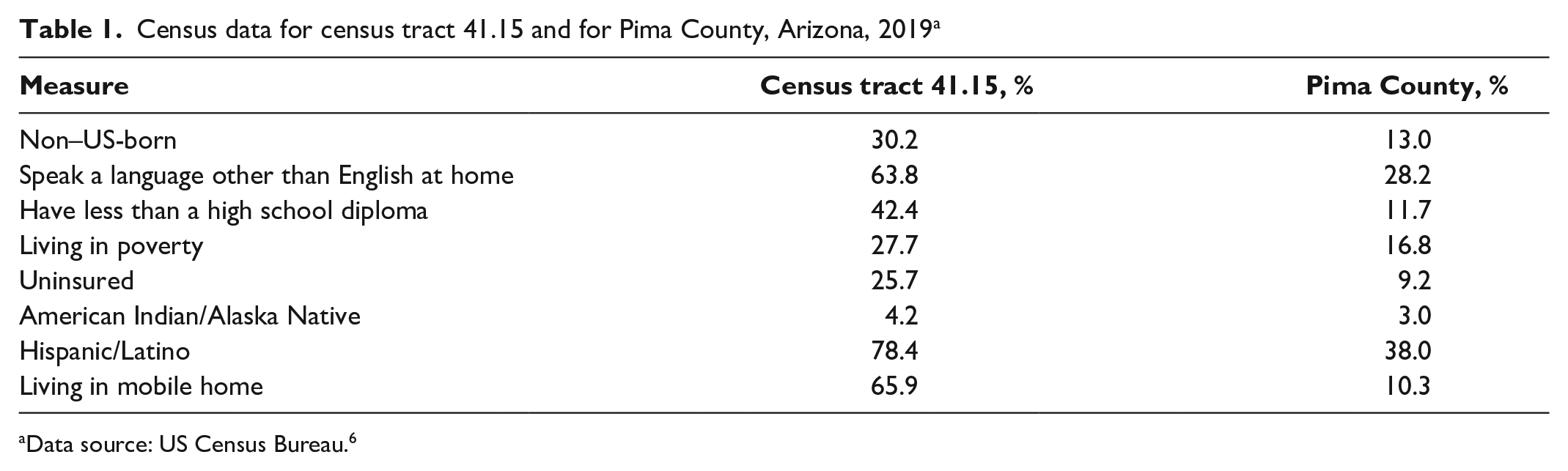
Data source: US Census Bureau. 6
Event Design
The multiresource COVID-19 vaccine event incorporated the data profile developed for census tract 41.15 and feedback from the key informant interviews. Gallego Intermediate Fine Arts Magnet School, located in the census tract, was identified from the windshield survey for its ample air-conditioned indoor space and the status of the school district as a trusted organization in the community. The school administrators helped inform the design of the event and offered their communication channels as a way to connect to the community. PCHD determined that a resource fair incorporating the social determinants of health would be the best approach to mitigate community stressors and barriers related to COVID-19 vaccination. Key informants from census tract 41.15 identified needs in the community to include housing, food, economic resources, childcare, and heat relief. Key social determinants of health involved access to health care, education, social and community connections, economic stability, and neighborhood and built environment. 9 In addition to bringing needed resources to the community, the multiresource event aimed to foster a lively atmosphere focused on community building. Safety was integral to this event. Precautions were taken, such as enforced social distancing, face mask wearing, and sanitation of surfaces.
Trusted messengers and preferred media, which may differ by census tract, are essential to building trust in COVID-19 vaccination and identifying a community’s preferred media and communication channels.10,11 PCHD identified trusted messengers in census tract 41.15 through key informant interviews. Text messages, telephone calls, and emails from the Sunnyside Unified School District advertised the multiresource event alongside community network outreach, Spanish-language television spots, Spanish-language radio, and posting of flyers.
Resources provided at the pilot event included food for the week, housing assistance, federal and county assistance for families, representatives from public health clinics and services, car seat and teen driver safety information, bike and pedestrian safety information, and COVID-19 vaccine education. These resources were available to all event attendees, regardless of whether they received the vaccine. All resources were available in English and Spanish. Interpretive services were available through event-provided telephones for other language needs.
Community health workers (CHWs), an integral part of the outreach, promoted and participated in the pilot event. Because of their unique understanding of the community, CHWs can break down the science of vaccines in a meaningful and culturally relevant manner. 12 Before and during the pilot event, CHWs participated in community outreach, addressed questions and concerns, facilitated the data collection process at the event, and participated in live radio spots to provide information in Spanish about the event and the COVID-19 vaccine. The event was advertised as “The Gallego Resource Fair and Vaccine Event.”
To facilitate a lively atmosphere, pilot organizers invited the University of Arizona mascot Wilbur the Wildcat, delivered a live broadcast from the event on a Spanish-language radio station, provided sack lunches, and held raffles every 30 minutes. Key informants in the community identified these attractions as ways to boost community attendance. Likewise, the key informants identified raffle prizes such as oscillating fans—a unique need in census tract 41.15 because of its location in a heat-stressed area of Pima County—and the radio station provided gift cards (PCHD, unpublished data, July 2021).
Data Collected at Event
Demographic data collected from event participants allowed PCHD to evaluate the extent to which the event reached the population within the pilot location. Data collected from the event included the various communication modalities that promoted the event, attendee surveys, and data from resource providers that tracked the number of people served. CHWs conducted entrance surveys in English and Spanish. Survey questions focused on how participants arrived at the event, which resources they came for, how they heard about the event, and their residential zip code. PCHD received additional data from the vaccine contractor, such as the number of COVID-19 vaccines administered, primary language spoken at home, race, and ethnicity.
Outcomes
The pilot event took place at the Gallego Intermediate Fine Arts Magnet School, located in census tract 41.15, on Saturday, June 19, 2021. The Gallego Resource Fair and Vaccine Event served 101 families and vaccinated 122 of 238 people, exceeding the goal of 100 families and 100 COVID-19 vaccinations for vaccine-eligible people. The COVID-19 vaccination rate at this event represented a 103.3% increase from the average vaccination numbers per event at PCHD-run mobile sites in May 2021 (60 vaccines). Of families who attended the event, 53% lived in the zip code of census tract 41.15. Other families who attended were from varying zip codes across Pima County. Ninety-three percent of people vaccinated at the event identified as Hispanic or Latino. Nearly one-third of event participants identified Spanish as their preferred language.
Community members answered a survey as they entered the event. The most commonly reported reason for attendance at the event was for the COVID-19 vaccine, with 75 of 101 families identifying the vaccine as their motivation to attend. Other primary reasons for attending the event were for food (9 families), financial assistance (4 families), and access to available resources (10 families). The vaccine education table saw 127 people. Of 101 families in attendance, 100 went home with enough food for the week in accordance with the size of their households. The rental and housing assistance table connected 18 families to rental assistance, although only 4 families had initially indicated financial aid as their primary reason for attendance.
Survey responses indicated that communications sent by the school district to the family email list was the most effective communication modality (27 families), followed by verbal communications from family and friends (19 families).
Lessons Learned
Our evaluation of the June 19, 2021, pilot event demonstrated the impact of bundling a comprehensive array of resources tailored to community needs in a mobile COVID-19 vaccine event. Our experiences with the pilot multiresource COVID-19 vaccine event model highlighted several important lessons: (1) community partnerships are integral to development and implementation of multiresource COVID-19 vaccine events; (2) future events should leverage and reinforce existing community assets; (3) community members appreciate demonstrable efforts to support and care for them; (4) future events should aim to mitigate the stressors of daily life; (5) diverse voices should be used in messaging; and (6) mobile vaccine events should be tailored to the community.
PCHD incorporated lessons learned in a new standard operating procedure to operationalize community engagement and resource connection into COVID-19 vaccine delivery. The new model includes a tiered plan that tailors vaccination events to community needs, considers varying timelines for events, builds data profiles for the community hosting the event, and maintains lists of other resources (eg, eviction prevention, food, childcare, non–COVID-19 health department services). Another element for future multiresource vaccine events is the incorporation of critical components of social determinants of health. For future events, PCHD will cross-train CHWs to offer resource connections and have a core set of services available at each event. Among social determinants of health, foundational resources to be included at COVID-19 vaccine events in low-uptake census tracts should consist of food assistance, housing/utility assistance, information on federal and county assistance that is available to families, and the presence of rotating public health services such as the Nurse-Family Partnership or representatives providing information on bike and pedestrian safety.
Because of the ever-changing nature of the COVID-19 emergency response, we suggest that the multiresource event model be flexible. Not every event can be a resource fair, and specific community venues may not want or have the capacity to host an extensive vaccine and resource event. PCHD has taken a flexible approach to account for changes in staff capacity and the emergency response. With consideration of timelines and staffing abilities, we propose 2 ways that core resources can be delivered. For shorter timelines or smaller venues, CHWs trained in the core services can provide resource connections. At vaccine events with >2-week lead times and adequate venue space, resource providers can directly provide the resources. Likewise, there may be a need to adjust promotional modalities for events based on the timeline. All events may not have the luxury of 6 communication modalities, as we had for our pilot event. At a minimum, the event should be advertised through social media and flyers and on the county website. These modalities have a wide reach for a comparatively low cost. PCHD developed a matrix to determine the scope of events based on various timelines (Table 2).
Pima County Health Department matrix for scope of multiresource COVID-19 vaccine events, by event lead time
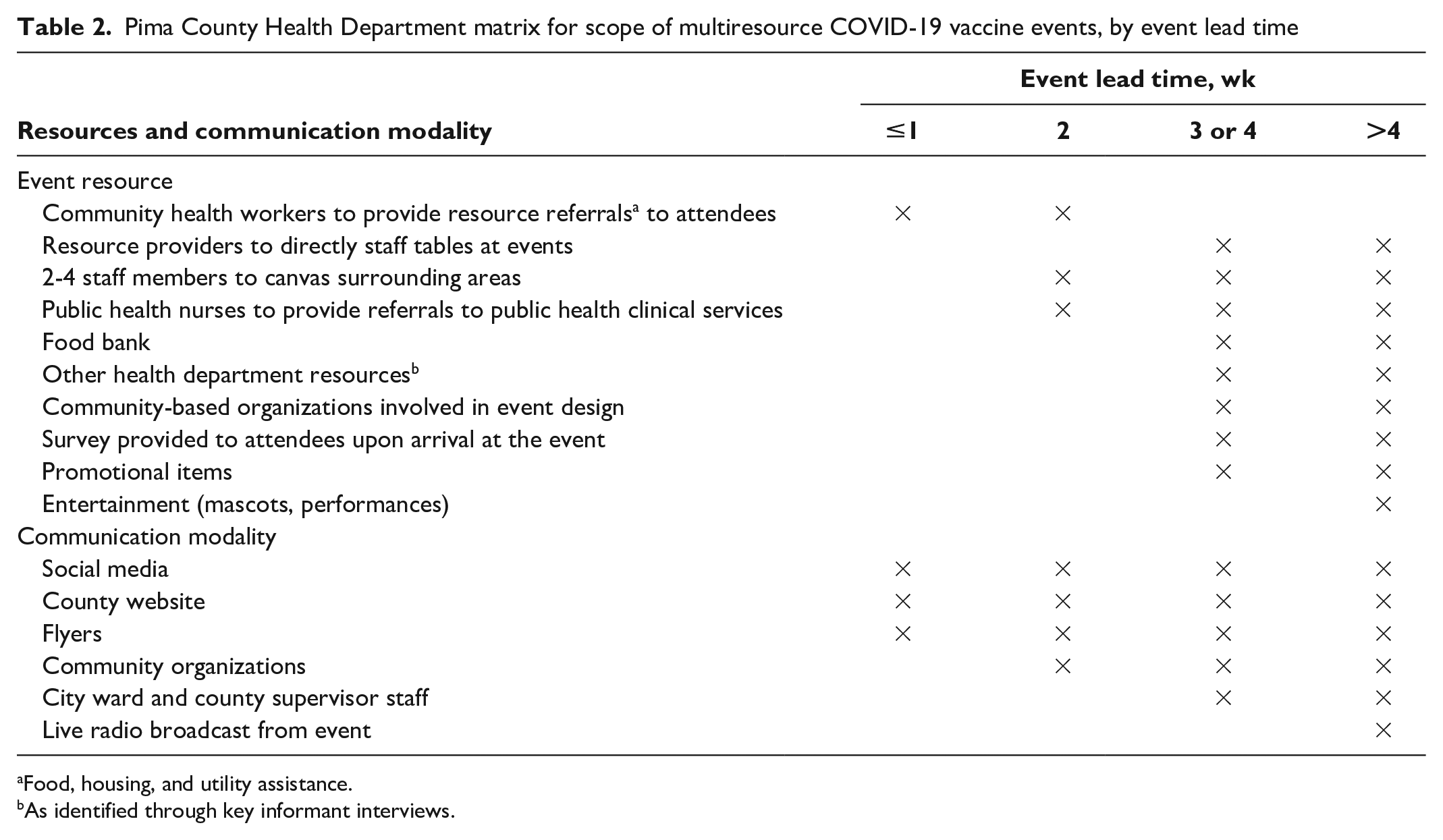
Food, housing, and utility assistance.
As identified through key informant interviews.
This pilot event had 3 limitations. First, we had a short lead time (2 weeks). Our suggested timelines are designed to minimize stress on staff capacity and resources and allow for the data collection needed to tailor an event to a community’s needs. Second, PCHD could not provide the incentives for the raffle or the sack lunches because of financial limitations; these were instead provided by community partners. This meant that partnerships were needed for the event and that PCHD needed to identify and mobilize these partnerships in a short amount of time. Third, among the 6 communication modalities used to promote the pilot event, we could not identify the primary promotional modality that notified attendees of the event. Because of the open-ended nature of the survey, not all responses reflected the 6 communication modalities. Furthermore, among those who indicated a family or friend referral as the communication modality, the survey did not elucidate how the referring parties heard about the event. We suggest a multiple-choice option in future surveys to identify the primary modality for notifying attendees.
In our pilot multiresource COVID-19 vaccine event model, we used a data-driven and community-centered approach that considered the needs of COVID-19 vaccine recipients, which resulted in a successful event. Census tract 41.15 has continued to see an increase in COVID-19 vaccine uptake since the event. As of September 1, 2021, 46.7% of people living in census tract 41.15 had received the COVID-19 vaccine, 5 a 12.8 percentage-point increase from June 1, 2021, when the rate was 33.9%. Public health departments could use mobile vaccine delivery opportunities to strengthen and build relationships with communities in their jurisdiction. Mobile models should be explored with other community public health initiatives. 13
Footnotes
Acknowledgements
The authors acknowledge the Sunnyside School District, Community Food Bank of Southern Arizona, Sunnyside Foundation, Pima County Community Workforce and Development, Pima County District 2, City of Tucson Ward 5, and Pima County Health Department for their support in implementing the pilot model.
Declaration of Conflicting Interests
The authors declared no potential conflicts of interest with respect to the research, authorship, and/or publication of this article.
Funding
The authors received no financial support for the research, authorship, and/or publication of this article.
