




Abstract
Objectives
Studies that evaluate the effectiveness of concussion laws often use only a single variable (ie, presence of the law), failing to account for law complexity. We examined the association between multiple design elements of state concussion laws and rates of sports-related concussion reporting among US high school athletes.
Methods
We derived 3 design elements of concussion laws from the 2009-2017 LawAtlas database: (1) strength of law, (2) number of law revisions, and (3) speed of law adoption. We examined the association between these design elements and rates of new and recurrent sports-related concussion reporting from the 2009-2010 through 2016-2017 academic years in a nationally representative sample of high school athletes participating in High School Report Information Online, an online data collection tool.
Results
A total of 7064 sports-related concussions (6332 [89.6%] new and 732 [10.4%] recurrent concussions) were reported during the study period, with an overall rate of 39.7 sports-related concussions per 100 000 athletic exposures (eg, game or practice). Rates of new concussion reporting were higher among high schools in states with medium- or high-strength concussion laws than in states with low-strength concussion laws and in states with at least 1 concussion law revision than in states with no concussion law revisions. Rates of recurrent concussion reporting were lower among high schools in states with ≥2 concussion law revisions than in states with <2 concussion law revisions. Early law adoption was associated with higher rates of new and recurrent concussion reporting, and late law adoption was associated with lower rates of new and recurrent concussion reporting.
Conclusion
Our findings may help inform legislators of the public health effect of concussion laws.
Sports-related concussions, a type of traumatic brain injury, affect approximately 2 million US children aged <18 years annually. 1 Concussions can negatively affect children’s physical, cognitive, emotional, and sleep health. 2,3 To mitigate concussion-related health consequences, all 50 US states and the District of Columbia enacted state-level concussion laws from 2009 through 2014 to increase awareness about the signs and symptoms of concussion and the potential negative consequences of concussive injury and to reduce the risk and consequences of repeated concussion among young athletes. 4 -6 These laws have 3 key tenets: (1) immediate removal from play after a suspected concussion, (2) required clearance by a health professional before return to play, and (3) mandatory concussion education for athletes, parents, and/or coaches. 4
After the enactment of these laws, the number of concussions and concussion-related emergency department visits increased substantially. 7 -11 Previous research showed that rates of reported new sports-related concussions increased shortly after the enactment of these laws, which likely reflected greater recognition and reporting of concussions 7 ; moreover, rates of reported recurrent concussions decreased roughly 2.6 years after law enactment, which might represent prolonged law implementation efforts. 7 Although these studies provide important empirical evidence about the effect of concussion laws on rates of concussion reporting, 7 -11 they used only the presence or absence of the law to measure the effect of the laws, failing to account for the laws’ complexity. 12 -16
This study aimed to examine the association between multiple design elements of state concussion laws and rates of new and recurrent sports-related concussion reporting over time in a nationally representative sample of US high school athletes. We used 3 design elements to measure the effects of state concussion laws on rates of concussion reporting: strength of law, number of law revisions, and speed of law adoption. We hypothesized that state concussion laws with greater mitigation provision strength, more revisions over time, and an earlier enactment date would be associated with higher rates of new concussion reporting and lower rates of recurrent concussion reporting over time. 4,5,7
Methods
Study Design and Population
We conducted a retrospective cohort study and matched the concussion injury date to the start and end date of each version of the state law by state. The study population comprised athletes from a nationally representative sample of high schools (100 schools per academic year) that participated in High School Reporting Information Online (RIO). High School RIO is a prospective, longitudinal, internet-based surveillance system that collects data on sports-related injuries and athletic exposures (eg, game or practice) among high school athletes. 17,18 This injury surveillance system, which is part of the National High School Sports-Related Injury Surveillance Study, first collected injury and exposure data for a national sample of high school athletes during the 2005-2006 academic year and has collected data annually since its initiation. Previous studies describe the sampling and data collection used in High School RIO. 17,18 Athletes included students who participated in 9 common sports during the study period: boys’ American football, basketball, soccer, baseball, and wrestling; and girls’ basketball, soccer, softball, and volleyball. We obtained institutional review board approval from Nationwide Children’s Hospital.
Concussion Law Data
We obtained data on state-level concussion laws from 2009 through 2017 from LawAtlas, a publicly available, comprehensive, online portal that collects, assesses, and describes law data in textual and quantitative form. 19 LawAtlas uses advanced data coding of state public health law language to provide data on common and unique features of each state’s concussion law, including the start and end date of each version of concussion laws. 19,20 For this study, we derived 3 law design elements from LawAtlas to measure the variation in concussion laws across all states: (1) strength of law (ie, differences between state-level law provisions), (2) number of law revisions (ie, changes in state-level laws over time), and (3) speed of law adoption (ie, time of state-level law enactment).
Concussion Data
We obtained concussion data from the 2009-2010 through 2016-2017 academic years from High School RIO. For this study, the unit of analysis was a concussion. We analyzed data on multiple concussions sustained by a single athlete separately. For each concussion, we analyzed data on whether it was a new concussion or recurrent concussion (defined as repeated episodes of concussion among athletes with at least 1 previous sports-related concussion), date of injury, and athletic exposure.
Measures
We measured the rate of new (or recurrent) concussion reporting as the number of new (or recurrent) concussions sustained while participating in an organized sporting activity during a specified time (ie, an academic year) and reported by an athletic trainer, divided by the total number of athletic exposures during the same period, multiplied by 100 000. 21,22 We defined an athletic exposure as 1 athlete attending 1 game or practice. 21,22
We measured strength of law using 13 discrete evidence-based concussion law provisions included in LawAtlas 19 : 7 baseline provisions related to the 3 key tenets of the concussion laws and 6 optimization provisions that reflected provisions beyond the key tenets (eg, medical clearance from a health care professional trained in concussion management) (Box). For states with concussion laws, we assigned 1 point for the presence of a provision and 2 points for the absence of a provision. We then summed the points to yield a discrete numerical strength of law score (range, 13-26), with lower scores indicating greater law strength. We classified each state’s summary score into 1 of 3 law strength categories on the basis of the distribution of the data: low (>18 points), medium (15-18 points), or high (<15 points). If a state revised the content of its law multiple times during the study period, the state might have multiple law strength scores and multiple strength categories.
Coding scheme for the strength of concussion laws in all 50 US states and the District of Columbia, 2009 through 2017 a
Removal from play provision
Required removal upon suspected or actual concussion
Return to play provisions
Specification of return to play requirements
Health professional clearance required before return to play
Concussion education provisions
Coach training in concussion management
Creation of concussion information sheet
Required distribution of concussion information sheet
Student signature required on concussion information sheet
Removal from play provision
Parental notification of injury
Return to play provisions
Written clearance before return to play
Health professional trained in concussion management
Other provisions
Return to learn requirements
Preventive measures specified
Annual updating of concussion law
aThe strength of US state concussion laws was defined on the basis of the absence or presence of the 7 baseline law provisions and the 6 additional law provisions beyond the baseline law provisions. For states with a concussion law, 2 points were assigned for the absence of a baseline (or additional) provision and 1 point was assigned for the presence of a baseline (or additional) provision. The summary score was used to assess the strength of the law, with lower scores indicating greater law strength. A score >18 indicated low strength, 15-18 indicated medium strength, and <15 indicated high strength.
We measured the number of law revisions, defined as the number of times a state updated or modified a provision of its existing concussion law after enactment, using the dates identified by LawAtlas. 19 We coded revision frequency into 1 of 3 groups on the basis of the distribution of data: no revisions, 1 revision, or ≥2 revisions.
We measured speed of law adoption by the state’s law enactment date. We grouped states on the basis of whether the law was enacted before, during, or after the standard adoption period, identified by LawAtlas, 19 of June 16, 2011, through November 7, 2012: early adoption (before June 16, 2011), standard adoption (from June 16, 2011, through November 7, 2012), and late adoption (after November 7, 2012).
Statistical Analysis
We described distributions in the strength of law, number of law revisions, and speed of law adoption across all 50 US states and the District of Columbia during the study period. We calculated changes in the number and proportion of new and recurrent sports-related concussions reported during the study period by strength of law and number of law revisions, respectively. To model count data with substantial zero counts of reported concussions, we used zero-inflated Poisson regression models to examine the association between each of the 3 design elements of state concussion laws and the rates of new and recurrent sports-related concussion reporting, along with 95% CIs, adjusting for academic year and sport. We set significance at α = .05. We conducted all analyses using SAS version 9.4 (SAS Institute, Inc).
Results
Three Design Elements of State Concussion Laws
Washington State was the first state to enact a concussion law (July 26, 2009), and Mississippi was the last (July 1, 2014). The average law strength score was 17.0, with 29.7% of states in the low-strength category, 50.3% in the medium-strength category, and 20.0% in the high-strength category. During the study period, 17 (33.3%) states revised their law once and 24 (47.1%) states revised their law ≥2 times. Florida had the most law revisions (n = 6) followed by Illinois, Ohio, Oregon, and West Virginia (5 law revisions each).
The strength of laws increased from 2009 to 2017 as more states enacted concussion laws (Figure). By 2014, all 50 states and the District of Columbia had enacted concussion laws, with 33 laws (64.7%) in the medium-strength category and 8 laws (15.7%) in the high-strength category. After 2014, the strength of laws for all states was stable.
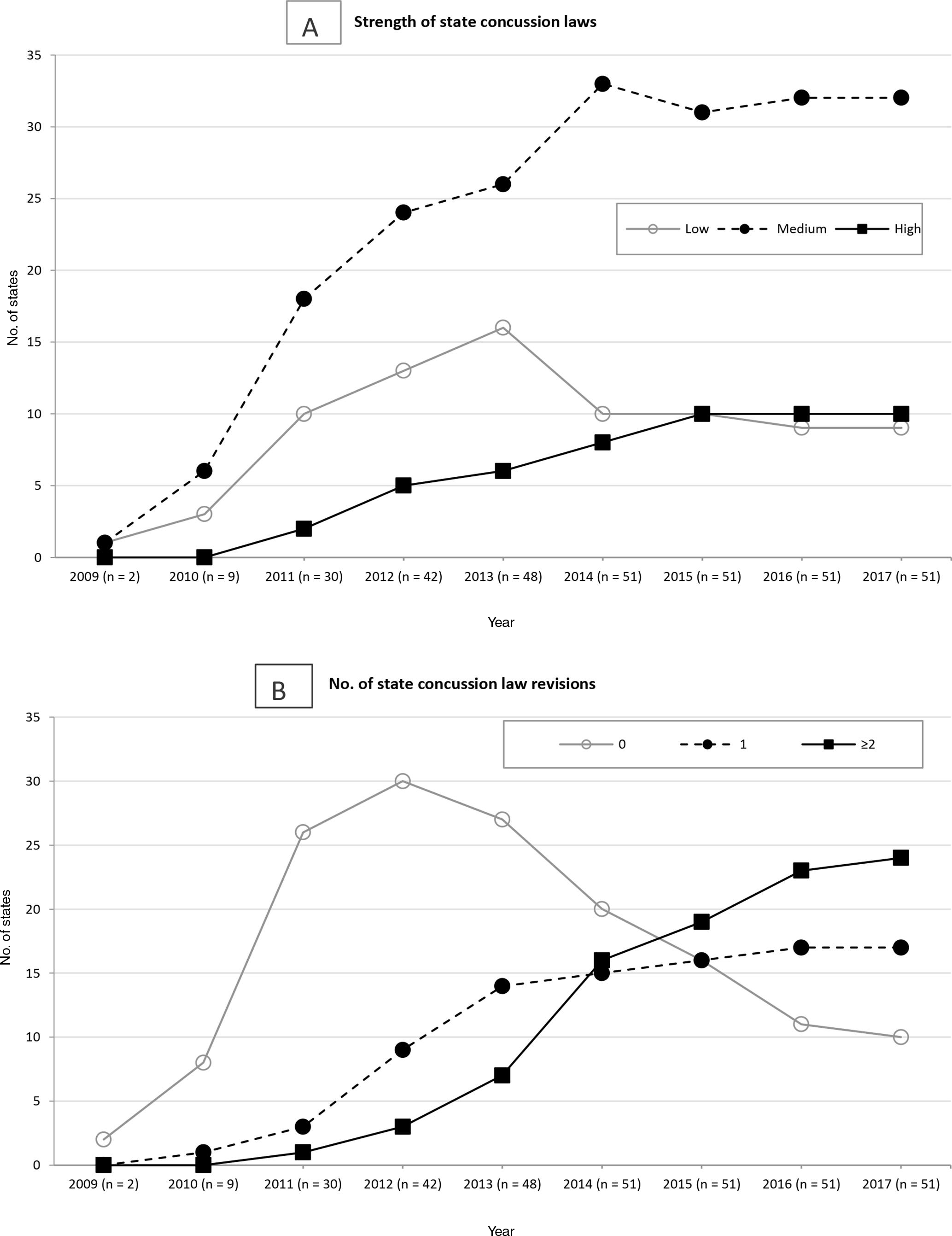
Number of states with a concussion law (n = 51), by (
States revised their laws over time, with an increased trend of multiple revisions from 2011 to 2017 (Figure). Thirty-one (60.8%) states had revised their law at least once by 2014, and 41 states (80.4%) had revised their law at least once by 2017, with 24 (47.1%) states revising their law ≥2 times by 2017.
We included only 43 states in the final analyses because of a lack of concussion data from 7 states and the District of Columbia in High School RIO during the study period. Of these 43 states, 25 (58.1%) were standard adopters, 11 (25.6%) were early adopters, and 7 (16.3%) were late adopters.
New and Recurrent Sports-Related Concussion Reporting
A total of 7064 unique concussions were reported during the 8-year study period: 6332 (89.6%) were new concussions and 732 (10.4%) were recurrent concussions (Table 1). We found the highest proportion of new and recurrent concussion reporting among athletes in states in the medium-strength category. As the proportion of states shifted over time to the high-strength category, so did the number and proportion of new and recurrent concussion reporting. We found similar patterns between the number of law revisions and the number of new and recurrent concussion reporting (Table 1). As the proportion of states that revised their law increased over time, so did the proportions of new and recurrent concussion reporting.
Number of new and recurrent concussions among US high school athletes, by strength of state concussion law and number of state concussion law revisions, from academic years 2009-2010 through 2016-2017, 50 US states and District of Columbia
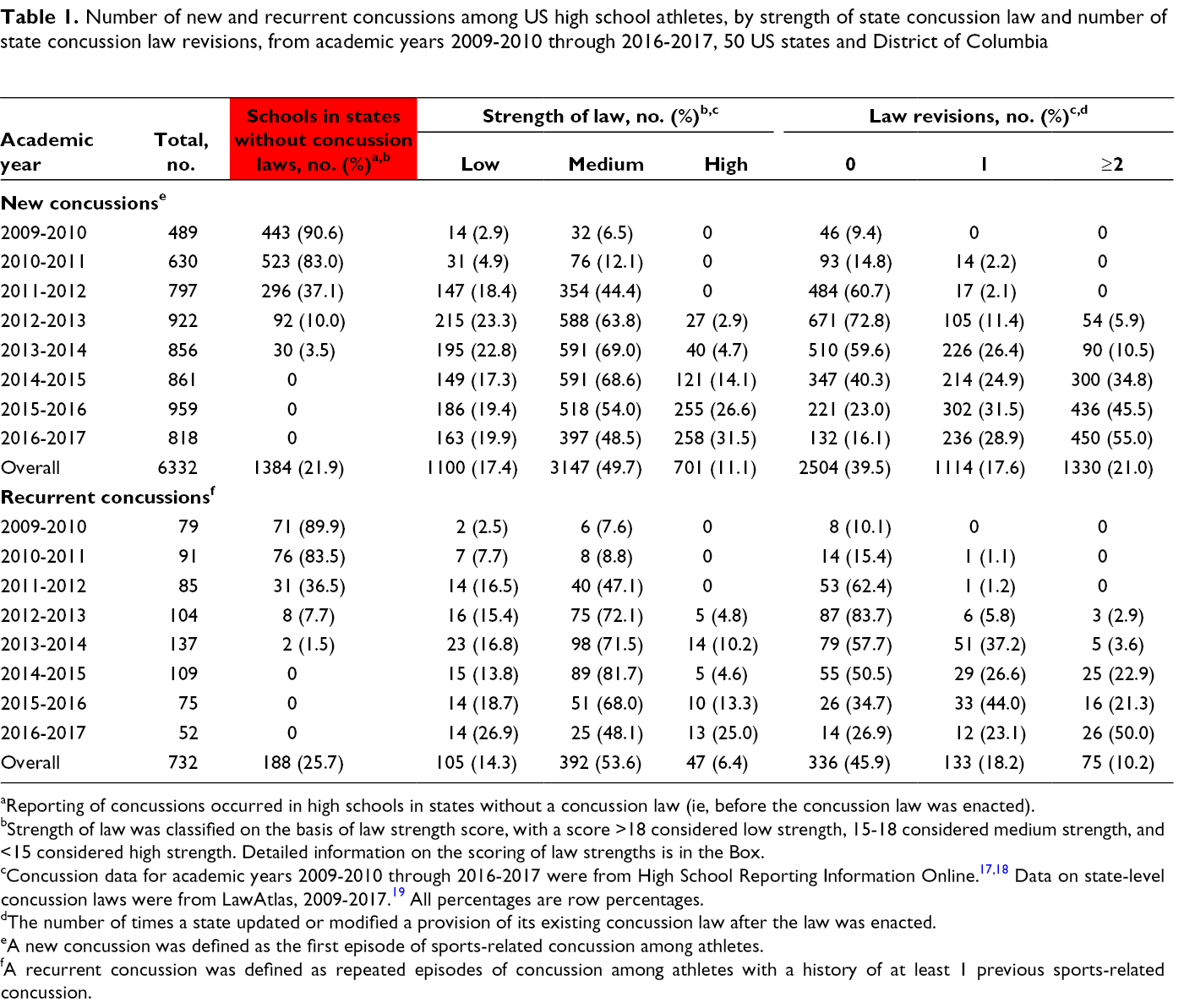
aReporting of concussions occurred in high schools in states without a concussion law (ie, before the concussion law was enacted).
bStrength of law was classified on the basis of law strength score, with a score >18 considered low strength, 15-18 considered medium strength, and <15 considered high strength. Detailed information on the scoring of law strengths is in the Box.
cConcussion data for academic years 2009-2010 through 2016-2017 were from High School Reporting Information Online. 17,18 Data on state-level concussion laws were from LawAtlas, 2009-2017. 19 All percentages are row percentages.
dThe number of times a state updated or modified a provision of its existing concussion law after the law was enacted.
eA new concussion was defined as the first episode of sports-related concussion among athletes.
fA recurrent concussion was defined as repeated episodes of concussion among athletes with a history of at least 1 previous sports-related concussion.
Rates of Concussion Reporting by Strength of Law and Number of Law Revisions
An overall rate of sports-related concussions was 39.7 per 100 000 athletic exposures (eg, game or practice). Compared with athletes in states in the low-strength category, athletes in states in the medium- and high-strength categories had 1.11 (95% CI, 1.02-1.19) and 1.23 (95% CI, 1.10-1.37) times the rate of new concussion reporting, respectively, after adjusting for academic year and sport(s) played (Table 2). Similarly, compared with athletes in states in the low-strength category, athletes in states in the medium-strength category had 1.41 (95% CI, 1.12-1.77) times the rate of recurrent concussion reporting. We found no other significant differences.
Rate ratios (RRs) of concussion reporting among US high school athletes, by state concussion law strength and number of revisions, from academic years 2009-2010 through 2016-2017, 50 US states and District of Columbia a
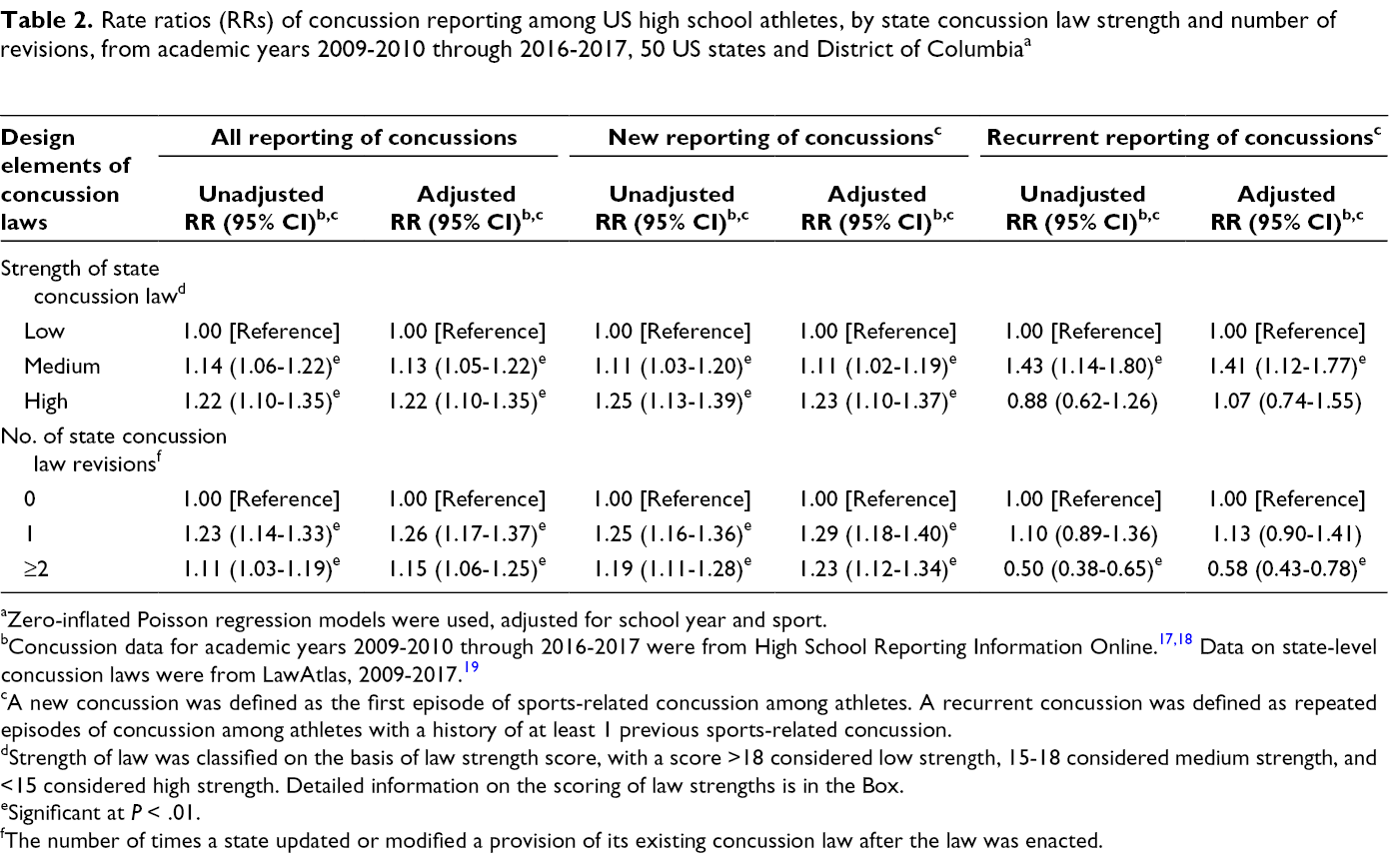
aZero-inflated Poisson regression models were used, adjusted for school year and sport.
bConcussion data for academic years 2009-2010 through 2016-2017 were from High School Reporting Information Online. 17,18 Data on state-level concussion laws were from LawAtlas, 2009-2017. 19
cA new concussion was defined as the first episode of sports-related concussion among athletes. A recurrent concussion was defined as repeated episodes of concussion among athletes with a history of at least 1 previous sports-related concussion.
dStrength of law was classified on the basis of law strength score, with a score >18 considered low strength, 15-18 considered medium strength, and <15 considered high strength. Detailed information on the scoring of law strengths is in the Box.
eSignificant at P < .01.
fThe number of times a state updated or modified a provision of its existing concussion law after the law was enacted.
Athletes in states with 1 law revision (adjusted rate ratio [aRR] = 1.29; 95% CI, 1.18-1.40) or ≥2 law revisions (aRR = 1.23; 95% CI, 1.12-1.34) had significantly higher rates of new concussion reporting than athletes in states with no law revisions (Table 2). Athletes in states with ≥2 law revisions had significantly lower rates of recurrent concussion reporting (aRR = 0.58; 95% CI, 0.43-0.78) than athletes in states with no law revisions. We observed no significant difference between athletes in states with no revisions or 1 revision.
Concussion Reporting by Speed of Law Adoption
Compared with athletes in states that were standard adopters of concussion laws, athletes in early adoption states had significantly higher rates of new (aRR = 1.36; 95% CI, 1.27-1.45) and recurrent (aRR = 1.37; 95% CI, 1.14-1.64) concussion reporting (Table 3), whereas athletes in late adoption states had significantly lower rates of new (aRR = 0.80; 95% CI, 0.73-0.87) and recurrent (aRR = 0.62; 95% CI, 0.47-0.83) concussion reporting.
Rate ratios (RRs) of concussion reporting among US high school athletes, by speed of state concussion law adoption, from academic years 2009-2010 through 2016-2017, 50 US states and District of Columbia
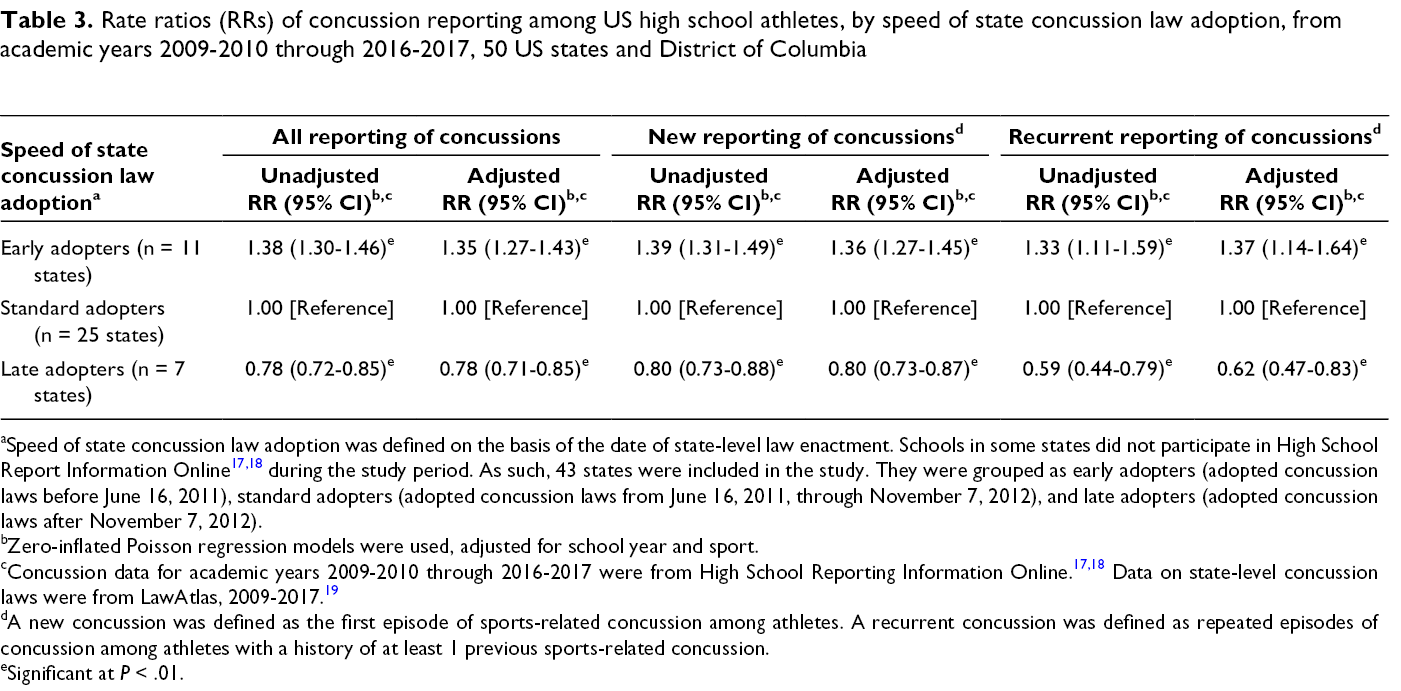
aSpeed of state concussion law adoption was defined on the basis of the date of state-level law enactment. Schools in some states did not participate in High School Report Information Online 17,18 during the study period. As such, 43 states were included in the study. They were grouped as early adopters (adopted concussion laws before June 16, 2011), standard adopters (adopted concussion laws from June 16, 2011, through November 7, 2012), and late adopters (adopted concussion laws after November 7, 2012).
bZero-inflated Poisson regression models were used, adjusted for school year and sport.
cConcussion data for academic years 2009-2010 through 2016-2017 were from High School Reporting Information Online. 17,18 Data on state-level concussion laws were from LawAtlas, 2009-2017. 19
dA new concussion was defined as the first episode of sports-related concussion among athletes. A recurrent concussion was defined as repeated episodes of concussion among athletes with a history of at least 1 previous sports-related concussion.
eSignificant at P < .01.
Discussion
To our knowledge, our study is the first to use multiple design elements, namely, strength of law, number of law revisions, and speed of law adoption, to examine the association between concussion laws and rates of new and recurrent sports-related concussion reporting in a national representative sample of US high school athletes. We found that concussion laws vary in strength, number of revisions, and speed of adoption over time and across states, and these variations were associated with rates of concussion reporting. Athletes in high schools in states with medium- or high-strength laws, laws that were revised at least once, and/or states that were early adopters had higher new concussion reporting rates than athletes in high schools in states with low-strength concussion laws or laws that were not revised or in states that were standard adopters. Athletes in high schools in states with ≥2 law revisions and/or that were late adopters had lower recurrent concussion reporting rates than athletes in high schools in states with concussion laws that were not revised or in states that were standard adopters. This study adds to the existing literature 7 -11 assessing the effect of concussion laws on concussion reporting rates by accounting for the complexity of these laws and by using multiple variables to assess the laws’ effect. Our findings contribute to our understanding of how concussion laws may influence the recognition and reporting of concussions and, subsequently, may reduce the risk and consequences of recurrent concussions among high school athletes. More generally, our findings have implications for public health law evaluation research, the findings of which could influence how states choose to respond to emerging public health issues. 14,23,24
Previous public health law research 12 -15,24 indicates that laws containing additive policy provisions yield greater harm reduction utility, suggesting that the number of policy provisions can be used as a proxy to measure law strength. In line with our hypothesis, our findings showed that the stronger the state concussion law, the higher the rate of new concussion reporting. In the short term, this finding suggests that stronger laws may be more effective in improving concussion recognition than weaker laws, thereby resulting in more reporting of new concussions. Over time, however, we hypothesized that as the number of policy provisions increased, the rate of recurrent concussion reporting would decrease. 7,9,11 Although this expectation was met for the reporting of new concussions, we found no such association between strength of law and rate of recurrent concussion reporting. This lack of effect may be due to the method used to identify and measure distinct law provisions, the relative weight of each law provision, or an overestimation by researchers of the predictive ability of strength of law. 16,19 Furthermore, a large number of policy provisions may be difficult to implement. More research is needed to explore alternative methods of calculating strength of law and evaluating the effects of law provisions.
Consistent with public health law research literature 25 -27 and our hypothesis, we found that multiple law revisions were associated with lower rates of recurrent concussion reporting. These results suggest that frequent revisions may inform legislative approaches to problems over time and may ultimately encourage lawmakers to continually revisit legislation to increase law effectiveness. Thus, the number of law revisions may serve as a proxy for an iterative approach to lawmaking, 14 although more research is needed to verify this finding. The relationship between the number of law revisions and rates of concussion reporting is complex. Although high schools located in states that revised their law ≥2 times yielded reductions in reporting of recurrent concussions, revising the law at least once was associated with greater rates of overall concussion reporting compared with high schools in states with no revisions. These findings suggest that an initial revision may help increase concussion awareness and recognition but may not be sufficient in achieving harm reduction. Legislators should consider an iterative, longitudinal approach when revising concussion laws to reduce the rate of recurrent concussions among high school athletes. 4,7,15
Consistent with our hypothesis, our results indicated that, over time, early adopters had 1.35 times the rate of reporting of all concussions compared with standard adopters, suggesting that the law may have helped increase awareness and recognition of concussion. We also found that late adopters had 0.78 times the rate of reporting of all concussions compared with standard adopters. It is unclear whether the observed lower reporting rate is the result of a shorter duration of law implementation or because late law adopters took a more cautious approach to law adoption. Another potential explanation is that late adopters learned from the experiences of early and standard adopters, which may have resulted in more efficacious laws (ie, increased concussion reporting rates). Although pioneers in state-level confrontation of emerging public health concerns are essential, 28 our results suggest that to yield the greatest effect, states should use an evidence-based approach to policy development. As such, important lessons can be learned from the trials and errors of early adopters, which should be used to inform the development of public health laws by late adopters. 14
Building on previous public health law research, 29 this study used a methodological approach that acknowledged that laws can vary in strength, evolve over time (revisions), and be informed by previous legal approaches (speed of adoption) specific to youth sports concussion laws. 12 -15,24 Using unique, longitudinal concussion data from a national representative sample of US high school athletes, 17,18 our study assessed the association of concussion law intervention with the intended outcome measures of new and recurrent concussion reporting. The approach used in this study could be useful when evaluating other state-level sports injury prevention policies or rule changes (eg, ice hockey’s fair play rule or soccer’s yellow card accumulation policies).
Limitations
This study had several limitations. First, the strength of law measure used equal weight for each additional provision and, thus, may have lacked sufficient sensitivity and specificity. The law revision measure also may have been biased because it did not consider the actual content changed in the law. In addition, we grouped the speed of law adoption on the basis of the distributions of law enactment date without accounting for variations within and across adoption groups. Second, athletes in this study may have had a previously undiagnosed or unreported concussion; therefore, some concussions recorded as new might have been recurrent. Third, although the data from High School RIO were representative of a national sample of high school athletes, these data were not necessarily representative of schools within states; thus, our results may have been affected by selection bias. Fourth, the participating schools may be more compliant with state-level concussion law requirements and associated best practices about concussion prevention and management than schools without athletic trainers because they all had at least 1 athletic trainer, which may have affected rates of concussion reporting. Thus, our findings may not be representative of schools that do not have athletic trainers. Finally, future studies should consider other contributing factors to the effects of the law, including law implementation and enforcement, because law design elements may not directly translate to effectiveness in practice.
Conclusion
We evaluated the effect of multiple law design elements on rates of new and recurrent sports-related concussion reporting among US high school athletes. The results indicate that athletes in high schools in states with stronger concussion laws have higher rates of new concussion reporting, and athletes in high schools in states with multiple concussion law revisions or late adopter states have lower rates of recurrent concussion reporting. Additional research is needed to validate the effects of these measures on rates of concussion reporting. Such information may help inform legislators of the public health effect of concussion laws. Future studies should also consider confounding factors (eg, media awareness, school compliance) that may influence observed rates of concussion reporting in high school athletes.
Footnotes
Authors’ Note
Jingzhen Yang and Hosea H. Harvey contributed equally to the article.
Declaration of Conflicting Interests
The authors declared no potential conflicts of interest with respect to the research, authorship, and/or publication of this article.
Funding
The authors disclosed receipt of the following financial support for the research, authorship, and/or publication of this article: This research was supported by funding from the Robert Wood Johnson Foundation (grant 30822). The funding agency had no role in the design and conduct of the study; in the collection, management, analysis, and interpretation of the data; or in the preparation, review, or approval of the article and the decision to submit the article for publication.
