




Abstract

Keywords
The aging of America is shining a spotlight on the role of family caregivers. Each year, an estimated 34.2 million people in the United States provide unpaid care 1 to an adult aged ≥50, contributing “80% of the total economic value of community-based long-term services and supports for older adults,” 2 with formal care settings providing the rest. State policy makers are considering a range of policies to support family caregivers, especially as they seek ways to reduce Medicaid costs associated with the care of high-need disabled and older adults (ie, adults who have multiple and complex comorbidities).
Juggling employment with caregiving responsibilities for an older adult or disabled family member is particularly challenging when the caregiver is a low-wage worker who lives paycheck to paycheck and cannot take time off from work without sacrificing income. 3 Because most family caregivers are employed at least part-time, 4 two important policy considerations are leave authorization and job protection.
A Growing Number of State Paid Family and Medical Leave Laws
State Paid Family and Medical Leave (PFML) laws generally cover parental leave for the birth or adoption of a child and for caregiving for an ill family member. In the latter context, PFML laws typically allow caregivers to take a specified period of leave from work while receiving a percentage of their regular salary to care for a family member who meets the law’s definition of having a serious health condition. Although the federal Family and Medical Leave Act (FMLA) requires employers with ≥50 employees to allow job-protected leave for this purpose, FMLA leave is unpaid. Employees may be required to use accrued vacation and sick time and then go without pay for any additional time off. 5
State policy makers have a growing interest in PFML laws. As of July 2020, state-run PFML laws were in effect in California, New Jersey, New York, Rhode Island, Washington State, and the District of Columbia, and programs were being prepared for implementation in Connecticut, Massachusetts, and Oregon. 6 The PFML benefit is typically funded by a payroll tax. Early adopters, such as California (2002), New Jersey (2008), and Rhode Island (2013), expanded upon their existing temporary disability insurance programs to offer the benefit. Newer adopters, such as Washington State, which began administering its program in January 2020, and Massachusetts, which passed its PFML law in 2018 and will launch its program in July 2021, are implementing new social insurance programs through a payroll tax. In this article, we focus on 3 states—Rhode Island and California (early adopters) and Massachusetts (a new adopter)—and compare various approaches taken by state lawmakers and across legal provisions, such as covered caregiver relationships and the number of weeks of leave allowed.
Most interest in PFML laws by policy makers and researchers has focused on parental leave. To our knowledge, little research has been published on the effect of PFML laws on caregiving for elders or for ill or disabled family members. We found only one study that addressed the effect of PFML laws on the type of care received by older adults. Arora and Wolf 7 analyzed Medicare claims data and concluded that California’s PFML law was associated with a small reduction in the number of people aged ≥65 who had an episode of nursing home care in a given year, compared with states that did not have a PFML law. However, the study had many confounding factors; as such, this result should be viewed with caution.
Studies of uptake of PFML benefits suggest that these programs are underused by caregivers of ill family members and older adults and are more often accessed to support parental leave. For example, researchers at the University of Rhode Island conducted a survey of Rhode Island–based PFML beneficiaries for the US Department of Labor that was submitted to the agency in 2016. Despite methodological limitations, the survey indicated that most (89%) PFML beneficiaries took leave to bond with a new child. People who cared for adult family members, in contrast, were more likely to take unpaid leave. The survey also found that about half of respondents were aware of the program, but few understood that it offers job protection and wage replacement. 8 A monthly report from the Rhode Island Department of Labor and Training found that uptake of PFML benefits among family caregivers has not improved; in August 2019, 82% of claims were for parental leave. 9
Similarly, an evaluation of the California PFML law found that most California PFML claims were for bonding with new children: from 2004 to 2014, of the 1.8 million claims filed, 10% were for caring for adult family members and 90% were for bonding with a new child. Of caregiver claims, one-third were for care of parents by their children. 10 About 6 million people in California are aged >65, 11 and about 470 000 children are born each year. 12 Demographers have noted that in California, as in much of the country, the birth rate is decreasing 12 and the age of the population is increasing. By 2030, California is expected to have 9 million people aged >65, nearly half of whom will be aged >75. 11
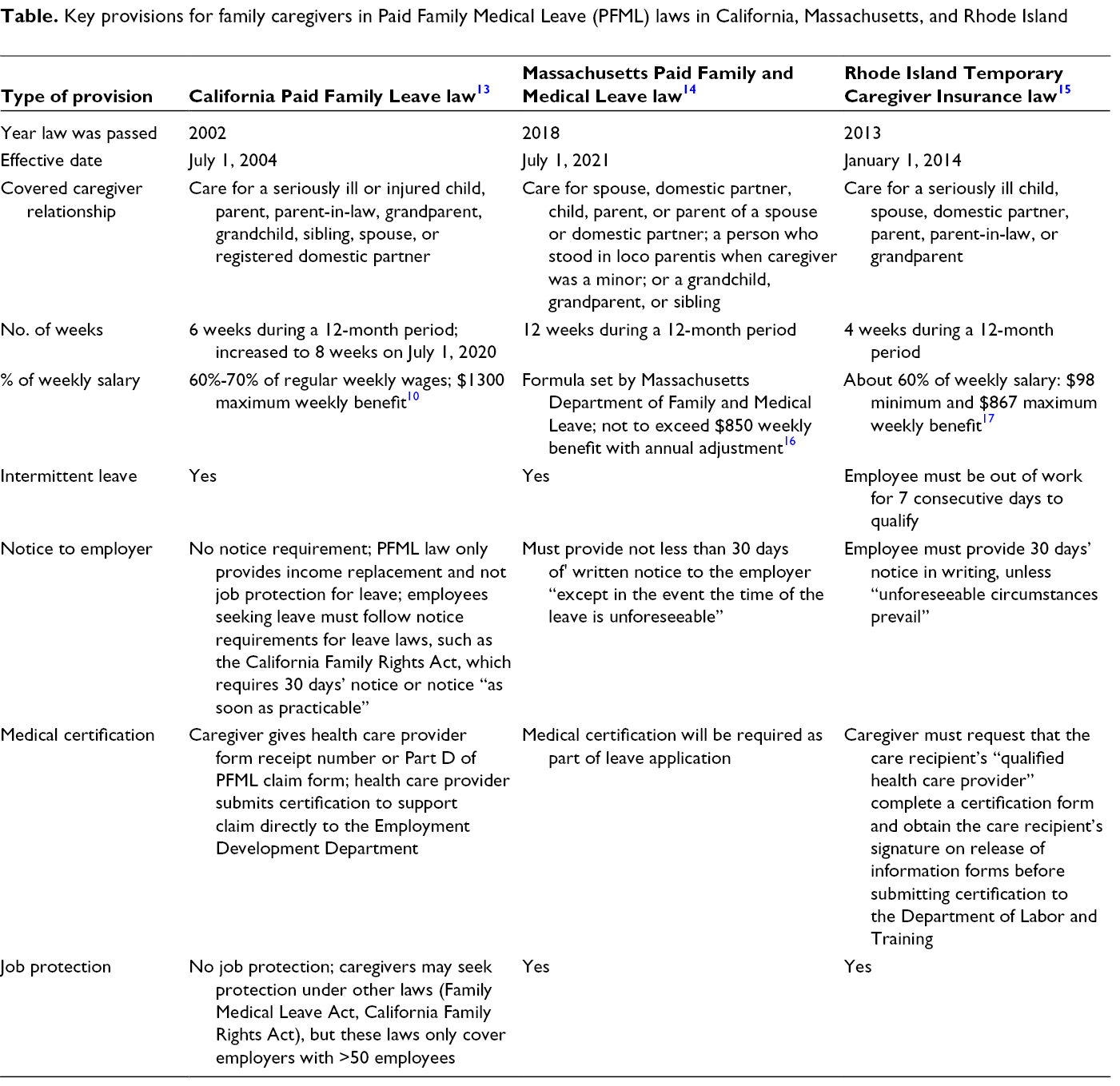
Although little evidence exists to answer why uptake of PFML programs is so much more robust for parental leave than for family caregiving, we posit that this disparity may result from two aspects of PFML laws: (1) the underlying structure of PFML laws and policies often favor parental caregiving needs over family caregiving for older or disabled family members, and (2) caregivers of older and disabled adults who are eligible for PFML benefits may be less aware than new parents of their rights to these benefits. We highlight the ways in which three states—California, Massachusetts, and Rhode Island—have structured their PFML laws and analyze elements of the laws that may either support or hinder caregivers in accessing benefits (Table).
Key provisions for family caregivers in Paid Family Medical Leave (PFML) laws in California, Massachusetts, and Rhode Island
Key Elements of PFML Laws and Policies That Affect Caregivers of Older and Disabled Family Members
In addition to providing adequate time off to attend to a family member’s needs (leave time ranges from four weeks in Rhode Island 15 to 12 weeks in Massachusetts) 14 and covering a reasonable percentage of a worker’s salary during leave (generally about 60%-70% of weekly wages), PFML laws contain several other elements that are important for addressing the needs of family caregivers Table. Even when PFML laws are drafted with family caregivers in mind, it is important to ensure that caregivers are fully informed of their rights and that the laws and policies are implemented and enforced in ways that best protect and support them.
Notice Requirements
Unlike people who give birth to or adopt a child, for which the period of leave is predictable, caregivers of older or disabled family members often are navigating unforeseeable medical events (such as a parent’s fall) that trigger an unexpected need for leave. Most PFML policies require an employee to provide written notice, usually 30 days in advance of the anticipated starting date of the leave, indicating the anticipated length of the leave and the expected date of return. Rhode Island and Massachusetts include an exception to this requirement for “unforeseeable” circumstances. 14,15 Because California’s PFML law provides income replacement but does not allow employees to take leave, 13 this state law is silent on advanced notice requirements. Rather, California’s PFML law works in tandem with laws that provide job-protected leave, such as the California Family Rights Act, 18 which requires 30 days of notice for foreseeable leave and notice “as soon as practicable”. Exceptions to notice requirements for unforeseeable care needs are critical for family caregivers; however, statutory protection is not enough. States should work to inform caregivers of their rights in this regard because employers may be less likely to accommodate them if leave is requested without prior notice.
Allowance for Intermittent Leave
Some PFML laws also require that a particular number of days be taken at once to qualify for the benefit. For example, Rhode Island’s PFML law requires that the employee take at least 7 days of leave to qualify for the paid leave program. 15 However, responsibilities for elder care often do not fit this model. Although no employment-based benefit can perfectly support long-term caregiving of older adults, the needs of employed caregivers for leave are usually episodic: 1 or 2 days occasionally to take a relative to a medical appointment, transact health-related legal business, support the submission of benefit applications, or move to a new home or transitional setting. The Rhode Island benefit seems to be best suited to childbirth or adoption. Its requirement of 30 days of notice and allowance of 1-4 weeks of paid leave (possibly supplemented by vacation and sick time) is more feasible for new parents than it is for caregivers of disabled or older adults, who may have difficulty planning ahead for when leave is needed. In this regard, the PFML laws in California and Massachusetts, which do not impose minimum leave requirements, are more appropriate for some elder care situations.
Job Protection
Because family caregiving of older adults and disabled family members may be needed more intermittently and without much notice to an employer, job protection is imperative. By combining job protection with PFML benefits, Rhode Island and Massachusetts best support workers to take protected leave and to receive crucial income while doing so. Although California workers may seek job protection through other laws, these protections are limited by the other laws’ coverage of particular classes of employees, which may not include all employees who are otherwise eligible for PFML benefits. Both the FMLA and the California Family Rights Act (CFRA) currently cover only employers with ≥50 employees; these restrictions do not apply to PFML benefits. However, on September 17, 2020, California passed Senate Bill 1383, which expanded CFRA coverage to employers with ≥5 employees. 19 In addition, California’s Senate Bill 83 expanded its paid leave benefit from 6 weeks to 8 weeks beginning on July 1, 2020, and created a task force to assess and address job protection as part of its PFML benefit. 20
Medical Certification
Another element of PFML laws that substantially affects family caregivers is medical certification requirements. One of the challenges for caregivers is that they must request certification, not from their own health care provider but, rather, from the health care provider of the ill or disabled family member. The process designed by the PFML policy can either facilitate or frustrate a caregiver who is attempting to acquire the necessary certification. Family caregivers may or may not have a direct relationship with a loved one’s health care provider. Rhode Island’s process is the most cumbersome of the three states, requiring that the caregiver obtain the certification directly from the health care provider and obtain a signature from the care recipient before submission. In contrast, California’s process is simple. Once caregivers submit an application for paid leave to the Employment Development Department, they receive a form receipt number that can be given to the health care provider and then submit the certification directly to the Employment Development Department. Reducing bureaucratic hurdles for caregivers in this way can alleviate additional stress and expedite prompt access to paid leave.
The Future of PFML Laws
Many questions about PFML laws have not been studied, particularly pertaining to caregiving for older and disabled family members. Given the documented lack of uptake of these benefits by family caregivers, future research should focus on barriers to accessing benefits, whether linked to design of the policy or implementation of the program. As policy makers consider the design of PFML benefits, it is important to ensure that these programs are well-suited to the needs of all family caregivers and do not perpetuate unnecessary obstacles to use of PFML programs. Furthermore, as federal policy makers consider a national PFML program, it is imperative to study the designs of state programs to learn what will work best for families in various situations.
Footnotes
Declaration of Conflicting Interests
The authors declared no potential conflicts of interest with respect to the research, authorship, and/or publication of this article.
Funding
The authors received no financial support for the research, authorship, and/or publication of this article.