



Abstract
Force health protection (FHP) is defined as “the prevention of disease and injury in order to protect the strength and capabilities” of any service population. FHP was the foundational principal of the US Public Health Service (USPHS). President John Adams’ signing of An Act for Sick and Disabled Seamen on July 16, 1798, marked the first dedication of US federal resources to ensuring the well-being of US civilian sailors and Naval service members. On January 4, 1889, President Cleveland enacted the USPHS Commissioned Corps, creating the world’s first (and still only) uniformed service dedicated to promoting, protecting, and advancing the health and safety of the United States and the world. Building on the lessons of the 2014-2015 response to the Ebola virus pandemic, the Corps Care program was formalized in 2017 to establish and implement a uniform and comprehensive strategy to meet the behavioral health, medical, and spiritual needs of all Commissioned Corps officers. Its role was expanded in response to the coronavirus disease 2019 (COVID-19) pandemic, which has placed unprecedented demands on health care workers and spotlighted the need for FHP strategies. We describe the FHP roles of the Corps Care program for the resiliency of Commission Corps officers in general and the Corps’ impact during the response to the COVID-19 pandemic. Qualitative analysis of FHP discussions with deployed officers highlights the unique challenges to FHP presented by the pandemic response.
Force health protection (FHP) is defined as “the prevention of disease and injury in order to protect the strength and capabilities” of any service population. 1 In the words of Dr Jonathan Letterman, the “father of the modern battlefield medicine” and medical director of the Army of the Potomac from 1862 through 1864, the purpose of FHP is not only to focus on “attending the wounded and sick” but to “strengthen the hands of the Commanding General by keeping his army in the most vigorous health, thus rendering it, in the highest degree, efficient for enduring fatigue and privation, and for fighting.” 1
FHP was the foundational principal of the US Public Health Service (USPHS). President John Adams’ signing of An Act for Sick and Disabled Seamen 2 on July 16, 1798, marked the first dedication of federal resources to ensuring the well-being of US civilian sailors and Naval service members. On January 4, 1889, President Cleveland enacted the USPHS Commissioned Corps, 3 creating the world’s first (and still only) uniformed service dedicated to promoting, protecting, and advancing the health and safety of the United States and the world. 3 -6 Today, the Corps includes more than 6000 officers from multiple health professions working for 21 federal agencies at 583 duty stations across the country and around the world. Corps officers can be deployed around the world to respond to public health emergencies ranging from natural disasters to bioterrorism attacks 6 under US Code title 42 §204. 7 In addition to the threats to resiliency shared across all health care providers, Corps officers face unique challenges. 8 To meet these challenges and maximize the benefits of the Commissioned Corps’ talents, the modern era has witnessed a substantial expansion and strengthening of the Corps mission. 9
Purpose
The foundation of the Corps Care program was laid during the Corps’ historic 2014-2015 response to the Ebola virus disease outbreak in West Africa. As the outbreak became a pandemic, the response placed officers in high-stress environments, demanded meticulous personal protective equipment protocols, and exposed officers to a high rate of patient deaths in the Ebola-infected patient population. Because of the emotional burden of these deployments and the need for active monitoring upon return to the United States, the Corps initiated a reintegration strategy for monitoring and supporting officers after their return.
The Corps Care program was officially formed in 2017 to formally establish and implement a standardized and comprehensive strategy to meet the behavioral, health, medical, and spiritual needs of all Commissioned Corps officers. The program’s role was expanded in response to the coronavirus disease 2019 (COVID-19) pandemic, which placed unprecedented demands on health care workers and spotlighted the need for FHP strategies. The Corps Care program is tasked with promoting resiliency via 2 primary missions: (1) the identification and prevention of FHP challenges and (2) the provision of outreach, education, and coordination of resources. The purpose of this case study is to detail the formation and expansion of the Corps Care program to provide insights to those who work in the FHP field.
Methods
Corps Care Formalization and Expansion
Resiliency training from Corps Care starts with lectures at Officer Basic Course for newly commissioned officers. The emphasis continues throughout the officers’ careers, culminating in Flag Officer Orientation. Resiliency is a process that evolves throughout the officers’ careers rather than being a static event. Corps Care focuses on educating and strengthening the officer throughout the deployment continuum (Figure 1). The emphasis on building and strengthening resiliency can assist officers and improve their impact throughout their deployment. The increased demands of the COVID-19 pandemic generated substantial expansion of Corps Care FHP duties. As of October 12, 2020, more than 50 officers had been deployed to augment Corps Care staffing for more than 1250 person-days (unpublished data, USPHS Commissioned Corps Readiness and Deployment Branch).
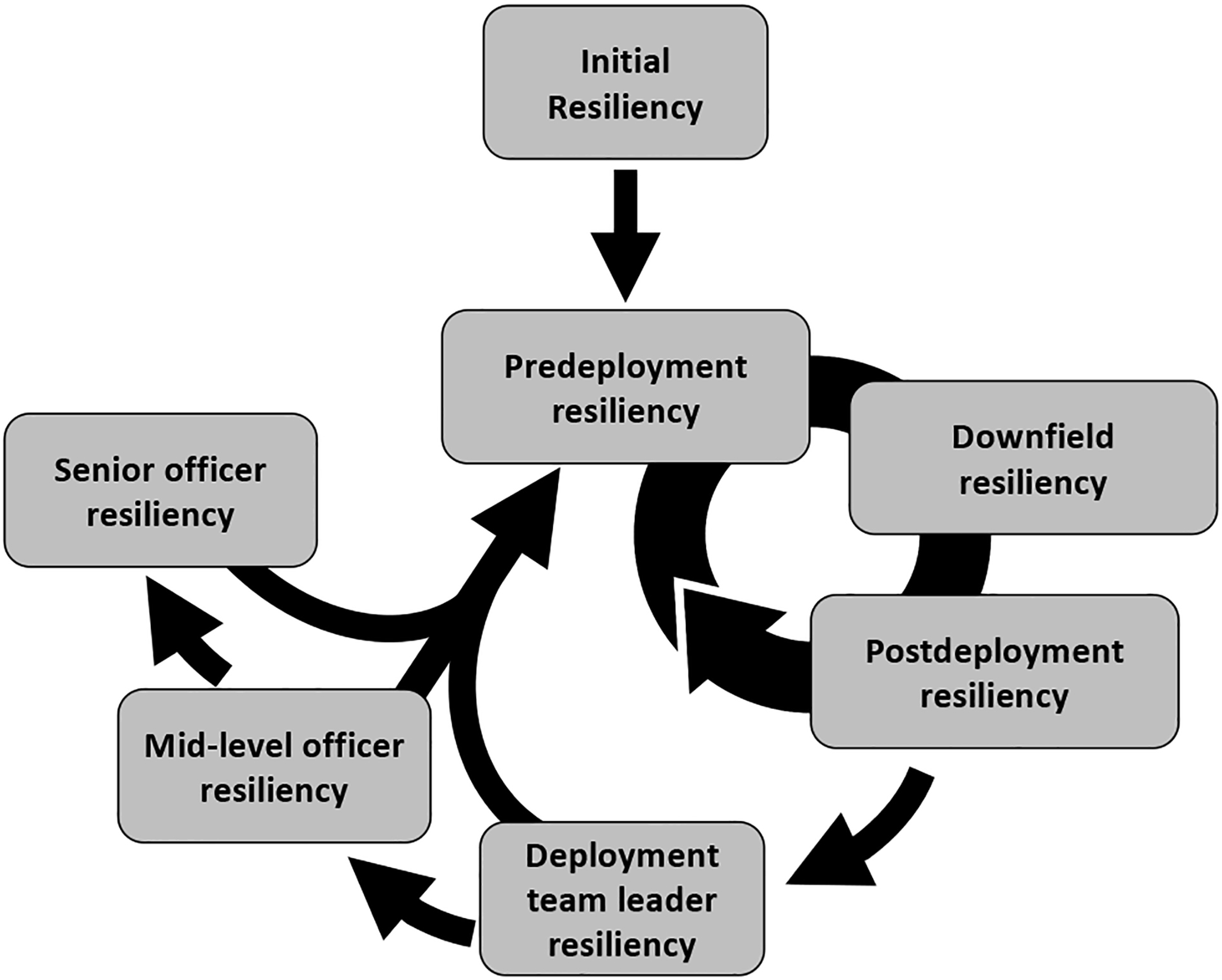
Flow diagram of the resiliency trainings offered through Corps Care. Corps Care is a program by the Commissioned Corps that is dedicated to force health protection throughout officers’ careers and includes multiple resiliency trainings.
Word Cloud Generation and Theme Extraction
Twelve Corps Care officers generated themes independently for the purpose of identifying the most common themes expressed by officers returning from deployment from March through October 2020. Officers collated lists of the top 5-10 most common themes from in-field and postdeployment conversations, converted them to .txt formatting, and then analyzed them by word cloud (a format that displays words from an input text at different sizes based on how frequently the given word or phrase appears) using wordclouds.com (zygomatic).
Outcomes
Identification of Threats to FHP Unique to the Corps
Threats to resiliency and FHP that are common for deployment for all services include separation from family and friends, new and often crowded living conditions, a tendency for the work pace to oscillate between tedious and frenetic, and the long hours in remote locations. Because Corps deployments require officers to leave their agency duty station, additional stressors might include the requirements to complete duty station projects before departure. Some officers have suboptimal support for the pending deployment from their supervisors or coworkers. Furthermore, although modern communication may allow for continued contact with loved ones and, thus, reduce the stress of deployment, it may also increase expectations for checking work-related emails and staying involved with work projects while deployed. In addition to these more traditional stressors, the ongoing response to COVID-19 threatens resiliency through presenting conditions that may pose a direct threat to the well-being of the officer, the officer’s family, and the officer’s contacts. The scale of the domestic COVID-19 outbreak presents risks to the well-being of officers and their loved ones, including the possibility of contracting the virus and transmitting it to close contacts. The extremely communicable nature of severe acute respiratory syndrome coronavirus 2 (SARS-CoV2, the virus that causes COVID-19) and media coverage of the death toll are additional pressures for officers during this pandemic deployment period. Although fears among officers’ families that their loved ones will become ill during deployment were also a burden of the Corps’ Ebola response, COVID-19 presents unique stressors that loved ones may contract the virus and become ill while officers are on deployment.
Development of Formal Predeployment Resiliency Trainings
Since its inception, Corps Care has implemented multiple programs to support the resilience, overall health, and well-being of Commissioned Corps officers. Given the demands of the COVID-19 pandemic response, the current focus of the Corps Care program is to ensure resiliency across the deployment continuum and throughout the Commissioned Corps officers’ careers (Figure 1). Corps Care offers directed trainings for family care planning that aim to streamline the process of preparing the officer’s family for both the emotional and logistical adjustments associated with deployments. Predeployment trainings are also offered to officers to help prepare for these expected challenges. Trainings include exercises on emotional grounding and mindfulness as well as expectation management. Formal resiliency training is now integrated into the onboarding for all new officers as part of the Officer Basic Course. In addition, annual resiliency training is required as part of predeployment fitness for duty preparations.
Downfield Deployment of FHP Officers
In addition to predeployment programs, Corps Care has successfully advocated for the inclusion of embedded FHP and force behavioral health protection (FBHP) officers as part of the deployment teams. These officers provide on-site monitoring for resiliency-related threats to mission success. FHP and FBHP officers serve as liaisons to command staff members to ensure a bidirectional flow in the communication of concerns and updates. FBHP officers were embedded with the teams that staffed the Monrovia Medical Unit, the treatment facility in Liberia operated by the Corps that was dedicated to serving health care providers who had suspected or confirmed Ebola virus disease. 10 For the COVID-19 pandemic, 33 FHP officers had been deployed to the field as members of public health response teams as of October 12, 2020. Although the goal is to have FHP or FBHP providers assigned to all deployed teams at their physical locations, Corps Care has the resources to offer remote support, interventions, and/or augmentation if acute threats to team resiliency arise in the field. Furthermore, Corps Care has designed trainings to educate the entire Commissioned Corps on the best practices for recognizing and mitigating compassion fatigue in both themselves and their fellow officers. In so doing, Corps Care aims to create a service in which all officers are active participants in the FHP mission.
Formalizing Postdeployment Resiliency Trainings
Postdeployment (reintegration) assessments are also a key component taken from the Ebola response and formalized into the Corps Care program. From January 18 to October 12, 2020, Corps Care made more than 20 000 postdeployment contacts to assess for signs of postdeployment trauma that may result from patient deaths, working in a high-risk environment, or any other stressor. Formal reintegration trainings have also been designed to help officers transition from deployment to home, maximize postdeployment growth, and sustain the connections formed during deployment. When coupled with an outlet for officers to express concerns and frustration, the effects of postdeployment monitoring can range from uplifting to lifesaving. 11,12 In addition to making postdeployment telephone calls, Corps Care has invested more than 40 320 hours on confidential, officer-initiated telephone calls. Such communications are vital given that many officers express fear that reporting signs of physical or mental conditions may result in limitations to career advancement or even expulsion from the Corps. A crisis line is available for officers to reach out if they are having difficulties and need immediate assistance. In addition, the Corps Care program is formulating trainings on suicide prevention, stress management, and other areas of resiliency and well-being.
Expansion of Preventive Medicine for FHP and FBHP
In addition to FHP, Corps Care promotes preventive and general medical guidance to officers throughout their career and deployment status. Programs for monitoring and promoting weight loss and physical fitness have begun in response to newly implemented fitness standards for officer retention. Officers with injuries or illnesses that could affect their performance during deployment are now assessed before departure, and, if necessary, medical waivers are provided. Immediate reporting of potential illness or injury to officers while in the field on a mission can be assessed by Corps Care leadership; thus, guidance on treatment and/or decisions for demobilization can be made in real time. Disease surveillance and documentation of service-related injuries are also provided.
Novel Responses to the COVID-19 Pandemic
The ongoing Corps response to the COVID-19 pandemic has once again demonstrated the courage of its service members and emphasized the need for dedicated resiliency protections. Previous FHP programs have proven effective in controlling antibiotic-resistant bacterial infections among US service members 13 and will likely be needed to monitor risks associated with SARS-CoV2 exposure. As of October 12, 2020, 3896 unique Corps officers had been deployed for 7337 unique COVID-19 missions, totaling more than 135 000 person-days. Many officers have taken on direct patient care in some of the hardest-hit areas in the nation. 14,15
Many officers who served in direct patient care reported traumatic loss because of the frequency of deaths in their patient population during their postdeployment telephone calls with officers at Corps Care or during debriefing sessions with headquarters. As a result, the Corps Care program developed resources for dealing with bereavement and coping with the stress of quarantine or isolation that follows most COVID-19–related deployments. In addition, officers have expressed ongoing concerns about contracting SARS-CoV-2 while deployed, the health of their loved ones, fear of infecting their families, and the additional stress of homeschooling children. Having Corps Care provide FHP ensures that officers have the guidance and support needed to complete their mission. The COVID-19 response has required officers to be deployed more frequently and for longer periods than during previous deployments, and this increased pace has revealed an even greater need for FHP for the Corps. Officers have reported increasing anxiety, distress, and family distress during their deployments. Corps Care has provided around-the-clock FHP services to officers to guarantee needs are identified and addressed.
A word cloud summarizes qualitatively extracted themes from Corps Care discussions with officers and objectively validates the narrative concerns expressed (Figure 2). The primary theme extracted from these telephone calls was “family,” highlighting the unique threat that responding to an infectious outbreak poses to officers’ loved ones and the logistical challenges faced by their families when officers are deployed. The other main themes were “communication” and “thankfulness,” which indicate the importance of keeping officers informed and their appreciation of the Corps Care program’s assistance in this process. Tracking these responses during future deployments may offer insights into the benefits of the Corps Care program and areas of continued need.
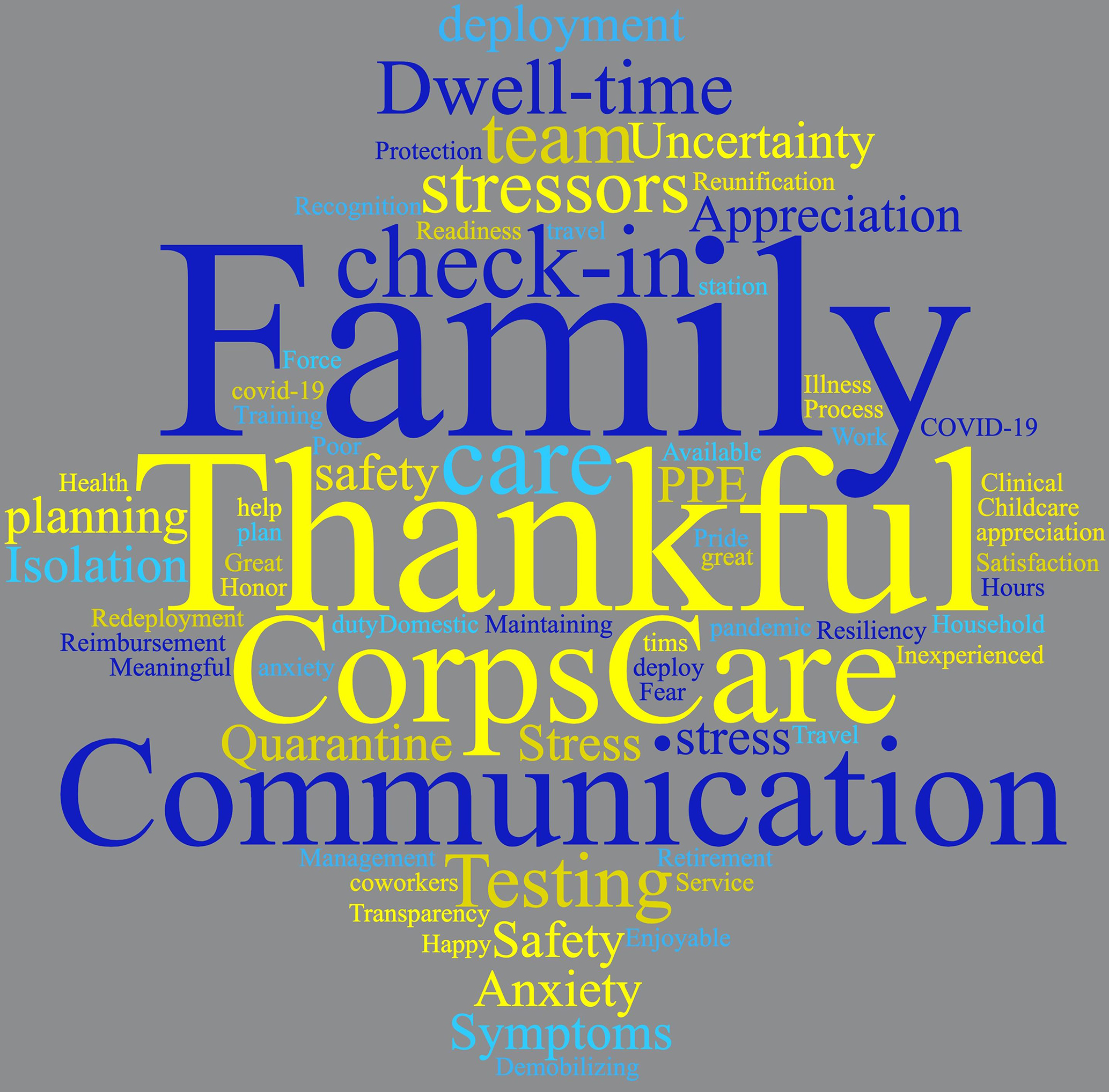
Word cloud extracted from qualitative analysis. Corps Care Officers conducted telephone conversations with officers deploying, or officers having returned from deployment, as part of the coronavirus disease 2019 (COVID-19) pandemic response from March through October 2020. Each Corps Care officer listed the 5-10 most common themes from their telephone calls independently before collation by the groups. Word cloud extraction is presented. “Tims” refers to the text message–based system for postdeployment monitoring of symptoms of COVID-19.
Lessons Learned
Although the COVID-19 pandemic has placed an increased burden on the Corps, the major lesson learned is the importance of having a standing office dedicated to FHP before an outbreak. The Ebola response demonstrated that these FHP measures offer great value for the Corps, whereas the COVID-19 pandemic demonstrated the advantage of formalizing, expanding, and appropriately funding these programs. With Corps Care in place, its programs can proactively address the crisis, rather than having to be constructed in the midst of an emergency. Threats to officer well-being and health have been directly communicated to top leadership, but Corps Care maintains confidentiality for the officers who express concerns. Expansion of the aforementioned mitigation strategies has been supplemented with the development of new programs for FHP. Serving as a nexus of FHP response, Corps Care will also facilitate data-driven expansion of existing, or creation of new, outlets for assuring resiliency of current and future Corps officers. Overall, we hope the Corps Care program can build off the success of the Ebola response and serve as a model for other agencies and nonprofit organizations that respond to public health needs worldwide.
Footnotes
Declaration of Conflicting Interests
The authors declared no potential conflicts of interest with respect to the research, authorship, and/or publication of this article.
Funding
The authors disclosed receipt of the following financial support for the research, authorship, and/or publication of this article: This project was funded by the Office of the Surgeon General and the US Department of Health and Human Services.
