




Abstract
Objectives
The US Food and Drug Administration (FDA) and local jurisdictions have different authorities to regulate menthol cigarettes, and a growing number of localities and the FDA are considering these policy options. The objective of this study was to update previous research on public support for a menthol ban, including examining differences in support by demographic factors, geographic region, and smoking status.
Methods
We assessed policy support among a cross-sectional sample of 2871 adults aged 18-64 from a nationally representative online panel. We calculated weighted estimates of support by demographic factors, political ideology, region (Northeast, Midwest, South, West), and smoking status (never, former, current nonmenthol, current menthol). We used weighted adjusted logistic regression analysis to examine correlates of support for a menthol ban.
Results
Overall, 56.4% (95% CI, 54.4%-58.3%) of participants supported a government policy to ban menthol cigarette sales. Support was significantly higher among women than among men (62.5% vs 50.1%; P < .001); among Hispanic/Latino (69.3%), non-Hispanic African American (60.5%), and non-Hispanic other (65.8%) people than among non-Hispanic White people (50.4%; P < .001); and among never (64.8%) and former (47.0%) smokers than among current nonmenthol cigarette smokers (30.1%; P < .001). A significant proportion (28.5%; P < .001) of current menthol cigarette smokers supported a ban. After controlling for other factors, geographic region was not significantly associated with support for a ban.
Conclusions
Efforts are needed to further increase support for a ban among current menthol cigarette smokers. These findings can be used to assist policy makers and communities in efforts to ban menthol cigarettes in their jurisdictions.
Smoking prevalence in the United States has declined significantly over time, 1 yet the prevalence of menthol cigarette use has either remained stable or increased among adolescents, young adults, and adults. 2,3 As of 2017, menthol cigarettes represented 36% of the total cigarette market. 4 As a flavor additive, menthol produces a variety of sensory effects that can reduce the harshness of smoking and enhance its appeal for new and established smokers. 5 Menthol cigarettes have been associated with increased rates of smoking initiation among young people and progression to established smoking. 6 -9 Furthermore, established menthol cigarette smokers are less likely to quit than nonmenthol cigarette smokers, despite making more quit attempts than their non–menthol cigarette-smoking counterparts. 9 -11 African American people, Hispanic/Latino people, Asian people, women, and young adults aged 18-24 have high rates of menthol cigarette use, 3,12 which reflect historic and continued disparities in marketing menthol cigarettes to young people and communities of color. 13 -17
Given the documented disparities associated with menthol cigarette use, 18 regulation of these products is a focus of federal policy debate and tobacco control efforts. In 2009, the Family Smoking Prevention and Tobacco Control Act granted the US Food and Drug Administration (FDA) the authority to regulate the manufacture, marketing, and sale of tobacco products in the United States. 19 This legislation also included a product standard that bans characterizing flavors in cigarettes, such as candy or fruit, in an effort to reduce smoking initiation. 19 However, the product standard excluded menthol. Although several evaluations, including one produced internally by the FDA in 2013, have since reviewed the existing scientific evidence and recommended a menthol cigarette ban to benefit public health 9,20,21 and avert smoking-related deaths, 22 the FDA has not yet acted on its authority to remove menthol cigarettes from the marketplace. 23
In the absence of a national ban, localities have led the charge. The Family Smoking Prevention and Tobacco Control Act preserves state and local authority to adopt measures on the sale of tobacco products. 19 A growing number of jurisdictions have implemented restrictions on local menthol cigarette sales 24 but with evolving degrees of comprehensiveness. For example, in 2017, Minneapolis added menthol cigarettes to its existing flavored tobacco sales restriction after 2 years of targeted community outreach efforts; however, tobacco and alcohol outlets are exempt from this provision. 25 In 2018, San Francisco implemented the first citywide flavored tobacco sales restriction that included all flavored tobacco products and applied to all retailers. 26 Despite industry efforts to block the ordinance, San Francisco’s policy was upheld by voters and has become the standard for comprehensive restrictions on flavored tobacco sales. 26
Public support for tobacco control policies can influence decision makers, inform agendas, and guide the messaging and mobilization of advocacy groups. 27 -29 Since 2009, several studies have examined public attitudes toward a menthol cigarette ban using nationally representative samples. 30 -34 These studies demonstrated a range of public support for a menthol cigarette ban (Table 1). For example, in 2009, Winickoff et al 34 found that 56.1% of respondents agreed that “menthol cigarettes should be prohibited just like other flavored cigarettes.” Rose et al 32 reported that 36.0% of participants agreed with this statement in a 2013 study, and support was even higher among nonsmokers (41.0%). In 2010, Pearson et al found that 20.0% of respondents agreed that “menthol flavoring in cigarettes should be banned,” but 51.9% did not report a strong opinion for or against a ban. 30 In addition, Schmidt et al 33 observed that 33.5% of participants answered “yes” and 17.3% answered “don’t know” to whether the “FDA should ban menthol, a minty flavor, from cigarettes” using data collected from 2014-2015. In 2016, Rath et al 31 found that 68.0% of nonsmokers agreed that the “FDA should ban menthol flavoring in cigarettes”; however, support was lower (34.0%) among smokers. The observed variation in support in these studies likely reflects differences in item phrasing and response categories as well as differences in telephone-based 33,34 versus online survey design. 30 -32 Nonetheless, support for a ban was consistently greater among non-White populations, 30,33,34 people with lower levels of education, 30,33,34 and nonsmokers across studies. 30 -34
Summary of research examining public attitudes toward a menthol cigarette ban in the United States, 2009-2016
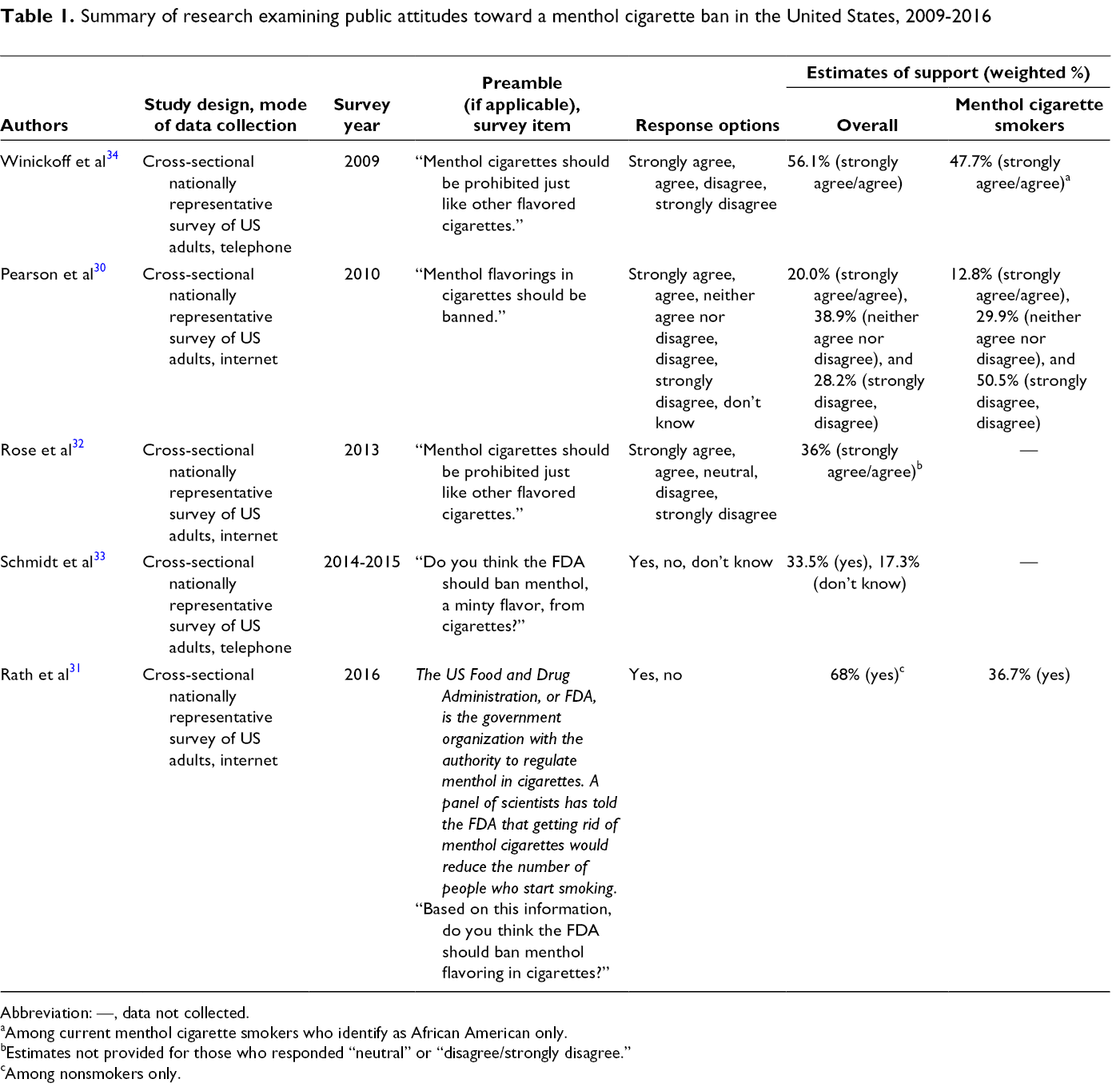
Abbreviation: —, data not collected.
aAmong current menthol cigarette smokers who identify as African American only.
bEstimates not provided for those who responded “neutral” or “disagree/strongly disagree.”
cAmong nonsmokers only.
In November 2018, the FDA expressed renewed interest in a product standard that prohibits menthol as a characterizing flavor in cigarettes, 23 indicating a window of opportunity to advance this measure. 29 However, past inaction, the long regulatory process, and tobacco industry resistance 25,26,35 suggest that the likelihood of this regulatory action at the federal level is unclear. 36 Thus, local sales restrictions may be the most feasible pathway to reduce access to flavored tobacco products in the short term. Our study updates previous research to provide a recent estimate of public opinion on a menthol cigarette ban by smoking status and key demographic variables. We provide estimates for support by region, not available in previous research. This additional insight is particularly relevant for regions such as the South and Midwest, where rates of smoking and using menthol cigarettes are higher than in regions such as the West, 1,37 and an opportunity exists to advance tobacco control initiatives, including restrictions on menthol cigarettes sales. 38,39 Findings from this research can provide updated evidence to federal and local policy makers and advocates seeking to reduce tobacco use.
Methods
Sample
We collected data from October 15 through December 17, 2018, using the Ipsos KnowledgePanel, an online, nationally representative, probability-based sample of English- and Spanish-speaking adults. Ipsos recruited panel members via address-based sampling and provided households without internet access a web-enabled device and free internet service. In total, Ipsos invited 5358 panelists, and the completion rate was 55.6% (n = 2979), which is in line with the average completion rate (approximately 60%) for the panel (unpublished data, Ipsos, February 2019). The analytic sample for this study included noninstitutionalized adults aged 18-64 without any missing data on the outcome or demographic variables (n = 2871). The number of excluded participants was <4% of the sample, and participants who were excluded did not differ substantially from participants who were included in the analysis. Ipsos weighted the data to adjust for differential nonresponse and further adjusted against Current Population Survey, March 2018 benchmark distributions for age, sex, race/ethnicity, region, education, annual household income, and primary language. 40 The Advarra Institutional Review Board (Pro-00029613) approved this study, and all participants provided written informed consent to participate.
Measures
We measured support for a menthol cigarette ban using the following item: “To what extent would you support a government policy to ban the sale of menthol cigarettes?” We included this question in a randomized block of policy support questions for other tobacco regulatory initiatives. We assessed support by using a 4-point scale of strongly support, support, oppose, and strongly oppose. We dichotomized responses into “support” and “oppose” for this analysis.
Demographic characteristics included sex (male, female), age (18-24, 25-34, 35-44, 45-54, 55-64), education (<high school degree, high school degree or equivalent, some college/associate degree, ≥bachelor degree), and race/ethnicity (non-Hispanic White, non-Hispanic African American, Hispanic/Latino, and non-Hispanic other [ie, ≥2 races]). We based participant geographic location on US Census region (Northeast, Midwest, South, West). We also assessed political ideology given previous research suggesting that more liberal citizen ideology is associated with tobacco control policy support and implementation. 41,42 To assess political ideology, we asked respondents, “How would you describe your overall political philosophy?” with response options of “very conservative,” “conservative,” “moderate,” “liberal,” “very liberal,” “none of the above,” and “prefer not to answer.” We categorized responses into “conservative,” “moderate,” “liberal,” and “unspecified,” where the latter category combined respondents who said none of the above and prefer not to answer. Estimates did not change if these categories were combined or treated separately.
Finally, we defined never smokers as those who never tried a cigarette and former smokers as those who smoked ≥100 cigarettes in their lifetime but did not smoke a cigarette in the past 30 days. Current smokers were defined as those who smoked ≥100 cigarettes in their lifetime and smoked on at least 1 of the past 30 days. We further classified current smokers into current nonmenthol cigarette smokers and current menthol cigarette smokers based on their response to the question, “In the past 30 days, were any of the cigarettes you smoked flavored to taste like menthol or mint?”
Statistical Analysis
We weighted and conducted all analyses using survey procedures in Stata version 15.1 (StataCorp LLC). We provided weighted prevalence of participant characteristics and menthol ban support. We used weighted Pearson χ2 tests to assess bivariate associations between support and demographic characteristics, geographic region, political ideology, and smoking status. We conducted a weighted adjusted logistic regression to examine correlates of support for a menthol ban. Because of their theoretical importance, we included all variables in the regression model, regardless of their significance level in the bivariate analysis. Tests of association were 2-sided, with P < .05 considered significant.
Results
Most participants were never smokers (66.1%; 95% CI, 64.3%-68.0%), 7.2% (95% CI, 6.2%-8.3%) were current nonmenthol cigarette smokers, and 6.1% (95% CI, 5.2%-7.2%) were current menthol cigarette smokers (Table 2). Overall, 56.4% (95% CI, 54.4%-58.3%) of participants supported a government policy to ban menthol cigarette sales, corresponding to 1.61 million US adults. In the bivariate analysis, age, sex, race/ethnicity, region, political ideology, and smoking status were all significantly associated with support for a menthol cigarette ban. Only 28.5% (95% CI, 21.2%-37.0%) of current menthol cigarette smokers supported a ban compared with 47.0% (95% CI, 43.0%-51.0%) of former smokers and 64.8% (95% CI, 62.7%-67.1%) of never smokers. Participants who were aged 18-24 (vs older age groups), female (vs male), and non-Hispanic African American, Hispanic/Latino, or non-Hispanic other (vs non-Hispanic White) reported higher levels of support for a menthol cigarette ban. Support for a menthol cigarette ban was lower among participants in the Midwest (vs other regions) and participants who reported a more conservative political ideology (vs liberal ideology).
Weighted a prevalence and adjusted odds of support for a ban on menthol cigarette sales among a nationally representative sample, Ipsos KnowledgePanel internet survey, United States, 2018
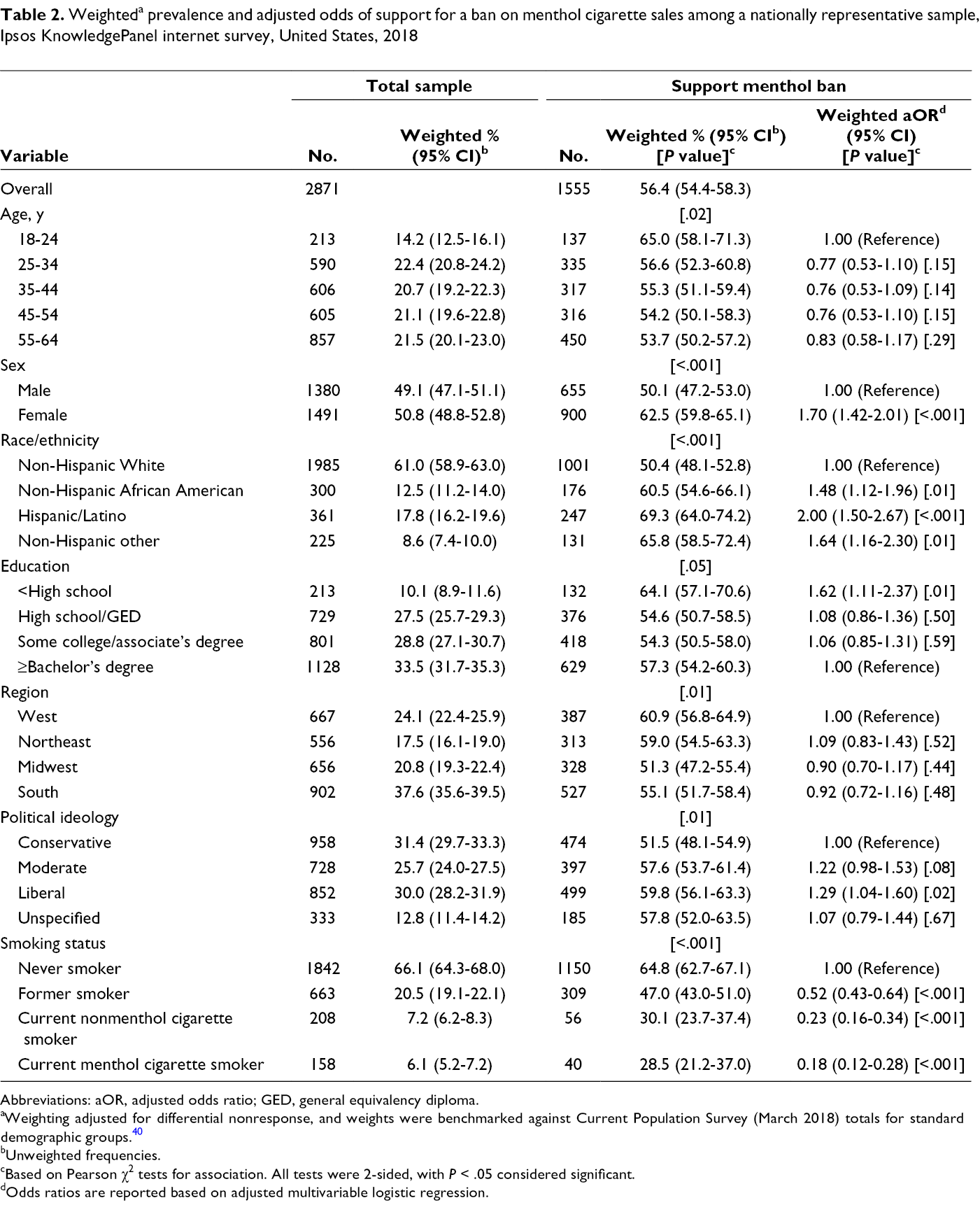
Abbreviations: aOR, adjusted odds ratio; GED, general equivalency diploma.
aWeighting adjusted for differential nonresponse, and weights were benchmarked against Current Population Survey (March 2018) totals for standard demographic groups. 40
bUnweighted frequencies.
cBased on Pearson χ2 tests for association. All tests were 2-sided, with P < .05 considered significant.
dOdds ratios are reported based on adjusted multivariable logistic regression.
In the adjusted logistic regression analysis, the odds of support for a menthol cigarette ban were significantly higher among women than among men (adjusted odds ratio [aOR] = 1.70; 95% CI, 1.42-2.01; P < .001). Participants who were Hispanic/Latino (aOR = 2.00; 95% CI, 1.50-2.67; P < .001), non-Hispanic African American (aOR = 1.48; 95% CI, 1.12-1.96; P = .01), or non-Hispanic other (aOR = 1.64; 95% CI, 1.16-2.30; P = .01) had significantly higher odds of support for a ban than non-Hispanic White participants. Participants with less than a high school education were also significantly more likely to support a menthol cigarette ban than participants with a college degree or higher (aOR = 1.62; 95% CI, 1.11-2.37; P = .01). Former and current nonmenthol cigarette smokers and current menthol cigarette smokers had significantly lower odds of support for a menthol ban than never smokers. For example, current menthol cigarette smokers had 82% lower odds of support for a ban than never smokers (aOR = 0.18; 95% CI, 0.12-0.28; P < .001). Identifying as liberal rather than conservative was associated with greater odds of menthol ban support (aOR = 1.29; 95% CI, 1.04-1.60; P = .02), after controlling for other participant characteristics. Age and region were no longer significantly associated with support in the adjusted analysis.
Discussion
Most participants (56.4%) in our study supported a government policy to ban menthol cigarettes. This estimate fits within the range of support documented in previous research 30,32 -34 and reflects shifting openness toward government intervention to remove or restrict access to menthol cigarettes. Furthermore, we found that support for a ban was highest among participants who belong to communities that have been historically targeted by the tobacco industry with menthol cigarette advertising and promotion. 14,17 In our study, non-Hispanic African American and Hispanic/Latino populations, women, and people with less than a high school education were more likely to support a menthol cigarette ban, which is consistent with previous research. 30,33,34 Given that menthol cigarettes are more likely to be used 3,12 and sold in low-income, African American, and Hispanic/Latino communities in the United States, 15,43 -46 findings from these studies suggest that constituent groups most affected by menthol cigarettes support efforts to restrict the sale of menthol cigarettes. However, some caution is warranted. In recent years, the tobacco industry has sponsored community events and invited prominent figures from the African American community (eg, Reverend Al Sharpton) to speak against local menthol sales restrictions and potentially undermine support. 25 Ongoing educational outreach to communities most affected by menthol cigarette use is necessary to sustain the levels of support documented in this study and counter any continued interference from the tobacco industry.
As expected, current and former smokers were less supportive of a menthol cigarette ban than never smokers were. 30 -34 In our sample, approximately 28% of current menthol cigarette smokers supported a ban on menthol cigarette sales. This estimate is higher than that reported by Pearson et al, in which the authors found that 12.8% of current menthol cigarette smokers agreed that menthol flavoring in cigarettes should be banned, and 29.9% neither agreed or disagreed. 30 In addition, our estimate is lower than that reported by Rath et al, 31 in which 36.7% of menthol cigarette smokers supported an FDA ban on menthol flavoring. 31 The Rath et al study included an extensive preamble to their survey item, which asked participants to base their support for a ban on information that a menthol cigarette ban “would reduce the number of people who start smoking.” 31 Given that both smokers and nonsmokers support tobacco control measures that protect young people specifically, 32 this higher estimate may have been partially driven by framing the question around new smokers. Nevertheless, these estimates suggest a range of support for a menthol cigarette ban among current menthol cigarette smokers. When forced to select whether they supported or opposed a menthol cigarette ban without any additional supporting information, 1 in 4 menthol cigarette smokers in our study favored such a policy. The effectiveness of any menthol cigarette policy depends partly on how menthol cigarette smokers respond, 46,47 including whether they intend to quit smoking, 30,48 -51 switch to another tobacco product, 48,49,51 or find other ways to access a menthol cigarette brand. 48 Our study results highlight the need for policy makers and advocates to communicate effectively with menthol cigarette smokers about the purposes and intended benefits of a product standard or local sales restriction through efforts such as community-led health communication campaigns or neighborhood educational outreach events. 25 Done correctly, these actions could engender support among menthol cigarette smokers and motivate and improve quit intentions.
This study provides new insight into how support for a menthol cigarette sales ban varies by geographic region. Although support was significantly higher among participants in the West (60.9%), where menthol cigarette use has been reported to be lower than in other regions, 37 most participants in the Northeast (59.0%), South (55.1%), and Midwest (51.3%) also supported a menthol cigarette ban in the bivariate analysis. Furthermore, region was no longer significantly associated with support for a ban after adjusting for participant characteristics and smoking behavior, suggesting that people living in regions with a greater burden of tobacco use and weaker tobacco control policy environments are just as likely as those in other regions to support a menthol cigarette policy. 1,38 More than half of respondents, regardless of political ideology, supported a menthol ban in our study, with liberal participants having higher odds of support than conservative participants. However, even among conservative people who may be less inclined than moderate or liberal people to support tobacco control policies, 41,42 the results of our study found majority support (51.5%) for this policy.
Given the uncertainty of a federal product standard banning menthol cigarettes, 35 our findings suggest an opportunity to advance local menthol cigarette sales restrictions. In the past 3 years, the number of local policies to restrict menthol cigarette sales has grown, 24 but efforts have been largely concentrated in a handful of states (eg, California, Massachusetts) that recently passed a state-level ban on all flavored tobacco products, including menthol cigarettes. 52 To date, no menthol cigarette sales restrictions have been enacted in the South, nor have any other state-level policies on menthol cigarettes been enacted. 24,39 Our results highlight the opportunity for stakeholders to advance this policy effort in states and regions where limited action has been taken on menthol cigarette sales restrictions. Local policies are important precursors to state and federal legislation and can be effective in reducing local availability of flavored products and use among young people. 53 -56 However, these menthol sales restrictions may not be currently feasible everywhere because of prohibitive state preemption rules, 57,58 which limit or eliminate the authority of the local governments to regulate tobacco sales and marketing beyond what the state allows. 59 Despite the limitations imposed by preemption, evidence suggests that public support for tobacco control policies was just as high or higher among residents who live in states where preemption is more likely than among residents who do not live in states with preemption. 60 Finally, only the federal government has the ability to enact a product standard to ban the manufacture and distribution of menthol cigarettes nationally. Localities and states can only restrict sales of these products in their jurisdiction, which necessarily limits the potential wide-scale effect of these policies. 19 Our study provides evidence to advocates and policy makers to continue to support and advance menthol cigarette sales restrictions at the local or state level while still advocating for a product standard banning menthol at the federal level.
Limitations
This study had several limitations. First, our policy support measure did not specify whether a “government policy to ban menthol cigarette sales” would be enacted at the federal, state, or local level. As such, our results can be interpreted only generally. However, these findings fit within the range of support documented in previous research and provide updated estimates to assist local and federal policy makers. Second, we did not include an oversample of smokers in this study. As such, we were unable to produce reliable estimates to detect how support for a ban may vary by demographic characteristics or quit intentions among menthol cigarette smokers. Previous research, however, provides insight into differences in support by demographic characteristics and intentions to quit among menthol cigarette smokers 30 and can be used by stakeholders to supplement our findings. Third, we did not include measures to identify usual cigarette brand or whether most or all cigarettes smoked in the past 30 days were menthol. Therefore, we were unable to distinguish whether estimates of support differed between occasional and regular menthol cigarette smokers. Fourth, we did not oversample young people, Hispanic/Latino people, or non-Hispanic African American people, which limited our ability to examine variation for support within the populations most affected by targeted menthol cigarette advertising and point-of-sale promotions. 14,15,44 Finally, our study used an online survey, which may not fully represent populations with low socioeconomic status, with low literacy, or without consistent internet access. To address these limitations, KnowledgePanel uses an address-based recruitment strategy that improves access to marginalized communities and provides access to internet service and a web-enabled device to improve population coverage. The use of an online survey also potentially limited the amount of social desirability bias that may be associated with self-reported smoking behavior or reporting opinions on political ideology or policy support. 61
Conclusion
Federal, state, and local governments have the authority to limit the availability of menthol cigarettes, either through a national product standard or local sales restrictions. We found majority support for a menthol cigarette ban among US adults and even higher support among groups most burdened by menthol cigarette advertising and use. This evidence can support efforts by lawmakers and advocates to remove or restrict access to menthol cigarettes. There is little doubt that banning menthol is likely to reduce cigarette use and its attendant harms, 8,20 -22 and accumulating evidence from Canada that a province-level menthol cigarette ban promotes cessation among menthol cigarette smokers helps support that conclusion. 62 Policy makers and advocates should capitalize on the local momentum to advance this lifesaving policy.
Footnotes
Acknowledgments
The authors thank Matthew L. Myers at the Campaign for Tobacco-Free Kids and Jeffrey Willett at the American Heart Association for assistance in designing this study.
Declaration of Conflicting Interests
The authors declared no potential conflicts of interest with respect to the research, authorship, and/or publication of this article.
Funding
The authors disclosed receipt of the following financial support for the research, authorship, and/or publication of this article: This research was funded by Truth Initiative.
