




Abstract
Objective:
Given challenges to recruiting nurses to public health and the growth in national policies focused on population health, it is crucial that public health agencies develop strategies to sustain this important group of employees. The objective of this study was to examine factors that influence nurses’ decisions to work in public health agencies.
Methods:
This cross-sectional study examined perspectives of nurses who worked in state and local public health departments and responded to the 2010 Council on Linkages Between Academia and Public Health Practice’s survey of public health workers. We calculated the mean rating of each recruitment and retention factor for nurses and non-nurses separately and compared differences by using t tests. We then used multivariate regression analysis to examine differences in ratings by role (ie, nurse or non-nurse).
Results:
After controlling for personal and organizational characteristics, the influence of 5 recruitment factors was significantly stronger among nurses than among non-nurses: flexibility of work schedule (P < .001), autonomy/employee empowerment (P < .001), ability to innovate (P = .002), specific duties and responsibilities (P = .005), and identifying with the mission of the organization (P = .02). The influence of 5 retention factors was stronger among nurses than among non-nurses: autonomy/employee empowerment (P < .001), flexibility of work schedule (P < .001), specific duties and responsibilities (P < .001), opportunities for training/continuing education (P = .03), and ability to innovate (P = .008).
Conclusions:
Some factors that influence nurses to begin and remain working in local governmental public health agencies, such as flexible schedules and employee autonomy, are factors that governmental public health agencies can design into positions and highlight when recruiting from health care organizations, private industry, and academia.
Health care organizations in the United States are experiencing a persistent shortage of nurses, and the nursing shortage is projected to grow through the next decade. 1,2 These shortages affect not only private sector health care organizations but also governmental public health agencies. One-third of local health departments surveyed in 2012 estimated that they anticipated a shortage of public health nurses by 2017, and almost one-quarter indicated having difficulty hiring nurses. 3,4 One challenge in recruiting nurses to work in governmental public health is that governmental budgets often cannot compete with the compensation provided by the private health care industry. 3,5 This challenge is exacerbated by today’s highly competitive recruitment environment, which is influenced by the ongoing shortage of nurse professionals in general. 1,2 It is therefore crucial to understand factors that influence public health nurses in recruitment and retention so that this information can inform strategies to retain current workers and fill public health workforce gaps; this understanding is especially important in light of the pending retirement of many nurses in the near future. 3,6 –8
Nurses are the largest professional group in the public health workforce, making up 16%, or approximately 47 000 employees, across local, state, and federal public health agencies in 2010-2013. 9 However, this workforce has declined by 9% since 2000, likely resulting from public health budget cuts, complicated public health hiring processes, capacity in nursing education, and competition from the private sector. 10,11 Recent state-specific studies and anecdotal reports provide evidence of the difficulties in recruiting nurses to public health positions. 12 Given these challenges, the growth in national policies focused on population health, and the fact that many public health positions specify that they must be filled by a nurse, it is increasingly important that public health agencies sustain this group of employees. 3,13,14 However, little is known about what influences public health nurses in their decisions to work in public health or their decisions to stay in these positions.
Two recent studies surveyed nursing students to examine the relationship between having an educational rotation in a public health agency and working in public health after completing nursing studies. 10,13 The findings from these 2 studies differed: 1 study found that nursing students who completed a clinical rotation in a public health department reported less intention to choose a career in public health. 10 However, the second study found that having field experience in a local public health department was associated with a stronger interest in a public health career. 13 Another study examined job satisfaction among nurses in local health departments in one region of Illinois; this study found that coordination between supervisors and subordinates in making decisions on job tasks and other matters was associated with greater job satisfaction and possibly better retention of nurses. 15 In the context of limited research and conflicting findings, more insight into the factors that influence nurses’ decisions to begin working and remain working in governmental public health is needed. 7
The objective of this study was to examine factors that influence nurses’ decisions to work in public health and their perspectives on factors that influence the decision to continue working in their local public health agency. Findings from this study may be of interest to those in leadership and management positions in public health agencies and may be useful in developing strategies to improve nurse recruitment and retention, especially at the local level.
Methods
Dataset and Population
We used secondary data from the Council on Linkages Between Academia and Public Health Practice’s survey of public health workers. 8,16 The survey was emailed in 2010 to 70 000 public health workers and had an overall response rate of 17% (11 640 of 70 315). It was designed to explore factors that attracted workers to the field of public health, satisfaction with organizational environments, and factors that influence decisions to remain in the field. Details on survey design and methodology are available elsewhere. 16
In addition to data from the Council on Linkages Between Academia and Public Health Practice, our study used data from 2 other sources. We obtained information on the governance structure of local boards of health from the National Association of County & City Health Officials’ 2010 National Profile of Local Public Health Departments (the Profile survey). 17 We determined the setting of each board of health (ie, urban or rural) using respondents’ ZIP code of employment and the Minnesota Population Center’s National Historical Geographic Information System (NHGIS). 18 We merged data from the Profile survey, the NHGIS, and the Council on Linkages Between Academia and Public Health Practice data to generate the study data set.
We examined the responses of 1288 public health nurses in local public health departments and compared them with the responses of 2357 non-nurses in the same setting. To be included in this analysis, respondents had to indicate that they were currently working in a local (county/municipality/township, tribal, or district/region within a state) governmental public health agency and must have been either full-time or part-time employees at the time of the survey. Respondents were asked to select their 3 primary work roles. If respondents indicated that being a nurse was one of their 3 primary roles, they were coded as a nurse for the purposes of this analysis. Respondents who did not indicate that being a nurse was one of their primary roles were coded as a non-nurse. Respondents were employed in 47 states and the District of Columbia. This study was deemed exempt from ethical review by the Tulane School of Public Health and Tropical Medicine Institutional Review Board.
Analysis
We summarized the demographic characteristics of all respondents using descriptive statistics. The survey asked respondents to rate the degree to which 12 organizational factors influenced their decision to work in governmental public health. These factors were (1) specific duties and responsibilities, (2) identifying with the mission of the organization, (3) competitive benefits, (4) job security, (5) flexibility of work schedule, (6) opportunities for training/continuing education, (7) ability to innovate, (8) autonomy/employee empowerment, (9) future opportunities for promotion, (10) competitive salary, (11) immediate opportunity for advancement/promotion, and (12) ability to work from home. In addition, they were asked to rate these same factors in their decision to remain working in governmental public health. Respondents rated the influence of each factor in both questions by using an 11-point Likert scale (from 0 = no influence to 10 = a lot of influence). We calculated the mean rating of each factor for nurses and non-nurses separately.
We then used multivariate regression analysis to examine differences in ratings by role (ie, nurse or non-nurse). Multivariate regression estimates the strength and direction (positive or negative) of the correlation between the independent and dependent variables; this estimate is expressed as a beta-coefficient. We included control variables for demographic characteristics (age, sex, education level, years employed by a governmental public health agency, most recent previous workplace setting prior to entering governmental public health) and organizational characteristics (organization’s size, organization’s location [various degrees of rural and urban], and organization’s governance structure) in the model because they may relate to a worker’s decision on recruitment and retention. 19 The location of the respondents’ workplace was considered urban if <25% of residents in the workplace ZIP code lived in rural areas, semi-urban if between 25% and 49% of residents lived in rural areas, semi-rural if between 50% and 74% of residents lived in rural areas, and rural if ≥75% of residents lived in rural areas. Organizations were categorized as small (<100 employees), medium (100-999 employees), and large (≥1000 employees).
Robust standard errors were clustered at the state level. We considered P < .05 and P < .01 to be significant. We conducted Ramsey regression specification-error tests for omitted variables on all regression models. We conducted all analyses using Stata version 13.1. 20
Results
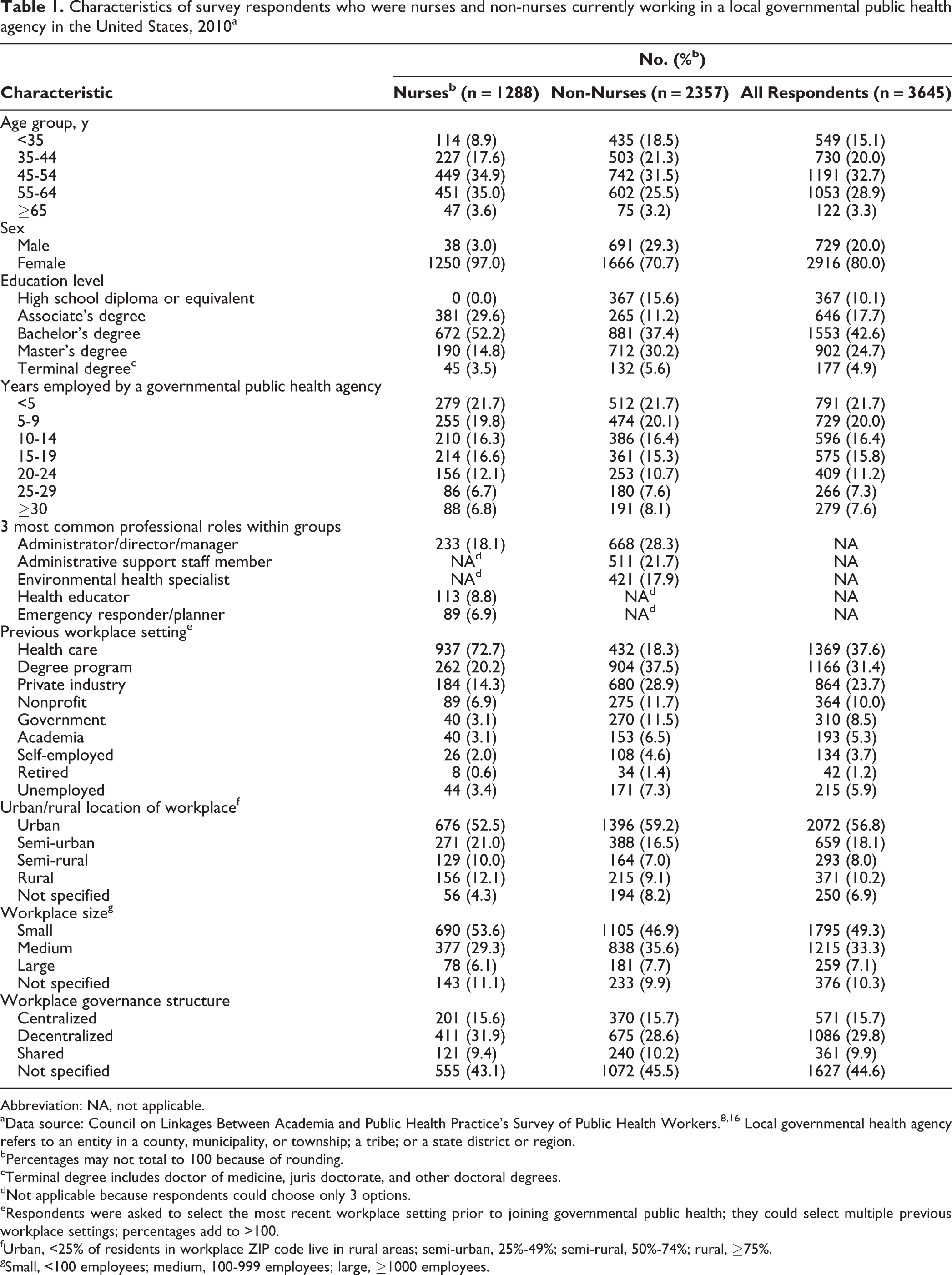
Most respondents (64.9%, 2366 of 3645) were aged ≥45 (Table 1). A higher percentage of nurses (73.5%, 947/1288) than non-nurses (60.2%, 1419/ 2357) were aged ≥45, and a higher percentage of nurses (97.0%, 1250/1288) than non-nurses (70.7%, 1666/2357) were female. The most common education levels for nurses were associate’s degrees and bachelor’s degrees. In contrast, non-nurses most commonly attained bachelor’s degrees or master’s degrees. The number of years working in governmental public health was similar between the 2 groups; among respondents overall, 21.7% (791/3645) had worked in governmental public health for <5 years, and 26.2% (954/3645) had spent ≥20 years in governmental public health. Nurses most frequently reported working as administrators, directors, or managers (18.1%, 233/1288); health educators (8.8%, 113/1288); or emergency responders/planners (6.9%, 89/1288). The largest percentages of non-nurses reported working as administrators, directors, or managers (28.3%, 668/2357); administrative support staff members (21.7%, 511/2357); or environmental health specialists (17.9%, 421/2357).
Characteristics of survey respondents who were nurses and non-nurses currently working in a local governmental public health agency in the United States, 2010a
Abbreviation: NA, not applicable.
aData source: Council on Linkages Between Academia and Public Health Practice’s Survey of Public Health Workers. 8,16 Local governmental health agency refers to an entity in a county, municipality, or township; a tribe; or a state district or region.
bPercentages may not total to 100 because of rounding.
cTerminal degree includes doctor of medicine, juris doctorate, and other doctoral degrees.
dNot applicable because respondents could choose only 3 options.
eRespondents were asked to select the most recent workplace setting prior to joining governmental public health; they could select multiple previous workplace settings; percentages add to >100.
fUrban, <25% of residents in workplace ZIP code live in rural areas; semi-urban, 25%-49%; semi-rural, 50%-74%; rural, ≥75%.
gSmall, <100 employees; medium, 100-999 employees; large, ≥1000 employees.
We found differences between nurses and non-nurses in where they had worked previously: 72.7% (937/1288) of nurses and 18.3% (432/2357) of non-nurses reported working previously in a health care setting. In contrast, 14.3% (184/1288) of nurses and 28.9% (680/2357) of non-nurses reported working previously in private industry. Substantial percentages of non-nurses also worked previously in nonprofit organizations (11.7%, 275/2357) and government (11.5%, 270/2357). Overall, the largest percentage of respondents worked in small organizations (49.2%, 1795/3645) and, among those for whom data were available, in organizations with a decentralized governance structure (29.8%, 1086/3645).
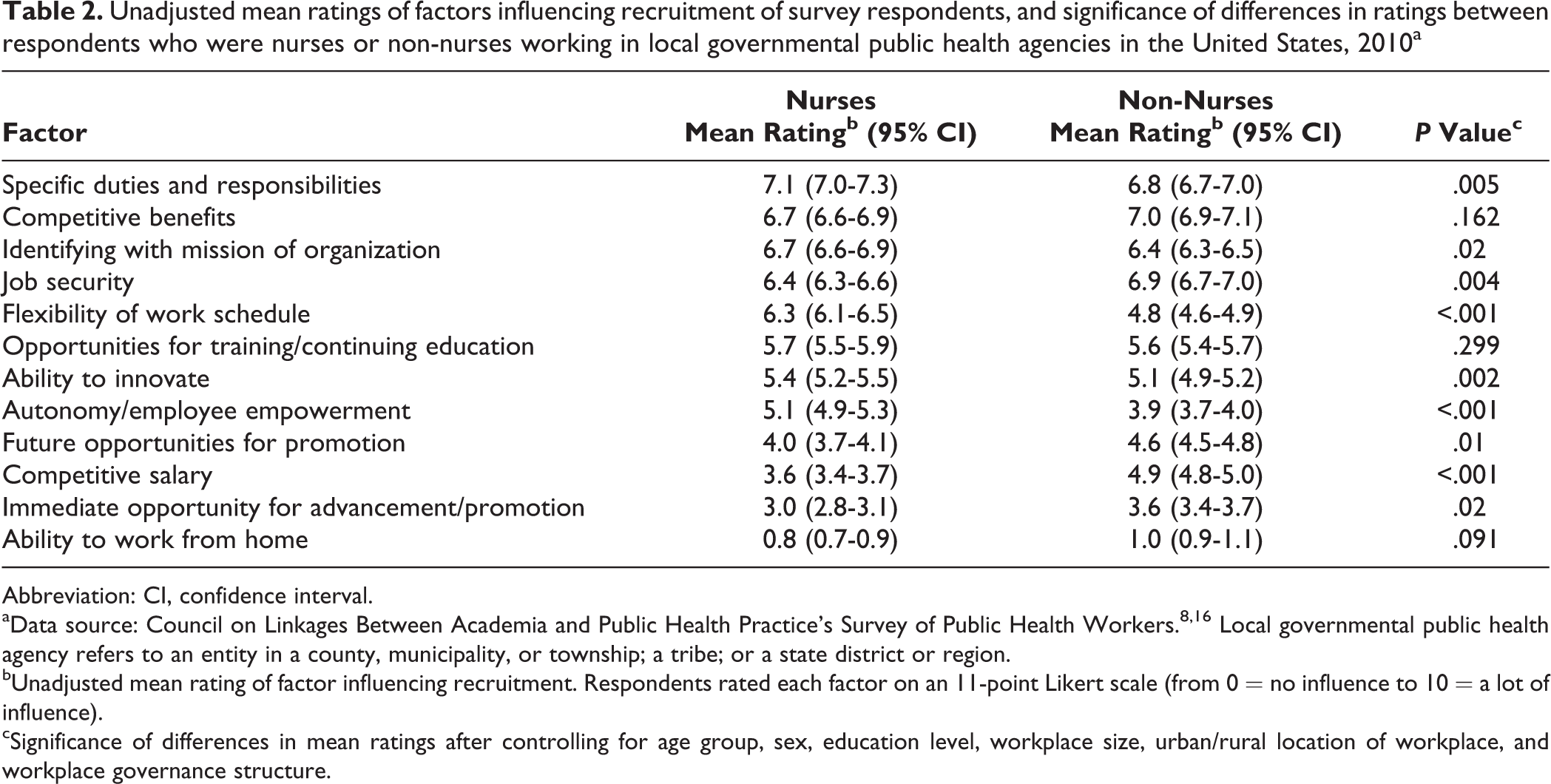
Among nurses, the 3 strongest recruitment factors were specific duties and responsibilities (mean rating, 7.1), competitive benefits (mean rating, 6.7), and identifying with the mission of the organization (mean rating, 6.7) (Table 2). Non-nurses were most strongly influenced by competitive benefits (mean rating, 7.0), job security (mean rating, 6.9), and specific duties and responsibilities (mean rating, 6.8) in their decision to take a job in governmental public health.
Unadjusted mean ratings of factors influencing recruitment of survey respondents, and significance of differences in ratings between respondents who were nurses or non-nurses working in local governmental public health agencies in the United States, 2010a
Abbreviation: CI, confidence interval.
aData source: Council on Linkages Between Academia and Public Health Practice’s Survey of Public Health Workers. 8,16 Local governmental public health agency refers to an entity in a county, municipality, or township; a tribe; or a state district or region.
bUnadjusted mean rating of factor influencing recruitment. Respondents rated each factor on an 11-point Likert scale (from 0 = no influence to 10 = a lot of influence).
cSignificance of differences in mean ratings after controlling for age group, sex, education level, workplace size, urban/rural location of workplace, and workplace governance structure.
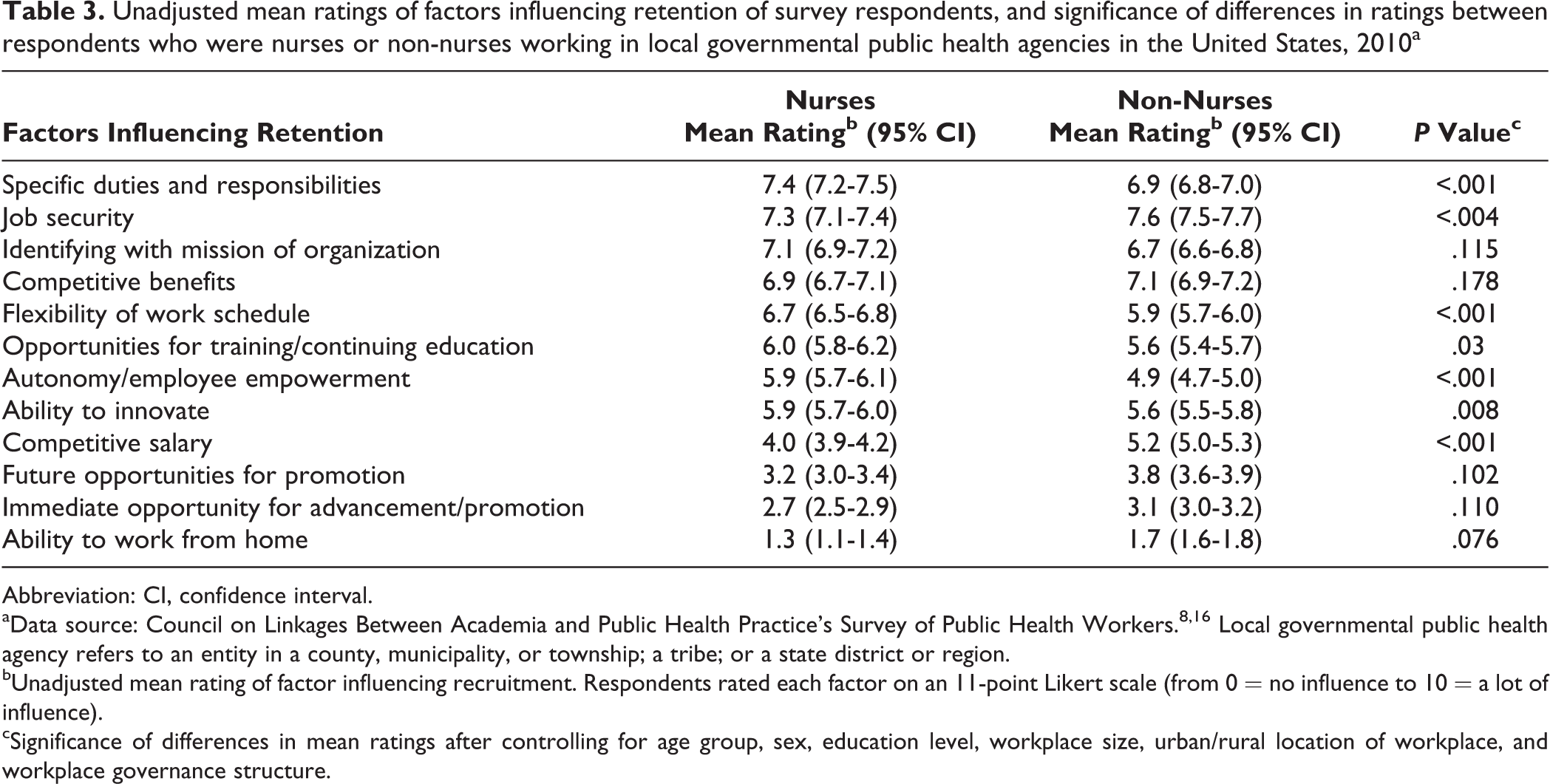
Nurses reported that retention in their organization was most strongly influenced by specific duties and responsibilities (mean rating, 7.4), job security (mean rating, 7.3), and identifying with the mission of the organization (mean rating, 7.1) (Table 3). Non-nurses were most strongly influenced by job security (mean rating, 7.6), competitive benefits (mean rating, 7.1), and specific duties and responsibilities (mean rating, 6.9).
Unadjusted mean ratings of factors influencing retention of survey respondents, and significance of differences in ratings between respondents who were nurses or non-nurses working in local governmental public health agencies in the United States, 2010a
Abbreviation: CI, confidence interval.
aData source: Council on Linkages Between Academia and Public Health Practice’s Survey of Public Health Workers. 8,16 Local governmental public health agency refers to an entity in a county, municipality, or township; a tribe; or a state district or region.
bUnadjusted mean rating of factor influencing recruitment. Respondents rated each factor on an 11-point Likert scale (from 0 = no influence to 10 = a lot of influence).
cSignificance of differences in mean ratings after controlling for age group, sex, education level, workplace size, urban/rural location of workplace, and workplace governance structure.
Multivariate regression analysis indicated that after controlling for personal and organizational characteristics, the influence of 5 recruitment factors was significantly (P < .05) stronger among nurses than among non-nurses (Table 2). These factors, in order of the strength of the influence, were (1) flexibility of work schedule (P < .001), (2) autonomy/employee empowerment (P < .001), (3) ability to innovate (P = .002), (4) specific duties and responsibilities (P = .005), and (5) identifying with the mission of the organization (P = .02). The influence of 4 recruitment factors was stronger among non-nurses than among nurses: (1) competitive salary (P < .001), (2) future opportunities for promotion (P = .01), (3) job security (P = .004), and (4) immediate opportunity for advancement/promotion (P = .02). Beta coefficients are available upon request.
We found fewer significant differences between nurses and non-nurses in the influence of retention factors than in the influence of recruitment factors (Table 3). Multivariate regression analysis indicated that, compared with non-nurses, nurses were more strongly influenced by (1) autonomy/employee empowerment (P < .001), (2) flexibility of work schedule (P < .001), (3) specific duties and responsibilities (P < .001), (4) opportunities for training/continuing education (P = .03), and (5) ability to innovate (P = .008). Compared with nurses, non-nurses were more strongly influenced by competitive salary (P < .001) and job security (P = .004) in their decisions to remain working in governmental public health. Ramsey regression specification-error tests for omitted variables indicated that 11 of the 12 models estimated were correctly specified. The model estimating the relationship between role (nurse vs non-nurse) and competitive salary as a recruitment factor was the only model in which we found evidence of misspecification.
Discussion
Understanding the factors that matter to the recruitment and retention of nurses willing to work in governmental public health is critical 3,5,13,14 to resolving the nursing shortage and enabling public health agencies to recruit and retain nurses in the highly competitive nursing environment. 1 –3,5 Without these valuable members of the workforce, public health departments may struggle to meet the increasing demands for health promotion and prevention. 3,13,14,21
Many recruitment and retention factors that influence nurses are within the control of public health organizations and can be addressed by targeted strategies. For example, our findings indicate that nurses value a flexible schedule and employee autonomy/empowerment. Previous studies indicate that nurses commonly leave private health care organizations seeking positions that are less physically demanding than positions that involve direct patient care and that have more flexible or more regular schedules than those in clinical settings such as hospitals. 10,22 –24 To attract these employees, public health agencies could emphasize these job characteristics in postings and, whenever possible, design positions that allow for flexible scheduling and worker autonomy. Involving nurses in decision making and fostering opportunities to create new work paths and solutions (innovation) may also be a valuable strategy to retain nurses. These strategies would align with our study finding on what matters to nurses in selecting a new job in public health and ongoing job satisfaction, and they align with other findings. 4,15
Given the importance of having specific duties and responsibilities and identifying with the mission of the organization, public health agencies recruiting nurses should publish clear and detailed job descriptions emphasizing the activities in which the employee would be involved. This kind of transparency may increase the number of nurse recruits, especially those who are attracted to the mission of public health. In addition, evidence suggests that employees in health-related organizations have higher rates of retention when they feel that they have a calling and perceive their organizations to be instrumental in achieving it, compared with employees in health-related organizations who do not feel this way. 25 Other studies made similar recommendations and encouraged public health agencies to emphasize high levels of job satisfaction and autonomy among public health nurses in their recruitment materials. 4
Because having opportunities for training and continuing education was also rated as an influential recruitment and retention factor, public health leaders should consider ways to create or extend benefits in training and continuing education, as well as form partnerships with local universities and colleges. One study showed that young public health employees were demotivated by the limited opportunities for advancement and the lack of access to continuing training and education in public health agencies. 26 Our study reinforces the importance of these factors to nurses in public health. Public health agencies recruiting nurses could, whenever possible, encourage continuing education through assistance programs and education-related leave and provide opportunities for employees to gain new skills and experience on the job. 27 Similar strategies were suggested in the report on the 2012 Public Health Nurse Workforce Survey, which recommended that public health agencies consider establishing policies to support tuition reimbursement for nurses in exchange for a guaranteed minimum number of years of service. 4
Non-nurses were more strongly influenced than were non-nurses by a competitive salary and job security. However, bivariate analyses indicated that job security was rated as more influential in the retention than in the recruitment of nurses. The greater value of job security in retention (compared with recruitment) may have been influenced by timing, given that the survey was administered in 2010 during the national economic recession. Job security may have been less influential before the recession when employees were likely making the decision to take a public health position. Future research should examine if and how the most influential recruitment and retention factors change over time.
Limitations
This study had several strengths and limitations. First, the dataset used for the analysis represented a large survey of public health workers, providing valuable information at one point in time. However, it was limited by a low response rate of 17%, and because of a lack of data on nonrespondents, we could not test for response bias. In addition, the data were collected in 2010, and conditions may have changed since that time. Furthermore, although the dataset included responses from nurses in 47 states, 55% of respondents were from only 7 states. Although the survey collected data on workers’ perspectives on issues that influenced decisions to take their job or remain in their current position, it did not assess job satisfaction in general. A question on job satisfaction might have contributed further insight into factors that influence workers. Finally, because the study surveyed current workers, it did not include perspectives of nurses who had not yet entered the public health workforce or those who had left it. Future research should examine the motivations of potential public health nurse employees when they are students, before their entry into the workforce, and the motivations of nurses who were previously employed in public health.
Conclusion
This study identified the factors that were most influential to nurses in their decisions to begin and remain working in local governmental public health agencies. Some of these factors, such as flexible schedules and employee autonomy, are factors that governmental public health agencies could design into positions and highlight when recruiting from health care, private industry, and academia. Public health leaders could also consider ways to extend benefits, including continuing education, and market these opportunities in their job announcements. More research is needed to examine what works and any barriers that discourage the recruitment of nurses.
Footnotes
Acknowledgments
The authors thank the Council on Linkages Between Academia and Public Health Practice for use of its survey data.
Declaration of Conflicting Interests
The authors declared no potential conflicts of interest with respect to the research, authorship, and/or publication of this article.
Funding
The authors received no financial support for the research, authorship, and/or publication of this article.