




Abstract
Objectives:
Little research has compared the demographic and practice characteristics of registered nurses (RNs) who work in public health (PH RNs) with other RNs and advanced practice registered nurses (APRNs) who work in public health (PH APRNs) with other APRNs. We examined differences in characteristics between PH RNs and other RNs and between PH APRNs and other APRNs.
Methods:
Using the 2018 National Sample Survey of Registered Nurses (N = 43 960), we examined demographic and practice characteristics, training needs, job satisfaction, and wages of PH RNs compared with other RNs and PH APRNs compared with other APRNs. We used independent sample t tests to determine significant differences between PH RNs and other RNs and between PH APRNs and other APRNs.
Results:
On average, PH RNs and PH APRNs earned significantly less than other RNs ($7082 difference) and APRNs ($16 362 difference) (both P < .001). However, their job satisfaction was comparable. PH RNs and PH APRNs were also significantly more likely than other RNs and APRNs to report the need for more training in social determinants of health (20 [P < .001] and 9 [P = .04] percentage points higher, respectively), working in medically underserved communities (25 and 23 percentage points higher, respectively [P < .001 for both]), population-based health (23 and 20 percentage points higher, respectively [P < .001 for both]), and mental health (13 and 8 percentage points higher, respectively [P < .001 for both]).
Conclusions:
Efforts that expand public health infrastructure and workforce development must consider the value of a diverse public health nursing workforce to protect community health. Future studies should include more detailed analyses of PH RNs and PH APRNs and their roles.
Keywords
The US public health system is a complex network of organizations that promote, protect, and preserve population health. State and local health departments are the first line of defense against threats to population health. However, during the last decade, funding for state and local public health departments has steadily declined, which has led to reductions in public health programs and the public health workforce.1 -3 As a result, state and local public health departments have been ill-prepared to respond quickly and effectively to threats to population health, including the COVID-19 pandemic. With a growing recognition of the importance of state and local public health departments, efforts are under way to increase investments in public health and build workforce capacity.3 -5 Public health draws its workforce from a wide array of professions and occupations, both within and outside of health care, including nursing. 5 Registered nurses (RNs) who work in public health (PH RNs) and advanced practice registered nurses (APRNs) who have a graduate degree or certificate and work in public health (PH APRNs) are a vital component of this workforce. During the pandemic, they routinely set up testing sites and immunization clinics to help communities in need.
A key focus for PH RNs is developing and implementing programs and policies aimed at managing chronic and communicable diseases and promoting community health.6,7 The scope of their work often encompasses broad measures of primary prevention designed to promote health and improve quality of life. 8 PH RNs have diverse skill sets and population-focused experience.7,9 They work in a variety of settings to guide local decision makers on public health issues, assess environmental threats, and develop population-based interventions that promote healthy communities.8,10 -15 While these responsibilities are critical to the effective functioning of the public health system, PH RNs and PH PAPRNs have also played increasingly important roles related to addressing community needs in response to the COVID-19 pandemic. 16 Since the pandemic began, PH RNs and PH APRNs have been implementing public health guidance and recommendations provided by the Centers for Disease Control and Prevention (CDC), organizing and scheduling COVID-19 vaccine clinics and testing, training and deploying contract tracers, and ensuring that the health needs of all communities continue to be met. 16
Unlike PH RNs, PH APRNs typically provide basic clinical services to medically underserved communities.15,17 Often functioning as primary care providers, PH APRNs, such as nurse practitioners who hold an advanced degree in nursing, address the care needs of their patients, manage chronic and communicable diseases, and provide patient education to promote health and quality of life.6,13,18 These APRNs often work in public health clinics, which provide accessible and affordable health care services in medically underserved communities. 19
While PH RNs and PH APRNs are an important component of the public health workforce, little research has been conducted on them. Only a few empirical studies have focused on PH RNs and PH APRNs, and these studies did not include a detailed examination of their demographic and practice characteristics or compare them with all other RNs and APRNs.1,15,20,21 The objective of the current study was to use data from the 2018 National Sample Survey of Registered Nurses (NSSRN) to profile PH RNs and PH APRNs to better understand their demographic and practice characteristics, training needs, wages, and job satisfaction and compare them with those of other RNs and APRNs. By examining this subset of nurses, our study aimed to provide a more detailed description of PH RNs and PH APRNs than previous studies have achieved.
Methods
The 2018 NSSRN was developed and administered by the National Center for Health Workforce Analysis with the help of the US Census Bureau to understand the characteristics of the nursing workforce and help forecast future nurse supply and demand. 22 The NSSRN is the largest survey on the demographic characteristics, employment, and training of nurses in the United States. Since 1977, the NSSRN has been conducted at regular intervals (usually every 4 years) and is the definitive data source for studies of the nursing workforce.1,23 -25 The data are publicly available on the Health Resources and Services Administration’s (HRSA’s) web page. 26 Research using publicly available data that do not include personally identifiable information is considered exempt from review by the University at Albany, State University of New York Institutional Review Board.
The 2018 NSSRN was distributed to a stratified random sample of 102 520 RNs from April through October 2018. The survey oversampled nurse practitioners, a subset of APRNs, to ensure that they were adequately represented. The final dataset included 50 273 RNs for a response rate of 49%. We excluded 6313 people who were not employed in a nursing position at the time of the survey, leaving 43 960 RNs in our study sample.
The population for this study consisted of US residents who held an active nursing license. This analysis described and compared 4 groups of nurses: PH RNs, other RNs, PH APRNs, and other APRNs. APRNs included clinical nurse specialists, nurse practitioners, nurse anesthetists, and nurse midwives. For the purposes of our study, a person who reported spending most of their time providing public health or community health services was considered a PH RN or a PH APRN (n = 991) based on responses to the following question: “For the primary nursing position you held on December 31, 2017, in what level of care or type of work did you spend most of your time?” Response options were the following: general or specialty inpatient; ambulatory care (including primary care outpatient settings, except surgical); ancillary care (radiology, laboratory); care coordination/patient navigation; critical/intensive care; education; emergency; health care management/administration; home health/hospice; informatics; long-term care/nursing home; public health/community health; rehabilitation; research; school nurse; step-down, transitional, progressive, telemetry; subacute care; surgery (including ambulatory, preoperative, postoperative, postanesthesia); urgent care; and other, specify.
We examined the demographic characteristics, employment settings, training needs, annual earnings, and job satisfaction of the 4 groups of nurses. The 2018 NSSRN questionnaire is available on HRSA’s web page. 26 Eleven types of training needs were examined: evidence-based care, patient-centered care, team-based care, practice management, social determinants of health, working in a medically underserved community, caring for patients with complex medical needs, population-based health, quality improvement, value-based care, and mental health. These training needs were coded as binary variables, where 1 indicated that training on the topic would have helped them do their job better and 0 indicated that training on the topic would not have helped them do their job better. The job satisfaction variable was also coded 1 if respondents were extremely or moderately satisfied with their primary nursing position and 0 if they were moderately or extremely dissatisfied with the primary nursing position they held on December 31, 2017.
We conducted independent sample t tests to determine significant differences between PH RNs and other RNs and between PH APRNs and other APRNs. We determined significance at a 95% CI level and based on 2-tailed t tests. We considered P < .05 to be significant. We conducted all analyses using Stata version 17.0 (StataCorp LLC).
Results
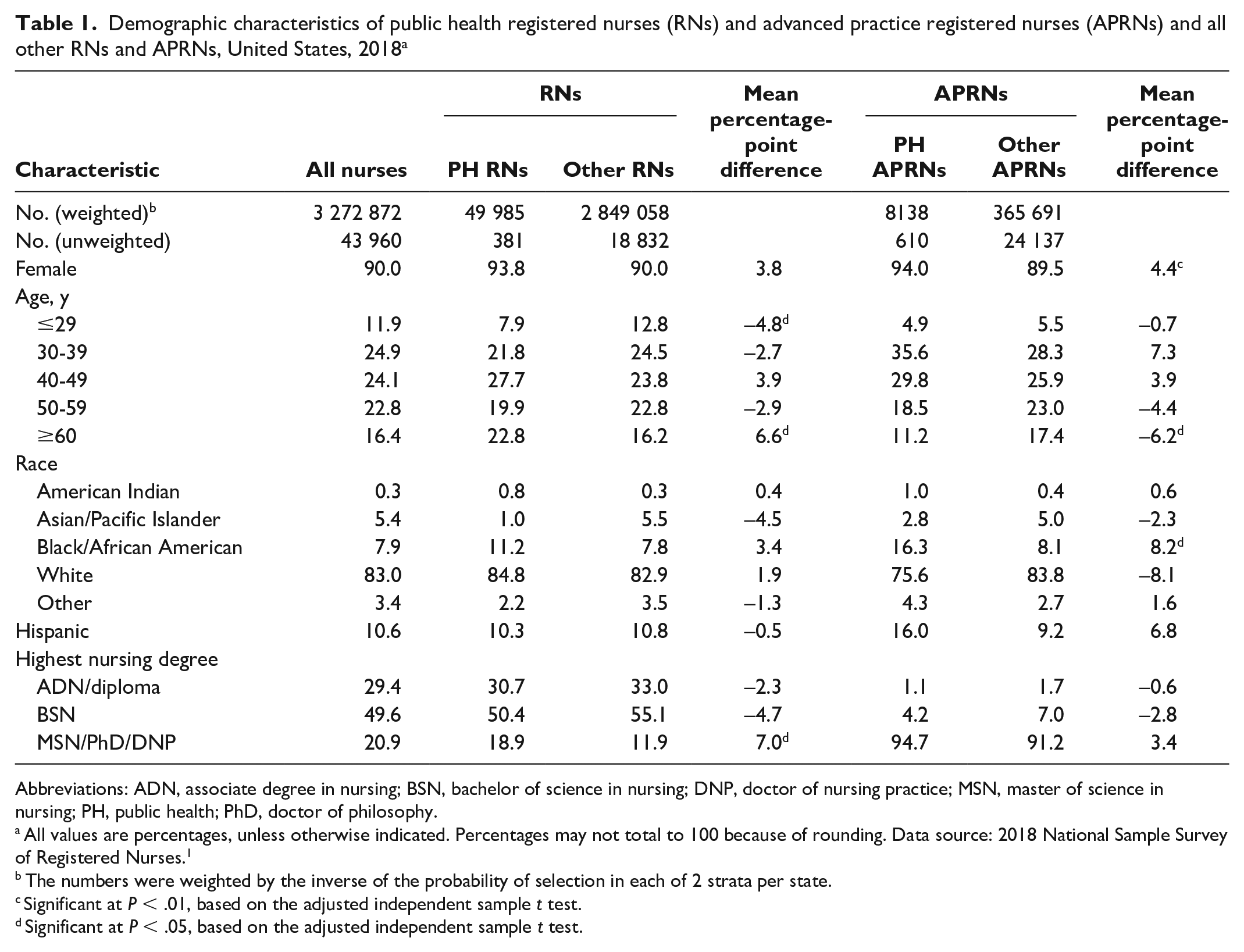
A total of 58 123 of 3 272 872 nurses in the United States spent most of their time providing public health and community health services, representing <2% of the nursing workforce (Table 1). A total of 49 985 nurses were PH RNs and 8138 were PH APRNs. A total of 2 849 058 RNs and 365 691 APRNs spent most of their time providing other nursing-related services.
Demographic characteristics of public health registered nurses (RNs) and advanced practice registered nurses (APRNs) and all other RNs and APRNs, United States, 2018 a
Abbreviations: ADN, associate degree in nursing; BSN, bachelor of science in nursing; DNP, doctor of nursing practice; MSN, master of science in nursing; PH, public health; PhD, doctor of philosophy.
All values are percentages, unless otherwise indicated. Percentages may not total to 100 because of rounding. Data source: 2018 National Sample Survey of Registered Nurses. 1
The numbers were weighted by the inverse of the probability of selection in each of 2 strata per state.
Significant at P < .01, based on the adjusted independent sample t test.
Significant at P < .05, based on the adjusted independent sample t test.
More than 90% of PH RNs and PH APRNs were female (Table 1). Although the educational background of PH RNs and PH APRNs was comparable with that of other nurses, we found differences in other characteristics. Sixteen percent of PH APRNs compared with 8.1% of all other APRNs were Black/African American (P = .05). The percentage of PH APRNs aged ≥60 years was lower than among other APRNs (11.2% vs 17.4%; P = .01). A higher percentage of PH APRNs compared with other APRNs was Hispanic (16.0% vs 9.2%; P = .28), but this difference was not significant.
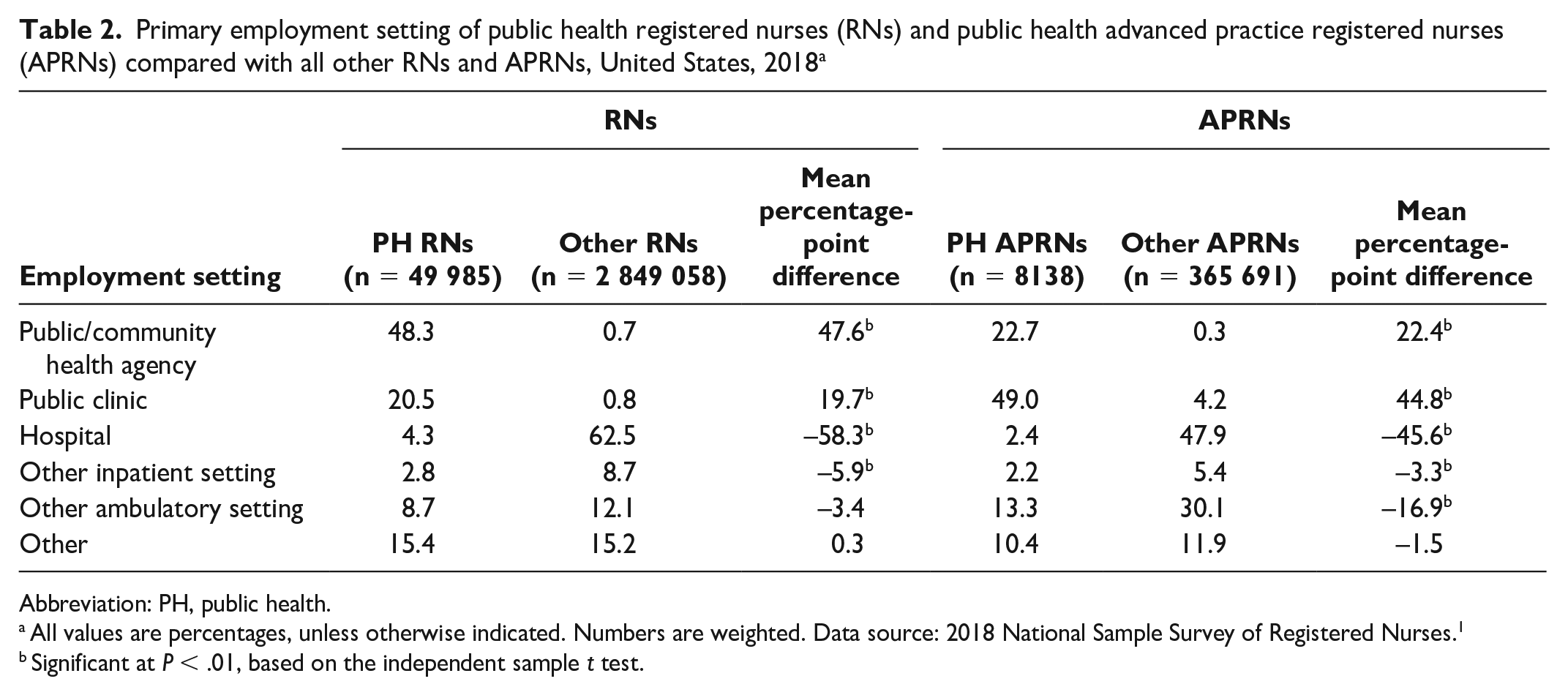
Most PH RNs and PH APRNs worked in public health or community health agencies or public clinics (eg, rural health clinic, federally qualified health center) (Table 2). Nearly 69% (68.8%) of PH RNs and 71.7% of PH APRNs worked in 1 of these 2 settings (P < .001). While most PH RNs worked in public health or community health agencies (48.3%), most PH APRNs were employed in public clinics (49.0%). Few PH RNs (4.3%) and PH APRNs (2.4%) were employed by hospitals, while 62.5% of all other RNs and 47.9% of all other APRNs worked in a hospital.
Primary employment setting of public health registered nurses (RNs) and public health advanced practice registered nurses (APRNs) compared with all other RNs and APRNs, United States, 2018 a
Abbreviation: PH, public health.
All values are percentages, unless otherwise indicated. Numbers are weighted. Data source: 2018 National Sample Survey of Registered Nurses. 1
Significant at P < .01, based on the independent sample t test.
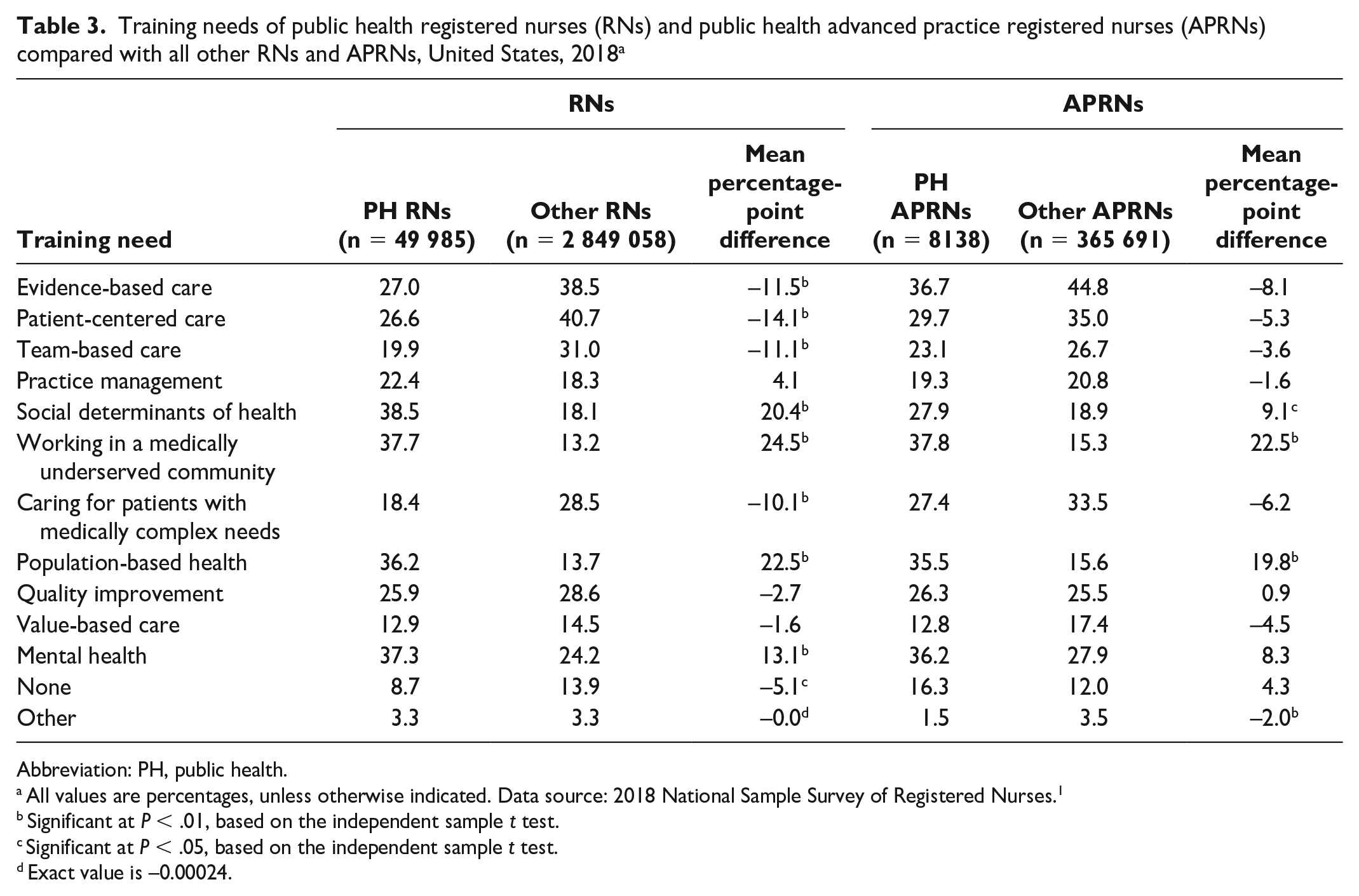
When asked to identify training topics that could improve job performance, the responses of PH RNs and PH APRNs differed from those of all other nurses (Table 3). Compared with other RNs and APRNs, PH RNs and PH APRNs were significantly more likely to indicate the need for more training on social determinants of health (20.4 [P < .001) and 9.1 [P = .04] percentage points higher, respectively), working in medically underserved communities (24.5 and 22.5 percentage points higher, respectively; P < .001 for both), and population-based health (22.5 and 19.8 percentage points higher, respectively; P < .001 for both). PH RNs were significantly more likely than other RNs to indicate the need for mental health training (13.1 percentage points higher; P < .001). In contrast, other RNs were significantly more likely than PH RNs to report that the following training topics would help them do their jobs better: training in evidence-based care (11.5 percentage points higher), patient-centered care (14.1 percentage points higher), team-based care (11.1 percentage points higher), and caring for patients with medically complex needs (10.1 percentage points higher) (P < .001 for all).
Training needs of public health registered nurses (RNs) and public health advanced practice registered nurses (APRNs) compared with all other RNs and APRNs, United States, 2018 a
Abbreviation: PH, public health.
All values are percentages, unless otherwise indicated. Data source: 2018 National Sample Survey of Registered Nurses. 1
Significant at P < .01, based on the independent sample t test.
Significant at P < .05, based on the independent sample t test.
Exact value is −0.00024.
The average annual earnings of PH RNs and PH APRNs from their primary employment position were lower than the annual earnings of other nurses (Figure 1). Annually, PH RNs earned an average of $61 453 compared with $68 535 for all other RNs (P < .001). PH APRNs earned an average of $81 012 annually compared with $97 374 for all other APRNs (P < .001).
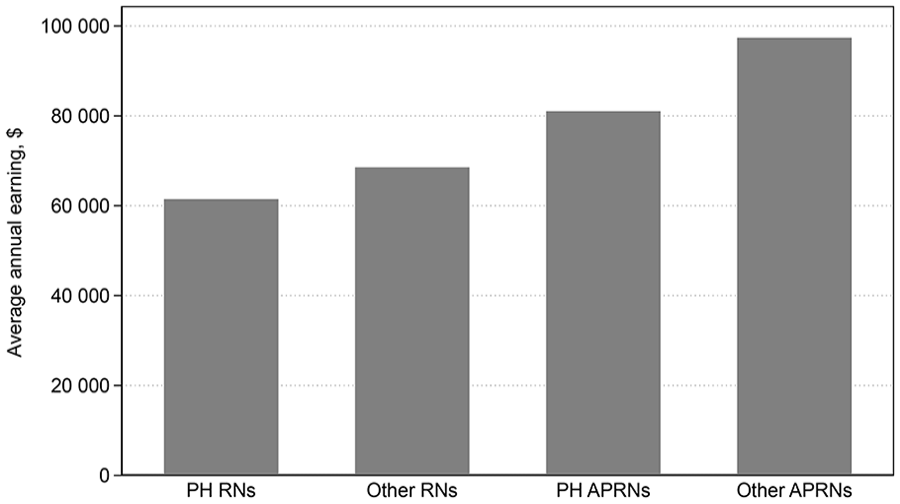
Average annual earnings of public health registered nurses (PH RNs) and public health advanced practice registered nurses (PH APRNs) compared with other RNs and APRNs, United States, 2018. Data source: 2018 National Sample Survey of Registered Nurses. 1
The job satisfaction of PH RNs and PH APRNs was comparable with other RNs and APRNs (Figure 2). Ninety percent of PH RNs and 88% of PH APRNs reported being moderately or extremely satisfied with their jobs. Similarly, 89% of other RNs and 90% of other APRNs indicated that they were moderately or extremely satisfied with their jobs.
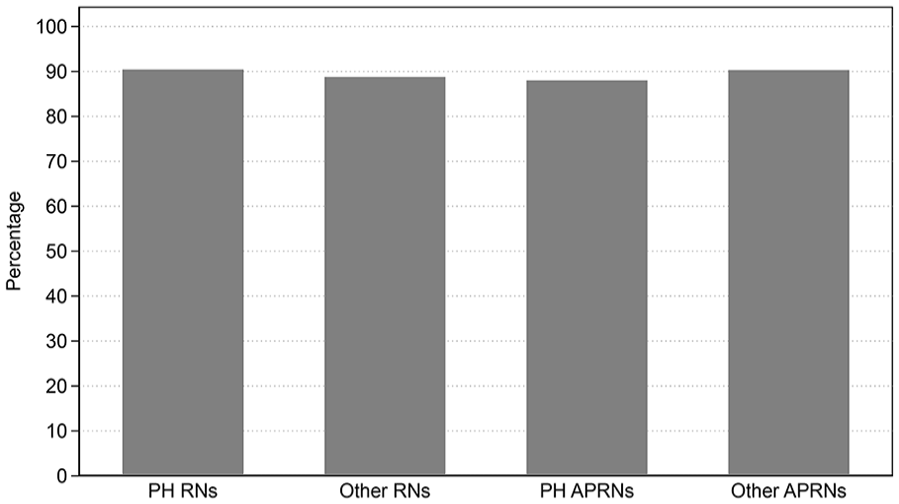
Job satisfaction of public health registered nurses (PH RNs) and public health advanced practice registered nurses (PH APRNs) compared with other RNs and APRNs, United States, 2018. Data source: 2018 National Sample Survey of Registered Nurses. 1
Discussion
This exploratory analysis revealed important differences between RNs and APRNs working in public health and all other RNs and APRNs. PH APRNs tended to be younger and more racially diverse than other APRNs. The average annual earnings of PH RNs and PH APRNs were significantly lower than that of all other RNs and APRNs, which may complicate efforts to recruit more RNs and APRNs into public health, particularly at a time when widespread nursing shortages are resulting in dramatic wage increases for nurses in a variety of settings. PH RNs and PH APRNS were more likely than all other RNs and APRNs to report the need for more training on social determinants of health and mental health, among others. This finding reflects efforts by PH RNs and PH APRNs to improve health equity, reduce health disparities, and promote community health.1,10 -12
More data and research are needed to provide a more detailed description of the public health nursing workforce, including who they are, what they do, and where they work. Despite the valuable roles they play in promoting population health,7,9 few empirical studies have been published about them. The NSSRN includes approximately 50 000 nurses, but fewer than 1000 of them report spending most of their time working in public health or community health. Better information on public health nurses is needed, and future studies should focus on detailed analyses of their characteristics and the roles they play in protecting population health and expanding access to care for medically underserved populations.
Limitations
This study had limitations. First, the sample sizes of PH RNs (n = 381) and PH APRNs (n = 610) in the 2018 NSSRN were small compared with the sample sizes of all other RNs and APRNs. As a result, the estimated characteristics of PH RNs and PH APRNs in this sample may not be generalizable to the population of PH RNs and PH APRNs. Second, the 2018 NSSRN may overestimate the number of Hispanic nurses; as such, the finding of higher rates of Hispanic PH APRNs compared with all other APRNs should be interpreted with caution. 27
Conclusion
PH RNs and PH APRNs have been instrumental in helping communities during the COVID-19 pandemic, offering immunization clinics, testing sites, and contact tracing. They play a critical role in addressing unmet health care needs in medically underserved communities, reducing health disparities, and promoting population health. The United States faces growing health workforce shortages, particularly in nursing, and concerted efforts have been made to invest federal and state resources to address these shortages. Expanding the supply of PH RNs and PH APRNs through scholarships and loan repayment programs and rebuilding incentive programs for them should be a priority.
Footnotes
Declaration of Conflicting Interests
The authors declared no potential conflicts of interest with respect to the research, authorship, and/or publication of this article.
Funding
The authors disclosed receipt of the following financial support for the research, authorship, and/or publication of this article: The Health Workforce Technical Assistance Center is supported by the Health Resources & Services Administration (HRSA) of the US Department of Health and Human Services (HHS) as part of an award totaling $447 164, with 0% financed with nongovernmental sources. The contents are those of the authors and do not necessarily represent the official views of, nor an endorsement by, HRSA, HHS, or the US government. For more information, please visit HRSA.gov.
