



Abstract
The family environment in which an individual resides plays an important role in the shaping of self-perception. The absence of a harmonious family environment may make it difficult for the individual to develop a clear and stable self-concept clarity due to a lack of relationship happiness and emotional reactivity. Conversely, harmonious family support positively supports self-concept clarity by maintaining the individual’s relationship happiness and emotional balance. In this research, the parallel mediating roles of relationship happiness and emotion reactivity in the relationship between family harmony and self-concept clarity were examined. The model in question was tested for the first time in a sample of parents. A total of 310 adults, consisting of 63 males (20.3%) and 247 females (79.7%), participated in the research (Mean age = 38.40; SD = 7.66). Analyses conducted using structural equation modeling (SEM) showed that both variables assumed significant parallel mediating roles in the relationship between family harmony and self-concept clarity. The findings reveal that supporting parents’ relational and emotion regulation resources is important in strengthening self-concept clarity.
Introduction
The consistency, clarity, and stability of individuals’ self-perceptions are regarded as one of the fundamental determinants for maintaining functionality, particularly in close relationships and parenting roles. This structural characteristic is explained in the literature through the concept of self-concept clarity, and it involves the individual exhibiting clear, consistent, stable, and reliable behaviors regarding their self (Campbell et al., 1996). It is known that individuals’ accumulation of knowledge about their selves increases especially during the period from emerging adulthood to middle age, and this accumulation contributes to the development of a clearer self-perception over time (Lodi-Smith & Roberts, 2010). When the psychological consequences of the clarity and stability gained regarding the self are examined, it is observed that individuals with high self-concept clarity exhibit more positive attitudes toward life events and experience the negative effects of stress less (Ritchie et al., 2011). Furthermore, it is known that these individuals possess higher levels of self-esteem (Suszek et al., 2018) and experience less personal distress in cases where they show high empathic concern (Krol & Bartz, 2021). In contrast, it is known that individuals with low self-concept clarity face various psychological difficulties. It has been observed that in these individuals, attachment anxiety and avoidance tendencies are higher (Kural & Kovacs, 2022), they are more dependent on external approval (Stinson et al., 2008), and an increase is seen in depressive symptoms and anxiety levels (Butzer & Kuiper, 2006); they experience difficulties in decision-making processes and their psychological adjustment is lower (Bigler et al., 2001; Nezlek & Plesko, 2001). While previous studies have predominantly focused on individual differences in self-concept clarity, comparatively less attention has been paid to the contextual and relational factors that may shape it. In this regard, the family environment provides an important social context for the development of an individual’s self-perception (Lodi-Smith & DeMarree, 2018). Therefore, examining the influence of intra-family processes on self-concept clarity may be considered an important contribution to filling a gap in the existing literature.
Family harmony is a fundamental dynamic that supports the individual in developing a consistent and clear self-perception through the guidance of parents. The contribution of the family to the child is not only advisory but also plays a decisive role in terms of personality development (Holmes & McKenzie, 2019). Therefore, individual perceptions regarding family harmony are of critical importance for the physical and mental development of children (Zhan & Wang, 2021). Harmonious family structures are explained by relationships based on open communication, mutual respect, warmth, and cooperation. These relationships strengthen the bond between family members (Safaria, 2015). At this point, it is highly important for every individual to be aware of their duties and responsibilities within the family for the continuity of harmony. Especially parents play a key role in the formation of a healthy balance and functioning within family dynamics (Sitepu, 2018). In this context, as relationship harmony provides access to the entirety of family interactions, it emerges as a decisive factor in intra-family interactions (Chuang, 2005). Research has revealed that high levels of family harmony strengthen individuals’ self-concept clarity (Xiang et al., 2022). Consequently, self-concept clarity is evaluated not merely as an individual characteristic but as a dynamic structure shaped by environmental factors such as parental attitudes, intra-family interactions, and emotional support. In this regard, it is hypothesized that intra-family harmony provides a safe and supportive environment for the individual to develop a consistent and clear perception of themselves.
Relationship Happiness as a Mediator
Interpersonal harmony and interactions are the fundamental mechanisms influencing the emergence of various emotions experienced by individuals. This quality of interaction in intra-family relationships also affects individuals’ levels of relationship happiness. In this context, the concept of relationship happiness occupies an important place. Relationship happiness is a multidimensional structure encompassing the dimensions of love, happiness, stability of the relationship, the severity of problems, general satisfaction, and commitment (Tutarel-Kışlak, 2006). Marital happiness supports the experience of emotional satisfaction between spouses while also fostering the well-being and development of children by creating healthy and balanced family environments (Herawati, 2016; Khojasteh Mehr & Mohammadi, 2021). According to the behavioral approach, every positive interaction in happy marriages indicates that the relationship is satisfying and prepares the ground for the repetition of similar behaviors (Aassve et al., 2016). In this regard, while happy marriages have psychological benefits, it is known that relatively unhappy marriages increase daily and chronic stress levels (Kamp Dush et al., 2008; Sobol-Kwapinska et al., 2016).
When other factors affecting relationship happiness are examined, it is observed that a supportive spouse contributes to marital happiness (Huntington et al., 2022) and that satisfaction is one of the most important factors contributing to this happiness (Fatima & Ajmal, 2012). Another critical structure affecting relationship satisfaction and happiness is self-concept clarity. Since the self-concept develops through how the individual perceives themselves and during interactions with others (Sheikh et al., 2013), self-concept clarity is closely related to relational processes. Research shows that individuals with high levels of self-concept clarity experience higher relationship satisfaction (Lewandowski et al., 2010) and that their partners also derive more satisfaction from these relationships (Parise et al., 2019). On the other hand, it has been found that individuals with low self-concept clarity have difficulty evaluating partner compatibility and, therefore, more frequently engage in relationships with incompatible partners (Kredl et al., 2024). Considering these theoretical frameworks, it can be suggested that relationship happiness may function as a mediating role in the relationship between family harmony and self-concept clarity.
Emotion Reactivity as a Mediator
Family harmony, while generally affecting relationships between individuals and self-development, can specifically play a decisive role in the emotional experiences of parents. Harmonious relationships within the family are among the fundamental elements that shape individuals’ emotional experiences. Such family environments allow individuals to express their emotions in a safe manner and to regulate their emotional experiences (Morris et al., 2007). In this case, distant family relationships may lead individuals to respond to negative emotions in a more reactive way. Emotion reactivity refers to the intensity of emotions that emerge in individuals’ relationships and the responses they give to these intense emotions (Nock et al., 2008). This concept is also defined as the sudden and intense experience of negative emotions in the face of a distinct stimulus (Gratz & Roemer, 2004). This structure is considered important for understanding how individuals experience and regulate their emotions (Mendoza-Denton & Ayduk, 2014). Therefore, it can be expected that individuals with high family harmony will have more balanced levels of emotion reactivity.
Individuals who can regulate their emotional reactions become more easily aware of their personal characteristics and tend to accept themselves as they are (Ercengiz et al., 2023). At this point, it can be considered that emotion reactivity and self-concept clarity may be related. Rather than being a fixed personality trait, self-concept clarity has a dynamic structure that can change depending on daily events and the emotional responses the individual gives to these events (Nezlek & Plesko, 2001). In this respect, it may have reflections not only on the relationship the individual establishes with themselves but also on their relationships with others. There are various findings in the literature regarding how this structure functions in the context of interpersonal relationships. For example, studies conducted in the context of romantic relationships have revealed that individuals with high levels of emotion reactivity experience more conflict in their relationships, and this situation negatively affects relationship satisfaction (Lavner et al., 2014). Furthermore, it is stated that emotion reactivity is related not only to relational problems but also to various psychological problems such as anxiety and depression (Gross, 2015). These findings suggest that emotion reactivity may play a decisive role in both internal and interpersonal adaptation processes. Therefore, emotion reactivity may undertake a mediating role in the relationship between family harmony and self-concept clarity.
The Present Study
When the transition to parenthood is examined, it has been emphasized that this period plays a decisive role in shaping individuals’ physical and mental health trajectories (Saxbe et al., 2018). The decline in individuals’ self-perception during the transition to parenthood indicates that self-concept is shaped not only by internal characteristics but also by the social roles they assume (Chen et al., 2021). This significant role transition is considered a life period that reshapes the individual’s self-structure. Especially in these processes, the decrease in positive emotions can lead to a decrease in self-concept clarity (Slotter & Walsh, 2017). Relationship processes and the self-concept clarity of parents have been examined by a limited number of studies (Crocetti et al., 2015; Jia et al., 2022). For instance, it has been shown that the level of parents’ self-concept clarity is positively related to both their own perceived parent-child relationship quality and their spouses’ evaluations of this relationship (Jia et al., 2022). Furthermore, it has also been found that parents’ self-concept clarity plays a role in children’s self-development (Crocetti et al., 2015). In this context, the parent–child relationship should be examined in consideration of the overall cohesion within the family system. When individual risk factors are controlled for, family cohesion has been shown to be negatively associated with depressive symptoms and to function as a protective factor against life stress (Kavikondala et al., 2016). Identifying the variables that influence self-concept clarity is therefore of great importance for developing preventive and supportive strategies aimed at strengthening individuals’ self-perception. Studies conducted in this direction may contribute to understanding the relational and emotional processes that shape self-concept clarity within the framework of family cohesion. The current study conducted within this scope examines whether relationship happiness and emotion reactivity have multiple mediating roles in the relationship between family harmony and self-concept clarity. Accordingly, the following hypotheses are tested in the current research.
Relationship happiness mediates the relationship between family harmony and self-concept clarity.
Emotion reactivity mediates the relationship between family harmony and self-concept clarity.
Method
Participant and Procedure
This study was conducted using appropriate sampling methods, and parents with at least one child under the age of 18 were invited to participate voluntarily through social media platforms, parenting groups, and online communities. Participation was entirely voluntary, and no monetary compensation was offered. During the data-cleaning process, 43 questionnaires that were incomplete, inconsistent, or completed in an unrealistically short period of time were excluded, and the analyses were carried out using the remaining valid dataset. The final sample consisted of 310 parents, of whom 247 were women (79.7%) and 63 were men (20.3%). Participants ranged in age from 24 to 55 years, with a mean age of 38.40 (SD = 7.66).
Ethics
During the research process, the ethical principles outlined in the Declaration of Helsinki were followed, and professional ethical standards were adhered to throughout the study. Ethical approval for the study was obtained from the Ethics Committee of Kırşehir Ahi Evran University Social and Human Sciences Scientific Research and Publication Ethics Committee (Decision No: 2025/10/21, Date: 28.05.2025). Research data were collected face-to-face from voluntary participants, and informed consent was obtained from all participants prior to data collection. Participants were informed that their responses would remain anonymous and confidential. No financial incentive or payment was provided to the participants.
Measures
Relationship Happiness Questionnaire (RHQ)
Developed by Fletcher et al. (1990), this is a 6-item, 7-point Likert-type self-report scale designed to assess the general level of happiness in close relationships. Its adaptation into Turkish was conducted by Tutarel-Kışlak (2006), and validity and reliability studies were carried out on married individuals. The internal consistency coefficient of the scale was found to be .80, and the test-retest reliability coefficient was .86. Furthermore, its significant correlation at the level of .69 with the Marital Adjustment Scale supports its criterion validity. The RHQ is a valid measurement tool covering relationship dimensions such as love, happiness, satisfaction, severity of problems, stability, and commitment/obligation.
Family Harmony Scale Short Form (FHS-SF5)
Developed by Kavikondala et al. (2016) and adapted into Turkish by Sarıçam (2018). This 5-item scale is in a 5-point Likert-type (1 = strongly disagree, 5 = strongly agree) format aimed at evaluating general harmony among family members. Confirmatory factor analysis determined that it reflects a unidimensional structure and that the model fit is high (RMSEA = .053, CFI = .99, GFI = .98). The internal consistency coefficient of the scale was found to be .90, and item-total correlations ranged between .72 and .81. In line with these results, the FHS-SF5 was determined to be a valid and reliable tool in the Turkish sample.
Emotion Reactivity Scale Short Form
Developed by Veilleux et al. (2023), this is a 6-item unidimensional scale aimed at measuring the intensity, duration, and sensitivity of individuals’ reactions to emotional stimuli. The Turkish adaptation study was conducted by Yüksel and Ekşi (2024); confirmatory factor analysis results showed that the model yielded a good fit (CFI = .95, GFI = .96, RMSEA = .07) and the Cronbach’s α reliability coefficient was found to be .74. The findings indicate that the scale is a valid and reliable tool that can be used in Turkish culture.
Brief Self-Concept Clarity Scale
Based on the short form of the Self-Concept Clarity Scale developed by Campbell et al. (1996), it was created by Ellison et al. (2022). The scale is a 6-item brief self-report measurement tool developed to measure an individual’s momentary self-clarity. The Turkish adaptation study was conducted by İşvarlar et al. (2024), and as a result of validity and reliability analyses, the scale was determined to be a usable, valid, and reliable measurement tool in Turkish culture.
Data Analysis
In this study, SPSS was used for descriptive statistics and correlation analysis, while the AMOS statistical program was utilized for structural equation modeling. Initially, the normality test of the data was examined in the study. After ensuring a normal distribution, descriptive statistics and correlation coefficients were calculated. Subsequently, to test the hypotheses of the study, the two-stage structural equation modeling proposed by Anderson and Gerbing (1988) was applied. The first of these two stages is the examination of the measurement model, and the second is the testing of the structural model. In both models, fit index values were examined to determine the consistency between the model and the data. In the literature, it is stated that for these fit indices, CFI, TLI, NFI, GFI, and IFI values should exceed 0.90, while SRMR and RMSEA values should be less than 0.08 (Hu & Bentler, 1999). The multiple mediation model was tested using a 5,000 bootstrap sample. In the analysis of this study, the parceling technique was used.
This technique should be preferred to reduce measurement errors when single-factor scales are used (Nasser-Abu Alhija & Wisenbaker, 2006). For this reason, the parceling method was used for the variables of family harmony, relationship happiness, and emotion reactivity in the research.
Results
Preliminary Analyses
Descriptive Statistics, Reliability and Correlation Coefficients for the Study Variables

Note. *p < .05, **p < .01, ***p < .001.
Following the completion of the preliminary analyses, a two-stage structural equation modeling analysis was conducted using the AMOS statistical package program. Subsequently, the significance of the mediation roles was tested using the bootstrapping method. In the first stage, the measurement model included four latent constructs (family harmony, relationship happiness, emotion reactivity, and self-concept clarity) and 10 observed variables. The fit indices obtained in the measurement model were at an adequate level: χ2 (44, N = 310) = 66.416, p = .034; χ2/df = 1.532; GFI = .973; AGFI = .949; IFI = .975; TLI = .960; CFI = .974; RMSEA = .041; SRMR = .039. Furthermore, all factor loadings were found to be significant. These findings indicate that the observed variables represent the latent variables at an adequate level.
After the measurement model supported the latent structure, the structural model was examined. In this context, the multiple mediating roles of relationship happiness and emotion reactivity in the relationship between family harmony and self-concept clarity were investigated using the structural model. As a result of the analysis, the fit index values were found to be at an acceptable level (χ2 (44, N = 310) = 65.782, p < 0.018, χ2/df = 1.495, CFI = 0.964, GFI = 0.967, TLI = 0.947, IFI = 0.966, RMSEA = 0.040, SRMR = 0.044); however, the path from family harmony to self-concept clarity was found to be statistically non-significant (β = −0.08, p > 0.05). Therefore, this path was removed from the model and the analysis was re-performed. Following the analysis, the fit index values were again found to be at an acceptable level: χ2 (45, N = 310) = 66.490, p < .05; χ2/df = 1.478; GFI = .967; AGFI = .943; IFI = .966; TLI = .948; CFI = .965; RMSEA = .039; SRMR = .044 (see Figure 1). This finding indicates that relationship happiness and emotion reactivity play a parallel mediating role in the relationship between family harmony and self-concept clarity. Standardized factor loading for the fully mediated structural model. Note. N = 310; **p < .01; *p < .05; Fh_P parcels of family harmony; Rh_P parcels of relationship happiness; Er_P parcels of Emotional Reactivity; Sc_P parcels of self-concept clarity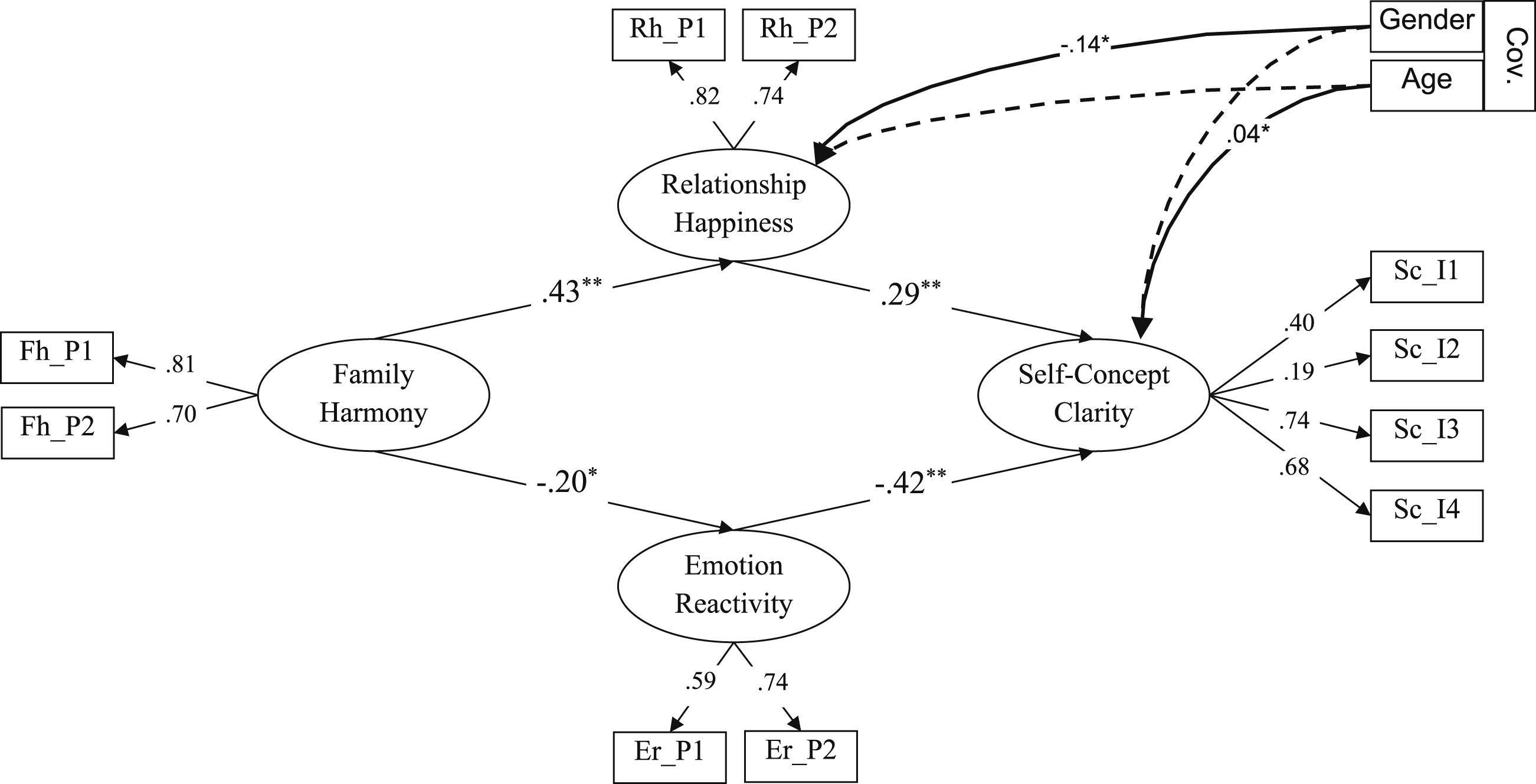
Indirect Effect of Parallel Mediation Model

Note. CI confidence interval; LL lower limit; UL upper limit.
In conclusion, it has been revealed that the relationship of family harmony on self-concept clarity occurs indirectly through both relationship happiness and emotion reactivity. Mediation through relationship happiness shows an effect in a positive direction, while mediation through emotion reactivity shows an effect in a negative direction. Age and gender were controlled as covariates in the model.
Discussion
The family is considered a holistic structure consisting of interconnected subsystems. The marital relationship and the parent–child interaction within this structure form the basis of healthy family functioning. One of the important factors determining the quality of family functioning is family harmony, which expresses the level of emotional bond between family members. Role transitions experienced by the individual in this holistic structure are closely related to the family system. For example, it is known that significant role transitions such as parenting reshape the individual’s self-structure, and especially in these processes, as positive emotions decrease, a decrease in self-concept clarity can occur (Slotter & Walsh, 2017). Other research in this field has also provided significant contributions to understanding the relationships between family dynamics, interpersonal processes, and self-development (Crocetti et al., 2015; Jia et al., 2022). However, it is observed that studies focusing on mediating factors to explain the mechanisms affecting family harmony in parents are limited. The study aimed to examine the multiple mediating roles of an individual’s level of relationship happiness and emotion reactivity in this relationship dynamic. The main findings obtained in this direction are as follows: (1) relationship happiness mediates the relationship between family harmony and self-concept clarity, and (2) emotion reactivity emerges as a variable that mediates the relationship between family harmony and self-concept clarity. The unique contribution of the study is that two variables with different structures, such as relationship happiness and emotion reactivity, explain the relationship between family harmony and self-concept clarity through parallel but independent pathways, and these relationships are comprehensively examined on a parent sample for the first time. In this context, the established hypotheses have been discussed within the framework of the relevant literature.
The first of the findings obtained is that family harmony in parents significantly predicts self-concept clarity through relationship happiness. This mediation model indicates that harmony within the family predicts individuals’ levels of relationship happiness, and this level of happiness prepares the ground for a clearer self-perception. Although this relationship has not been directly examined in the literature, it gains meaning through existing indirect studies. Supporting studies in the literature reveal that strong family functioning is positively related to individuals’ general happiness, life satisfaction, and harmony in romantic relationships (Zarei & Fooladvand, 2022; Çalışkan, 2017). These findings point out that harmony in the family system prepares the ground for individuals to develop satisfaction and happiness in their close relationships. On the other hand, it is a noteworthy point that the happiness experienced in marriage and close relationships is closely related to individuals’ self-concept clarity processes. It is observed that individuals with high self-concept clarity experience more satisfying, healthy, and fulfilling relationships (Parise et al., 2019), and their levels of communication, relationship quality, satisfaction, and commitment are also positively shaped by this structure (Gurung et al., 2001; Lewandowski et al., 2010). It can be considered that this two-way relationship directs self-development by internalizing the harmony and happiness in the individual’s relationship. Therefore, although there are no studies focusing directly on the relationship between relationship happiness and self-concept clarity, these indirect findings presented in the literature may show that the relationship in question is theoretically significant.
The second of the findings obtained in this study is that family harmony in parents significantly predicts self-concept clarity through emotion reactivity. According to this finding, harmony within the family significantly predicts individuals’ emotion reactivity levels, and this reactivity level contributes directly to self-concept clarity. Although this finding has not been directly examined in the literature, it gains meaning through indirect studies. For example, the decisive role of the family environment on the individual’s emotional regulation and reactivity processes is emphasized (Morris et al., 2007). Specifically, parents’ attitudes toward emotions within the family, the level of intra-family warmth, and conflict are among the factors that shape the individual’s capacity to regulate emotional reactions (Hu et al., 2023). In this direction, it can be considered that a harmonious family environment facilitates the individual’s emotion regulation skills. Self-concept clarity is a dynamic structure that can change along with daily events and emotional experiences lived by the individual (Nezlek & Plesko, 2001). This dynamic structure is also consistent with findings revealing that individuals with low self-concept clarity experience more intense negative emotions (Campbell et al., 2003). Although this study does not address emotion reactivity directly, it is consistent with current findings in terms of revealing the relationship between self-concept clarity and emotions. This situation indirectly supports our finding that changes experienced in emotion reactivity can be related to self-concept clarity. In light of all these findings, support from a harmonious family environment may offer positive indicators for an individual’s self-concept clarity by increasing relational satisfaction and decreasing emotion reactivity.
Conclusion
The primary finding of this research is that family harmony in parents significantly predicts self-concept clarity through emotion reactivity and relationship happiness. In the obtained model, emotion reactivity and relationship happiness function as variables that fully mediate this relationship. In parallel mediation models, two or more mediating variables are included to explain the effects of an independent variable on a dependent variable (Rucker & Preacher, 2019). Mediating variables are typically correlated with one another due to their effects on the dependent variable. As the level of correlation among mediating variables increases, the effect of each mediator on the dependent variable may weaken, which can reduce the strength of the indirect effects (Preacher & Hayes, 2008). Additionally, if the indirect effect has the opposite sign to the total effect, the mediating variable may be considered a suppressor (Rucker et al., 2011). If one of the mediating variables plays a suppressed role—in other words, if one mediator has a negative effect on the dependent variable while the other has a positive effect—this can lead to the emergence of offsetting indirect effects (Preacher & Hayes, 2008). In this study, emotional reactivity may also have played a suppressor role in the research model. Although no study has been found in the literature that addresses these four variables together, the current finding demonstrates consistency with various theoretical approaches and indirect studies. This situation, while revealing the unique contribution of the research, is also important in terms of drawing attention to gaps in the literature. Self-concept clarity, which is treated as the dependent variable in this study, relates to the consistency, clarity, and continuity of the individual’s self-perception. This structure is decisive in many areas such as psychological well-being, self-esteem, self-regulation, interpersonal relationships, and emotional processes (Light, 2018; McIntyre et al., 2018; Nezlek & Plesko, 2001; Rahim et al., 2021). This situation reveals that the individual’s self-perception is shaped not only by internal processes but also by the social environment and emotional processes. When the literature is reviewed, it is known that individuals with high self-concept clarity have higher life satisfaction, possess better mental health (Na et al., 2018), and experience lower levels of anxiety and depressive symptoms (Butzer & Kuiper, 2006; Van Dijk et al., 2014). Therefore, considering relationship happiness and emotion reactivity together as independent variables may play an important role in strengthening parents’ self-concept clarity levels and supporting their family harmony. These findings can offer a significant theoretical and practical contribution to the literature regarding how parents’ self-concept clarity is shaped.
Limitations and Suggestions
There are some limitations to this study. First, since the research was conducted in a cross-sectional design, although the relationships between variables have been revealed, it has not been possible to establish a causal relationship. Therefore, preferring longitudinal designs where data collected over time is used in future research is of importance in terms of examining the causal direction of the relationships, especially between family harmony, emotion reactivity, and self-concept clarity, more deeply. Furthermore, despite the findings obtained in line with the mediation model used in this study, testing the effect of the level of emotion reactivity on self-concept clarity directly by using experimental designs will contribute to filling the gaps in the literature.
Since all the data used in the study are based on participants’ self-reports, the possibility of being open to measurement biases such as social desirability and respondent bias should be considered. For this reason, there is a need for future studies in which mixed methods are used and qualitative and quantitative data sources are evaluated together.
Additionally, the fact that the proportion of female participants in the sample is significantly higher than that of males should be evaluated as a limitation that could lead to bias in gender-based analyses. Therefore, it is suggested that care be taken to ensure a more balanced gender distribution in future studies.
Footnotes
Author Note
This article was presented as an abstract paper at the 11th International TURKCESS Conference on Education and Social Sciences, held on September 18–20, 2025.
Acknowledgments
We thank the participants of this study and those who developed the measures we used in the study.

Ethical Considerations
During the research process, the ethical principles outlined in the Declaration of Helsinki were followed, and professional ethical standards were adhered to throughout the study. Ethical approval for the study was obtained from the Ethics Committee of Kırşehir Ahi Evran University Social and Human Sciences Scientific Research and Publication Ethics Committee (Decision No: 2025/10/21, Date: 28.05.2025). Research data were collected face-to-face from voluntary participants, and informed consent was obtained from all participants prior to data collection. Participants were informed that their responses would remain anonymous and confidential. No financial incentive or payment was provided to the participants.
Consent to Participate
Informed consent was obtained from all the individual participants that were included in the study.
Funding
The authors received no financial support for the research, authorship, and/or publication of this article.
Declaration of Conflicting Interests
The authors declared no potential conflicts of interest with respect to the research, authorship, and/or publication of this article.
Data Availability Statement
Data will be available on request.
Pre-registration Statement
This study was not pre-registered.