



Abstract
This research aims to examine the mediating role of attitudes toward hiring people with disabilities on the relationship between stereotypes of prospective employers and hiring intentions toward people with disabilities (PwD). Although employer perceptions are often cited as barriers to disability inclusion, less is known about how these evaluations take shape before individuals enter formal hiring roles. We address this gap by testing whether attitudes toward hiring PwD indirectly link stereotypes to hiring intentions among business administration students. The study included 163 individuals from Romania aged 19-33 years (M = 21.52, SD = 2.57), all of whom were business administration students preparing for future roles as employers. Our findings revealed that stereotyping is negatively related to both attitudes and hiring intentions toward PwD, while positive attitudes are associated with greater hiring intentions. Moreover, attitudes toward hiring people with disabilities had a mediating role on the relationship between stereotypes and hiring intentions. These results support the relevance of the theory of planned behavior in explaining hiring-related processes and highlight the importance of attitudes as a psychological mechanism linking stereotypes to behavioral intentions. Based on our findings, theoretical and practical implications for higher education institutions and teachers are discussed, aimed at improving the initial training framework in diversity and inclusion for future employers.
Keywords
Introduction
Living with a disability presents numerous challenges concerning societal inclusion, including acquiring suitable vocational training for the labor market and the processes of securing and retaining employment (Saleh & Bruyère, 2018). Despite anti-discrimination laws and assistance implemented by EU member countries (Bunt et al., 2020), PwD remain a vulnerable group (Gherguţ, 2023), and constitute a large minority that, due to different etiological factors, any person can become part of at any point in life (Reher, 2020). Against this backdrop, employment represents a necessary (and often contested) pathway to social inclusion for PwD.
In 2022, approximately 54.3% of people with disabilities (PwD) aged 20 to 64 in the EU were employed, compared to 72.1% of those without disabilities in the same age group (European Commission: Directorate-General for Employment, Social Affairs and Inclusion and Human European Consultancy, 2025). PwD have fewer opportunities for employment because employers tend to judge PwD based on their perceived limitations rather than their actual abilities and potential (Ameri et al., 2018), approaching disability from a medical model perspective. The negative behaviors of employers toward employees with disabilities can be explained by negative attitudes and stereotypical beliefs about PwD, including views of them as dependent, less competent, unemployable, and passive (Dovidio et al., 2011; Rohmer & Louvet, 2011, 2018).
Besides its role in achieving financial well-being, employment for PwD is an important factor in extending their social network, normalizing life, and supporting self-determination, understood as their right and capacity to have control over their lives (Naberushkina et al., 2021; Saunders & Nedelec, 2014; Wehmeyer, 2020). However, it remains unclear how stereotypes translate into hiring intentions at the start of the decision-making pipeline, before individuals assume hiring authority. Addressing this gap is essential for understanding early psychological barriers to labor market inclusion for people with disabilities.
The Context of People With Disabilities in Romania
Within Romanian society, PwD report facing discrimination, prejudice, and labeling as barriers (Baciu et al., 2016; Huțul et al., 2022; Karner-Huțuleac & Huțul, 2023) across various life stages, from accessing education and socializing to participating in social activities and maintaining employment (Baciu & Lazar, 2017; Birau et al., 2019). Despite existing legislation aimed at increasing accessibility and employability for PwD through the National Authority for the Protection of the Rights of Persons with Disabilities (Facilitating the Labor Market Integration of People with Disabilities - National Authority for the Protection of the Rights of Persons with Disabilities, 2023), the difference in employment rates between PwD and people without disabilities in Romania remains significant (Baciu & Lazar, 2017), further aggravated by the COVID-19 pandemic (European Commission, Directorate General for Employment, Social Affairs and Inclusion., 2021). Potential factors contributing to low employability rates among PwD include employers’ negative attitudes and subjective norms concerning their employment (McDonnall & Lund, 2020), which depict these individuals as potentially less capable of fulfilling job requirements due to challenges in maintaining regular attendance, punctuality, productivity, performance, and, in certain instances, social interaction skills (Ju et al., 2013). Our goal is to examine these attitudes and stereotypes among future employers, business administration students, who are in a distinctive position to shape the business landscape. This aspect represents a key direction for research and educational efforts to enhance students’ training programs, given the growing prevalence of negative attitudes toward PwD during their education (Castillo & Larson, 2020).
Most European countries have acceded to the 2006 UN Convention on the Rights of Persons with Disabilities, committing them to eliminate discriminatory practices (Vornholt et al., 2018). However, a comparative study across multiple European countries (Romania, Czech Republic, Poland, Slovak Republic, Hungary, and Lithuania), showed that Romania was the country with the lowest level of labor market inclusion of PwD among the countries investigated (Mussida & Sciulli, 2016).
The Employability of People With Disabilities
In the literature, employability is recognized as a multidimensional concept that goes beyond individual qualifications or competencies and at the same time encompasses contextual and relational factors that are relevant to the labor market (Fugate et al., 2004); thus, previous findings have highlighted that, alongside access to education, prior career guidance, and workplace accommodation, employment outcomes are also influenced by how employers perceive and facilitate the employment process (Bonaccio et al., 2020; Vornholt et al., 2018). Therefore, the employment of PwD may be highly influenced by hiring decision-making processes, in which employers’ subjective evaluations can shape favorable or unfavorable outcomes. Moreover, prior research suggests that regardless of their competencies and qualifications, the viability of PwD as candidates depends mostly on employers’ perceptions of their reliability, adaptability, and productivity within the workplace (Kaye et al., 2011).
Previous studies exploring hiring patterns in diversity contexts suggest that hiring intentions are a significant predictor of actual employment behavior. Relating this framework to the explanations provided by the theory of planned behavior (Ajzen, 1991), it seems that hiring intentions indicate the willingness to act in a particular manner and are also shaped by underlying beliefs and attitudes. Thus, investigating hiring intentions among individuals likely to assume decision-making roles can provide valuable insights into future employment practices, as well as identify psychological barriers to labor market inclusion. This approach is especially relevant when focusing on groups such as business administration students as potential future employers, whose attitudes and beliefs may directly influence subsequent hiring decisions affecting PwD.
The Role of Stereotypes Toward People With Disabilities and Hiring Intentions
Stereotypes are defined as sets of conceptual traits linked to a specific group, as outlined by a particular society (Amodio, 2014). For example, PwD may be stereotyped as helpless or having a low level of competence (Colella & Varma, 1999; Rohmer & Louvet, 2018), and these stereotypes create labels that can decrease expectations about their level of functioning, leading to restrictions in their participation in social life (Klinksiek et al., 2023).
In organizational contexts, disability generates an automatic categorisation, at least initially, based on socially accessible information about the social category concerned, including stereotypes and associated affects (Stone & Colella, 1996). The literature argues that this initial categorisation dominates the formation of an impression of people with disabilities in the job, at least until further additional information is considered relevant from the employer’s point of view (Fiske & Neuberg, 1990). PwD reported challenges in entering the labor market due to being perceived as less capable because of their disability (Shier et al., 2009) or, if hired, they experienced discrimination within the organisation and dismissal from employment (Magee, 2004).
Employers’ Attitudes Toward Hiring People With Disabilities
Attitudes can be defined as “a latent tendency or disposition to respond with some degree of favorableness or unfavorableness to a psychological object” (Fishbein & Ajzen, 2011, p. 76) and are thus considered in the literature as more immediate precursors to inclusive behavior than stereotypes. By referring to the theory of planned behavior, which focuses on attitude formation (Ajzen, 1991), we acknowledge that stereotypes underlie the formation of attitudes, thus giving meaning to these beliefs and subsequently leading to the emergence of behaviors consistent with them, whether favorable or unfavorable (Nelissen et al., 2016). Research on employer attitudes toward hiring PwD indicates that only a small proportion of employers hold positive views and truly see them as productive and dependable workers (Chan et al., 2010), while the majority of employers hold negative perceptions and concerns that make it difficult for them to employ PwD, as they question PwD’s ability to perform job duties and worry about potential impacts on their company’s efficiency and productivity (Fraser et al., 2011; Peck & Kirkbride, 2001). Employers may perceive PwD as less talented, as requiring a higher degree of supervision, and as employees less able to cope with work requirements (Bjelland et al., 2010), but on the other hand, extensive work experience with PwD can lead to more positive employer attitudes and understanding of their true abilities (Copeland et al., 2010).
The Present Study
The present research builds on a series of aspects referring to the lives of people with disabilities in Romania. Most studies examine current employers; comparatively less is known about these processes among future employers during professional training. We therefore test whether attitudes toward hiring PwD explain how stereotypes relate to hiring intentions in business administration students. More specifically, Romania has a higher poverty rate compared to other European countries, and people with disabilities are significantly underrepresented in the labor market compared to other European nations, an aspect that may be explained by limitations in their social or economic participation. Thus, in general terms, employment is not viewed strictly as a source of financial stability for everyone, including people with disabilities, but also as a means of effective community participation and social inclusion (Schur et al., 2005). However, as previous findings indicate, labor market inclusion may be affected by various barriers, such as structural barriers, but also by the way employers may perceive future candidates. In situations in which these barriers are reduced or removed, people with disabilities may integrate more easily into the labor market and find employment more readily. Looking toward the future, prospective employers, such as business administration students, may play a role in designing more inclusive organizational environments. This study focuses on understanding stereotypes and attitudes toward PwD in a sample of future decision-making agents in the labor market. Building on the theory of planned behavior (Ajzen, 1991), the present work aims to investigate existing relationships between stereotypes, attitudes toward hiring PwD, and hiring intentions toward PwD among business administration students who are prospective employers. Moreover, we examine whether attitudes toward hiring PwD may have a mediating role on the relationship between stereotypes and hiring intentions. In this regard, the present work may contribute to educational policies and practices regarding social inclusion and labor market inclusion for people with disabilities, which could be designed to support the training of business administration students as prospective employers. In order to achieve the objectives of the present study, we formulated the following hypotheses:
There are significant associations between stereotypes, attitudes toward employing PwD, and hiring intentions toward PwD. We expect stereotypes to be significantly and negatively associated with attitudes toward employing PwD and hiring intentions toward PwD. Similarly, we expect attitudes toward employing PwD to be significantly and positively associated with hiring intentions toward PwD.
Attitudes toward employing PwD will mediate the relationship between stereotypes of prospective employers and hiring intentions toward PwD.
Method
Participants and Procedure
Prior to data collection, an a priori power analysis was conducted in G*Power 3.1.9.4 (Faul et al., 2007). The analysis was performed using a linear multiple regression model (fixed model, R2 deviation from zero), assuming a medium effect size (f2 = .15), α = .05, and statistical power of .95. For a regression model including two predictors, the estimated minimum sample size was 107 participants. We note that this analysis reflects the power associated with the regression component of the mediation model rather than the bootstrap-based estimation of the indirect effect. Because mediation analyses, particularly those relying on bootstrapping procedures, involve different power considerations, we additionally considered recommendations from Fritz and MacKinnon (2007) when evaluating the adequacy of the sample size. The final sample of 163 participants exceeded the minimum required size and was considered sufficient for the planned analyses.
The sample of participants consisted of 163 students aged 19 to 33 years (M = 21.52; SD = 2.57, 75.5% female). They were all students of the Faculty of Economics and Business Administration at the time they completed the questionnaires. The inclusion criteria were that respondents had to be business administration students at the time of participation and be at least 18 years old. Questionnaires were completed online via Google Forms, with the link shared by teachers from the Faculty of Economics and Business Administration, and the selection was based on convenience. The scales were administered in Romanian, having been previously translated using the backward translation method (Hambleton & Zenisky, 2010). All participants received an informed consent form, which stated that participation was voluntary, with the option to withdraw at any time, and that data would remain anonymous and would be used for the present research. The research, conducted in accordance with the ethical principles of the 2013 Helsinki Declaration, received approval from the Ethics Board of the authors’ affiliated university (No. 161/20.02.2023).
Measures
Attitudes toward hiring people with disabilities
Attitudes were assessed using the “Attitudes Toward Employing People with Disabilities Scale” (Loo, 2004), which includes 13 items rated on a 6-point Likert scale (1 = strongly disagree, 6 = strongly agree). The instrument covers three human resource management themes: organizational policies and procedures (e.g., “Companies should not make a special effort to recruit people with disabilities”), organizational climate (e.g., “Companies tend to discriminate against people with disabilities”), and working relationships (e.g., “I don’t care whether a colleague of mine has a disability or not”). Higher total scores indicate more positive attitudes toward employing PwD. In the present sample, internal consistency was acceptable (Cronbach’s α = .76).
Hiring intentions toward people with disabilities
Hiring intentions were measured with a four-item willingness-to-hire measure adapted from Grześkowiak et al. (2021). Participants indicated how willing they would be to hire employees with four types of disabilities: (a) mobility/manual difficulties, (b) visual difficulties, (c) hearing/communication difficulties, and (d) cognitive difficulties (including intellectual and mental disabilities). The item stem follows the format “How willing would you be to hire employees with the following disabilities in your company?” and responses are given on a 4-point scale (1 = definitely no, 2 = rather no, 3 = rather yes, 4 = definitely yes). Total scores were computed by summing responses across the four items, with higher scores reflecting stronger hiring intentions. Internal consistency in the present sample was good (Cronbach’s α = .88).
Stereotypes of prospective employers
Stereotypes were assessed using an adapted version of the Scale of Stereotypes about the Mentally Ill (SSMI; Sousa & Maciel, 2019), reframed to refer to PwD in general. The scale consists of 10 bipolar adjective pairs rated on a 7-point semantic differential (e.g., Harmless–Dangerous, Docile–Aggressive, Competent–Incompetent, Productive–Unproductive). The original instrument includes two dimensions (“Threat stereotypes” and “Disability stereotypes”; each represented by five adjective pairs). Higher scores indicate more negative stereotypical perceptions toward PwD. In the present sample, internal consistency was good (Cronbach’s α = .81).
Socio-demographic variables
Participants provided information about their age, gender, and place of residence. They also stated their current academic status; all participants were enrolled in business administration at the time of data collection. These variables helped characterize the sample but were not used as predictors in the main analyses.
Results
Preliminary Data Analyses
Descriptive statistics and Pearson correlation matrix
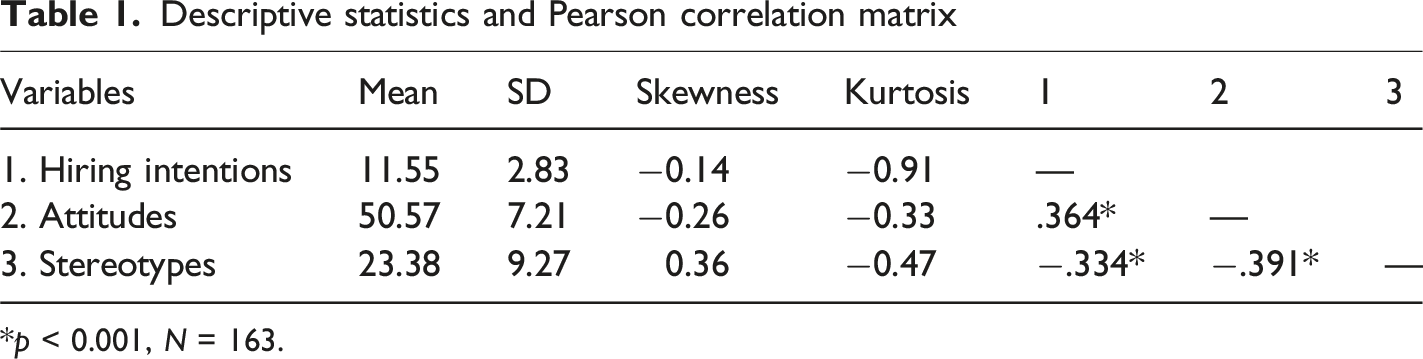
*p < 0.001, N = 163.
To assess the potential impact of common method variance, Harman’s single-factor test was conducted by entering all measurement items into an exploratory factor analysis using an unrotated solution. The results indicated that multiple factors emerged, with seven factors having eigenvalues greater than 1. The first factor accounted for 25.08% of the total variance, which is below the commonly accepted threshold of 50%. These findings suggest that common method variance is unlikely to represent a substantial source of bias in the present study.
Associations Among the Main Variables
We calculated total scores for the variables under investigation, stereotypes, attitudes toward employing PwD, and hiring intentions toward PwD, and analyzed Pearson correlations between them (Table 1).
Results showed significant negative associations between stereotypes, attitudes toward employing PwD, and hiring intentions toward PwD. Attitudes toward employing PwD were positively associated with hiring intentions, suggesting that more positive attitudes were associated with stronger hiring intentions.
Testing the Mediation Analysis
We further analyzed the potential mediating role of stereotypes of prospective employers on hiring intentions toward PwD through attitudes (Figure 1), using the PROCESS macro in SPSS 26 – Model 4 (Hayes, 2022), while controlling for gender. The overall model was significant and explained 11.2% of the variance in hiring intentions (R
2
= 0.11, F (2, 160) = 10.09, p < .001). The results indicated that the total effect of stereotypes of prospective employers and hiring intentions toward PwD is significant, b = −0.10, SE = 0.02, p <.001, 95% CI [−0.14; -0.05]. The direct effect was significant, b = −0.07, SE = 0.02, p = .003, 95% CI [−0.11; -0.02]. Attitudes toward employing PwD had a significant indirect effect on the relationship between stereotypes of prospective employers and hiring intentions toward PwD, b = −0.03, SE = 0.01, 95% CI [−0.05; −0.01]. The coefficients reported in the text are unstandardized coefficients. The mediating role of stereotypes of prospective employers on hiring intentions toward people with disabilities through attitudes.
Discussion
The present study aimed to examine the relationship between stereotypes and hiring intentions toward PwD among business administration students who are prospective employers, as well as the mediating role of attitudes toward employing PwD in this relationship. By focusing on students who are likely to assume future managerial and human resources roles, the study sought to identify psychological factors that may shape early employment-related decision-making processes affecting PwD.
First, we hypothesized that stereotypes would be associated with attitudes toward employing PwD and hiring intentions toward PwD, and our results confirmed this hypothesis, with stereotypes being significantly and negatively correlated with attitudes toward employing PwD and hiring intentions toward PwD. In addition, our results showed that attitudes toward employing PwD were significantly and positively correlated with hiring intentions toward PwD. The literature provides several explanations supporting these results. For example, one explanation for this is that a lack of interaction and experience working with PwD limits individuals’ perspectives to stereotypes, portraying them as incapable of high performance, often absent, and causing discomfort to those around them (Kaye et al., 2011). Interaction and generally pleasant experiences with PwD help people understand the field’s details, finding resources related to diversity, and ultimately reduce stereotypes (Pachița & Gherguț, 2021). Stone and Colella (1996) have also suggested in their studies that stereotypes may influence employers’ responses to working with PwD. Consequently, stereotypes influence employers’ expectations of working with PwD, which in turn have an effect on how PwD are included, treated, and helped within the organization. Employees use stereotypes to evaluate others and will therefore make assumptions about how they will behave in the workplace, which will contribute to the decision whether or not to employ a person with disabilities. Research on intra-group stereotypes (Fiske et al., 2002) mentions that favorable management of impressions of the competence of PwD can lead to reduced pity reactions and increased levels of admiration (Cuddy et al., 2007; Dovidio et al., 2011), which lead to a strengthening of employers’ hiring intentions. Overall, these findings support the idea that stereotypes can impact hiring decisions both directly and indirectly by shaping more immediate evaluative processes, like attitudes toward employing PwD.
Further, we aimed to explore the mediating role that attitudes toward employing PwD may have on the relationship between stereotypes and hiring intentions toward PwD. Our findings have revealed that levels of attitudes may play a mediating role on the link between stereotypes and hiring intentions toward PwD. These results are in line with the theory of planned behavior described by Ajzen (1991). Through this theoretical framework, it is suggested that stereotypes can shape more proximal attitudes, thus, in turn, informing hiring intentions. This finding is supported by earlier research indicating that attitudes toward people with disabilities (PwD) originate from stereotypes and beliefs rooted in a limited understanding of disability and minimal interaction with PwD (Scior, 2011). Based on these beliefs that people in management positions have about PwD and how they translate into predictions about how they will work in the company, attitude formation occurs (Fishbein & Ajzen, 2011). Affective reactions such as pity or admiration highlight a set of action tendencies associated with subsequent behavioral intentions toward PwD as candidates (Cuddy et al., 2007). When candidates are seen as incompetent and helpless, the emotional reaction of pity generates attitudes of rejection and disrespect, and employers are less willing to facilitate their membership. If, however, employers relate to candidates with admiration, this can foster a positive approach, including a desire for inclusion within the company (Cuddy et al., 2007). Due to the lack of disability awareness, it has been shown that students majoring in business administration, as prospective employers, reported having unfavorable attitudes toward PwD (Chan et al., 2002; Hunt & Hunt, 2004). A series of meta-analyses (Glasman & Albarracín, 2006; Kraus, 1995) provide an explanation for our findings, reinforcing the idea that attitudes are immediate predictors of inclusive behavior. For example, positive employer attitudes, prior experiences working with PwD that tend to deconstruct stereotypes, and an organizational climate that values disability in the context of diversity tend to facilitate employers’ intentions to hire PwD (Kulkarni & Lengnick-Hall, 2014; von Schrader & Nazarov, 2015).
Conclusions
We highlighted how stereotypes and attitudes toward employees with disabilities among business administration students as prospective employers impact their hiring intentions toward PwD, i.e., inclusive behavior in the professional context. Our findings support a framework showing that insufficient awareness of disability within diversity contributes to stereotypes and attitudes toward PwD, which in turn influence hiring decisions. This reveals a culture lacking inclusion, starting from the training of future employers, and likely explains the low employment rate of PwD overall. For this reason, addressing diversity education and disability awareness during the training and preparation of prospective employers, managers, and human resources professionals is emerging as an urgent need to create an inclusive, informed, and high-performing labor market for all categories of candidates.
Limitations and Future Directions
While our study has its strengths, certain limitations must be recognized. Firstly, our study was based on self-report measures, which are susceptible to recall and social desirability biases (Akbulut, 2025). This limitation is particularly relevant in research on hiring intentions toward PwD, as respondents may feel socially pressured to provide more favorable responses. Future research could benefit from using additional methods, such as qualitative interviews, focus groups, or experimental designs, to gain deeper insights into underlying beliefs and to minimize socially desirable responses. Although Harman’s single-factor test did not indicate a substantial risk of common method variance, this technique has limitations and cannot fully rule out method bias. Future research could employ marker variables or multi-source data to better control for CMV. Additionally, the sample was exclusively from Romania, a socio-cultural setting where stigmatization of PwD persists at relatively high levels, and public policies promoting positive attitudes are either limited or inconsistently implemented. As a result, the generalizability of these findings to different cultural or national settings might be limited. Future research could implement cross-cultural comparisons to investigate whether the relationships among stereotypes, attitudes, and hiring intentions toward PwD vary across countries with different levels of inclusiveness and policy support. Additionally, future studies should explore the impact of prior contact and experience with specific types of disabilities. The way participants interact with PwD and how often they do so can shape their perceptions and assessments of disability in the workplace. Differentiating between various disability types and degrees of previous contact may offer more detailed insight into how stereotypes and attitudes develop and impact hiring decisions.
Theoretical and Practical Implications
The current study enhances understanding of the psychological factors influencing hiring intentions toward PwD among business administration students who may become future employers. By analyzing stereotypes, attitudes toward employing PwD, and hiring intentions together, our results support and expand the theory of planned behavior (Ajzen, 1991) within the context of disability and employment. Specifically, the results suggest that stereotypes are more distant cognitive structures, while attitudes toward employing PwD serve as a closer mechanism through which these beliefs influence employment-related intentions. In this context, our study contributes to the existing literature by empirically showing the mediating role of attitudes on the relationship between stereotypes and hiring intentions toward PwD. While past research has shown negative stereotypes and unfavorable attitudes toward PwD in organizations, fewer studies have explored how these are connected in a sequence among those not yet employers but likely to become future decision-makers. Focusing on business administration students, our findings highlight that inclusive or exclusionary hiring tendencies can start developing during professional training, long before individuals officially enter managerial or human resources roles. This perspective highlights that employability outcomes for PwD are shaped not only by labor market structures or personal skills but also by early-developed cognitive and attitudinal patterns among organizational gatekeepers. Additionally, by stressing the indirect influence of attitudes toward hiring PwD, our findings emphasize the need to differentiate between general beliefs about disability and specific evaluative judgments related to workplace inclusion. This distinction adds to theories of stigma and employment by indicating that efforts to reduce stereotypes might be ineffective unless they also target attitudes related to specific employment contextual practices. In line with previous findings (Nelissen et al., 2016), our study indicates that more positive attitudes toward employing PwD are associated with stronger hiring intentions, which are a key precursor of inclusive behavior in organizational settings.
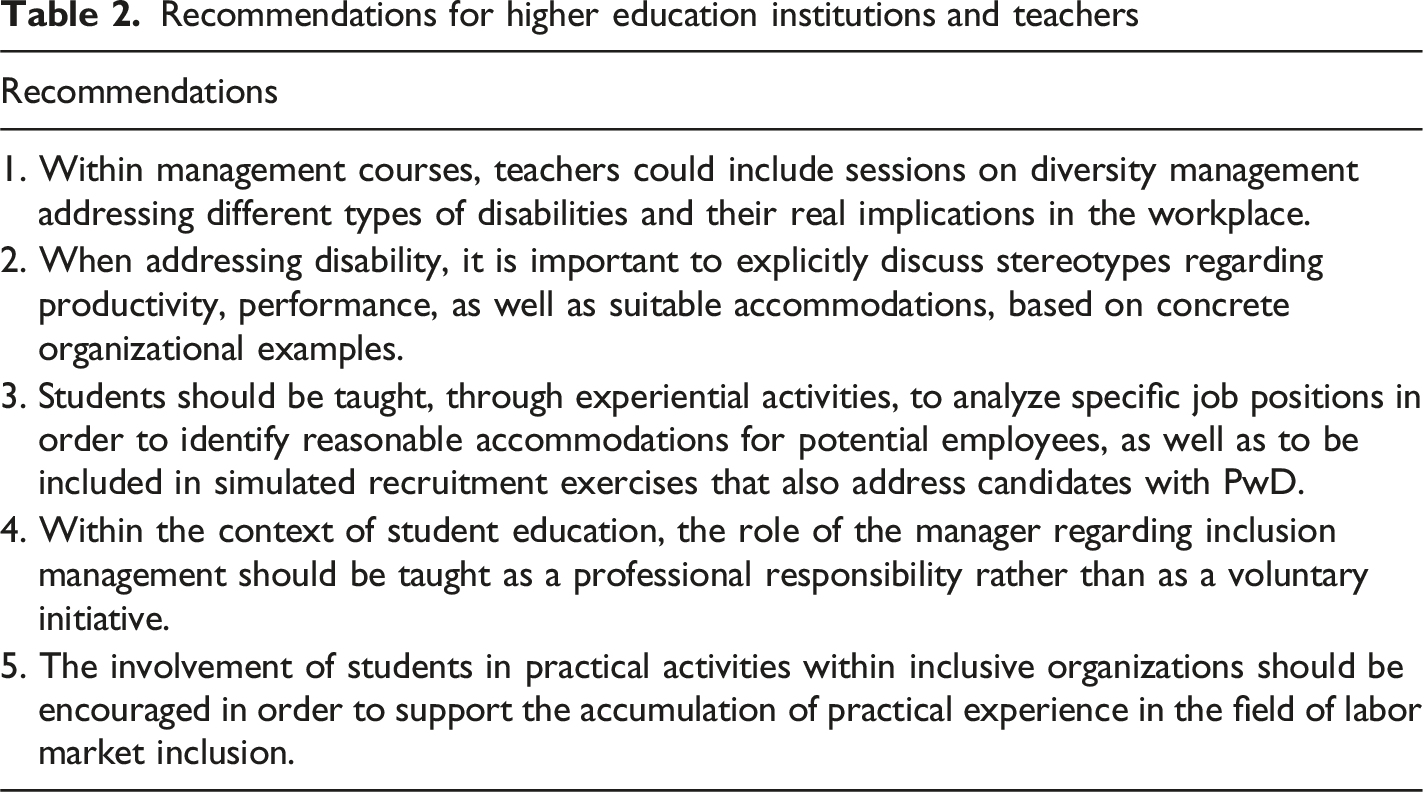
Recommendations for higher education institutions and teachers
Footnotes

Ethical Considerations
The study was approved by the Ethics Committee of the Faculty of Psychology and Educational Sciences, Alexandru Ioan Cuza University of Iaşi, Romania, before beginning the study and supervised by Alois Gherguț (No. 161/20.02.2023).
Consent to Participant
This study’s protocol was designed in concordance with ethical requirements specific to the Faculty of Psychology and Educational Sciences, Alexandru Ioan Cuza University of Iaşi, Romania, before beginning the study and supervised by Alois Gherguț. All participants voluntarily participated in the study and gave written informed consent following the Declaration of Helsinki and the national laws of Romania regarding ethical conduct in scientific research, technological development, and innovation. No animal studies are presented in this manuscript.
Author Contribution
Both authors contributed equally to all aspects of the study, including conceptualization, methodology, formal analysis, investigation, data curation, writing – original draft, writing – review & editing, and visualization.
Funding
The authors received no financial support for the research, authorship, and/or publication of this article.
Declaration of Conflicting Interests
The authors declared no potential conflicts of interest with respect to the research, authorship, and/or publication of this article.
Data Availability Statement
The data supporting the findings of this research are available from the corresponding author upon request.