




Abstract
Previous research indicates that resilience is correlated with Emotional Intelligence (EI), although limited studies examining adaptation to stress have measured both trait and ability EI. This study examined the relative roles of trait and ability EI in the prediction of resilience in adolescents. The total sample consisted of 112 Australian secondary school students who were completing Year 10 at the time of participation. There were 53 (47.3%) males and 59 (52.7%) females of ages ranging from 14 – 16 years (M = 15.04, SD = .36). The Resiliency Scales for Children and Adolescents (RSCA), Mayer-Salovey-Caruso Emotional Intelligence Test – Youth Research Version, and Adolescent Swinburne University Emotional Intelligence Test were administered to participants via an online survey under the supervision of a classroom teacher. Linear multiple regressions showed that only trait EI was predictive of mastery, relatedness, and emotional reactivity components of the RSCA. According to our findings, utilising emotional recognition, expression, understanding and management more often is related to increased resilience. These findings emphasise trait EI as a personal resource regarding the development of resilience in adolescence over ability EI and suggest that fostering perceived competence of emotion-related behaviours in a range of contexts could be beneficial for adolescent resilience outcomes.
Introduction
Adolescence is a period characterised by significant physical, cognitive, social, and emotional development. During this developmental stage, adaptive functioning is associated with the presence of protective factors that buffer the impact of encountered risks and stressors (Dray, 2021). A growing body of evidence suggests that Emotional Intelligence (EI) acts as a protective buffer against psychosocial stressors that promote adaptation in adolescence and early adulthood (Collado-Soler et al., 2023; Howell & Miller-Graff, 2014), and is of particular interest given that it has been shown to be amenable to development (Hodzic et al., 2018; Mattingly & Kraiger, 2019; Schutte et al., 2013; Sklad et al., 2012).
Despite growing interest in EI as a protective factor, it remains unclear which conceptualisation of EI is most relevant for adaptive functioning in adolescence. EI has been operationalised both as a cognitive ability reflecting emotion-related reasoning capacities and as a dispositional construct reflecting typical emotional behaviours and self-efficacy (Luebbers et al., 2007; Rivers et al., 2012a). Determining which of these conceptualisations is more closely aligned with resilient functioning is critical for advancing theory and informing intervention design.
Two prominent models of EI are commonly distinguished: ability (Mayer & Salovey, 1995) and trait EI (Petrides, Furnham, & Mavroveli, 2007). The Mayer and Salovey (1997) ability model conceptualises EI in terms of emotion-related proficiencies and declarative knowledge, representing a capacity to both reason about emotions and use emotion to enhance thinking and problem-solving (Mayer & Salovey, 1995; Salovey & Mayer, 1990). Emotional abilities into four branches: perception and expression, facilitation of thought, understanding, and management and control. In contrast, trait EI models emphasise behavioural dispositions and self-perceived emotion-related functioning (Petrides & Furnham, 2000; Petrides, Pita, & Kokkinaki, 2007).
The distinction between ability and trait EI may be particularly relevant in the context of resilience. Resilience is the ability to cope and continue to withstand adversity in an adaptive way (Van der Hallen et al., 2020), and to implement adaptive strategies in response to stress (Luthar et al., 2000). While ability EI captures emotion-related cognitive capacities under optimal conditions, trait EI reflects individuals’ typical emotional functioning and behavioural tendencies in everyday contexts. As resilience requires the effective enactment of adaptive responses to stress, distinguishing between emotional capacity and dispositional emotional functioning may clarify which aspects of EI are more closely aligned with resilient adjustment in adolescence.
In adolescent populations, the 4-branch ability model of EI can be measured using performance-based instruments such as the Mayer-Salovey-Caruso Emotional Intelligence Test – Youth Research Version (MSCEIT-YRV), which has demonstrated associations with academic performance, social competence, and psychological well-being in adolescent samples (Rivers et al., 2012b). Trait measures aligned with the 4-branch model such as the Adolescent Swinburne University Emotional Intelligence Test (Adolescent-SUEIT) (Luebbers et al., 2007), which have also been linked to academic performance (Droppert et al., 2019), interpersonal relationships (Lomas et al., 2012; Schokman et al., 2014), and problem behaviours (Downey et al., 2010). While both measures draw from the same theoretical framework, they differ in measurement perspective: maximal performance versus self-reported typical performance.
Performance-based measures of EI are generally only moderately correlated (Brackett & Mayer, 2003; Di Fabio & Saklofske, 2014), and sometimes uncorrelated (Davis & Humphrey, 2012; Goldenberg et al., 2006). Although ability-based instruments are considered more objective and less susceptible to social desirability bias (Bru-Luna et al., 2021), research suggests that possessing emotion-related knowledge may be insufficient for successful adaptation (Davis & Humphrey, 2014; Di Fabio & Saklofske, 2014; Lea et al., 2023). Accordingly, typical patterns of emotion-related behaviours may provide additional explanatory value when examining adjustment outcomes (O'Connor et al., 2019). Adolescence represents a particularly salient developmental context in which to examine these associations. During adolescence, emotional systems undergo significant maturation, social environments become more complex, and exposure to peer-related and academic stressors increases (Sisk & Gee, 2022). As adolescents are still consolidating their capacity to translate emotional understanding into effective coping behaviours, resilience provides a meaningful lens through which to evaluate the relative contributions of ability and trait EI.
Previous research indicates that resilience is correlated with EI (Armstrong et al., 2011; Droppert et al., 2019; Rao et al., 2024; Schneider et al., 2013), and some studies suggest that trait EI may demonstrate stronger associations with resilience than ability EI (Davis & Humphrey, 2012; Di Fabio & Saklofske, 2014; Lea et al., 2023). Relatively few studies have simultaneously examined both forms of EI when predicating adaptation to stress (Lea et al., 2019).
This study therefore examines whether emotional capacity (ability EI) or dispositional emotional functioning (trait EI) is more strongly associated with resilience in adolescents. By distinguishing between emotional knowledge and the typical enactment of emotion-related behaviours, the study seeks to clarify which conceptualisation of EI is more proximally aligned with resilient adaptation during adolescence. It was hypothesised that trait EI would demonstrate stronger associations with mastery, relatedness, and emotional reactivity, and would explain incremental variance beyond ability EI.
Materials & Methods
Procedure
All procedures were performed in compliance with relevant laws and institutional guidelines and approval to conduct the research was granted by the relevant Institutional Human Research Ethics Committee (Reference number 2016/280).
Parental consent was obtained prior to participant recruitment. All students with parental consent were then invited to participate. Students who consented to participate in the study completed an online survey in a classroom setting, supervised by a teacher.
Sample
The total sample consisted of 112 Australian secondary school students in the private school system, who were completing Year 10 at the time of participation. There were 53 (47.3%) males and 59 (52.7%) females of ages ranging from 14–16 years (M = 15.04, SD = .36).
A priori power analysis was conducted to establish the required sample size for linear multiple regression with eight predictors, effect size of 0.15, at the 95% confidence level. It was determined that a minimum sample size of 89 was required. The initial dataset contained a sample of 112 indicating that the study was adequately powered.
Materials
Resilience
The Resiliency Scales for Children and Adolescents (RSCA) is a 64-item self-report measure of resiliency in individuals aged 9–18 years (Prince-Embury, 2007). The RSCA conceptualises resilience in terms of perceived strength and/or vulnerability defined in three dimensions: Sense of Mastery which assesses optimism about life, competence, self-efficacy related to developing problem-solving attitudes and strategies (20 items, e.g. “If I have a problem, I can solve it”); Sense of Relatedness, which assesses degree of trust, support, comfort, and tolerance with others (24 items, e.g. “There are people who will help me if something bad happens”) and Emotional Reactivity, which measures sensitivity, recovery, and impairment from emotional situations (20 items, e.g. “When I get upset, I stay upset for the whole day”). Items are measured on a 5-point Likert scale where 0 = ‘never, 1 = ‘rarely’, 2 = ‘sometimes’, 3 = ‘often’ and 4 = ‘almost always’. Each subscale has been shown to be of high reliability (Mastery α = .89, Relatedness α = .91 and Emotional Reactivity α = .91) (Prince-Embury, 2007). Higher scores for sense of mastery and sense of relatedness and lower scores on emotional reactivity represent greater resilience.
Ability EI
The MSCEIT-YRV is a 101-item ability measure of the four branches of emotional intelligence (Emotional recognition and expression, understanding emotions, emotional reasoning, and emotional management and control) and takes approximately 40 minutes to complete. Responses are scored by the test publishers (Multi-Health Systems) with items assigned a scaled value of 0 (less correct) to 2 (more correct), signifying the degree of congruence with expert consensus opinion. Higher scores indicate a higher skill. Previous research has reported that EI can be measured reliably with the MSCEIT-YRV (Rivers et al., 2012b). Split-half reliabilities of .67 (perceiving), .81(using; managing), .86 (understanding) and .90 for total AEI have been previously reported (Papadogiannis et al., 2009).
Trait EI
The 57-item Adolescent SUEIT (Luebbers et al., 2007) was used to measure EI competencies as it is an Australian measure that has previously shown high construct validity with other real-life behaviours in adolescents that have been theoretically linked to EI including problem behaviour (Downey et al., 2010) and scholastic success (Downey et al., 2008). It comprises the following subscales: Emotional Recognition and Expression (ERE) (10 items, ‘I can tell others how I feel about things’) which concerns the accuracy with which individuals can identify emotions and emotional content in language, appearance and behaviour, Understanding and Analysing Emotions (UAE) (19 items, ‘I can tell when other people are trying to hide their true feelings’) focuses on the abilities associated with understanding the complexities and relationships between emotions, Emotions Direct Cognition (EDC) (10 items, ‘I use my ‘gut feelings’ when I try to solve problems’) incorporates abilities pertaining to the use of emotions to facilitate thought, and Emotional Management and Control (EMC) (18 items, ‘I find it hard to think clearly when I am worried about something’) measures reflective regulation of emotions and control over strong emotions. Each item required participants to indicate how they typically thought, felt, or acted using a five-point scale, where 1 = ‘very seldom’ and 5 = ‘very often’.
A higher subscale score reflects higher self-reported proficiency for that EI skill set. Past research has indicated that the internal reliability coefficients of the four subscale scores range from α = 0.75 to α = 0.85 (Luebbers et al., 2007).
Results
Data Preparation
Descriptive Statistics and Internal Reliability for Resilience, Trait EI, and Ability EI Subscales
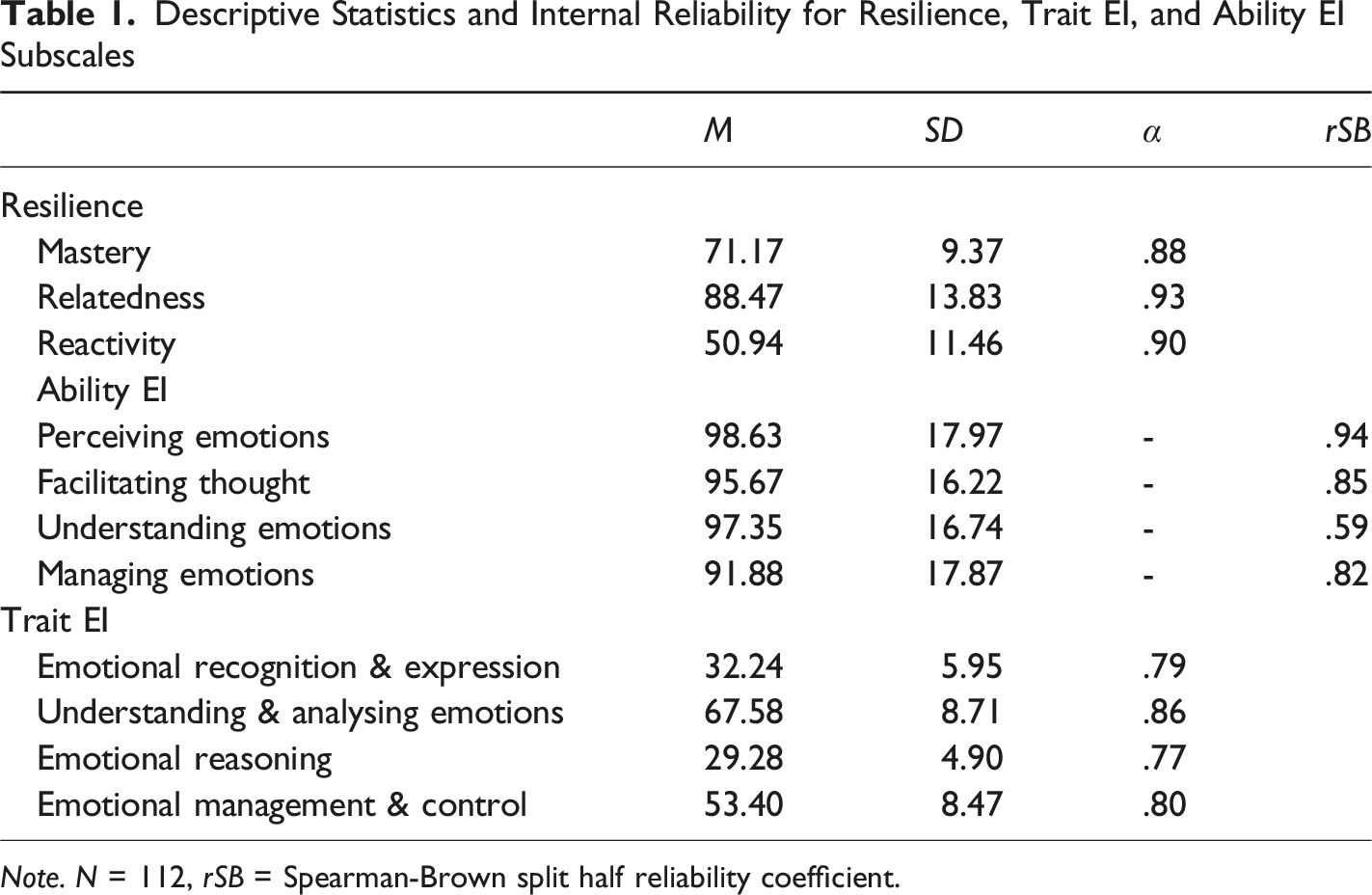
Note. N = 112, rSB = Spearman-Brown split half reliability coefficient.
Descriptive and Correlational Analyses
Table 1 reports the means, standard deviations, and range for the EI and resilience dimensions. The internal reliability is also reported, reporting alpha for the resilience and trait EI dimensions and Spearman-Brown split-half coefficient for Ability EI.
Correlations Between Resilience, Trait EI, and Ability EI
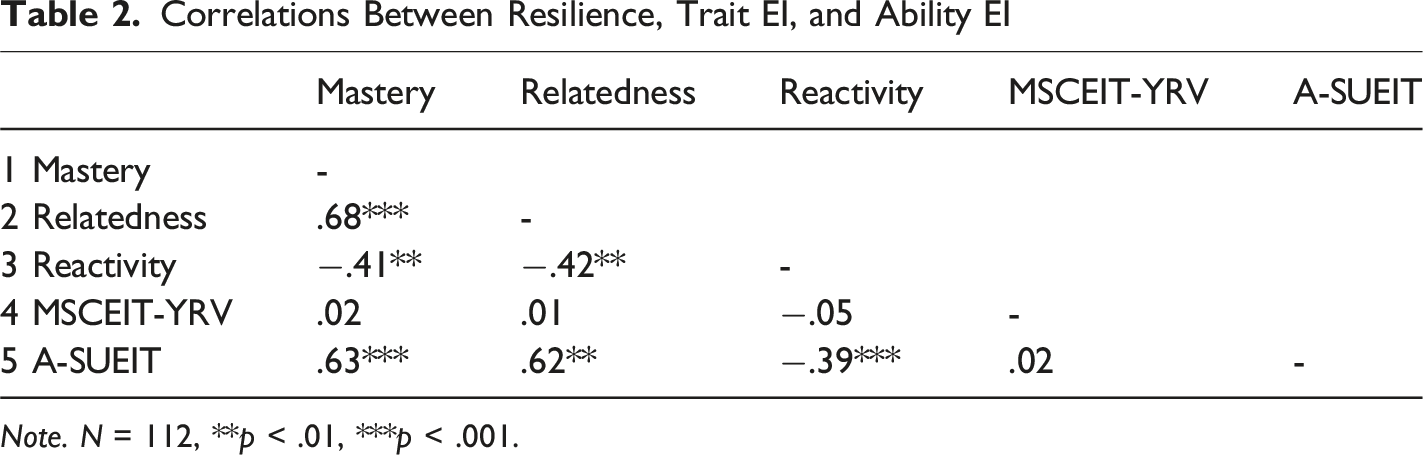
Note. N = 112, **p < .01, ***p < .001.
Regression Analyses
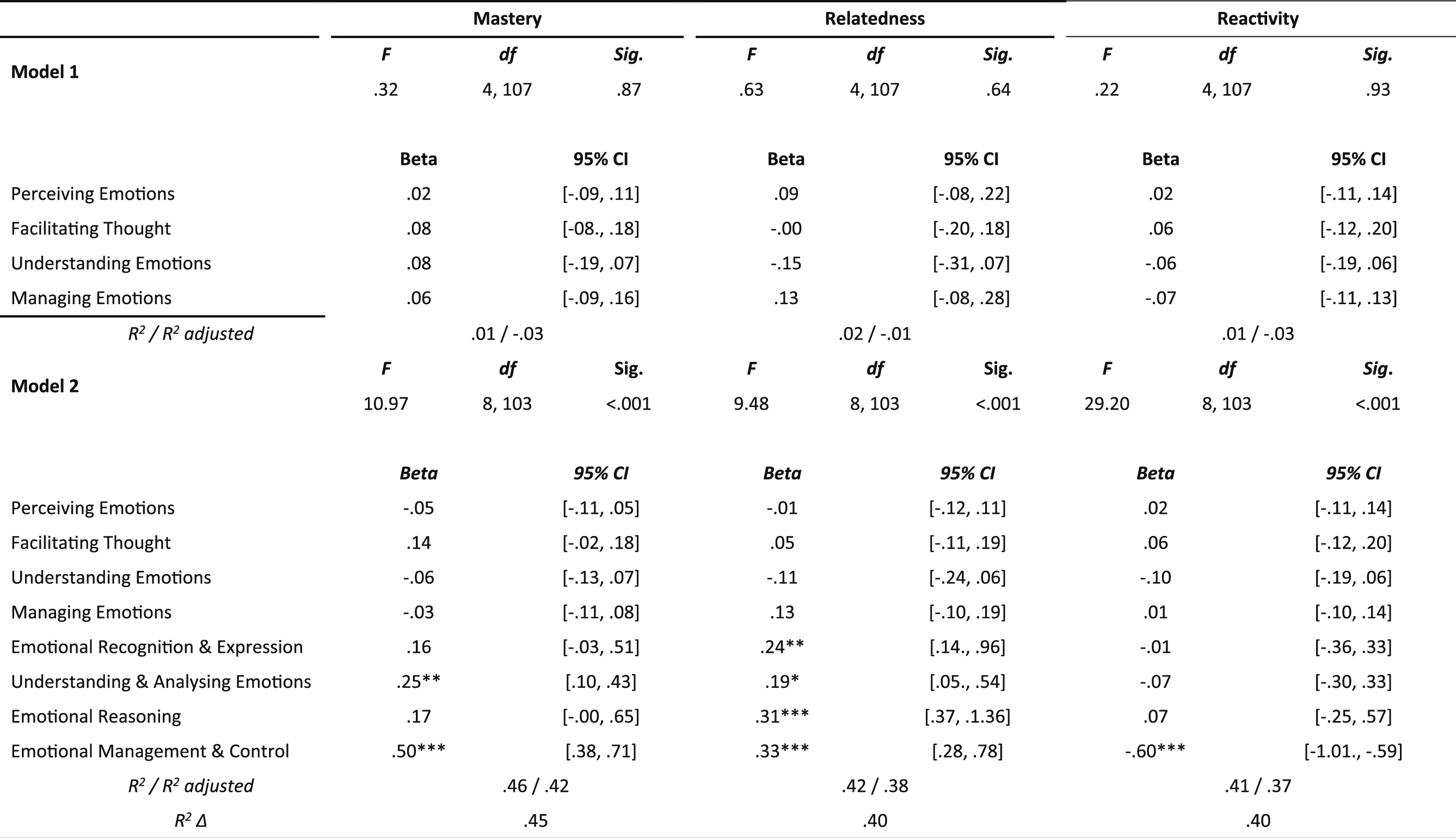
Multiple Linear Regression Analyses Predicting Resilience With Ability and Trait EI as Predictors
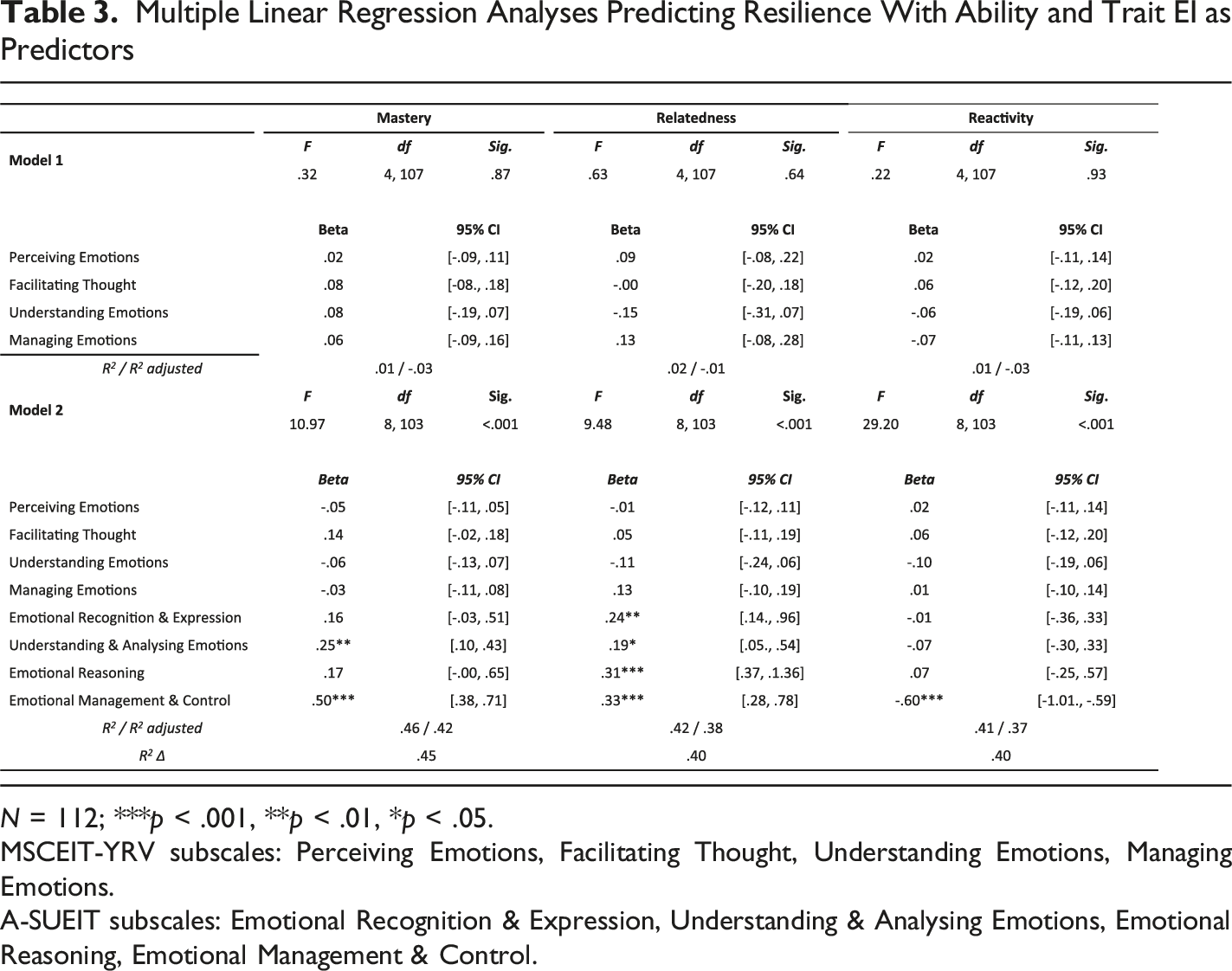
N = 112; ***p < .001, **p < .01, *p < .05.
MSCEIT-YRV subscales: Perceiving Emotions, Facilitating Thought, Understanding Emotions, Managing Emotions.
A-SUEIT subscales: Emotional Recognition & Expression, Understanding & Analysing Emotions, Emotional Reasoning, Emotional Management & Control.
Each of the models predicting mastery, relatedness and emotional reactivity were non-significant at Step 1 with ability EI domains as predictors, indicating that ability EI did not significantly predict resilience outcomes in this sample; (F (4,107) = .32, p = .87, R2 = .01), (F (4,107) = .63, p = .64, R 2 = .02), and (F (4,107) = .22, p = .93, R 2 = .01), respectively. At Step 2, the models predicting mastery, relatedness and emotional reactivity were each significant, indicating that Trait EI significantly predicted resilience in this sample.
The final model predicting Mastery was significant, (F (8,103) = 10.97, p < .001, R 2 = .46), accounting for 46% of the total variance in Mastery with the model being significantly improved by the additional of the Trait EI variables, (FΔ (4,103) = 21.38, p < .001, R 2 Δ = .45) At step 2, of the EI subscales, UAE and EMC significantly contributed to the prediction of mastery, accounting for 25% and 50% of the total variance respectively.
The final model predicting Relatedness was significant, (F (8,103) = 54.72, p < .001, R2 = .52), accounting for 52% of the total variance in Relatedness with the model being significantly improved by the additional of the Trait EI variables, (FΔ (4,103) = 17.94, p < .001, R 2 Δ = .40) At step 2, all Trait EI subscales significantly contributed to the prediction of Relatedness, accounting for 24% (ERE), 19% (UAE), 31% (ER) and 33% (EMC) of the variance each.
The final model predicting Reactivity was significant, (F (8,103) = 9.00, p < .001, R 2 = .41), accounting for 41% of the total variance in Reactivity with the model being significantly improved by the additional of the Trait EI variables, (FΔ (4,103) = 17.65, p < .001, R 2 Δ = .40) At step 2, of the EI subscales, only EMC significantly contributed to the prediction of Reactivity, accounting for 60% of the total variance.
Discussion
This study examined the relative predictive validity of ability and trait EI in adolescent resilience. Findings revealed that trait EI, but not ability EI, significantly predicted greater mastery and relatedness and less emotional reactivity. According to our findings, utilising emotional understanding and management more often is related to increased resilience, which reflects previous literature suggesting that trait EI is a stronger predictor of resilience in adolescence than ability EI (Davis & Humphrey, 2012; Di Fabio & Saklofske, 2014; Lea et al., 2023). Consistent with this pattern, Armstrong et al. (2011) demonstrated that trait EI predicted psychological resilience to negative life events, reinforcing the role of self-perceived emotional competencies in adaptive functioning. It appears that self-reported engagement in adaptive emotion-related behaviours to navigate and adapt to adversity may help in the development of resilience, rather than having emotional knowledge or capability as reflected in ability EI metrics.
In this study, two specific aspects of trait EI predicted the mastery component of resilience. Individuals who viewed themselves as able to perceive and understand their environment accurately and remain in control of their emotions under pressure reported greater self-efficacy in their ability to remain optimistic and engage in effective problem-solving in the face of adversity. This echoes extant research indicating that trait EI helps individuals remain optimistic and engage proactively to manage stress (Schneider et al., 2013). Furthermore, in the current sample, engaging in these behaviours more often appears to be more predictive of successful adaptation to adversity than possessing the relevant emotion-related proficiency and knowledge, highlighting the benefit of translating emotional knowledge into practical action to promote resilience.
Increased social connectedness has been recognised as a protective factor in resilience (Howell & Miller-Graff, 2014) and in this study, trait EI predicted the relatedness dimension of resilience. Previous research suggests that trait EI is related to a person’s ability to establish and maintain positive relationships with others (Summerfeldt et al., 2006), increased friendship quality (Batool & Lewis, 2022), prosocial behaviours (Schokman et al., 2014), and reduced anti-social behaviours (Downey et al., 2010; Liu, 2004). Taken together, this suggests there may be value in establishing effective emotion-related behaviours to foster social support, particularly to offer an advantage during times of adversity.
Only the trait EI domain of emotional management and control predicted emotional reactivity in this study, showing that those with higher perceptions of their ability to effectively manage and transition emotions and control strong emotions reported less sensitivity to adversity, shorter recovery time and less impairment from emotional situations. This reflects previous literature suggesting emotional regulation is a protective factor in resilience (Azpiazu-Izaguirre et al., 2021; Lea et al., 2023; Mestre et al., 2017). Greater engagement in emotional regulation appears to mitigate the negative emotional consequences of adversity, suggesting that interventions to enhance resilience in adolescents should focus on developing behaviours related to effective emotion regulation in particular.
The finding that ability EI did not contribute significantly to the prediction of resilience suggests that emotional knowledge alone may not be adequate to produce results in important adolescent interactions. This contrasts with findings reported by Schneider et al. (2013), who found that ability EI predicted stress resilience in a university sample, albeit with gender differences. Several factors may account for this discrepancy. First, developmental differences may be important: emotional knowledge may be more fully consolidated and behaviourally accessible in university students than in secondary school adolescents. Second, the smaller sample size and younger age range in the present study may have reduced statistical power to detect smaller effects of ability EI. Third, ability-based measures may capture optimal performance under structured conditions, which may not translate into consistent real-world emotional functioning in younger populations. Rehearsal and ultimately effective implementation of strategies involving emotions and emotional knowledge, as measured by trait EI, appear to offer a more informative appraisal of adolescent predictors of resilience compared to ability EI. That is, understanding what a person can do under optimal circumstances may not necessarily translate into real-world behaviour and outcomes.
Limitations and Directions for Future Research
Although the current findings are limited by only including EI as predictors, and the cross-sectional and self-report aspects of the research design, they offer additional support for the notion that trait and ability EI have different relationships to adolescent adaptive processes. We were interested in comparing the relative importance of trait and ability EI in the prediction of resilience in this study, and were not able to control for known confounding factors of EI (e.g., fluid intelligence [Elfenbein & MacCann, 2017]) or personality (Petrides, Pita, & Kokkinaki, 2007), thus effect sizes should be interpreted with caution. Future studies should seek to account for these factors to reduce bias in the predictions. Given that this study was conducted in a small sample of Australian students, additional replications in other samples would further support the current findings. Further studies could also more thoroughly examine the underpinning of the EI models by including a wider range of trait and ability measures of adolescent EI to reduce the influence of measure-specific factors on the findings.
Practical Implications
Our finding that trait EI, but not ability EI, predicts adolescent resilience has direct implications for the development, implementation, and appraisal of social and emotional learning programs that aim to foster adaptive outcomes for adolescents. First, programs should go beyond providing instruction and declarative knowledge regarding emotions and emotional processes and provide opportunity to rehearse effective emotion-related behaviours and responses. To optimise impact, providing numerous opportunities for practical application of emotion-related knowledge within a range of contexts to bolster emotional self-efficacy and adaptive behaviours in different settings may be beneficial. Second, assessment of the efficacy of EI interventions that aim to improve positive adaptation should measure changes in trait EI to gauge real-world behavioural changes resulting from the intervention. Measuring only changes in emotion-related proficiencies and declarative knowledge (ability EI) may not be sufficient to predict changes in positive adaptation, which is the ultimate objective of such interventions.
Conclusion
The results of the present study indicate that trait EI is predictive of resilience in adolescents, adding to the literature emphasising trait EI as a personal resource important for fostering resilience.
Footnotes

Ethical Considerations
All procedures were performed in compliance with relevant laws and institutional guidelines and approval to conduct the research was granted by Swinburne University Human Research Ethics Committee on 15/12/2016 (Reference number 2016/280). Parental consent was obtained prior to participant recruitment. Participants gave written consent before completing study surveys.
Consent to Participate
Parental consent was obtained prior to participant recruitment. All students with parental consent were then invited to participate. Participants gave written consent before completing study surveys online in a classroom setting, supervised by a teacher.
Author Contributions
Both authors contributed to the study conceptualisation and methodology. Justine Lomas was responsible for the formal analysis, project administration and writing the original draft of this manuscript. Luke A. Downey was responsible for supervision, review and editing the manuscript.
Funding
The authors received no financial support for the research, authorship, and/or publication of this article.
Declaration of Conflicting Interests
The authors declared no potential conflicts of interest with respect to the research, authorship, and/or publication of this article.
Data Availability Statement
The data that support the findings of this study are available on request from the corresponding author. The data are not publicly available due to privacy or ethical restrictions.