




Abstract
Leadership styles play a critical role in shaping employees’ work attitudes and intentions to remain with their organizations. This study examines how transformational and abusive leadership relate to turnover intentions, with a focus on how job satisfaction and affective organizational commitment mediate these relationships. Survey data were collected from 304 employees across diverse Portuguese organizations, using validated measures of leadership styles, job satisfaction, affective organizational commitment, and turnover intentions. Using serial multiple regression analyses with bootstrapping procedures, transformational leadership was positively associated with job satisfaction and affective organizational commitment and negatively associated with turnover intentions. In contrast, abusive leadership showed the opposite pattern of associations. Job satisfaction and affective organizational commitment were negatively related to turnover intentions and were identified as key attitudinal intervening variables in the associations between leadership styles and turnover intentions. Overall, the findings highlight contrasting associations between positive and negative leadership styles and key employee attitudes and turnover intentions, underscoring the importance of job satisfaction and affective organizational commitment for understanding employee retention in organizational contexts.
Keywords
Introduction
Turnover remains a vital concern in human resource management, impacting all professional sectors (Kostick & Zhu, 2023; Sharma & Tiwari, 2023). It undermines organizational strategies and incurs substantial costs due to the need to recruit, select, and train replacements (Nielsen et al., 2023; Shibiti, 2019). Existing research emphasizes that leadership style significantly influences employees’ intentions to leave, as leadership behaviors impact employees’ work experiences, encouraging either retention or withdrawal (Badar et al., 2023). Negative leadership behaviors generally have more pronounced harmful effects than the absence of positive leadership (Schyns & Schilling, 2013). Abusive leadership has been associated with reduced performance, engagement, and job satisfaction, as well as increased job insecurity and turnover intentions (Lee et al., 2024). On the other hand, positive leadership styles, such as transformational leadership, are systematically associated with increased motivation, employee development, and retention (Bass, 1999; Ntseke et al., 2022). These opposing leadership approaches can indirectly affect turnover intentions by influencing immediate work attitudes, such as job satisfaction and affective organizational commitment. These factors are well-known predictors of voluntary turnover (Griffeth et al., 2000; Meyer & Allen, 1997).
Previous studies have examined the relationships among leadership styles, job satisfaction, affective organizational commitment, and turnover intentions, often focusing on either positive or negative leadership in isolation. However, few studies have simultaneously integrated transformational and abusive leadership within a serial mediation framework in which job satisfaction and affective organizational commitment predict turnover intentions (Hoch et al., 2018; Schmidt, 2014). To address this limitation in the literature, the present study employs a serial mediation approach to examine how these two leadership styles relate to turnover intentions via two key attitudinal mechanisms (i.e., job satisfaction and affective organizational commitment).
By integrating both transformational and abusive leadership within a serial mediation framework, this study advances a more holistic understanding of how contrasting leadership behaviors operate through shared attitudinal pathways to relate to turnover intentions. Theoretically, it contributes to leadership and turnover research by simultaneously considering positive and negative leadership styles, thereby addressing calls for integrative approaches that capture the full spectrum of leader behaviors and their attitudinal correlates. From a practical perspective, examining these relationships within a unified model can provide valuable insights for organizational leaders and HR practitioners. Understanding these associations could inform leadership development initiatives, guide the monitoring of harmful leader behaviors, and support the creation of work environments that foster job satisfaction and affective organizational commitment – key attitudinal conditions associated with improved employee retention.
Theoretical Background and Hypotheses
Leadership Styles and Turnover Intentions
Transformational leadership is commonly defined as a positive form of leader-employee interaction that drives constructive change at individual and organizational levels (Hermanto et al., 2024). By fostering self-motivation, transformational leaders encourage employees to enhance their skills, reframe their beliefs, and exceed expectations (Chua & Ayoko, 2021; Yuwono et al., 2023). This style is associated with organizational citizenship behaviors, stronger work engagement, and a culture of empowerment that promotes trust, involvement, and productivity (Ahmad et al., 2023; Jacobsen et al., 2021; Scholl & Schermuly, 2020). Transformational leaders act as role models by articulating and sharing a long-term organizational vision, supporting employee development, granting decision-making authority, and strengthening morale and loyalty (Bastari et al., 2020; Jensen et al., 2019). Bass and Avolio (1994) conceptualized transformational leadership as comprising four core components: idealized influence, inspirational motivation, intellectual stimulation, and individualized consideration. Idealized influence refers to the leader’s behaviors, such as acting as a role model, that engender followers’ respect, trust, and admiration. Inspirational motivation reflects the leader’s ability to clearly articulate expectations, goals, and a compelling vision that inspires and energizes followers. Intellectual stimulation involves encouraging followers’ creativity and critical thinking when addressing problems or developing new ideas and approaches to work. Finally, individualized consideration encompasses the leader’s attentiveness to followers’ professional needs, supporting their personal development and helping them realize their full potential (Bass & Avolio, 1994).
Unlike transformational leadership, abusive leadership is a destructive form of leader behavior characterized by persistent hostile verbal and nonverbal actions that undermine subordinates’ dignity, psychological well-being, and professional functioning (Labrague et al., 2020; Mrayyan, 2025; Tepper et al., 2017; Webster et al., 2016). This leadership style has gained increasing scholarly attention due to growing concern about its prevalence and detrimental consequences across organizational contexts (Jantjies & Botha, 2024; Morris, 2019). Abusive leadership encompasses behaviors such as bullying, intimidation, manipulation, and unfair treatment, which are often sustained over time and may be reinforced by organizational environments that tolerate or normalize such conduct (Bakkal et al., 2019; Marchant-Pérez et al., 2024; Padilla et al., 2007). Consistent evidence indicates that abusive leadership is associated with adverse attitudinal, behavioral, and well-being outcomes for employees (Abdallah & Mostafa, 2021; Saleem et al., 2021).
Transformational and abusive leadership thus represent two opposing poles of leader behavior, reflecting fundamentally different relational dynamics between leaders and followers (Diko & Saxena, 2023; Jantjies & Botha, 2024). Given these contrasting dynamics, scholars have increasingly examined how such leadership styles are associated with employees’ work attitudes and withdrawal-related outcomes, particularly turnover intentions, which remain a critical concern for both theory and practice in organizational behavior and human resource management (Jantjies & Botha, 2024).
Transformational leadership has been associated with reduced turnover intentions, yet the mechanisms underlying this relationship remain underexplored. For instance, Saeed and Jun (2022) demonstrated a robust, negative association between transformational leadership and turnover intentions in SMEs, mediated by affective organizational commitment and job embeddedness. Additionally, Diko and Saxena (2023) found that the relationship between transformational leadership and employees’ intention to leave is partially mediated by employee engagement. In contrast, abusive leadership has been linked to higher turnover intentions, yet empirical work quantifying this association remains more limited (Jantjies & Botha, 2024). Nunes and Palma-Moreira (2024) revealed a significant positive association between abusive leadership and turnover intentions in Portuguese and Angolan organizations, with burnout (particularly disengagement) as a critical mediator. Additionally, Lopes et al. (2025) reported that abusive leadership is positively and significantly associated with turnover intentions.
Building on the previous literature, the following hypotheses were formulated.
Transformational leadership is negatively associated with turnover intentions.
Abusive leadership is positively associated with turnover intentions.
The Mediating Role of Job Satisfaction and Affective Organizational Commitment
Leadership styles directly and indirectly affect turnover intentions through key attitudinal variables, such as job satisfaction and affective organizational commitment. Job satisfaction reflects employees’ evaluative judgements of their work experiences (Weiss, 2002). Affective organizational commitment captures individuals’ emotional attachment and identification with the organization (Meyer & Allen, 1991). Both constructs are robustly associated with lower turnover intentions (Falatah & Conway, 2019; Meyer & Allen, 1997; Meyer et al., 2002; Pathardikar et al., 2025), highlighting their potential as mediating mechanisms in the leadership-turnover relationship.
Positioning job satisfaction and affective organizational commitment as mediators in the leadership-turnover relationship is well supported by established organizational psychology theories. According to the three-component model of organizational commitment (Meyer & Allen, 1991, 1997), job satisfaction is viewed as an immediate evaluative response that leads to stronger emotional attachment to the organization. Supporting this, meta-analyses have shown that job satisfaction reliably predicts affective organizational commitment (Mathieu & Zajac, 1990; Meyer et al., 2002). Additionally, classic turnover models (Hom & Griffeth, 1991; Mobley, 1977) suggest that changes in job satisfaction occur before the development of withdrawal-related attitudes. Moreover, the study by Luz et al. (2018) found that employees who feel involved in organizational processes and perceive adequate benefits and rewards report higher job satisfaction and affective organizational commitment, which, in turn, support their continued tenure and, consequently, lower turnover intentions. Together, these perspectives indicate a sequence in which leadership styles influence employees’ job satisfaction, which, in turn, promotes affective organizational commitment and ultimately influences turnover intentions.
In the context of a constructive leadership style, transformational leadership has been positively associated with job satisfaction and affective organizational commitment, thereby fostering a supportive, motivating, and empowering work environment. Previous studies suggested that transformational leadership enhances job satisfaction and affective organizational commitment, reducing turnover cognitions (Breevaart & Zacher, 2019; Saira et al., 2021). These studies support the proposition that job satisfaction and affective organizational commitment represent critical pathways through which transformational leadership indirectly reduces employees’ turnover intentions.
In contrast, abusive leadership undermines job satisfaction and affective organizational commitment by fostering destructive work environments characterized by intimidation, unfairness, and lack of support. Previous studies suggest that abusive leadership is associated with reduced satisfaction and weakened affective organizational commitment, which in turn increases employees’ likelihood of turnover intentions (e.g., Alsadaan & Alqahtani, 2024; Bou Reslan et al., 2025; Ofei et al., 2023). This aligns with previous studies showing that destructive leadership behaviors erode psychological resources and organizational attachment, thereby increasing turnover intentions (Labrague et al., 2020; Ofei et al., 2023). Recent studies further highlight that the adverse effects of abusive leadership on job satisfaction and affective organizational commitment may be particularly severe in high-demand contexts, where employees have limited coping mechanisms (Nunes & Palma-Moreira, 2024).
This evidence underscores the importance of examining positive and negative leadership styles in relation to turnover intentions, with job satisfaction and affective organizational commitment serving as mediators. Accordingly, in this study, the following hypotheses are proposed:
Job satisfaction and affective organizational commitment mediate the relationship between transformational leadership and turnover intentions.
Job satisfaction and affective organizational commitment mediate the relationship between abusive leadership and turnover intentions.
Method
Procedure and Sample
The data were collected through Google Forms. A convenience sampling approach was employed, whereby several organizations were contacted and invited to facilitate the dissemination of the study among their employees. Following their voluntary agreement to disseminate the study among their employees, the organizations were provided with a survey link. Subsequently, the participating organizations issued an email to their employees, inviting them to participate in the study. The link initially directed participants to an informed consent form, which, upon completion and signature, permitted access to the questionnaire.
The questionnaire responses were anonymous, and no identifying information was requested, thereby ensuring confidentiality and anonymity.
A total of 304 participants employed in various organizations across Portugal and across different sectors were included. The participants were, on average, approximately 34 years old (SD = 11.48). Most participants were women (58.9%), whereas the remaining were men (41.1%). Regarding education, 7.2% of participants had less than 9 years of schooling, 23.0% had twelve years of schooling, 36.8% had graduated, 31.6% held a master’s degree, and 1.3% held a PhD. 66.8% of the participants held permanent contracts, and most participants (40.1%) had between one and 5 years of service in their current organization. 33.2% of participants reported teleworking, while 66.8% reported working exclusively on-site.
Instruments
Transformation Leadership
To assess transformational leadership, the Global Transformational Leadership Scale was used; an instrument developed by Carless et al. (2000) and validated for the Portuguese context by van Beveren (2015). This unidimensional self-report measure comprises seven items (e.g., “My leader encourages and recognizes employees’ contributions”). In this study, participants were asked to consider their closest leadership relationship, namely the immediate leader in their workplace. Items are rated on a five-point Likert-type scale ranging from 1 = Rarely or never to 5 = Very frequently or consistently. Cronbach’s alpha was adequate (α = .94).
Abusive Leadership
The Abusive Supervision Scale (Tepper, 2000) was used to assess abusive leadership. This unidimensional instrument comprises five items (e.g., “My supervisor ridicules me”) and was already used with a Portuguese sample by Oliveira and Najnudel (2023). Participants are instructed to rate the level of abusive leadership they perceive from their current supervisor. Items are rated on a five-point Likert-type scale ranging from 1 = Never to 5 = Very often. Cronbach’s alpha was adequate (α = .75).
Job Satisfaction
To assess job satisfaction, the Short Index of Job Satisfaction (SIJS) was used; an instrument developed by Brayfield and Rothe (1951) and adapted for the Portuguese context by Sinval and Marôco (2020). This unidimensional self-report measure comprises five items (e.g., “I feel fairly well satisfied with my present job”). In the present study, participants reported their level of job satisfaction. Items are rated on a five-point Likert-type scale (1 = Strongly disagree, 2 = Disagree, 3 = Undecided, 4 = Agree, 5 = Strongly agree), with items 3 and 5 reverse-coded. Cronbach’s alpha was adequate (α = .84).
Affective Organizational Commitment
The Affective Organizational Commitment Scale (Meyer & Allen, 1997; adapted by Nascimento et al., 2008) is a unidimensional self-report instrument comprising six items (e.g., “I do not feel ‘emotionally attached’ to this organization”), with items 1, 3, and 6 reverse-coded. Participants are asked to indicate their level of affective organizational commitment toward their current employer. The scale consists of statements representative of the construct and is rated on a seven-point Likert-type scale ranging from 1 = Strongly disagree to 7 = Strongly agree. Cronbach’s alpha was adequate (α = .85).
Turnover Intentions
The Turnover Intentions scale, developed by Bozeman and Perrewé (2001) and used in a Portuguese sample by Moreira et al. (2020), was administered to assess turnover intentions. This unidimensional self-report instrument consists of three items (e.g., “At present, I am actively searching for another job”). In the present study, participants were asked to indicate their intention to leave their current organization. Items are rated on a five-point Likert-type scale (1 = Strongly disagree, 2 = Disagree, 3 = Neither agree nor disagree, 4 = Agree, 5 = Strongly agree), with item 3 reverse-coded. Cronbach’s alpha was adequate (α = .78).
Results
Measurement Model and Common Method Variance
A test of the measurement model was conducted to assess the potential impact of common method variance and to establish discriminant validity (Podsakoff et al., 2003, 2012). As an initial diagnostic, Harman’s single-factor test was performed by entering all measurement items into an unrotated principal component analysis. The results indicated that five factors with eigenvalues greater than 1.0 emerged, accounting for 65.11% of the total variance, whereas the first factor accounted for only 35.70%. These findings suggest that no single factor accounted for the majority of the covariance among the measures, indicating that common method variance was unlikely to be a serious concern. Consistent with this conclusion, a one-factor confirmatory factor analysis (CFA) model, in which all items were specified to load onto a single latent factor, exhibited poor fit to the data [χ2 (299) = 2193.25, p < .01, SRMR = .13; CFI = .58; IFI = .58; RMSEA = .15]. In contrast, the hypothesized five-factor model demonstrated an acceptable fit [χ2 (289) = 618.17, p < .01, SRMR = .05; CFI = .93; IFI = .93; RMSEA = .06] and fit the data significantly better than the one-factor model [Δχ2 (10) = 1575.08, p < .01]. Overall, these analyses indicate that the factor structure of the study variables was consistent with the proposed conceptual model and that the observed indicators loaded on their intended latent constructs.
Descriptive Statistics
Descriptive Statistics and Correlation Matrix
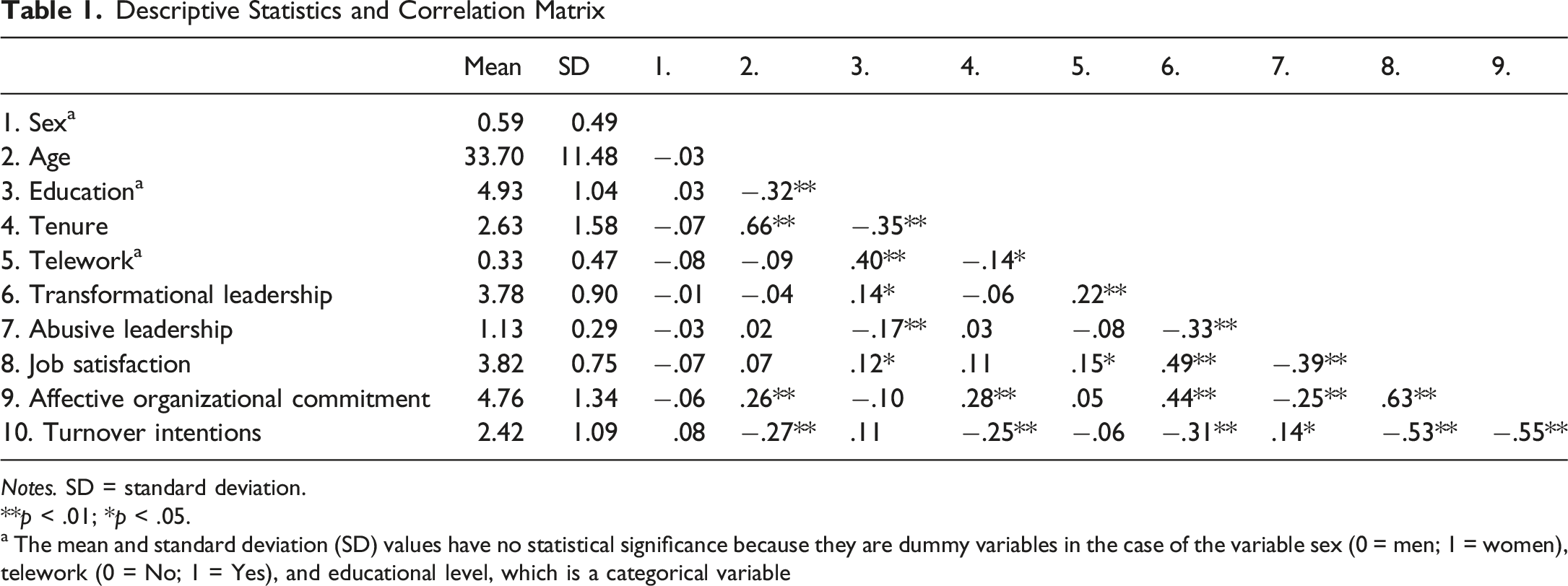
Notes. SD = standard deviation.
**p < .01; *p < .05.
a The mean and standard deviation (SD) values have no statistical significance because they are dummy variables in the case of the variable sex (0 = men; 1 = women), telework (0 = No; 1 = Yes), and educational level, which is a categorical variable
The correlations among the studied variables were consistent with expectations (Table 1). Transformational leadership was positively correlated with job satisfaction (r = .49, p < .01) and affective organizational commitment (r = .44, p < .01) and negatively correlated with turnover intentions (r = −.31, p < .01). Thus, Hypothesis 1 was supported. Abusive leadership was negatively associated with job satisfaction (r = −.39, p < .01) and affective organizational commitment (r = −.25, p < .01) and positively associated with turnover intentions (r = .14, p < .05). Thus, Hypothesis 2 was supported. Job satisfaction was positively correlated with affective organizational commitment (r = .63, p < .01) and negatively correlated with turnover intentions (r = −.53, p < .01). Affective organizational commitment was also negatively associated with turnover intentions (r = −.55, p < .01).
Several demographic variables were significantly correlated with the study variables (Table 1). Age was positively correlated with affective organizational commitment (r = .26, p < .01) and negatively correlated with turnover intentions (r = −.27, p < .01). Education was positively associated with transformational leadership (r = .14, p < .05) and job satisfaction (r = .12, p < .05) and negatively associated with abusive leadership (r = −.17, p < .01). Tenure was positively correlated with affective organizational commitment (r = .28, p < .01) and negatively correlated with turnover intentions (r = −.25, p < .01). Telework was positively linked with transformational leadership (r = .22, p < .01) and job satisfaction (r = .15, p < .05), indicating that those who work remotely tend to perceive a more transformational leader and experience higher job satisfaction than onsite workers.
Mediating Models Testing
The PROCESS macro (Model 6), with 5,000 bootstrap resamples and a 95% confidence interval, was used to test serial multiple mediation models. Two separate models were tested: (1) Transformational leadership as the independent variable (X), and (2) abusive leadership as the independent variable (X). In both models, job satisfaction (M1) and affective organizational commitment (M2) were entered as mediators sequentially, with turnover intention (Y) as the dependent variable.
Direct Effects
In the transformational leadership model, transformational leadership was positively associated with job satisfaction (β = .49, b = .41, p < .01, SE = .04, 95% CI [.33, .49]). Concerning the association between affective organizational commitment and transformational leadership and job satisfaction, the two conceptualized predictors of affective organizational commitment were significant: job satisfaction showed a strong positive effect (β = .54, b = .97, p < .01, SE = .09, 95% CI [.79, 1.15]), and transformational leadership had a smaller but positive effect (β = .18, b = .26, p < .01, SE = .08, 95% CI [.12, .41]). In the final equation for turnover intention, higher job satisfaction (β = −.32, b = −.46, p < .01, SE = .09, 95% CI [−.64, −.28]) and higher affective organizational commitment (β = −.35, b = −.29, p < .01, SE = .05, 95% CI [−.38, −.19]) were both associated with lower turnover intention. The direct path from transformational leadership to turnover intention was significant without adding the conceptualized mediating variables (β = −.31, b = −.37; p < .01, SE = .07, 95% CI [−.50, −.24]), but non-significant when the conceptualized mediating variables were added (β = .00, b = .01; p = .93, SE = .07, 95% CI [−.12, .14]) suggesting that its effect is fully mediated through the proposed mediators. Thus, Hypothesis 3 was supported. Figure 1 summarizes all the standardized paths obtained for the proposed model with transformational leadership as the predictor variable. Standardized coefficients for the proposed model with transformational leadership as the predictor variable. Note. **: p < .01; *: p < .05. The paths in the figure do not represent causal effects but only associative relationships consistent with the theory. Values in brackets correspond to values obtained after adding the mediating variables in the model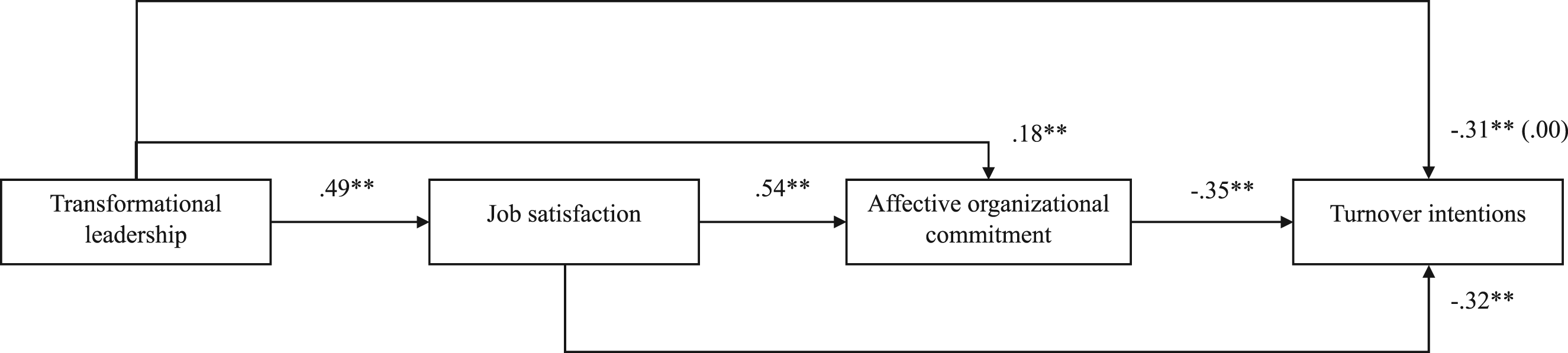
In the abusive leadership model, abusive leadership was negatively associated with job satisfaction (β = −.39, b = −1.00, p < .01, SE = .14, 95% CI [−1.27, −.74]). In the affective organizational commitment equation, job satisfaction was again a strong positive predictor (β = .63, b = 1.12, p < .01, SE = .09, 95% CI [.95, 1.29]). In contrast, the direct effect of abusive leadership on affective organizational commitment was non-significant (β = −.01, b = −.03, p = .88, SE = .22, 95% CI [−.47, .40]). In the turnover intention equation, both job satisfaction (β = −.34, b = −.50, p < .01, SE = .09, 95% CI [−.68, −.32]) and affective organizational commitment (β = −.35, b = −.29, p < .01, SE = .05, 95% CI [−.38, −.19]) predicted lower turnover intentions. The direct path from abusive leadership to turnover intention was significant without adding the mediating variables (β = .14, b = .53, p < .05, SE = .21, 95% CI [.11, .95]), but non-significant when the mediating variables were added (β = −.08, b = −.30, p = .11, SE = .19, 95% CI [−67, .06]) suggesting that the association between abusive leadership and turnover intention is largely indirect. Thus, Hypothesis 4 was supported. Figure 2 summarizes all the standardized paths obtained for the proposed model with abusive leadership as the predictor variable. Standardized coefficients for the proposed model with abusive leadership as the predictor variable. Note. **: p < .01; *: p < .05. The paths in the figure do not represent causal effects but only associative relationships consistent with the theory. Values in brackets correspond to values obtained after adding the mediating variables in the model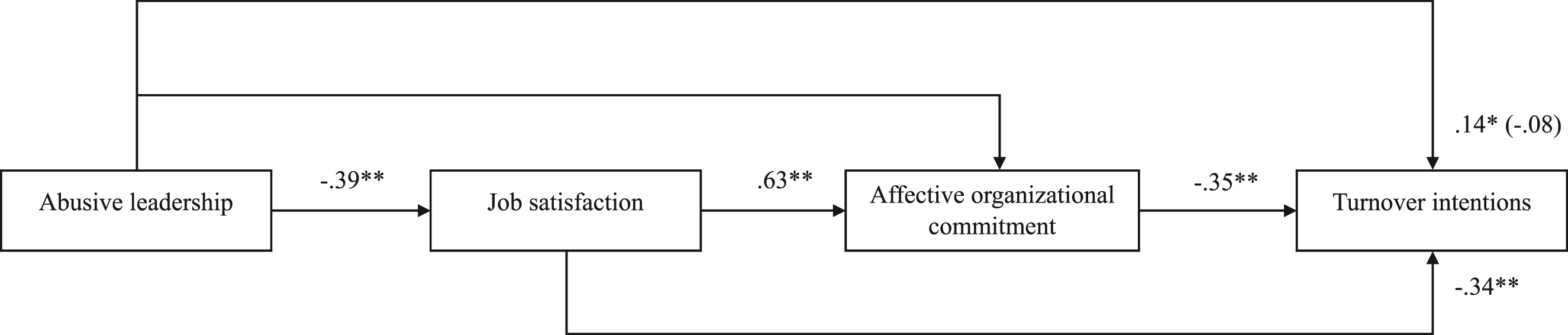
Indirect Effects
In the transformational leadership model, the total indirect effect was significant (b = −.38, 95% CI [–.49, −.28]). All specific indirect pathways were significant: via job satisfaction alone (b = −.19, 95% CI [−.29, −.10]); via affective organizational commitment alone (b = −.08, 95% CI [−.13, −.03]); and via the serial pathway through job satisfaction and affective organizational commitment (b = −.11, 95% CI [−.17, −.07]).
The total indirect effect of the abusive leadership model was significant (b = .84, 95% CI [.56, 1.15]). The specific indirect path via job satisfaction alone was significant (b = .51, 95% CI [.27, .78]); while the indirect path via affective organizational commitment alone was not significant (b = −01, 95% CI [−.10, .12]). The serial pathway through job satisfaction and affective organizational commitment was significant (b = .32, 95% CI [.18, .49]).
Discussion
The present study examined the associations between transformational and abusive leadership and employees’ turnover intentions and assessed the potential roles of job satisfaction and affective organizational commitment in these associations. Using a serial mediation analytical framework, the study contributes to the leadership and turnover literature by jointly considering positive and negative leadership styles and by evaluating whether these constructs are statistically linked through sequential patterns involving job satisfaction and affective organizational commitment. Given the cross-sectional nature of the data, the results should be interpreted as indicative of association patterns consistent with the proposed pathways rather than as evidence of causal or definitive mediating relationships.
Regarding the first hypothesis, results showed that transformational leadership was negatively associated with turnover intentions. This finding is consistent with prior research that highlights the protective role of transformational leadership against withdrawal behaviors, as it fosters employee motivation, trust, and organizational attachment (Ntseke et al., 2022; Saeed & Jun, 2022). Diko and Saxena (2023) similarly found that transformational leadership was associated with lower turnover cognitions, partly through enhanced engagement. Overall, these results are consistent with the theoretical proposition that transformational leadership, by shaping supportive and inspiring work contexts, is associated with lower turnover intentions.
The second hypothesis was also supported, as abusive leadership was positively associated with turnover intentions. This finding aligns with evidence indicating that destructive leadership behaviors undermine job satisfaction and organizational bonds, leading to increased withdrawal tendencies (Jantjies & Botha, 2024; Nunes & Palma-Moreira, 2024). Consistent with Lopes et al. (2025), the present study suggests that abusive leadership creates hostile work environments that erode trust and morale, thereby increasing employees’ desire to leave.
Regarding the third hypothesis, the results showed that job satisfaction and affective organizational commitment fully mediated the relationship between transformational leadership and turnover intentions. This pattern aligns with theoretical perspectives suggesting that constructive forms of leadership, such as transformational leadership, influence employees’ turnover intentions primarily by shaping positive work attitudes and relational bonds, namely job satisfaction and affective organizational commitment, through processes of social exchange and identification, rather than by directly triggering intentions to leave the organization (Griffeth et al., 2000; Kark et al., 2003). Transformational leaders typically provide meaning, support, and individualized consideration, which enhance the perceived quality of the work experience and strengthen employees’ attachment to the organization based on their desires (Breevaart & Zacher, 2019; Saira et al., 2021). From a social exchange perspective (Blau, 1964), supportive and respectful leader behaviors, characteristics of transformational leadership, can be interpreted as discretionary investments by the organization, thereby activating the norm of reciprocity and motivating employees to respond with positive attitudes, such as higher job satisfaction (Walumbwa et al., 2011). In addition, by signaling trustworthiness and shared values, transformational leaders foster identification with the organization and increase employees’ affective organizational commitment (Kark et al., 2003). In this sense, the observed full mediation indicates that the effects of transformational leadership are transmitted primarily through employees’ positive job evaluations, thereby increasing job satisfaction. As employees become more satisfied at work, they are likely to reciprocate with a stronger emotional bond to the organization, as reflected in increased affective organizational commitment. Then, the higher the affective organizational commitment, the lower the turnover intentions.
Finally, the fourth hypothesis was supported, as job satisfaction and affective organizational commitment mediated the association between abusive leadership and turnover intentions. Importantly, however, the predominance of job satisfaction as the key mechanism in the abusive leadership pathway is theoretically coherent when destructive leadership is conceptualized as a chronic context of resource loss and threat. Abusive leadership involves a persistent pattern of interpersonal conflicts and challenges (e.g., humiliation, blame, disrespect) that elicit negative affect and stress responses, thereby eroding employees’ overall appraisal of their work situation, as reflected in decreased job satisfaction (Tepper et al., 2017). From the perspective of conservation of resources theory (Hobfoll, 1989; Hobfoll et al., 2018), abusive leadership threatens valued resources (e.g., self-esteem, control, social standing, predictability), and withdrawal cognitions emerge as employees attempt to protect remaining resources by psychologically disengaging and considering exit (Tepper et al., 2017). This framing also explains why alternative mediators commonly found in the destructive leadership literature, such as emotional exhaustion or burnout, might also be considered (Pradhan & Jena, 2018). Specifically, abusive leadership can exacerbate exhaustion and depletion, which in turn erode job satisfaction and ultimately increase turnover intentions (Tepper et al., 2017).
Limitations and Future Research
Although this study offers valuable insights, several limitations must be recognized. First, the cross-sectional design prevents causal inference, as associations cannot establish temporal precedence. Methodological work has consistently shown that cross-sectional mediation analyses may yield biased or misleading estimates of longitudinal mediation processes and cannot empirically verify temporal precedence among variables (Cole & Maxwell, 2003; Maxwell & Cole, 2007; Maxwell et al., 2011). As a result, the proposed ordering of leadership styles, job satisfaction, affective organizational commitment, and turnover intentions should be understood as theoretically derived rather than empirically confirmed. Thus, future research employing longitudinal or experimental designs would help more robustly test the mediating role of job satisfaction and affective organizational commitment in the leadership-turnover relationship. Second, all data were collected via employee self-reports at a single point in time, an inherent limitation that raises the possibility of common method variance. Although self-reported measures were appropriate, given that the focal constructs capture employees’ perceptions of leadership behaviors and job-related attitudes grounded in personal experiences, such perceptual assessments may nonetheless be influenced by shared affective or cognitive biases. For instance, individuals’ generalized evaluative tendencies or transient affective states may shape concurrent appraisals of leadership and work-related attitudes, potentially inflating observed associations. To mitigate these concerns, several procedural and statistical remedies were implemented in line with the methodological recommendations of Podsakoff et al. (2003, 2012). Specifically, respondents were assured of anonymity and confidentiality, informed that there were no right or wrong answers, and survey items were presented in a counterbalanced order. In addition, we conducted Harman’s single-factor test and confirmatory factor analyses, whose results suggest that common method variance is unlikely to fully account for the observed relationships. Nevertheless, the possibility of residual method bias cannot be ruled out entirely. Accordingly, future research should employ multi-source and/or multi-wave designs, such as combining employee self-reports with supervisor ratings or objective indicators, to further distinguish perceptual biases from substantive relationships and to strengthen causal inferences (Gallegos et al., 2022). Third, although key demographic characteristics of the sample were reported, finer-grained information on participants’ job categories, industries, and organizational contexts was unavailable. The data collection protocol prioritized respondent anonymity and confidentiality and sought to minimize response burden, which constrained the amount of organizationally identifiable information that could be collected. As a result, caution is warranted when interpreting the findings across specific occupational or industry contexts. Future studies would benefit from collecting more detailed contextual descriptors to examine whether the observed relationships vary across job roles, industries, or organizational settings. Fourth, the study was conducted in Portugal, which may limit generalizability to other cultural settings. As such, the current findings should be interpreted in light of their cultural context. Conducted within a Portuguese sample, the findings reflect leadership perceptions embedded in a societal context characterized by moderate collectivism and relatively high power distance, a cultural configuration shared with several Southern European countries, such as Spain, Italy, and Greece, which may influence employees’ responses to both transformational and abusive supervisory behaviors (Akaliyski et al., 2026). Comparative research suggests that leadership effects and their underlying mechanisms vary across cultures, limiting the direct generalization of the present pattern of associations to contexts with different cultural profiles (Den Hartog & De Hoogh, 2024; Rockstuhl et al., 2023). Future research should replicate the proposed model across diverse cultural settings using longitudinal or multi-wave designs to examine whether these relationships hold under different societal norms and leadership expectations. Finally, future research could extend the model by examining additional variables that may help explain or condition the observed associations. Variables such as psychological safety, resilience, and perceived organizational support may be relevant correlates that further illuminate the relationships between leadership and turnover intentions (Djourova et al., 2020; Siyal, 2023). Similarly, individual differences, such as emotional intelligence and self-efficacy, could serve as boundary conditions, potentially altering the strength or direction of these associations (Bui et al., 2024; Tian & Guo, 2024). Investigating such contingencies, particularly using longitudinal or multi-method designs, would help clarify the temporal ordering and robustness of these relationships, thereby refining our understanding of when and for whom leadership styles are most consequential for retention outcomes.
Theoretical and Practical Contributions
This study advances research on leadership and turnover by exploring the links between transformational and abusive leadership and turnover intentions. While transformational leadership has been studied in relation to positive organizational outcomes, abusive leadership has more recently gained attention as a distinct concept, often examined separately. By considering both leadership styles, this study extends theoretical frameworks that account for the dual nature of leadership (i.e., constructive and destructive) and their distinct pathways to turnover intentions. Furthermore, the results contribute to the literature by showing that job satisfaction and affective organizational commitment mediate these associations, thereby reinforcing the central role of work attitudes in the leadership-turnover relationship.
From a practical perspective, the findings underscore the importance of actively cultivating transformational leadership behaviors while systematically preventing and correcting destructive leadership practices. Beyond general leadership development, organizations may benefit from implementing evidence-based interventions that have been shown to shape leader behavior. For instance, leadership coaching and structured 360-degree feedback processes can enhance leaders’ self-awareness, reinforce transformational behaviors such as inspirational motivation and individualized consideration, and reduce harmful conduct (Aasland et al., 2010; Bass & Riggio, 2006). Such interventions enable leaders to align their behavior more closely with employees’ expectations for support, fairness, and empowerment, thereby strengthening job satisfaction and affective organizational commitment. In parallel, organizations may consider preventive initiatives to identify and mitigate destructive leadership patterns early. Civility training and behavioral assessment tools have been shown to reduce abusive supervision and interpersonal mistreatment by clarifying behavioral norms and increasing accountability (Tepper et al., 2017). Embedding these practices in leadership development programs, performance appraisal systems, and promotion criteria may help organizations discourage harmful leadership behaviors that erode trust and morale. Collectively, these targeted interventions provide actionable pathways for HR practitioners and organizational leaders to translate the study’s findings into retention-focused strategies by fostering healthier leadership climates and reducing employees’ intentions to leave.
Conclusion
The findings add to the growing body of research emphasizing the dual pathways through which leadership styles influence turnover intentions. This study broadens the literature by concurrently analyzing transformational and abusive leadership within a serial mediation framework. It highlights the vital role of job satisfaction and affective organizational commitment as mechanisms linking leadership styles with employees’ intention to leave.
Footnotes

Ethical Considerations
This study was conducted following the Declaration of Helsinki. It was approved by the Scientific Council of the Portuguese Catholic University (UCP-2025-016) on January 28, 2025, ensuring compliance with ethical research guidelines. All participants provided informed consent.
Funding
The authors received no financial support for the research, authorship, and/or publication of this article.
Declaration of Conflicting Interests
The authors declared no potential conflicts of interest with respect to the research, authorship, and/or publication of this article.
Data Availability Statement
The data supporting this study’s findings are available from the corresponding author upon reasonable request. Although the dataset is fully anonymized, access is restricted due to institutional agreements with participating organizations. Qualified researchers may obtain access for academic purposes upon request (Aasland et al., 2010; Abdallah & Mostafa, 2021; Ahmad et al., 2023; Akaliyski et al., 2026; Alsadaan & Alqahtani, 2024; Badar et al., 2023; Bakkal et al., 2019; Bass, 1999; Bass & Avolio, 1994; Bass & Riggio, 2006; Bastari et al., 2020; Blau, 1964; Bou Reslan et al., 2025; Bozeman & Perrewé, 2001; Brayfield & Rothe, 1951; Breevaart & Zacher, 2019; Bui et al., 2024; Carless et al., 2000; Chua & Ayoko, 2021; Cole & Maxwell, 2003; Den Hartog & De Hoogh, 2024; Diko & Saxena, 2023; Djourova et al., 2020; Falatah & Conway, 2019; Gallegos et al., 2022; Griffeth et al., 2000; Hermanto et al., 2024; Hobfoll, 1989; Hobfoll et al., 2018; Hoch et al., 2018; Hom & Griffeth, 1991; Jacobsen et al., 2021; Jantjies & Botha, 2024; Jensen et al., 2019; Kark et al., 2003; Kostick & Zhu, 2023; Labrague et al., 2020; Lee et al., 2024; Lopes et al., 2025; Luz et al., 2018; Marchant-Pérez et al., 2024; Mathieu & Zajac, 1990; Maxwell et al., 2011; Maxwell & Cole, 2007; Meyer et al., 2002; Meyer & Allen, 1991, 1997; Mobley, 1977; Moreira et al., 2020; Morris, 2019; Mrayyan, 2025; Nascimento et al., 2008; Nielsen et al., 2023; Ntseke et al., 2022; Nunes & Palma-Moreira, 2024; Ofei et al., 2023; Oliveira & Najnudel, 2023; Padilla et al., 2007; Pathardikar et al., 2025; Podsakoff et al., 2003, 2012; Pradhan & Jena, 2018; Rockstuhl et al., 2023; Saeed & Jun, 2022; Saira et al., 2021; Saleem et al., 2021; Schmidt, 2014; Scholl & Schermuly, 2020; Schyns & Schilling, 2013; Sharma & Tiwari, 2023; Shibiti, 2019; Sinval & Marôco, 2020; Siyal, 2023; Tepper, 2000; Tepper et al., 2017; van Beveren, 2015; Walumbwa et al., 2011; Webster et al., 2016; Weiss, 2002; Yuwono et al., 2023).