




Abstract
Despite substantial gender equality in highly gender-egalitarian countries like Germany, perceptions of persistent inequality remain widespread. We examine systematic perception gaps that may explain this disconnect. In a survey of 735 German adults, participants reported their perceived societal and personal gender inequality, estimated others’ perceptions, and indicated their attitudes toward gender equality measures. Both women and men perceived women as less fairly treated than men. Women reported a classic person–group discrepancy, perceiving more inequality in society than in their own lives, and projected this discrepancy onto ‘average women.’ This projection, combined with systematic misperceptions of others’ beliefs forms what we term a pluralistic illusion: the logically incoherent belief that most others perceive more inequality in society than people personally experience. We also find a better-than-average effect such that participants see themselves as more supportive of gender equality than the average person. Finally, both men and women substantially underestimated men’s support. In combination, these perception gaps may help explain persistent, polarized debates about gender equality in egalitarian societies.
Keywords
In both society and academia, gender equality has become a widely recognized priority, as reflected in the agendas of global institutions such as the United Nations and the World Health Organization, as well as in the growing number of academic publications on the topic (Belingheri et al., 2021). Established indices measuring national levels of gender inequality, such as the Global Gender Gap Index (World Economic Forum, 2024) and the European Index of Gender Equality (European Institute of Gender Equality, 2024), suggest that no country has yet achieved full gender equality. However, there is no consensus: other indices, such as the Gender Inequality Index (United Nations, 2024) suggest that many countries have come close to full equality, with only minimal gaps remaining. Yet other indices, such as the Gender Development Index (GDI; United Nations, 2025), suggest that in some countries there has even been a gender gap reversal. In fact, according to the GDI about 15% of countries showed a gap in favor of women (United Nations Development Programme, 2025, p. 288). Moreover, in several domains where women historically faced disadvantage, men now face disadvantage (e.g., university degrees, hiring discrimination, Stoet & Geary, 2019; Schaerer et al., 2023; Reeves, 2022). These different viewpoints arise because measures of societal gender inequality are not entirely objective. While they typically include a range of quantifiable indicators, such as gender differences in access to education, birth ratios, life expectancy, and political representation, there is subjectivity in the choice, weighing, and truncation of indicators (Stoet & Geary, 2019).
Beyond academic research, there is widespread societal awareness of gender inequality, as reflected in media coverage, social media discussions, and debates in schools and universities (Bleske-Rechek et al., 2024; Ceci et al., 2023; Ceci & Williams, 2011; Herlitz et al., 2025; Stern & Madison, 2022; Stewart-Williams et al., 2021; Williams & Ceci, 2015). These public debates and broader societal narratives may shape people’s own personal perceptions of gender inequality in their society. This can create a disconnect between national indicators of gender equality, which may reflect relatively low levels of inequality, and subjective perceptions of inequality, which may reflect relatively high levels of inequality. We aim to help explain this disconnect by examining several perception gaps, which in unison may contribute to relatively high perceived gender inequality in the most egalitarian countries. This in turn may, vice versa, help explain the pervasiveness of debates around gender equality in these countries.
Specifically, we investigate multiple types of perception gaps that are well known to social psychology, namely the person-group discrepancy (Crosby, 1984), pluralistic ignorance (Katz & Allport, 1931), and the better-than-average effect (Zell et al., 2020) in the context of gender equality in Germany. Germany is among the topmost gender-equal countries. It ranks seventh out of 146 countries, according to the Global Gender Gap Report (World Economic Forum, 2024). Nevertheless, Germany exhibits high levels of perceived gender inequality (Li et al., 2022; Ludwig et al., 2024; Sevincer et al., 2023).
The person-group discrepancy occurs when people perceive more inequality in society at large than they report experiencing in their personal life (Crosby, 1984; Moghaddam et al., 1997; Taylor et al., 1990). It has been suggested that the person-group discrepancy involves misperceptions of either societal inequality, personal inequality, or both (Kessler et al., 2000). Pluralistic ignorance refers to a widespread perception gap of how prevalent people believe a particular view is in their own group. That is for example, when people believe that the members of their group hold a particular view when, in fact, most members do not (Katz & Allport, 1931; Krech & Crutchfield, 1948; Prentice & Miller, 1993; Sevincer et al., 2025; reviews by Miller, 2023; Sargent & Newman, 2021). Finally, the better-than-average describes the tendency for people to view themselves more positively than the average person, for example, perceiving themselves as more caring and supportive (Alicke & Govorun, 2005; Svenson, 1981; Zell et al., 2020).
Overview of the Concepts From the Introduction
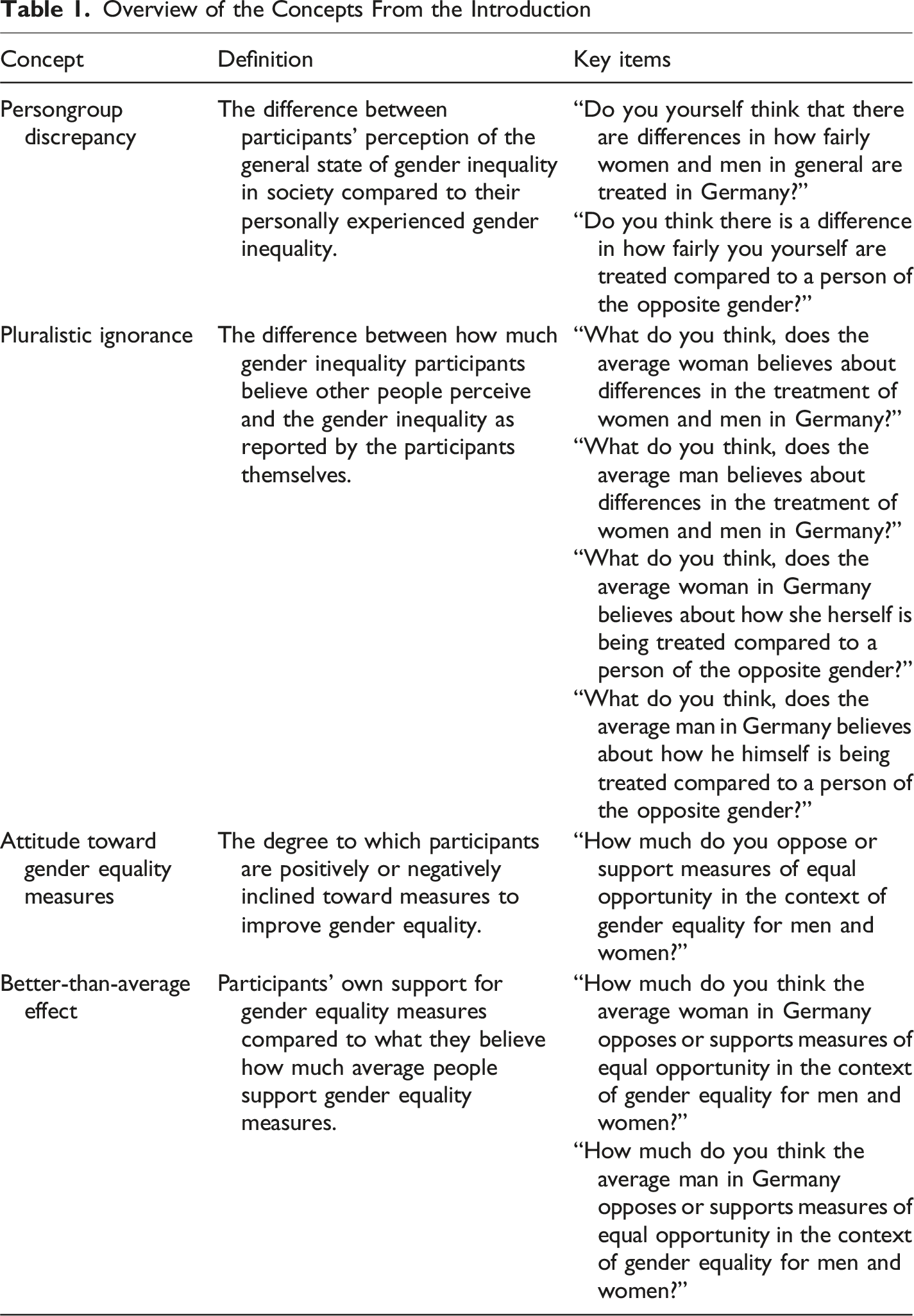
Crucially, our study goes beyond these well-established phenomena by examining them all together in the context of gender inequality, and by uncovering a novel pattern we call the pluralistic illusion. This illusion emerges when participants project their perception that there is more gender inequality in society than they personally experience onto others. That is, they believe that most others in their own gender group also perceive more societal inequality than personal inequality. However, this belief is logically impossible: If most people believe that most other people perceive higher inequality in society than they personally experience, this would suggest that the overall perceived societal inequality is higher than the overall personally experienced inequality. This incoherent belief may help explaining the disconnect between high perceived societal inequality and low inequality measured by the gender inequality indicators. In summary, we test for the presence of three well-known perception gaps, and introduce the pluralistic illusion as a distinct, complementary fourth one.
Method
Participants and Recruitment
We recruited a sample of 825 adult participants from Germany (aged from 18 to 83, including 473 women) to obtain a diverse sample, we used three different sampling methods. First, we recruited 245 participants from a pedestrian zone in a mid-sized town in northern Germany (population ∼75,000). One female and one male experimenter randomly approached passers-by and asked them whether they would be interested in participating in a study on “current trends in society.” Participants learned that they would fill out a short questionnaire and receive €1 for taking part. Second, we recruited 311 participants from Germany via the online-recruiting platform Prolific. Participants could sign up for the study on “current trends in society.” We used a pre-screening option in Prolific to recruit a balanced gender ratio. Third, we recruited 269 students from a medium-sized public German university via the university’s online recruitment system. Participants could sign up for the study on “current trends in society.” They were informed that they would complete a short online questionnaire and receive course credits for their participation. Supplemental Table 1 provides detailed demographic information on the sample.
Following the criteria specified in our preregistration, we excluded 90 participants (10.9%): Forty-three for completing less than half of the questionnaire, 36 for failing the attention check (a question asking participants to answer in a specific way, ensuring they actually read the question), and 11 who selected “diverse” as their gender or did not indicate their gender as our focus was on women’s versus men’s perceptions of gender equality. This resulted in a sample consisting of 735 participants (450 female, 285 male; Mage = 30.4 years, SD = 13.5). The exclusion did not change the pattern of results (see Supplemental Material).
Sensitivity analyses using G*power (Faul et al., 2009) for a mean difference between two independent groups (men vs. women) yielded that with our gender distribution, an alpha level of p = .05 (two-tailed), we could detect an effect size of d = 0.27 with 95% power. Moreover, with this sample size observed correlations between variables remain stable (Schönbrodt & Perugini, 2013). The study used a quasi-experimental, correlational, cross-sectional design. The preregistration, data, code, and complete materials are available at: https://shorturl.at/apQZs.
Materials
Perceived Societal Inequality Measures
To measure participants’ estimates of how much inequality women and men in general experience in society we used validated measures (Sevincer et al., 2023). Specifically, we asked: “Do you yourself think that there are differences in how fairly women and men in general are treated in Germany? I think…” We used a bipolar 7-point scale (1 = women are treated a lot less fairly; 4 = both genders are treated about equally fairly; 7 = men are treated a lot less fairly).
To measure participants’ estimates of how much societal inequality others perceive we asked “What do you think, does the average woman believes about differences in the treatment of women and men in Germany? I think the average woman believes…” (7-point bipolar scale: 1 = women are treated a lot less fairly; 4 = women and men are treated equally fairly; 7 = men are treated a lot less fairly). We added an analogous item for participants’ perceptions of what the average man believes. Following previous studies on pluralistic ignorance (Prentice & Miller, 1993), we kept the wording of these items as close as possible to the item assessing participants’ own beliefs. Moreover, because previous work indicated that the item order does not influence results (Prentice & Miller, 1993; Van Boven, 2000), we kept the item order the same for all participants. We recoded the perceived societal inequality measures so that higher number indicate women are treated less fairly.
Perceived Personal Inequality Measures
To measure how much gender inequality participants personally experience, we employed the following item that was successfully used in previous research (Sevincer et al., 2023): “Do you think there is a difference in how fairly you yourself are treated compared to a person of the opposite gender? If you are a woman, do you believe you yourself are treated more or less fairly than men? If you are a man, do you believe you yourself are treated more or less fairly than women?” We used a bipolar 7-point scale (1 = I am treated a lot less fairly; 4 = I am treated about equally fairly; 7 = I am treated a lot more fairly).
To measure participants’ estimates of how much personal inequality others experience, we asked: “What do you think, does the average woman in Germany believes about how she herself is being treated compared to a person of the opposite gender? I think the average woman believes…” (7-point bipolar scale: 1 = she is treated a lot less fairly; 4 = she is treated about equally fairly; 7 = she is treated a lot more fairly). An analogous item measured participants’ beliefs about what the average man experiences. We recoded all perceived personal inequality variables so that higher number indicate women are treated less fairly.
Attitudes Toward Gender Equality Measures
To measure participants’ own attitudes toward supporting gender equality, we used the following item from Sevincer et al. (2023): “How much do you oppose or support measures of equal opportunity in the context of gender equality for men and women?” (7-point bipolar scale; 1 = I am extremely opposed toward measures of equal opportunity; 4 = I am neither opposed nor supportive of measures of equal opportunity; 7 = I am extremely supportive of measures of equal opportunity).
To measure participants’ beliefs about others’ attitudes, we asked: “How much do you think the average woman in Germany opposes or supports measures of equal opportunity in the context of gender equality for men and women? I think, the average woman…” (bipolar 7-point scale; 1 = is extremely opposed toward measures of equal opportunity; 4 = is neither opposed nor supportive of measures of equal opportunity; 7 = is extremely supportive of measures of equal opportunity). We added an analogous item to measure participants’ beliefs about what the average man believes.
Attention Check, Subjective Socioeconomic Status, and Political Orientation
As an attention check, we asked: “Please select ‘6’ to indicate that you read the question completely.” (7-point scale, 1 = strongly disagree, 4 = neither/nor, 7 = strongly agree). Because perceptions of inequality may be influenced by people’s position within a society and their political orientation, we also measured subjective socioeconomic status (SES) and political orientation. To measure subjective SES, we employed the widely used MacArthur scale, a single pictorial item in which participants mark their perceived rank relative to others in their society on the rungs of a depicted ladder (10-point scale; Adler et al., 2000, To measure political orientation, we used one item from Conway et al. (2012) that we considered well suited for the German political landscape. Participants completed the statement: “Based on what I know about politics I am most likely to vote…” on a 7-point scale (1 = left-wing; 7 = right-wing). For the analyses, we reverse-coded this item so that higher scores indicate a more left-wing orientation. To conclude, participants provided demographic information, including their age, gender, ethnic background, and religion.
Results
First, we report estimates of societal gender inequality (“Do you yourself think there are differences in how fairly women and men in general are treated in Germany?”). Both female and male participants estimated that women, in general, are less fairly treated than men (Mdiff = 1.37, 95% CI [1.30, 1.45], p < .001, d = 1.27). However, female participants estimated that women were much less fairly treated than men believed this to be the case t (728) = 8.11, 95% CI [−0.85, −0.64], p < .001 (Figure 1). Perceived societal gender inequality among women and men in Germany.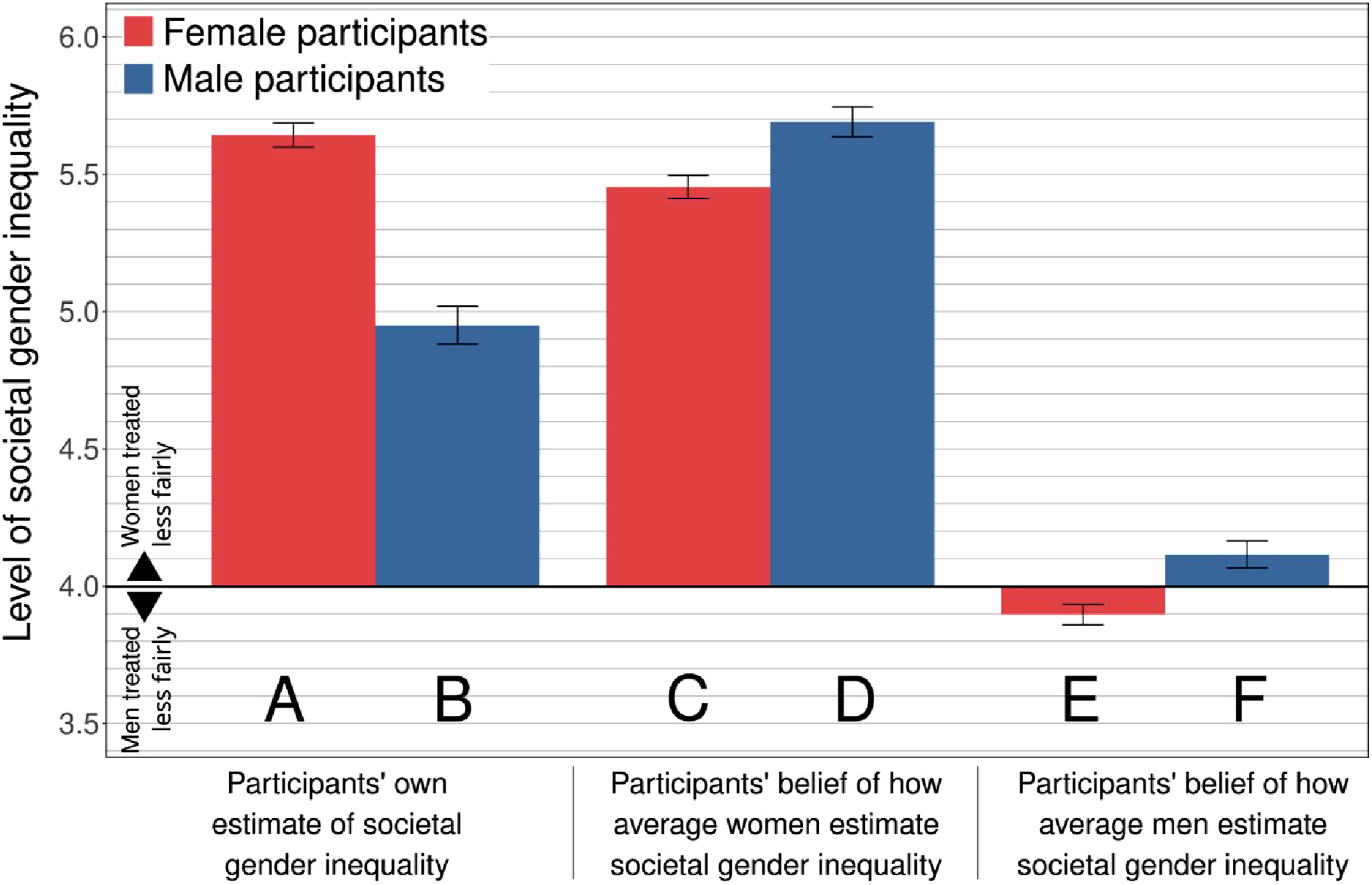
Perceived Societal Inequality
We first compared participants’ own estimates of societal gender inequality in Germany with their beliefs about how others perceive it (e.g., “What do you think, does the average woman believe about differences in the treatment of women and men in general in Germany,” Figure 1). Female participants estimated societal gender inequality to be higher themselves than what they believed average women would perceive (Mdiff = 0.19, 95% CI [0.09, 0.29], p < .001, d = 0.18), and substantially higher than what they believed average men would perceive (Mdiff = 1.75, 95% CI [1.64, 1.86], p < .001, d = 1.49). Male participants also estimated societal gender inequality to be higher than what they believed average men would perceive (Mdiff = 0.73, 95% CI [−0.91, −0.58], p < .001, d = 0.54). However, they believed that average women would perceive even higher societal gender inequality than they themselves did (Mdiff = 0.84, 95% CI [0.68, 0.99], p < .001, d = 0.65).
Perceived Personal Inequality
So far, we have focused on participants’ estimates of societal gender inequality (“Do you think that there are differences in how fairly women and men in general are treated in Germany?”). Next, we focused on participants’ own personal experiences of gender inequality (“Do you think there is a difference in how fairly you yourself are treated compared to a person of the opposite gender?”). Female participants believed that they were personally treated less fairly than men, (one-sample t-test from 7-point scale midpoint 4 = equality: Mdiff = 0.79, 95% CI [−0.88, −0.70], p < .001, d = 0.83; Figure 2). However, this reported personal inequality was lower than the inequality they perceived in the society at large (Mdiff = 0.84, 95% CI [−0.93, −0.76], p < .001, d = 0.92) – the person-group discrepancy. Perceived societal versus personally experienced gender inequality: Women’s beliefs.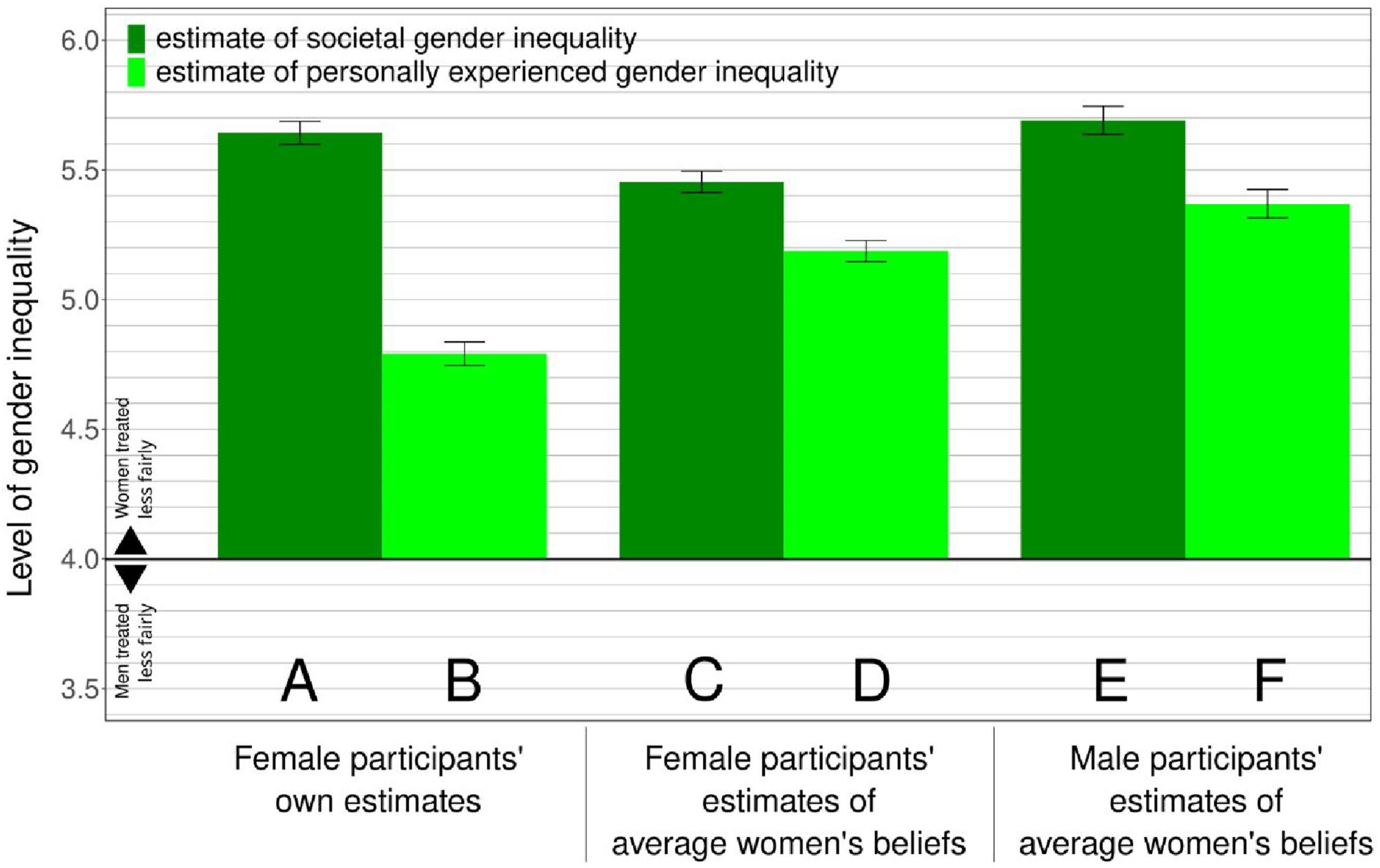
Importantly female participants’ estimated that average women’s personal experience was even worse (“What do you think, does the average woman in Germany believe about how she herself is being treated compared to a person of the opposite gender?”; one-sample t-test from 7-point scale midpoint; Mdiff = 1.19, 95% CI [1.11, 1.27], p < .001, d = 1.37; difference between female participants’ own experience and their estimate of average women’s experience: Mdiff = 0.40, 95% CI [0.30, 0.50], p < .001, d = 0.36). In contrast, male participants reported that they were personally treated more fairly than women (one-sample t-test from 7-point scale midpoint; Mdiff = −0.23, 95% CI [−0.34, −0.11], p < .001, d = 0.22; Supplemental Figure 1), but estimated that average men would believe being personally treated less fairly than women (Mdiff = −0.12, 95% CI [−0.22, −0.03], p = .01, d = 0.15). Thus, both male and female participants believed that on average the experience of other people in their own gender group was worse than their own experience.
Projected Person Group Discrepancy: Pluralistic Illusion
One could argue that female participants’ estimation of average women personally experiencing more gender inequality than they themselves suggests that female participants see themselves as part of a privileged group of women who are relatively less affected by inequality. However, this interpretation clashes with the finding that female participants also believed that average women perceive more societal gender inequality than the women personally experience (Mdiff = 0.27, 95% CI [−0.19, 0.35], p < .001, d = 0.30, Figure 2). Male participants show an analogous belief pattern: They believe that average women perceive more societal inequality than the women personally experience (Mdiff = 0.32, 95% CI [0.21, 0.44], p < .001, d = 0.33).
Attitudes Toward Gender Equality Measures
Finally, we analyzed attitudes toward promoting gender equality (“How much do you oppose or support measures of gender equality for men and women”). Female participants supported gender equality measures more strongly than male participants (Mdiff = 0.88, 95% CI [−1.06, −0.69], p < .001, d = 0.71, Figure 3). Support for measures promoting gender equality, as estimated by female participants and male participants.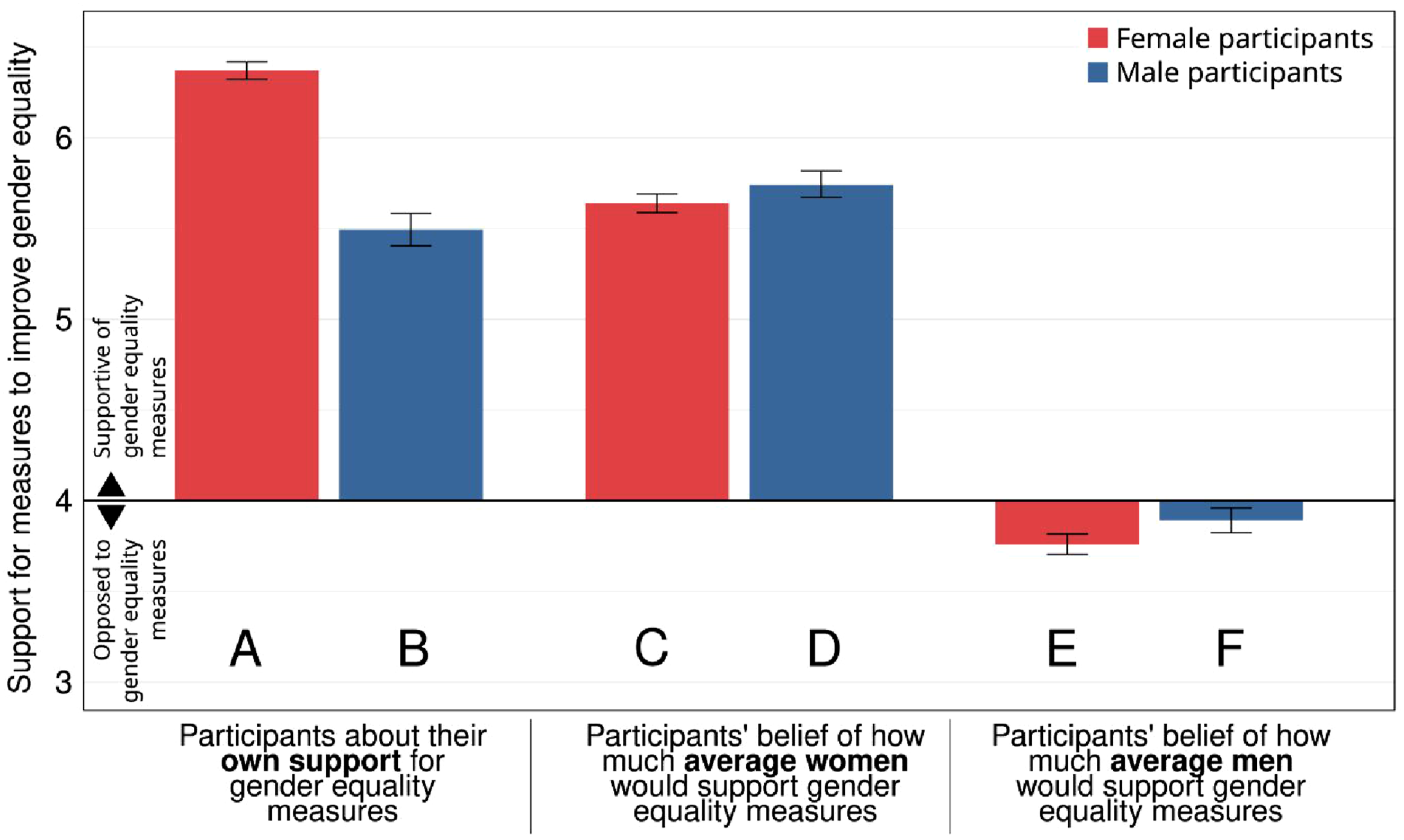
Interestingly, female participants believed that average women support gender equality measures less than themselves (Mdiff = 0.73, 95% CI [0.62, 0.85], p < .001, d = 0.58). Male participants, conversely, believed that average women support gender equality measures more than themselves (Mdiff = −0.25, 95% CI [−0.44, −0.05], p = .01, d = 0.15). Strikingly, both female and male participants severely underestimated average men’s support for gender equality measures (females: Mdiff = 1.74, 95% CI [1.54, 1.93], d = 1.31; males: Mdiff = 1.60, 95% CI [1.41, 1.80], d = 0.96). Indeed, participants believed average men would oppose gender equality measures, whereas in reality, the male participants expressed strong support.
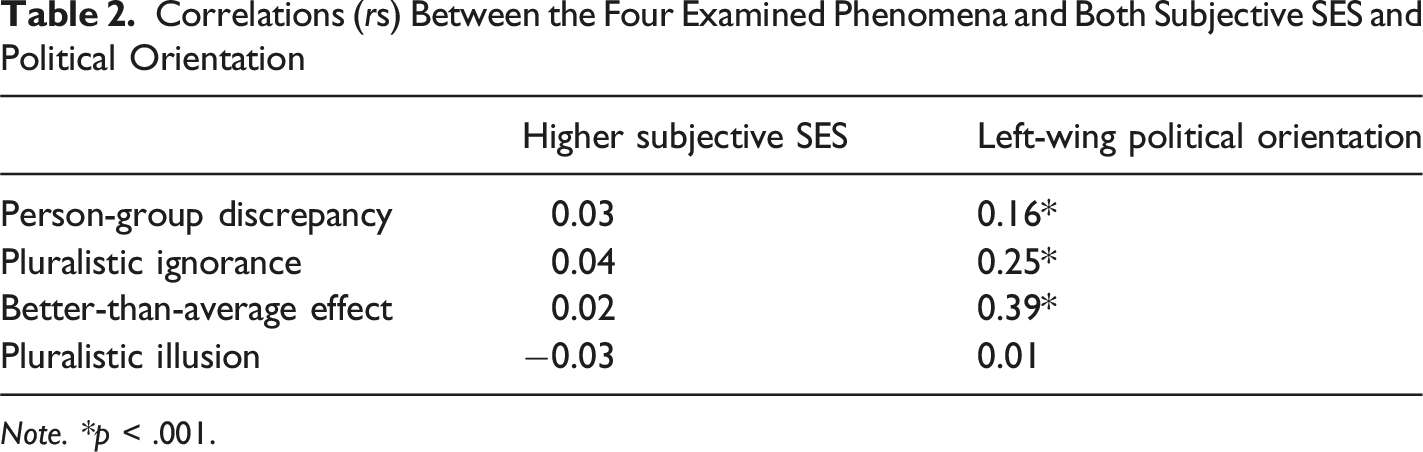
Subjective Socioeconomic Status and Political Orientation
Correlations (rs) Between the Four Examined Phenomena and Both Subjective SES and Political Orientation
Note. *p < .001.
Discussion
This study revealed systematic perception gaps in how people view gender inequality and support for gender equality. On average, participants believed that women in general are treated less fairly than men and estimated that average women would strongly share this view. By contrast, both male and female participants believed that average men would not perceive much societal inequality, even though the male participants in our sample actually did (Figure 1). This finding extends research on pluralistic ignorance by showing that male and female participants substantially underestimate the degree to which men perceive gender inequality in their society.
Furthermore, female participants perceived more inequality in society overall than they reported personally experiencing. This finding replicates the person–group discrepancy found in previous research. Going beyond prior work, participants also believed that average women experienced much more personal inequality than the female participants themselves reported experiencing and, crucially, that average women would perceive more inequality in society overall than they personally experienced (Figure 2). In other words, there was not only a gap between female participants’ estimates of societal inequality and their personally experienced inequality, but participants projected this gap onto average women. This creates a logical paradox: Although it is possible that there is more inequality in society overall than some women personally experience, it is statistically impossible that there is more inequality in society than all women personally experience. We refer to this phenomenon as a pluralistic illusion: the logically incoherent meta-belief that most people believe that there is more inequality in society than they personally experience. This phenomenon may help explain the disconnect between relatively high perceived societal inequality and comparatively low inequality as measured by standard gender inequality indicators in gender-egalitarian countries.
Finally, we found evidence of a better-than-average effect with both female and male participants believing that they were more supportive of gender equality than others in their gender group. Notably, both male and female participants underestimated men’s support for gender equality to such a degree that they believed that average men oppose gender equality measures, when in fact the male participants in our study strongly supported such measures (Figure 3). This is in line with earlier findings that people underestimate how much men recognize gender bias as a problem (De Souza & Schmader, 2022). We argue that our finding is the opposed of the known stereotypical “women are wonderful” effect (Eagly & Mladinic, 1994), namely a stereotypical “men are terrible” effect. This pattern highlights an extreme asymmetry in views on gender inequality that may have implications for intergroup dialogue and public discourse.
Taken together, these phenomena may help explain why addressing gender inequality can feel especially pressing: not only because of its objective status, but also because people, particularly women, perceive high inequality while believing that others, particularly men, either do not share their perceptions or are indifferent to the problem. As a result, gender inequality remains a highly charged and contested topic, even in societies with relatively high measured equality.
Limitations and Future Directions
No study comes without limitations. First, because we used three different samples from Germany: pedestrians, Prolific users, and students, our sample is not entirely representative of the German population, which limits the generalizability of our findings. Future work should use stratified sampling methods to obtain nationally representative samples. We stress that our results provide only preliminary evidence for the pluralistic illusion, and future work should examine the robustness and generalizability of the findings.
Second, we focused on one single country that is ranks high on indicators of gender-equality: Germany. Future work should examine whether the same phenomenon will be found in other highly gender-egalitarian countries in which people report high perceived inequality (e.g., Sweden; Martinsson et al., 2017). One should also conduct cross-cultural studies involving non-WEIRD countries (Western, Educated, Industrialized, Rich, Democratic; Henrich et al., 2010) to compare perception gaps between countries with various degrees of gender equality.
Third, as with all self-report research on socially sensitive topics, there is a risk of social desirability bias for some of our measures. For example, participants underestimated others’ support for gender equality, yet it remains possible that their own support was inflated because they wanted to present themselves positively. However, this limitation generally applies to research on above-average effects and pluralistic ignorance. Moreover, for many of our measures it is not clear what the socially desirable response would be: Is perceiving high gender inequality more socially desirable than low gender equality, or the other way round?
Fourth, our study measured several similar and related concepts, such as perceived personal inequality, perceived societal inequality, and beliefs about average people’s perceptions of inequality. Future work may use longitudinal or experimental designs to examine whether these perceptions influence each other. For example, whether how much inequality people believe average people perceive influences their own perceptions of inequality or whether, vice versa, they project their own perceptions onto their estimates of other people’s perceptions.
Fifth, future work should measure domain-specific perceptions of inequality (e.g., workplace, education, politics, domestic life, etc.) to examine whether some domains are more influential in driving people’s overall perception of inequality than others, and whether the pattern of results emerges for some domains rather than others.
Finally, because we were interested in how much inequality women and men perceive compared to each other, we did not analyze participants who identified as non-binary or diverse. Future work may investigate perceived gender inequality in these groups.
Conclusion
We propose an explanation for why people perceive high gender inequality in the most gender-egalitarian societies, even though indexes of gender equality suggest otherwise. Specifically, people hold the logically incoherent belief that they and others perceive high social inequality, although their own experiences do not align with this view – a pluralistic illusion. Moreover, both women and men believe that men, in general, oppose gender equality, even though men actually express strong support for it. These phenomena may help explain why debates about gender equality remain so prominent, charged, and contested.
Supplemental Material
Supplemental Material - The Pluralistic Illusion of Gender Inequality
Supplemental Material for The Pluralistic Illusion of Gender Inequality by A. Timur Sevincer, Gijsbert Stoet in Psychological Reports.
Footnotes
Acknowledgments
We gratefully acknowledge the help of Chiara Korn, Annika Meyer, and Gülperi Yesildas with collecting the data.
Funding
The authors disclosed receipt of the following financial support for the research, authorship, and/or publication of this article: This research was supported in part by a fellowship by the Hanse-Wissenschaftskolleg - Institute for Advanced Study (HWK) for ATS and GS acknowledges support from the Institute for Advanced Study (Delmenhorst, Germany) to work on this study.
Declaration of Conflicting Interests
The authors declared no potential conflicts of interest with respect to the research, authorship, and/or publication of this article.
Data Availability Statement
The preregistration, data, code, and complete materials are available at: https://osf.io/rpajc by 
Supplemental Material
Supplemental material for this article is available online.
Author Biographies
References
Supplementary Material
Please find the following supplemental material available below.
For Open Access articles published under a Creative Commons License, all supplemental material carries the same license as the article it is associated with.
For non-Open Access articles published, all supplemental material carries a non-exclusive license, and permission requests for re-use of supplemental material or any part of supplemental material shall be sent directly to the copyright owner as specified in the copyright notice associated with the article.
