




Abstract
Self-forgiveness plays a crucial role in mitigating self-directed blame and enhancing psychological well-being. While prior research has linked self-compassion to self-forgiveness, the extent to which distinct self-compassion components contribute to self-forgiveness over time has not been systematically examined. The study aimed to assess the extent to which different dimensions of self-compassion (self-kindness, self-judgment, common humanity, isolation, mindfulness, and over-identification) predict initial levels and growth trajectories of dispositional self-forgiveness over time employing a linear growth curve. A three-wave longitudinal study (with two-month intervals) was conducted with 164 Polish adults, predominantly Catholics. Dispositional self-compassion and self-forgiveness were assessed using validated Polish adaptations of the Self-Compassion Scale and Toussaint Self-Forgiveness Scale. Self-kindness was positively associated with higher baseline self-forgiveness (β = .27, p = .02), whereas isolation significantly predicted a slower increase in self-forgiveness over time (β = −.17, p = .026). The final model explained 80% of the variance in self-forgiveness at the last wave, with significant individual variability in growth trajectories. The study highlights the therapeutic potential of fostering self-kindness and reducing social disconnection to support self-forgiveness as a phenomenon commonly associated with healthier psychological adaptation.
Introduction
Self-forgiveness mitigates self-directed blame and promotes psychological well-being (Skalski-Bednarz et al., 2024; Toussaint et al., 2024). It is a multidimensional process involving cognitive, emotional, and behavioral shifts from self-condemnation to a more balanced self-view (Hall & Fincham, 2005). This requires acknowledging wrongdoing, experiencing appropriate guilt or remorse, and fostering self-acceptance without excessive self-punishment (Skalski-Bednarz et al., 2024).
Self-compassion, defined as self-kindness, mindfulness, and recognition of shared human imperfection (Neff, 2003a), has been linked to self-forgiveness by reducing self-criticism and guilt (Ghorbani et al., 2017; Mróz & Sornat, 2023; Oral & Arslan, 2017; Tahir et al., 2024; Woodyatt et al., 2017). Cross-sectional studies have consistently demonstrated that self-compassion predicts greater self-forgiveness across diverse populations, including Iranian seminarians and university students (Ghorbani et al., 2017), healthcare professionals (Tahir et al., 2024), and university students in Turkey and Poland (Mróz & Sornat, 2023; Oral & Arslan, 2017). These studies show that self-compassion can serve as a psychological buffer against shame-proneness, rumination, and perfectionistic tendencies, all of which are known barriers to self-forgiveness.
Specifically, Woodyatt et al. (2017) identified self-compassion as a primary driver of the hedonic pathway, which provides psychological relief by alleviating self-punitiveness and negative self-affect rather than fostering moral repair. While self-compassion may help individuals disengage from self-blame, it does not necessarily promote accountability or value reaffirmation, distinguishing it from the eudaimonic pathway, which focuses on amends-making and long-term moral growth. Notably, existing findings predominantly rely on cross-sectional data, limiting insight into the dynamic and temporal nature of how self-compassion shapes self-forgiveness over time.
Cultural and religious factors may further shape this relationship. In Muslim populations, self-compassion aligns with religious commitment, yet self-forgiveness is often less emphasized, as forgiveness is primarily sought from God rather than through personal acceptance (Ghorbani et al., 2017). In Catholicism, confession provides a structured means of moral repair through absolution, potentially reducing the role of self-compassion in self-forgiveness (Toussaint & Williams, 2008). This suggests that in religious contexts, self-forgiveness may either be secondary to divine forgiveness or shaped more by structured moral reflection and external validation, where self-compassion, while less central, may still play a certain role as a predictor of self-forgiveness (Exline et al., 2017). At the same time, beyond religious frameworks, self-compassion is not a singular construct; its influence on self-forgiveness may vary depending on the distinct roles of its specific dimensions.
Self-kindness, as a dimension of self-compassion, could facilitate self-forgiveness by helping to reduce harsh self-judgment and fostering emotional resilience (Berg et al., 2024), while mindfulness may enable individuals to maintain balanced awareness of their emotions, preventing excessive rumination and allowing for constructive guilt processing (Barnard & Curry, 2011). In turn, a sense of shared humanity can facilitate self-forgiveness by reinforcing the awareness that suffering, mistakes, and wrongdoing are an inseparable part of the human experience (Backus, 2024; Tahir et al., 2024). Each of these positive components has an opposing pole that may hinder self-forgiveness: self-judgment (the inverse of self-kindness) reinforces self-criticism, over-identification (the counterpart to mindfulness) leads to emotional overabsorption, and isolation (the opposite of common humanity) deepens a sense of separateness (Neff, 2003b). However, no study to date has examined which specific dimension of self-compassion is the strongest predictor of self-forgiveness.
Based on the detected theoretical gaps and limited longitudinal evidence, this study explores the role of self-compassion in self-forgiveness by employing Latent Growth Curve Modeling (LGC) across three waves to examine how specific dimensions of dispositional self-compassion predict both initial levels and changes over time in dispositional self-forgiveness. This analytical approach further enables a nuanced examination of whether self-compassion influences self-forgiveness primarily at baseline or contributes to its progressive development, while also capturing individual differences in the trajectory of change across time. Focusing on a Polish, predominantly Catholic sample, this research provides a unique perspective on self-forgiveness in a context where forgiveness is often linked to external validation rather than self-directed processes (Exline et al., 2017; Toussaint & Williams, 2008). Focusing on a Polish, predominantly Catholic sample, this research provides a culturally specific lens on self-forgiveness in a context where forgiveness is often associated with external moral frameworks and social validation rather than with self-directed psychological processes (Exline et al., 2017; Toussaint & Williams, 2008). Although religiosity is not directly assessed as a study variable, its cultural salience in Poland provides an essential interpretive backdrop. With over 80% of the population identifying as Roman Catholic—and Catholicism representing the largest branch of the world’s most widespread religion—religious beliefs in this context often shape how individuals interpret personal failure and moral adversity. As such, this national setting allows for the exploration of how self-compassion may operate within, and be shaped by, dominant religious and cultural frameworks (CBOS, 2024; Krok, 2015). This setting allows for an investigation into whether self-compassion contributes to self-forgiveness beyond religious and cultural mechanisms.
Materials and Methods
Participants
A total of 231 Polish adults (Mage = 41.23, SD = 13.21, range = 18–65) participated in a three-wave longitudinal study (February, April, and June 2024). However, due to participant dropout over time, the final sample consisted of 164 individuals, reflecting a 71% retention rate. Among the retained participants, 61% were female and 39% were male. Education levels were 48% secondary, 29% postsecondary, and 23% higher education. Employment status was 63% full-time, 12% part-time, 9% unemployed, 8% retired, and 8% students. Marital status included 68% married/in a relationship, 25% single, and 7% divorced/widowed. Religious affiliation was 90% Christian (predominantly Catholic) and 10% other or none.
Procedure
Participants completed an online survey at each wave. In Wave I, they provided demographic data and completed measures of dispositional self-compassion and dispositional self-forgiveness. In Waves II and III, only dispositional self-forgiveness was assessed. Participants were recruited through social media platforms such as Facebook and X (formerly Twitter). To facilitate participant retention, email addresses were collected and stored in a separate encrypted file, used solely for sending invitations to subsequent waves. Surveys were fully anonymized, and unique participant codes were assigned to match responses across waves. Reminder emails were sent before each wave to encourage continued participation. Participation in Wave I took approximately 15 minutes, while Waves II and III required about 7 minutes each.
Measures
Self-compassion was measured using the Self-Compassion Scale (Neff, 2003b), adapted into Polish by Kocur et al. (2022). The scale consists of 26 items rated on a 5-point scale (1 = Almost never to 5 = Almost always), with higher scores indicating greater self-compassion. It assesses six dimensions: self-kindness (α = .91), reflecting warmth and understanding toward oneself (e.g., “I try to be loving toward myself when I’m feeling emotional pain”); self-judgment (α = .79), capturing harsh self-criticism (e.g., “When times are really difficult, I tend to be tough on myself” – reversed); common humanity (α = .88), recognizing personal struggles as part of the shared human experience (e.g., “When things are going badly for me, I see the difficulties as part of life that everyone goes through”); isolation (α = .85), reflecting feelings of disconnection in suffering (e.g., “When I’m feeling down, I tend to feel like most other people are probably happier than I am” – reversed); mindfulness (α = .80), indicating balanced awareness of thoughts and emotions (e.g., “When something upsets me, I try to keep my emotions in balance”); and over-identification (α = .83), representing excessive absorption in negative emotions (e.g., “When I’m feeling down, I tend to obsess and fixate on everything that’s wrong” – reversed). The overall internal consistency for the total scale was excellent (α = .94). All reliability coefficients were calculated using data from the present sample. For a detailed description of the subscales, see Neff (2003b).
Dispositional self-forgiveness was assessed using a validated Polish adaptation (Charzyńska & Heszen, 2013) of the Toussaint Self-Forgiveness Scale (Toussaint et al., 2001), which consists of two items, rated on a 5-point scale (1 = Strongly disagree to 5 = Strongly agree), with higher scores reflecting greater self-forgiveness. The scale demonstrated acceptable internal consistency across waves (Wave I: α = .74, Wave II: α = .72, Wave III: α = .73). A sample item is: “I often feel that no matter what I do now, I will never make up for the mistakes I have made in the past” (reverse-coded).
Statistical Analyses
Analyses were conducted using JASP (Version 0.19). Descriptive statistics included means, standard deviations, skewness, and kurtosis. Acceptable thresholds for normality were considered as skewness values within ±2 and kurtosis values within ±7 (Byrne, 2016), which supported the use of parametric analyses. Pearson’s correlations were used to examine intercorrelations among the self-compassion dimensions and their relationships with self-forgiveness. The variables exhibited approximately normal distributions, allowing for the application of parametric analyses. LGC, using Maximum Likelihood Estimation (MLE), assessed initial levels and changes in dispositional self-forgiveness over time, with specific self-compassion dimensions at baseline included as predictors of both the self-forgiveness intercept and the slope. All necessary assumptions for LGC were met, including multivariate normality and linearity of change. Model fit was evaluated using the χ2 test (p > .05 preferred), Comparative Fit Index (CFI ≥.95), Tucker-Lewis Index (TLI ≥.95), Root Mean Square Error of Approximation (RMSEA ≤.06, 90% CI), and Standardized Root Mean Square Residual (SRMR ≤.08) (Byrne, 2016). The explanatory power of the model was assessed using R2, with higher values indicating stronger predictive capacity for self-forgiveness growth. Values around .02, .13, and .26 are often interpreted as small, medium, and large effects, respectively (Cohen, 1988; Hair et al., 2010).
Results
Appendix 1 provides the descriptive statistics and correlations among the main study variables. All correlations were significant, with absolute r values exceeding .21, ps < .01. The latent growth curve model assessing initial levels and changes in self-forgiveness over time in relation to self-compassion demonstrated a good fit to the data, χ2(7) = 10.48, p = .163, RMSEA = 0.048, 90% CI [0.001, 0.104], CFI = 0.990, TLI = 0.97, SRMR = 0.015 (see Figure 1 for visualization and Table 1 for model coefficients). The mean initial level of self-forgiveness was 3.23 (SE = 0.74, p < .001), while the mean rate of change over time was 0.396 (SE = 0.180, p = .027), indicating a significant increase in self-forgiveness over time. Visualization of the Latent Growth Curve Model for Self-Forgiveness Based on Self-Compassion Latent Growth Curve Model Parameters for Self-Forgiveness Based on Self-Compassion (N = 164)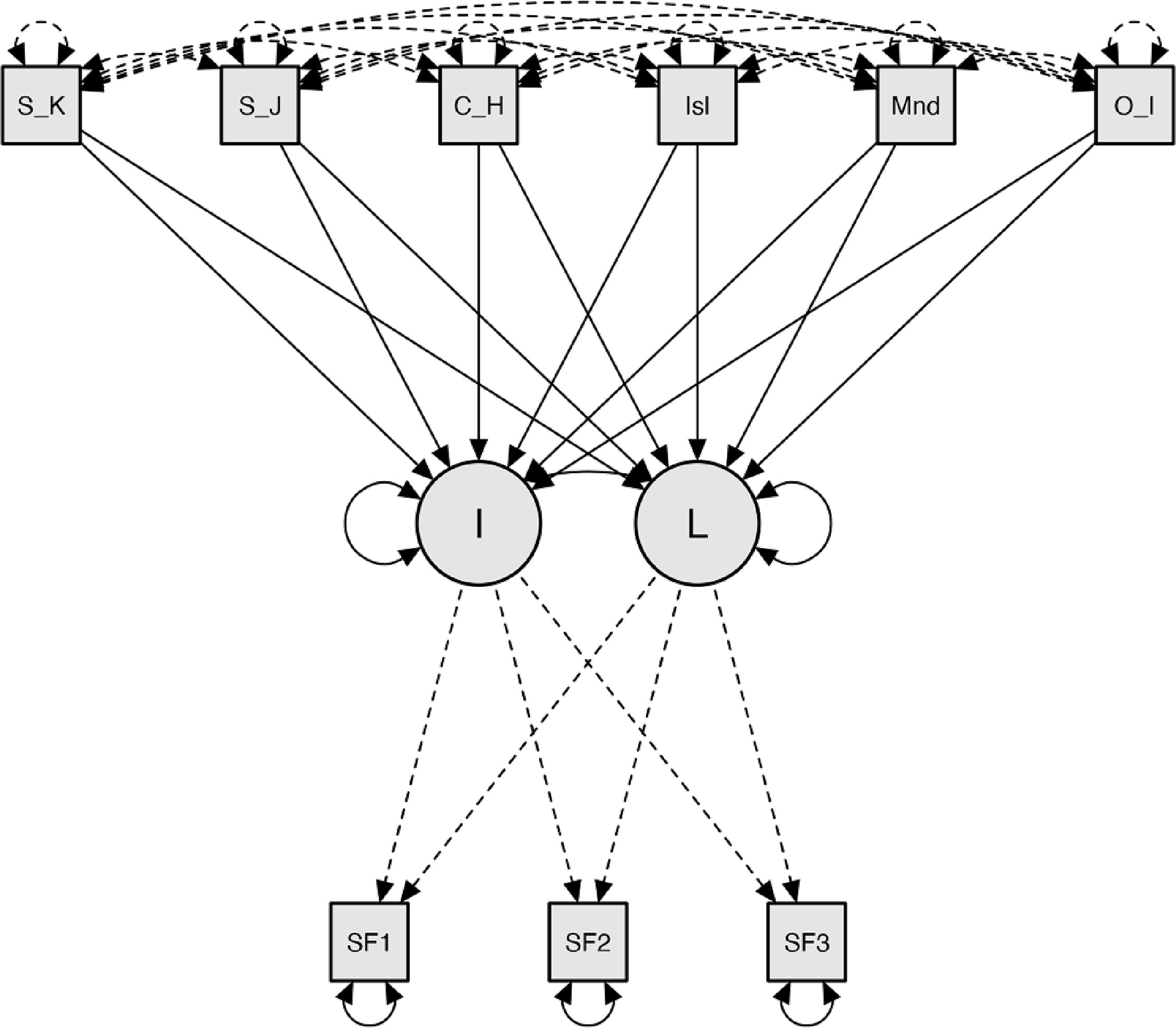
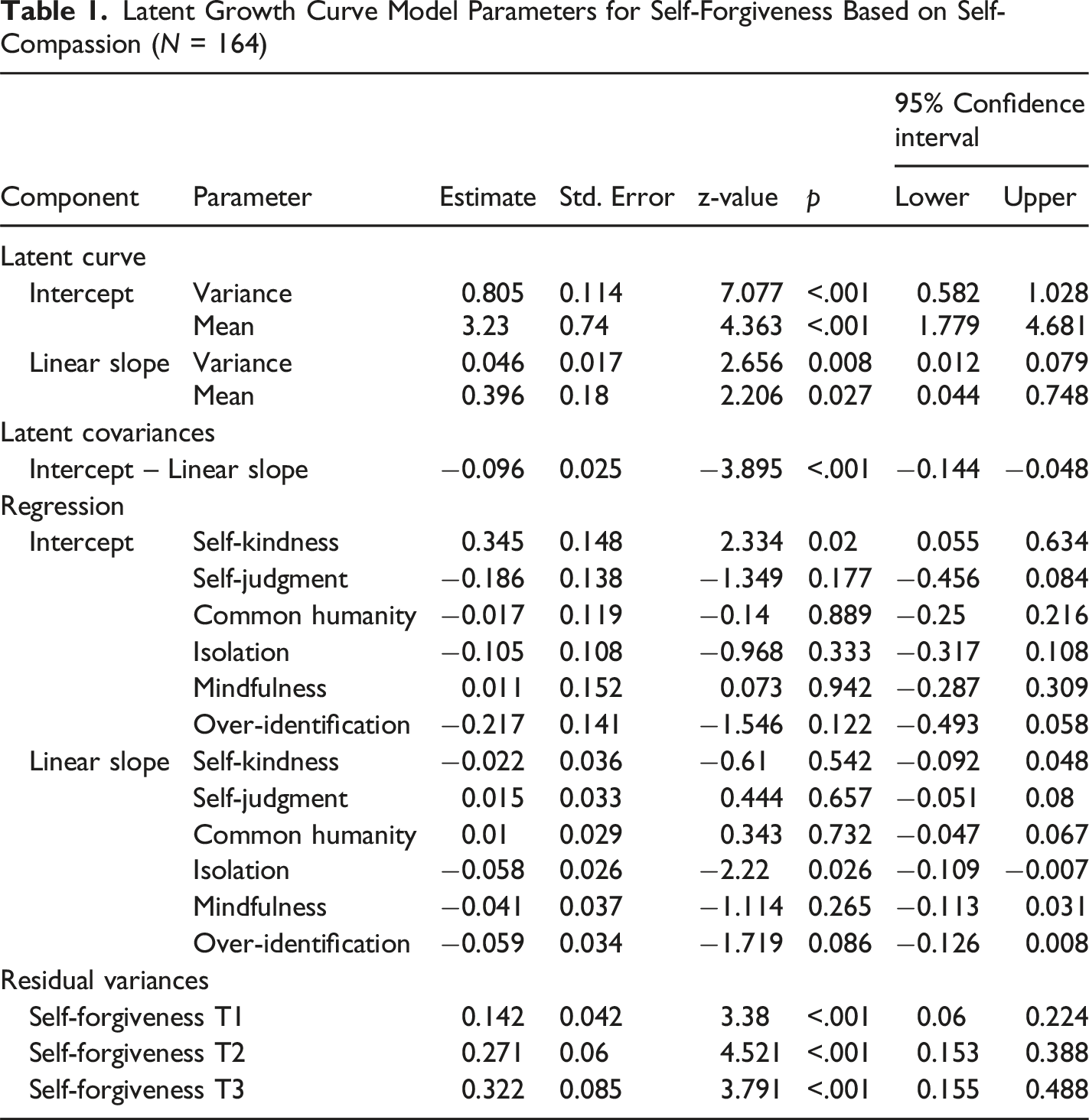
There was significant individual variation in both initial levels (variance = 0.805, SE = 0.114, p < .001) and growth trajectories (variance = 0.046, SE = 0.017, p = .008). The covariance between the intercept and the growth factor was negative (covariance = −0.096, SE = 0.025, p < .001), suggesting that individuals with higher initial self-forgiveness showed a slower increase in forgiveness over time.
Regression coefficients indicated that higher self-kindness at T1 was associated with higher initial self-forgiveness (B = 0.345, β = .27, p = .02), whereas other self-compassion components, such as isolation and over-identification, did not significantly predict the initial level. Regarding the rate of change, isolation at T1 was the only significant predictor of a slower increase in self-forgiveness over time (B = −0.058, β = −.17, p = .026).
The model explained a substantial portion of the variance in self-forgiveness, especially at the final stage (R2 for T3 = 0.8), while it accounted for 41% of the variance at the initial stage. Residual variance in self-forgiveness was significant at T1 (B = 0.142, β = .12, p < .001), T2 (B = 0.271, β = .2, p < .001), and T3 (B = 0.322, β = .22, p < .001), suggesting that the model effectively captures the dynamics of self-forgiveness over time, with variance increasing as self-forgiveness develops.
Discussion
This study highlights the role of specific self-compassion dimensions in shaping self-forgiveness initial levels and trajectories over time. The findings indicate that self-kindness was the sole significant and positive predictor of initial levels of self-forgiveness, which may resonate with Neff’s (2003b) conceptualization of self-kindness and self-judgment as opposing poles on the self-compassion continuum. While self-kindness fosters a nurturing and accepting attitude toward oneself, self-judgment reinforces excessive self-criticism, which can hinder emotional resilience and psychological recovery (Neff, 2009). Gilbert and Irons (2005) assert that recognizing the detrimental effects of self-judgment is crucial for cultivating self-kindness. This shift in awareness encourages a more compassionate self-perception, reducing self-critical tendencies that often obstruct self-forgiveness. Empirical research supports this perspective, demonstrating that self-acceptance—closely linked to self-kindness (Neff, 2009)—strongly predicts self-forgiveness (Martinčeková & Enright, 2020).
Conversely, isolation emerged as the sole significant and negative predictor of self-forgiveness growth, theoretically linked to heightened emotional distress and self-punitive tendencies (Neff, 2009). This finding aligns with broader literature on the psychological costs of social disconnection. Kuang et al. (2024) identified isolation as a moderating factor in the relationship between psychological resilience and depression via self-forgiveness, suggesting that social disconnection exacerbates difficulties in self-forgiveness. Additionally, Kaşıkcı and Korkmaz (2024) found that self-forgiveness mediates the relationship between social exclusion and psychological symptoms, indicating that self-unforgiveness amplifies the negative psychological impact of isolation by perpetuating distress and self-punitive cycles. Neff (2003b) emphasized the protective role of recognizing common humanity, explicitly identifying isolation as its direct opposite. Thus, isolation not only fosters self-criticism and prolonged guilt but also directly impedes self-forgiveness growth by reinforcing a sense of separateness and unworthiness.
Recent research suggests that Neff’s (2003b) self-compassion model can be grouped into two dimensions: positive and negative (Baggaley et al., 2025; Cleare et al., 2018; Mantzios et al., 2020). Within this framework, the positive dimension (i.e., self-kindness) facilitates initial self-forgiveness, whereas the negative dimension (i.e., isolation) hinders long-term self-forgiveness. This finding can be explained through Sapolsky’s psychosocial stress model (Sapolsky, 1994), which posits that chronic stressors, while partially mitigated by adaptive resources, progressively weaken psychological well-being by depleting these resources over time. Similarly, prolonged isolation may gradually diminish the protective benefits of self-compassion, further compromising resilience. Thus, while self-kindness may provide an early emotional buffer, its long-term efficacy appears to diminish unless individuals actively counteract the negative consequences of social disconnection.
Despite identifying significant self-compassion contributors to self-forgiveness, it remains the case that cultural and religious factors may influence self-forgiveness as much or more than self-compassion. Given the predominantly Catholic sample, structured practices such as confession and penance may facilitate forgiveness more effectively than self-compassion alone in this context (Toussaint & Williams, 2008; Woodyatt et al., 2017). Unlike hedonic self-forgiveness, which primarily alleviates negative self-affect, Catholicism emphasizes eudaimonic self-forgiveness through repentance, moral repair, and social reintegration. This aligns with the dual-pathway model, which contrasts self-compassion-driven emotional relief with value-based amends-making (Woodyatt et al., 2017). Nevertheless, our findings indicate that self-compassion remains a valuable pathway for fostering emotional resilience and reducing self-condemnation. It could be interesting in future work to consider how self-compassion and religious practices such as confession, religious rites of contrition, and mediation or prayer might act jointly to support self-forgiveness.
The findings offer practical insights for designing interventions aimed at enhancing self-forgiveness as a phenomenon commonly associated with healthier psychological adaptation (Skalski-Bednarz et al., 2025). Specifically, fostering self-kindness and addressing feelings of isolation could be key therapeutic targets in counseling or clinical settings. Programs such as Restore: The Journey Toward Self-Forgiveness (Toussaint et al., 2024) may be enhanced by integrating these self-compassion components to promote emotional resilience and reduce self-punishment.
This study’s focus on a Polish, predominantly Catholic sample limits its generalizability, and future work might examine clinical populations or culturally and religiously diverse groups. Additionally, self-report measures assess subjective tendencies rather than actual behaviors, limiting real-world applicability. Given that dispositional forgiveness does not always translate into situational forgiveness (Allemand et al., 2007; Stackhouse, 2019), future research should employ experimental or observational methodologies to examine the interplay between self-compassion and self-forgiveness under conditions of heightened self-criticism and across broader populations.
Conclusions
These findings highlight that while self-kindness catalyzes self-forgiveness, its long-term stability depends on reducing perceptions of isolation—the belief that one’s struggles, mistakes, or failures are uniquely personal rather than shared human experiences. Although self-compassion provides a buffer against guilt and self-condemnation, sustained self-forgiveness requires individuals to actively challenge self-critical tendencies and recognize their experiences as part of the broader human condition. Interventions designed to promote self-forgiveness, such as Restore: The Journey Toward Self-Forgiveness (Toussaint et al., 2024), may benefit from incorporating these self-compassion elements to enhance overall well-being.
Footnotes
Acknowledgements
S.B.S.-B. gratefully acknowledges the International Visegrad Fund for supporting a visiting professorship (#52410344) at Ilia State University in Tbilisi, Georgia, during which this manuscript was written.

Ethical Consideration
The authors assert that all procedures contributing to this work comply with the ethical standards of the relevant national and institutional committees on human experimentation and with the Helsinki Declaration of 1975, as revised in 2013. All procedures involving human subjects/patients were approved by the Ethics Committee of the University of Economics and Human Sciences in Poland, approval number #3/6/2023.
Consent to Participate
Written informed consent was obtained from all subjects.
Author Contributions
P.U. collected the data. S.B.S.-B. developed the hypotheses, conducted the analyses, and prepared the initial draft of the manuscript. J.S. and L.L.T. reviewed and edited the manuscript.
Funding
The authors received no financial support for the research, authorship, and/or publication of this article.
Declaration of Conflicting Interests
The authors declared no potential conflicts of interest with respect to the research, authorship, and/or publication of this article.
Data Availability Statement
The data that support the findings of this study are available on request from the author, P.U.
Transparency Declaration
The lead author affirms that this manuscript is an honest, accurate, and transparent account of the study being reported. No important aspects of the study have been omitted.
Author Biographies
Appendix
Note. T = Time, **p < .01, ***p < .001.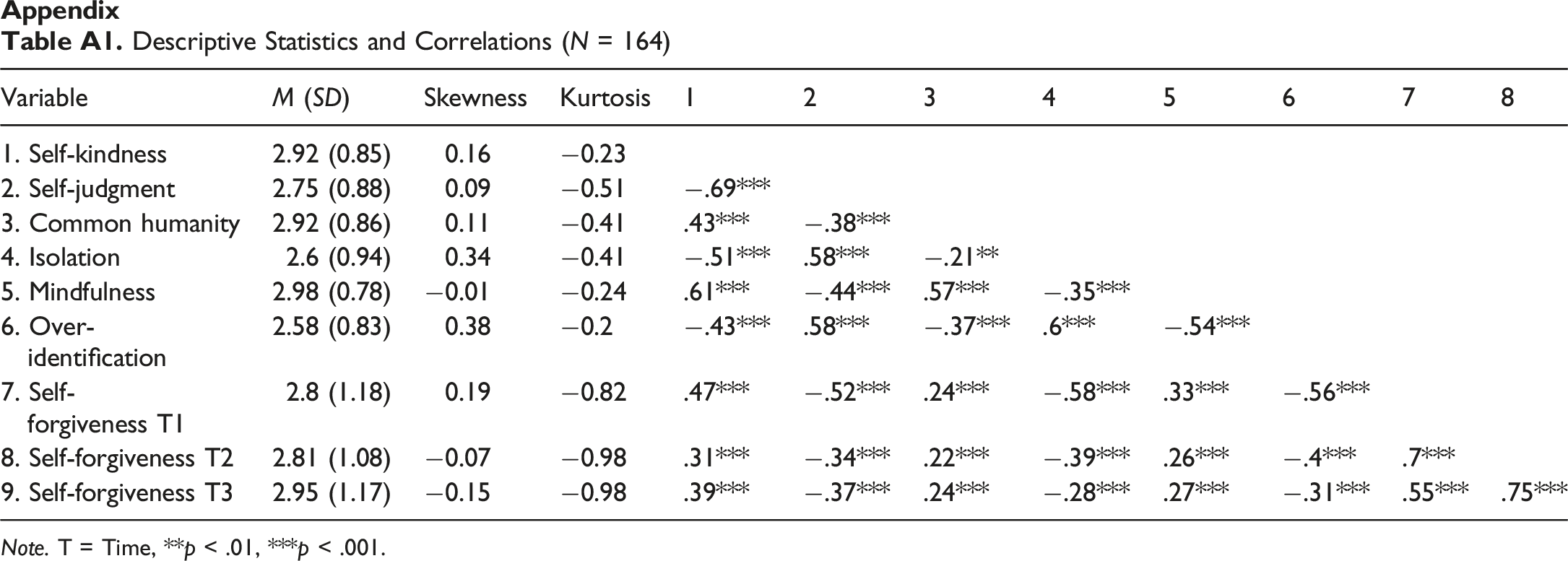
Variable
M (SD)
Skewness
Kurtosis
1
2
3
4
5
6
7
8
1. Self-kindness
2.92 (0.85)
0.16
−0.23
2. Self-judgment
2.75 (0.88)
0.09
−0.51
−.69***
3. Common humanity
2.92 (0.86)
0.11
−0.41
.43***
−.38***
4. Isolation
2.6 (0.94)
0.34
−0.41
−.51***
.58***
−.21**
5. Mindfulness
2.98 (0.78)
−0.01
−0.24
.61***
−.44***
.57***
−.35***
6. Over-identification
2.58 (0.83)
0.38
−0.2
−.43***
.58***
−.37***
.6***
−.54***
7. Self-forgiveness T1
2.8 (1.18)
0.19
−0.82
.47***
−.52***
.24***
−.58***
.33***
−.56***
8. Self-forgiveness T2
2.81 (1.08)
−0.07
−0.98
.31***
−.34***
.22***
−.39***
.26***
−.4***
.7***
9. Self-forgiveness T3
2.95 (1.17)
−0.15
−0.98
.39***
−.37***
.24***
−.28***
.27***
−.31***
.55***
.75***