



Abstract
Trust in leaders plays a central role in shaping how teams function and perform. While prior research has explored leadership styles and outcomes, the mechanism by which trust in leaders influences team dynamics remains underexplored; particularly from a multilevel, longitudinal perspective. The current study investigated the role of trust in team members as a mediator in the relationship between trust in the leader and team cooperation, and team cooperation as a mediator in the relationship between trust in team members and team performance. Drawing on social contagion theory, this study develops and tests a cascading trust model in which trust in the leader fosters trust among team members, enhances team cooperation, and ultimately improves team performance. Data were collected in two waves over three months from 307 employees across 71 teams in Malaysian private-sector organizations. Using multilevel modelling, the results showed that trust in the leader had a positive relationship with trust in team members, team cooperation, and team performance. Trust in team members also mediated the relationship between trust in the leader and team cooperation, while team cooperation mediated the relationship between trust in team members and team performance. This study extends existing trust and leadership literature by uncovering the affective processes through which trust flows within teams and by highlighting the leader’s role in cultivating a high-trust, high-performing team environment, particularly salient in collectivist, relationship-focused contexts. Practical implications for cultivating high-trust, high-performing teams are discussed.
Introduction
Team-based work has become the foundation of organizational success, particularly in knowledge-driven and interdependent environments. As the complexity of tasks increases, organizations increasingly rely on the collective output of teams rather than individual efforts to drive performance and innovation (Kozlowski & Ilgen, 2006; Mathieu et al., 2019). Among the factors that enable teams to function effectively, team cooperation stands out. Team cooperation reflects the degree to which team members coordinate, share information, and assist one another in pursuit of shared goals. It is closely linked to other team processes like communication, cohesion, and mutual accountability (Bell et al., 2023; Hamdi et al., 2016; Mesmer-Magnus & DeChurch, 2009). However, team cooperation does not occur automatically; it depends on relational mechanisms that foster psychological safety and mutual confidence, most notably, trust (Edmondson & Lei, 2014; Silva et al., 2022).
Trust is central to effective collaboration, particularly in today’s increasingly digital (Vuchkovski et al., 2023) and cross-cultural (Ward et al., 2022) work environments, which alter the dynamics of trust between leaders and team members. However, its role in team dynamics remains underexplored in the organizational literature. Defined as a psychological state involving the willingness to be vulnerable based on positive expectations of others’ intentions or behavior (Rousseau et al., 1998), trust serves as the glue in both leader–member and member–member relationships. Much of the existing research on trust and leadership has focused on dyadic exchanges, primarily through the lens of leader–member exchange (LMX) theory (Graen & Uhl-Bien, 1995). However, trust in the leader is not merely a byproduct of role-based exchange; it also carries affective and symbolic weight. Unlike LMX and the model of trust (Mayer et al., 1995) which emphasize individual-focused reciprocity and one-to-one resource exchange between leaders and members, trust in leadership encompasses beliefs about the leader’s integrity, benevolence, and competence; attributes that shape team norms and influence how team members relate to each other, adopting a more collective or team-based approach (Lee et al., 2024a; Legood et al., 2021; McEvily & Tortoriello, 2011).
Studies suggest that trust in a leader may operate not just at the interpersonal level but as a social signal that shapes broader team climate. When employees trust their leader, they may infer that trust is a valued norm, leading them to extend similar trust to peers (Dirks & de Jong, 2022; Fulmer & Ostroff, 2017). This “trust contagion” aligns with social contagion theory, which posits that attitudes and behaviors can diffuse through social networks (Barsade & Knight, 2015; Christakis & Fowler, 2013). However, empirical research examining how trust in the leader translates into trust among team members; and how that trust, in turn, affects cooperation and team performance; is still scarce (Breuer et al., 2020; Feitosa et al., 2020). Even fewer studies have used longitudinal, multilevel methods to capture these dynamic and cross-level processes (Gelfand et al., 2024).
The need to explore these trust-based mechanisms is particularly salient in collectivist cultures, where relational harmony and indirect communication are deeply ingrained in work interactions (Choi & Han, 2011; Hofstede, 2011). In such contexts, trust is not merely instrumental but is seen as a moral and emotional commitment that sustains workplace relationships (Chen & Kuo, 2024; Tan et al., 2024). Malaysia offers a compelling setting for this investigation. As a multicultural, Asian society where respect for hierarchy and interpersonal relationships is central to organizational life, the dynamics of trust may unfold differently than in Western settings (Huff & Kelley, 2003). Yet, despite the cultural relevance of trust in this region, empirical studies focusing on trust in Malaysian organizations remain limited (Juhdi et al., 2013; Lee et al., 2017).
This study seeks to address these gaps by investigating how trust in the leader influences team performance through two mediators: trust in team members and team cooperation. Drawing from social contagion theory and adopting a multilevel longitudinal design, we examine how trust cascades from leaders to teams over time. Specifically, we test whether trust in the leader at the team level fosters trust in team members at the individual level, which then enhances team cooperation and ultimately improves team performance. By collecting data from 71 work teams in Malaysian private-sector organizations over two time points, this research offers a rare glimpse into how affective and social processes develop across levels and time.
This study contributes to the literature in several ways. First, it shifts the conversation on leadership effectiveness from a dyadic to a multilevel relational perspective, highlighting the cascading role of trust within teams. Second, it integrates and extends social contagion theory within the organizational trust literature, offering a novel framework to explain how trust flows within teams. Third, it provides much-needed evidence from an Asian context, enhancing the cross-cultural relevance of existing theory. Finally, by capturing trust development over time, the study helps clarify its role not just as a static belief but as a dynamic social force that underpins cooperation and performance.
This study builds upon and extends existing trust frameworks in two important ways. First, while foundational models such as LMX theory (Graen & Uhl-Bien, 1995) and the integrative model of trust (Mayer et al., 1995) primarily examine trust as a dyadic or individual-level construct, we conceptualize trust as a multilevel, socially contagious process, with its foundation in teams rooted in the dynamics with the leader. Second, by introducing a cascading trust model grounded in social contagion theory, we capture how leader trust permeates team dynamics over time; an approach that addresses current gaps in organizational trust literature (Dirks & de Jong, 2022; Fulmer & Ostroff, 2017).
The remainder of the paper is organized as follows. The next section reviews relevant literature and develops the study’s hypotheses. This is followed by a description of the research method, including design, sample, and analysis. The results are then presented and discussed in relation to the theoretical framework. The paper concludes with practical implications, limitations, and directions for future research. Figure 1 illustrates the proposed model. Hypotheses and Research Model. Note. Solid arrows represent hypothesized mediation pathways based on social contagion theory; each arrow represents a three-month gap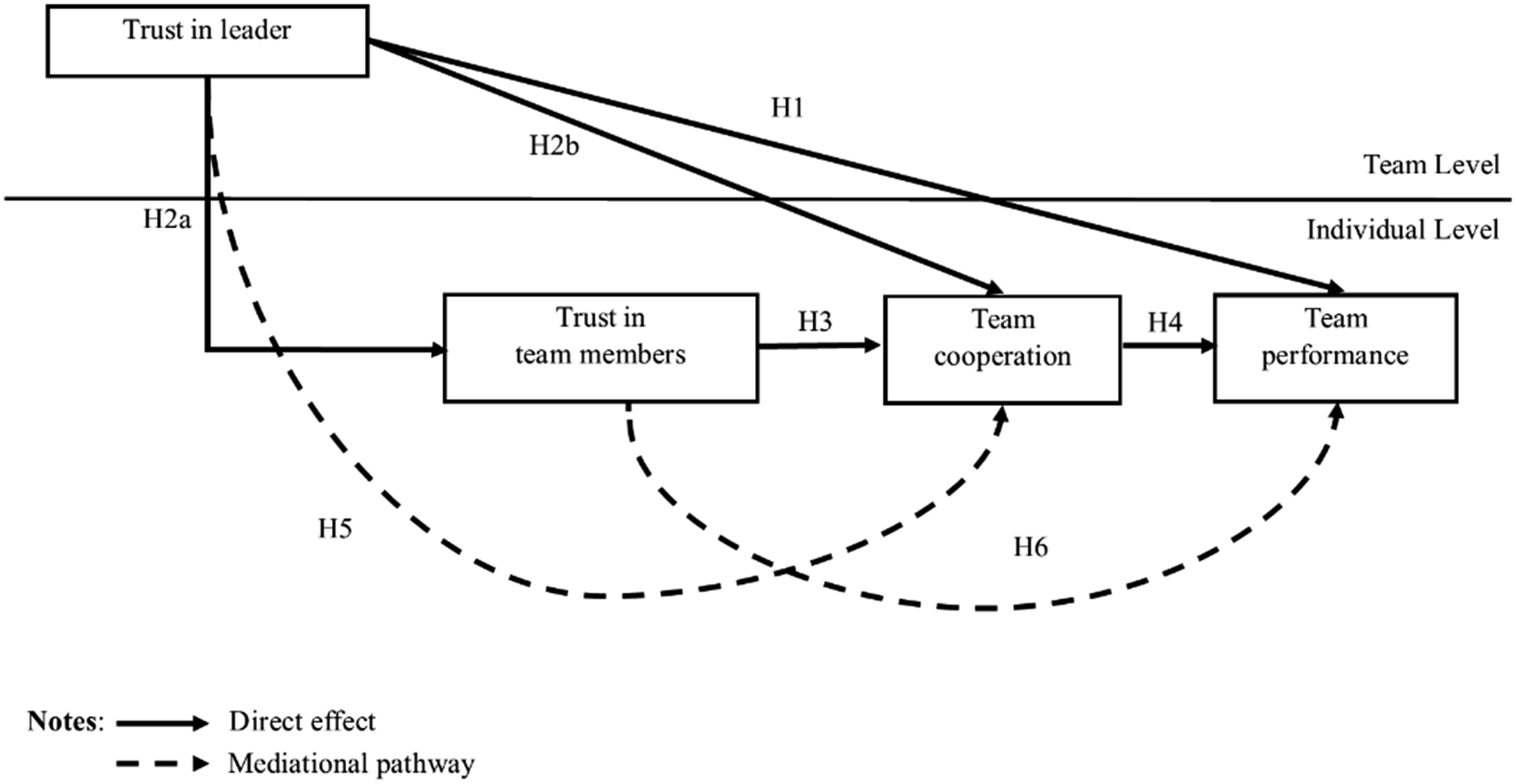
Literature Review
Theoretical Foundation
This study offers a distinct theoretical contribution by advancing a cascading trust model of Team Functioning. Whereas prior models (e.g., LMX theory, Mayer et al.'s integrative model of trust) emphasize dyadic exchanges or individual cognition, with a primary focus on the leader-employee relationship, they tend to overlook the relationships among team members. In contrast, our model conceptualizes trust as a dynamic, socially transmitted resource that shapes team-level climate and emergent states. By explicitly modeling how trust in the leader diffuses horizontally to foster trust among team members; ultimately driving cooperation and performance, our framework extends existing multilevel trust research (Fulmer & Ostroff, 2017) and responds to recent calls for greater integration of social network and contagion perspectives in organizational trust literature (Costa & Anderson, 2017; Dirks & de Jong, 2022).
Cascading Trust Model of Team Functioning
This study advances a cascading trust model that conceptualizes trust as a dynamic, multilevel process flowing from leaders to teams. Prior models, such as LMX theory (Graen & Uhl-Bien, 1995) and Mayer et al.’s (1995) integrative model of trust, primarily examine dyadic exchanges and individual-level outcomes. In contrast, the cascading trust model integrates social contagion theory (Christakis & Fowler, 2013) to explain how trust in the leader (team-level) transmits downward and laterally, shaping trust in team members (individual-level), which in turn fosters team cooperation (individual-level) and ultimately drives team performance (individual-level) (refer Figure 2). This model extends Mayer et al.’s (1995) integrative model of trust and contributes to the broader organizational trust literature (Dirks & de Jong, 2022; Fulmer & Ostroff, 2017) by explicitly articulating how leader trust signals permeate horizontal team interactions and emergent team states over time. Moreover, it captures the cultural nuance of relational trust contagion, which may be amplified in collectivist contexts where interpersonal harmony is highly valued (Chen & Kuo, 2024; Huff & Kelley, 2003). Cascading Trust Model of Team Functioning (Trust in the Leader and Team Performance)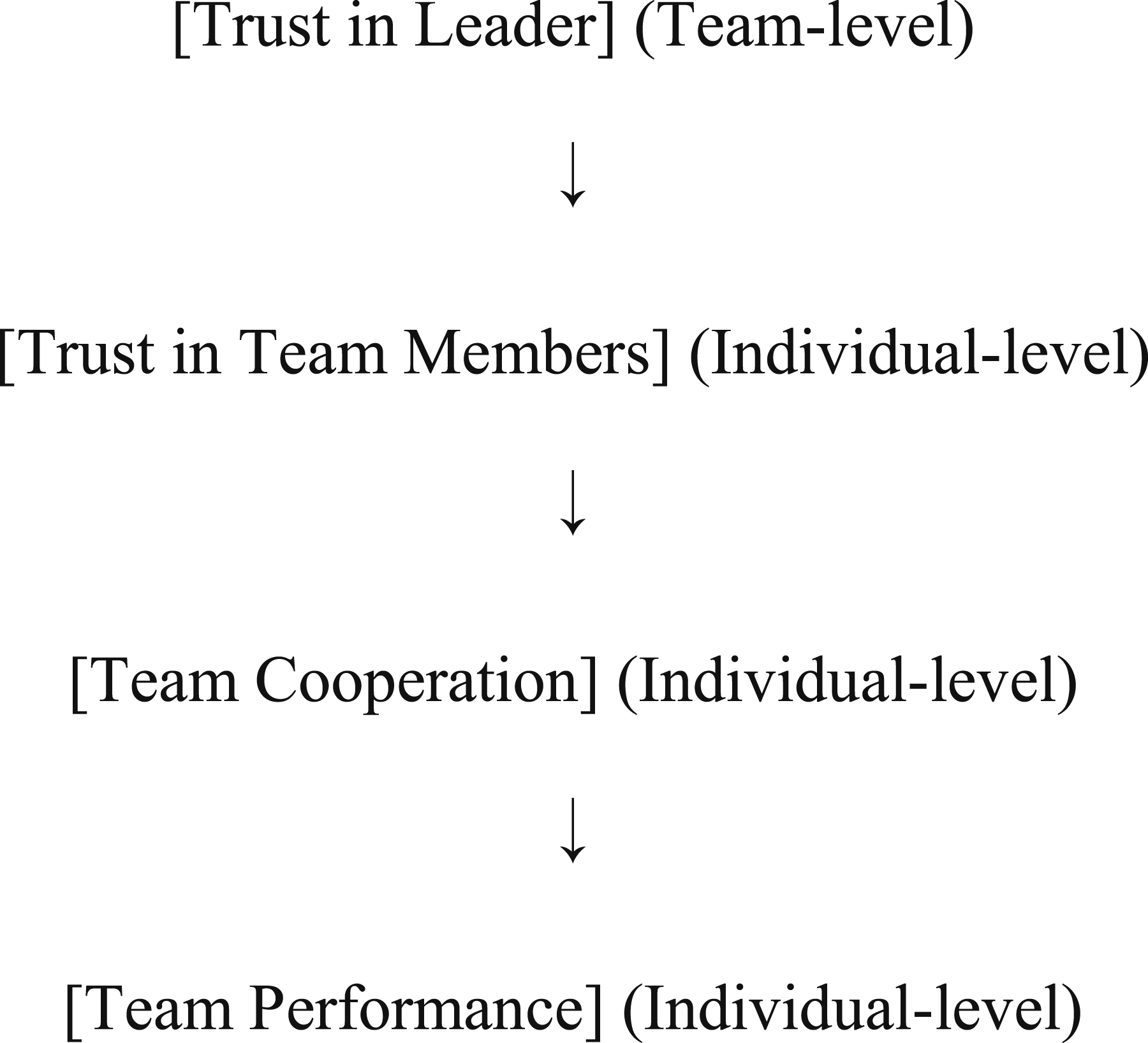
Moreover, by looking at the roles of cognitive and affective trust, this study deepens our understanding of how the two trust components contribute to team functioning. While cognitive trust may catalyze efficient knowledge exchange and task coordination, affective trust appears essential for fostering team cohesion, emotional engagement, and discretionary effort; elements that sustain cooperation under conditions of ambiguity or stress.
Trust in the Leader and Team Performance
A leader’s effectiveness lies in how much trust employees place in him/her (Bligh, 2017). Trust has been shown to influence the relationship between the leader and employees’ work performance. In recent years, the literature has expanded to include the team, with similar findings on trust in the leader’s influence on team performance. For example, a study by de Jong et al. (2016) showed how trust increased team performance. Hence, we can conclude that the leadership role, especially the trust aspect, namely, trust in the leader, not only influences employees individually but also influences the team collectively in achieving optimal functioning.
Trust serves a few purposes, firstly, its role in knowledge sharing (Lee et al., 2011). When a high level of trust is evident, knowledge sharing between the leader and employees also increases (Politis, 2003). In a high knowledge-sharing environment, knowledge acquisition will also be increased, allowing employees to better manage their work with the information required for their work tasks. This is also useful in self-managed teams where little supervision is required of the leader. Secondly, a high trust environment allows communication between the leader and employees, ensuring a high-quality relationship (Boies et al., 2015). As trust involves a certain level of risk taking, with the trustor exposed to risk through the sharing of information and lowering of the self-protection aspect, the trustor still shares the information, knowing that the trustee will make good use of the information to the benefit of both parties (Frey, 2017).
Two types of trust are commonly viewed in the literature: cognitive and affective trust. Cognitive trust is where the trustor places a high level of confidence in the trustee based on the likelihood that the trustee will keep his/her promises and deliver what has been said (Mayer et al., 1995; McAllister, 1995). Such a level of confidence depends on the predictability of the trustee’s actions and is derived from the trustor’s past experiences and observations of the trustee. Affective trust, on the other hand, is where the trustor places a high level of confidence in the trustee based on the quality of the relationship. It is derived from the trustee’s kindness, benevolence, care, and concern, which enable the trustor to have a sense of security in the relationship, knowing that the trustee will not harm the trustor. In the context of placing trust in a leader, the trustor is the employee, and the trustee is the leader.
The two types of trust function differently. Cognitive trust tends to develop relatively quickly, based on an individual’s work-related attributes such as ability, competence, and integrity. In contrast, affective trust involves perceptions of warmth, including kindness and benevolence, and typically takes longer to develop (Legood et al., 2023). Moreover, affective trust is generally more enduring, as it is rooted in the quality of the interpersonal relationship. Cognitive trust, however, may diminish rapidly if the individual fails to demonstrate the expected work-related attributes (McAllister, 1995). Within the Asian context, affective trust may be more effective in fostering collaboration among team members than cognitive trust, due to cultural norms that emphasize relational harmony and emotional connection (Teubner et al., 2024).
While both cognitive and affective trust contribute to overall trust in leadership, they may exert distinct influences on team dynamics. Cognitive trust, grounded in perceptions of leader competence and reliability, primarily fosters confidence in task-related processes, enhancing information sharing and coordination (Lee et al., 2011). In contrast, affective trust, rooted in emotional bonds and benevolence, is more strongly associated with interpersonal cohesion, psychological safety, and willingness to cooperate beyond formal role requirements (Edmondson & Lei, 2014; McAllister, 1995). Therefore, we anticipate that affective trust plays a particularly critical role in promoting deep team cooperation and resilient performance in collectivist cultural settings where relational harmony is paramount (Chen & Kuo, 2024; Huff & Kelley, 2003).
Trust in the leader reflects team members’ cognitive evaluation of the leader’s ability to develop their expertise and foster their willingness to share and disclose information with other team members (Lee et al., 2011). From a resources perspective, trust is viewed as a type of social resource which is beneficial to ongoing interaction between employees which is pertinent to carrying out the work well. All these factors reflect honesty, transparency, and a focus on others to ensure every employee is successful at work by bringing out the best in all employees, in addition to delivering organizational objectives.
In the context of team settings, especially in Asian cultures like Malaysia, where hierarchical relationships and emotional loyalty carry significant weight, affective trust in leaders may play a more powerful role than in Western contexts (Hofstede, 2011). Trust in leaders also signals behavioral norms to the team, shaping shared expectations about collaboration and performance (Salanova et al., 2021). As such, trust in leadership serves as a social resource that enhances team outcomes by fostering a psychologically safe environment, empowering members to contribute fully without fear of exploitation (Edmondson & Lei, 2014).
Trust in the leader is positively related to team performance.
From Leader Trust to Team Trust: The Role of Social Contagion
Trust within the organization, when viewed from the affective perspective, is multifocal (Tanghe et al., 2010). Specifically, it can refer to different layers of employees’ trust. For example, employees can place their trust in the organization, their leader, their team, and their fellow employees. In the current study, our focus is on the importance of employees’ trust in the leader and their team members.
When trust in the leader, both cognitive and affective trust, is evident, it shows that the leader is effective in managing all employees. Trust, then, is communicated as the values cherished and valued in the work environment (Shamir & Lapidot, 2003). In conveying these values, employees would strive to create a high level of trust in the team environment. Trust contains a high element of the relational aspect, thus creating trust transferability. While not everyone is able to initiate a trust environment, leaders often have the ability to influence employees cognitively regarding expected behaviors and actions, as well as clarifying what is considered unacceptable.
Most trust literature focuses on SET. However, SET often focuses on individual outcomes (Ilies et al., 2007). With the work setting not solely influenced by individual factors, social contagion theory (Christakis & Fowler, 2013) focuses on social settings and postulates how social networks may provide various signals that encourage employees to join these networks. Acknowledging the role of cultural context in shaping relationship dynamics, social contagion theory applies to our model in which the relationship between leaders and team members is hierarchical and varies in frequency and closeness, particularly within an Asian context (Chen et al., 2019). More specifically, these authors found that individuals are connected by three degrees of separation and three degrees of influence. In the current study, this means that employees’ behaviors and thought processes are influenced by their closest two counterparts. With leaders and team members closely related to employees, they consequently become an influential aspect in employees’ behaviors and thought processes. A study by Boies et al. (2015) also showed that trust in the leader enables team communication and trust in team members. Furthermore, Mach and Lvina (2017) stated in their study that trust in the leader is also an important aspect of creating a high level of trust in team members which influences how they work together.
In the Asian context, human interaction depends not only on verbal cues but also on non-verbal cues such as kindness, empathy, and emotional closeness. Similarly, trust, although intangible, is reflected in how employees interact with leaders and team members. When a high level of trust is evident, this shows that employees are willing to be vulnerable, confident in their relationship with their team members, and can display kindness and honesty, being open and knowing that the other party is competent to do his/her work well on a consistent basis (Cheng et al., 2016). Moreover, an environment characterised by high cognitive trust often includes strong respect for the leader’s ability and professionalism. The leader often signals how things should be run, with team members following how they are expected to behave at work (Lee & Ding, 2020). Hence, when employees are close to and have high trust in the leader, they too would also exhibit a similar attitude towards their fellow team members. Various studies in sports settings (Dirks, 2000; Mach et al., 2010) and even in virtual settings (Peters & Karren, 2009) have supported the trust in the leader–team performance relationship. In addition, the trust factor is not only focusing on current performance; trust is able to synergize previous performance into current performance. Hence:
Trust in the leader is positively related to (a) trust in team members and (b) team cooperation.
Trust in Team Members, Team Cooperation, and Team Performance
With trust in the leader which allows a higher level of transparency, knowledge sharing, and communication between the leader and employees (Williams, 2005), trust in team members signifies strong cohesion in the team. When strong cohesion exists in the team, it is likely to be more outward focused and not solely focused on self-interest (Lee et al., 2024b). More specifically, with a high level of trust in team members, employees will activate the “we-mode” and the “I-mode” (Tuomela & Tuomela, 2005). It also shows that team members hold one another in high regard for their ability, professionalism, willingness to be vulnerable, care for one another, and the close relationships they share. Thus, employees will have their thought and behavior processes are aligned and in tune with those of the team, benefiting all team members. Therefore, team members will be more likely to ensure a high level of cooperation so the whole team can work amicably and produce good work outcomes.
A stronger relationship was evident between trust and team performance in virtual teams (Breuer et al., 2016). This showed that, in the absence of face-to-face interaction or opportunities to pick up cues from a physical setting, trust then becomes an important criterion for deciding the actions and behaviors undertaken by employees when members of that team. There are a few distinctions in how trust in team members is more closely linked to team cooperation than trust in the leader: trust in team members promotes good relationships among team members of similar hierarchy; it consists of a shared mental model to guide their work behaviors collectively; and it allows communication and sharing of information, which helps in achieving goals together (Feitosa et al., 2020).
Trust in team members is positively related to team cooperation. Team cooperation, in turn, plays a direct role in driving performance. Cooperative teams are more likely to engage in coordinated action, mutual support, and seamless information exchange (Salas et al., 2015; Syed-Yahya et al., 2022). These attributes improve not only the efficiency of task execution but also the innovation and adaptability of the team (Chiocchio et al., 2011; Tanghe et al., 2010).
Team cooperation is positively related to team performance.
Mediating Role of Trust in Team Members and Team Cooperation
We argue that trust in leaders can shape team cooperation indirectly through trust in team members. When leaders establish a trustworthy climate, team members internalize these values and extend them horizontally within the team. This sets in motion a virtuous cycle of reciprocal trust and support (Mach & Lvina, 2017; Salanova et al., 2021).
Trust in team members mediates the relationship between trust in the leader and team cooperation. In a study by de Jong et al. (2016), trust in team members was found to be different from trust in the leader. After controlling trust in the leader, trust in team members showed an above average impact on team performance. Trust in team members allowed task interdependence, authority differentiation, and skill differentiation in teams. Further, trust in team members not only enhances cooperation but also amplifies its effect on performance. Teams with strong interpersonal trust are more likely to coordinate effectively, share responsibilities, and maintain morale, even under stress (Dirks, 2000; Tanghe et al., 2010). Hence, we argue that, while the first part of the model emphasizes trust’s social contagion effect from trust in the leader to trust in team members, the second part of the model shows how trust in team members becomes a productive and effective activator to ensure a high level of team cooperation, resulting in high team performance.
Team cooperation mediates the relationship between trust in team members and team performance.
Method
Participants
This study employed a two-wave longitudinal, multilevel design with a three-month interval between measurements, involving 307 employees (age; M = 31.43 years, SD = 9.57) working across 71 teams in private-sector organizations located in Kuala Lumpur, Malaysia. We selected a three-month interval to balance the need for sufficient time for affective and relational trust dynamics to unfold, while minimizing potential confounding influences from organizational change or turnover that may occur over longer intervals. Shorter intervals (e.g., 1 - 2 months) may capture initial cognitive trust formation, but may be too brief to observe deeper shifts in team cooperation and performance outcomes influenced by affective trust. The three-month interval between measurements aligns with previous longitudinal studies on employee trust (e.g., Bal et al., 2011; Zolin et al., 2004). The selected industries represented diverse sectors, including information and communication (36.81%), professional, scientific, and technical services (22.15%), education (17.91%), food and beverages (12.05%), and arts, entertainment, and recreation (11.07%). These sectors were targeted due to their high reliance on team-based structures and knowledge-intensive work environments.
Kuala Lumpur, being the country’s economic hub, was chosen as the research setting to reflect a metropolitan workforce with a mix of organizational forms and diverse team compositions. All participants were white-collar employees with formal work schedules, operating in office-based environments. On average, participants had 37.54 months (SD = 53.7) of working experience. The gender composition included 180 females (58.6%) and 127 males (41.4%). The mean working hours per week were 46.13 (SD = 77.12), while average monthly salary stood at RM 3463.62 (SD = 2097.98). Participants’ average performance appraisal score for the prior year was 74.59 out of 100 (SD = 16.25).
Prior to commencement of the study’s data collection, the necessary ethics approval was obtained from the main author’s university ethics board. Once ethics approval was granted, with contact details obtained from the list of small and medium-sized enterprises (SMEs) from the Malaysian governmental website, organizations were contacted to see if they were interested in participating in the study. Our study then followed up for further discussion with organizations that had responded positively. The result was 85 teams consisting of 466 participants agreeing to participate in the study. Physical questionnaires were then given to employees in those teams. We returned to the organizations one week after distribution to collect the completed (and incomplete) questionnaires that were sealed in the supplied envelope. The number of participants per team ranged from three to 11. Three months after the first data collection, we returned to the same organizations to distribute a second set of questionnaires, which were returned after a week. A three-month interval was selected as trust has been suggested to develop and change over time (Van Der Werff & Buckley, 2017). This timeframe allows for a more nuanced understanding of how trust in the leader crosses over to trust in team members and how trust in team members affects team cooperation and performance. Several longitudinal studies, such as those by Dirks and de Jong (2022) and Van Der Werff and Buckley (2017), have suggested a minimum of two to six months for observing changes in trust. At Time 1 (T1), 466 participants responded, with 307 participants at Time 2 (T2), representing a fall-out rate of 34.1%, a rather common phenomenon in longitudinal data collection (Spiers et al., 2018).
Instruments
Means, Standard Deviations, Reliability, and Pearson’s Bivariate Correlations of Variables at the Individual and Team Levels
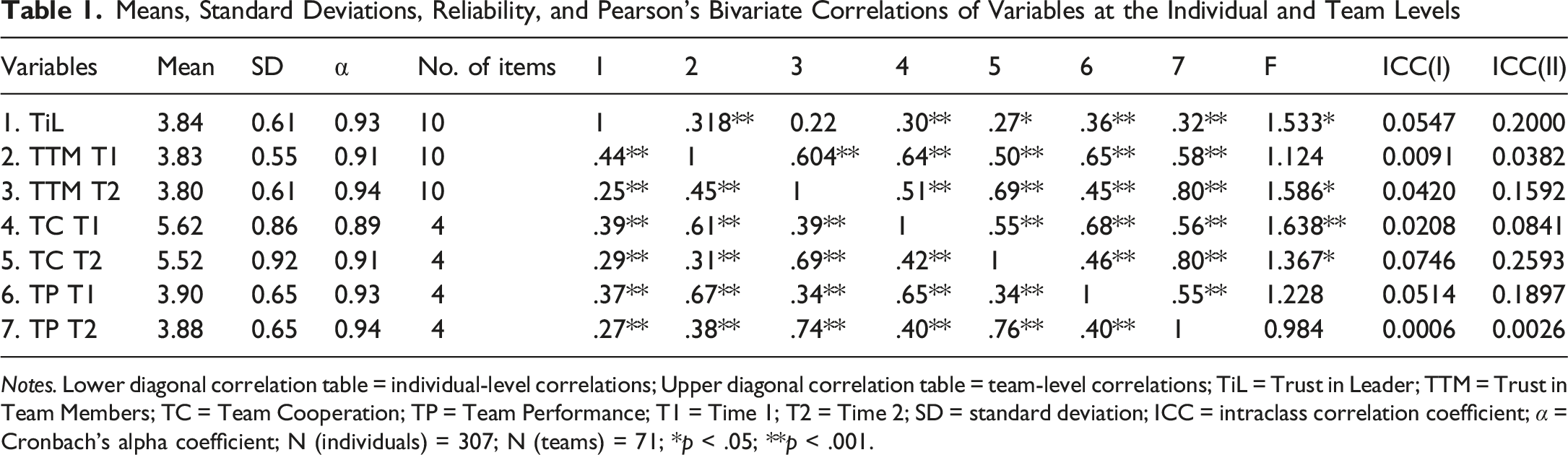
Notes. Lower diagonal correlation table = individual-level correlations; Upper diagonal correlation table = team-level correlations; TiL = Trust in Leader; TTM = Trust in Team Members; TC = Team Cooperation; TP = Team Performance; T1 = Time 1; T2 = Time 2; SD = standard deviation; ICC = intraclass correlation coefficient; α = Cronbach’s alpha coefficient; N (individuals) = 307; N (teams) = 71; *p < .05; **p < .001.
‘Trust in leader’ was measured using 10 cognitive and affective trust items adopted from McAllister (1995). These items included: “I know my leader will do what is best at work” (cognitive trust) and “If I share my problems with my leader, I know (s)he will respond with care” (affective trust). A scale with a value of ‘1’ (strongly disagree) through to ‘5’ (strongly agree) was used.
‘Trust in team members’ was measured similarly using 10 cognitive and affective trust items adopted from McAllister (1995), with the term “leader” rephrased as “team members” and “he/she” rephrased as “they.” The items included “I trust my team members to do what they need to do at work” (cognitive trust) and “If I discuss my problems with my team, I am confident they will respond constructively” (affective trust). A scale with a value of ‘1’ (strongly disagree) through to ‘5’ (strongly agree) was used.
‘Team cooperation’ was measured using four items measuring cooperation adapted from Lee et al. (2011), with the term “this coworker” rephrased as “team members” and “his/her” rephrased as “team members” to indicate the focus on team members rather than on a specific coworker. One example was: “I am open to sharing new ideas, information, and resources with my team members.” A scale with a value of ‘1’ (strongly disagree) through to ‘7’ (strongly agree) was used.
‘Team performance’ was measured using four items measuring in-role behavior adapted from Van Dyne and LePine (1998), with the term “I” rephrased as “my team” to indicate the focus on the team. “My team completes the tasks expected of them” is one example of an item. A scale with a value of ‘1’ (strongly disagree) through to ‘7’ (strongly agree) was used.
Analysis Strategy
Prior to analyzing the hypotheses, our study first ascertained whether ‘trust in leader’ was a group-level construct. ‘Trust in leader’ had an r(WG)(J) value of .85, indicating satisfactory within-group agreement (LeBreton & Senter, 2008). The intraclass correlation coefficient (ICC[I]) value of .05, ICC [II] value of .20, and the F(III) value were found to be significant (F(III) = 1.53, p < .001), indicating that ‘trust in leader’ had sufficient justification to be aggregated and treated as a group-level construct (Lorah, 2018; McCoach et al., 2022).
To test our hypotheses, hierarchical linear modeling (HLM) software (Bryk & Raudenbush, 1992) was used: ‘trust in leader’ was treated as a group-level construct as it influenced internal processes within employees, even more so in the Asian context (Suen et al., 2007). Three types of analysis were conducted: lower-level direct effects, cross-level direct effects, and mediation effect. Lower-level direct effects and cross-level direct effects were tested using Mathieu and Taylor’s (2007) recommendations. Firstly, we ran the analysis for lower-level direct effects, followed by conducting a cross-level direct effects analysis.
For lower-level direct effects (Hypotheses 3 and 4), the lower-level dependent variable was regressed on the independent variable. The following equation is an example of a lower-level HLM equation:
For cross-level direct effects (Hypotheses 1 and 2), the lower-level outcomes’ variable was first regressed on lower-level independent variables, followed by regressing the lower-level outcomes’ variable on the cross-level variable (i.e., ‘trust in leader’).
Examples of cross-level HLM equations are as follows:

Finally, Shapiro–Wilk tests were undertaken with all variables that had been determined to be normally distributed (p > .05) to evaluate the mediation hypotheses (Hypotheses 5 and 6). We then followed the testing steps as recommended by Baron and Kenny (1986). Firstly, a significant relationship should be found for all relationships between X→Y, X→M, and M→Y in the presence of X, with X being the independent variable, Y being the outcome variable, and M being the mediation variable. A full mediation would occur if the X in the relationship between M→Y was not found to be significant. If the X was found to be significant, then this would be partial mediation. The Monte Carlo test (Selig & Preacher, 2008) was then used to confirm the mediation pathway relationship which would be confirmed if both values of the lower-level and upper-level variables did not contain zero (0) (MacKinnon et al., 2004). The Monte Carlo test was conducted using a 95% confidence interval (CI) and with 20,000 repetitions.
Results
Hierarchical Linear Modeling (HLM) Analyses of Individual-Level Outcomes and Team-Level Effect of Trust in Leader on Individual-Level Outcomes
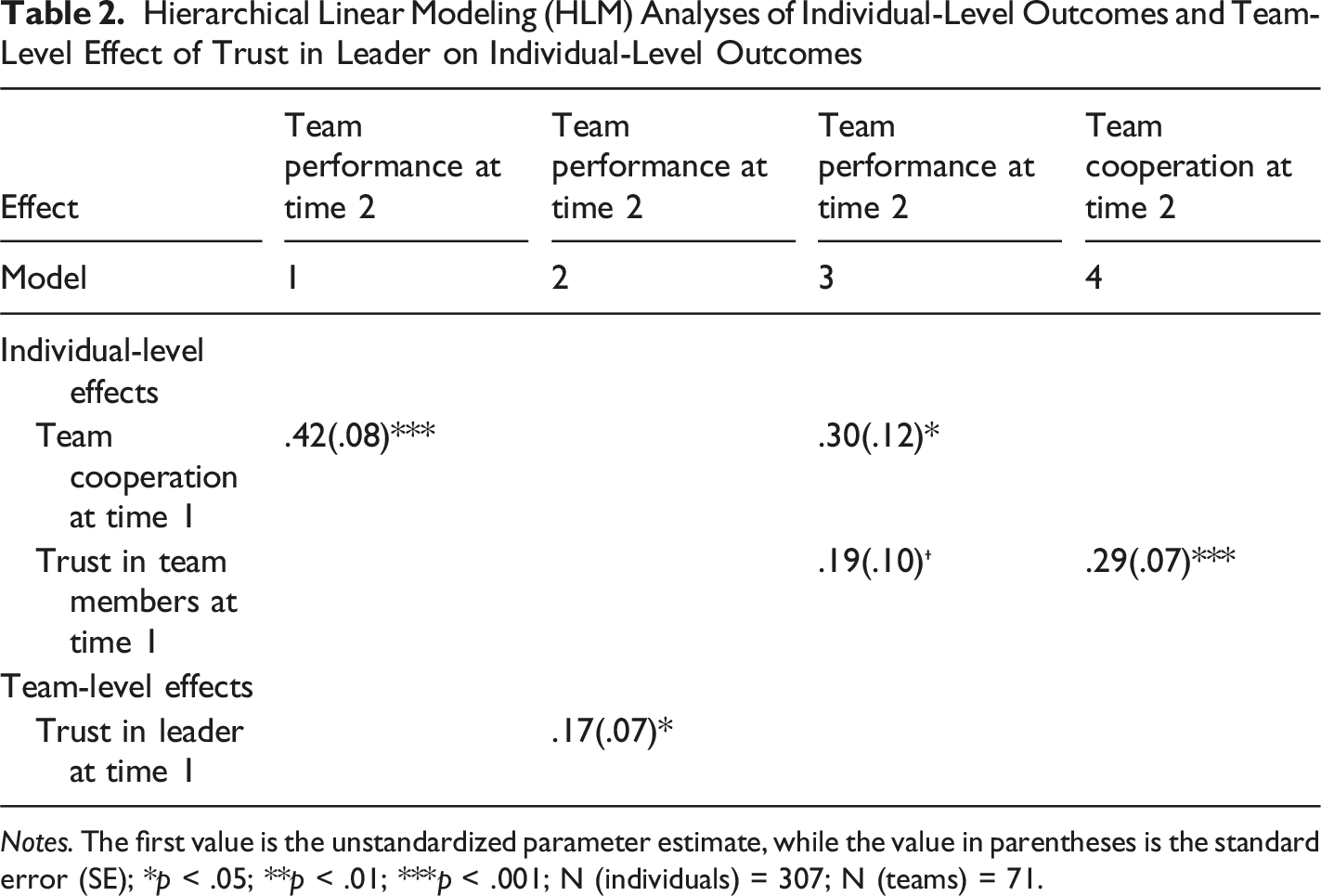
Notes. The first value is the unstandardized parameter estimate, while the value in parentheses is the standard error (SE); *p < .05; **p < .01; ***p < .001; N (individuals) = 307; N (teams) = 71.
Hierarchical Linear Modeling (HLM) Analyses of Individual-Level Outcomes and Team-Level Effect of Trust in Leader on Individual-Level Outcomes
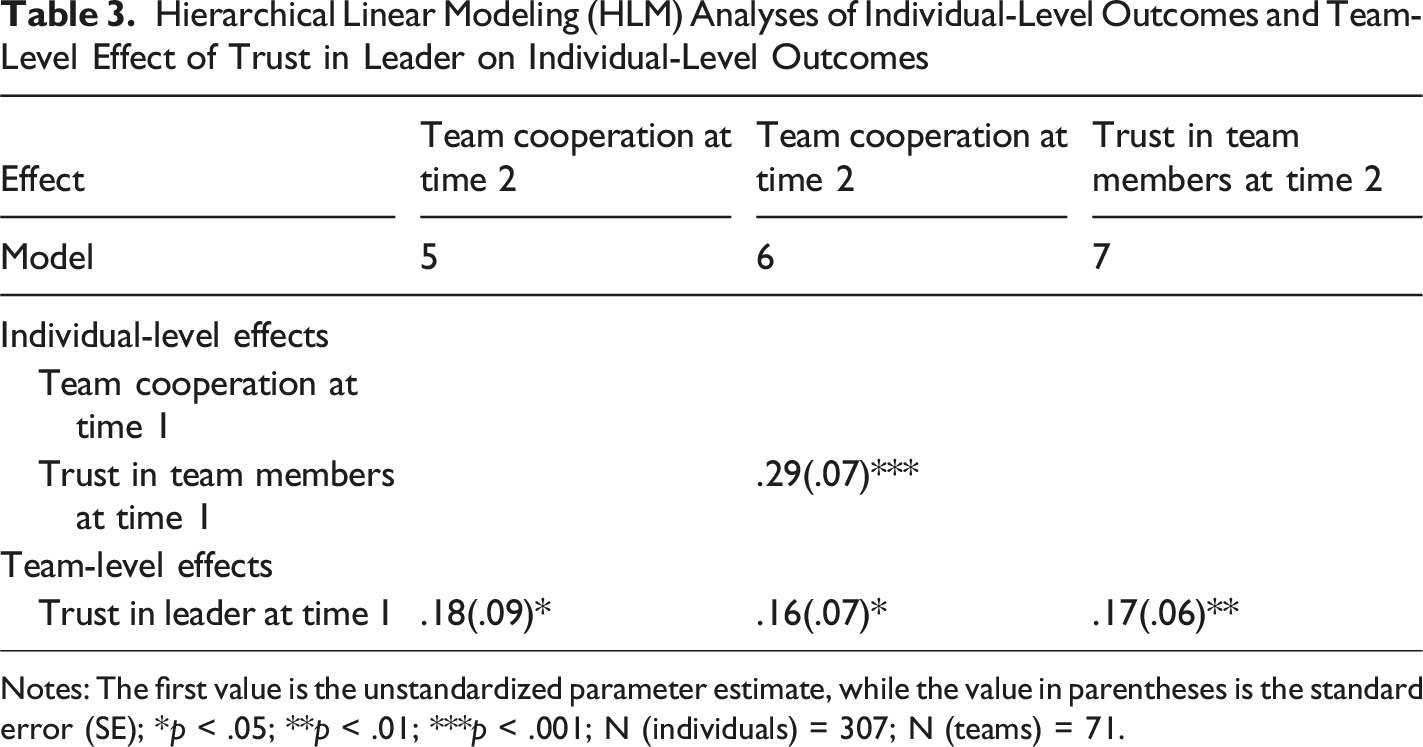
Notes: The first value is the unstandardized parameter estimate, while the value in parentheses is the standard error (SE); *p < .05; **p < .01; ***p < .001; N (individuals) = 307; N (teams) = 71.
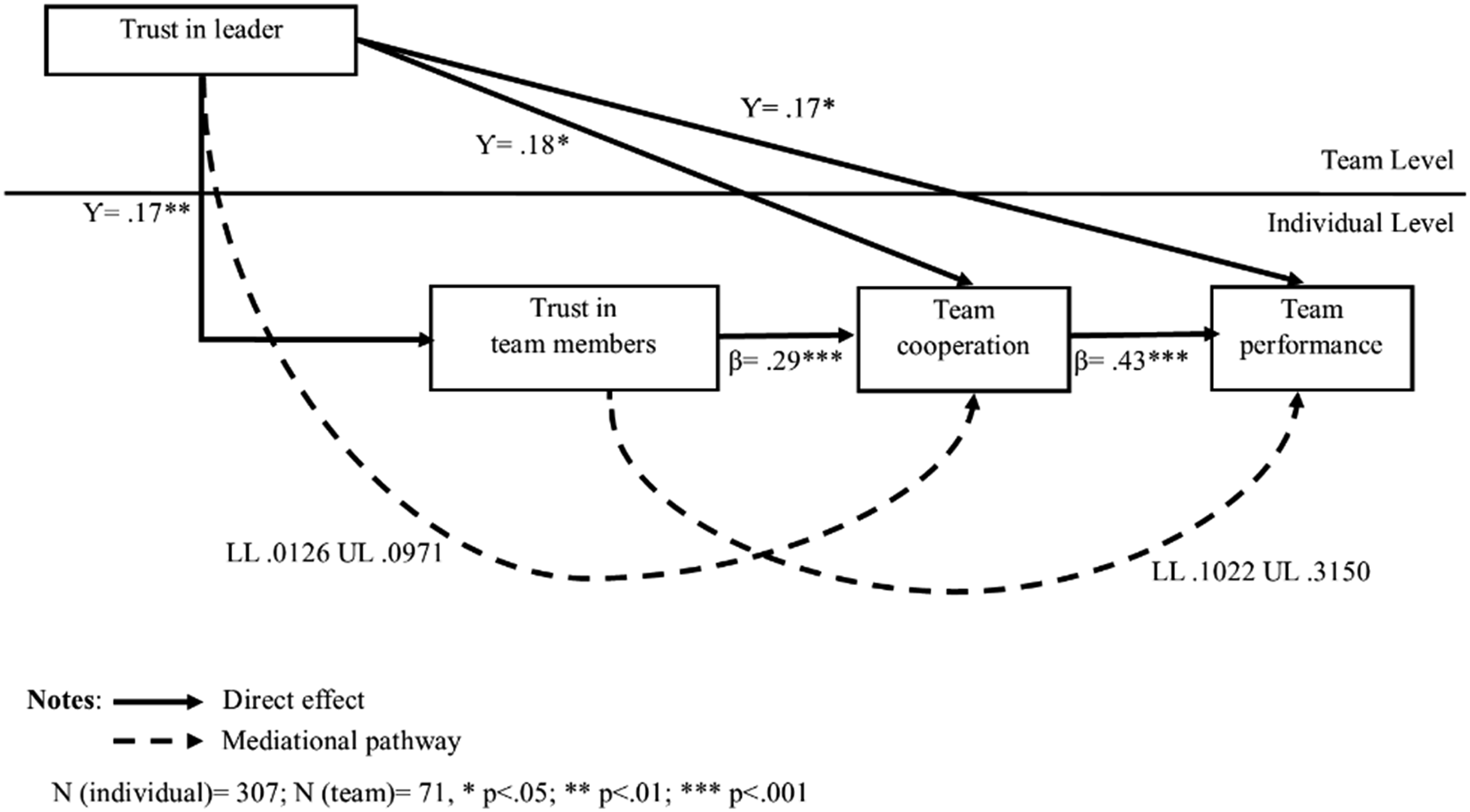
Final Model
Hypothesis 1 predicted that ‘trust in leader’ is positively related to ‘team performance.’ As indicated in Table 2, Model 2, our analysis shows that ‘trust in leader’ and ‘team performance’ are positively related (γ = .17, p = .018). Hence, Hypothesis 1 was supported. Hypothesis 2 predicted that ‘trust in leader’ is positively related to (a) ‘trust in team members’ and (b) ‘team cooperation.’ This was supported by ‘trust in leader’ having a significant positive relationship with ‘trust in team members’ (γ = .17, p = .01) and ‘team cooperation’ (γ = .18, p = .039) (see Table 3, Models 5 and 7).
Hypothesis 3 stated that ‘trust in team members’ is positively related to ‘team cooperation.’ This was supported by the finding that ‘trust in team members’ and ‘team cooperation’ had a positive relationship (β = .29, p < .001) (see Table 2, Model 4). Hypothesis 4 stated that team cooperation is positively related to team performance. This was supported as team cooperation and team performance had a positive relationship (β = .42, p < .001) (see Table 2, Model 1).
Mediational Analyses for Hypothesis 5 and 6
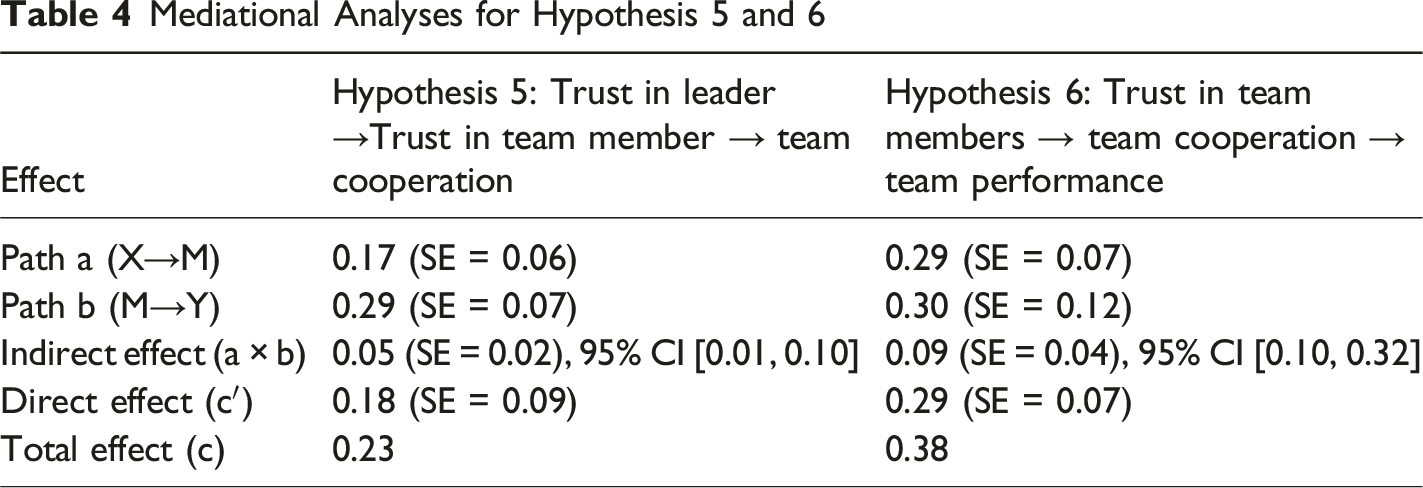
Hypothesis 6 predicted that ‘team cooperation’ mediates’ trust in team members’ and ‘team performance.’ The requirements outlined by Baron and Kenny (1986) were met in the process of testing this hypothesis. Firstly, we found a direct effect only from X→Y (‘trust in team members’→‘team performance’). The Monte Carlo test was then used to examine the mediation effect using the path from ‘trust in team members’→‘team cooperation’→‘team performance.’ Specifically, we used the parameter estimate from Table 2, Model 4 as the value for the direct effect from ‘trust in team members’ to ‘team cooperation’ (β = .29, SE = .07), and the parameter estimate for Table 2, Model 3 ‘(team cooperation’→‘team performance’; β = .30, SE = .12) with ‘trust in team members’ in the model. The Monte Carlo bootstrapping indicated that ‘trust in team members’ had a significant effect on ‘team performance’ through ‘team cooperation’ (95% CI, LL = .1022, UL = .3150) (see Table 4).
Additional Analyses
Additional analyses were conducted to test the possibility of reverse causality between the variables at the individual level (i.e., ‘team performance’ at Time 1 → ‘team cooperation’ at Time 2, ‘team cooperation’ at Time 1 → ‘trust at team members’ at Time 2). We first tested if ‘team performance’ at Time 1 was able to predict ‘team cooperation’ at Time 2, after controlling for team cooperation at Time 1. The result was not significant, showing that ‘team performance’ at Time 1 had no relationship with ‘team cooperation’ at Time 2 (β = .14, SE = .10, p = .15). We also further tested if ‘team cooperation’ at Time 1 was able to predict ‘trust in team members’ at Time 2, after controlling for ‘trust in team members’ at Time 1. The result was significant, showing that ‘team cooperation’ at Time 1 has a positive relationship with ‘trust in team members’ at Time 2 (β = .20, SE = .09, p < .05). Finally, we further tested if ‘team cooperation’ at Time 1 was able to predict ‘trust in leader’ at Time 2, after controlling for ‘trust in leader’ at Time 1. The result was not significant, showing that ‘team cooperation’ at Time 1 did not have any relationships with ‘trust in leader’ at Time 2 (β = .11, SE = .06, p = .10).
Discussion
This study extends organizational trust and team performance research by examining how trust in the leader cascades to shape trust in team members, team cooperation, and ultimately team performance. Unlike prior work that largely focused on dyadic leader–member interactions (e.g., Boies et al., 2015), this study employed a multilevel, multifocal framework grounded in social contagion theory. Overall, we found that the importance of trust in the leader was in activating the trust processes among employees, with this seen as a type of social resource which, in turn, generates job resources. The findings underscore that trust is not a static or isolated attribute but a socially embedded process that diffuses across relationships and influences team dynamics over time.
Theoretical Contributions
Social exchange theory (SET) (Cropanzano & Mitchell, 2005) is commonly referenced in the employee-leader literature, emphasizing LMX as the foundation of a strong relationship. However, this perspective has constrained our understanding of leadership development by focusing primarily on the role aspect of the relationship (Legood et al., 2021). The current study offers an alternative perspective by highlighting the affective aspect of employees, specifically trust in the leader. While it is commonly known that trust in the leader leads to higher team performance (Dirks, 2000; Lee et al., 2010), through our study, we found the specific pathway for the transfer of trust from the leader to team members that allows for high team performance. Specifically, trust in the leader also led to higher trust in team members. The process from trust in the leader to trust in team members is aligned with social contagion theory (Christakis & Fowler, 2013) through which “individuals adopt the attitudes or behaviors of others in the social network with whom they communicate” (Scherer & Cho, 2003, p. 262). This has greater importance in the Asian context where non-verbal interactions and signals convey as much as verbal interactions and communication (Chen & Starosta, 2003). When an employee places trust in the leader, this behavior would also be seen by other employees or by those who have newly joined the team who are still trying to understand the team’s culture. Therefore, other employees would also trust the leader, emulating the same behavior shown by that employee. A synergy of trust would then flow into the team members’ context: as they shared similar views, beliefs, values, and behaviors, team members would also develop trust among themselves. This would create another system of trust among team members which would be conducive to their work processes (Costa & Anderson, 2017).
Our study’s findings are also consistent with social identity theory (Tajfel, 1979) which posits that individuals seek to find their identities in the group to which they belong and, from there, perform the roles and duties aligned with that identity. In the work context, trust in the leader transmits an environment that is trusting and receptive, initiated by the leader and accepted by both the leader and employees. When trust is present, it accentuates a sense of belonging and inclusion for employees (Valcke et al., 2020). Consequently, employees would give more attention to the importance of the role that they play in the team’s success and would ensure that they deliver in their team’s performance. Cohesive bonding translates to a focus on “we”, rather than only on “me” (Kim & Han, 2019).
While the literature has not been viewed from the perspective of resources, we can see that trust is a positive catalyst which, although intangible, conveys a very strong message on the strength of team members and their work processes. We therefore propose that trust is a form of social resource which is an indicator of the leader’s effectiveness and of the strong bonding relationship among team members. Furthermore, Shamir and Lapidot (2003) added that trust then becomes both an interpersonal and a collective phenomenon that materializes within the system level, the group level, and the individual level. Relating this to our study, we observe that trust can penetrate across various levels and at different focal points, thus creating a trusting work environment. Especially in an Asian context where guanxi (i.e., relationship) is signaled through trust and social capital – an element important for team members to work well with one another (Chen & Kuo, 2024; Tan et al., 2024; Zhao & Castka, 2021).
Our study supports the notion of a positive gain spiral through which one type of resources will lead to an increase in other types of resources (Lee & Ding, 2024). Our study found that trust, a form of social resources, led to higher team cooperation, another form of social resources. This shows the positive influence of resources with their focal points not only towards leaders but also towards team members, while resources also increase in other ways, for instance, from trust through to team cooperation. In another school of thought, especially from the job resources perspective, team cooperation is viewed as a type of job resources. Looking at both arguments, team cooperation can be viewed as a type of social resources or as a type of job resources. It is a type of social resources as employees are required to work well together with other employees. This is supported in a study in Pakistan by Imam and Zaheer (2021) where trust in team members also displays higher level of knowledge sharing and team cohesion. It is also a type of job resources as the focus of team cooperation is to get tasks done well. Irrespective of the literature’s argument of whether team cooperation is a type of social resources or a type of job resources, it contributes to team performance.
In addition, team cooperation has been shown to be an important aspect for achieving team performance. Without team cooperation, communication and knowledge sharing will be difficult. As mentioned above, team cooperation can also be a type of job resources which are defined as “physical, psychological, social, or organisational aspects of the job that are either/or: (1) functional in achieving goals, (2) reduce job demands and the associated physiological and psychological costs, and (3) stimulate personal growth, learning, and development” (Bakker & Demerouti, 2007, p. 312). When cooperation is present among team members, it is much easier for tasks to be completed smoothly, especially tasks that require interdependence between employees with different specializations and abilities (West & Hirst, 2005). This means that constant updates are needed on the latest progress of the specific task, while also demonstrating that everyone’s contribution to this task is influential and important for its successful completion. The additional analyses on the reverse causality, where team performance at Time 1 did not have a significant relationship with team cooperation at Time 2, suggest that team performance is treated as an outcome rather than an antecedent. However, the significant finding where team cooperation at Time 1 had a positive relationship with trust in team members (but not trust in leader) at Time 2 supports the positive gain spiral hypothesis but only limited to the team member context. Cooperation and interdependence—common features of collectivistic teams, are key conditions under which trust is further developed and strengthened (Costa et al., 2018).
As leaders are influential at the workplace where they are often viewed as a reference point, and more so in Asian countries, leaders are seen as initiators or activators of how things are run in the workplace (Lee et al., 2017). The current study showed how trust in the leader is derived from employees’ interaction with the leader. It also showed that the leader has certain positive characteristics that enable trust to occur, then allows trust to be a main aspect in leader–employee relationship and the employee–employee relationship, thus enabling increased team cooperation and ensuring higher team performance.
Strengths, Limitations, and Future Directions
Past studies have linked leaders and employees from the job resources perspective However, the current study views leaders and employees from the perspective of trust. The findings show that trust can be contagious (Elfenbein, 2014). The findings also support other studies in the literature which have indicated that leaders can facilitate work outcomes. The current study’s findings show that trust plays a role in the leader–employee relationship, with trust beginning from trust in the leader, then followed by trust among team members. This shows, indirectly, that the leader is the anchor for how the team should function as well as for the atmosphere within the team (Reicher et al., 2005).
The current study is one of the few that manages to explore the relationship between the leader and the team. Past studies in the literature on leadership have mainly focused on its influence on employees, with this resonating with the leader–member exchange theory (cf. Ilies et al., 2007), but studies have not explored how the leadership aspect influences teamwork. In the current study, rather than using a specific leadership style, trust in the leader is positively related to trust in team members and teamwork outcomes. This further accentuates the affective aspect of trust between the leader and the team in facilitating teamwork. This applies especially in Asian countries where people focus on human relationships amid the increasing presence of teamwork in organizations (Huff & Kelley, 2003).
The use of a multilevel approach allows the study to capture a collective response on how team members’ trust in their leader then influences their trust in other team members. The use of a longitudinal approach also shows that the effect of trust in the leader can be effective for three months or more. However, in our study, we were not able to control possible external events which may interfere with the trust processes among team members. Examples, such as conflict with team members or high job demands which reduce certain job resources while increasing strains among team members, will affect how they trust their fellow team members (Malhotra & Lumineau, 2011). Individual characteristics too can influence the trust processes in employees. Employees who have a high level of trust propensity would initiate trust faster and more simply compared to employees who have a low level of trust propensity (Colquitt et al., 2007). In addition, factors such as employees’ organizational membership, team members’ diversity, proximity of employees, level of diverse social interactions among team members, team’s years of formation, hierarchical relationships with team members and supervisors, procedural and interactional justice, and organizational culture may influence the development of trust (Cui et al., 2018; Dayan & Di Benedetto, 2010; Spector & Jones, 2004; Zolfaghari & Madjdi, 2022). Additionally, factors such as team size and pre-existing relationships among team members (e.g., prior collaborations or friendships) could influence initial trust levels and trust development trajectories (Breuer et al., 2020; Dirks & de Jong, 2022).
The study also adopted a longitudinal method to examine the relationship between the variables. This approach allows for the observation of lagged effects of antecedents on outcomes. Similar studies, such as Kim et al. (2023), which used a one-month time gap to examine the impact of authentic leadership on employee outcomes through trust, and Figgins et al. (2025), which used a four-month time gap to investigate identity leadership and follower inspiration, found significant relationships. These findings may indicate that trust can be established in as little as one month. Nevertheless, we interpret the findings with caution, as trust is often contextual and episodic. As such, it evolves in response to events, individuals, and interpersonal dynamics (Legood et al., 2023).
The topic of this study, while able to discover the affective process aspect of trust, requires more investigation on what compels employees to place trust in their leaders. In other words, no specific leadership style or characteristics were indicated as helping to provide a more comprehensive picture of trust’s emotional contagion effect on team processes. In addition, the social contagion process may be limited by the degree of relationship closeness between leaders and team members, which tends to be more formal in Asian cultures. Additionally, the frequency of communication can vary depending on the nature of the work and geographical location (Eisenberg et al., 2019). Nevertheless, trust can still exist and be developed in the absence of emotional closeness, emerging instead through hierarchical norms, power distance, and collectivist values (Klein et al., 2019; Ward et al., 2014). Future studies could investigate various leadership styles and behaviors which increase employees’ trust in the leader. For example, Gao et al. (2011) found that the employee voice was related to trust in the leader. This may signify that leaders who acknowledge the presence and input of employees are more trusted by them.
We have also not yet investigated the dark side of too much trust, with certain employees possibly taking advantage of the situation and sabotaging the relationship and affective processes (Skinner et al., 2014). Employees who have a high level of the dark side of trust will display characteristics that assist them in controlling the work situation, creating a situation that is to their advantage by abusing the established work practices. All these elements will interfere with the emotional contagion effect among team members over time.
Expanding to a three-wave or more longitudinal panel design (Ployhart & MacKenzie, 2014) would enhance causal inference and uncover delayed or recursive effects. We also exercise caution in interpreting the findings as the study has only been conducted in selected industries in Malaysia. Further studies may replicate the study and consider intracultural and intercultural aspects, as well as modifying the methodological timeline, when investigating the development of trust. Future research could also vary the length of measurement intervals to capture different stages of trust development. For example, shorter intervals may better capture the emergence of cognitive trust, whereas longer intervals (e.g., 4–6 months) may reveal the full development of affective trust and its integration into team norms and identity. Future research might further examine the temporal dynamics between cognitive and affective trust, as affective trust may emerge more gradually but exert stronger and more durable effects on team cohesion and sustained performance over time (Dirks & de Jong, 2022).
Practical Implications
With leaders serving as a bridge between higher management and employees, they play an important role in influencing not only employees but also the teams that are increasingly present in organizations (Taggar & Ellis, 2007). The current study’s findings showed that leaders are contributors to team performance. Therefore, it is imperative that leaders are aware of the level of trust that employees have in them. Leaders may use a few strategies to increase trust among employees. This includes being supportive and attending to employee socio-emotional needs (Meyer et al., 2017). In addition, leaders who acknowledge their own mistakes and communicate their own vulnerabilities also help in increasing trust among employees (Ford et al., 2017). This applies especially in the Asian context where work relationships matter (Choi & Han, 2011) and where trust becomes a deciding factor when considering communication and the sharing of information with other team members (Collins et al., 2017).
The study’s findings also showed that team characteristics, such as team cohesion, are positively related to team performance. Employees should understand that, to ensure the team’s success, every member of the team plays a role, with cooperation much appreciated in such a dynamic working relationship. Each employee needs to be aware that it is not only his/her individual performance that matters, but also that his/her behaviors can facilitate or jeopardize other team members’ performance (Chiniara & Bentein, 2018). In a context in which team members are required to work together to complete a task, unity is key, and team members should ensure that they have a high level of communication, information sharing, transparency, and a focus on the same goal (Mesmer-Magnus & DeChurch, 2009).
The findings on trust show that trust between team members is pertinent to team cooperation and team performance. Trust is an important component in increasing organizational competitive advantage (Jones & George, 1998): it is also an internal evaluation towards a third party while taking certain risks oneself. Therefore, organizations should establish ways to help increase the level of trust among team members. Studies in literature have found that frequent communication and discussion can help to increase the level of trust (Willemyns et al., 2003). Interestingly, the finding that trust in the leader transfers to trust in team members reveals an emotional contagion effect from the leader to team members. This shows that the leader acts as a role model in establishing a trust climate within the team that also spreads to team members (Dasborough et al., 2009). Findings again show that the leader establishes the working dynamics among team members.
Conclusion
The findings of this study compel a rethinking of how trust functions in organizational teams. Trust in the leader should not be viewed merely as a predictor of individual outcomes, but as a dynamic force that operates across interpersonal boundaries to shape group norms, cohesion, and ultimately team effectiveness. The evidence highlights trust as a socially transmitted and emotionally resonant construct, embedded within a team’s identity and enacted through its cooperative behaviors. What emerges is a model of leadership not as control or coordination, but as relational influence such that where the leader’s behaviors create emotional cues that ripple through the team, anchoring expectations for collaboration and mutual respect. In high-context cultural settings, such as Malaysia, these processes are intensified by a heightened sensitivity to relational cues and group harmony.
Trust becomes an intangible infrastructure supporting not only the immediate functionality of teams but also their adaptability, resilience, and engagement over time. Leaders who neglect this dimension risk undermining not just relationships, but the structural integrity of team performance. Thus, cultivating trust must be understood as a strategic imperative, inseparable from leadership effectiveness and organizational health. In sum, this research advances social contagion theory through cascading trust model that bridges dyadic leadership theories and broader organizational trust frameworks. By demonstrating how leader trust acts as an upstream social signal shaping team cooperation and performance over time, our findings offer a novel lens for understanding trust as an emergent, dynamic team resource.
Footnotes

Consent to Participate
All participants were given a participant information sheet and participated voluntarily in the study. Participants could also end their participation at any point of the study without any penalty.
Funding
The author(s) disclosed receipt of the following financial support for the research, authorship, and/or publication of this article: This study was funded by the Asian Office of Aerospace Research & Development (AOARD) (Grant number: FA2386-17-1-4097).
Declaration of Conflicting Interests
The author(s) declared no potential conflicts of interest with respect to the research, authorship, and/or publication of this article.
Data Availability Statement
The datasets generated and/or analyzed during the current study are available from the corresponding author in response to a reasonable request.