




Abstract
Academic and personal-emotional adjustment to university are important for students’ success. Dispositional mindfulness is known to be associated with academic and personal-emotional adjustment. However, less is known about the underlying mechanisms explaining this relationship. Coping self-efficacy has been found to be related to dispositional mindfulness, academic and personal-emotional adjustment to university. Therefore, this cross-sectional study sought to investigate a possible indirect effect of dispositional mindfulness on academic and personal-emotional adjustment through coping self-efficacy (emotion-focused and problem-focused). A sample of 65 second-year undergraduate students (Mage = 19.57, SD = .78; 77% women; 68% White) completed a series of measures. Problem-focused self-efficacy was found to be consistent with a partial mediation model whereby increase in dispositional mindfulness was associated with increase in academic and personal-emotional adjustment, partially through increases in problem-focused self-efficacy. Emotion-focused coping self-efficacy was consistent with a partial mediation model whereby increase in dispositional mindfulness was associated with increase in personal-emotional adjustment partially through emotion-focused coping self-efficacy, but was not consistent with a mediation model between dispositional mindfulness and academic adjustment. Findings have theoretical and clinical implications for student adjustment to university and retention.
Keywords
Introduction
Emerging Adulthood
Emerging adulthood (Arnett et al., 2014) is a pivotal developmental period marked by rapid transitions which can overlap with attending university for many (Arnett, 2016). The stress and the challenges of attending university have been associated with alarming rates of student mental health difficulties (Mofatteh, 2020) which can negatively affect academic performance and result in dropout (National Academies of Sciences et al., 2021). As many as 59.5% of students report academics as “very difficult to handle or traumatic” and 41.9% report stress as a main factor adversely affecting their academic performance (American College Health Association [ACHA], 2019). Therefore, students’ emotional and academic adjustment as they adapt to university requires special attention.
Adjustment to University During Emerging Adulthood
Adjustment to university is multifaceted and refers to how well students adapt to the demands of university life (Credé & Niehorster, 2012). Academic and personal-emotional adjustment issues are among the main areas in which students report difficulty that can ultimately lead to academic dropout (Hjorth et al., 2016; Respondek et al., 2017). Moreover, learning is an emotional process (Schutz & Davis, 2000) and academic and emotional adjustment are highly associated (Mettler et al., 2019), such that students with academic adjustment issues tend to report emotional adjustment problems as well (Duchesne et al., 2007). So, it is important to gain more insight on students’ academic and emotional adjustment.
Academic Adjustment
Academic adjustment refers to how well a student can adjust to and cope with the different academic demands of university and encompasses motivation towards pursuing higher education, applying study strategies to succeed academically, performing well academically, and satisfaction with the overall academic environment (Baker & Syrik, 1999). It is closely related to students’ grade point average (GPA) (Credé & Niehorster, 2012). Notably, first year GPA is related to third-year dropout risk (Allen et al., 2008), and academic difficulties are a main reason that undergraduate students terminate their studies (Webb & Cotton, 2019). Thus, academic adjustment is critical for student retention.
Given the importance of academic adjustment, with students reporting alarming rates of difficulties handling academic demands (ACHA, 2019), and academic maladjustment related to contemplation about terminating studies (Webb & Cotton, 2019), there is a need to pay attention to factors that can enhance it. For example, self-efficacy and problem- and emotion-focused coping strategies have been shown to predict academic adjustment (Valenti & Faraci, 2021). Moreover, there was significant improvement in academic adjustment for undergraduate students who participated in a program on stress management and coping, communication skills, and self-awareness (Michaeli Manee et al., 2015), suggesting that academic adjustment is modifiable.
Personal-Emotional Adjustment
Personal-emotional adjustment is a critical intrapersonal aspect of students’ overall adjustment to university concerned with students’ social and emotional adjustment to university (Baker & Syrik, 1999). Personal-emotional adjustment is also related to mental health and well-being. For example, students who seek counselling services tend to score low on personal-emotional adjustment to university (Credé & Niehorster, 2012). Moreover, low levels of personal-emotional adjustment are strongly associated with depression, and are a likely barrier in seeking help when faced with academic challenges, which can result in poor academic performance (Credé & Niehorster, 2012). Therefore, it seems there is a relationship between low personal-emotional adjustment to university and poor mental health.
Given the close associations between personal-emotional adjustment to university and mental health, combined with high levels of mental health difficulties among university students (Mortier et al., 2018), and students with emotional problems more likely to drop out of university (Hjorth et al., 2016), it is important to examine what can contribute to personal-emotional adjustment to university. Although much of the literature regarding university adjustment has focused on the experiences of first-year students (Joly et al., 2022), there is growing evidence that later years of university are associated with more stress (Böke et al., 2019), such as the second year.
Second Year of Undergraduate Studies
Second-year university students report greater anxiety regarding academics and difficulties regulating their emotions (Stewart et al., 2016), show less satisfaction with university compared to first-year students (Sterling, 2018), report the highest levels of stress and the lowest satisfaction with their program compared to final year students (Admi et al., 2018), and appear to have increased thoughts about dropping out of university (Webb & Cotton, 2019). Difficulties of second-year students are known as a phenomenon first documented in the 1950s referred to as the “sophomore slump” (Freedman, 1956; Vaughn & Parry, 2013). Meckamalil et al. (2022) showed that the one-week prevalence of anxiety and depression symptoms was the highest among second-year students compared to students in other years. Overall, second-year university students are still in the process of adjusting to university. They face different types of stressors due to increased demands of their programs and courses (Macaskill, 2012) and choosing a major (Tobolowsky, 2008), while most universities are focused on helping first-year students transition into university (Macaskill, 2012). Therefore, it is imperative to examine protective factors that may enhance second-year students’ academic and emotional adjustment to university. One such factor is mindfulness.
Mindfulness
Mindfulness is a protective factor for a host of psychological difficulties and is related to better well-being (Tomlinson et al., 2018) and its effects have been studied in educational settings (Dawson et al., 2020). Mindfulness is “the awareness that emerges through paying attention on purpose, in the present moment, and nonjudgmentally to the unfolding of experience moment by moment” (Kabat-Zinn, 2003, p. 145) and can be categorized as a state or a trait (disposition) (Brown & Ryan, 2003; Tang et al., 2016). State mindfulness is the temporary experience of mindfulness states at a given time (Tanay & Bernstein, 2013) and dispositional mindfulness is one’s natural tendency to be mindful (Brown & Ryan, 2003). When an individual practices mindfulness, state mindfulness increases, and with regular practice and over time, increases in state mindfulness can lead to increases in dispositional mindfulness (Kiken et al., 2015).
Dispositional mindfulness is associated with positive outcomes for university students (Heath et al., 2016; Mettler et al., 2019). Although only a few studies have looked at the link between dispositional mindfulness and university adjustment, a cross-sectional study by Mettler et al. (2019) found that dispositional mindfulness was predictive of better adjustment to university among first-year students. Although Mettler et al. (2019) established a clear link between dispositional mindfulness and different domains of adjustment to university in first-year students, the mechanisms through which dispositional mindfulness is related to university adjustment in second-year students remain unclear. For instance, Dong et al. (2021) found that resilience partially mediated the relationships between dispositional mindfulness and university adjustment. Although the results are informative, resilience is broad and multifaceted, and does not allow one to understand which ‘active ingredients’ of resilience account for these relations. It is possible that coping self-efficacy, a component of resilience (Pillay et al., 2022), may be one such active ingredient.
Coping Self-Efficacy
Self-efficacy is the perception of one’s ability to accomplish desired outcomes (Bandura, 1977). Students with higher self-efficacy and higher academic self-efficacy report better university adjustment (Ramos-Sánchez & Nichols, 2007; Valenti & Faraci, 2021). Moreover, academic self-efficacy has been found to be a protective factor for student retention in university (Respondek et al., 2020). In the same vein, higher self-efficacy beliefs have been shown to be related to higher grade point average (GPA) and higher persistence towards degree completion (Vuong et al., 2010). In addition to being a protective factor for university adjustment, self-efficacy is also associated with greater dispositional mindfulness (Klainin-Yobas et al., 2016; Mettler et al., 2019). Much of the literature on university adjustment has focused on general and academic self-efficacy. However, there is emerging evidence that coping self-efficacy, defined as confidence in one’s ability to cope with challenging situations (Chesney et al., 2006), is associated with university adjustment (Joly et al., 2022). In addition to academic stressors, university students face multiple layers of social and emotional stressors (e.g., Li & Lee, 2024), and navigating multiple transitions typically faced during emerging adulthood years (e.g., moving out, becoming more financially independent, embarking in new relationships; Arnett, 2016) require relying on coping skills. Moreover, transition periods (such as transitioning to second year) are marked by emotional reactivity, such as emotional distress, cognitive and affective susceptibilities (e.g., Conley et al., 2014). Therefore, it was deemed that coping self-efficacy, as opposed to mere academic or general self-efficacy, would be more appropriate to study in that it directly relates to one’s ability to cope under pressure and resilience (e.g., Kaniasty et al., 2025). Coping self-efficacy has been also found to be positively correlated with dispositional mindfulness (Heath et al., 2016; Petrovic et al., 2022). Coping self-efficacy has been also found to be positively correlated with dispositional mindfulness (Heath et al., 2016; Petrovic et al., 2022).
Although research on the role of coping-self efficacy in educational settings is in its infancy, there is evidence that coping self-efficacy may play a role in explaining the relationship between mindfulness and university adjustment. Coping self-efficacy is based on Bandura’s self-efficacy theory (1977) which is concerned with one’s beliefs of one’s ability to accomplish desired outcomes. Although coping self-efficacy is closely related to Bandura’s self-efficacy, it is also a construct that taps into Lazarus and Folkman’s theory of coping (1984).
Lazarus and Folkman’s theory of coping identified two types of coping strategies: emotion-focused and problem-focused coping (Lazarus & Folkman, 1984). Emotion-focused coping is “[a] coping that is directed at regulating emotional responses to [a] problem” while problem-focused coping can be defined as “managing or altering the problem causing the distress” (Lazarus & Folkman, 1984, p. 150). However, before executing any coping responses, first the individual needs to assess their confidence to see whether they can rely on using either of these coping strategies, or their coping self-efficacy. Therefore, it can be argued that coping-self efficacy is a prerequisite for one’s choice of coping behavior (Chesney et al., 2006) and a likely precursor in executing an appropriate coping behavior accordingly.
Interestingly, coping self-efficacy is related to both dispositional mindfulness and university adjustment. For instance, undergraduates who enrolled in a mindfulness-based intervention reported greater coping self-efficacy, especially emotion-focused coping self-efficacy, compared to controls (Taylor et al., 2022). Thus, practicing mindfulness may increase one’s sense of coping self-efficacy. Moreover, language learners with higher dispositional mindfulness reported higher coping self-efficacy and lower anxiety when speaking a foreign language, and coping self-efficacy partially explained this relationship (Fallah, 2017). Similarly, Heath et al. (2016) found that there was a significant and positive association between dispositional mindfulness and coping self-efficacy’s emotion-focused and problem-focused subscales. Moreover, Petrovic et al. (2022) reported that there were significant and positive correlations between overall coping self-efficacy and dispositional mindfulness. Subsequently, Joly et al. (2022) demonstrated that coping self-efficacy (emotion-focused and problem-focused coping self-efficacy) is positively and significantly related to overall university adjustment (including academic and personal-emotional adjustment). Lastly, Luberto et al. (2014), showed that dispositional mindfulness was associated with coping self-efficacy, which in turn mediated the relationship between dispositional mindfulness and regulating emotions among undergraduate students.
The Present Study
In summary, there is growing evidence that coping self-efficacy is related to dispositional mindfulness and adjustment to university in the areas of personal-emotional adjustment and academic adjustment. Therefore, it is plausible to expect that dispositional mindfulness may enhance academic and personal-emotional adjustment to university via its effect on coping self-efficacy. Thus, the current study had three main objectives. The first was to assess the associations between dispositional mindfulness, emotion-focused coping self-efficacy, problem-focused coping self-efficacy, academic adjustment, and personal-emotional adjustment to university among a sample of second-year university students. It was hypothesized that all variables would be positively and significantly associated with one another. The second objective was to assess the potential mediating role of emotion-focused (objective 2a) and problem-focused (objective 2b) coping self-efficacy in the relationship between dispositional mindfulness and academic adjustment. It was hypothesized that both coping self-efficacy domains would significantly mediate the relationship between dispositional mindfulness and academic adjustment. The third objective was to assess the potential mediating role of emotion-focused coping self-efficacy (objective 3a) and problem-focused coping self-efficacy (objective 3b) in the relationship between dispositional mindfulness and personal-emotional adjustment. It was hypothesized that both coping self-efficacy domains would mediate the relationship between dispositional mindfulness and personal-emotional adjustment.
Method
Participants
The sample consisted of 65 second-year undergraduate university students (Mage = 19.57, SD = .78; 77% women). Most students belonged to the faculties of Arts (32%), Science (22%), Medicine (14%), Engineering (11%), Arts and Science (5%), Education (5%), and Management (3%). Additionally, four participants (6%) reported Psychology as their program of study without mentioning their associated Faculty. The rest of the participants belonged to the faculties of Agricultural and Environmental Sciences and Music (3%). Of the total sample, 48% were in science, technology, engineering, and mathematics (STEM) fields, 41% were in a non-STEM field, and 11% could not be categorized due to insufficient data. Most students identified as White (68%), followed by East Asian (15%), Middle Eastern (5%), Other (8%), South East Asian (3%), and one participant did not report their ethnicity (1%).
Procedure
After obtaining institutional ethics board approval, participants were recruited from a large urban university in Canada. They completed online surveys on Limesurvey in the winter semester of their second year of university.
Measures
Dispositional Mindfulness
Dispositional mindfulness was assessed using the 15-item Mindful Attention Awareness Scale (MAAS; Brown & Ryan, 2003) which measures awareness and attention in the moment. It is the most administered unidimensional assessment of dispositional mindfulness (Hepburn et al., 2021). Given that the current study was the first to examine the mediating role of coping self-efficacy domains in the relationship between dispositional mindfulness and university adjustment, a global unidimensional measure of mindfulness was used as opposed to a multifaceted measure. This was done to establish whether such mediating link exists, before narrowing the focus to examine different facets of dispositional mindfulness. Items include statements such as, “I do jobs or tasks automatically, without being aware of what I’m doing,” and are rated on a 6-point Likert scale (1 = almost always to 6 = almost never). Higher scores indicate higher dispositional mindfulness. In this study, the measure had good internal consistency (α = .89).
Adjustment to University
The Student Adaptation to College Questionnaire (SACQ; Baker & Syrik, 1999) was used to determine university adjustment. The SACQ includes 67 items divided into four subdomains of adjustment to university (i.e., academic, social, personal or emotional, and institutional attachment) rated on a 9-point Likert scale (1 = applies very closely to me and 9 = doesn’t apply to me at all). Higher scores indicate better adjustment. For the purpose of this study, only the academic and the personal-emotional subscales were used. Sample items include “I really haven’t had much motivation for studying lately,” and, “lately I have been feeling blue and moody a lot.” In the present study, internal consistency was excellent for academic adjustment (α = 0.90) and good for personal-emotional adjustment (α = 0.83).
Coping Self-Efficacy
The Coping Self-Efficacy Scale (CSES: Chesney et al., 2006) is a 26-item questionnaire which assesses one’s confidence or certainty in using three types of coping strategies (emotion-focused, problem-focused, and social support) to handle challenging situations. The items are rated on an 11-point Likert scale ranging from 0 (cannot do at all) to 10 (certain I can do). Higher scores indicate higher coping self-efficacy. Given the focus of this study, only the emotion-focused (e.g., “take your mind off unpleasant thoughts”) and problem-focused subscales (e.g., “make a plan of action and follow it when confronted with a problem”) were used. Internal consistency for the problem-focused (α = .91) and emotion-focused subscales (α = .90) were excellent.
Data Analytic Plan
All data were analyzed using SPSS version 28. Patterns of missingness, outliers (univariate and multivariate), and assumption checks were assessed and met prior to running the primary analyses. Preliminary analyses were run before conducting the main analyses to examine if demographic variables (age, gender, ethnicity, and being in a STEM or a non-STEM field) needed to be controlled. Pearson’s correlation was conducted using the Bonferroni correction for the first objective. For the second and third objectives, a series of four mediation analyses were performed using Process macro with bootstrapping in SPSS. Significance was determined using bootstrapped confidence intervals.
Results
Preliminary Analyses
Two MANOVAs were run to assess any significant differences between STEM and non-STEM students regarding coping self-efficacy and adjustment to university and there were no significant differences between the groups in coping self-efficacy [F (2, 55) = 2.26, p = .114; Wilk’s Λ = 0.924, partial η2 = .07] and university adjustment [F (2, 55) = 2.73, p = .074; Wilk’s Λ = 0.910, partial η2 = .09]. Furthermore, a one-way ANOVA revealed there were no significant differences between STEM and non-STEM students in dispositional mindfulness, (F (1,56) = .308, p = .581). Therefore, program of study was not entered in the analyses as a control variable. Moreover, given the limited variability in participants’ age, gender, and ethnicity, group differences as a function of these demographic variables were not assessed.
Main Analyses
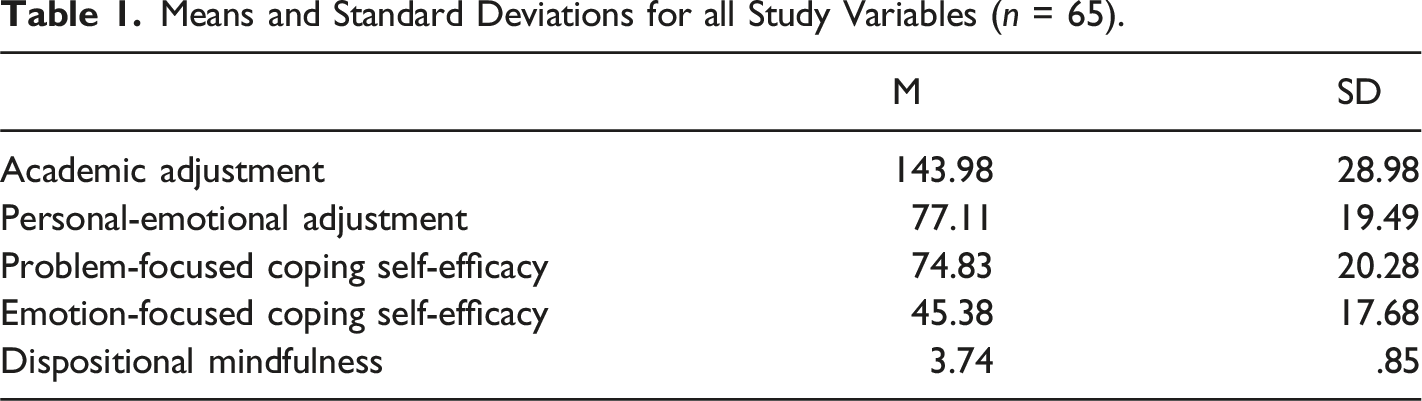
Means and Standard Deviations for all Study Variables (n = 65).
Correlations Between Study Variables (n = 65).
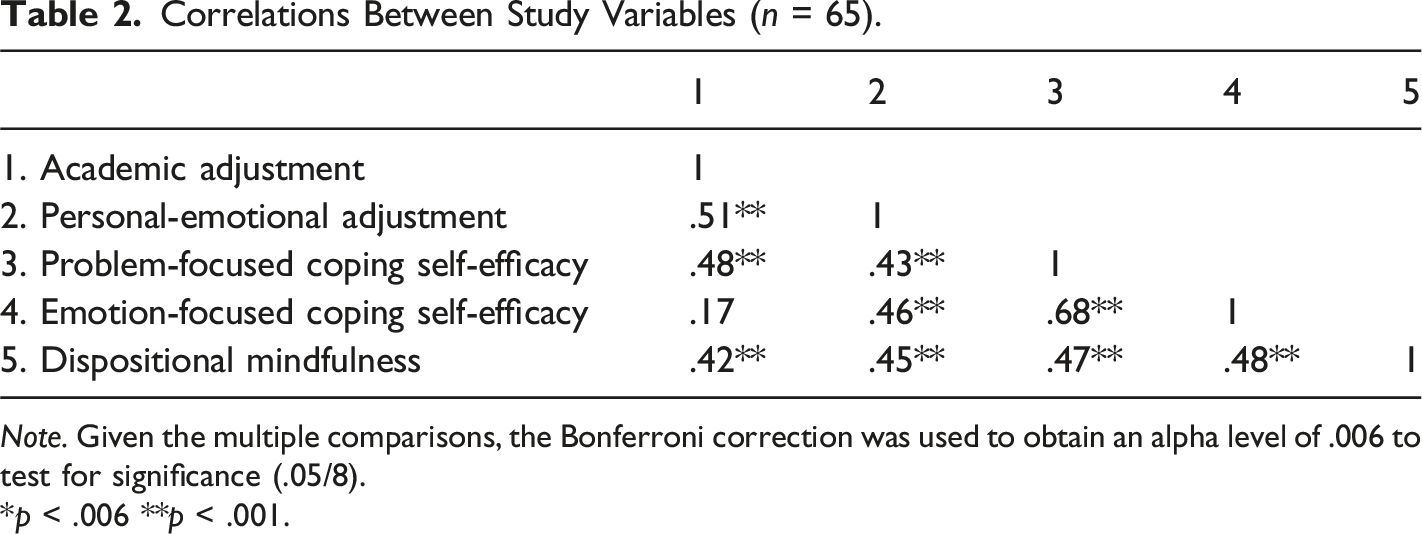
Note. Given the multiple comparisons, the Bonferroni correction was used to obtain an alpha level of .006 to test for significance (.05/8).
*p < .006 **p < .001.
For the second and third objectives, four mediation analyses were run. The results of the mediation analyses for objective 2 are presented in Figure 1 panel a and Figure 1 panel b. In partial contradiction of the hypotheses, emotion-focused coping was not consistent with a mediation model between mindfulness and academic adjustment (indirect effect β = 0.422, 95% CI [-0.151, 0.104]; Figure 1 panel a), although problem-focused coping was consistent with a mediation model (indirect effect β = 0.171, 95% CI [0.029, 0.358]; Figure 1 panel b). Interestingly, despite the lack of indirect effect through emotion-focused coping self-efficacy, the direct effect of dispositional mindfulness on academic adjustment was significant (path c’ β = 0.440, 95% CI [6.092, 23.909]; Figure 1panel a). When examining the indirect effect through problem-focused coping self-efficacy, dispositional mindfulness retained a significant, albeit reduced, main effect on academic adjustment (path c’ β = 0.251, 95% CI [0.236, 16.893]; Figure 1 panel b), consistent with a partial mediation model. Standardized Regression Coefficients for the Mediation Analyses (n = 65). (a), (c), (b), (d). *p < .05, **p < .001.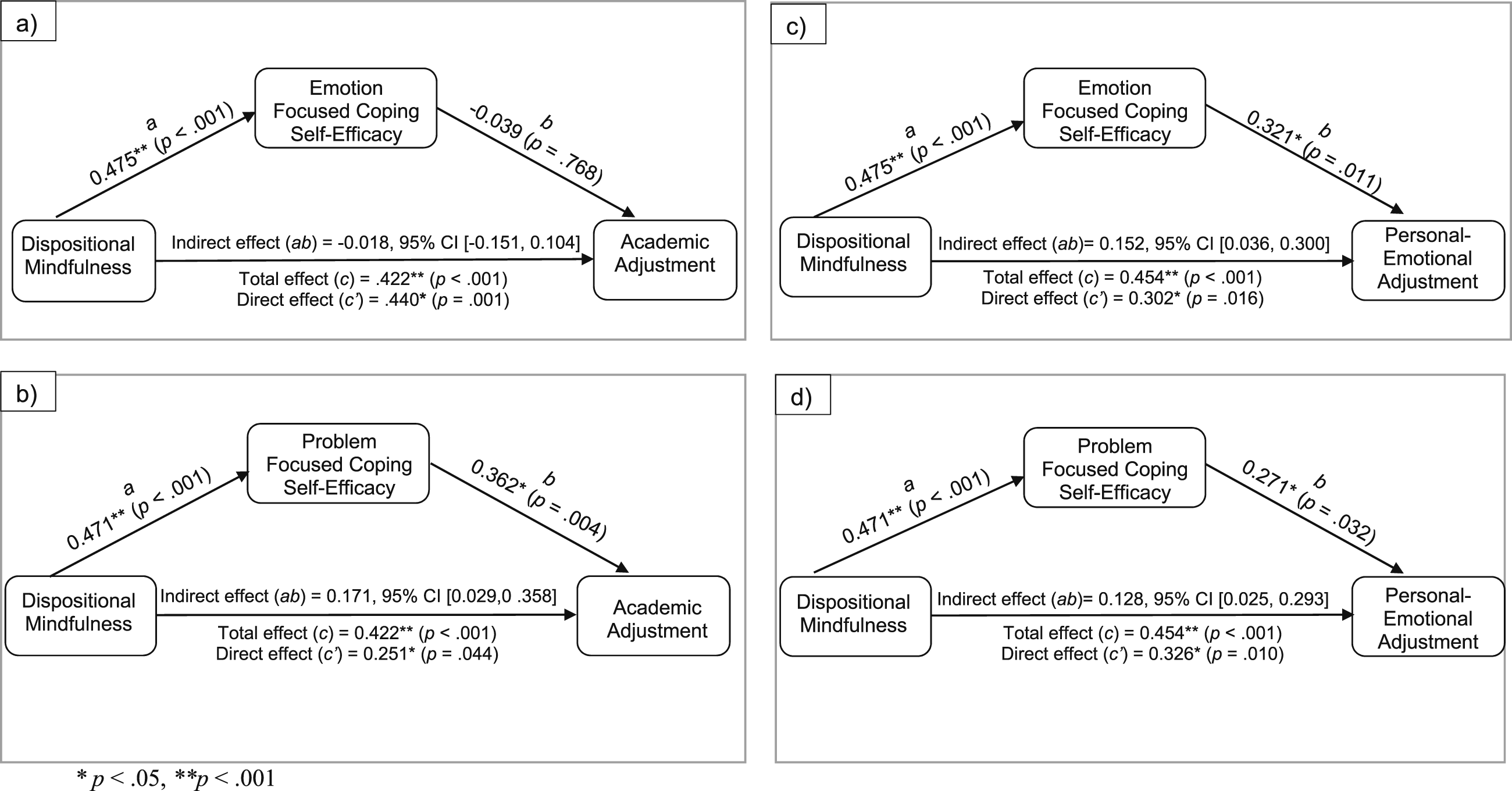
The results of the mediation analyses for objective 3 are presented in Figure 1 panel c and Figure 1 panel d. In full support of the hypotheses, both emotion-focused coping self-efficacy (indirect effect β = 0.152, SE = .068, 95% CI [0.036, 0.300]; Figure 1 panel c) and problem-focused coping self-efficacy (indirect effect β = 0.128, SE = .068, 95% CI [0.025, 0.293]; Figure 1 panel d) were consistent with a mediation model between dispositional mindfulness and personal-emotional adjustment. When examining the indirect effect through emotion-focused coping self-efficacy, dispositional mindfulness retained a significant, albeit reduced main effect on personal-emotional adjustment (path c’ β = 0.302, SE = 2.797, 95% CI [1.321, 12.502]; Figure 1 panel c), consistent with a partial mediation. Additionally, when examining the indirect effect through problem-focused coping self-efficacy, dispositional mindfulness retained a significant, albeit reduced main effect on personal-emotional adjustment (path c’ β = 0.326, SE = 2.834, 95% CI [1.804, 13.135]; Figure 1 panel d), also consistent with a partial mediation model.
Discussion
This study sought to (a) examine the associations between dispositional mindfulness, coping self-efficacy domains (emotion- and problem-focused), and key university adjustment domains (academic and personal-emotional adjustment to university) in the second year of university and (b) to examine the potential mediating role of coping self-efficacy domains (emotion and problem-focused) in explaining the relationship between dispositional mindfulness and key university adjustment domains (academic and personal-emotional adjustment) among second-year undergraduate students.
For the first objective, findings revealed that, consistent with previous literature (Dong et al., 2021; Mettler et al., 2019), there were positive and significant correlations between dispositional mindfulness and domains of university adjustment (academic and personal-emotional adjustment). Furthermore, as hypothesized, and consistent with past studies (Fallah, 2017; Heath et al., 2016; Luberto et al., 2014; Petrovic et al., 2022), there were positive and significant associations between dispositional mindfulness and coping self-efficacy domains. These findings provide additional support for the notion that dispositional mindfulness and coping self-efficacy are modifiable constructs worthy of further exploration in relation to university adjustment.
Consistent with Joly et al. (2022), findings revealed strong positive correlations between problem-focused coping self-efficacy and domains of adjustment to university (academic and personal-emotional). In line with Bandura’s theory of self-efficacy (1977), it is possible that those with higher problem-focused coping self-efficacy may see difficult situations as challenges that can be overcome, rather than as threats, enabling them to experience better university adjustment. Furthermore, as hypothesized, and consistent with past research (Joly et al., 2022), there was a positive and significant correlation between emotion-focused coping self-efficacy and personal-emotional adjustment. However, surprisingly, no significant link was found between emotion-focused coping self-efficacy and academic adjustment.
A possible interpretation may be that emotion-focused coping self-efficacy may not be as helpful as problem-focused coping when faced with academic issues that require active problem-solving. This is aligned with Folkman and Lazarus’ theory (1980), which posits that when faced with a challenge that one deems as controllable- such as academic demands- problem-focused coping may be more advantageous than emotion-focused coping. Given that coping self-efficacy is a precursor to one’s choice of coping strategy (Chesney et al., 2006), a student who is overwhelmed by their coursework but perceives the challenge as manageable through proper time management and organization skills (i.e., who has high problem-focused coping self-efficacy) would likely experience better academic adjustment than a student who attempts to manage the unpleasant feelings they have around academic demands in the absence of active problem-solving.
Dispositional Mindfulness and Academic Adjustment
For the second objective, findings revealed that problem-focused coping self-efficacy was consistent with a partially mediation model whereby increase in dispositional mindfulness was associated with increase in academic adjustment partially through problem-focused self-efficacy. This is in line with findings showing that one’s appraisal of one’s problem-solving skills is predictive of academic performance (Veerasamy et al., 2019), and that dispositional mindfulness is related to problem-solving (Ostafin & Kassman, 2012) as well as academic adjustment (Mettler et al., 2019). For instance, a student who has high dispositional mindfulness and is overwhelmed by coursework may report better academic adjustment partially through being confident that with proper time management and organization skills (i.e., problem-focused coping self-efficacy) they can overcome the challenge, more effectively, rather than trying to stop the unpleasant feeling they have about their course load.
Surprisingly, emotion-focused coping self-efficacy was not found to be consistent with a mediation model between dispositional mindfulness and academic adjustment, although Joly et al. (2022) found significant positive correlations between emotion-focused coping self-efficacy and overall university adjustment. Given that students with higher coping self-efficacy tend to have lower academic performance stress (Watson & Watson, 2016), a possible explanation for the absence of the mediating role of emotion-focused coping self-efficacy in the relationship between dispositional and academic adjustment may be that emotion-focused coping self-efficacy may not be as helpful when one is faced with academic adjustment issues that need problem-solving rather than changing one’s mindset about the problem, above the direct influence that dispositional mindfulness exerts on predicting academic adjustment. Nevertheless, the significant direct effect of dispositional mindfulness on academic adjustment points to the crucial direct link between dispositional mindfulness and academic adjustment, which is in line with previous findings (Dong et al., 2021; Mettler et al., 2019). Therefore, the findings suggest that it is problem-focused coping self-efficacy, rather than emotion-focused coping self-efficacy, that mediates the relationship between dispositional mindfulness and academic adjustment.
Dispositional Mindfulness and Personal-Emotional Adjustment
For the third objective, emotion-focused coping self-efficacy was found to be partially consistent with a mediation model whereby increase in dispositional mindfulness was associated with increase in personal-emotional adjustment partially through emotion-focused coping self-efficacy. This suggests that for students with high dispositional mindfulness, this may also influence their emotion-focused coping self-efficacy. Therefore, as a result of emotion-focused coping self-efficacy, they would not interpret a difficult scenario as a threat and may see the problem at hand as a challenge that can be overcome by reorienting their perspectives about it (i.e., emotion-focused coping self-efficacy), which is in line with Bandura’s theory of self-efficacy (1977) and can ultimately enhance personal-emotional adjustment to university.
Moreover, there is evidence that non-reacting component of dispositional mindfulness helps individuals disengage from emotionally disturbing stimuli (Makowski et al., 2019), pointing to the role of dispositional mindfulness in reorienting one’s attention from overwhelming emotions (i.e., emotion-focused coping) which may result in better personal-emotional adjustment to university. For example, when a student is struggling with course load and feels overwhelmed, if they are innately mindful, they would report better personal-emotional adjustment. Moreover, dispositional mindfulness may affect their coping confidence, in that if they see the course as a means to obtain their degree and have their dream job (i.e., having confidence in using emotion-focused coping such as reorienting their perspective about the challenge at hand). Then, they may not hold a negative view of the course and their dispositional mindfulness can translate into better personal-emotional adjustment via its effect on emotion-focused coping self-efficacy. Lastly, the significant direct link between dispositional mindfulness and emotion-focused coping self-efficacy is consistent with earlier findings that dispositional mindfulness is related to emotion regulation and coping self-efficacy (Luberto et al., 2014).
Problem-focused coping self-efficacy was also found to be partially consistent with mediation model whereby increase in dispositional mindfulness was associated with increase in personal-emotional adjustment to university, partially through problem-focused coping self-efficacy. These results echo earlier findings by Valenti and Faraci (2021) who found task-oriented coping (which is similar to problem-focused coping given its focus on approaching the problem rather than avoiding it; Stanislawski, 2019) to be related to personal-emotional adjustment to university. Moreover, given that dispositional mindfulness is related to personal-emotional adjustment to university (Mettler et al., 2019) and dispositional mindfulness is related to coping self-efficacy (including problem-focused coping self-efficacy) (Heath et al., 2016), findings reveal that beyond the direct effect of dispositional mindfulness on personal-emotional adjustment, problem-focused coping self-efficacy partially explains this relationship as well.
For instance, someone who has high dispositional mindfulness may report better personal-emotional adjustment partially through having more confidence to use problem-focused coping to deal with hurdles. In fact, there is evidence that mindfulness supports creativity (Henriksen et al., 2020) and that problem-solving is often an inherently creative process (Wimmer, 2016). Thus, mindfulness may enhance one’s confidence in their ability to see a problem from different angles and come up with creative solutions which can bring about better personal-emotional adjustment to university. Moreover, the enduring significant direct effect of dispositional mindfulness on personal-emotional adjustment to university speaks to the overwhelming evidence of the importance of dispositional mindfulness on adjustment to university (Dong et al., 2021; Kingery et al., 2021; Mettler et al., 2019).
Limitations and Future Directions
Although the current study provides new insights on the role of coping self-efficacy domains as underlying mechanisms between dispositional mindfulness and academic and personal-emotional adjustment to university, there are limitations to this study. First, previous studies have noted gender differences regarding university adjustment (Charalambous, 2020; Duchesne et al., 2007). However, gender was not controlled for in the analyses given that the sample was overwhelmingly comprised of women. Similarly, ethnic background is related to academic (Batyrshina et al., 2021) and emotional adjustment (Smith et al., 2014); however, given the high percentage of White students in the study, ethnicity was not included as a control variable. Future research would benefit from taking these variables into account in their analyses.
Another limitation is that students were recruited from a large, urban, competitive university, which limits the generalizability of the findings. Given that the sample was made up of predominantly White women, the findings may not be as applicable to a more gender or ethnically diverse sample and future studies would benefit from replicating the findings using a larger, more ethnically and gender diverse sample to better understand the nuances underlying the associations between coping self-efficacy, dispositional mindfulness, and university adjustment. For example, women tend to report higher mindfulness levels in university setting (e.g., Rojiani et al., 2017). Given that the sample was predominantly women, it is possible that the results might have been different had larger sample of men was included. Similarly, it has been reported that women tend to report higher coping self-efficacy beliefs compared to men in the general population (e.g., Colodro et al., 2010). Moreover, even though minoritized students, who experienced additional barriers and stressors in their lives, tend to report lower university adjustment (e.g., Besch, 2024), they also report higher resilience (e.g., Cabrera Martinez et al., 2022), a concept closely related to one’s self-efficacy beliefs (Schwarzer & Warner, 2013). Therefore, it may be possible given that dispositional mindfulness has been reported to be a protective factor for minoritized groups (e.g., Graham et al., 2013), a similar pattern might have been observed with regards to the findings; however, future studies using a more diverse sample could answer this question, as well as considering the intersectionality between multiple minoritized identities (e.g., first generation students, gender).
Moreover, although the current sample size was deemed sufficient by the power analysis for the analyses used in the present study, a larger sample size would have been advantageous in permitting more complex and conservative analyses (e.g., latent Structural Equation Modeling, comparing fit of alternate direction mediational models, examining gender, ethnicity differences) and thus sample size could be seen as a limitation. Even though the mediation analyses were conducted using robust bootstrapping methods, findings should be interpreted with this limitation in mind, highlighting the necessity of replicating the study with a larger and more diverse sample size. However, the findings serve as a preliminary investigation into the topic. Moreover, given the study’s cross-sectional design, temporal causal inferences cannot be made; there remains a need for longitudinal and experimental studies to shed light on the temporal sequence and the direction of the associations found. Finally, although we used a unidimensional measure of mindfulness to establish whether a mediating link exists between the variables before narrowing the focus to examine different facets of dispositional mindfulness, now that the indirect effect of overall dispositional mindfulness and university adjustment via coping self-efficacy has been preliminarily established, future research is needed employing multi-faceted measures of dispositional mindfulness (e.g., The Five Facet Mindfulness Questionnaire (FFMQ; Baer et al., 2006)). Using a multidimensional measure would provide an additional nuanced understanding of which specific facets of mindfulness are indirectly related to university adjustment via coping self-efficacy.
Implications
The findings add to the literature on the underlying mechanisms through which dispositional mindfulness is related to academic and personal-emotional adjustment to university in the second year of university. The present findings shed light on the importance of targeting emerging adults’ dispositional mindfulness levels alongside their coping self-efficacy beliefs, which then, directly and indirectly, can affect their academic and personal-emotional adjustment to university.
Considering this study’s results, in that mindfulness can influence one’s sense of coping self-efficacy, college counsellors and program developers should consider integrating strategies for enhancing dispositional mindfulness to support second year students’ academic adjustment to university while taking into account that coping self-efficacy, particularly problem- and emotion-focused coping, plays a role in facilitating this relationship. Thus, mental health professionals may benefit from implementing strategies that can improve students’ problem- and emotion-focused coping self-efficacy beliefs in relation to students’ personal-emotional adjustment issues when offering mindfulness skills instruction. They may also benefit from integrating ways to enhance problem-focused coping self-efficacy when offering mindfulness-based programs to maximize the effects of dispositional mindfulness on students’ academic adjustment. Particular attention should be paid to delivering these interventions in a culturally-sensitive and adapted manner (e.g., Hytman et al., 2025) that can be tailored to the needs of culturally diverse campuses with minoritized and international students (e.g., Xiong et al., 2022). For example, mindfulness programs could be offered in multiple languages, depending on the linguistic profile of universities’ student populations, and the content revised to be more culturally accessible to diverse campuses (e.g., Hytman et al., 2025). Considering these adaptations in offering mindfulness programs is essential as even though the benefits of mindfulness programs are well-known, accessibility and barriers in participating in such programs remains an issue (e.g., Bautista et al., 2022).
Conclusion
The present study extends previous research on the relationship between dispositional mindfulness and domains of adjustment to university (academic and personal-emotional), and is the first to shed light on specific domains of coping self-efficacy as underlying mechanisms that explain the relationship between dispositional mindfulness and domains of adjustment to university. The findings enhance our understanding of the importance of dispositional mindfulness as a variable that is directly and indirectly, via its impact on coping self-efficacy, associated with academic and personal-emotional adjustment to university. The findings highlight that enhancing students’ mindfulness may coincide with improved coping self-efficacy, in particular problem-focused coping self-efficacy. This may, in turn, positively impact academic and personal-emotional adjustment to university. The results challenge the notion that mindfulness merely increases affect and emotion-regulation since the results clearly indicate that mindfulness enhances students’ perception of their ability to problem-solve. Therefore, the findings show that the benefits of dispositional mindfulness go beyond emotion regulation alone and can enhance students' confidence in their ability to cope with academic and personal-emotional challenges by facing the problem and using problem-focused coping approaches.
Footnotes
Declaration of Conflicting Interests
The author(s) declared no potential conflicts of interest with respect to the research, authorship, and/or publication of this article.
Funding
The author(s) received no financial support for the research, authorship, and/or publication of this article.
Ethical Approval
Ethical approval from McGill University Research Ethics Board was obtained.
Informed Consent
All participants provided written informed consent prior to participating in the study.

Data Availability Statement
Data will be made available on reasonable request.