




Abstract
Work engagement, a key driver to job performance, has been highly researched in the literature, yet most studies have looked at it from a job demands-resources perspective. In addition, research has rarely tapped into the social aspect of resources, which are important in work relationships. In this era of globalization, employees come from various backgrounds making the workplace more diverse than ever. From the perspective of social capital theory, the current study hypothesized that leadership can be the driver of social capital, specifically that employees’ perceptions of their leader’s cultural intelligence would be related to a stronger sense of inclusivity among employees, which then would be related to higher levels of perceived work meaningfulness and work engagement. This study used a two-wave multilevel approach where three hundred and seven employees from 71 teams in Malaysian organizations participated. As hypothesized, employees’ collective perceptions of leaders’ cultural intelligence at Time 1 were positively related to employee perceptions of inclusivity, work meaningfulness, and work engagement at Time 2. Perceptions of inclusivity also mediated the relationship between collective perceptions of leaders’ cultural intelligence and work meaningfulness while work meaningfulness mediated the relationship between inclusivity and work engagement. The findings clarify that leaders who are seen as culturally intelligent can provide social capital for employees by increasing inclusivity in the workplace, indirectly making work more meaningful which can result in higher work engagement.
Keywords
Introduction
Work engagement has become one of the most highly investigated phenomena within management studies. From a positive psychology perspective, research into work engagement champions the importance of internal motivation that allows employees to perform well at work (Lee et al., 2017). Work engagement has been found to have many positive outcomes such as higher productivity, job performance and organizational citizenship behavior. Most current research into work engagement is closely embedded within the job demands-resources model, where the presence of job resources increases work engagement while the presence of job demands reduces work engagement (He et al., 2022).
While work engagement is closely tied to the job demand-resources theory, we argue that there is a need to extend the focus on the social aspects of work beyond the focus on the job or task aspects of work. As workforces become more diverse in their cultural backgrounds, ideologies, and practices (Flory et al., 2021), there is an increasing need to look at how organizations can manage their employees more effectively from a social perspective in order to increase work engagement. Social capital is defined as “knowledge and organizational resources that enhance the potential for individual and collective action in human social systems” (McElroy et al., 2006, p. 125). In other words, it is a construct that explains social connection, relationships and trust (Schmid & Robison, 2015) which indirectly enhance employees’ work productivity and quality through social connections (Lee et al., 2024a). Social capital serves as a link in creating a collective, beyond self, and reciprocal working environment which employees feel a part of (Singh et al., 2021). It relates not only the social processes within the organization but also the economic processes (Gannon & Roberts, 2020) which benefit both employees and the organization. Much current social capital theory and research focuses on knowledge management and knowledge sharing (Berraies et al., 2020; Han et al., 2020) rather than on who and how in enhancing social capital in organizations.
Leadership is one of the most important components of organizational-behavioral research (Agars et al., 2008) and organizational leaders can have a major influence on workplace social capital and employee work outcomes (Yukl, 2012). This implies that leaders’ perceived competencies can be at least as important as other job resources given that work is social in nature. This has led to many studies looking at how leaders’ attributes can motivate or demotivate employees to achieve organizational objectives and goals (Sonmez Cakir & Adiguzel, 2020). Based on social capital theory (Putnam, 1993) and a multilevel mediational approach, we propose that perceptions of an inclusive work environment can be initiated by leaders who are seen to be high in cultural intelligence, and that inclusivity will mediate the relationship between perceptions of leaders’ cultural intelligence and work meaningfulness, while work meaningfulness will mediate the relationship between inclusivity and work engagement. Cultural intelligence has been chosen as the independent variable in this study because workforces are becoming increasingly globalized and diverse (Podsiadlowski et al., 2013). Therefore, there is a need for leaders who are culturally sensitive to employees from diverse backgrounds. The study will be the first to link perceptions of leaders’ cultural intelligence to employee inclusivity, emphasizing the importance of looking at the leader-employee relationship from a relational (i.e., social) perspective. The present study also seeks to answer a call for scholars to adopt the cross-level approaches when exploring the intricate dynamics and relationships between the leader and employees (Amabile & Mueller, 2008). Malaysia is a multicultural nation, with three major ethnicity groups which retain their own distinctive language, culture, and customs, making it a suitable context for exploring cultural issues at work. The findings will guide practitioners and HR personnel in developing effective leaders and will also help expand the social resources literature. The proposed model is illustrated in Figure 1. Hypotheses and research model.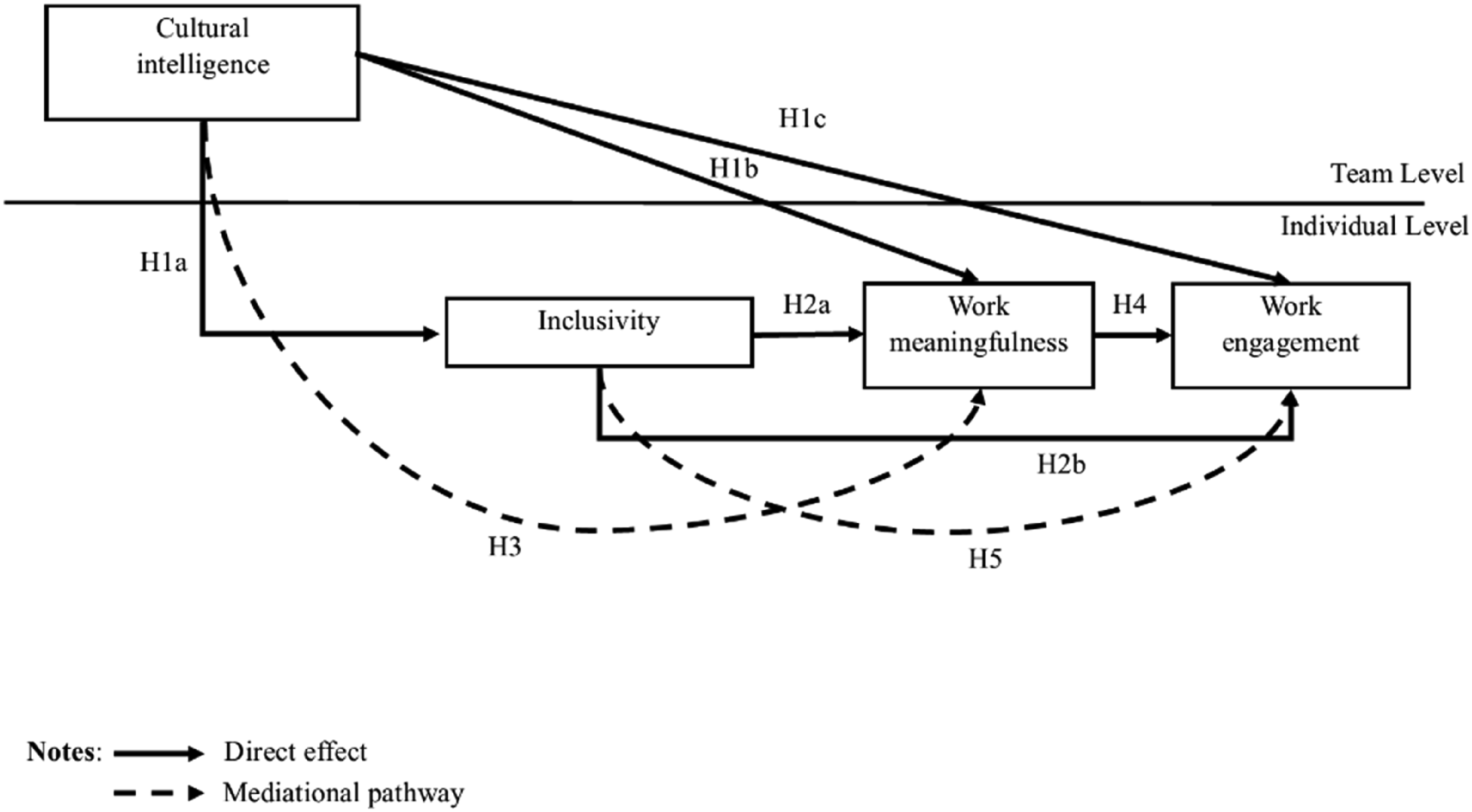
Cultural Intelligence, Inclusivity, Work Meaningfulness and Work Engagement
Cultural intelligence, one of the skills which can help individuals in understanding and managing differences in cross-cultural setting, is a leadership attribute that has been researched in recent times. Cultural intelligence is defined as ‘individual’s capability to function and manage effectively in culturally diverse situations and settings’ (ref. Ott & Michailova, 2016, p. 99). Different from social intelligence and emotional intelligence, it is a multifaced construct consisting of cognitive, behavioral, and motivational abilities (Earley & Ang, 2003) related to cultural knowledge, cross-cultural skills, and cultural metacognition (Thomas et al., 2008). These abilities allow individuals to work effectively with individuals from different cultures and backgrounds. The ‘cultural’ aspect of cultural intelligence applies not only to cultural elements of nationality or background, but also encompasses the diversity of ethnicity, beliefs, ages, and sexual orientations among employees (Young et al., 2017). Groves and Feyerherm (2011) found that employees’ perceptions of their leaders’ cultural intelligence were positively related to perceived leader and team performance, Gabel-Shemueli et al. (2019) found that cultural intelligence had a positive relationship with employees’ work engagement in multinational companies, while Ramalu and Subramaniam (2019) found that, among expatriates working in Malaysia, psychological need satisfaction mediated the relationship between cultural intelligence and work engagement. Cultural intelligence has therefore been viewed as a form of social intelligence that is crucial for organizational competitiveness, resilience, and long-term survival within the business environment (Buehring & Moore, 2018).
Since a team consists of employees from different backgrounds, a leader can increase the social capital of the team by creating a working environment that is inclusive and supports employees’ feelings that they belong and are valued within the team. Inclusivity refers to the degree to which individuals feel enabled to participate in work-related and social activities (Maurer et al., 2003), and a sense of inclusivity is an important aspect of the workplace (Men et al., 2023). The essence of inclusion has been stated to lie not on the individual but the environment through shared trust, norms and values (Durlauf & Fafchamps, 2004). Building a sense of inclusivity requires a leader to be sensitive and aware of the cross-cultural differences and to treat all with respect and kindness (Thomas et al., 2008). Cultural intelligence can be a core component to building a sense of inclusivity among employees (Men et al., 2023), as leaders who can show a positive attitude towards cultural differences are most likely to create a workplace that is inclusive (Booysen, 2014). One of a leader’s objectives is to ensure that team members achieve organizational goals (Ezeanya, 2024). A competent and effective leader can “assess the situation, understand the cause-and-effect, and recognize patterns in random events” (Swanson et al., 2020, p. 89). Putting this in a cultural intelligence perspective, it refers to the ability of the leader to assess cultural differences, understand the dynamics of various cultures and backgrounds, and how they may affect work relationships and work outcomes. When leaders have seen to have high cultural intelligence, they are seen as being able to process differences and manage employees through awareness and sensitivity to cultural differences (Richard-Eaglin, 2021). In addition, leaders need to be aware of employees’ needs, to accept differences and work to bring everyone together for the success of the team (Srivastava & & Singh, 2023). A leader who wants to create an inclusive environment within a diverse workforce will need a high level of cultural intelligence in order to be accepting of and accommodating towards employees from various backgrounds (Ang et al., 2015). This translates to leaders’ ability to appreciate knowledge, skills, and abilities that are diverse and useful in delivering organizational objectives (Li et al., 2016).
When leaders establish an environment that is inclusive, this sends signals to employees to respect and include other team members as well. In an Asian context where leaders command high authority, employees tend to follow the systems which leaders have set (Lee et al., 2017), so if leaders are seen to practice inclusivity, employees are more likely to feel that they are being treated appropriately (Korkmaz et al., 2022), and to be inclusive towards other team members. A workplace which is seen to be inclusive and supported by culturally intelligent leadership is likely to enhance employee perceptions of work meaningfulness. Work meaningfulness is where ‘employees have an inner life that nourishes and is nourished by meaningful work that takes place in the context of community’ (Duchon & Plowman, 2005, p. 809). Work meaningfulness can be achieved when work relates to an improvement to society (Lips-Wiersma et al., 2016), which requires an interpretation of both the work environment and the work itself. Work meaningfulness is achieved when the employee has a sense of purpose, and the purpose is aligned with that of the organization, and culturally intelligent leadership can work to ensure employees understand organisational goals in ways that is relevant and important to them.
Leaders’ cultural intelligence has also been found to be related to higher levels of employee work engagement (Cavazotte et al., 2020; Ramalu & Subramaniam, 2019; Shaik et al., 2020). Work engagement is defined as ‘a positive, fulfilling, work-related state of mind that is characterized by vigor, dedication and absorption’ (Schaufeli et al., 2002, p. 74). Culturally intelligent leadership can help ensure employees’ psychological needs are satisfied, allow employees to have successful interactions with other employees and increase motivation, effort and energy at work (Afsar et al., 2020; Gabel-Shemueli et al., 2019). The perceived cultural intelligence of leaders therefore acts as a social resource in the workplace, which creates an environment that is positive and allows employees to display higher effort and energy, aligning with social capital theory. When leaders lack cultural intelligence and do not display respect, consideration, and understanding of employees’ uniqueness, employees may feel marginalized, not acknowledged, and have a sense of exclusion. These feelings can lead employees to perceive that their work is not valued and meaningful to the organization, which does not help in building social capital. Based on the arguments outline above, we hypothesize that employees’ perceptions of their leaders’ cultural intelligence will be related to their self-reported perceptions of inclusivity, meaningfulness, and work engagement.
Employees’ collective perceptions of leaders’ cultural intelligence at Time 1 is positively related to a) Inclusivity, b) Work meaningfulness, and c) Work engagement at Time 2. We also hypothesize that inclusivity is a key predictor of perceived work meaningfulness and work engagement. Inclusivity touches on the relatedness needs of individuals where employees desire a sense of belongingness and acceptance (Ryan & Deci, 2000). Perceived inclusivity can be a type of social capital, which helps establish a conducive relationship among colleagues at the workplace. For work to be successful, especially in workspaces where collaboration plays an important role, good relationships can ensure a quality exchange of information and communication for the successful delivery of work outcomes (Diener et al., 2020). Inclusivity strengthens work relationships by encouraging frequent interactions and communications among employees of various backgrounds, leading to greater collaboration and innovation. This also allows employees to have a sense of social identity, purpose, and presence (Tajfel & Turner, 1979) that establishes their work roles and functions within the workgroup. Even in remote working, employees who felt included also reported feeling high levels of work meaningfulness. This sense of inclusivity supports employees’ perceptions that their work is meaningful to them and to the organization (Men et al., 2023). In Malaysian work settings where cultures may be collectivistic, being accepted by a group plays an important role in establishing one’s self-esteem, social identity, and social role. Feeling included by team members translates to employees feeling that their skills and contribution to the workplace are recognised and appreciated (Lee et al., 2019). With high inclusivity, employees can experience a higher sense of meaningfulness in, and engagement with their work (Bryer, 2020). The second set of hypotheses examines the direct relationships of inclusivity with work meaningfulness and work engagement.
Inclusivity at Time 1 is positively related to a) work meaningfulness and b) work engagement at Time 2. Social capital theory (Putnam, 1993) emphasizes the importance of ‘social organizations, such as networks, norms and trust that facilitate action and cooperation for mutual benefit’ (p. 35). A social context that is inclusive, adaptable, and focused on individuals’ strengths and optimal functioning will support employees’ career development and individual and organizational success. Social capital theory also supports the importance of cultural intelligence, multiculturalism, and social justice, as culturally intelligent leaders who support inclusivity also recognise individual, contextual and organizational factors which support or act as barriers to fulfilling work. Culturally intelligent leadership can therefore create an empowering and psychologically safe environment for employees (Khan et al., 2020). We propose that leaders who are seen as having high cultural intelligence create inclusive working environments which in turn support employees’ perceptions of meaningfulness at work. Taken together, we hypothesize that:
Inclusivity mediates the relationship between employees’ collective perceptions of leaders’ cultural intelligence and employees’ work meaningfulness. Meaningful work can provide a sense of purpose, hope, and direction which extends beyond work. When job demands are high, meaningful and fulfilling work can become important to employees when deciding whether to stay in their role or search for new opportunities. Meaningful work addresses employees’ needs for growth, development, and competence (Ryan & Deci, 2000), which support work engagement and sustainable organizational performance (Viljoen, 2009) – important outcomes of social capital. Lee et al. (2017) and Mostafa and Abed El-Motalib (2020) found that effective leadership led to higher work engagement through work meaningfulness. We therefore propose that meaningfulness and engagement are positively related.
Work meaningfulness at Time 1 is positively related to work engagement at Time 2. Taken together, we argue that inclusivity, which sends a message on the cohesiveness of the team, also signals trust and autonomy given to employees to do their job well (Men et al., 2023; Rosso et al., 2010). Consistent with social capital theory and in fulfilling psychological needs for social connection, autonomy and competency, inclusivity supports the meaningfulness of work, which in turn supports increased work engagement. When employees find support in their work and as individuals, they feel a sense of belonging and recognize the importance of their contributions in the workplace. Hence, we hypothesize that:
Work meaningfulness mediates the relationships between inclusivity and work engagement.
Method
Procedure
The current study employed a two-wave multilevel design with a three-month time gap. Prior to data collection, ethics approval was obtained from the main author’s university ethical board. Data were collected from employees in small and medium enterprises (SMEs) in the capital city of Malaysia, Kuala Lumpur. The location was chosen as it is the main economic hub of the country.
Once ethical approval had been obtained, organizations identified from the list of small and medium enterprises from a government site (https://smecorp.gov.my/) were contacted by email with information about the study to see if they were interested in participating. This resulted in 85 teams consisting of 466 participants agreeing to participate in the study. This meets sample size requirements as recommended by Maas and Hox (2005), who specify 50 teams with a minimum of five members in a team. Thereafter, a set of hard copy questionnaires in envelopes were given to employees in those teams by a liaison officer in each organization who had direct contact with the research team. Each team was given a different code on the envelope and participants were assured on their privacy and confidentiality. The envelopes contained a participant information sheet, demographic information, and all scales used in this study.
One week following the initial distribution, members of the research team returned to the organizations to collect the questionnaires, which had been sealed in envelopes. Three months after the first data collection, we returned to the same organizations to distribute the second set of questionnaires which participants returned one week later. The second set of questionnaires was similar to the first set, except that the cultural intelligence scale was not included. Participants’ data was matched according to their last four digit of their identification card and the organization they were attached to. A two-wave data collection approach allows investigation of possible causal relationships. Various time gaps have been used in multi-waves studies, from daily to weekly, monthly, three months, six months, and one year. Three months was chosen as the time gap for this study due to practical constraints, as a longer time gap risked a higher attrition rate.
Participants
Participants were 307 employees (average age = 30.22 years; standard deviation [SD] = 8.99) in 71 teams. All organizations were from service industries and all participants were white-collar employees working from offices with an established work schedule. The mean length of work experience in the current organization was 51.22 months (SD = 65.42). The mean length of work experience with the current leader was 33.66 months (SD = 45.51). There were more females (N = 188, 61.2%) than males. The mean number of working hours per week was 46.13 hours (SD = 77.12) and the mean salary was RM3463.62 (SD = 2097.98). The mean performance appraisal score for the previous year was 74.59/100 (SD = 16.25).
The number of participants per team ranged from three to 11. At Time 1 there were 466 participants while at time 2 there were 307 participants, indicating a dropout rate of 34.1%, which is acceptable in longitudinal data collection (Spiers et al., 2018). The participants’ demographic profiles for both Time 1 and Time 2 were similar (Female: 58.7% vs. 61.2%; mean age 31.47 vs. 30.22).
Measures
Means, Standard Deviations, Reliability, and Pearson’s Bivariate Correlations.
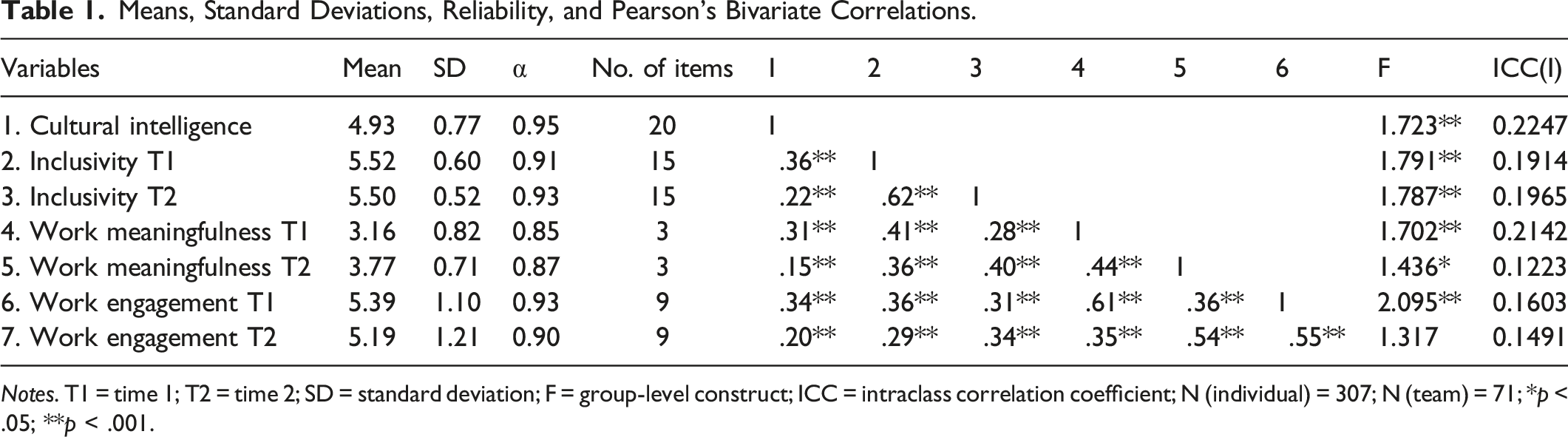
Notes. T1 = time 1; T2 = time 2; SD = standard deviation; F = group-level construct; ICC = intraclass correlation coefficient; N (individual) = 307; N (team) = 71; *p < .05; **p < .001.
Data Analysis
Leadership is an organizational construct and presents a problem when studies depend on individual-level responses from employees. This creates problems such as subjectivity, preferential bias, halo effect, and common method variance issues. The use of multilevel analysis helps to address a few issues. Firstly, it makes employees’ responses about a leader more objective, as scores from a group of employees rather than one individual may minimise bias. Secondly, it allows a better understanding of how employee processes and outcomes relate to a particular leader, and how a leader can influence a group of employees collectively.
Prior to analyzing the hypotheses, Shapiro–Wilk tests were conducted with all variables found to be normally distributed (p > .05). We then ascertained team members’ perceptions of their leader’s cultural intelligence as a group-level construct. The r (WG) (J) (index of agreement) for perceptions of leaders’ cultural intelligence was .92, indicating a high level of within-group agreement (LeBreton & Senter, 2008). The intraclass correlation coefficient (ICC [I]) was .22 and the F(III) value was significant (F(III) = 1.72, p < .001), indicating that perceptions of leaders’ cultural intelligence could be aggregated and treated as a group-level construct.
To test our hypotheses, HLM software (Bryk & Raudenbush, 1992) was used. The measure of perceptions of leaders’ cultural intelligence was treated as a group-level construct since participants were ‘nested’ into work teams reporting about the team leader. Three types of analysis were conducted: lower-level direct effects, cross-level direct effects, and mediation effects.
Lower-level direct effects and cross-level direct effects were tested using Mathieu and Taylor’s (2007) recommendations. For lower-level direct effects (Hypotheses 2 and 4), the lower-level dependent variable was regressed on the independent variable. An example of a lower-level HLM equation is as follows:
For cross-level direct effects (Hypothesis 1), the lower-level criterion variable was first regressed on the lower-level independent variables, followed by regressing the lower-level criterion variable on the cross-level variable (i.e., leader’s cultural intelligence).
An example of a cross-level HLM equation is as follows:

Finally, to test the mediation hypotheses (Hypotheses 3 and 5), we followed the testing steps as recommended by Baron and Kenny (1986). Firstly, a significant relationship should be found for all relationships between X→Y, X→M, and M→Y in the presence of X; X being the independent variable, Y being the outcome variable, and M being the mediation variable. Full mediation occurred if X in the relationship between M→ Y was not significant. If it remained significant, this would indicate partial mediation. The Monte Carlo test (Selig & Preacher, 2008) was then used to confirm the mediation pathway. The mediation pathway was confirmed if both values of the lower-level and upper-level variables did not contain zero (MacKinnon et al., 2004). The Monte Carlo test was conducted using a 95% confidence interval (CI) with 20,000 repetitions.
Results
Hierarchical Linear Modelling (HLM) Analyses of Lower-Level Outcomes and Cross-Level Effect of Cultural Intelligence on Lower-Level Outcomes.
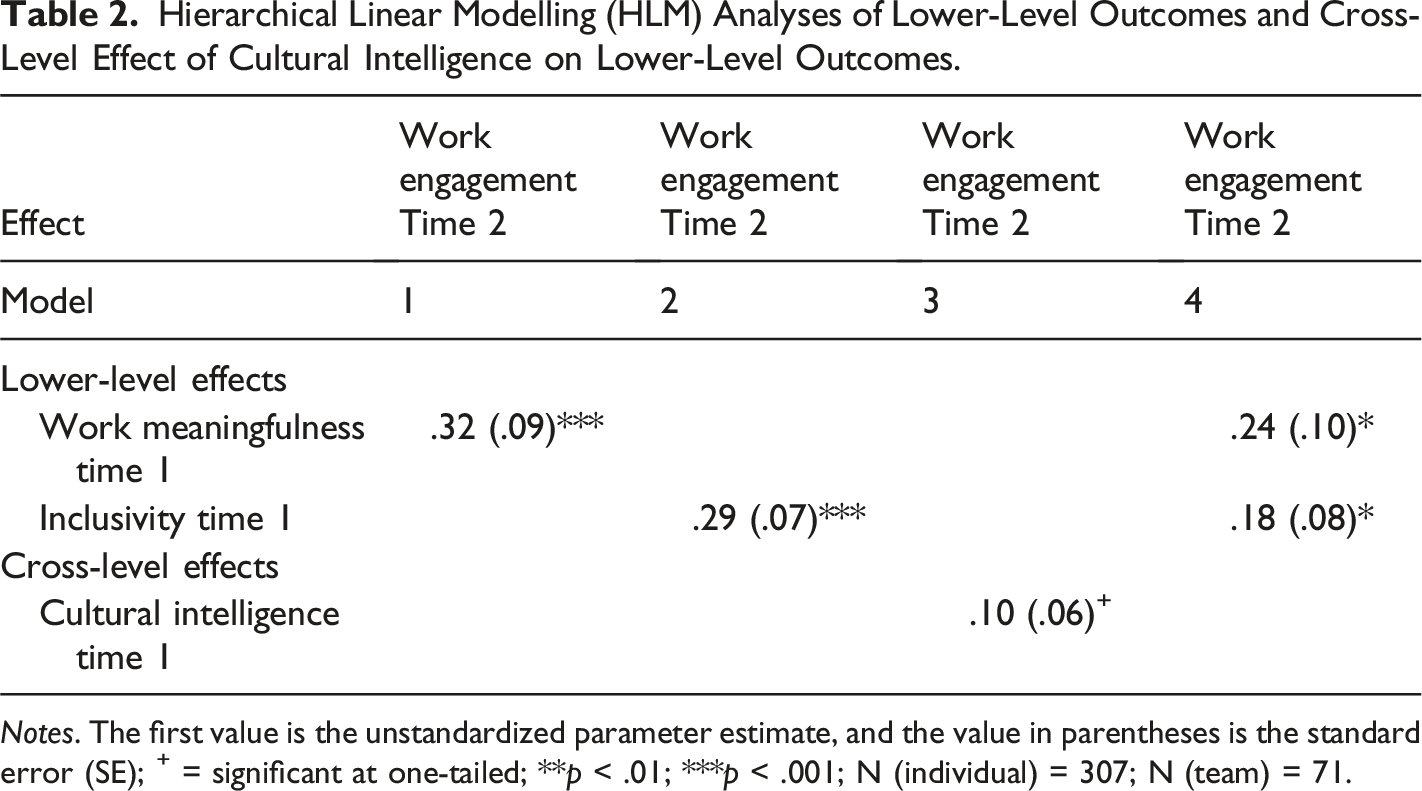
Notes. The first value is the unstandardized parameter estimate, and the value in parentheses is the standard error (SE); + = significant at one-tailed; **p < .01; ***p < .001; N (individual) = 307; N (team) = 71.
Hierarchical Linear Modelling (HLM) Analyses of Lower-Level Outcomes and Cross-Level Effect of Cultural Intelligence on Lower-Level Outcomes.
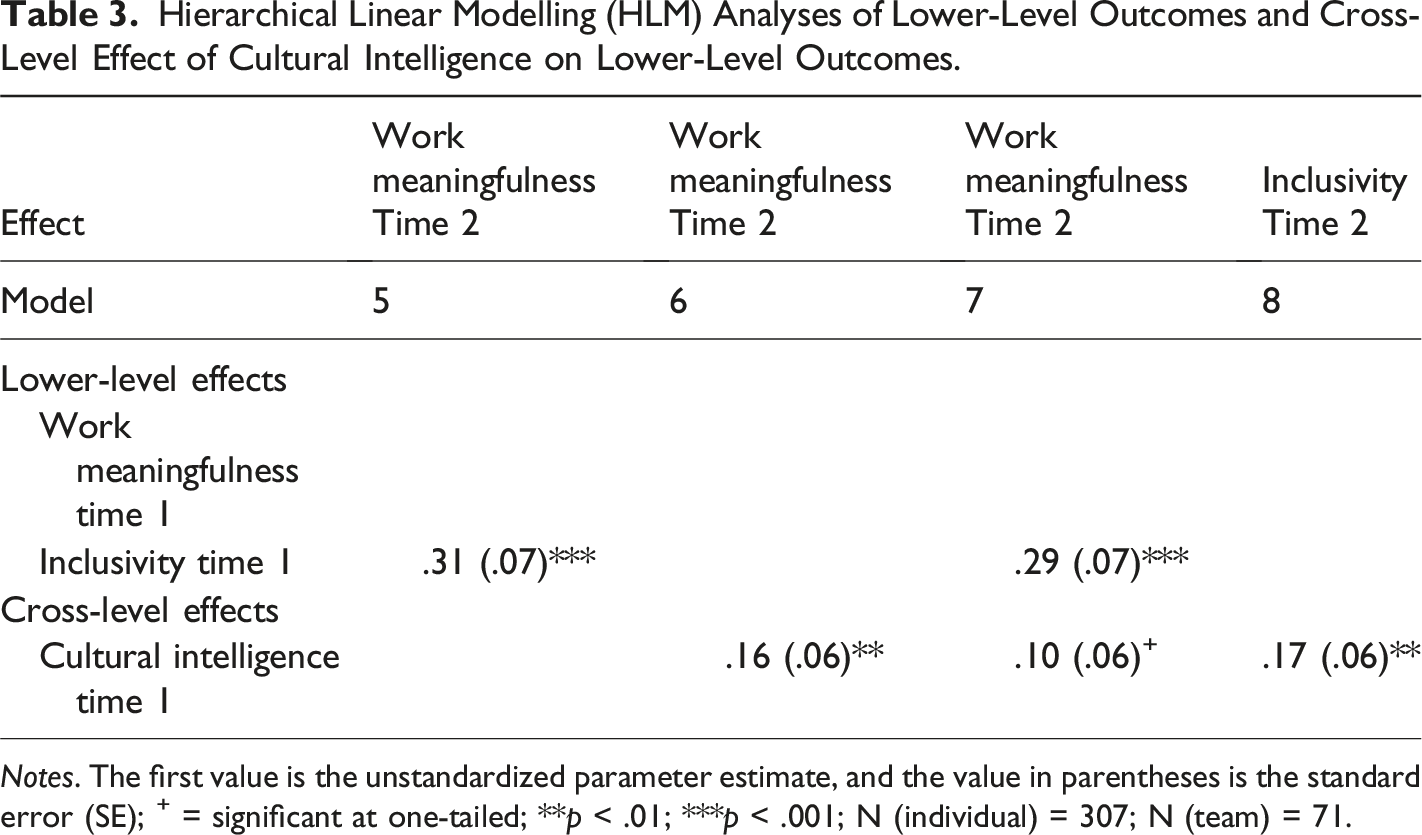
Notes. The first value is the unstandardized parameter estimate, and the value in parentheses is the standard error (SE); + = significant at one-tailed; **p < .01; ***p < .001; N (individual) = 307; N (team) = 71.
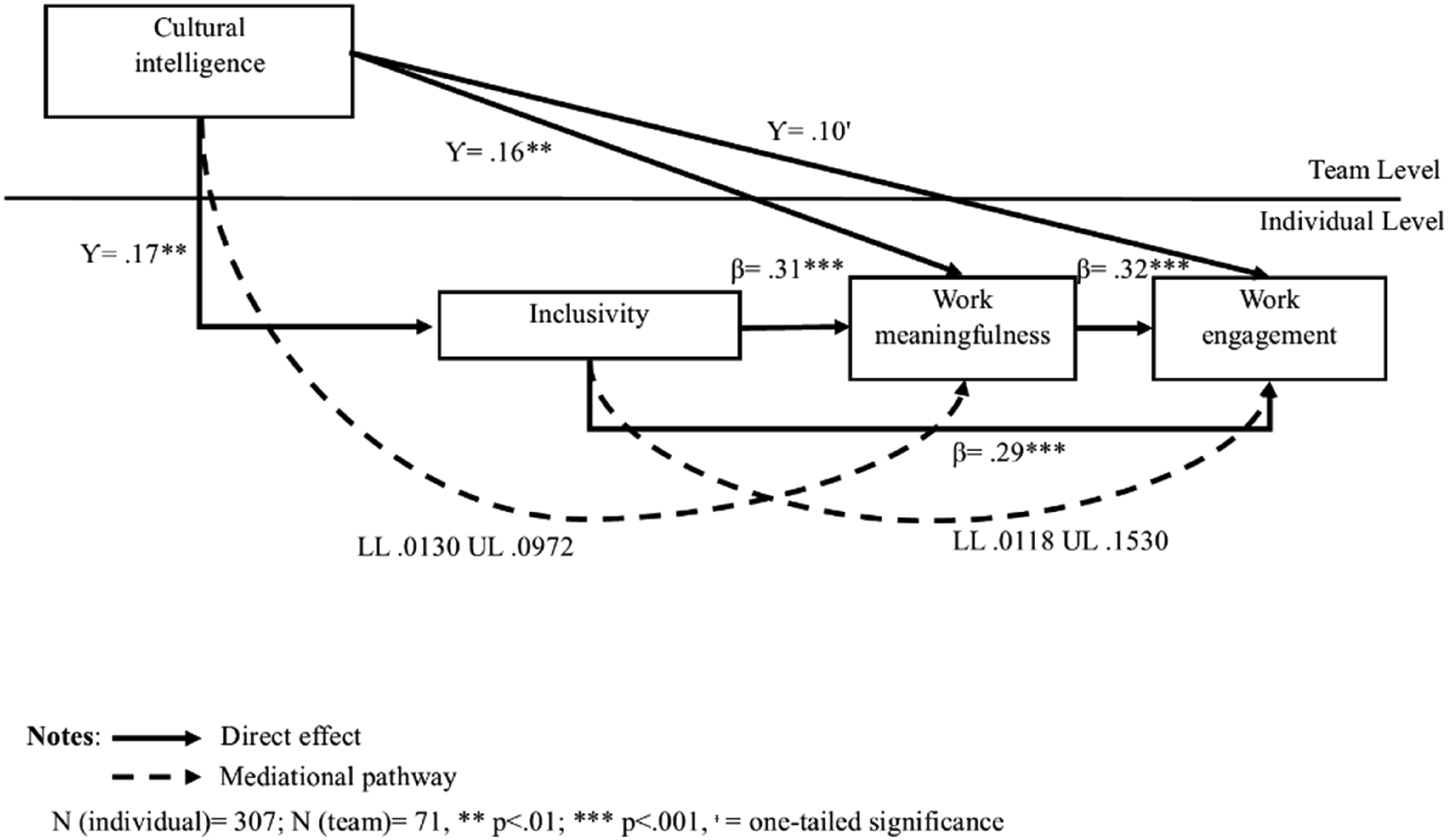
Final model.
Hypothesis 1 predicted that employees’ collective perceptions of leaders’ cultural intelligence at Time 1 would be positively related to (a) inclusivity, (b) work meaningfulness, and (c) work engagement at Time 2. This was supported as collective perceptions of cultural intelligence had a significant positive relationship with inclusivity (γ = .17, p = .009), work meaningfulness (γ = .16, p = .007), and work engagement (γ = .10, p = .075) (see Table 2, Model 3 and Table 3, Models 6 and 8).
Hypothesis 2 predicted that inclusivity at Time 1 would be positively related to (a) work meaningfulness and (b) work engagement at Time 2. This was also supported as inclusivity had a significant positive relationship with work meaningfulness (β = .31, p < .001) and work engagement (β = .29, p < .001) (see Table 2, Model 2 and Table 3, Model 5).
Hypothesis 3 predicted that inclusivity would mediate the relationship between employees’ collective perceptions of leaders’ cultural intelligence and work meaningfulness. In testing the hypothesis, the conditions stated by Baron and Kenny (1986) were fulfilled. Firstly, we found a direct effect from X→Y (cultural intelligence→work meaningfulness). We then analyzed the mediation effect using the path from cultural intelligence→inclusivity→ work meaningfulness by using the Monte Carlo test. Specifically, we used the parameter estimate from Table 3, Model 8 as the value for the direct effect from cultural intelligence to inclusivity (γ = .17, SE = .06), and the parameter estimate for Table 3, Model 7 (inclusivity→work meaningfulness; β = .29, SE = .07) with cultural intelligence in the model. The Monte Carlo bootstrapping indicated that perceptions of cultural intelligence had a significant effect on work meaningfulness through inclusivity (95% CI, LL = .0130, UL = .0972), indicating partial mediation. Hypothesis 3 was supported.
Hypothesis 4 was supported. As shown Table 2, Model 1, our analysis showed that work meaningfulness at Time 1 was positively related to work engagement at Time 2 (β = .32, p < .001).
Hypothesis 5 predicted that work meaningfulness would mediate the relationship between inclusivity and work engagement. In testing the hypothesis, the conditions stated by Baron and Kenny (1986) were fulfilled. Firstly, we found a direct effect from X→Y (inclusivity→work engagement). We then analyzed the mediation effect using the path from inclusivity→work meaningfulness→ work engagement by using the Monte Carlo test. Specifically, we used the parameter estimate from Table 3, Model 5 as the value for the direct effect from inclusivity to work meaningfulness (β = .31, standard error [SE] = .07), and the parameter estimate for Table 2, Model 4 (work meaningfulness→work engagement; β = .24, SE = .10) with inclusivity in the model. The Monte Carlo bootstrapping indicated that inclusivity had a significant effect on work engagement through work meaningfulness (95% CI, LL = .0118, UL = .1530), indicating partial mediation. Hypothesis 5 was supported.
Discussion
Previous research on leadership has mainly focused on how leadership provides job resources and supports work engagement but has largely neglected (1) its role in improving workplace inclusivity within a diverse workplace, (2) the type of leadership skills needed in influencing employee work outcomes, and (3) the social role it plays in relation to employees. Thus, our research helps identify cultural intelligence as one of the skills needed for leaders to create an environment that facilitates inclusivity, work meaningfulness, and work engagement. Specifically, our study investigated how (1) followers’ perceptions of their leaders’ cultural intelligence help create work environments that make employees feel included and (2) how, when employees feel included, they are able to find meaning at their work that energizes their work (i.e., work engagement). Overall, we found that when team members perceive that their leaders are high in cultural intelligence, employees feel included by the team and this supports a sense that the work is meaningful, which in turn supports high levels of work engagement.
Theoretical Contributions
Social capital theory in the past has focused mainly on two areas. The first is the investigation of social capital on knowledge management and how it can drive innovation and productivity among employees. The second is the relationship of social capital to multiple intelligences such as emotional intelligence and cognitive intelligence (Brooks & Nafukho, 2006; Goyal & Akhilesh, 2007). The current study extends the theory on how social capital can be facilitated and initiated from leaders in relation to cultural intelligence. This was achieved by examining employees’ perceptions of leaders’ cultural intelligence, and how it relates to employees’ perceptions of inclusivity, work meaningfulness and work engagement. The study showed that leaders’ cultural intelligence can be an effective social resource in workplaces. To be more specific, this is the first study to show how employees’ perceptions of leaders’ cultural intelligence help create an inclusive working environment that can improve meaningfulness and work engagement for employees.
The study also shows how leadership factors matter for employee attitudes and outcomes, particularly within Malaysia (Lee et al., 2023, 2024b, Lee & Ding, 2020, 2024). The link between employees’ perceptions of leaders’ cultural intelligence and work meaningfulness was mediated by inclusivity. This indicates that leaders’ cultural intelligence can translate into employees’ sense of belongingness and acceptance within a team which can help create, maintain, and sustain positive workplace relationships (Randel et al., 2018). When employees feel included and that their strengths and contributions are valued, this sends the message that the work environment is empowering and allows employees to display their competencies (Amin et al., 2018). The effects of employees’ perceptions of leaders’ cultural intelligence on inclusivity showed that leaders who are accepting of, and able to work with, employees from various cultural backgrounds can create better work environments (Carmen et al., 2006). In addition, when viewing work meaningfulness as a personal resource, social resources can increase employees’ personal resources. In other words, resources in various forms are related, reciprocated, and even create a positive spiral of resources (Kerksieck et al., 2019). Even resources which come from various sources (i.e., social, personal, and job resources) contribute to positive aspects of employee work motivation, work processes, and work outcomes and are all useful in influencing employee work motivation (Lee et al., 2020).
In Asian countries where leaders command authority and make final decisions, leader behavior is influential. Culturally intelligent, inclusive leadership can enable employees to feel empowered and psychologically safe (Javed et al., 2019; Zeng et al., 2020). These conditions fulfil basic needs for autonomy, competency, and relatedness, supporting meaningfulness and engagement at work (Deci & Ryan, 2012). The overall findings show a better understanding of how employees’ perceptions of leaders’ cultural intelligence lead to work engagement within employees.
While prior research into cultural intelligence has often been carried out in multinational organizations, we focused on SMEs. While small and medium sized businesses may seem to display a more homogenous profile of employees than large multinationals, we were still able to explore meaningful relationships between cultural intelligence, inclusivity, meaningfulness and work engagement. We found that the importance of cultural intelligence is not limited to differences between nationalities, but extends to cultural differences between the various ethnicities within a country.
Strengths, Limitations, and Future Directions
We have focused on employees’ collective perceptions of the cultural intelligence of the leader, a soft skill which can be trained and developed to improve leader effectiveness (Imai & Gelfand, 2010). With increasing globalization and cultural diversity in workplaces, we emphasize the need to not only look at intelligence from a knowledge aspect, but from a social aspect as well. A social capital perspective (Lee et al., 2020; Putnam, 1993) has allowed us to understand how leaders can connect with employees by creating inclusive and psychologically safe work environments in which employees feel included, accepted, supported, and acknowledged. This emphasis on the relational aspects of leadership resonates in an Asian setting where guanxi plays an important part in work relationships and has an immense influence on how employees interact, communicate and bond with leaders (Chung, 2018). In a culture where there is a high power distance and collectivism, there is a need to ensure that leaders play their role effectively (Lee et al., 2020).
The study treats perceptions of leaders’ cultural intelligence as a group-level construct which can affect the group of employees collectively, in contrast to research which has looked at leader attributes on an individual level. The use of multilevel analysis has allowed group and individual-level data to be explored. However, the findings are preliminary and need to be replicated beyond the Malaysian context. Further research can establish whether similar findings can be found across different contexts.
Due to the need to protect participant confidentiality, we were unable to collect data on employee or leader ethnicity. Further research needs to explore whether the ethnicity of the leader and employees moderates the effects of cultural intelligence and inclusivity. It is possible that when leaders and employees are of the same ethnicities, they may display higher levels of cultural intelligence and inclusivity due to mutual familiarity. Future work could also replicate the study in multinational organizations, where local and expatriate employees must work together. Leaders in multinationals are often expatriates managing local employees, where it could be argued that leaders’ cultural intelligence will be essential for success. Similarly, it will be important to investigate whether differences between leaders’ and employees’ cultural values moderate the relationship between leader cultural intelligence and employee inclusivity. We suggest that the larger the discrepancy, the weaker the relationship. More information is also needed on the distinction between cultural intelligence and emotional intelligence. Both have been proposed as important soft skills that leaders require for managing not only themselves but also their teams and employees (Davaei et al., 2022).
While the two-wave data collection approach has helped to establish causal inferences in the variables investigated, it has been recommended to conduct a lengthier longitudinal study which involves more data points to capture a better understanding of the dynamics of those relationships (Ployhart & Vandenberg, 2010). Future studies may investigate these areas.
Practical Implications
The current study highlights the importance of leaders being seen as culturally intelligent by their employees. This is especially important as globalisation increases, leading to more diversity amongst employees. Cross-cultural settings not only occur within multinational organizations or among expatriates, they also occur at the local level where organizations consist of employees from various backgrounds (Chua et al., 2019).
Skills training may become a method by which organizations can develop their leaders’ ability to manage diverse workforces for achieving organizational objectives (Lord & Hall, 2005). By focusing on skills which can be trained and nurtured, rather than schools of thought where leadership styles or leader traits are seen as relatively static and difficult to change, there is potential to identify and build relevant leadership skills (Gagliardi & Mariani, 2022). Skills development could include developing leaders’ cultural knowledge, so they are well-equipped with information on, for example, cultural differences and their implications for communication, conflict and collaboration, and the development of skills to address those issues (Earley & Peterson, 2004). These can be achieved by conducting cultural awareness training programs that educate leaders on the various cultural differences that may occur in a workplace setting. Leaders can also be placed in cross-cultural interactions to enhance their awareness and understanding of different cultural knowledge (Sepideh, 2024). Additionally, posting leaders to another country can help them understand the cultural aspects of that country and its people (Sharma & Makhija, 2024). These will allow leaders to acknowledge and accept diversity, build inclusive work environments, and support employee engagement and performance.
These are particularly important within the Asian context where community may take priority over individual needs, and harmony over tension (Jiang et al., 2020), which translates to the need to have high inclusivity for employees to feel appreciated and accepted. Cultural differences also extend to differences in age, life stage and priorities. It has been argued that the work values of younger employees may differ from those of older workers, and that meaningful work may be more important to those who are in early career stages. In diverse workforces, leader sensitivity to every employee’s cultural background can help create an inclusive environment and meaningful work, which in turn supports high levels of work engagement (Glavas, 2012).
From a societal perspective, there is a need for organizational leaders to be tolerant, inclusive and accepting of the need to learn about other peoples’ cultures. This will cultivate a society that is more harmonious, forgiving, understanding, and open minded. This will help societies to progress with more acceptance and inclusion of people with diverse experiences and perspectives. Employees as well as leaders should recognize the importance of everyone feeling included in the team. Employees’ cultural intelligence will also be found to be important, as employees need to be aware of how they interact with their colleagues in order to ensure no-one feels excluded, regardless of their ethnicities and nationalities. This may be particularly important within collective cultures where community may take priority over individual needs, and harmony is often prioritised over tension (Jiang et al., 2020). But in all cultures, the importance of inclusive workplaces where employees feel appreciated and accepted should be recognised.
Conclusion
The current study supports the importance of employees’ perceptions of leaders’ cultural intelligence in stimulating employees’ perceptions of inclusivity, work meaningfulness and work engagement. Findings show a mediated pathway starting with leader’s cultural intelligence leading to higher inclusivity, which in turn supports more meaningful work and higher work engagement. Future studies can further investigate other skills which leaders may develop to support employee motivation and performance.
Footnotes
Declaration of Conflicting Interests
The author(s) declared no potential conflicts of interest with respect to the research, authorship, and/or publication of this article.
Funding
The author(s) disclosed receipt of the following financial support for the research, authorship, and/or publication of this article: This study was funded by Asian Office of Aerospace Research and Development; FA2386-17-1-4097
Ethical Statement

Data Availability Statement
The datasets generated during and/or analysed during the current study are available from the corresponding author on reasonable request.