




Abstract
The goal of the current study was to examine the interactive effect of perceiving a calling and meaningful work on employee attitudes. Specifically, we explored the multiplicative effect of perceiving a calling and meaningful work on work engagement, affective, and normative occupational commitment using a prospective design. Results indicated that meaningful work moderated the relation between perceiving a calling and affective occupational commitment. Specifically, the effects of perceiving a calling on affective occupational commitment were stronger for those who perceived less, but not more, meaning in their work. The interactive effect of perceiving a calling and meaningful work did not predict work engagement or normative occupational commitment. Implications and future research directions are discussed.
Studies have shown that employee attitudes, in part, are influenced by individual dispositions (Staw & Ross, 1985). One such disposition is calling toward a certain type of work. Research on calling has accelerated in the last decade, with studies focusing on the impact of calling on a variety of work experiences and outcomes (Duffy & Dik, 2013; Duffy, Dik, & Steger, 2011). Studies have shown that calling is related to several positive employee attitudes including life satisfaction, job satisfaction, organizational identification, career commitment, and organizational commitment (Cardador, Dane, & Pratt, 2011; Duffy et al., 2011; Duffy, England, Douglass, Autin, & Allan, 2017).
The literature on work orientation distinguishes between perceiving a calling and living a calling (Duffy, Dik, Douglass, England, & Velez, 2018). Perceiving a calling has been conceptualized in various ways. For instance, Dobrow and Tosti-Kharas (2011) defined calling as meaningful passion individuals find for a particular career domain. On the other hand, Dik and Duffy (2009) defined calling as transcendent summons, experienced as originating beyond the self, to approach a particular life role in a manner oriented toward demonstrating or deriving a sense of purpose or meaningfulness and that holds other-oriented values and goals as primary source of motivation. (p. 427)
An underlying assumption in the calling literature is that individuals who perceive a calling find meaning in their work (Hirschi, 2012). Steger, Dik, and Duffy (2012) conceptualized the construct of meaningful work as individuals’ judgments regarding the significance and value they derive from the work they perform. In fact, living a calling is often considered a proxy for finding meaning in one’s work (Duffy et al., 2012).
Researchers have recently argued that those who perceive a calling may not always have an opportunity to live out their calling (Duffy et al., 2018). Therefore, while those who perceive a calling and are able to live out their calling may experience meaning in their work, it may be inaccurate to assume that all individuals who perceive a calling always find meaning in their work. Although researchers acknowledge the disconnect between perceiving and living a calling, prior research has positioned meaningful work as a mechanism through which perceiving a calling impacts work engagement. To explore whether perceiving a calling is an adequate prerequisite for achieving positive employee attitudes in the absence of living a calling, research is needed to further explore the conditional effect of meaningful work on the relation between perceiving a calling and employee attitudes.
Existing research suggests that calling predicts employees’ commitment toward their profession. Although prior studies have examined the relation between perceiving a calling and the broad construct of career commitment (Duffy et al., 2011; Serow, Eaker, & Ciechalski, 1992), no study we are aware of has explored the role of perceiving a calling in predicting different facets of occupational commitment. Considering that commitment is a multidimensional construct with different antecedents and outcomes for the different components of commitment (Meyer, Stanley, Herscovitch, & Topolnytsky, 2002), studies are needed to delineate the forms of commitment that are influenced by the perception of calling. For instance, individuals who exhibit affective commitment to their professions stay in their line of work because they want to. On the other hand, those who experience normative commitment stay in their profession due to a sense of obligation they feel toward their occupation (Meyer, Allen, & Smith, 1993). Therefore, it is possible that perceiving a calling may exhibit a stronger relationship with affective occupational commitment than normative occupational commitment. Furthermore, given that the existing research assessing the relation between perceiving a calling and career commitment is cross-sectional, studies are needed to examine this link overtime.
In light of these gaps, the present study makes two main contributions to the existing literature on calling. First, this study examines the effect of perceiving a calling on work engagement and two components of occupational commitment (i.e., affective and normative) using a prospective design. Second, we investigate the moderating role of meaningful work on the relation between perceiving a calling and work attitudes. The hypothesized model is presented in Figure 1.
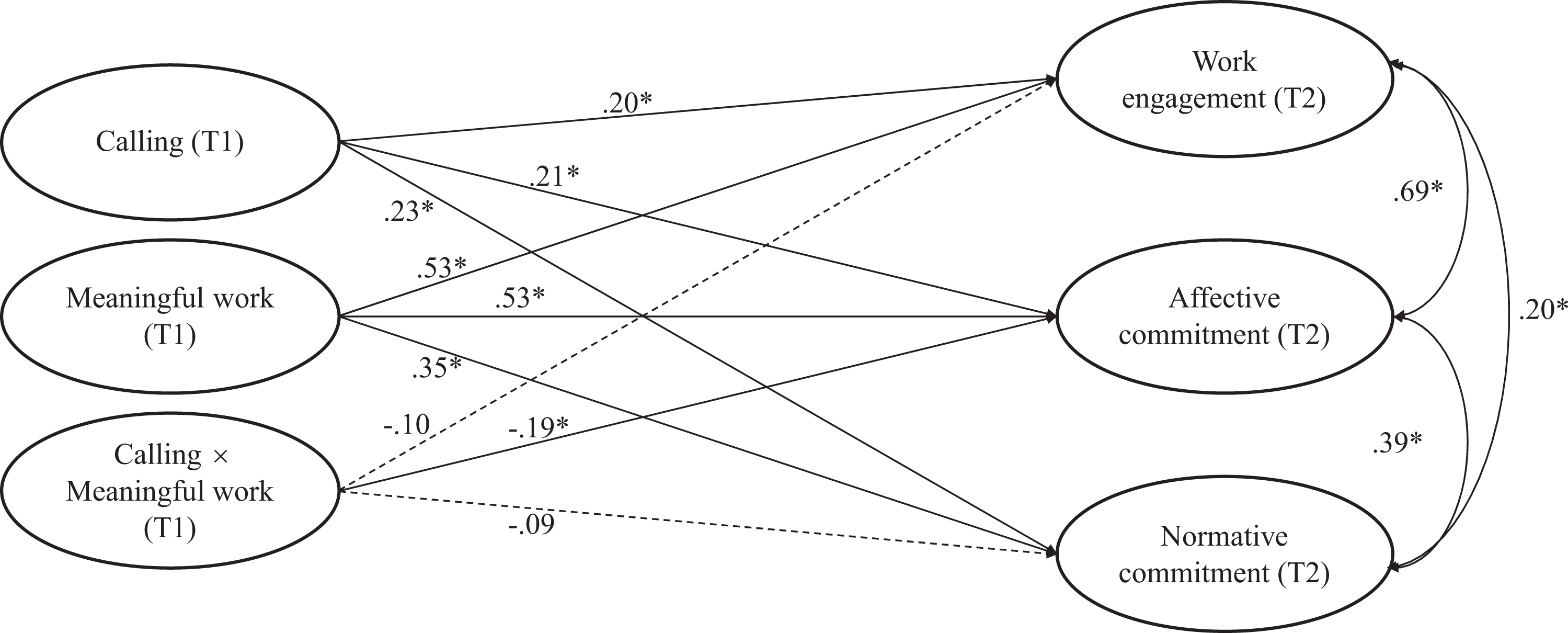
Model testing the moderating effect of meaningful work on the relationship between perceiving a calling and three work attitudes. Solid lines represent significant relationships while dashed lines indicate nonsignificant findings. *p < .01.
The Role of Perceiving a Calling on Work Engagement
Kahn (1990) posits that individuals possess characteristics which they utilize to “express themselves physically, cognitively, and emotionally during role performances” (p. 694). Engaged employees demonstrate psychological presence, which entails being connected, attentive, cognitively vigilant, and fully present with respect to their roles (Kahn, 1992). Because these individuals identify with their role, they drive personal energies into their tasks, thereby fully engaging in their work. Perceiving a calling could be considered an individual characteristic that energizes employees to be engaged in their work.
Employees who perceive a calling feel “a sense of purpose or direction that leads [them] toward some kind of personally fulfilling and/or socially significant engagement within the work role” (Dik & Duffy, 2009, p. 427). Prior research has shown that the relevance of an employee’s work role to his or her identity is a critical determinant of work engagement (Britt, 2003). Therefore, employees with a calling orientation toward their work should report higher work engagement at work. Two studies have examined this relation, and both found a positive association between perception of calling and work engagement using cross-sectional (Hirschi, 2012) and prospective (Xie, Xia, Xin, & Zhou, 2016) designs.
The Role of Perceiving a Calling on Occupational Commitment
Much of the research on commitment is focused on organizational commitment (Allen & Meyer, 1996; Bartlett, 2001), with fewer studies examining occupational commitment (Irving, Coleman, & Cooper, 1997; Snape & Redman, 2003). The organizational literature has treated occupational commitment as a multidimensional construct including affective, normative, and continuance commitment (Meyer & Allen, 1991; Meyer et al., 2002). All three forms of commitment characterize the relationship that an employee has with an organization as well as signify an individual’s intention to continue in their profession. Individuals who exhibit affective occupational commitment are psychologically attached to and invested in their work and consider their occupation an important part of their identity (Meyer et al., 1993). On the other hand, those who demonstrate normative occupational commitment remain in their profession because they feel they ought to do so. Lastly, employees who exhibit continuance commitment largely stay in their professions due to the costs associated with leaving their line of work. In the present study, we move beyond showing perceiving a calling as a predictor of career commitment (Duffy et al., 2011) by specifying the specific forms of occupational commitment that are expected to be predicted by perceiving a calling.
According to Wrzesniewski, McCauley, Rozin, and Schwartz (1997), individuals who perceive a calling are intrinsically motivated to pursue their line of work. They are drawn to their careers due to the fulfillment it brings them. Similarly, Kahn (1990) argues that when employees’ work roles are congruent with their preferred self-image, they become heavily involved in their work and perceive a connection to their work. Due to their high level of investment in their jobs, those who perceive a calling are likely to exhibit affective occupational commitment.
In addition to being affectively committed, employees who perceive a calling may demonstrate normative commitment toward their occupation. Specifically, Wrzesniewski et al. (1997) have argued that these individuals consider their work to be socially valuable and may feel a social obligation to stay in their current occupation (Meyer et al., 1993). Considering that perceiving a calling results in positive experiences (Duffy & Dik, 2013), individuals who perceive such a calling may feel indebted to their professions for the positive outcomes, thereby contributing to the development of normative occupational commitment.
While extant theory suggests that affective and normative occupational commitment are outcomes of perceiving a calling, theoretical or empirical evidence linking perceiving a calling and continuance occupational commitment is currently lacking. Considering that “work is seen as inseparable from life” for individuals who perceive a calling (Parker, Bindl, & Strauss, 2010), we contend that these individuals are unlikely to exhibit continuance occupational commitment. Therefore, we do not expect continuance occupational commitment to be predicted by perceiving a calling.
The Moderating Role of Meaningful Work
Researchers have argued that individuals want their careers to be meaningful rather than just a source of income (Dik, Duffy, & Eldridge, 2009). In fact, existing studies have demonstrated the benefits of work meaningfulness including greater employee engagement, job satisfaction, and organizational citizenship behaviors, among others (Hirschi, 2012; Steger, Dik, & Duffy, 2012). Therefore, it is not surprising that work meaningfulness has been studied extensively in the literature.
Kahn (1990) posited that individuals who experienced meaningfulness “felt worthwhile, useful, and valuable—as though they made a difference and were not taken for granted” (p. 704). More recently, Steger et al. (2012) have argued that meaningful work is a multidimensional construct which consists of three facets: positive meaning, greater good motivation, and meaning making. Positive meaning refers to the subjective assessment that individuals make regarding the significance of their work, while greater good motivation focuses on an individual’s “desire to make a positive impact” (Steger et al., 2012, p. 325). Lastly, meaning making focuses on the role of work in facilitating individual growth. In the present study, we examine the role of the overall construct of meaningful work as a moderator of the relations between perceiving a calling and employee attitudes.
According to Steger, Littman-Ovadia, Miller, Menger, and Rothmann (2013), individuals derive meaning from their work when they have the opportunity to “really apply themselves to significant work activities that serve a valued, broader purpose” (p. 352). Because work has an important place in the lives of those who experience meaning through their work, employees are likely to invest themselves more fully into their jobs. In fact, meaningful work can be regarded as a motivational force that promotes employee engagement in their work (Steger, Littman-Ovadia, Miller, Menger, & Rothmann, 2013). Similarly, Steger et al. (2012) have argued that individuals who experience meaning in their occupations are committed to their work.
Duffy, Dik, Douglass, England, and Velez (2018) contend that experiencing meaning at work is determined by the opportunities available to individuals. Therefore, it is plausible that individuals who perceive a calling may not always have an opportunity to act out this orientation and find meaning in their work. In situations where those who perceive a calling are unable to derive meaning from their work, the relation between perceiving a calling and work engagement and perceiving a calling and occupational commitment will be weaker. Although prior research has examined meaningful work as a moderator (Allan, Douglass, Duffy, & McCarty, 2016; Allan, Duffy, & Douglass, 2015), studies that model the interactive effects of calling and meaningful work are lacking.
We argue that the relation between perceiving a calling and work engagement will be strengthened for individuals who perceive their work to be positively meaningful. Similarly, the association between perceiving a calling and both affective and normative occupational commitment should be stronger for those who perceive higher meaning in their work. We do not expect calling to interact with meaningful work to predict continuance occupational commitment.
Present Study
Considering the substantial research on perceiving a calling, the goal of this research was to examine the relation between perceiving a calling and employee attitudes as well as delineate the conditions under which perceiving a calling predicts employee attitudes using a prospective design. To this end, this research assessed the relation between perceiving a calling and three employee attitudes, namely work engagement, affective occupational commitment, and normative occupational commitment. Additionally, this study investigated the moderating role of meaningful work on the relation between perceiving a calling and the three employee attitudes. In light of the theory and empirical evidence presented above, we pose the following hypotheses:
Method
Participants and Procedure
The data collected for the present study were taken from a larger study on calling and work outcomes. At this time, no studies have been published using these data. Participants were 301 working adults within the United States who responded to surveys at Time 1 and Time 2, 3 months apart. On average, participants were 37.36 years of age (SD = 9.78), and worked 41.86 hrs (SD = 6.07) per week. The mean duration for which the participants worked at their current jobs was 6.41 years (SD = 5.70). In our study, the sample was predominantly female (i.e., 57.80%). The ethnic and racial composition of participants was 79.10% White, 7.30% African American, 7.30% Asian, 4.70% Hispanic, and 1.70% Native American.
In terms of educational attainment, 8.60% completed high school, 14.30% had some college education, 11.30% had an associate’s degree, 44.90% had a bachelor’s degree, 2.70% had some graduate school education, 15.60% had a master’s degree, and 2.70% had a doctoral degree. Participants in the current study belonged to a wide range of industries including, but not limited to, education, technical services, finance, and health care. The annual personal income of participants was as follows (in thousands of $US): less than $25 (17.90%), $25–49 (46.20%), $50–74 (23.60%), $75–99 (8.60%), $100–149 (2.30%), or more than $150 (1.30%).
Participants were recruited through an online data collection service, Amazon’s Mechanical Turk (MTurk), where adults can complete tasks for compensation. MTurk has been increasingly used for social science research (Sheehan & Pittman, 2016), as it provides easy access to an ethnically and socioeconomically diverse sample (Casler, Bickel, & Hackett, 2013). Additionally, studies have shown that MTurk workers represent a diverse set of industries (Barger, Behrend, Sharek, & Sinar, 2011). A recent study explored the labor characteristics of MTurk workers and found that these workers are representative of the labor market (Michel, O’Neill, Hartman, & Lorys, 2018). Considering the goals of our study were to examine the relation of calling with work engagement and occupational commitment, the use of an MTurk sample is justified as it would provide us access to a sample that is diverse with respect to occupations and industries. MTurk members that were at least 18 years old, worked at least 30 hr per week at a job other than MTurk, and were U.S. citizens were encouraged to participate in a 45-min survey at Time 1.
To enhance the quality of the data, six attention checks were dispersed throughout the survey. A total of 589 participants completed the survey at Time 1. Of these, 5 participants failed one or more attention checks and were removed from the study, resulting in 584 participants at Time 1. Attention checks were used to identify participants that paid little to no attention while responding to the survey items (Goodman, Cryder, & Cheema, 2013). These attention checks required that participants select a certain response option. A sample attention check item was “If you are reading this item, please select ‘Never’ for this item.” Overall, 99% of all participants were retained at Time 1. All participants were notified at the end of the survey that they may be contacted in 3 months for a follow-up assessment.
The 584 participants that passed all attention checks at Time 1 were invited to participate in another survey after 3 months, at Time 2. Up to four reminder e-mails were sent to participants to enhance the response rate. A total of 301 participants responded to the survey at Time 2, resulting in a response rate of 58.11%. No participants failed any of the six attention checks at Time 2, thereby 301 participants were retained. Participants at Time 1 and Time 2 were paid $2.50 for completing each survey. At the beginning of each survey, participants were asked to provide their MTurk ID, which served as an identifier to confidentially link surveys between Time 1 and Time 2.
We tested for response bias between participants who completed the survey at both Time 1 and Time 2 versus those who only completed the survey at Time 1 using independent samples t test and χ2 tests. Participants who completed the survey at both time points were older (M = 37.20, SD = 9.90) than those who only completed the survey at Time 1 (M = 33.50, SD = 9.78), t(516) = 4.22, p < .01. Similarly, significant differences were observed in the two groups with respect to ethnicity and race, χ2(5) = 12.29, p < .01. Specifically, a greater number of White participants completed the survey at both Time 1 and Time 2 compared to those who dropped out after Time 1. Additionally, fewer African American and Native American participants completed the survey at both time points compared to those who participated at Time 1 only. However, the two groups did not exhibit differences in gender, χ2(1) = 1.88, ns, highest level of education, χ2(6) = 10.74, ns, the number of hours they worked each week, t(516) = 0.63, ns, or the number of years they had been employed at their current job, t(515) = 0.33, ns Lastly, participants who completed the survey at both Time 1 and Time 2 did not differ significantly from those that dropped out from the study at Time 2 on perception of calling, t(516) = −0.28, ns, or meaningful work, t(471) = 1.00, ns.
Measures
Perception of calling and meaningful work were assessed at Time 1, while work engagement and occupational commitment were measured at Time 2, 3 months later.
Perceiving a calling
The Brief Calling Scale, consisting of 2 items by Dik, Eldridge, Steger, and Duffy (2012), was used to assess perceiving a calling at Time 1. A sample item is “I have a calling to a particular kind of work.” Both items were rated on a 5-point Likert-type scale ranging from 1 (not at all true of me) to 5 (totally true of me). Higher scores indicated greater perception of calling. Existing research has demonstrated that this 2-item measure exhibits reliability greater than .70 (e.g., Duffy & Sedlacek, 2007, 2010). Additionally, prior studies have shown that this measure of perceiving a calling is positively related to vocational identity, career commitment, and job satisfaction (Duffy et al., 2012; Galles & Lenz, 2013). In the present study, Cronbach’s α reliability for this measure was .94.
Meaningful work
The degree to which participants perceived their work to be meaningful was assessed at Time 1 using 10 items from the Work and Meaning Inventory (WAMI; Steger et al., 2012). This measure comprises three dimensions, namely positive meaning (e.g., “I have found a meaningful career”), greater good motivations (e.g., “The work I do serves a greater purpose”), and meaning making through work (e.g., “My work helps me make sense of the world around me”). The items were rated on a 5-point Likert-type scale ranging from 1 (definitely untrue) to 5 (definitely true). Consistent with prior studies (Steger et al., 2013; Tims, Derks, & Bakker, 2016), we combined the three facets of meaningful work into a single scale score. Higher scores indicated greater meaning in one’s work. Prior research has established reliability (i.e., above .70) and construct validity for the WAMI (e.g., Allan, Owens, & Douglass, 2019; Steger et al., 2012). In addition, meaningful work has been positively linked to career commitment, job satisfaction, and work engagement, among others (Duffy et al., 2012; Steger et al., 2013). Cronbach’s α reliability for this measure in the current study was .95.
Work engagement
The degree to which participants reported being engaged at work was assessed using the Utrecht Work Engagement Scale (Schaufeli, Bakker, & Salanova, 2006). The 9-item scale consisted of three subscales: vigor (3 items), absorption (3 items), and dedication (3 items). A sample item is “I am immersed in my work” (absorption). The items were rated on a 6-point Likert-type scale ranging from 1 (almost never, a few times a year or less) to 6 (always, everyday). Higher scores indicated greater engagement in one’s work. The Utrecht Work Engagement Scale has been validated in 10 countries and demonstrates high internal consistency and test–retest reliability as well as factorial validity (Schaufeli et al., 2006). Additionally, this measure of work engagement has been positively linked to job performance and job satisfaction and negatively linked to turnover intentions (Breevaart, Bakker, Demerouti, & van den Heuvel, 2015; van Beek, Taris, Schaufeli, & Brenninkmeijer, 2014). In the present study, the Cronbach’s α reliability of this measure was .96.
Occupational commitment
Affective and normative commitment pertaining to an individual’s occupation were assessed at Time 2 using the Occupational subscale of the Occupational and Organizational Commitment Scale (Meyer et al., 1993). Both scales contained 6 items each. A sample item for the Affective subscale is “I am proud to be in my profession” and for the Normative subscale is “I feel a responsibility to my profession to continue it.” The items were rated on a 7-point Likert-type scale ranging from 1 (strongly disagree) to 7 (strongly agree). Higher scores indicated greater commitment to one’s work. Existing research has shown that the two measures of occupational commitment exhibit both adequate reliability and predictive validity (Meyer et al., 1993). Additionally, the two forms of commitment have been shown to positively correlate with job satisfaction and negatively correlate with turnover intentions (Irving et al., 1997; Weng & McElroy, 2017). In the present study, the Cronbach’s α reliability for Affective and Normative subscales was .92 and .92, respectively.
Results
Means, standard deviations, correlations, and reliabilities for all study variables are presented in Table 1. Bivariate correlations indicated that perceiving a calling at Time 1 was positively related to work engagement at Time 2. Additionally, perceiving a calling at Time 1 was positively associated with affective and normative occupational commitment at Time 2. Similarly, meaningful work at Time 1 was positively related to work engagement, affective, and normative occupational commitment at Time 2. These findings provide preliminary support for Hypotheses 1–3.
Means, Standard Deviations, Bivariate Correlations, and Reliabilities Across Study Variables.
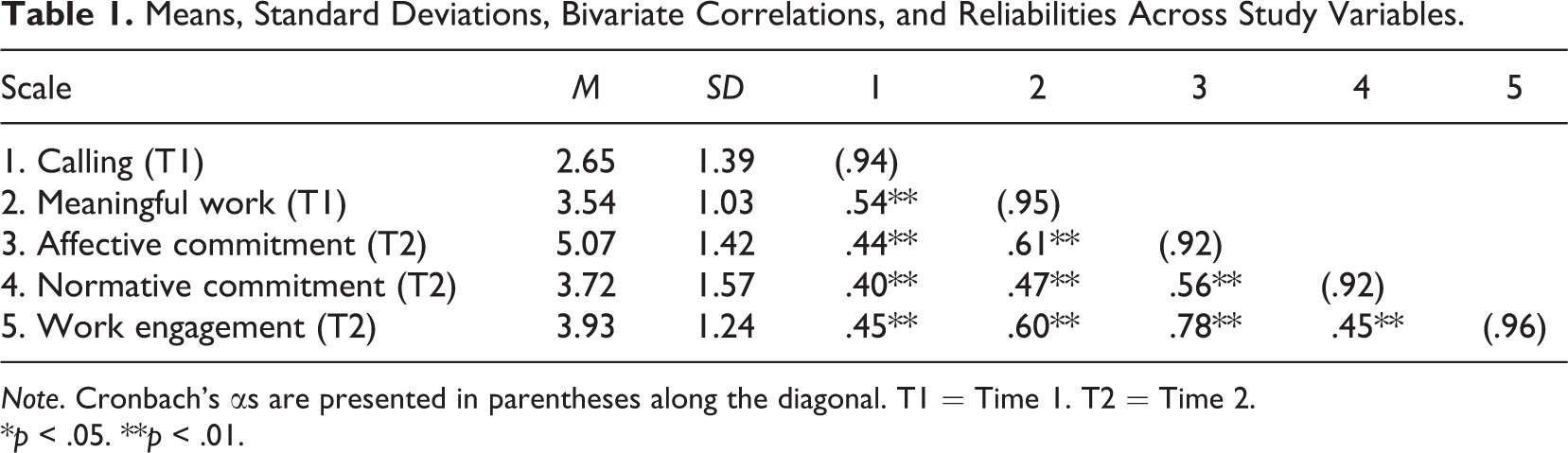
Note. Cronbach’s αs are presented in parentheses along the diagonal. T1 = Time 1. T2 = Time 2.
*p < .05. **p < .01.
To test our hypotheses, we utilized structural equation modeling with Mplus Version 8 (Muthén & Muthén, 1998–2017). Prior to testing the structural paths between the latent constructs, we conducted a confirmatory factor analysis with robust maximum likelihood (MLR) estimation to examine the distinctiveness of the five constructs in our study. Specifically, we compared the fit of a five-factor model in which items for each of the five constructs (i.e., perceiving a calling, meaningful work, work engagement, affective occupational commitment, and normative occupational commitment) were allowed to load on their respective factors to a more parsimonious one-factor model where items across all measures loaded on a single factor. To assess model fit, we utilized the comparative fit index (CFI; Bentler, 1990), root mean square error of approximation (RMSEA; Steiger, 1990), and the standardized root mean squared residual (SRMR; Bentler, 1995). While the χ2 has been traditionally used as an indicator of model fit (Ryan, Chan, Ployhart, & Slade, 1999), it “provides a highly sensitive statistical test, but not a practical test, of model fit” (Cheung & Rensvold, 2002, p. 234). CFI values of .90 or higher indicate adequate fit (Bentler, 1990), while RMSEA and SRMR values of .08 or below are deemed acceptable (Hu & Bentler, 1999).
The initial five-factor model failed to adequately fit the data, χ2(486) = 1,554.44.99, p < .01; CFI = .88, RMSEA = .07, 90% CI [.06, .07], SRMR = .05. Therefore, we used the Lagrange multiplier test to determine the cause of misfit (Byrne, 2006). In line with the recommendations provided by MacCallum, Roznowski, and Necowitz (1992), one error covariance for items in the meaningful scale with similar content was freely estimated to enhance model fit. The respecified five-factor model provided adequate fit to the data, χ2(485) = 1,395.84, p < .01; CFI = .90, RMSEA = .06, 90% CI [.05, .06], SRMR = .05. In comparison, the one-factor model demonstrated significantly poor fit to the data, χ2(496) = 7,029.11, p < .01; CFI = .29, RMSEA = .16, 90% CI [.15, .16], SRMR = .22, compared to the five-factor model, ▵χ2(11) = 1,722.16, p < .01. Therefore, we retained the five-factor solution and treated the constructs as distinct from one another.
Next, to test our hypothesized model, we utilized latent moderated structural (LMS) equations (Klein & Moosbrugger, 2000) approach to model the latent interaction between perceiving a calling and meaningful work in predicting work engagement and affective and normative occupational commitment. Prior research suggests that LMS provides unbiased estimates by correcting for measurement error (Cheung & Lau, 2017). The model was tested using MLR estimation and a numerical integration algorithm (Muthén & Muthén, 1998–2007).
As indicated in Figure 1, perceiving a calling and meaningful work at Time 1 were significantly and positively related to work engagement, affective, and normative occupational commitment at Time 2. Additionally, the interaction between perceiving a calling and meaningful work significantly predicted affective occupational commitment (β = −.19, p < .01). The significant interaction is plotted in Figure 2. Simple slope analysis revealed that the relation between perceiving a calling and affective occupational commitment was significant when meaningful work was low, t(295) = 4.13, p < .01. However, there was no relation between perceiving a calling and affective occupational commitment under high levels of meaningful work, t(295) = 1.29, ns. Therefore, Hypothesis 5 did not receive support. No support was found for Hypotheses 4 and 6 as the multiplicative effect of perceiving a calling and meaningful work did not predict work engagement or normative occupational commitment.
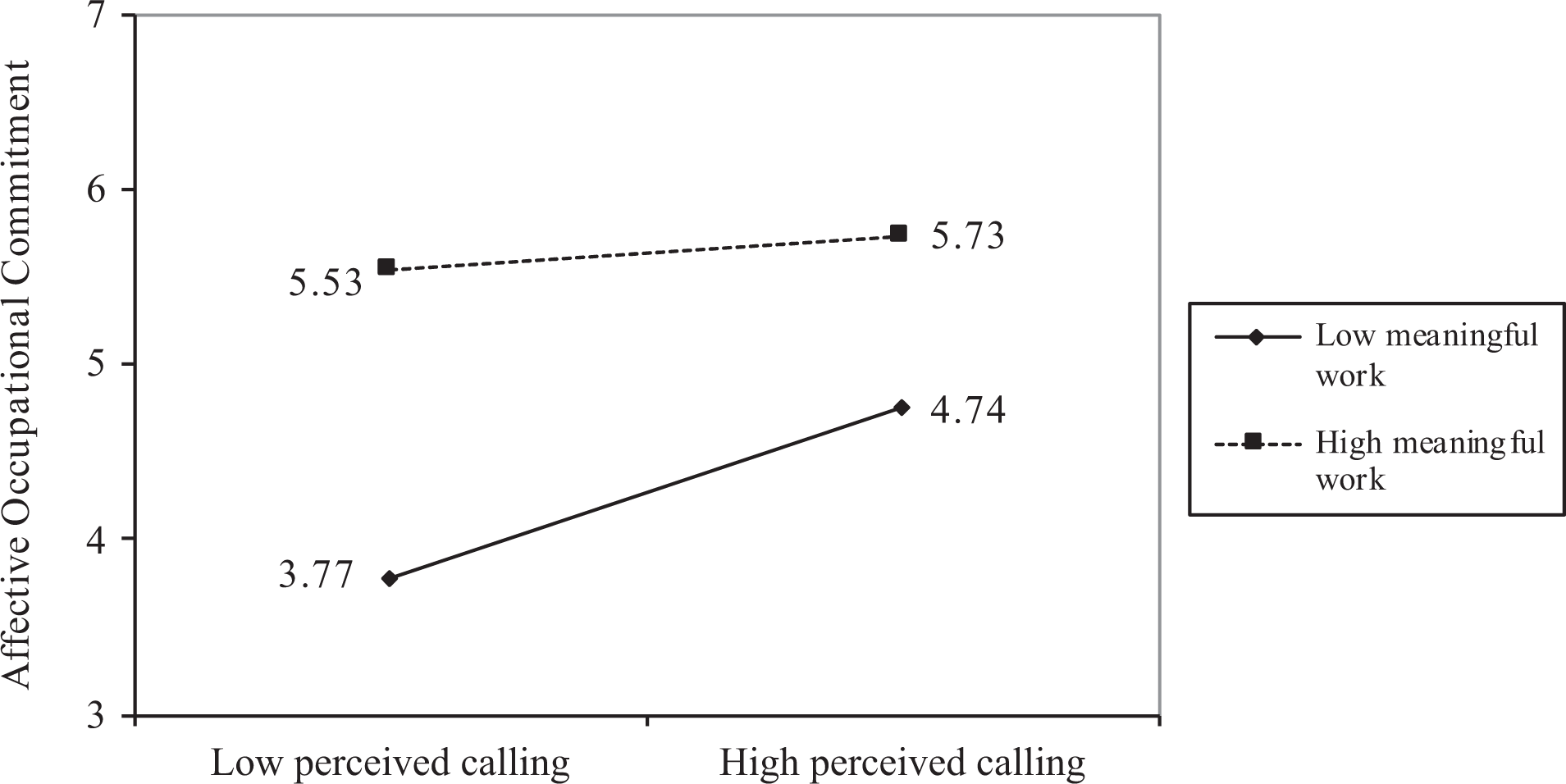
Two-way interaction between calling and meaningful work on affective commitment.
Discussion
Although the research on calling has advanced in the last decade (Duffy & Dik, 2013), a few gaps continue to persist in this literature. For instance, while the research on calling acknowledges that perceiving a calling does not always result in living a calling and thereby deriving meaning from one’s work, meaningful work has mostly been considered a mechanism through which perceiving a calling impacts work attitudes. Additionally, while studies have examined the relation between calling and career commitment, no study to our knowledge has attempted to delineate the forms of commitment that result from perceiving a calling. To bridge these gaps, the objective of the present study was to examine the interactive effect of perceiving a calling and meaningful work on work engagement, affective occupational commitment, and normative occupational commitment using a prospective design.
In line with Hypothesis 1, we found that perceiving a calling at Time 1 was positively related to work engagement at Time 2. These results fit well within the Kahn (1990) theory of engagement, which suggests that individual characteristics (perceiving a calling) are precursors to work engagement. Our findings are consistent with prior studies which have demonstrated that the two constructs are positively related (Hirschi, 2012; Xie et al., 2016).
With respect to Hypotheses 2 and 3, we found that perceiving a calling predicted both affective and normative occupational commitment, 3 months later. These findings extend prior research which suggests that career commitment is an outcome of perceiving a calling (Duffy et al., 2011) by highlighting the specific forms of commitment which are associated with perceiving a calling. Because individuals who perceive a calling are likely to be emotionally invested in their chosen line of work, they demonstrate affective commitment. Similarly, due to the efforts invested in their careers, those who perceive a calling exhibit normative commitment.
In terms of our moderation hypotheses, we found a significant interactive effect of perceiving a calling and meaningful work on affective occupational commitment. Contrary to our hypothesis that perceiving a calling would be especially related to affective occupational commitment when individuals experienced high meaningful work, the relation between calling and affective occupational commitment was actually stronger when participants reported low meaningful work. This finding suggests that when employees do not consider their work meaningful, perceiving a calling may be especially important for maintaining a high level of affective commitment to one’s occupation. On the other hand, employees who consider their jobs highly meaningful are likely to be affectively committed to their occupation irrespective of whether they perceive a calling. These results illustrate that perceiving a calling is actually a buffer against the negative consequences of less meaningful work when it comes to maintaining an emotional attachment to one’s occupation. Additional longitudinal research is needed to examine the time frame for which perceiving a calling may compensate for a lack of meaningful work for employees. Prolonged conditions of meaningless work may dilute the buffering impact of perceiving a calling on affective occupational commitment.
Our results indicated that the interactive effect of perceiving a calling and meaningful work did not significantly predict work engagement or normative occupational commitment. In the present study, we used a short time lag of 3 months, which may partially explain the null interaction. While those who perceive a calling may become emotionally attached to the idea of working in a certain profession, thus developing affective occupational commitment, one can argue that both work engagement and normative commitment take time to build. Even though an individual perceives a calling and finds meaning in their work, it may take years for them to develop the necessary skill set to be fully engaged in their work. Similarly, the positive benefits of an occupation toward which one has a calling may accrue over a period of time, and hence changes in normative occupational commitment may not be captured over a span of 3 months. We urge researchers to further explore the multiplicative effect of perceiving a calling and meaningful work on work engagement and normative commitment using longer time lags.
The findings of our study contribute to the theoretical advancement of the calling literature. Specifically, we provide a more complete understanding of the work attitudes that are outcomes of perceiving a calling. While prior research has demonstrated calling as an antecedent of the broad construct of career commitment (Duffy et al., 2011), our study is the first to have explored the relation between perceiving a calling and two forms of occupational commitment. Additionally, this is the first study that examined the conditional effect of meaningful work on the relation between perceiving a calling and work attitudes.
Our results also have implications for organizations. We demonstrated that while both perceiving a calling and meaningful work are positively related to affective occupational commitment, meaningful work can compensate low levels of calling in predicting affective commitment. While an organization may not have control over hiring employees that perceive a calling toward a particular type of work, they can play a pivotal role in enhancing employees’ affective occupational commitment by ensuring that the work is meaningful to its employees.
Limitations and Future Directions
Although the present study had a number of desirable features (i.e., a prospective design and the examination of two forms of occupational commitment), the findings of the present study need to be interpreted in light of its limitations. First, we used an abbreviated measure of calling (Dik et al., 2012) in the present study. Although this measure of calling has been validated in prior research, future research should examine the role of perceiving a calling on work attitudes using multidimensional measures of calling.
Second, our study relied solely on an MTurk sample, which may be viewed as a limitation. Although MTurk provides access to diverse populations (Casler et al., 2013), the cognitive abilities of MTurk workers remain unknown (Paolacci & Chandler, 2014). However, existing research has demonstrated that there are no differences in responses between MTurk, student, and worker samples on self-report measures of numeracy (Paolacci, Chandler, & Ipeirotis, 2010). We urge researchers to replicate our findings using samples across different industries and occupations.
Third, participants who chose to complete the survey at both Time 1 and Time 2 were significantly older and different with respect to their ethnicity and race than those who dropped out after Time 1. These differences in demographics may have introduced bias or reduced our ability to detect interactive effects of perceiving a calling and meaningful work on work engagement and normative occupational commitment. However, we suspect that the extent of the bias would be minimal since there were no significant differences in scale means for either perceiving a calling or meaningful work. We urge researchers to further replicate our findings using a more diverse sample.
Fourth, our research relied exclusively on self-report data, which are especially susceptible to common method variance (CMV), whereby the correlations between the independent and dependent variables are inflated (Zapf, Dormann, & Frese, 1996). To overcome the limitation of CMV, this study utilized a prospective design where measures of calling and meaningful work were assessed at Time 1, while work engagement and occupational commitment were measured 3 months later, at Time 2. To further alleviate concerns of CMV, we urge researchers to multisource data.
Fifth, despite the various orientations discussed in the literature including career and job, we only examined the interactive effect of calling orientation and meaningful work on work attitudes. To determine whether the results of the current study will apply to the career and job orientations, future research may consider exploring these relations using measures of the two orientations.
Conclusion
In the present study, we tested the conditional effect of meaningful work on the association between perceiving a calling and three work attitudes, namely work engagement, affective occupational commitment, and normative occupational commitment. Our results provide partial support for our hypotheses. As expected, perceiving a calling and meaningful work positively predicted work engagement, affective, and normative occupational commitment. Additionally, the interaction between perceiving a calling and meaningful work significantly predicted affective occupational commitment but not work engagement or normative occupational commitment. The relation between perceiving a calling and affective commitment toward one’s profession was stronger when employees perceived low, rather than high, meaning in their work. These findings expand our understanding of the specific forms of occupational commitment that result from perceiving a calling as well as signal the need for organizational processes which ensure that employees find meaning in their work.
Footnotes
Declaration of Conflicting Interests
The author(s) declared no potential conflicts of interest with respect to the research, authorship, and/or publication of this article.
Funding
The author(s) received no financial support for the research, authorship, and/or publication of this article.
