




Abstract
Personality, the enduring pattern of affect, behaviors, cognitions, and desires, strongly predicts important outcomes, such as mental and physical health, and specific emotional reactions. However, the reasons behind these associations are still unclear, and explanatory processes are now being searched for. Appraisal theories of emotion, particularly the Component Process Model of emotion, can help to address this gap. In this model, an appraisal process, a situational cognitive evaluation, influences emotion unfolding by activating concomitant experiential, expressive, motivational and physiological responses. While evidence on the personality-appraisal relationship exists, specific knowledge about the potential mediatory role of appraisal in this relationship is very sparse, although it could explain how personality might shape emotional reactions. In a survey, we evaluated the personality of 500 participants (MAge = 22.41; Females = 83.2%) and confronted them with two emotional scenarios of different valences. Leveraging exploratory mediation analysis (EMA), we found that, in the Negative Scenario, the appraisals of negative consequences, powerlessness, and future consequences adjustment emerged as the most influential mediators, being differentially implicated in the relationship between Neuroticism, on the one hand, and the Feeling and Autonomic Arousal components, on the other hand. Mediation pathways in the Positive Scenario were more diverse, with the appraisal of powerlessness again emerging as a relevant mediator in the relationship between traits and emotional outcomes. This study highlights appraisal as a fundamental explanatory mechanism linking individual differences to emotional responses. Appraisal could be thus leveraged in interventions to allow certain personality to take the path of specific, healthier affective outcomes.
Introduction
The Big Five structural model is one of the most widely endorsed personality taxonomies in the psychological literature (John & Srivastava, 1999; McCrae & Costa, 2021). Based on lexical studies, five factors account for personality variation: (N) Neuroticism, as a predisposition towards anxiety and negative affect; (E) Extraversion, as a predisposition towards sociability, and positive affect; (O) Openness/Intellect, as a predisposition towards curiosity and unconventionality; (A) Agreeableness, as a predisposition towards selflessness and tenderness; and (C) Conscientiousness, as a predisposition towards order and diligence.
The Big Five model has enjoyed broad consensus due to its ability to predict important life outcomes, such as life satisfaction, psychological distress, physical and mental well-being, divorce, loneliness, career success and quality of relationships (Graziano & Tobin, 2017; Jackson & Roberts, 2017; Lahey, 2009; Leger et al., 2016; Tackett & Lahey, 2017; Vainik et al., 2019; Wilt & Revelle, 2017). Despite this compelling evidence, the underlying reasons for Big Five-outcome associations are not entirely clear (Hampson, 2021). The same explanatory challenges remain when considering affectivity (Uziel, 2006). For example, one of the most consistent results in the psychological literature is the relation of N and E to the experience of negative and positive emotionality, respectively (Reisenzein et al., 2020; Revelle & Scherer, 2009). The description of the emotional concomitants of O, A, and C has only recently received increasing attention: higher O being related to a more intense experience of Curiosity, higher A to a more intense experience of Love, Compassion and Awe; and higher C to a more intense experience of self-conscious emotions such as Pride and Guilt (Reisenzein et al., 2020). Overall, different causal mechanisms have been proposed, ranging from cognitive processes such as attentional and information processing biases for N and A (Robinson, 2021) to relationship quality and quantity, personally relevant goals, and perceived uniqueness for E (Wilt & Revelle, 2017). Recently, a renewed interest in the intertwinement between personality and emotional and broader life outcomes have led scholars to investigate these relations under a mechanistic and more fined grained framework: that is, by focusing on processes.
As one of the most authoritative models in the emotion field, the Component Process Model of emotion (CPM; Scherer, 2001) appears to be particularly suited to clarify the full array of processes behind emotion generation. The CPM provides a detailed structural description of appraisal as the cause of emotion ignition, tying together a particular situation with the resulting emotional outcomes. Cognitive appraisal is defined as a situational interpretation of an internal event (e.g., a memory) or external event (e.g., a friend not waving back), judged against personal well-being and goals. Specifically, the theory argues that appraisal occurs when a set of detailed and sequential Stimulus Evaluation Checks (SECs) are performed, assessing for example if the situation entails potential negative outcomes or the break of social norms (Scherer, 2001). These checks are grouped into four main functional categories: Relevance, Implications, Coping Potential, and Normative Significance, with corresponding, more nuanced sub-checks (Figure 1). Briefly, the first category of Relevance is deemed essential for (modern) survival, since, through this evaluation, stimulus is judged against its potential novelty, pleasantness/unpleasantness, and relevance/irrelevance for the person’s current or long-term objectives, including well-being (Ellsworth & Scherer, 2003). If the functional category of Relevance suggests a course of action, the second category of Implications further suggests specific adaptations or adjustments (Ellsworth & Scherer, 2003). Implications assess, for example, the conduciveness or obstructiveness of the stimulus to personal goals, followed by an assessment of the desirability of its consequences and its causal sources, such as differentiating between who or what caused the event. The functional category of Coping Potential seeks to establish a new equilibrium in the emotional system by assessing stimulus controllability and possibility to be coped with, specifically in relation to the expected consequences. Finally, the functional category of Normative Significance, which assesses the compatibility of the stimulus with external norms (i.e., cultural, moral and legal values) and internal norms (i.e., personal values), is essential for social relations and organization establishment. The sequential combination of SECs outputs produces coordinated responses at the physiological, expressive, motivational and experiential levels. In this process, physiological reactions are part of an adaptive response to a changing environment, and have been identified as acceleratory or deceleratory modifications at the cardiac, exocrine and respiratory levels (Scherer & Fontaine, 2013). Regrouping facial, postural and vocal signatures of emotions, expressive responses have an important role in social communication, conveying information about the present emotional state, in both human and non-human species, a state that needs to be consistently and reliably interpreted from peers (Scherer, 2009; Wingenbach, 2023). Motivational tendencies relate to the intrinsic evolutionary function of emotions fostering survival and adaptation, and refer to the internal, motivational drive that urges us to either engage in approach or withdraw tendencies within a situation (Scherer, 2009). Finally, experience is theorized to monitor the unfolding of the emotion process by coherently integrating the synchronized activity of the other components in a conscious and subjective representation of the emotion episode, initially undifferentiated but varying over two axes of intensity and duration. Only later, this emotional experience is labelled and expressed through language (Scherer, 2001). Component Process Model (CPM) of emotion, adapted and redrawn from Scherer (2009). Emotion emergence process and related phases are depicted: elicitation (green), differentiation (blue), representation (pink), matched to their corresponding components. The multilevel appraisal component is presented in details in the excerpt, which shows the major appraisal checks and corresponding subordinate checks.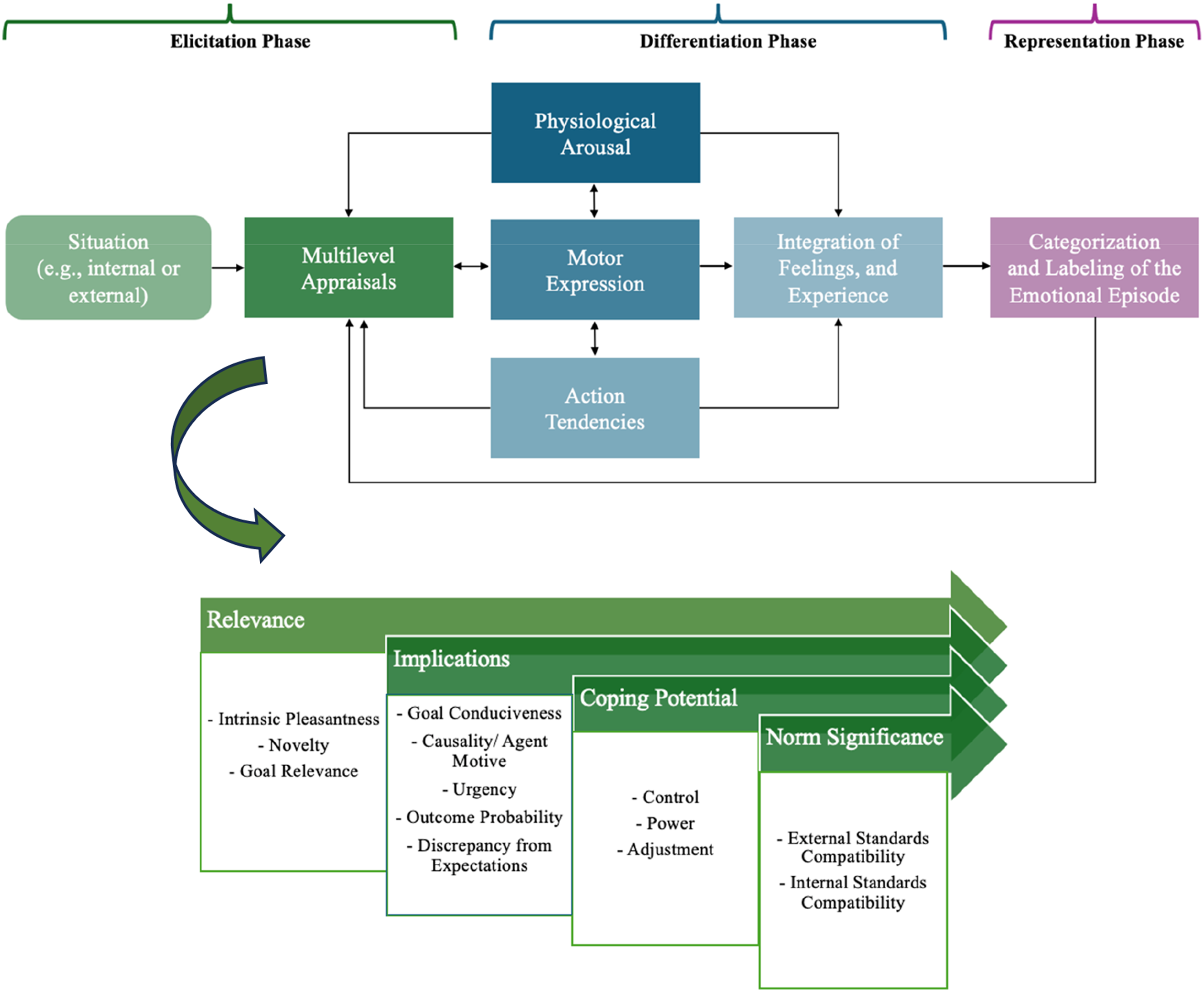
Given the clear importance of appraisal processes in the elicitation of emotions (Scherer, 2009), its explanatory role between personality traits and emotional outcomes has been hypothesized (Keltner & Shiota, 2021), but with little empirical evidence so far. This may be due to the statistical complexity involved (Meuleman et al., 2019), with most studies performing correlational or moderation analyses (e.g., Kuppens et al., 2008; Tong, 2010; Tong et al., 2006). In past research, moderation has been essentially used to clarify which personality traits attenuate or amplify the effect of a given appraisal on a given emotional outcome (MacKinnon, 2011). This method does not however give information about how different appraisals may differentially drive emotional reactivity (Fernando et al., 2017), specifically under the influence of different traits. In other words, within the same situation, through which appraisal processes are personality traits conditioning emotions? As nicely concluded by Poluektova et al. (2023, p. 8): “Knowledge about precisely which personality characteristics are important for different appraisals and how they exert their effects is still limited”. This type of research question can be addressed with mediation, which uncovers how an intervention - or as in this case, a stable, fixed independent variable - affects an outcome (MacKinnon et al., 2020).
To our knowledge, within the CPM tradition, only two studies have been conducted on the topic via stepwise hierarchical regression analyses. Scherer (2020) recently inferred a mediatory role of appraisal by showing how, in a large sample of adults, the appraisals of pleasantness, agency, and low coping potential (operationalized as appraisal biases) accounted for a sizeable amount of variance in the emotion dispositions of Worry, Sadness, and Anger. Unexplained variance was then analyzed for the effects of the personality traits of N, E, a composite A/C variable, and of the background variables of age and gender. Subsequently, following the same rationale and analytical steps of Scherer (2020), Scherer et al. (2022) concluded that, in a sample of university students, the appraisal of low coping potential may be detrimental to mental health in the long run by increasing the frequency of reported Sadness and Worry, which in turn may affect Depression/Anxiety scores. Given that the statistical approach employed by Scherer (2020) and Scherer et al. (2022) bears only indirect and preliminary evidence for mediation processes, since indirect effect path significance cannot be established via hierarchical regressions (Hayes & Rockwood, 2017; MacKinnon et al., 2002), further studies are needed to investigate the plausibility of the proposed causal models, possibly using more refined analyses.
Our study addresses this call by going a step further in several ways. First, not only did we address the lack of mediation models in the appraisal literature, but also employed a recent and innovative statistical approach called exploratory mediation analysis (EMA; Serang et al., 2017). EMA is an extension of mediation analysis that, in a data-driven way, selects the most relevant mediators in the presence of many theoretically based mediating variables. EMA has importantly contributed to the identification of behavioral and psychological mechanisms acting as suicidal behavior and attempt risk factors (Ammerman et al., 2018; O’Loughlin et al., 2021; Tang et al., 2024), or specific emotion regulation strategies bridging rejection sensitivity and aggressive, withdrawing, and prosocial behavior (Casini et al., 2022). EMA appears to be particularly suited to our research question as well, as several scholars in the field have vocalized the need for a refined understanding of personality–appraisal–emotional reactivity relations (Keltner & Shiota, 2021; Poluektova et al., 2023; Scherer, 2020). Thanks to EMA, we were thus able to feed a comprehensive list of appraisals to our models as potential mediators, which has not been done before due to the statistical complexity involved (Meuleman et al., 2019). As previously mentioned, the more recent attempts in appraisal research (Scherer, 2020; Scherer et al., 2022) only suggest that a relationship between the variables of interest of the current study might be mediated, and the stepwise approach — also regularly used for answering similar questions — has been strongly criticized in the literature due to its proneness to overfitting and multicollinearity issues (Babyak, 2004; Harrell, 2015). Moreover, presenting a limited range of appraisals as in Scherer (2020) and Scherer et al. (2022) might have spurred ceiling or floor effects for certain personality traits.
Second, we incorporated the Big Five personality traits together, as predictors in our EMA models, allowing to explore the cognitive processes linking all the traits (not only the affective ones) to emotional reactivity. Third, Scherer (2020) and Scherer et al. (2022) focused on emotion dispositions and appraisal biases, that is, the stable tendencies to experience a certain type of emotion, and the reiterate accessibility of given appraisals, respectively. We focused on the step before their dispositional crystallization, focusing on how they may be situationally established, through the activation of the other emotion components, namely at the physiological, expressive, motivational, and experiential levels. This is because personality effects on broader outcomes might be transmitted through all emotion components: for example, in extraverts, approach-related action tendencies or expressive behaviors, such as smiling, and affiliative and assertive manners, might reinforce their status, leading to a later higher social satisfaction (Keltner & Shiota, 2021). Similarly, in neurotics, the recurrent pairing of negative emotions with increased physical symptoms (e.g., heart beating faster, sweating) might explain the higher incidence of psychosomatic complaints in this population (Cuijpers et al., 2010).
Altogether, with EMA, we tested the mediating effect of several cognitive appraisals drawn from the CPM on the relationship between personality traits and emotion responses. We aimed at identifying pivotal appraisals that could explain why, in a given situation, people with diverse dispositional traits may experience various levels of emotional reactivity. In particular, we examined how each the Big Five traits (N, E, O, A, C) could predict emotion responses at the motivational, physiological, expressive and experiential levels, as mediated by representative appraisal items (i.e., SECs) belonging to the functional categories of Relevance, Implication, Coping Potential and Normative Significance. In turn, this knowledge can channel a more comprehensive understanding – and speculation - of which appraisals might be contributing to long-term life outcomes when specific personality traits are faced with certain life situations. The exploratory nature of our research question limits the formulation of more specific hypotheses. However, given that the literature accords great importance to the pleasantness and goal relevance appraisals from an evolutionary perspective (Ellsworth & Scherer, 2003), and to the coping potential appraisals from a clinical perspective (Mehu & Scherer, 2015), we envision these appraisals as playing a more influential role.
Method
Participants
Given that we planned to answer several research questions with this database, we aimed at the largest possible sample based on funding availability. We initially recruited first-year psychology students at our host institution, who were compensated with course credits. We then recruited, via social media, students at other Swiss educational institutions at the Bachelor, Master, and occasionally doctoral level, if deemed appropriate. Inclusion criteria were being between 18 and 45 years old, being in good health, and having sufficient proficiency in French. Exclusion criteria were medical treatment, regular use of drugs or medication, and diagnosis of a psychiatric disorder. The final sample consisted of 500 participants (83% female), aged 18 to 44 years (M = 22.41, SD = 3.23), of whom 288 (57.6%) were rewarded with university credits and 212 (42.4%) with vouchers. The predominant educational level was bachelor’s degree (90% of the sample) — with psychology being the most common subject (72% of the sample) — and with 78% of the participants being native French speakers.
Context and Procedure
This study was based on scenarios, for which participants had to indicate their appraisal and emotional reactions. This methodological choice aimed at counteracting confounding variables related to social context (Sacchi & Dan-Glauser, 2024a). Indeed, the use of scenarios — as compared to past experience recall, for example — allowed for standardization across participants, reducing the likelihood that uncontrolled differences between participants’ experiences accounted for the relationships. Scenarios selection was based on two main criteria: being relevant to a student population, and including some ambiguity, given its known role in amplifying individual differences in appraisal processes (Lazarus & Folkman, 1984; Skinner & Brewer, 2002).
Two scenarios were retained for testing our present research question, a negative and a positive, which offer a comparative opposed valence modelling. This is based on a bimodal approach (negative-positive) that is extensively used in affective science (Mauss & Robinson, 2009). The negative scenario was adapted from Zimmer-Gembeck and Nesdale (2013) — hereafter Negative Scenario — which entails a passive, ambiguous type of social rejection, and the positive one — hereafter Positive Scenario — was adapted from Farrell et al. (2015) and Rohrbacher and Reinecke (2014), depicting the preparation of a birthday dinner. In addition to offering comparison with a negative scenario, results in the positive scenarios could highlight virtuous ways of situational interpretations that could be enhanced through interventions, as the focus is generally on ameliorating negative appraisals (Scherer, 2020). The text of the selected scenarios, along with their corresponding French translations, are reported in supplemental Table S1.
At the beginning of the online study (conducted on LimeSurvey, https://www.limesurvey.org), students were given general information about the study, and presented with the consent form. If this was signed, they were then redirected to demographic questions. The main study was divided in two parts, a scenario part, and a questionnaire part, which were randomized to avoid order effect. In the scenario part, participants were given a brief instruction based on that of Smith and Lazarus (1993), encouraging them to imagine themselves in the scenarios and to immerse themselves in the emotions, feelings, and thoughts they elicited. Each scenario started with a description of the scene over a few lines, followed by the appraisal and emotion response questionnaire (see the Measures section). In the questionnaire part, personality and other variables were measured. At the end of the study, a detailed debriefing on the research questions was provided. The study lasted between 60 and 90 min. All data were anonymized. The study was approved by the Ethics Committee of the authors’ institution (protocol number: C-SSP-042020-00001).
Measures
Independent Variables
The Big Five were assessed using the French version of the 60-item NEO Five-Factor Inventory-Revised (Costa & McCrae, 1992; Rolland et al., 1998). The five dimensions of N, E, O, A and C were measured using 12 items each, rated on a 5-point Likert scale (1 = strongly disagree; 5 = strongly agree).
Mediators and Dependent Variables
English Translation and Factor Assignment of the CoreGRID Appraisal Checks and MiniGRID Component Items.
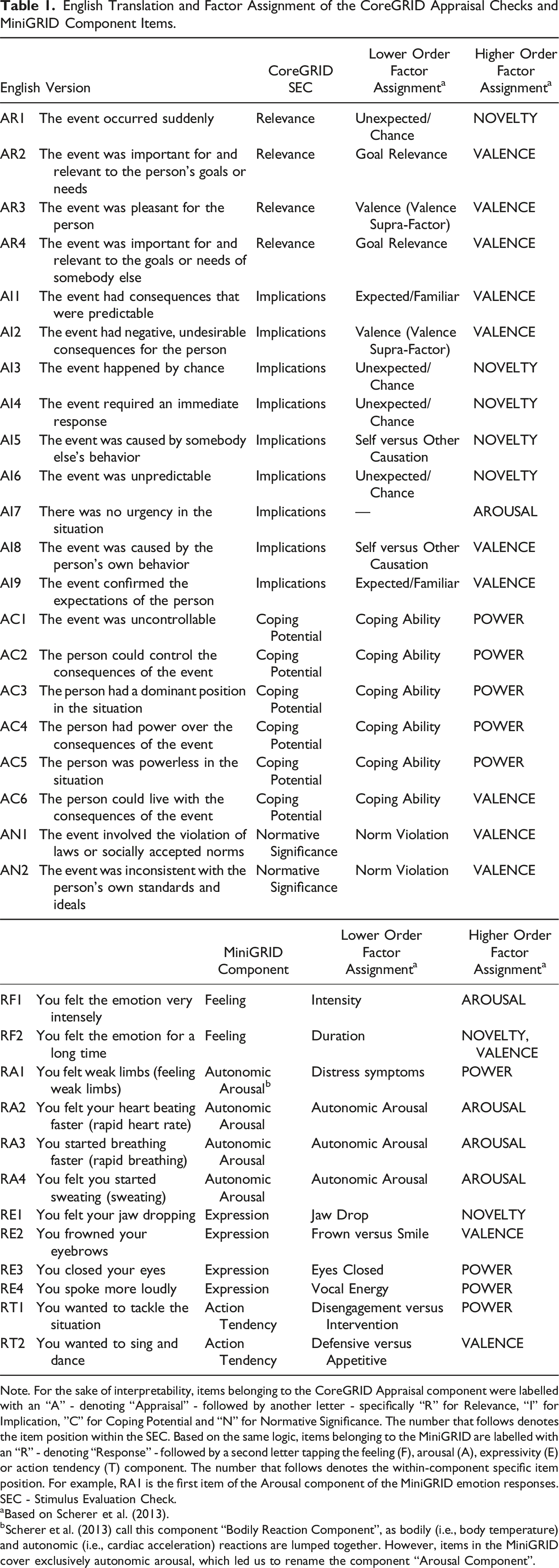
Note. For the sake of interpretability, items belonging to the CoreGRID Appraisal component were labelled with an “A” - denoting “Appraisal” - followed by another letter - specifically “R” for Relevance, “I” for Implication, ”C” for Coping Potential and “N” for Normative Significance. The number that follows denotes the item position within the SEC. Based on the same logic, items belonging to the MiniGRID are labelled with an “R” - denoting “Response” - followed by a second letter tapping the feeling (F), arousal (A), expressivity (E) or action tendency (T) component. The number that follows denotes the within-component specific item position. For example, RA1 is the first item of the Arousal component of the MiniGRID emotion responses. SEC - Stimulus Evaluation Check.
aBased on Scherer et al. (2013).
bScherer et al. (2013) call this component “Bodily Reaction Component”, as bodily (i.e., body temperature) and autonomic (i.e., cardiac acceleration) reactions are lumped together. However, items in the MiniGRID cover exclusively autonomic arousal, which led us to rename the component “Arousal Component”.
Other Measures
Participants also rated the intensity of nine categorical emotions experienced in the scenarios on a scale from 0 to 100, and additionally filled the following individual differences batteries: the Toronto Alexithymia Scale (TAS; Bagby et al., 1994; Loas et al., 2001); the Difficulties in Emotion Regulation Scale (DERS-F; Dan-Glauser & Scherer, 2013); the Personality Inventory for DSM-5 (PID-5; Maples et al., 2015; Roskam et al., 2015); the 4-item Patient-Health Questionnaire (PHQ-4; Carballeira et al., 2007; Kroenke et al., 2009); the Berkeley Expressivity Questionnaire (BEQ; Gross & John, 1997; Ouellet et al., 2012); and the Positive and Negative Affective Scales (PANAS; Bouffard & Lapierre, 1997; Watson et al., 1988). These variables were not used in the current study, and are therefore not discussed further.
Data Analyses
As a first step, Confirmatory Factor Analysis (CFA) was fitted to NEO-FFI personality data to derive latent factor scores and thus account for measurement error. We followed the literature guidelines on the specifications of NEO-FFI loadings (Booth & Hughes, 2014), with 12 items exclusively loading on each of the five assigned factors, and with cross-loadings set to 0. Model fit was judged against extant guidelines, with inspection of factor loadings to ensure an acceptable magnitude (≥ 0.5, α = .05). To ensure factors distinctiveness, all factor correlations were checked to be < 0.85. Moreover, we investigated modification indices in a theoretically driven way (Schreiber et al., 2006). Modification indices quantify the amount of improvement in model fit if a specific parameter is included in the model, for example by allowing an item originally belonging to a specific Big Five trait (e.g., A) to be additionally regressed on another trait (e.g., E) or by specifying the covariances between two items belonging to different traits. After this investigation, we included the items that were flagged by the analysis of the modification indices, but only if their inclusion was theoretically substantiated, based also on semantic content (Booth & Hughes, 2014; Schreiber et al., 2006).
For the main analyses, only the response components of Feeling and Autonomic Arousal were retained as outcomes, given that the Expression and Action Tendency ones did not show sufficient internal reliability (see Table S4). Average scores were used for representing these components in the later analyses.
Each appraisal drawn from Table 1 was entered in two separate models as a mediator variable, and it was subjected to EMA with regularisation, an approach called XMed, via the regsem R package (Jacobucci et al., 2016; Li et al., 2021). Regularisation allows the selection of the truly relevant mediators in the Big Five–emotional reactivity relationship by retaining those coefficients that, after the application of the least absolute shrinkage and selection operator (LASSO; Tibshirani, 1996), are non-zero. Specifically, by pairing a tuning parameter (known as lambda) with the application of penalties, LASSO shrinks the coefficients associated with the a (predictor–mediator) and b (mediator–outcome) paths towards zero, and, consequently, the indirect effect — the product of a and b — in order to obtain a smaller pool of truly influential mediators.
Based on Serang et al. (2017) guidelines, XMed consists of two analytical steps. Step 1 entails fitting a model inclusive of all mediators of interest, which are regularised through LASSO. In this step, two separate EMA via regularization were performed per scenario (one for the Feeling outcome and one for the Autonomic Arousal outcome). The latent factor scores of N, E, O, A, and C were entered as predictors, and all the 21 as the mediators to be regularised. Similarly to Ammerman et al. (2018), we included in this step age and gender as covariates to account for the effects of these important variables within the regularisation process. The recently updated XMed function allows entering the five personality traits together and selecting the strongest mediators for each trait. One limitation is, however, that the traits and mediators are not allowed to covary within and between them, leaving interdependencies unmodelled. To overcome this, and following a similar approach to Casini et al. (2022), Step 2 entails running a parallel mediation model for each scenario to ensure that the interdependencies among personality traits, among mediators, and among the two emotion responses of Feeling and Autonomic Arousal, are accounted for in the final parameters estimations. Moreover, since the application of LASSO leads to an underestimation of the indirect effects due to the overall coefficients shrinkage, or penalisation, Step 2 also entails refitting in the SEM framework a mediation model with no penalties applied to the selected pool of mediators. In this way, unbiased estimates of the indirect effects are obtained, with the use of bootstrapped confidence intervals (Williams & MacKinnon, 2008), making EMA a far more robust method compared to more traditional hierarchical regression analyses employed for mediation purposes (Preacher & Hayes, 2004; Shrout & Bolger, 2002).
Analyses were performed in the R environment (R Development Core Team, 2020). The Supplementary Material includes descriptive statistics, correlations, and reliability analyses (Tables S2 and S3, Figure S5, and Table S4, respectively); the NEO-FFI CFA regression and covariance coefficients (Tables S5 and S6); and, for both scenarios, all the parallel mediation model parameters, including significant and non-significant regression and covariance coefficients, and non-significant indirect effects (Tables S7–S12). The de-identified dataset and analyses code for all the analyses of the current study are publicly available at: https://osf.io/z4jgk/.
Results
CFA Results
The Chi-square test of model fit was significant (χ2 = 5006.64, df = 1700, p < .001), indicating a suboptimal fit to the data. However, given the known sensitivity of the Chi-square to large sample size, other indices needed to be considered. The Comparative Fit Index (CFI; .667), the Tucker-Lewis Index (TLI; .653), the Root Mean Square Error of Approximation (RMSEA; .062) and the Standardized Root Mean Square Residual (SRMR; .090) were also not satisfactory. Thus, overall, the model appeared to inadequately fit the data. After iteratively implementing the prompted modification indices in a theoretically driven way, and refitting the model (see Tables S5 and S6 for final model parameters), we ended up with acceptable parameters: χ2 = 3193.03, df = 1547, p < .001; CFI = .83, TLI = .82, respectively, RMSEA = .046, 95% CI [.044, .048]); SRMR = .07. Similar values are reported in other NEO-FFI CFA studies (Booth & Hughes, 2014).
We used the nonnest2 R package (Merkle et al., 2016) via Vuong (1989) tests to compare the initial and final NEO-FFI CFA models fit. The models are non-nested, given the different specified covariances and regressions paths. The Vuong’s variance test indicated that the two models were distinguishable, with the non-nested likelihood ratio test (LRT) confirming the final model fit to be superior to the initial model (z = −38.364, p = < .001). The Akaike Information Criteria (AIC) and the Bayesian Information Criteria (BIC) for the initial model were 84124.17 and 84672.07, respectively. The AIC and BIC for the final model were 80145.96 and 80837.16, respectively, again showing a larger improvement in model fit compared to the initial model.
The Cronbach’s α reliability coefficients for the NEO-FFI latent factors were: N= 0.795; E= 0.744; O= 0.739; A= 0.621; C= 0.699. The ω reliability coefficients for the NEO-FFI latent factors were: N, 0.755; E, 0.749; O, 0.724; A, 0.608; C, 0.779.
Selection of the most relevant mediators (Step 1)
Negative Scenario
Influential Mediators of the Big Five Traits – Feeling and Autonomic Arousal Components Relationship in the Negative Scenario.
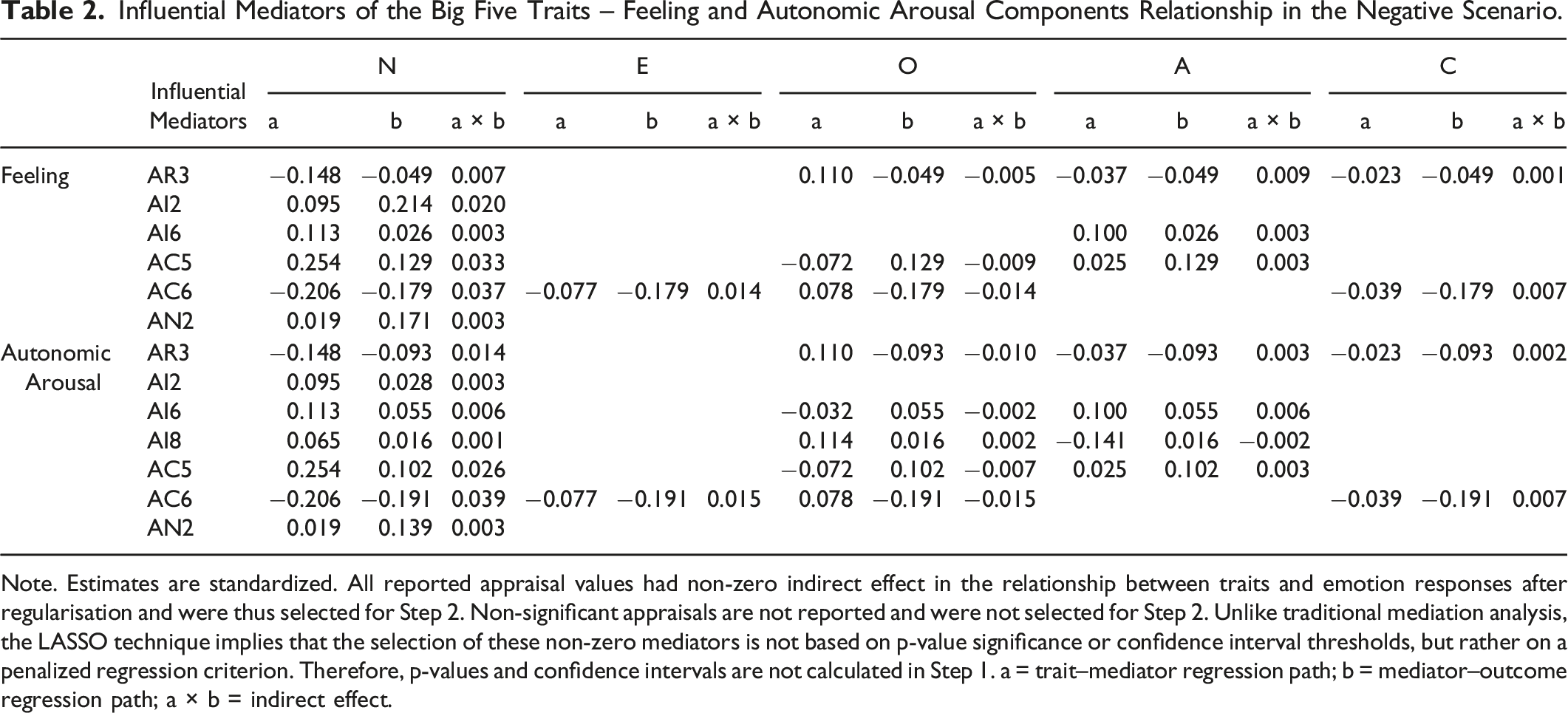
Note. Estimates are standardized. All reported appraisal values had non-zero indirect effect in the relationship between traits and emotion responses after regularisation and were thus selected for Step 2. Non-significant appraisals are not reported and were not selected for Step 2. Unlike traditional mediation analysis, the LASSO technique implies that the selection of these non-zero mediators is not based on p-value significance or confidence interval thresholds, but rather on a penalized regression criterion. Therefore, p-values and confidence intervals are not calculated in Step 1. a = trait–mediator regression path; b = mediator–outcome regression path; a × b = indirect effect.
Positive Scenario
Influential Mediators of the Big Five Traits – Feeling and Autonomic Arousal Components Relationship in the Positive Scenario.
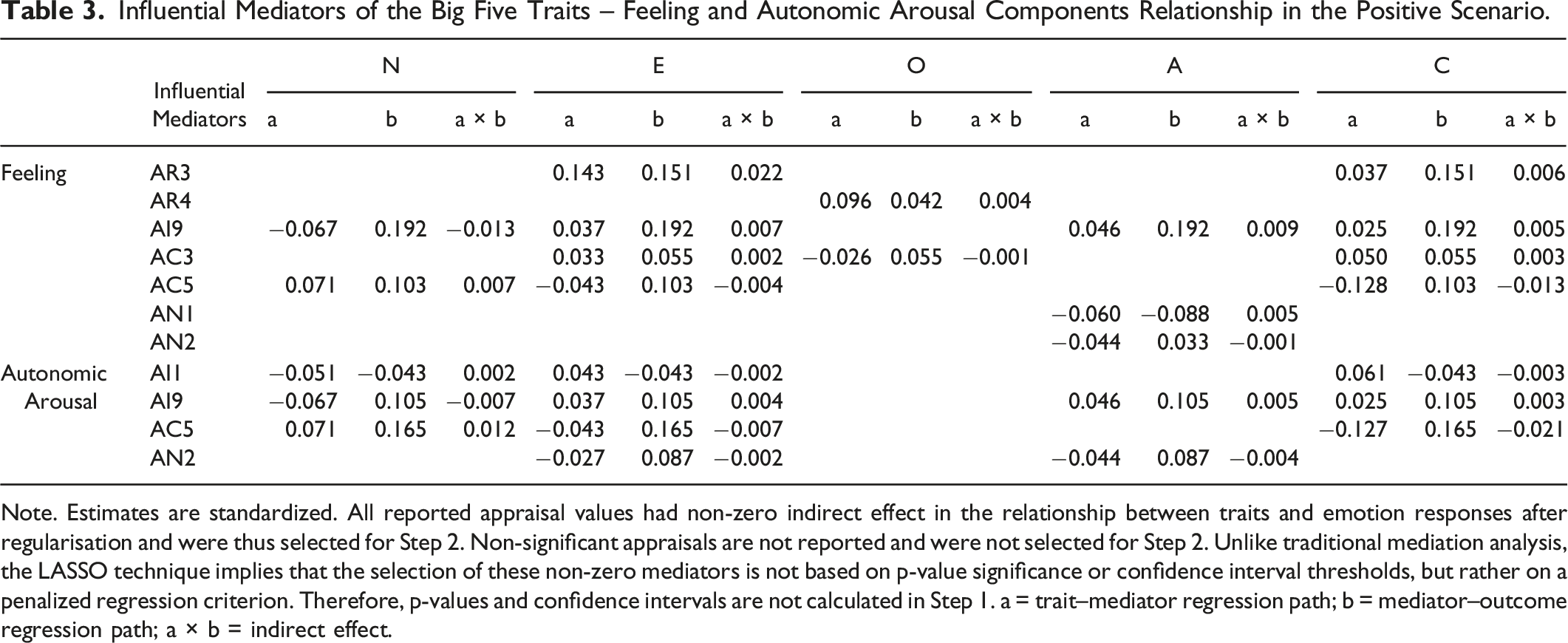
Note. Estimates are standardized. All reported appraisal values had non-zero indirect effect in the relationship between traits and emotion responses after regularisation and were thus selected for Step 2. Non-significant appraisals are not reported and were not selected for Step 2. Unlike traditional mediation analysis, the LASSO technique implies that the selection of these non-zero mediators is not based on p-value significance or confidence interval thresholds, but rather on a penalized regression criterion. Therefore, p-values and confidence intervals are not calculated in Step 1. a = trait–mediator regression path; b = mediator–outcome regression path; a × b = indirect effect.
Full parallel mediation model results (Step 2)
Negative Scenario
We then included all the mediators selected in Step 1 into a full parallel mediation model to account for the interrelations between predictors, between mediators, and between outcomes. The initial model fit was not satisfactory: the Chi-square test of model fit was significant (χ2 = 200.19, df = 31, p < .000), with the CFI and TLI being from acceptable to poor (0.88 and 0.69, respectively), and the RMSEA and SRMR being very poor (0.10 and 0.10, respectively). We therefore investigated and implemented the prompted modification indices in a theoretically driven way, as for the NEO-FFI CFA. For example, in this context we let certain appraisals to be regressed on other appraisals following the theoretically based sequentiality assumption of the CPM. We ended up with a very good model: χ2 = 40.01, df = 26, p = .039; CFI = .99, TLI = .97, respectively, RMSEA = .03, 95% CI [.01, .05]; SRMR = .03. Results of the Chi-square difference test indicated a significant difference in model fit between the initial model and the alternative final model (Δχ2 = 160.18, Δdf = 5, p < .001), confirming the better fit of the latter model to the data.
In this scenario, the only significant indirect effects emerged in the relation between the trait of N and the Feeling and Autonomic Arousal components, respectively. In particular, the appraisal of negative consequences (AI2; b = .04, SE = .01, 95% CI [.01, .07], mediated proportion = .25, 95% CI [.09, .64]), of powerlessness (AC5; b = .03, SE = .01, 95% CI [.01, .06], mediated proportion = .20, 95% CI [.06, .59]), and of consequences adjustment (AC6; b = .05, SE = .01, 95% CI [.03, .08], mediated proportion = .29, 95% CI [.14, .70]) were significant partial mediators in the relationship between the trait and the Feeling component. The overall indirect effect was significant (b = .13, SE = .02, 95% CI [.08, .18]).
Similarly, the appraisal of powerlessness (AC5; b = .02, SE = .01, 95% CI [.01, .05], mediated proportion = .14, 95% CI [.06, .59]); and of consequences adjustment (AC6; b = .05, SE = .02, 95% CI [.02, .09], mediated proportion = .26, 95% CI [.10, .65]) were significant partial mediators in the relationship between the trait and the Autonomic Arousal component. The overall indirect effect was significant (b = .10, SE = .02, 95% CI [.06, .15]).
To summarize, with Step 2 of the procedure in the Negative Scenario, it was found that the appraisal of negative consequences was relevant as a mediator only in the relationship between N and the Feeling component. By contrast, the appraisals of powerlessness and consequence adjustment were salient mediators in the relationship between N and both emotional components (see Figure 2). Results indicate that with higher N there was a stronger appraisal of negative consequences, which led to a stronger duration and intensity of the emotional state; similarly, with higher N, there was a higher evaluation of powerlessness and a lower evaluation of being able to adjust to the situation consequences, leading to a stronger duration and intensity of the emotional state, and a higher physiological activation. The estimated model of relations between the Big Five personality traits (upper right box) and the Feeling and Autonomic Arousal components (lower right box), mediated by cognitive appraisals (middle) in the Negative Scenario. N = Neuroticism; E = Extraversion; O = Openness; A = Agreeableness; C = Conscientiousness; AR3 = Appraisal of pleasantness; AI2 = Appraisal of negative consequences; AI6 = Appraisal of unpredictability; AC5 = Appraisal of powerlessness; AC6 = Appraisal of consequences adjustment; AN2 = Appraisal of internal standard incompatibility. For figure interpretability only significant a and b paths are reported, with related R squared; covariances are not specified; and traits are depicted as manifest.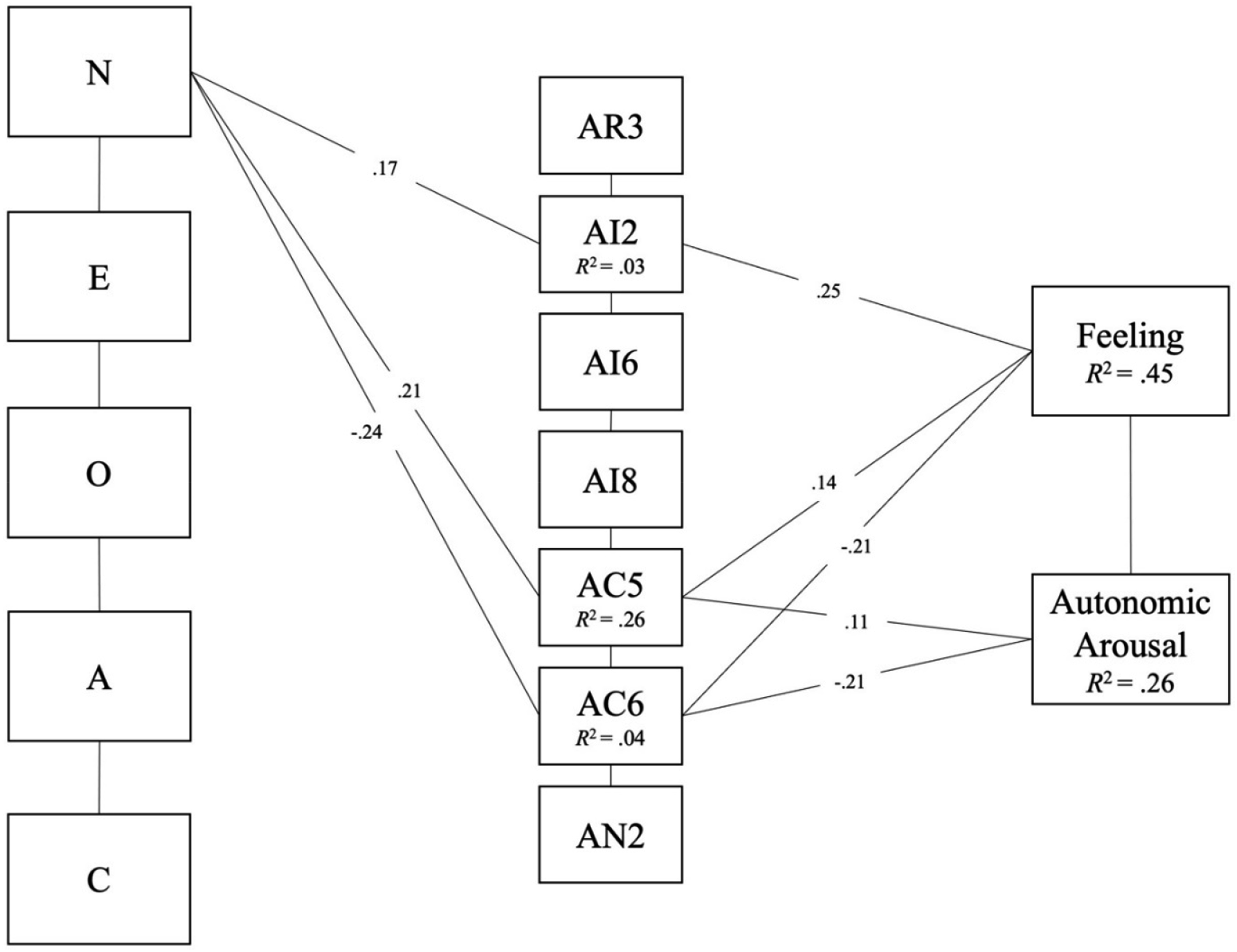
Positive Scenario
We included all the selected mediators into a second full parallel mediation model. The initial model fit was not satisfactory: the Chi-square test of model fit was significant (χ2 = 280.23, df = 48, p < .000), with the CFI and TLI being from acceptable to poor (0.85 and 0.68, respectively), and the RMSEA and SRMR being very poor (0.10 and 0.09, respectively). Again, we investigated and implemented the prompted modification indices in a theoretically-driven way, ending up with a very good model: χ2 = 56.26, df = 43, p = .085; CFI = .99, TLI = .98; RMSEA = .03, 95% CI [.00, .04]); SRMR = .03. Results of the Chi-square difference test indicated a significant difference in model fit between the initial model and the alternative final model (Δχ2 = 223.97, Δdf = 5, p < .001), confirming the better fit of the latter model to the data.
In this scenario, the results were more nuanced in terms of indirect effects linking traits to emotional outcome. In particular, the appraisal of confirmed expectations (AI9; b = −.03, SE = .01, 95% CI [−.06, −.00], mediated proportion = −.68, 95% CI [−6.11, 5.59]) and of powerlessness (AC5; b = .02, SE = .01, 95% CI [.00, .04], mediated proportion = .23, 95% CI [−1.32, 1.80]) were partially mediating the relationship between N and the Feeling component. However, their overall indirect effect was not significant (b = −.01, SE = .02, 95% CI [−.04, .02]). In addition, the appraisal of pleasantness (AR3; b = .04, SE = .01, 95% CI [.02, .07], mediated proportion = .16, 95% CI [.06, .41]) partially mediated the relationship between E and the Feeling component. The appraisal of external standards incompatibility (AN1; b = .01, SE = .01, 95% CI [.00, .03], mediated proportion = −.58, 95% CI [−4.73, 3.21]) was partially and marginally mediating the relationship between A and the Feeling component. Finally, the appraisal of powerlessness (AC5; b = −.03, SE = .01, 95% CI [−.06, −.01], mediated proportion = .33, 95% CI [.03, 1.83]) was partially mediating the relationship between C and the Feeling component.
Similarly, the appraisal of confirmed expectations (AI9; b = −.02, SE = .01, 95% CI [−.04, −.00], mediated proportion = −.16, 95% CI [−1.20, .03]) and of powerlessness (AC5; b = .02, SE = .01, 95% CI [.01, .05], mediated proportion = .15, 95% CI [.03, .52]) were partially mediating the relationship between N and the Autonomic Arousal component. However, their overall indirect effect was not significant (b = .01, SE = .01, 95% CI [−.02, .03]). Finally, the appraisal of powerlessness (AC5; b = −.04, SE = .01, 95% CI [−.07, −.01], mediated proportion = .33, 95% CI [.08, 1.58]) was partially mediating the relationship between C and Autonomic Arousal.
To summarize, with Step 2 of the procedure in the Positive Scenario, it was found that not only were different appraisals relevant to different Big Five traits, but also, that these appraisals mediated differently the relation with the Feeling and Autonomic Arousal components (see Figure 3). Namely, with higher N, there was a higher uncertainty concerning the outcome of the situation which led to a weaker duration and intensity of the emotional state and weaker physiological arousal; with higher N, there was also a higher powerlessness over the situation, which led to a stronger duration and intensity of the emotional state and stronger physiological arousal; with higher E, the scenario appeared more pleasant, which led to a stronger duration and intensity of the emotional state; higher A led to lower appraisal of social norms disruption, which also impacted duration and intensity of the emotional experience. Finally, with higher C there was a stronger appraisal of situational power, which led to a weaker duration and intensity of the emotional state and weaker physiological arousal. The estimated model of relations between the Big Five personality traits (left) and the Feeling and Autonomic Arousal components (right), mediated by cognitive appraisals (middle) in the Positive Scenario. N = Neuroticism; E = Extraversion; O = Openness; A = Agreeableness; C = Conscientiousness; AR3 = Appraisal of pleasantness; AR4 = Appraisal of others’ goal relevance; AI1 = Appraisal of consequences predictability; AI9 = Appraisal of confirmed expectations; AC3 = Appraisal of dominance; AC5 = Appraisal of powerlessness; AN1 = Appraisal of external standard incompatibility; AN2 = Appraisal of internal standard incompatibility. For figure interpretability only significant a and b paths are reported, with related R squared; covariances are not specified; and traits are depicted as manifest.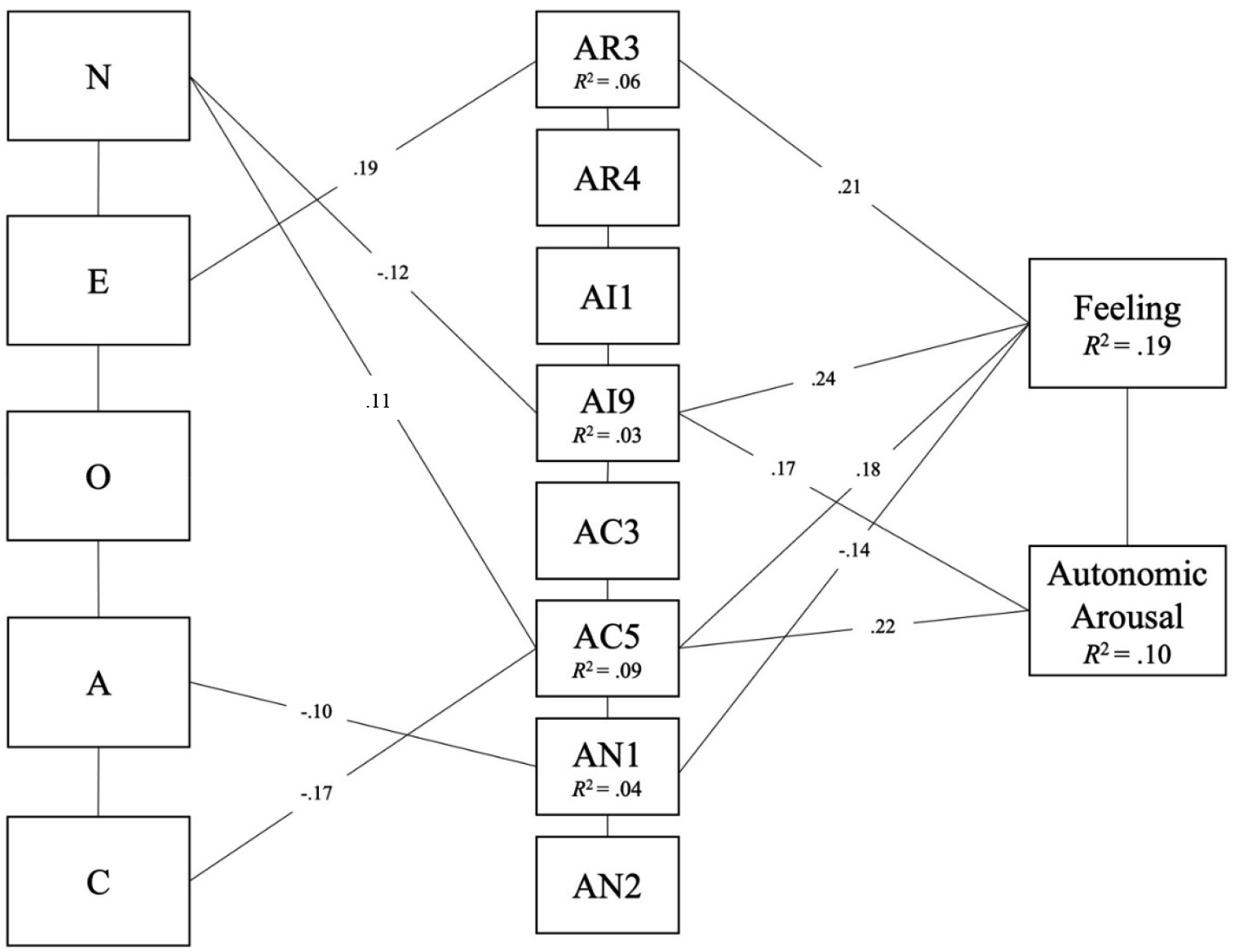
Discussion
The goal of this study was to explore the mechanisms linking the Big Five to self-reported emotional reactivity, specifically via cognitive appraisals. This is because, so far, we lacked studies investigating whether personality traits systematically impact some situational appraisals, which in turn modulate subsequent emotion responses. We deemed essential to first disentangle how and which appraisals contextually influence specific emotion components. Indeed, not all appraisals could be situationally relevant to all personality traits, and in each Big Five trait–emotion response relation. With our novel approach we attempted to break down the mechanism in smaller and contextualised explanations, possibly shading light on the current discourse on how and why personality traits might be linked to important processes, such as emotion. In turn, this knowledge could be important in characterizing more specifically the determinants of mental and physical health (Hampson, 2021; Uziel, 2006).
Overall, interesting patterns emerged, with some appraisals being transversally relevant. For example, in Step 1, out of all possible combinations (trait × scenario × component), the appraisal of powerlessness (AC5) was selected 12 times; the appraisal of pleasantness (AR3) 11 times; and the appraisal of internal standards incompatibility (AN2) seven times. The finding related to the appraisal of pleasantness confirms the universal role of this appraisal in emotional reactivity, regardless of individual differences and contextual factors, whose involvement has been theoretically hypothesized (Ellsworth & Scherer, 2003) but not explicitly proven in a standardized (see Tong, 2010; Tong et al., 2006) or comprehensive (Scherer, 2020) way. The appraisal of powerlessness is also of great interest, given that its crystallization is believed to play a role in the onset of affective disorders (Mehu & Scherer, 2015), and it has recently been suggested to promote negative self-efficacy emotions in the university learning context (Mattsson et al., 2020). One explanation for the transversal property of this appraisal may be found in recent explanatory accounts of the personality–appraisal relationship (Reisenzein et al., 2020; Sacchi & Dan-Glauser, 2024b). Briefly, it was suggested that the Big Five personality traits could be differentially related to cognitive appraisals via the three mechanisms of information processing (i.e., attention), chronic accessibility (i.e., memory schemas), and desires (i.e., motivational drives). Thus, the appraisal of powerlessness might be best capturing these three mechanisms in context. Similarly, the appraisal of internal standard incompatibility entails a social perspective on situations and appeared to be specifically relevant to more socially oriented traits, such as N, E and A. Of particular note, during the selection procedure of most relevant appraisal, representatives of all the four SECs were selected in Step 1, which strengthens the importance of the four theoretically identified appraisal groups.
After Step 2, the number of significant relative indirect effects was parsimonious. Interestingly, there was a clear diversification between the negative and the positive scenarios. In the former, the appraisals of negative consequences, of powerlessness and of consequences adjustment significantly mediated the relationship only between the trait of N and the Feeling component; moreover, the latter two appraisals were also significant mediators in the relationship between the trait and the Autonomic Arousal component. It is possible that the presented scenario was particularly arousing for neurotic individuals only, making this trait more salient in this specific context of covert rejection, as postulated by Trait-Activation Theory (Tett et al., 2021). Concerning the other traits, it is possible that a non-linear relationship between appraisals and emotional reactivity exists (Meuleman et al., 2019), which would go undetected in our model. Overall, the findings concerning the trait of N are not surprising, given the extensive literature documenting the threat-oriented nature of highly neurotic individuals. In particular, our results are coherent with neurotic individual increased negative evaluations of and their stronger affective reactivity to negative stimuli (Suls & Martin, 2005; Uziel, 2006). When these become chronic, they could build up to affect distal affective outcomes, as shown by Scherer et al. (2022) for Anxiety and Depression scores. In a recent review of the appraisal literature, Scherer & Moors (2019) conclude that novel stressors that require active coping have been stably associated to cardiac reactivity and an overall physiological orienting response. Thus, this could be particularly pronounced in neurotic individuals who already start from a higher reactivity baseline (Barlow, Ellard et al., 2014; Norris et al., 2007), explaining our findings for the Autonomic Arousal component, and the higher rate of reported psychosomatic distress in this population (Lahey, 2009).
Unexpectedly, the positive scenario appeared to amplify individual differences specifically for the Feeling component. Appraisals were indeed differentially relevant for different Big Five traits, beyond those more generally implicated in affective processes such as N and E (Reisenzein et al., 2020). Our findings nicely echo the relational stance on appraisal advocated by Smith and Kirby (2009), that is, appraisals are transactions emerging from individual’s goals, needs, and resources in relation to the situational characteristics of a given event. The positive context of the preparation of a birthday party might have specifically emphasized the pro-social and organized nature of agreeable and conscientious individuals, respectively. In turn, their respective appraisals of the situation led to a slight amplification of the intensity and duration of the emotional state for agreeable individuals, while for conscientious individuals the emotional state appeared to be dampened, as in a form of self-regulation. Another possibility could be that this positive context enhanced the social dimension of appraisal. Indeed, it has been argued that, despite appraisal being generally considered as a situational and individual product, its object frequently includes appraising the feelings and behaviors of other individuals that might be present in the same situation (Manstead & Fischer, 2001). This perspective would be particularly useful in explaining the findings for E and A, given their known (pro)social inclination and their positive, habitual processing of social cues (Reisenzein et al., 2020; Sacchi & Dan-Glauser, 2024b).
The main limitation of the present work is the use of few imagined scenarios, limiting generalization. With this methodological choice, we attempted to eliminate much of the situational variability that could act as a confounder between appraisals uniquely triggered by situations and personality-driven environment evaluations. However, note also that beyond low generalizability, many other confounders are left in such design.
A second important limitation lies in the restricted mechanistic conclusion we can draw from our results given the cross-sectional design of the present study. Indeed, despite the identification of mediating mechanisms between personality and emotional reactivity, we acknowledge that causality cannot be claimed — and, most importantly, the temporal sequence of variables relation cannot be definitely established. Our inferences remain thus associational in nature (Hernán, 2018). However, our exploratory approach is directly informed by solid theoretical accounts about the nature of the data we focused on, where personality traits are generally seen as stable and unchanging (McCrae & Costa, 2021), and were repeatedly shown to influence how we perceive and interpret the world (our X → M path; Kuppens & Tong, 2010), and our affectivity (our X → Y path; Revelle & Scherer, 2009). Similarly, and again according to theory and numerous experimental validations, situational appraisal is antecedent to emotional responses and shape these (our M → Y path; Scherer & Moors, 2019). We acknowledge however that other explanatory paths might exist, and most likely complex, recursive and non-linear ones (Meuleman et al., 2019; Sander et al., 2005). Hence, future research is needed to clarify the personality–appraisal–emotions mediation hypothesis, for example with longitudinal or ecological momentary assessment methods (Kuppens et al., 2022; Stachl et al., 2020), and within a more robust causal methods, such as causal mediation analysis (Imai et al., 2010), embedded in the potential outcome framework (Pearl, 2012; Rohrer, 2024).
Finally, on a more general note, it would be worth going beyond personality traits as operationalized by the Big Five inventories. Indeed, personality is subsumed by affects, behaviors, cognitions, and desires (ABCD; Wilt & Revelle, 2015). However, it is now evident that traits are differentially represented by these components, resulting in unbalanced aggregation in Big Five measurements (Wilt & Revelle, 2015). In our view, a taxonomy such as that developed by Wilt and Revelle (2015), where traits are balanced in their ABCD content, could provide a more nuanced and non-overlapping prediction of relevant outcomes, and should therefore be tested in the future. Scholars could similarly employ EMA (Serang et al., 2017) in a data-driven way to investigate other plausible processes implicated in other personality–outcomes relations, such as goals (Costantini et al., 2020), or emotion regulation strategies (Trentini & Dan-Glauser, 2024).
The current work aimed at understanding how appraisals mediate the relationship between personality traits and emotional responses. In an exploratory and preliminary way, we isolated core appraisals, which nicely represented all the four theoretically identified appraisal main checks, with an emphasis on powerlessness appraisal, which appears transversally pivotal. Our study provides preliminary evidence for a plausible, processed-based chain linking personality to emotional reactivity, a knowledge that can now be applied to broader mental and physical health outcomes (Hampson, 2021; Scherer, 2020). Moreover, our study reinforces the current clinical literature showing how these intermediate appraisal processes can be manipulated to ameliorate behavioral consequences of certain traits, such as of N (Sauer-Zavala et al., 2021), and suggest volitional mechanisms through which long-term changes in personality-relevant outcomes could be achieved for other traits, such as for C and its relation to academic and career success (Costantini & Perugini, 2018). This important question now deserves to be further tested experimentally (Baumert et al., 2019; Scherer & Moors, 2019) and exploited in interventional settings (Barlow, Sauer-Zavala et al., 2014).
Supplemental Material
Supplemental Material - My Perceptions are not your Perceptions: The Mediating Role of Cognitive Appraisal on the Association between Personality and Emotional Reactivity
Supplemental Material for My Perceptions are not your Perceptions: The Mediating Role of Cognitive Appraisal on the Association between Personality and Emotional Reactivity by Livia Sacchi, and Elise Dan-Glauser in Psychological Reports
Footnotes
Acknowledgments
We are grateful to Professor Farrell and Professor Zimmer-Gembeck for sharing their scenarios with us. We are grateful to Professor Serang for the insightful correspondence on the EMA approach.
Authors Contributions
Livia Sacchi: Conceptualization, Methodology, Formal analysis, Investigation, Data curation, Writing, Visualization. Elise Dan-Glauser: Conceptualization, Methodology, Writing, Visualization, Supervision, Project administration, Funding acquisition
Declaration of Conflicting Interests
The author(s) declared no potential conflicts of interest with respect to the research, authorship, and/or publication of this article.
Funding
The author(s) disclosed receipt of the following financial support for the research, authorship, and/or publication of this article: This work was supported by a Swiss National Science Foundation Eccellenza Grant (no PCEFP1_186836) to E.D-G.
Ethical Statement

Data Availability Statement
Supplemental Material
Supplemental material for this article is available online.
Author Biographies
References
Supplementary Material
Please find the following supplemental material available below.
For Open Access articles published under a Creative Commons License, all supplemental material carries the same license as the article it is associated with.
For non-Open Access articles published, all supplemental material carries a non-exclusive license, and permission requests for re-use of supplemental material or any part of supplemental material shall be sent directly to the copyright owner as specified in the copyright notice associated with the article.
