



Abstract
This study examined virtuous leadership’s effect on employees’ attitudes and work behaviors, more specifically, their affective commitment, turnover intention, and individual performance. The analyses also focused on affective commitment’s mediating role in therelationships between virtuous leadership and both turnover intention and individual performance. The sample consisted of 280 workers from diverse business sectors, who voluntarily filled out an electronic survey. The results suggest that, first, workers’ perception of virtuous leadership significantly is correlated with their levels of affective commitment, turnover intention, and individual performance. Second, affective commitment is linked to turnover intention and individual performance, and, third, the relationship between virtuous leadership and turnover intention is partially mediated by affective commitment. Last, the relationship between workers’ perception of virtuous leadership and their individual performance is fully mediated by affective commitment. The findings suggest that virtuous leaders can generate an emotionally committed workforce that is motivated to stay in the same organization and strive to achieve higher levels of individual performance—if supervisors exhibit significant virtues in the workplace.
Introduction
The business world’s current dynamics are driven by increasing globalization, which has provoked changes in all types of organizations and, transversally, all sectors (Rego et al., 2012; Taskan et al., 2022). Leaders’ main mission is thus to provide innovative answers to the challenges and adversities created by these new forces at work. Managers need to know the best path to take to redefine their company’s legitimate role in society and, concurrently, have to guarantee their organization’s responsible growth. This course of action implies investing in internal development and human capital, as well as contributing in positive ways to the surrounding economy and society’s sustainable development.
Achieving these goals, however, is neither a linear nor a simple process. In recent years, corporate scandals have erupted worldwide, including the imprudent behavior associated with the crisis that collapsed much of the global economy in 2008 (Ribeiro et al., 2013). These practices represent a rebuttal of the trend toward developing more sustainable values that ensure more just and economically, socially, and environmentally developed societies (Bendell et al., 2017; Metcalf & Benn, 2013; Rego et al., 2012).
The latter trend has strengthened the importance currently given to ethical behaviors and moral actions in business, emphasizing virtues that promote more effective leadership (Bischak & Woiceshyn, 2016; Caldwell et al., 2015; Dawson, 2018; Manz & Manz, 2014; Newstead et al., 2021; Palanski et al., 2015). Virtuousness has thus regained its place of honor in contemporary management and organizational behavior theory (Alshehri & Elsaied, 2022; Alzola, 2015; Arjoon et al., 2018; Bright et al., 2014; Nassif et al., 2021; Newstead et al., 2018; Tripathi, 2024). Virtue in companies translates into organizational contexts in which good actions (e.g., humanity, compassion, integrity, forgiveness, trust, and justice) are sanctioned, encouraged, and disseminated —both individually and collectively (Cameron et al., 2004).
To define organizational virtuousness and its relevance to business studies more fully, Cameron (2003) suggests that three key attributes must be present, of which the first is human impacts. That is, virtuousness is associated with the flourishing of individuals’ morals. The second attribute is moral goodness since virtuousness denotes what is good, right, and worthy of being cultivated. The last key attribute is social improvement, in which virtuousness extends beyond the instrumental desires of the actors who practice it and creates social value that transcends mere personal benefit. Cameron and Winn (2012) later developed this conceptualization by including two more attributes: (1) eudaemonic assumptions or the presupposition that kindness exists in the pursuit of intrinsic value and (2) inherent value or the pursuit of goals that are worthy in themselves rather than a means to other ends.
Virtuous leadership is thus based on the proposal that good leadership is guaranteed by leaders’ character and, more importantly, by their virtues. Becoming a leader is more than just exercising power because leadership must produce social harmony and feed individuals’ moral muscle, willpower, and/or resilience in the face of challenges (Cameron et al., 2004; Rego et al., 2012). In line with Pearce et al. (2006, p. 63), virtuous leadership is “distinguishing right from wrong in one’s leadership role, taking steps to ensure justice and honesty, influencing and enabling others to pursue righteous and moral goals for themselves and their organizations, and helping others to connect to a higher purpose.”
A virtuous leader’s character and behavior are fully evident in the relevant situations and associated with the most prominent prevailing virtues expected of those in supervisory positions (Alshehri & Elsaied, 2022). In this way, these leaders create positive bonds with employees and a sense of “us,” that is, an emotional bond to their company (Meyer & Allen, 1991). Employees who have a strong affective commitment, in turn, are more likely to improve their performance and less likely to leave their employer (Casimir et al., 2014; Duarte et al., 2021; Meyer & Herscovitch, 2001; Ouerdian et al., 2021; Ribeiro et al., 2020, 2021).
According to Social Exchange Theory (Blau, 1964), the followers who perceive their leader as virtuous develop a sense of obligation to reciprocate with positive attitudes, such as increased affective commitment. Belongingness theory (Baumeister & Leary, 1995) can also be applied to understand why virtuous leaders are more likely to motivate employees to enhance their performance by fulfilling their need for belonging. Employees seek a sense of connection within their organization and value positive interpersonal relationships. As a result, when they perceive their leader as virtuous, they are driven to improve their individual performance. The Conservation of Resources theory (Hobfoll, 1989) posits that individuals seek to acquire, preserve, and protect resources that are important to their well-being, such as material, emotional, and informational resources. According to the theory, when virtuous leaders provide these resources to subordinates, they ensure more positive work experience because employees feel supported and empowered to deal with the demands of the workplace, which can improve their performance and well-being.
Various authors have called for more empirical research to strengthen and/or expand this leadership style’s theoretical basis (Crossan et al., 2017; De Cremer & Moore, 2020; Guimarães et al., 2019; Hendriks et al., 2020; Meyer et al., 2019; Newstead et al., 2021; Tripathy, 2024). The present study, in response, simultaneously examined virtuous leadership’s novel approach and its implications for employees’ attitudes and work behaviors, such as stronger affective commitment and individual performance and decreased turnover intention.
Virtuous leadership, affective commitment and performance are critical for organizational success. By cultivating a positive and ethical work culture, virtuous leadership enhances employee commitment, reduces voluntary turnover rates, and boosts performance. This relationship is essential to building strong, resilient organizations that prioritize people and performance, ultimately creating sustainable success, in an increasingly complex, uncertain, ambiguous and volatile business world.
The literature review conducted for this study confirmed that it is the first to address the relationship between virtuous leadership and employees’ turnover intention and performance. This research is also pioneer in exploring how virtuous leadership affects workers’ turnover intention and performance through the mediating variable of affective commitment. By examining virtuous leadership’s consequents at the individual level, the present research sought to expand the limited literature on this topic (Alshehri & Elsaied, 2022; Hendriks et al., 2020) and produce an empirically robust model of how supervisors’ virtuous behavior affects followers’ job attitudes and conduct.
This study highlights the crucial role of virtuous leadership in enhancing employees’ affective commitment and individual performance while reducing turnover intention, making this leadership style a key predictor of these behaviors and attitudes. Additionally, the study expands the understanding of how virtuous leaders shape their followers’ mindsets and the mechanisms that reinforce this influence (Alshehri & Elsaied, 2022).
Previous studies have emphasized affective commitment’s mediating role in the relationship between various leadership styles, such as authentic leadership and employee performance as well as turnover intention (Duarte et al., 2021; Ribeiro et al., 2018, 2020). However, no research has yet explored affective commitment’s mediating role in the relationship between virtuous leadership and individual performance or turnover intention. A thorough review of the existing literature indicates that the connections between these variables have not been examined in prior research.
Theoretical Framework and Hypotheses Development
Virtuous Leadership
According to Pearce et al. (2006), virtuous leaders adopt measures that guarantee fairness and honesty to enable both individuals and organizations to achieve just and moral objectives. These leaders are concerned not only about getting results but also the way their followers go about accomplishing this. Virtuous managers cultivate and develop virtuous attitudes, decisions, and actions—in both internal interactions and those with external stakeholders—so these leaders are better able to place their organization at the service of economic and social development. While promoting organizational virtuousness, these leaders can also foster human development and, directly or indirectly, improve social well-being and long-term sustainability (Ribeiro et al., 2013; Wang & Hackett, 2016).
In contrast, leadership devoid of virtues can have devastating effects on supervisors and their workers, organization, and society. Thus, virtuous leaders can potentially gain the power, freedom, and involvement needed to make their positive impacts especially noticeable (Hackett & Wang, 2012; Ribeiro et al., 2013). For this to occur, their characteristics and actions must be consistent with specific virtues.
Hackett and Wang (2012) developed a new taxonomy of virtues with a more parsimonious, coherent, and integrated structure. The cited authors included 6 virtues: 4 classified as cardinal by Aristotle (i.e., courage, temperance, justice, and prudence) and 2 classified as essential by Confucius (i.e., veracity and humanity). In a later study, Wang and Hackett (2016) achieved better adjustment indexes after eliminating one dimension—veracity.
The present research, therefore, only considered five dimensions: courage, temperance, justice, prudence, and humanity. Courage allows leaders to do good regardless of any danger or risk of negative consequences, such as damage to their personal reputation. Temperance, in turn, helps managers to control their desire for instant gratification even without externally imposed restraints. Justice encourages supervisors to treat their employees’ respectfully and fairly. Prudence allows leaders to adopt appropriate evaluations and/or decisions that consider multiple stakeholders’ interests. Finally, humanity permits those in superior positions to show that they care and that they are concerned about their workers’ needs and interests (Nassif et al., 2021; Wang & Hackett, 2016).
However, leaders’ ability to practice virtues does not mean that they are genuinely virtuous. Committing sins also does not make individuals devoid of virtues. Leaders are, like all humans, imperfect beings. What virtuous leadership theory advocates is instead following the path of excellence, namely, an approximation to what is desirable within the boundaries of what is possible (Rego & Cunha, 2011). Positive consequences can be expected when followers perceive their leaders as virtuous (Hendriks et al., 2020; Nassif et al., 2021).
Virtuous Leadership and Affective Commitment
One model of organizational commitment has produced more consistent results—the model of Meyer and Allen (1991) with three components. The first variable is affective commitment (i.e., an emotional alignment with the relevant organization), while the second is normative commitment (i.e., a perception of moral obligation to remain in that company). The last component is continuance commitment (i.e., a perception of the costs related with leaving behind the organization and/or the absence of options).
Affective commitment is based on an emotional bond to the relevant organization, so employees are more likely to be strongly committed and to make a more significant effort for their company than individuals with a weak emotional attachment (Rego et al., 2007). Affective commitment causes individuals to have a feeling of belonging to their company, as well as displaying pride, understanding, and empathy for organizational goals and values (Jaramillo et al., 2005; Meyer et al., 2002; Riketta, 2002). Not unexpectedly, the affective aspect of commitment contributes the most to desirable organizational results (Allen & Meyer, 1996; Meyer et al., 2002). Researchers have thus focused on uncovering the factors that most contribute to strengthening workers’ emotional connection with their organization.
The literature suggests that positive leadership styles play a fundamental role in employees’ attitudes and behaviors (Duarte et al., 2021; Ribeiro et al., 2018; Semedo et al., 2018). By being transparent and honest and valuing their followers’ contributions and points of view, leaders can foster relationships built on trust and cooperation (Ribeiro et al., 2013), which helps organizations become more virtuous. Virtuous managers engage in higher quality interactions with their workers, and the latter reciprocate with stronger emotional attachment. That is, employees who perceive their leaders as being virtuous (i.e., exhibiting courage, temperance, justice, prudence, and humanity in the way they behave and interact with others) tend to reciprocate with increased affective commitment.
Social exchange theory (Blau, 1964) contributes to justify why followers who sense that their leader is virtuous improve a feeling of obligation to reciprocate with positive attitudes such as affective commitment. Virtuous supervisors can create a sense of “us” that encourages workers to feel a stronger affective connection with their company. Belongingness theory (Baumeister & Leary, 1995) explains that people also feel the need to belong to social groups and develop positive interpersonal relationships. In turn, positive and ethical leadership styles (e.g., virtuous leadership) affect positively followers’ emotional bond to their organization (Hoch et al., 2018). Virtuous leaders can additionally provide necessary resources (i.e., material, emotional, and informational) to their subordinates, thus guaranteeing more positive work experience. To reflect the above theories, the subsequent hypothesis was proposed for the current investigation:
Virtuous Leadership and Turnover Intention
Voluntary turnover consists of workers’ choice to depart from their company, which entails a process through which individuals create a physical and/or psychological distance from the relevant organization (Rosse & Hulin, 1985). Employee-initiated turnover has attracted the attention of various researchers whose studies have highlighted this behavior’s importance and consequences (e.g., Duarte & Silva, 2023; Griffeth et al., 2000). After adopting this perspective, Mobley (1982) found that organizations have tangible costs associated with the recruitment, selection, integration, and training of new employees and a weaker productivity during the replacement process. In addition, multiple intangible costs arise including a possible decrease in job satisfaction, team cohesion, and involvement among the remaining employees and/or a disruption of communication and social interaction structures.
Thus, companies must strengthen their ability to attract and preserve talent, which is increasingly critical to their effectiveness and maintenance of competitive advantages. Anticipating and countering workers’ voluntary departure is a key function of human resource management (Davidson & Wang, 2011), but a realistic conceptualization of turnover intention is crucial to ensuring success in this area. Turnover intention usually refers to a behavioral attitude that reflects individuals’ conscious, deliberate desire to leave their organization soon (Aydogdu & Aşıkgil, 2011). Despite studies’ different theoretical frameworks, most research on this topic has verified that turnover intention is the main and strongest predictor of employees’ departure (i.e., turnover behavior) (Tett & Meyer, 1993).
Prior investigations focused on leadership have also confirmed supportive leadership’s influence on employees’ turnover intention (Nedd, 2006; Tourangeau & Cranley, 2006). More recently, authentic leaders have been found to be a significant factor in workers’ decreased turnover intention (e.g., Ribeiro et al., 2020). The literature provides evidence that, when organizations are endowed with morally rich environments, they are capable of having virtuous, burgeoning, and positive impacts inside and outside their borders, which can be a powerful deterrent against turnover intention (Ribeiro et al., 2020). These findings reinforce the significance of virtuous leadership’s ability to make employees believe they are supported and treated with respect, concern, justice, and dignity. In return, workers who feel recognized as having an intellectual and emotional value are less likely to develop the intention to leave their organization.
The opposite scenario can have a quite perverse effect so that individuals feel unappreciated and disrespected, which causes them to reduce their level of effort, identify less with their company, and be more tempted to leave (Ribeiro et al., 2013, 2020). Social identity theory (Ashforth & Mael, 1989) can explain why employees may more closely identify with their organization’s virtuous leaders and thus why these workers express fewer intentions to leave. Conservation of Resources theory (Hobfoll, 1989) can also help understanding how virtuous leadership behavior might contribute to reducing employee turnover intention. According to the theory, by providing several types of resources, including material, informational and emotional resources to subordinates, virtuous leaders ensure more positive work experiences, which reduce their willingness to abandon the current workplace. Given the findings described above, the second hypothesis was defined as follows:
Virtuous Leadership and Individual Performance
Individual performance represents the set of actions, behaviors, and results that lead workers to connect with their organization and contribute to the achievement of its objectives (Viswesvaran & Ones, 2000). The cited authors observe that the various taxonomies of workplace behaviors previously proposed can be grouped into three main categories. The first is task performance behavior, that is, the proficiency with which employees execute activities formally recognized as part of their job. The third group is organizational citizenship behaviors, namely, discretionary activities not immediately or clearly established by the compensation system or formally required by job descriptions, which promote the relevant company’s more effective functioning. The last category is counterproductive work behaviors, that is, voluntary actions that infringe organizational norms and threaten an organization’s well-being or that of its members—or both simultaneously.
The present study focused on task performance behavior, which was defined as employees’ individual performance. This variable refers to workers’ ability to accomplish job-related responsibilities satisfactorily or to the standard expected by their employer. Assessing individual performance is necessary to ensure companies are better managed and to facilitate empirical analysis of this improvement (Ribeiro et al., 2018).
Prior research has revealed that virtuous organizational environments can foster improved individual and organizational performance (Bright et al., 2014; Cameron et al., 2004; Tripathi, 2024). Leaders’ virtuous practices also stimulate employees to strengthen their individual performance because these behaviors generate attitudes and behaviors among followers that enhance their effort and commitment (Ribeiro et al., 2013).
As mentioned previously, the belongingness theory (Baumeister & Leary, 1995) posits that a primary human drive is the need of belonging and the development of strong positive interpersonal relationships. Virtuous supervisors are more likely to inspire their employees to perform better by contributing to satisfying their need to belong. That is, workers want to feel the need to belong to their organization, and they want to feel strong positive interpersonal relationships, so employees’ perception of virtuous leadership encourages them to increase their individual performance.
Social exchange theory (Blau, 1964) can as well be applied to understand why employees led by virtuous leaders develop a sense of duty to reciprocate with better personal performance. Given the findings described above, the current study’s third hypothesis was worded as follows:
Affective Commitment and Turnover Intention
Prior empirical research has developed interesting approaches to the diverse components of organizational commitment’s relationship to turnover intention (e.g., Allen & Meyer, 1996; Jaros, 1997; Jensen & Luthans, 2006; Meyer & Herscovitch, 2001; Ouerdian et al., 2021). The reported conclusions indicate that the affective dimension is the most firmly related to turnover intention and thus to actual departures. The more individuals feel emotionally connected to, identified with, and involved in their organization, the greater their personal desire becomes to remain a member. They become less predisposed and motivated to seek alternative employment even if a change would imply greater financial rewards.
Conversely, when workers feel dissatisfied, they experience dissociation from their organization and alienation from their work, which tends to contribute to higher levels of absenteeism, turnover intention, and, finally, actual departures. Employees who develop a more intense affective connection to their organization have a stronger sense of identification with and belonging, and consequently demonstrate lower turnover intention (DiPietro et al., 2019; Jang & Kandampully, 2018; Ribeiro et al., 2020). To reflect the existing research, we propose the subsequent hypothesis:
Affective Commitment and Individual Performance
Affective commitment is reflected in employees’ willingness to develop significant effort on behalf of their company (Porter et al., 1974), which suggests an attitudinal or behavioral disposition that improves their individual performance (Allen & Meyer, 1996; Meyer et al., 2004; Meyer & Herscovitch, 2001). These individuals are also expected to exhibit reactions and behaviors that are closely adjusted to their organization’s objectives, as well as showing a stronger predisposition to fulfil duties and responsibilities (Allen & Meyer, 1996). Previous research has provided evidence that workers with greater affective commitment tend to work better and to be more productive (Casimir et al., 2014; Duarte et al., 2021; Leroy et al., 2012; Meyer et al., 2002; Ribeiro et al., 2018; Riketta, 2002).
Thus, workers with stronger affective commitment are more willing to find significant contributions to their company, improve their performance, and contribute to organizational success (Ribeiro et al., 2021). Given the findings described above, we propose the next hypothesis:
Virtuous Leadership, Affective Commitment, and Turnover Intention
Virtuous managers lead by example and follow a moral compass, so they create organizational environments more conducive to trust, cooperation, and mutual help (Hendriks et al., 2020; Rego & Cunha, 2011). In response, individual workers develop a strong sense of belonging to and identification with their organization because they consider it a valuable collective entity of which they like to be a part (Ribeiro et al., 2013). Since employees’ affective commitment results from an emotional attachment to their company, individuals with more affective commitment are likely to be more motivated to contribute enthusiastically to their employer’s success. For example, they may have lower absenteeism and turnover intention (DiPietro et al., 2019; Ouerdian et al., 2021; Ribeiro et al., 2020).
Affective commitment thus tends to act as a mediating variable in the relationship between virtuous leadership and turnover intention. The following hypothesis was developed for the present research to reflect the above findings:
Virtuous Leadership, Affective Commitment, and Individual Performance
Good management practices combined with humanized guidance lay the foundations for leaders and their organizational context’s virtuousness (Wang & Hackett, 2016). Virtuous managers create the ideal conditions for valorization, prosperity, ennoblement, and vitality. These supervisors are also better able to develop structures that improve interpersonal relationships and ensure that their employees have meaningful work, enjoy optimized learning, and commit more deeply to building their organization’s future (Ribeiro et al., 2013).
Workers feel that they are esteemed, respected, and cared for by virtuous leaders, so they tend to channel their entire self (i.e., physical, mental, emotional, and spiritual) into their company so that work becomes more of a vocation than a mere job. They become more emotionally connected to their organization and inevitably more committed and productive in the pursuit of company objectives (Rego et al., 2007). In contrast, unvirtuous leadership can reduce followers’ affective commitment and loyalty, organizational citizenship behaviors are neglected, retaliatory and counterproductive actions occur, demotivation prevails, and individual performance decreases.
Thus, virtuous leaders evidently contribute to making workplaces that provide greater meaning to employees and that foster their sense of purpose, self-determination, belonging, happiness, and life satisfaction (Wang & Hackett, 2016). These workers may also develop a stronger affective bond to their organization and reciprocate with more loyalty, enthusiasm, effort, creativity, and productivity (Casimir et al., 2014; Duarte et al., 2021; Leroy et al., 2012; Meyer et al., 2002; Rego et al., 2007; Ribeiro et al., 2018). Virtuous leadership is similar to other positive leadership styles (e.g., transformational and authentic) in that it promotes a friendly and supportive work context.
Workers’ perception of being respected and appreciated by their company inspires their emotional bond to the same (Battistelli et al., 2016; Sharma & Dhar, 2016). Their affective commitment, in turn, tends to boost their performance (Casimir et al., 2014; Duarte et al., 2021; Leroy et al., 2012; Ribeiro et al., 2018; Riketta, 2002). The assumption can be made that this kind of commitment mediates the relationship between virtuous leadership and individual performance. Considering the above research, the present study also included the following hypothesis:
Methods
Procedures and Sample
A survey was developed to gather quantitative data from a sample of employees from different business sectors. The inclusion criteria were having a job at the time of the survey and working under the same supervisor for at least six months. The questionnaire was disseminated via email by various companies and published on LinkedIn along with an appeal to workers to participate to maximize the number of respondents.
The initial sample was composed by 298 individuals that have accessed the questionnaire. After discarding any incomplete questionnaires and screening the respondents for the inclusion criteria (i.e., being employed and working under the same supervisor for at least six months), the final sample comprised 280 employees. G*Power software was used to calculate the sample size based on statistical power (Faul et al., 2009) and to certify the collected sample’s adequacy. A sample size of 107 was recommended to achieve a statistical power of 0.95 in the model testing phase. Since the present study’s sample size surpasses this number, it was deemed adequate to test the model. Participants were mostly women (64.6%) aged between 20 and 61 years old (mean = 33.25; standard deviation [SD] = 8.02). Nearly four-fifths of the participants have a university degree (79.3%).
Most respondents had a permanent employment contract (73.6%). Their job tenure varied between 6 months and 29 years (mean = 4.85; SD = 6.03). Slightly over half of the participants reported not having a management position (55%). The average time with the same leader was 3.31 years (SD = 4.39 years; minimum = 6 months; maximum = 26 years), and most of these workers had daily interactions with their supervisor (70.7%). Their organizations were mostly private (90.4%) and for profit (83.6%), as well as operating in the tertiary sector (76.8%). These companies were from multiple businesses sectors, such as consultancy, hospitality, food, and commerce.
Measures
The survey included three sections. The first provided the informed consent form with information on research goals, data confidentiality, and respondents’ anonymity. As suggested by Podsakoff et al. (2012), the initial instructions stated that the questions had no right or wrong responses and that these should be as honest as possible in order to prevent common method variance (CMV). To this end, scales’ items were also presented to the participants in a random order, and different response scales were provided.
The second section consist of four scales with the selected substantive variables. All the constructs were measured with validated scales adapted from reputable researchers. The respondents were invited to specify to what extent each statement applied to them (i.e., affective commitment, individual performance, and turnover intention) or to their leader (i.e., perceived virtuous leadership). The last section contained questions about the respondents’ socio-professional attributes.
Virtuous Leadership as a Predictive Variable
Virtuous leadership was assessed using Wang and Hackett’s (2016) Virtuous Leadership Questionnaire (VLQ). This scale has 18 items that evaluate virtuous leadership’s five dimensions. The latter included courage (e.g., “My supervisor acts with sustained initiative even in the face of possible personal risk.”), temperance (e.g., “My supervisor avoids indulging his/her desires at the expense of others.”), justice (e.g., “My supervisor allocates valued resources in a fair manner.”), prudence (e.g., “My supervisor exercises sound reasoning when deciding on the optimal courses of action.”), and humanity (e.g., “My supervisor shows concern for subordinates’ needs.”). The respondents indicated the frequency of supervisors’ adoption of each behavior on a five-point Likert scale ranging from 1 (never) to 5 (always or almost always).
Confirmatory factor analysis (CFA) was performed using AMOS to test the VLQ’s structural validity using bootstrapping. A second-order factor model emerged with a good fit (chi-squared [χ2] = 241.586; degrees of freedom [df] = 125; calculated probability [p] < 0.000; χ2/df = 1.933; goodness of fit index [GFI] = 0.908; confirmatory fit index [CFI] = 0.963; Tucker-Lewis index [TLI] = 0.955; root mean squared error of approximation [RMSEA] = 0.058) (Hu & Bentler, 1999; Marsh et al., 2004). A composite virtuous leadership score for each respondent was calculated by averaging all his or her responses to the scale’s 18 items (alpha [α] = 0.934). Higher scores correspond to perceptions of stronger virtuous leadership.
Affective Commitment as a Mediator Variable
The respondents’ affective commitment was measured with five items from Rego et al.’s (2012) measure (e.g., “I feel like ‘part of the family’ at my organization.”). The respondents indicated how much each item applied to them on a 7-point Likert scale from 1 (this statement does not apply to me at all) to 7 (this statement applies to me completely). CFA results show that the measurement instrument fits the data adequately (χ2 = 11.721 [4]; p = .05; χ2/df = 2.930; GFI = 0.983; CFI = 0.991; TLI = 0.991; RMSEA = 0.083). A composite score was obtained by averaging the items’ scores (Cronbach’s α = 0.899). Higher scores show stronger affective commitment.
Individual Performance as a Criterion Variable
The respondents’ individual performance was self-assessed using six items from Staples et al. (1999) (e.g., “I believe I’m an effective worker”). The respondents indicated their levels of agreement with each item on a 5-point Likert scale from 1 (totally disagree) to 5 (totally agree). The CFA results expose that this measurement instrument fits the data well (χ2 = 12.214 [8]; p > .05; χ2/df = 1.527; GFI = 0.985; CFI = 0.992; TLI = 0.985; RMSEA = 0.043). To obtain a composite score, the items’ scores were averaged (α = 0.823). Higher scores represent better individual performance.
Turnover Intention as a Criterion Variable
The turnover intention was evaluated using four items developed by Bozeman and Perrewé (2001) (e.g., “I will probably look for a new job in the future.”). The respondents indicated how much each item applied to them on a 7-point Likert scale from 1 (this statement does not apply to me at all) to 7 (this statement applies to me completely). The CFA results reveal that the measurement instrument fits the data well (χ2 = 1.126 [1]; p > .05; χ2/df = 1.126; GFI = 0.998; CFI = 1.000; TLI = 0.999; RMSEA = 0.021). A composite score was estimated by averaging the items’ scores (α = 0.947). Higher scores show stronger turnover intention.
Testing Discriminant, Convergent Validity, and Common Method Variance
Data were collected from a single source and at the same time, so CMV could diminish the findings’ validity (Podsakoff et al., 2012). Various analyses were performed to confirm discriminant and convergent validity and provide assurance regarding the absence of data bias. Harman’s single-factor test (Podsakoff et al., 2012) revealed that the first factor accounts for less than 50% of the total variance, that is, only 35.93% out of total variance of 66.119% (Kaiser-Meyer-Olkin = 0.933; Bartlett’s test (528) = 6126.93; p < .001). Then, the measurement model’s goodness of fit was assessed. The four-factor model fit the data well (χ2 = 757.476; df = 481; p < .001; χ2/df = 1.575; GFI = 0.858; TLI = 0.950; CFI = 0.955; RMSEA = 0.045), while the single-factor model presented unacceptable fit statistics (χ2 = 3064.435; df = 495; p < .001; χ2/df = 6.191; GFI = 0.501; TLI = 0.551; CFI = 0.579; RMSEA = 0.136). These results indicate that the variables in question capture different constructs.
Mean (M), Standard Deviation (SD), Spearman’s Correlation, Cronbach’s α, Composite Reliability (CR), and Average Variance Extracted (AVE) Values.
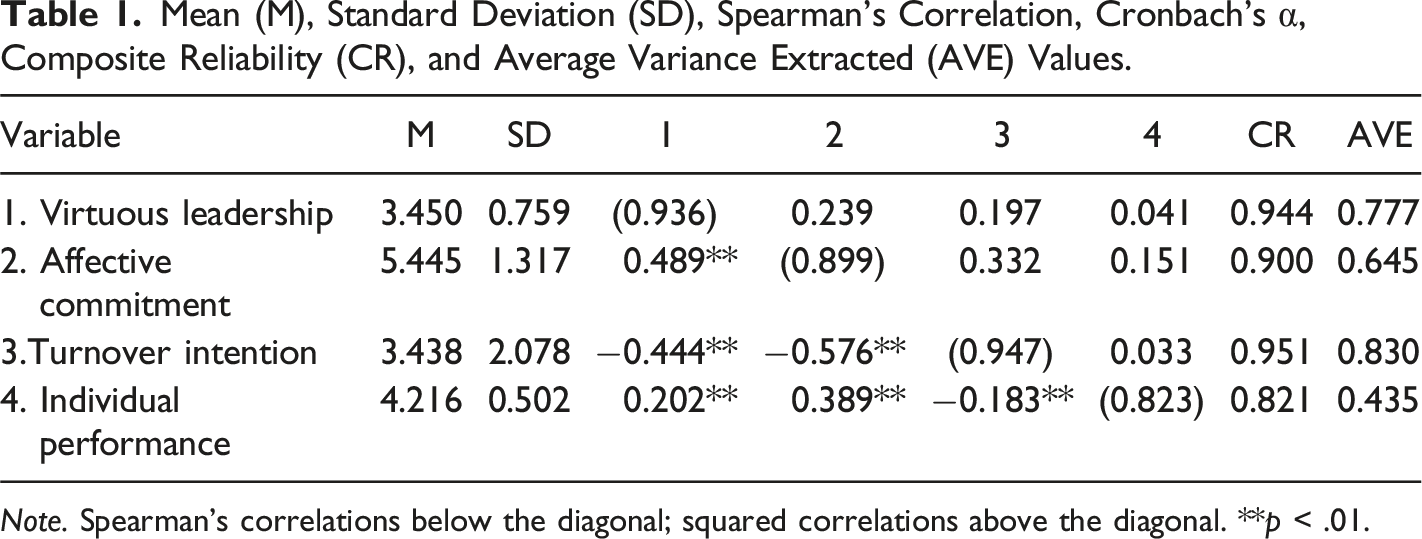
Note. Spearman’s correlations below the diagonal; squared correlations above the diagonal. **p < .01.
Last, the AVE values were contrasted with the squared correlations between all pairs of variables, as recommended by Fornell and Larcker (1981), in order to calculate discriminant validity (see Table 1 above). The results reveal that these estimates are higher than the shared variance between the variables, thus providing guarantee of the indicators’ discriminant validity. Based on these three analyses, the measures were considered to have acceptable reliability and validity, and CMV seems to have had no substantial impact on the outcomes.
Results
Descriptive Statistics and Correlations
The data were examined employing SPSS and AMOS software. Table 1 presents the means, SDs, and Spearman’s correlation coefficients between the main variables. Overall, the main variables’ relationships are statistically significant, creating low to moderate correlation coefficients.
The connections between the main constructs and the respondents’ socio-professional profile and their organizations’ characteristics were also analyzed. None of these variables were significantly correlated with turnover intention. Tenure in the leader-follower dyad and having a management position have a significant positive correlation with individual performance (both rho = 0.124; p < .05). This result suggests a minor tendency among those working for a longer time with their supervisor and those in a leadership position to self-assess their individual work performance as better. However, given the low correlation coefficient values (i.e., <.30; Cohen, 1988), these variables were left out of the hypotheses testing.
Hypotheses Testing
Structural Equation Modeling: Hypotheses Testing.
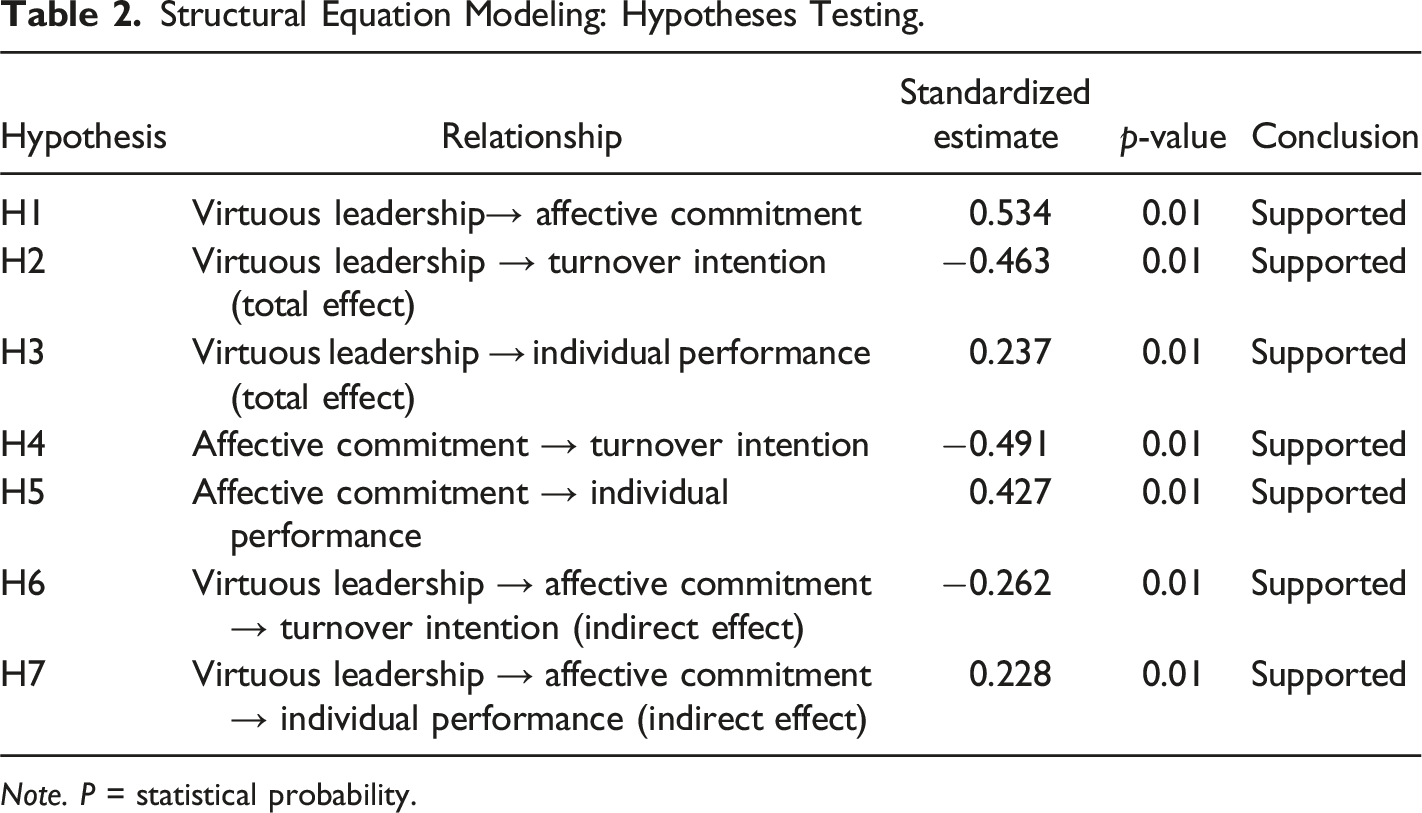
Note. P = statistical probability.
Perceived virtuous leadership also significantly influences employees’ turnover intention (β = −0.463; p < .01). The effect is negative, indicating that, the more leaders are seen as virtuous, the lower their subordinates’ turnover intention becomes—thereby supporting H2. As well, virtuous leadership has a statistically significant positive influence on individual performance (β = 0.237; p < .01), which implies that workers are more likely to report improved individual performance as their perception of virtuous leadership increases. H3 was thus also confirmed.
The results for H4 and H5 reveal that affective commitment has a significant effect on both turnover intention (β = −0.491; p < .01) and individual performance (β = 0.427; p < .01). Affective commitment evidently helps decrease employees’ desire to leave their company and concurrently contributes to their improved performance.
The analysis further confirmed that virtuous leadership has an indirect effect through affective commitment’s impacts on turnover intention (β = −0.262; p < .01) and individual performance (β = 0.228; p < .01), so these mediation effects confirm H6 and H7, respectively. This leadership style, however, has no statistically significant influence on individual performance when affective commitment is integrated in the model (i.e., direct effect) (β = 0.009; not statistically significant). Virtuous leadership’s direct effect on turnover intention remains statistically significant (β = −0.201; p < .01) in the same model.
These findings provide support for affective commitment’s partial mediation of this leadership style and turnover intention’s relationship and a complete mediation of virtuous leadership and individual performance’s relationship. Stronger perceptions of this type of leadership (i.e., leaders’ behavior guided by prudence, courage, justice, humanity, and temperance) seem to improve workers’ affective commitment to their organization. This effect, in turn, diminishes their intention to abandon their organization and enhances their individual performance at work (see Figure 1). Overall, the model explains 39% of turnover intention’s unique variance and 19% of individual performance’s variance. Structural equation modeling for predicting turnover intention and individual performance (standardized path coefficients). Note. n.s. = not statistically significant. **p < .01.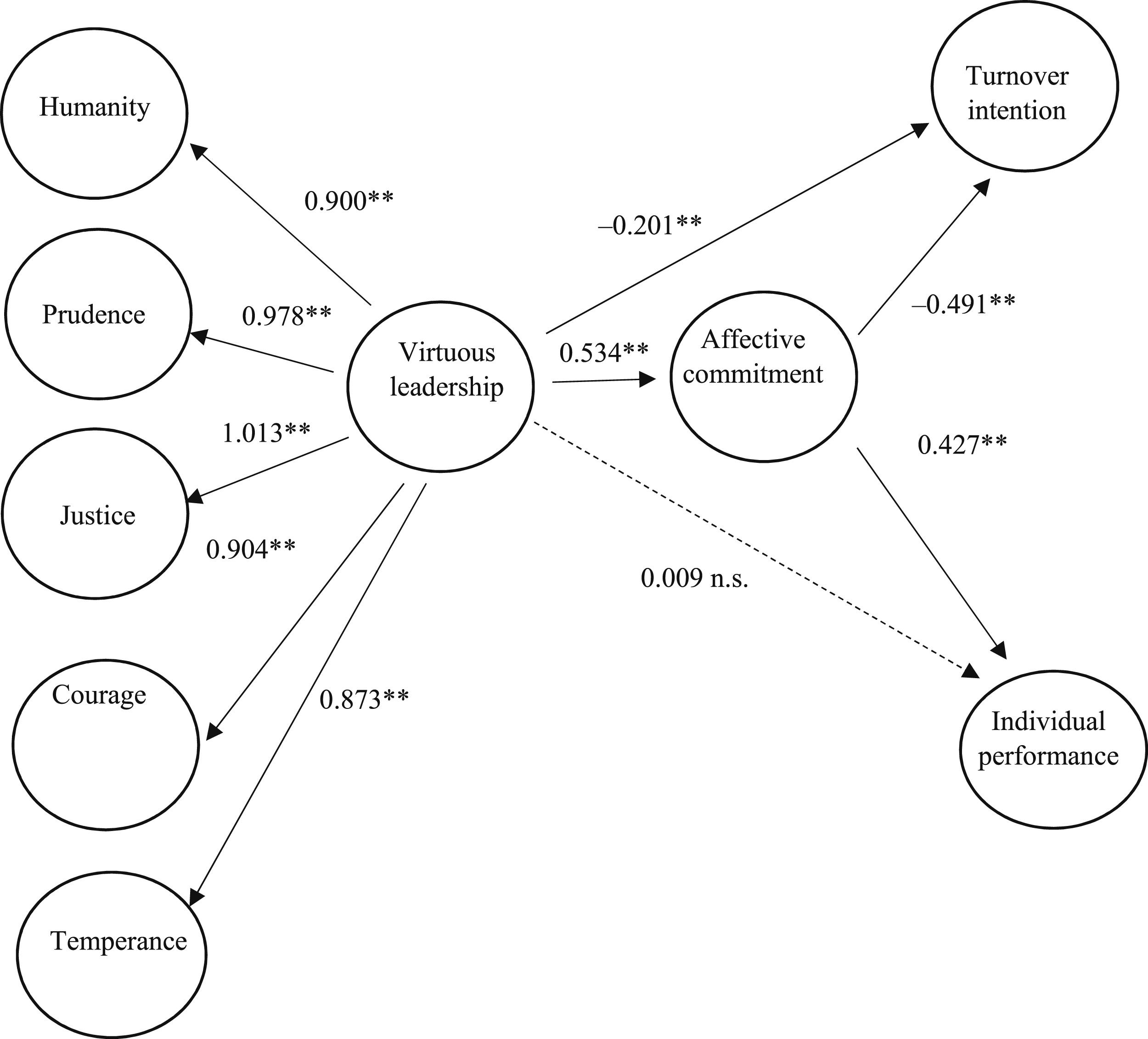
Discussion
This study focused on virtuous leadership’s impacts on employees’ job-related attitudes and behaviors, more specifically, on affective commitment, turnover intention, and individual performance. This research, in particular, analyzed affective commitment’s mediating role to understand more fully how virtuous leaders can diminish followers’ turnover intention while improving their work performance. Organizational virtuousness has regained an honorable place in contemporary management and organizational behavior theory (Alshehri & Elsaied, 2022; Alzola, 2015; Arjoon et al., 2018; Bright et al., 2014; Nassif et al., 2021; Newstead et al., 2018), but few empirical studies have sought to understand how virtuous leadership affects organizational members’ workplace mindset and conduct. The present research expanded on previous efforts to fill this gap in the literature (Alshehri & Elsaied, 2022; Hendriks et al., 2020), producing results that offer more empirically robust evidence of affective commitment as a mediating variable linking virtuous leaders to their followers’ improved performance and lower turnover intention.
The findings reveal that virtuous leadership’s predictive power regarding affective commitment is strong since individual employees who perceive their supervisors as virtuous also report more affective commitment to their company. This correlation may be due to these workers’ closer identification with leaders who are prudent, just, tempered, courageous, and humane, and humane or to these employees’ stronger involvement with their supervisors and feeling that their interactions are valuable. These results converge with the evidence provided by prior research that has applied social exchange theory, which postulates that individuals tend to act reciprocally with greater affective commitment in response to positive leadership practices (Duarte et al., 2021; Ribeiro et al., 2018, 2020; Semedo et al., 2018).
This research’s findings based on the available data also point to virtuous leadership’s positive role in turnover intention. The findings are in line with what has been reported previously about, for example, authentic leadership (Ribeiro et al., 2020). Based on the current research, virtuous leaders’ relationships with followers and the positive, respectful, and supportive work environments they create together are an successful way to retain talent employees by developing virtuous relationships. When their supervisors show courage, temperance, justice, prudence, and humanity, workers feel they should act reciprocally, so they become more committed to their work, devote greater effort to achieving their organization’s objectives, and feel less inclined to leave their job.
Virtuous leadership has a weaker explanatory power regarding followers’ individual performance, but this leadership style can predict employees’ improved performance. These findings are aligned with extant research which suggests that other forms of positive leadership, namely, transformational and authentic, generate better individual performance (Duarte et al., 2021; Ribeiro et al., 2018). Leaders’ virtuous conduct thus fosters more positive attitudes, behaviors, and emotions in their followers. For instance, individual workers become more creative, vigorous, resilient, and proactive, as well as becoming better at establishing fruitful social relationships to solve problems (Hendriks et al., 2020). One outcome of this behavior can be improved individual performance and, ultimately, organizational performance.
The present results also show that virtuous leadership is associated with significantly reduced turnover intention and that this relationship is partially mediated by affective commitment. These findings indicate that courageous, fair, humane, and prudent (i.e., virtuous) leaders contribute to strengthening their employees’ feelings of belonging to—and identification and affective connection with—their organization. These emotions, in turn, reduce workers’ intention to abandon their company (DiPietro et al., 2019; Jang & Kandampully, 2018; Ouerdian et al., 2021; Ribeiro et al., 2020).
Affective commitment has a similar mediating effect on the relationship between virtuous leaders and their followers’ individual performance. These supervisors promote their employees’ affective commitment to their organization, after which they reciprocally respond with better performance. Virtuous leadership, therefore, helps workers develop emotional bonds that impel them to fulfil the functions assigned to them with greater zeal and professionalism (Casimir et al., 2014; Duarte et al., 2021; Leroy et al., 2012; Meyer et al., 2002; Rego et al., 2007; Ribeiro et al., 2018).
Contributions and Limitations
Limitations and Suggestions for Future Studies
The present study had various limitations that can offer a starting point for future investigations. First, the convenience sample of respondents surveyed may fall short of representativeness. Further research needs to be based on samples with more controlled characteristics and could test whether, for example, the current empirical results can be replicated in other cultures and/or the findings vary according to companies’ sector of activity.
Second, CMV’s risks should not be overlooked as data gathered at the same time and from a single source can constitute a problem. An alternative would be to obtain data at separate times and/or use a dual-source approach. Third, given the correlational research design adopted, the causal nexus discussed above remain theoretical because the data collected cannot support any firm conclusions regarding causal effects amongst the model’s variables. Longitudinal studies could help overcome this limitation in the future.
Third, individual performance was self-reported without controlling for potential bias in self-assessment. Future research can consider including social desirability measures or soliciting the assessment from other source (e.g., direct supervisor and/or co-workers) to prevent self-serving bias in self-reporting.
Last, the proposed research model was parsimonious, and only affective commitment was tested as a mediating variable. Other mediators can be considered in additional investigations, such as psychological contract fulfilment, perceived leadership support, or positive emotions and/or psychological capital. An equally pertinent approach would be to explore the degree to which various employees’ characteristics moderate the relationships between virtuous leadership and criterion variables (e.g., moral identity).
Despite these limitations, the present empirical research’s findings enrich the literature on positive organizational studies. The foundations are laid for future studies of the current investigation’s implicit premise. That is, virtuous leadership facilitates the reconciliation of organizational health with individuals’ physical and psychological well-being.
Theoretical and Practical Contributions
This study underscores the vital impact of virtuous leadership in boosting employees’ affective commitment and performance, while also reducing turnover intention, positioning this leadership style as a key predictor of these outcomes. Additionally, it broadens the understanding of how virtuous leaders influence their followers’ attitudes and behaviors and the mediation mechanism that strengthens this effect. No studies have yet investigated this mediating role in the context of virtuous leadership.
The above results contribute to the extant literature in various aspects. First, the findings emphasize virtuous leadership’s significant role in promoting workers’ affective commitment and individual performance and reducing their turnover intention, which makes this leadership style an important predictor of these attitudes and behaviors. The findings also increase the existing knowledge about virtuous leaders’ influence on their followers’ mindset and the mechanisms that strengthen them (Alshehri & Elsaied, 2022; Hendriks et al., 2020).
Second, prior studies have highlighted affective commitment’s mediating role in the relationship between different types of leadership (e.g., authentic) and workers’ performance (Ribeiro et al., 2018) and turnover intention (Ribeiro et al., 2020). However, no researchers have investigated affective commitment’s mediating role in the relationship between virtuous leadership and individual performance and/or virtuous leadership and turnover intention. A careful review of the relevant literature revealed that no prior researchers have focused on these variables’ interconnections.
From a practical perspective, this research’s findings could benefit leaders at different organizational levels because the results offer insights into how virtuous leadership increases workers’ affective commitment and performance and decreases their turnover intention. Training, coaching, or mentoring programs can be implemented to help managers to understand their own strengths and weaknesses and recognize how courage, temperance, justice, prudence, and humanity might affect their workers. The present findings also highlight how virtuousness in organizational settings has a significant impact on individuals’ attitudes and behaviors in the workplace. In a world in which virtues seem to be fading, this effect should call leaders’ attention to how being virtuous is crucial to their organization’s success.
Footnotes
Declaration of Conflicting Interests
The author(s) declared no potential conflicts of interest with respect to the research, authorship, and/or publication of this article.
Funding
The author(s) disclosed receipt of the following financial support for the research, authorship, and/or publication of this article: This work was supported by the Fundação para a Ciência e Tecnologia, Portugal, under the auspices of the Business Research Unit Grant (UIDB\00315\2020) and contract DL57/2016/CP1359/CT0004 and of the Center for Applied Research in Management Grant (UIDB/04928/2020).

Data Availability Statement
The data that support the findings of this study are available from the corresponding author, upon reasonable request.