




Abstract
Previous research into two forms of perfectionism known as perfectionistic concerns and perfectionistic strivings suggests that while perfectionistic concerns are associated with lower levels of self-esteem, perfectionistic strivings are associated with higher levels of self-esteem. However, the factors that explain why these two forms of perfectionism differ in their relationships to self-esteem remain unclear. The present research—involving two studies—used a self-determination theory perspective to investigate the possibility that three basic psychological needs for competence, autonomy, and relatedness explain the relationships between the two forms of perfectionism and self-esteem. In Study 1 (N = 255) perfectionistic strivings were associated with higher levels of needs satisfaction and lower levels of needs frustration, while perfectionistic concerns were associated with lower levels of needs satisfaction and higher levels of needs frustration. In Study 2 (N = 260) needs satisfaction mediated the positive association between perfectionistic strivings and self-esteem, and needs frustration mediated the negative association between perfectionistic concerns and self-esteem. Taken together, these findings suggest that the basic psychological needs for competence, autonomy, and relatedness play an important role in explaining why some forms of perfectionism are beneficial to self-esteem and some forms of perfectionism are harmful to self-esteem.
Introduction
Self-esteem refers to the self-evaluations and self-representations of one’s worth and value as an individual (Rosenberg, 1965). High self-esteem is characterised by positive self-representations and a sense that one is worthy and likeable, whereas low self-esteem is characterised by negative self-representations and an unfavourable view of the self (Baumeister et al., 2003). Self-esteem is an important component of psychological functioning (Baumeister et al., 2003; Zeigler-Hill, 2013), with high self-esteem having been linked to well-being, relationship satisfaction, job satisfaction, and physical health (Orth et al., 2012; Paradise & Kernis, 2002); and low self-esteem having been linked to a variety of maladaptive outcomes, such as eating disorders (Krauss et al., 2023), depression, and anxiety (Sowislo & Orth, 2013). Given this link to healthy psychological functioning, it is important to identify the factors and processes that influence self-esteem.
One such process is the tendency for individuals to protect their self-esteem when it is threatened (Pyszczynski et al., 2004). This protective reaction to perceived threats has been linked with defence mechanisms and compensatory behaviours such as rationalisation, passive aggression, dissociation, and denial (Zeigler-Hill et al., 2008). In response to perceived threats, individuals can also become dependent upon achieving external contingencies to enhance their self-esteem, including contingencies linked to one’s appearance, the approval of others, perceived personal competencies, and achievement (Buckingham et al., 2019; Crocker, 2002; Crocker & Wolfe, 2001).
Perfectionism
One personality characteristic that has historically been closely linked with low self-esteem is perfectionism. According to Horney (1950), a perfectionist’s self-esteem is contingent upon the attainment of an unrealistic ideal (or perfect) self, and the inevitable failure to live up to this perfect self is harmful to self-esteem. Indeed, the dominant view among various authors in the mid to late 20th century was that elements of poor self-esteem—including a lack of self-worth, self-criticism, a gap between one’s ideal and actual selves, and a need for social approval combined with a fear of rejection—were both a consequence and the underlying cause of perfectionistic tendencies (Flett et al., 1991; Moroz & Dunkley, 2015; Sorotzkin, 1985). This conception of perfectionism is consistent with arguments about the nature and effects of contingent self-esteem, whereby a failure to meet certain contingencies, such as the unrealistic standards inherent to perfectionism, is harmful to one’s sense of self-worth (Crocker, 2002; Crocker & Park, 2004).
However, this view evolved in response to the more recent multidimensional model of perfectionism which argues that perfectionism is a more complex phenomenon involving several unique dimensions (Frost et al., 1990; Hewitt & Flett, 1991; Stoeber & Otto, 2006). Two of the most commonly studied perfectionism dimensions are referred to as perfectionistic concerns—which are characterised by pressure to meet the excessively high expectations of others, a preoccupation with personal failure, a fear of negative social evaluations, and negative reactions to imperfection—and perfectionistic strivings—which are characterised by an intrinsic desire for perfection combined with high personal standards and expectations of performance (Hewitt & Flett, 1991; Stoeber & Otto, 2006). While a significant proportion of research into the multidimensional model of perfectionism has involved Caucasian American samples (DiBartolo & Rendón, 2012), more recent research has validated the multidimensional model across different cultures (Smith et al., 2016) and nations (Sherry et al., 2016).
Research suggests that while perfectionistic concerns are associated with lower levels of self-esteem—which is consistent with the historical conception of perfectionism as being inextricably linked to poor self-worth and self-criticism—perfectionistic strivings are associated with higher levels of self-esteem (Ashby & Rice, 2002; Fekih-Romdhane et al., 2023; Khossousi et al., 2024; Moroz & Dunkley, 2015; Raudasoja et al., 2023; Sheveleva et al., 2023; Taylor et al., 2016). These findings challenge the historical view of perfectionism and its relationship with self-esteem, in that while some forms of perfectionism can be harmful to individuals’ self-esteem, other forms of perfectionism can be beneficial to individuals’ self-esteem.
However, there have been surprisingly few investigations into the mediating factors that might explain the distinct relationships between the two perfectionism dimensions and self-esteem. One of the few examples of research to address this question by Fearn et al. (2022) found that self-critical rumination along with metacognitions about self-critical rumination—including positive metacognitions (e.g., worry helps avoid future problems) and negative metacognitions (e.g., an inability to control one’s negative thoughts)—partially mediated the negative relationship between perfectionistic concerns and self-esteem. In addition, research by Park et al. (2010) found that maladaptive coping fully mediated the negative relationship between perfectionistic concerns and self-esteem, while Eusanio et al. (2014) found that shame fully mediated the relationship between perfectionistic concerns and poor self-concept. These studies provide some initial insights into the factors that explain why perfectionistic concerns are linked to lower self-esteem, though research in this area is somewhat limited, and crucially, the factors that explain why perfectionistic strivings are linked to higher self-esteem remain unclear.
Basic Psychological Needs
One possibility is that three basic psychological needs for competence, autonomy, and relatedness outlined by self-determination theory may play an important role in explaining the unique relationships between the two forms of perfectionism and self-esteem. According to self-determination theory, satisfaction of these three basic psychological needs underlies healthy psychological functioning in the form of growth, intrinsic motivation, and well-being (Deci & Ryan, 2000). Competence represents the need to experience a sense of efficacy in one’s actions and interactions with the environment; autonomy represents the need to experience a sense of personal volition and to behave congruently with one’s internalised standards, values, and beliefs; and relatedness involves the need to feel a sense of connection and belonging with other people (Ryan & Deci, 2002).
Ryan and Deci (2000a) explain that within self-determination theory, self-esteem is viewed as an indicator of healthy psychological functioning and that experiences of competence, autonomy, and relatedness satisfaction give rise to the experiences of self-worth and positive self-evaluations that characterise high self-esteem. In support of this, a range of previous studies have observed positive relationships between needs satisfaction and self-esteem and negative relationships between needs frustration and self-esteem (Butkovic et al., 2020; Erdvik et al., 2020; Erturan-Ilker, 2014; Evans & Liu, 2019; Garn et al., 2012; León & Núñez, 2013; Megías et al., 2018; Orsini et al., 2018; Reis et al., 2000; van Egmond et al., 2020; Vanhove-Meriaux et al., 2018, 2020; Woodman et al., 2020). Thus, from both a theoretical and empirical perspective, the three basic psychological needs for competence, autonomy, and relatedness appear to be linked to self-esteem: high self-esteem in the case of needs satisfaction, and low self-esteem in the case of needs frustration.
The basic psychological needs also appear to share unique links with perfectionistic strivings and perfectionistic concerns. In terms of perfectionistic concerns, studies have found evidence pointing to a negative relationship between perfectionistic concerns and needs satisfaction, and a positive relationship between perfectionistic concerns and needs frustration (Boone et al., 2014; Haraldsen et al., 2020; Mallinson & Hill, 2011). These findings suggest that perfectionistic concerns are associated with feelings of perceived incompetence, heteronomy, and unhealthy relationships with others. Furthermore, there are conceptual links between the characteristics that define perfectionistic concerns and psychological needs frustration which help to interpret these findings. For example, autonomy frustration may be associated with the extrinsic motives that drive perfectionistic concerns (Stoeber et al., 2018), competence frustration may be associated with the self-criticism and concern over mistakes that characterise perfectionistic concerns (Sorotzkin, 1985; Stoeber & Otto, 2006), and relatedness frustration may be associated with the preoccupation with social approval and a fear of rejection that characterises perfectionistic concerns (Dunkley et al., 2012; Stoeber & Otto, 2006).
Despite these conceptual and empirical links between perfectionistic concerns and basic psychological needs frustration, evidence is less clear in relation to perfectionistic strivings. While research by Jowett et al. (2016) found a positive relationship between perfectionistic strivings and needs satisfaction and a negative relationship between perfectionistic strivings and needs frustration, research by Haraldsen et al. (2020) found non-significant relationships between perfectionistic strivings and needs frustration, while Nordin-Bates (2020) found a non-significant relationship between perfectionistic strivings and needs satisfaction. Thus, it is not clear to what extent perfectionistic strivings are associated with satisfaction and frustration of the basic psychological needs.
However, perfectionistic strivings and perfectionistic concerns often coexist within individuals, meaning that it is possible to strive for perfection while simultaneously experiencing a fear of failure and negative reactions to imperfection (Gaudreau & Thompson, 2010; Stoeber & Gaudreau, 2017). Importantly, the positive relationships between perfectionistic strivings and adaptive outcomes often only appear when the overlap with perfectionistic concerns is controlled for statistically (Stoeber & Gaudreau, 2017; Stoeber & Otto, 2006). In the case of the basic psychological needs, while some studies controlled for the overlap between the two forms of perfectionism (e.g., Jowett et al., 2016) other studies did not (e.g., Nordin-Bates, 2020) and this might explain the inconsistent findings observed in terms of the relationship between perfectionistic strivings and needs satisfaction. Nonetheless, given that perfectionistic strivings are generally considered to be a more intrinsically motivated form of perfectionism (Jowett et al., 2013; Stoeber et al., 2018), and that intrinsic motivation is associated with basic psychological needs satisfaction (Deci & Ryan, 2000; Ryan & Deci, 2000a), it is reasonable to suggest that perfectionistic strivings would be more strongly associated with basic psychological needs satisfaction. Furthermore, research has found links between perfectionistic strivings and both greater self-efficacy (Stoeber et al., 2008) and positive interpersonal relationships (Gilman et al., 2011). Taken together, these findings suggest that perfectionistic strivings may be linked with a greater sense of confidence (competence satisfaction) and freedom (autonomy satisfaction) in one’s actions combined with healthier personal relationships (relatedness satisfaction).
The Present Research
The basic psychological needs are unique in the sense that, according to self-determination theory, they are culturally ubiquitous and “innate, essential, and universal” (Ryan & Deci, 2000b, p. 74) nutriments underlying healthy psychological functioning, including self-esteem (Ryan & Deci, 2000a). This implies that the basic psychological needs may be foundational and essential factors that explain why some forms of perfectionism are harmful to self-esteem (via needs frustration) while others are beneficial to self-esteem (via needs satisfaction).
Against this background, the present research involved two studies with several key aims. Study 1 aimed to explore the relationships between the two forms of perfectionism (perfectionistic strivings and perfectionistic concerns) and satisfaction and frustration of the three basic psychological needs (competence, autonomy, and relatedness). It was predicted that perfectionistic strivings would be associated with higher levels of needs satisfaction and lower levels of needs frustration. Conversely, it was predicted that perfectionistic concerns would be associated with lower levels of needs satisfaction and higher levels of needs frustration. Study 2 involved two primary aims. Firstly, Study 2 aimed to re-examine the relationships between perfectionism and self-esteem, where it was predicted that perfectionistic strivings would be associated with higher levels of self-esteem and perfectionistic concerns with lower levels of self-esteem. Secondly, Study 2 aimed to explore the extent to which satisfaction and frustration of the basic psychological needs mediate the relationships between the two forms of perfectionism and self-esteem (see Figure 1). Proposed mediation model involving perfectionism, basic psychological needs, and self-esteem.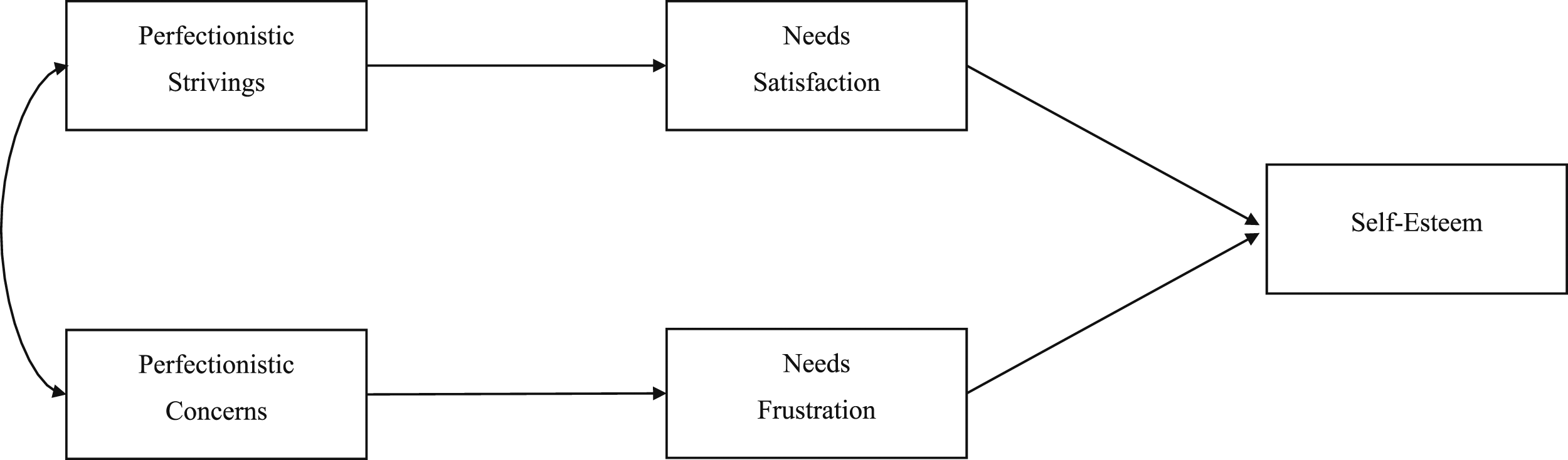
Study 1: Method
Participants
A sample of 255 participants (41 male, 214 female) aged between 17–39 years (M = 19.6; SD = 2.1) was recruited through the School of Psychology Research Participation Scheme at the University of Kent. The research participation scheme is an internal School of Psychology platform that allows researchers to advertise and recruit student participants for their studies. The scheme offers credit points as an incentive for taking part. Once students have obtained a certain number of credit points, they are able to advertise their own studies and recruit participants using the scheme. Since access to the research participation scheme is limited to School of Psychology students, the sample for the present study was comprised solely of psychology students.
Measures
Perfectionism
The present study adopted three of the most widely used perfectionism measures to capture perfectionistic strivings and perfectionistic concerns: the Frost Multidimensional Perfectionism Scale (Frost et al., 1990), the Hewitt-Flett Multidimensional Perfectionism Scale (Hewitt & Flett, 1991), and the Revised Almost Perfect Scale (Slaney et al., 2001). Each of these measures include subscales that can be used as indicators (or proxies) of perfectionistic strivings or perfectionistic concerns (Stoeber, 2018a).
Three indicators were used to capture perfectionistic strivings—namely, pure personal standards, self-oriented perfectionism, and high standards. Pure personal standards (5 items; e.g., “I have extremely high goals”) were measured on a 1 (strongly disagree) to 5 (strongly agree) scale using the Cox et al. (2002) short form of the Frost Multidimensional Perfectionism Scale (Frost et al., 1990; see also DiBartolo et al., 2004). Self-oriented perfectionism (5 items; e.g., “I set very high standards for myself”) was measured on a 1 (disagree) to 7 (agree) scale also using the Cox et al. (2002) short form of the Hewitt and Flett Multidimensional Perfectionism Scale (Hewitt et al., 1991). High standards (4 items; e.g., “I expect the best from myself”) were measured on a 1 (strongly disagree) to 7 (strongly agree) scale using the Rice et al. (2014) short form of the Revised Almost Perfect Scale (Slaney et al., 2001).
Three indicators were used to capture perfectionistic concerns—namely, concern over mistakes, socially-prescribed perfectionism and discrepancy. Concern over mistakes (5 items; e.g., “If I fail partly, it is as bad as being a complete failure”) was measured on a 1 (disagree) to 5 (agree) scale using the Cox et al. (2002) short form of the Frost Multidimensional Perfectionism Scale (Frost et al., 1990). Socially-prescribed perfectionism (5 items; e.g., “My family expects me to be perfect”) was measured on a 1 (disagree) to 7 (agree) scale using the Cox et al. (2002) short form of the Hewitt and Flett Multidimensional Perfectionism Scale (Hewitt et al., 1991). Discrepancy (4 items; e.g., “Doing my best never seems to be enough”) was measured on a 1 (strongly disagree) to 7 (strongly agree) scale using the Rice et al. (2014) short form of the Revised Almost Perfect Scale (Slaney et al., 2001).
Basic Psychological Needs
The Basic Psychological Need Satisfaction and Frustration Scale (Chen et al., 2015) was used to measure basic psychological needs satisfaction and frustration, including competence satisfaction (4 items; e.g., “I feel confident that I can do things well”), competence frustration (4 items; e.g., “I feel disappointed with many of my performances”), autonomy satisfaction (4 items; e.g., “I feel that my decisions reflect what I really want”), autonomy frustration (4 items; e.g., “I feel pressured to do too many things”), relatedness satisfaction (4 items; e.g., “I experience a warm feeling with the people I spend time with”) and relatedness frustration (4 items; e.g., “I feel the relationships I have are just superficial”). All items were measured on a 1 (not true at all) to 7 (completely true) scale.
Procedure
The study was described as an investigation into the relationship between perfectionistic attitudes and experiences of well-being. Participants were directed to Qualtrics® where they were provided with details of the study topic, aims, and withdrawal procedure. Participants who provided informed consent to take part were then asked to complete the measures for the study. To prevent order effects, the presentation order of the measures was counterbalanced and the order of the questions within each measure was randomised. After completing all of the measures, participants were presented with a debrief which included further information regarding the study aims and background. Participants were also awarded two course credits upon successful completion of all measures.
Ethics
This research adhered to the ethical guidelines of the British Psychological Society and received ethical approval from the University of Kent Research Ethics Committee. Informed consent was obtained from all participants.
Preliminary Analyses
Analytic Strategy
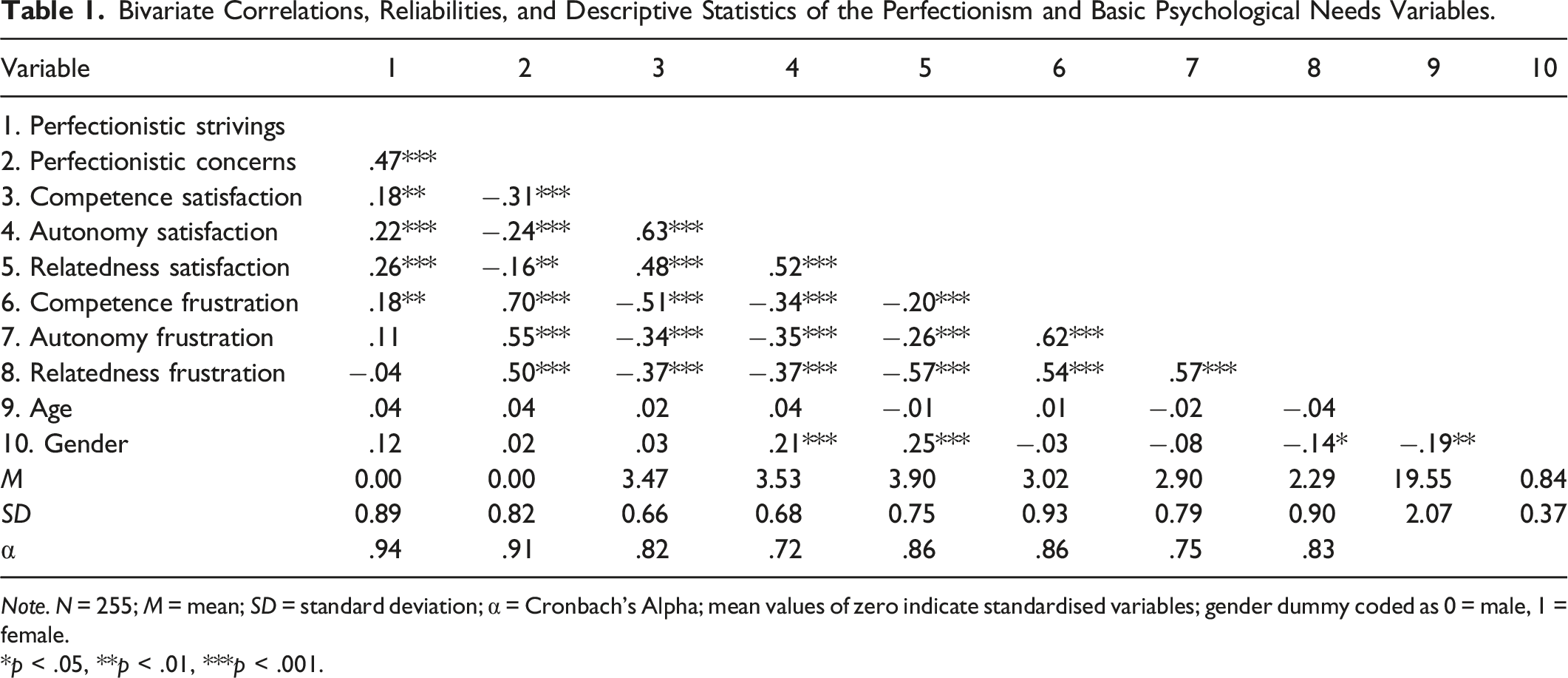
Bivariate Correlations, Reliabilities, and Descriptive Statistics of the Perfectionism and Basic Psychological Needs Variables.
Note. N = 255; M = mean; SD = standard deviation; α = Cronbach’s Alpha; mean values of zero indicate standardised variables; gender dummy coded as 0 = male, 1 = female.
*p < .05, **p < .01, ***p < .001.
Data Screening
Firstly, univariate outliers were tested for by calculating z-scores for each of the variables. Cases with z-scores equivalent to three or more standard deviations (z ≥ 3.29) were classed as univariate outliers (Tabachnick & Fidell, 2013, p. 107). Three outliers were identified on the competence satisfaction variable and one outlier was identified on the relatedness satisfaction variable. These outliers were coded as missing data.
Secondly, Mahalanobis distances were calculated to detect multivariate outliers which are extreme combinations of scores across two or more variables (Tabachnick & Fidell, 2013, p. 106). There were no cases that exceeded the critical value of χ2(8) = 26.13, p < .001.
Results
Bivariate Correlations
The results of the bivariate correlation analysis are displayed in Table 1. There were significant small positive correlations between perfectionistic strivings and each of the basic psychological needs satisfaction variables. Furthermore, there was a significant small positive correlation between perfectionistic strivings and competence frustration, but non-significant correlations between perfectionistic strivings and both autonomy frustration and relatedness frustration. There was a significant medium negative correlation between perfectionistic concerns and competence satisfaction, and significant small negative correlations between perfectionistic concerns and autonomy satisfaction and relatedness satisfaction. Finally, there were significant large positive correlations between perfectionistic concerns and each of the basic psychological needs frustration variables.
Regression Analyses
Since there was a medium correlation between perfectionistic strivings and perfectionistic concerns, the variance inflation factor (VIF) was calculated to check for the presence of multicollinearity for the two predictors. The VIF was 1.31 which indicated that multicollinearity was not an issue since this did not exceed the critical value of 10 (Shrestha, 2020).
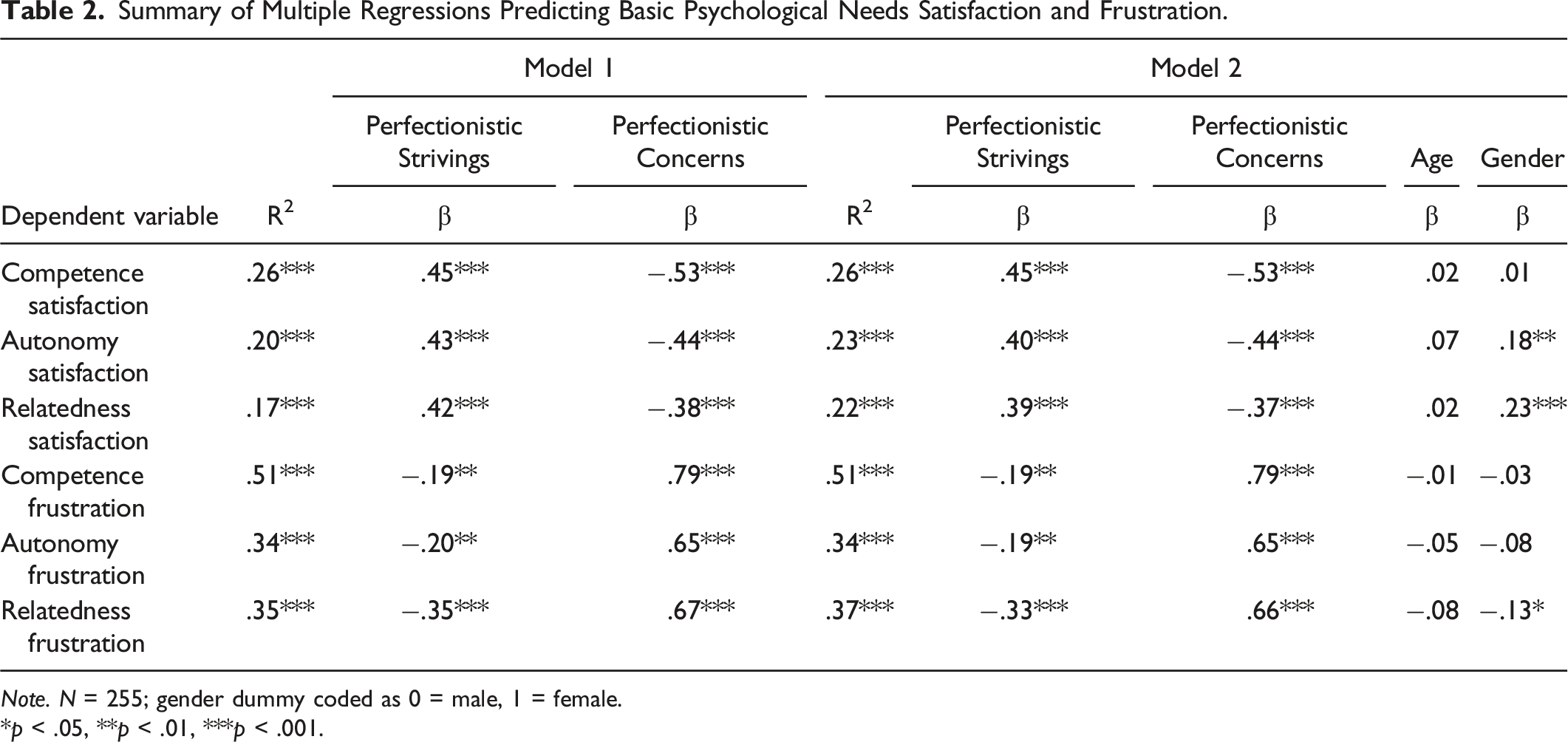
Summary of Multiple Regressions Predicting Basic Psychological Needs Satisfaction and Frustration.
Note. N = 255; gender dummy coded as 0 = male, 1 = female.
*p < .05, **p < .01, ***p < .001.
In Model 2, gender and age were added as control variables alongside the predictors perfectionistic strivings and perfectionistic concerns, the results of which are also displayed in Table 2. There were no meaningful changes to the direction, strength, or significance of the relationships between the two forms of perfectionism and the competence, autonomy, and relatedness satisfaction and frustration variables.
Brief Discussion
As predicted, perfectionistic concerns were associated with lower levels of needs satisfaction and higher levels of needs frustration, while perfectionistic strivings were associated with higher levels of needs satisfaction and lower levels of needs frustration. Furthermore, there were no meaningful differences observed in terms of the relationships between the two dimensions of perfectionism and each of the respective needs satisfaction and frustration variables, which suggests that perfectionistic strivings and perfectionistic concerns are not associated more strongly with either competence, autonomy, or relatedness.
Study 2: Method
Participants
An initial sample of 321 participants (171 male, 147 female, 3 missing) aged between 18-71 years (M = 32.1; SD = 11.4) was recruited through the University of Lincoln SONA system and Amazon Mechanical Turk (MTurk). Similar to the research participation scheme outlined in Study 1, the SONA system allows researchers to advertise and recruit student participants for their studies. Students are also able to recruit participants for their own studies once they obtain a certain number of credit points. Amazon MTurk is an online platform that allows researchers the opportunity to recruit participants for their studies by offering a small payment as an incentive.
Measures
Perfectionism
The same measures as those outlined in Study 1 were used to capture the indicators of perfectionistic strivings (pure personal standards, self-oriented perfectionism and high standards) and the indicators of perfectionistic concerns (concern over mistakes, socially-prescribed perfectionism and discrepancy).
Basic Psychological Needs
The Basic Psychological Need Satisfaction and Frustration Scale (Chen et al., 2015) was again used to measure satisfaction and frustration of the basic psychological needs for competence, autonomy and relatedness.
Self-Esteem
Self-esteem was captured using the Rosenberg Self-Esteem Scale (Rosenberg, 1965). Participants were asked to respond to 10 items—five positively worded items (e.g., “I take a positive attitude toward myself”) and five negatively worded items (e.g., “At times I think I am no good at all”)—on a 1 (strongly disagree) to 4 (strongly agree) scale.
Procedure
The study was described as an investigation into the relationship between perfectionism and self-esteem. Participants were directed to Qualtrics® where they were provided with details of the study topic, aims, and withdrawal procedure. Participants who provided informed consent to take part were then asked to complete each of the measures. As in Study 1, the presentation order of the measures was counterbalanced and the question order within each measure was randomised to prevent any order effects. Participants were presented with a debrief at the end of the study which summarised the study aims and provided additional information and resources about the research topic. Participants who completed the study were awarded £0.25 if recruited through MTurk or two research credit points if recruited through the SONA system.
Ethics
This research adhered to the ethical guidelines of the British Psychological Society and received ethical approval from the School of Psychology Research Ethics Committee at the University of Lincoln. Informed consent was obtained from all participants.
Analytic Strategy
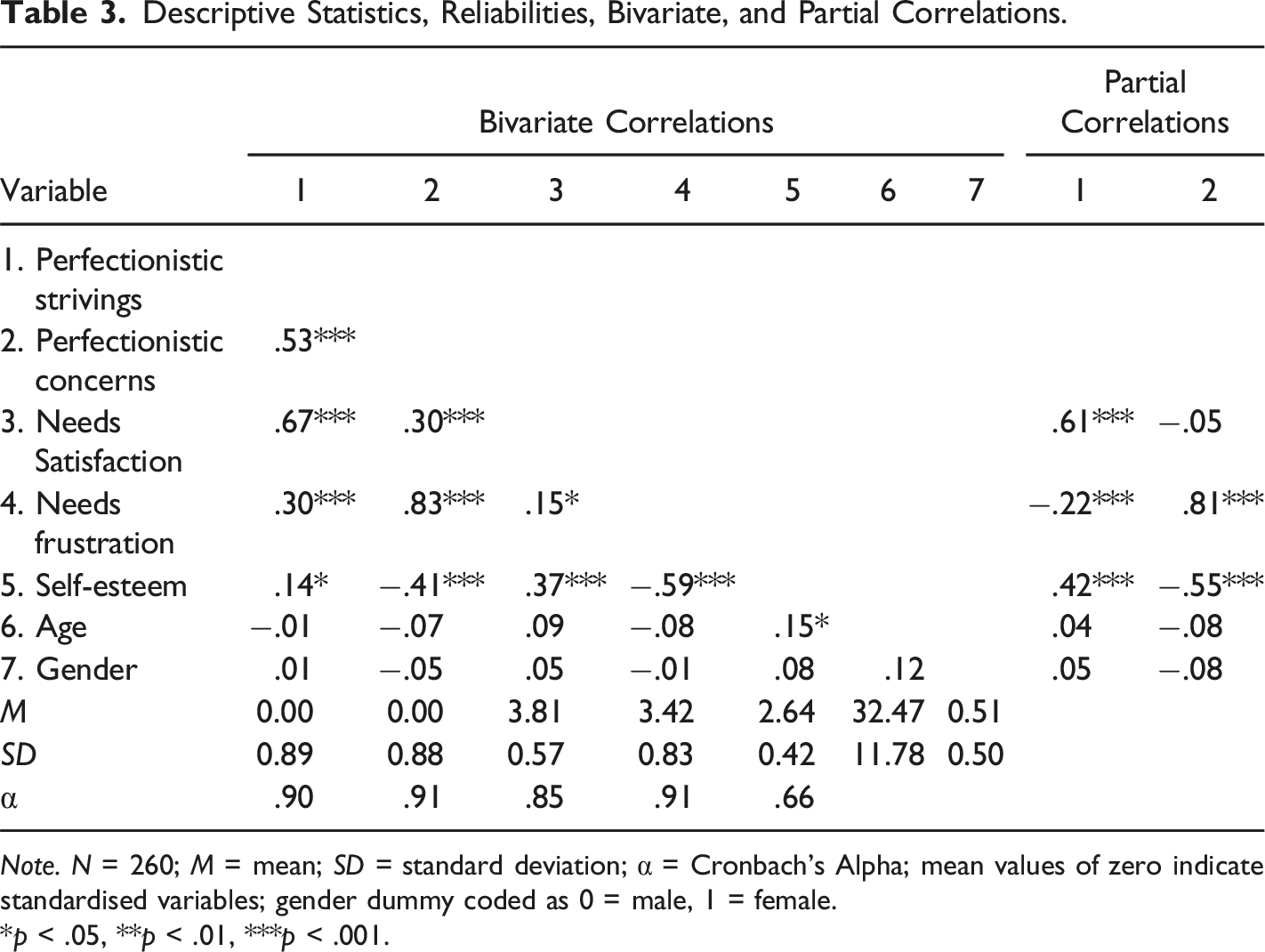
Descriptive Statistics, Reliabilities, Bivariate, and Partial Correlations.
Note. N = 260; M = mean; SD = standard deviation; α = Cronbach’s Alpha; mean values of zero indicate standardised variables; gender dummy coded as 0 = male, 1 = female.
*p < .05, **p < .01, ***p < .001.
Data Screening
Poor data quality as a result of inattentive or careless responses is a concern for researchers who make use of online participant recruitment platforms such as MTurk (Curran, 2016). As such, three attention check questions were included in the survey to identify inattentive responses (e.g., “It is important that you try to pay attention to the questions in this study. Please select ‘4’”). Fifty-six participants failed at least one of the three attention check questions and were subsequently excluded from the final analysis. As in Study 1, cases with z-scores equivalent to three or more standard deviations (z ≥ 3.29) were classed as univariate outliers (Tabachnick & Fidell, 2013, p. 107). Three outliers were identified: one case on the perfectionistic strivings variable, one case on the perfectionistic concerns variable, and one case on the needs satisfaction variable. These cases were coded as missing data. Mahalanobis distances were then calculated to detect multivariate outliers. Five cases exceeded the critical value of χ2(5) = 20.515, p < .001. These cases were excluded from the main analysis, leaving a final sample of 260 participants (132 male, 128 female) aged between 18-71 years (M = 32.5; SD = 11.8).
Results
Bivariate Correlations
The bivariate correlations between all variables are displayed in Table 3. In terms of perfectionistic strivings, there was a significant large positive correlation between perfectionistic strivings and needs satisfaction, a significant medium positive correlation between perfectionistic strivings and needs frustration, and a significant small positive correlation between perfectionistic strivings and self-esteem. In terms of perfectionistic concerns, there was a significant medium positive correlation between perfectionistic concerns and needs satisfaction, a significant large positive correlation between perfectionistic concerns and needs frustration, and a significant medium negative correlation between perfectionistic concerns and self-esteem.
Partial Correlations
The results of the partial correlations are displayed in Table 3. In terms of perfectionistic strivings, the significant large positive correlation between perfectionistic strivings and needs satisfaction remained unchanged, while the significant medium positive correlation between perfectionistic strivings and needs frustration changed to a significant small negative correlation. Furthermore, the significant small positive correlation between perfectionistic strivings and self-esteem increased in size to a significant medium positive correlation. In terms of perfectionistic concerns, the significant medium positive correlation between perfectionistic concerns and needs satisfaction became non-significant, while the significant large positive correlation between perfectionistic concerns and needs frustration remained unchanged. Finally, the significant medium negative correlation between perfectionistic concerns and self-esteem increased in size to a significant large negative correlation.
Mediation Analyses
As there were substantial correlations between perfectionistic strivings, perfectionistic concerns, needs satisfaction, and needs frustration, VIFs were calculated to check for the presence of multicollinearity. All variables showed VIFs < 3.96 which indicated that multicollinearity was not an issue since these values did not exceed the critical value of 10 (Shrestha, 2020).
Figure 2 displays the results from the mediation analysis. There was a significant medium positive relationship between needs satisfaction and self-esteem, and a significant large negative relationship between needs frustration and self-esteem. There was a significant large positive relationship between perfectionistic strivings and needs satisfaction, and a significant large positive relationship between perfectionistic concerns and needs frustration. Finally, needs satisfaction fully mediated the relationship between perfectionistic strivings and self-esteem with an indirect effect of .30 [.19, .41], p < .001 while needs frustration fully mediated the relationship between perfectionistic concerns and self-esteem with an indirect effect of −.52 [−.69, −.35], p < .001. Mediation model showing only significant paths. Note. N = 260. Brackets contain CI = 95% confidence intervals of β [lower limit, upper limit]; standardized coefficients (STDYX estimates); age and gender were included in the mediation model as predictors of needs satisfaction, needs frustration, and self-esteem, but these paths were all non-significant; the direct effects from perfectionistic strivings to self-esteem (β = .06 [−.21, .24], p = .40) and perfectionistic concerns to self-esteem (β-.05 [−.29, .19], p = .57) were non-significant. *p < .05, **p < .01, ***p < .001.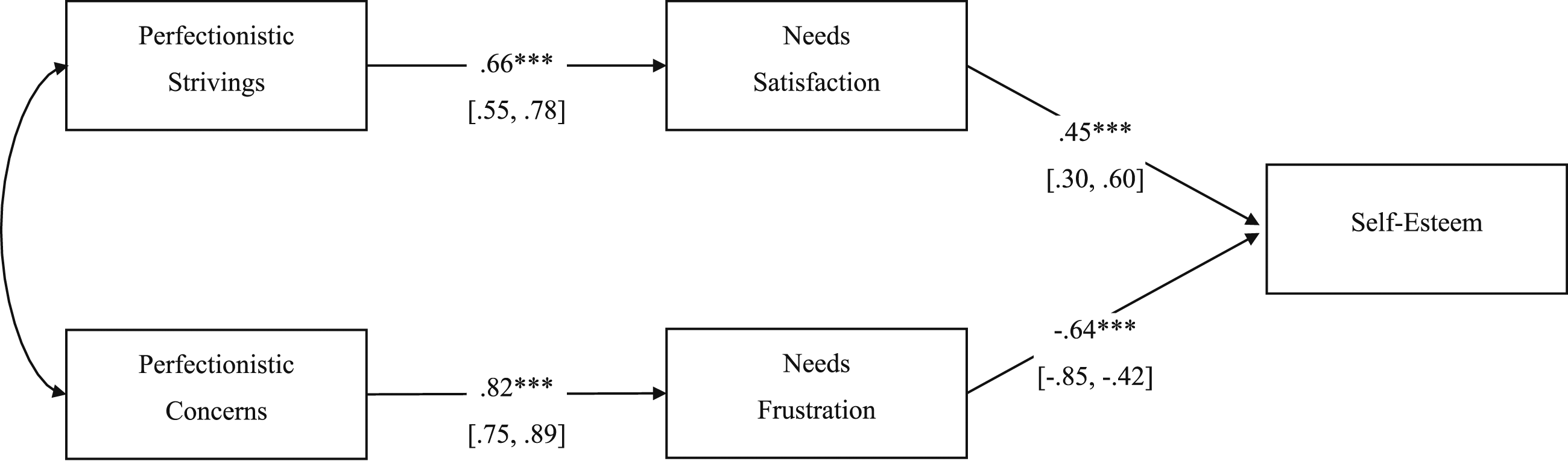
Brief Discussion
As predicted, perfectionistic strivings were associated with higher levels of self-esteem, and perfectionistic concerns were associated with lower levels of self-esteem. Furthermore, basic psychological needs satisfaction was found to fully mediate the positive relationship between perfectionistic strivings and self-esteem, while basic psychological needs frustration was found to fully mediate the negative relationship between perfectionistic concerns and self-esteem. These findings build upon evidence from previous research by highlighting the role of the basic psychological needs proposed by self-determination theory in explaining why perfectionistic concerns are associated with low self-esteem (via needs frustration) and why perfectionistic strivings are associated with high self-esteem (via needs satisfaction).
General Discussion
Historically, perfectionism was viewed as a maladaptive aspect of human psychology associated with low self-esteem. This view evolved with the more recent emergence of the multidimensional model of perfectionism, which proposed that certain forms of perfectionism may be beneficial rather than harmful to self-esteem. However, while previous studies have enhanced our understanding of how the different forms of perfectionism relate to self-esteem, the factors and mechanisms that explain these relationships remain unclear. To address this issue, the present research applied a self-determination theory perspective to explore the extent to which the three basic psychological needs for competence, autonomy, and relatedness mediate the relationships between perfectionism and self-esteem.
Perfectionism and Self-Esteem
As expected, and consistent with the trends observed in previous studies (Ashby & Rice, 2002; Fekih-Romdhane et al., 2023; Khossousi et al., 2024; Moroz & Dunkley, 2015; Raudasoja et al., 2023; Sheveleva et al., 2023; Taylor et al., 2016), perfectionistic concerns were linked with lower levels of self-esteem while perfectionistic strivings were linked with higher levels of self-esteem. These findings suggest that the qualities and priorities inherent to perfectionistic concerns—which include an extrinsically motivated desire to meet the high standards and expectations of others, self-criticism, and a fear of failure and negative social evaluations—are associated with a lack of self-worth and a negative evaluation of one’s inherent value. Conversely, these findings suggest that the high personal standards and expectations of performance that characterise perfectionistic strivings are associated with a greater sense of self-worth and more positive evaluations regarding one’s inherent value.
Perfectionism and Basic Psychological Needs
Also expected were the findings that perfectionistic concerns were linked with higher levels of needs frustration and lower levels of needs satisfaction. These findings are consistent with previous research (Boone et al., 2014; Haraldsen et al., 2020; Mallinson & Hill, 2011) and suggest that the characteristics of perfectionistic concerns—including punitive self-criticism, excessively high expectations of performance, and a fear of failure and negative social evaluations—are associated with needs frustration in the form of a lack of confidence in one’s skills and abilities (competence frustration), feelings of heteronomy (autonomy frustration), and unfulfilling personal relationships (relatedness frustration).
It was also found that perfectionistic strivings were linked to higher levels of needs satisfaction and lower levels of needs frustration. These findings are consistent with previous research by Jowett et al. (2016) who found a similar pattern of relationships. They also add clarity in response to the non-significant findings observed in previous studies between perfectionistic strivings and both needs frustration (Haraldsen et al., 2020) and needs satisfaction (Nordin-Bates, 2020). Part of this additional clarity may be due to the fact that the present research utilised statistical partialling (Stoeber & Gaudreau, 2017) to isolate and observe the relationships between perfectionistic strivings and the basic psychological needs independent of perfectionistic concerns, an approach which was not utilised in the studies by Haraldsen et al. (2020) and Nordin-Bates (2020). Collectively, these findings suggest that perfectionistic strivings are associated with greater confidence in one’s skills and abilities (competence satisfaction), a sense of personal choice and volition in one’s actions (autonomy satisfaction), and more satisfying personal relationships (relatedness satisfaction).
Basic Psychological Needs as Mediators
The present research found evidence to suggest that the basic psychological needs for competence, autonomy, and relatedness help to explain the relationships between the two forms of perfectionism and self-esteem. Specifically, needs frustration was found to mediate the negative relationship between perfectionistic concerns and self-esteem, while needs satisfaction was found to mediate the positive relationship between perfectionistic strivings and self-esteem. These mediation effects provide novel insights into the reasons why perfectionistic strivings are linked with higher self-esteem and why perfectionistic concerns are linked with lower self-esteem.
Importantly, this research used partialling to create a statistical representation of individuals who strive for perfection without experiencing perfectionistic concerns, or alternatively experience perfectionistic concerns but do not strive for perfection (Stoeber & Gaudreau, 2017). Consequently, the findings from this research are primarily applicable to such individuals. Specifically, these findings suggest that people who strive for perfection but do not experience perfectionistic concerns are more likely to experience a sense of proficiency in their skills and capabilities (competence satisfaction), a sense of self-authorship and congruence in their lives (autonomy satisfaction), and a sense of belonging and connection with other people (relatedness satisfaction), and that these experiences explain why striving for perfection is associated with higher levels of self-esteem. The findings also suggest that people who suffer from perfectionistic concerns but do not experience perfectionistic strivings are more likely to experience deficiencies in their skills and capabilities (competence frustration), a lack of personal freedom and volition in their actions (autonomy frustration), and a sense of disconnection and a lack of belonging with others (relatedness frustration), and that these experiences explain why perfectionistic concerns are associated with lower levels of self-esteem.
However, perfectionistic strivings and perfectionistic concerns often co-occur, meaning that it is possible to simultaneously strive for perfection and experience perfectionistic concerns (Gaudreau & Thompson, 2010; Stoeber & Gaudreau, 2017). This presents a more complex picture in terms of how the two perfectionism dimensions relate to the basic psychological needs and self-esteem. Indeed, in Study 2, the bivariate correlation between perfectionistic strivings and self-esteem was smaller than the partial correlation (controlling for perfectionistic concerns) between perfectionistic strivings and self-esteem. Furthermore, the bivariate correlations between perfectionistic strivings and both needs satisfaction and needs frustration were positive, and the relationship with needs frustration only changed direction to negative after controlling for perfectionistic concerns. Consequently, these findings suggest that people who simultaneously strive for perfection and experience perfectionistic concerns may experience a combination of needs satisfaction and needs frustration along with lower levels of self-esteem overall. Nonetheless, despite the complexity of perfectionism in both its dimensions and manifestations, the findings from the present research provide evidence to suggest that the basic psychological needs play an important role in explaining why the two forms of perfectionism relate differently to self-esteem.
There are also several wider implications and possibilities that emerge from these findings. Firstly, identifying the basic psychological needs as mediators in the relationship between perfectionism and self-esteem could contribute to wider initiatives aimed at providing individuals with the knowledge necessary to manage the negative aspects of perfectionism. In a therapeutic sense, while approaches such as cognitive behavioural therapy have been shown to help individuals manage the harmful aspects of perfectionism (Egan & Shafran, 2018), treatment for perfectionism is somewhat in its infancy and there is a need for efficient and effective approaches to help individuals overcome the harmful effects of perfectionism (Shafran et al., 2016). However, the findings from the present study provide a foundation for future research into the therapeutic benefits of addressing perfectionists’ experiences of the basic psychological needs for competence, autonomy, and relatedness. Since basic psychological needs can be viewed as both antecedents and outcomes of other variables (Deci & Ryan, 2000; Ryan & Deci, 2000a), then while perfectionistic concerns may predict higher levels of needs frustration, needs frustration may also predict higher levels of perfectionistic concerns. This means that minimising experiences of competence, autonomy, and relatedness frustration combined with encouraging experiences of competence, autonomy, and relatedness satisfaction may help individuals manage their perfectionistic concerns and thus help individuals to improve their self-esteem. Indeed, studies have shown that encouraging individuals’ sense of competence, autonomy, and relatedness leads to improved attitudes and behaviours in areas such as physical education (Mitchell et al., 2015; Standage et al., 2005), leadership (Bean et al., 2017), student well-being (Tian et al., 2016), and problematic online gaming (Yu et al., 2015).
Secondly, given that the basic psychological needs are considered to be innate and ubiquitous psychological nutriments (Deci & Ryan, 2008; Ryan & Deci, 2000b, 2002), researchers may be able to apply a self-determination theory perspective to explore the extent to which the basic psychological needs explain the relationships between perfectionism and other psychological and behavioural outcomes. Indeed, many individuals display perfectionistic tendencies in at least one area of their lives (Stoeber & Stoeber, 2009), and researchers have observed beneficial and harmful effects of perfectionism on a wide range of outcomes (see Stoeber & Otto, 2006). As such, the inherent versatility of the basic psychological needs could provide useful opportunities for further investigations into the underlying factors and mechanisms that explain the adaptive and maladaptive effects of perfectionism in all of its forms.
Limitations and Future Directions
Despite the insights and implications provided by this research, there are several limitations to consider.
Firstly, several large correlations were observed between the two perfectionism dimensions and basic psychological needs satisfaction and frustration in Study 1 and Study 2, and this raised questions about the possible presence of multicollinearity. Multicollinearity is problematic when present in that it can prevent obtaining an accurate reflection of how each predictor in a regression model independently relates to the dependent variable (Kraha et al., 2012). However, large correlations in and of themselves are not indicative of multicollinearity (Thompson et al., 2017), and so additional steps were taken as a precautionary measure in the present research. In both studies, there were acceptable VIF values that did not exceed a critical value of 10. In fact, the critical values in both studies were less than 5, with 5 being a more conservative critical VIF value in the detection of multicollinearity (Alauddin & Nghiemb, 2010). Despite the large correlations observed in both studies, the acceptable VIF values suggest that multicollinearity did not negatively impact the interpretation of the results outlined in this research.
Secondly, the present research did not consider other aspects of self-esteem such as contingent self-esteem, which is considered to be a less healthy and unstable form of self-esteem dependent upon extrinsic factors such as success and approval (Kernis, 2003). Previous studies have found evidence to suggest that both perfectionistic strivings and perfectionistic concerns are linked with higher levels of contingent self-esteem (Hill et al., 2011; Sturman et al., 2009), though certain indicators of perfectionistic strivings—such as pure personal standards (DiBartolo et al., 2004)—have shown non-significant relationships with contingent self-esteem (Sturman et al., 2009). Furthermore, Vonk and Smit (2012) argued that non-contingent self-esteem—that is, self-esteem that is intrinsically stable, self-sustaining, and independent of extrinsic influences—may in fact be detrimental to individuals since truly healthy self-esteem arises through a dynamic and fluid process of growth and development in response to both intrinsic and extrinsic factors. While an investigation into this issue was unfortunately beyond the scope of the studies outlined in the present research, Vonk and Smit (2012) paint a far more complex picture of the nature of contingent and non-contingent self-esteem and so it would be useful for future studies (1) to explore how the two forms of perfectionism relate to these two aspects of self-esteem, and (2) to investigate the role of the basic psychological needs in terms of the relationships between the two forms of perfectionism and the two aspects of self-esteem.
Thirdly, while the proposed causal relations between perfectionism (antecedent), the basic psychological needs (mediators), and self-esteem (outcome) are supported by theory and previous research, the present research did not observe these relationships over time and so it was not possible to test these causal relations statistically. This is particularly relevant to basic psychological needs because they are proposed to operate as both antecedents and outcomes of other variables (Deci & Ryan, 2000; Ryan & Deci, 2000a), though this may also extend to self-esteem and perfectionism. Indeed, studies have found evidence to suggest that self-esteem has an important role in predicting outcomes such as depression (Orth et al., 2008), social support, and job satisfaction (Orth et al., 2012), while the emergence of perfectionistic strivings and concerns has been linked to antecedents such as social anxiety (Gautreau et al., 2015), conscientiousness (Stoeber et al., 2009), and academic efficacy (Damian et al., 2017). Consequently, while the evidence outlined in the present research provides an initial insight into the role of basic psychological needs in explaining the relationships between the two forms of perfectionism and self-esteem, future longitudinal studies could test alternative causal pathways; for example, whether self-esteem predicts the two forms of perfectionism over time, and whether basic psychological needs satisfaction and frustration mediate these relationships.
Finally, while the multidimensional model of perfectionism has been investigated and validated across different cultures (Smith et al., 2016) and nations (Sherry et al., 2016), there is still a lack of sufficient systematic research to examine possible differences in the prevalence of perfectionism, what perfectionism means, and how perfectionism manifests across different cultural, ethnic, and national groups (Smith et al., 2022). Unfortunately, the present research did not account for these differences which is an important consideration because while research suggests that self-esteem (Schmitt & Allik, 2005) and the basic psychological needs (Chen et al., 2015) are relatively invariant across cultures, experiences of perfectionism and the relationships between perfectionism, basic psychological needs, and self-esteem may vary between groups. Indeed, there may be cultural differences in how the self is perceived and what constitutes a desirable self, or a self worthy of esteem. For example, Hamamura and Heine (2008) suggested that East Asian cultures view self-criticism as a desirable trait in the context of avoiding embarrassment and maintaining respect from others (see also Smith et al., 2022; Stoeber, 2018b). As such, future studies should seek to explore and account for these differences by recruiting appropriate samples.
Conclusion
The present research found evidence to suggest that satisfaction of the basic psychological needs for competence, autonomy, and relatedness explains why perfectionistic strivings are associated with higher self-esteem, and frustration of the basic psychological needs explains why perfectionistic concerns are associated with lower self-esteem. These findings provide an important insight into the reasons why perfectionistic strivings and perfectionistic concerns differ in their associations with self-esteem. Future studies could build upon the findings outlined in the present research by considering the extent to which the basic psychological needs explain the relationships between the two forms of perfectionism and contingent self-esteem, while also examining these relationships over time and between different cultural groups.
Footnotes
Acknowledgements
I would like to extend my thanks to Dr. Patrick Hylton and Dr. Rachel Bromnick for their help in proof reading my PhD thesis from which this paper emerged. I would also like to thank Professor Joachim Stoeber for his help in the design of Study 1.
Declaration of Conflicting Interests
The author(s) declared no potential conflicts of interest with respect to the research, authorship, and/or publication of this article.
Funding
The author(s) received no financial support for the research, authorship, and/or publication of this article.
Ethical Statement

Data Availability Statement
The data for this research are publically available via the Open Science Framework: https://doi.org/10.17605/OSF.IO/YBWP6 (Burkitt, 2024).