




Abstract
This study examines the separate and joint effects of potential factors of fake news dissemination. A sample of 359 Romanian participants (61.3% female), aged between 18-79 years (M = 45.01; SD = 15.69) filled questionnaires assessing their perceptions of conflict between European Union (EU) and Ukraine; fake news sharing, and various socio-demographic data. Our results revealed that the behaviour of sharing fake news is positively associated with age and more prevalent in men. Also, people who perceive a conflict between EU and Ukraine and thus suspect that behind the EU’s consistent support for Ukraine lies a hidden interest are more inclined to spread fake news. In the female group, age was found to moderate the relationship between perceptions of conflict between EU and Ukraine and fake news sharing. We also discuss the relevance of our findings for public communication efforts aiming to mitigate the dissemination of fake news.
Introduction
Fake news refers to information disseminated with the intent to deceive people and achieve specific objectives, whether they be political, financial, or journalistic (Gelfert, 2018; Tandoc et al., 2018). While the phenomenon of fake news is not new (Gelfert, 2018; McGonagle, 2017), the rapid development and increasing popularity of social networks, combined with technological advancements, have amplified it into a significant threat on the online environment (Esan et al., 2023; Stănescu, 2022). This situation is exacerbated by the fact that billions of people have access to and control over digital media on their personal devices, such as computers and smartphones (Okereka et al., 2024). Thus, whereas in the past the primary mechanisms for disseminating fake news were print media and television, this has changed as social media networks have become an integral part of our day-to-day lives, and platforms such as Facebook, Twitter/X, or Instagram now operate at a level where they can influence and alter individuals’ perceptions, behaviours, and choices across various domains of life (High & Solomon, 2011). In this context, the phenomenon of fake news has become one of the most significant challenges in recent years, impacting social life and the broader community (Borto & Hagiu, 2023). This impact is negative, affecting both individuals and society as a whole (Shu et al., 2017). Among the negative effects of spreading fake news are the disruption of the news system, which undermines the reliability and authenticity of information; the manipulation of consumers into accepting false or biased beliefs for the purpose of advancing political agendas and influencing public opinion; and the alteration of individuals’ interpretation and response to genuinely accurate news, thereby impairing their ability to differentiate between truth and falsehood (Shu et al., 2017). It is important to note that the dissemination of fake news has occurred through both text-based articles and procedures like deepfake — hyper-realistic videos employing face-swapping techniques that leave minimal evidence of manipulation (Chawla, 2019) — and has even been produced to spread disinformation in the political sphere (Ikenga & Nwador, 2024).
The emergence of spreading fake news in the context of the Ukraine-Russia war, beginning on February 22, 2022 is not surprising, considering that fake news can manifest across a wide array of domains, including the political sphere (Gelfert, 2018; Tandoc et al., 2018). Research on fake news in the context of this war is rapidly expanding (Stănescu, 2022; Vintilă et al., 2023) and is of particular importance because fake news can impact public opinions about the conflict, shape views and behaviours within and beyond the conflict zones, serve as a tool for propaganda and political manipulation, affect national security by exacerbating tensions, or undermine social cohesion while provoking polarization, among other effects (Gjerazi & Skana, 2023). Thus, it is important to continue and complement existing research by exploring factors implicated in fake news sharing, such as the effect of perceptions of a latent conflict between the European Union and Ukraine.
Unpacking the Russia-Ukraine War: Key Contexts
The most acute tensions between Russia and Ukraine since the fall of the Soviet Union began in 2013, when the Ukrainian Parliament approved an association agreement with the European Union (Kyiv Post, 2013). At that time, Russia exerted pressure on Ukraine to reject the agreement (Dinan et al., 2017), and Sergei Glazyev (a Kremlin advisor) warned the national and international community in September 2013 that if Ukraine signed the agreement, Russia would no longer recognize Ukraine’s borders (Walker, 2013). As a result of these threats, Ukrainian President Viktor Yanukovych abruptly withdrew from signing the agreement (Traynor & Grytsenko, 2013). However, as a consequence of the withdrawal from the agreement with the European Union and the subsequent rapprochement with Russia, the “Revolution of Dignity” erupted in Ukraine in February 2014, leading to the removal of President Viktor Yanukovych from power (Shveda & Park, 2016). This series of events led to pro-Russian unrest in the eastern and southern regions of Ukraine, and Russian soldiers without insignia occupied and subsequently annexed Crimea (Salem et al., 2014). Additionally, in April 2014, the conflict in Donbas began, with Russian-supported separatists declaring the Donetsk People’s Republic and the Luhansk People’s Republic, and Russian troops being directly involved (Ragozin, 2019; Tsvetkova & Vasovic, 2014). The entire context surrounding the annexation of Crimea and the situation in Donbas triggered a strong wave of nationalism within Russia, frequently referring to the annexation of parts of Ukraine as a step toward “Novorossiya” (“New Russia”) (Casey, 2015).
Following these events, Vladimir Putin published an essay in which he described Ukraine as a historical Russian territory and asserted that there is no historical basis for the separation of the Ukrainian people from the Russian people (Putin, 2023). Against this backdrop, On February 24, 2022, Russia launched a military assault against Ukraine, marking the largest armed conflict on European soil since World War II (Fedorenko & Fedorenko, 2022; Ramani, 2023).
Building Theoretical Framework: Fake news in the Context of the Russia-Ukraine War
Thus, for nearly a decade, Russia has conducted a hybrid war — a strategic integration of conventional and unconventional forces to achieve a synergistic effect on the battlefield (Muradov, 2022) — against the Ukrainian population (Snegovaya, 2017). This strategy has also involved the dissemination of comments aimed at influencing the political opinions of people in Western countries on various social platforms, such as Facebook and Twitter/X (Peters, 2018).
The dissemination of fake news about the ongoing armed conflict between Ukraine and Russia has occurred both during the prelude to the conflict and after its commencement on February 24, 2022. This propaganda and disinformation campaign has taken place on various social media platforms, both domestically and internationally (Babacan & Tam, 2022). The spread of fake news has rapidly increased since the beginning of this conflict, particularly on social media, on media channels that have not verified the accuracy of the information (Stănescu, 2022). For example, one of the most widespread pieces of fake news concerning this war alleges that Ukraine has collapsed and suffered economic, social, and humanitarian destruction due to the conflict, with Russia being identified as the primary source of spreading this misinformation (Babacan & Tam, 2022). Fake news, such as the example provided, can have several detrimental effects, including: (I) misinformation and confusion, which can lead to a distorted understanding of reality; (II) diplomatic and political tensions, which can intensify discord and contribute to the escalation of the conflict; (III) a decrease in international support and humanitarian assistance for Ukraine if it is implied that the country has already been devastated and that further efforts are therefore deemed futile; (IV) manipulation and propaganda, which can complicate efforts to reach a resolution to the conflict; or (V) obstacles to peace-building initiatives, with such misinformation creating additional barriers between the involved parties, among other consequences.
The Suspicions Regarding the European Union’s Intentions Towards Ukraine and Fake News Sharing
Also, it is important to note that fake news in the context of the current conflict have been generated both to increase social media engagement (such as likes, comments, or views) and to manipulate the masses (Babacan & Tam, 2022). The current situation has placed the state of Ukraine in a position where it treats fake news as a security threat to its own country (Kreft et al., 2023). However, regardless of the reason for which fake news is created and distributed, most of it is targeted towards specific categories of people. Often, fake news is targeted at individuals with conservative tendencies, as it is known that they are more likely to disseminate articles from fake news domains (Guess et al., 2019). One of the most well-known and widely disseminated descriptions of conservatism states that it represents “resistance to change and the tendency to prefer safe, traditional and conventional forms of institutions and behaviour” (Wilson, 2013, p. 4). A conservative outlook entails the belief that the current society is founded on various bonds that need to be preserved through the maintenance of social values and by keeping the established institutions (Heywood, 2012). Often, these beliefs come into contradiction with the overarching vision of the European Union (EU), which promotes the establishment of an internal market, solidarity among EU members, monetary unity under the euro currency, and so forth (European Union, 2023). In this regard, conservative individuals may come to believe that the European Union has malevolent intentions, seeking to weaken the autonomy and the national character of individual countries. Applied in the specific context of the current conflict, the suspicion that European Union harbors malicious intentions about Ukraine and the perception of a hidden conflict between the latter and the EU may be one of the triggers of the dissemination of fake news. A key argument for this is that fake news propaganda has been including claims that the European Union support to Ukraine is in fact due to its hidden agenda to undermine Ukraine’s identity, which, according to the propaganda, should remain separate from the European Union in order to progress.
Age and Gender Differences in the Dissemination of Fake News
In times of international crises, such as wars, individuals tend to disseminate more content related to the subject on their social media accounts (Haq et al., 2020). One of the most important factors in the spread of fake news is age (Tantau et al., 2018). Past research has highlighted that age is positively associated with exposure to fake news sources across all political groups (Grinberg et al., 2019). Moreover, older individuals are primarily targeted by fake news propaganda due to their higher likelihood of spreading speculation and fake news (Sun et al., 2020; Yong et al., 2014). For instance, a study in the political context (during the 2016 U.S. presidential campaign) indicated that older individuals shared nearly seven times as many articles with fake news in comparison to younger individuals (Guess et al., 2019). It is important to note that, in an effort to avoid confirmation bias, we also sought out studies with contradictory results. However, based on our knowledge and research, there are no studies indicating that younger groups spread more fake news than older individuals.
On another note, another factor involved in spreading fake news is represented by gender. Past research has indicated that there are significant differences in how men and women consume news, as well as in the topics that interest them the most (Fortunati et al., 2014). For example, women, compared to men, tend to seek out and be more interested in news related to everyday life, such as weather or health, and are less interested in political news (Poindexter et al., 2010). However, when it comes to spreading fake news, research on gender differences is limited to only a few studies, as this area of interest is still under investigation (Almenar et al., 2021). Gender comparisons have indicated that men are more predisposed to disseminating fake news, especially on political topics (Laato et al., 2020). This occurs because men have more political concerns (Kittilson, 2016; Verba et al., 1997) and also receive more fake news on political topics than women (Almenar et al., 2021). Additionally, men have higher scores in overconfidence compared to women (Bengtsson et al., 2005), and therefore may have greater trust in the news they read and spread than women. Finally, another argument for why men might be more inclined to share fake news than women could be rooted in group identity theory (Shih et al., 1999). According to this theory, disclosing one’s political position and disseminating false news (including in the context of war) can be perceived as a threat to group identity, power, and the status that an individual holds (Peteraf & Shanley, 1997). Given that men and women may respond differently to threats and stressors of all types, both behaviourally (McClure et al., 2004) and physiologically through cortisol secretion (Kirschbaum et al., 1992), the behaviour of spreading fake news may differ. Specifically, women might be merely disturbed by threats and attempt to avoid them (Lighthall et al., 2009, 2012; Mather & Lighthall, 2012), while men might perceive certain fake news as a challenge and engage in behaviours to address this threat, such as spreading fake news (Turel, 2024).
Aims of the Present Study
The present study aimed to examine the separate and joint effects of several potential factors of fake news dissemination. Firstly, we investigate the gender and age differences in this respect, as well as the association between fake news sharing and the perception of a latent conflict between Ukraine and the EU. As detailed above, the current fake news propaganda has claimed that the EU’s support for Ukraine masks its true interests of undermining Ukraine’s national identity. Based on the past research on the effects of these types of conservative beliefs on the tendency to spread consonant fake news, we aim to test, in the specific ideological climate of the current war, the assumption that people who perceive a latent conflict between the two parties are more inclined to engage in fake news sharing.
Furthermore, this study aims to examine the joint effects of these factors. Firstly, we investigate the potential moderating role of the age in the relationship between perceptions of conflict between EU and Ukraine and fake news sharing. In this respect, based on past findings that highlighted elder individuals to be more inclined to disseminate fake news, we expect this relationship to be stronger at older ages, thus indicating perceptions of conflict and associated suspicions towards EU to be a factor that further strengthens the tendency to spread fake news, especially among this age group. Secondly, in order to extend the psychosocial profiling of individuals more prone to spread fake news in the context of the current war and considering the previous findings that highlighted significant gender differences in fake news sharing, we test this age moderation separately among males and females.
Method
Design of the Study
The present study adopted a cross-sectional research design, allowing for the examination of variables and their interrelations at a specific point in time. This design was selected to provide a comprehensive snapshot of the phenomena under investigation, enabling a detailed analysis of current conditions. By utilizing this approach, the study captures the prevailing patterns and associations within the study population, offering insights into the variables of interest at the moment of data collection.
Participants and Procedure
A sample consisting of 359 participants was included in this study, aged between 18 and 79 years (M = 45.01; SD = 15.69), from Romania. Most of the participants were females (61.3%). Regarding the educational level, 52 individuals completed pre-university studies without pursuing higher education, while 307 individuals had university studies (either in progress or completed).
For the purpose of conducting the present research, a link was created using the free online platform Google Forms, which contained our set of instruments. The survey link was disseminated from August 31, 2023, to September 14, 2023, in a diverse range of groups from the major cities in Romania, such as Facebook groups for residents of Iași, Suceava, Galați, Craiova, or Timișoara. To ensure a diverse participant pool, the link was not distributed in groups targeting specific categories of individuals, such as university-specific groups. Instead, it was posted in community-based groups such as “Residence of Suceava”, “Residents of Dacia Neighborhood in Iași”, or “Residents of Mehala Neighborhood in Timișoara”. This approach to participant recruitment has also been used in other studies involving the Romanian population (Huțul & Karner-Huțuleac, 2024a; 2024b). The message posted alongside the Google Forms link containing our instruments was general, specifying that the current research is conducted solely for academic purposes and not for political reasons, that the authors are affiliated with a university, and that participation is voluntary and will not be compensated. This method of recruitment resulted in a sample of individuals from diverse backgrounds and educational levels.
Before completing our research questionnaires, participants were provided with informed consent regarding the study, and they could withdraw from the research at any time without any consequences. The only eligibility criterion was a minimum age requirement of minimum 18 years of age at the time of completing the questionnaires. The average completion time was approximately 5 minutes, and all participants responded to all items. The questionnaire included a control question in the middle, using a 7-point Likert scale ranging from 1 to 7: “If you are reading these questions carefully, please answer with 5”. Twenty-three individuals provided a response other than 5 and were therefore excluded from the study, resulting in our final sample of 359 responses (the Google Forms link in total collected 382 responses, including those that failed the control question). The protocol for the study was approved by the Ethics Board of the Faculty at the University with which the authors are affiliated, in accordance with the ethical guidelines of the 2013 Helsinki Declaration (No. 1829/2023).
Instruments
Perceptions of Conflict Between EU and Ukraine
To assess this construct, we used one adapted item from previous works (Mazepus et al., 2023): “The European Union and Ukraine have very different interests; what is good for The European Union, is bad for Ukraine”. This item was measured on a 5-point Likert scale, where 1 represents “strongly disagree”, and 5 represents “strongly agree”.
Fake News Sharing
To assess this behaviour, we utilized two items (“I often share news, even if I do not have the time to verify their authenticity.” and “I share news even though I do not have the time to verify the credibility of the sources”.) adapted in accordance with the previous works (Talwar et al., 2019). These items have previously demonstrated their psychometric properties within the Romanian population (Vintilă et al., 2023). The two items were measured on a 7-point frequency scale, where 1 represents “never” and 7 represents “always”. A Cronbach’s alpha of α = 0.85 was obtained. Higher scores indicated greater fake news sharing.
Socio-Demographic Variables
Participants reported their age, gender, and level of education. Regarding age, participants were required to provide a short numerical response indicating their age. For gender, participants could choose between “man” or “woman”, as well as an open-ended option to specify a different gender if applicable. Finally, concerning educational level, the question was closed-ended with the response options being “pre-university studies without pursuing higher education” and “university studies (either in progress or completed)”.
Overview of the statistical analysis
Firstly, we conducted a preliminary analysis of the data to verify whether the study variables were normally distributed. Subsequently, we used Pearson’s correlation to examine the association between the main variables. Then, we explored the potential moderating roles of age on the link between perceptions of conflict between EU and Ukraine and fake news sharing, by performing bootstrapping with 5000 bootstrapped samples and a 95% bias-corrected confidence interval (CI) using the PROCESS macro for SPSS. In this study, we were unable to analyze differences based on education level as the participant groups were highly unbalanced.
Additionally, in this study, we were unable to analyze differences based on participant education level, as the groups were highly imbalanced.
Data Analysis
Association between Socio-Demographic Factors and Fake News Sharing
Descriptive Statistics and Correlations Among the Main Variables.
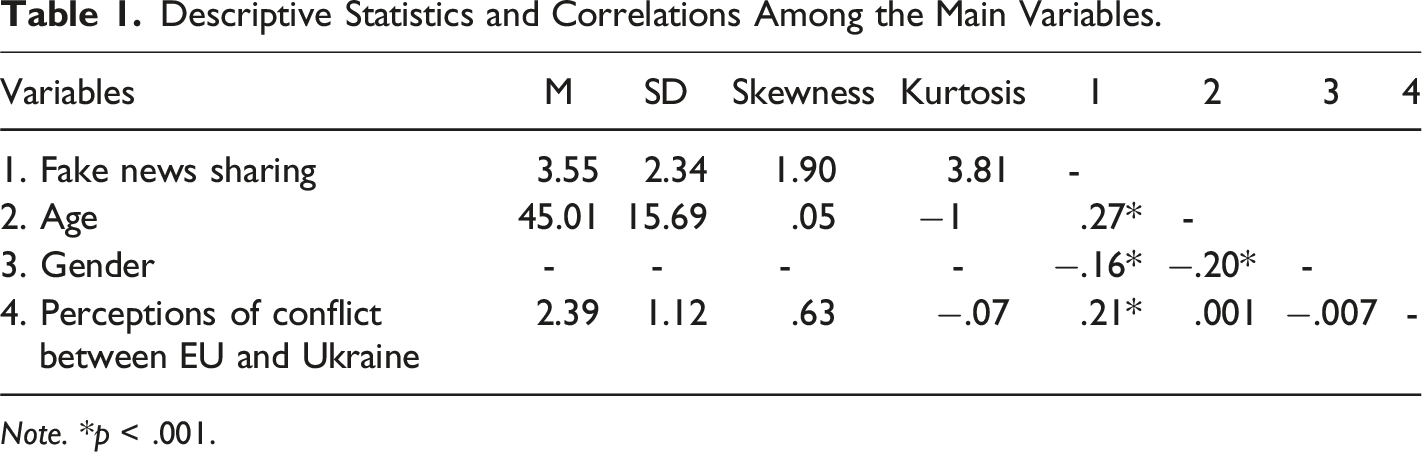
Note. *p < .001.
The results of the correlation analyses (see Table 1) indicate that fake news sharing was positively related to age and perceptions of conflict between EU and Ukraine and negatively to gender, with males scoring higher than females on the measure of this behaviour (p < .001 for all three correlations mentioned). Although the correlation coefficients are significant, the values are small. Despite the proportions of 61.3% women and 38.7% men, the literature provides theoretical and methodological foundations for incorporating this proportional ratio of the two groups into statistical analyses (Cohen, 2013; Field, 2024).
Testing the Moderation
We used the SPSS macro program PROCESS – Model 1 (95% confidence interval (CI); 5000 bootstrapped samples) to explore the potential moderating roles of age on the link between perceptions of conflict between EU and Ukraine and fake news sharing (Hayes & Preacher, 2013).
Among female participants, the direct effect of perceptions of conflict between EU and Ukraine on fake news sharing was moderated by age, as their interactions was significant (b = .02, SE = .007, p = .001), with a R2change brought by this interaction of 5.9%. The association between perceptions of conflict between EU and Ukraine and fake news sharing was not significant for participants with lower age – under 26 years (b = −.19, SE = .20, p = .32). The association was significant and weaker in those with average age: 27 – 42 years (b = .26, SE = .13, p = .04), and this relationship was strongest for individuals of older age – over 43 years (b = .07, SE = .15, p = .001). Although the path coefficients are significant, the values are small.
Among male participants, the direct effect of perceptions of conflict between EU and Ukraine on fake news sharing was not moderated by age, as their interaction was not significant (b = −.001, SE = .01, p = .90).
Discussion
Our study has yielded a series of significant findings. The results of the correlation analyses demonstrate that the behaviour of spreading fake news is positively associated with age, in line with the existing literature, which has demonstrated that age represents a significant predictor regarding the dissemination of fake news (Sun et al., 2020; Tantau et al., 2018), and that in political contexts — such as the current conflict between Ukraine and Russia, people of older age are more inclined to distribute fake news (Guess et al., 2019). This result can be explained by the fact that older individuals are seen as the primary target of propagandistic fake news (Sun et al., 2020; Yong et al., 2014).
Moreover, our findings indicate that the likelihood of spreading fake news is negatively related to gender, men tending to spread more fake news compared to women, in line with previous results (Laato et al., 2020). Several factors may contribute to this gender difference. Firstly, men generally have stronger tendencies towards overconfidence than women (Bengtsson et al., 2005), and are much less critical when it comes to filtering the information they encounter. In other words, men may have greater trust in online information than women. Secondly, women, compared to men, are generally more interested in news related to everyday experiences, such as weather or health (Poindexter et al., 2010), and have less interest in political topics, unlike men (Almenar et al., 2021; Kittilson, 2016; Verba et al., 1997). Finally, another explanation for these results may be found in group identity theory (Shih et al., 1999). According to this theoretical framework, revealing one’s political viewpoint and disseminating false news (including in the context of war) can be viewed as a threat to group identity, power, and the status that an individual holds (Peteraf & Shanley, 1997). The behaviour of disseminating fake news may differ by gender, as men and women respond differently to stressors (such as news about war) both behaviourally (McClure et al., 2004) and psychologically through cortisol secretion (Kirschbaum et al., 1992). Thus, women may attempt to avoid news that stresses them (Lighthall et al., 2009, 2012; Mather & Lighthall, 2012), whereas men may perceive such news as challenges and subsequently engage in disseminating them (Turel, 2024).
We also found perceptions of conflict between EU and Ukraine to be positively related to fake news sharing. This finding indicates that people who perceive that beneath EU’s consistent support for Ukraine throughout the current war there is also a latent conflict between the two parties are more inclined to spread fake news. Furthermore, as these perceptions may stem from suspicions of hidden interests that the EU has towards Ukraine, this result highlights the mistrust in the political agenda of the EU in the context of the current war as a fertile ground for misinformation, both in terms of accepting and spreading such contents, which may further undermine the individual’s confidence in the EU leadership. As Romania is a member of the EU and represented in its overarching decision making, this kind of mistrust could easily extend also towards perceptions of national leadership.
When examining the relationship between perceptions of conflict between EU and Ukraine and fake news sharing separately in the groups defined by gender and age variations, we found the strength of this association to vary. Among female participants, the relationship was moderated by age, that is, the predisposing effect of perceptions of conflict between EU and Ukraine on fake news sharing was strongest for females of older age, supporting previous findings highlighting elderly individuals as a significant portion of communication when it comes to spreading speculation (Guess et al., 2019; Sun et al., 2020; Yong et al., 2014). This effect was not significant for young females. On the other hand, among male participants, the relationship between perceptions of conflict between EU and Ukraine and fake news sharing was not moderated by age, suggesting that men of all ages are similarly inclined to spread misinformation when they harbor suspicions concerning the real intentions of the EU in Ukraine. This result can be explained by the stronger interest that men have in political topics in comparison to women (Kittilson, 2016; Verba et al., 1997), regardless of age, and, relatedly, by their stronger predisposition to distribute fake news (Almenar et al., 2021; Laato et al., 2020).
Limitations and Future Directions
There are several limitations of our research. Despite the strengths of the present research, several limitations need to be addressed. Firstly, the recruitment of participants through social networks introduces potential sampling bias, as these platforms may not reflect the general population. Future studies should consider diversifying the sampling strategy to include offline methods and a broader range of platforms. Secondly, the fact that our male sample had a higher mean age than the female sample constitutes another limitation, as does the predominance of participants with university-level education, which may restrict the generalizability of the findings. Future studies should aim for a more balanced mean age between male and female participants and a more educationally diverse sample to enhance result representativeness. Thirdly, the sensitivity of the topic at hand for the study population might have affected participants’ responses, as the country shares a border with an ongoing armed conflict. This is supported by other studies conducted in the Romanian context, which have demonstrated that the armed conflict in Ukraine can lead to negative outcomes related to the mental health of Romanian individuals (Hăisan et al., 2022; Hutul et al., 2023, 2024; Vintilă et al., 2023). Fourthly, we omitted the testing of the conservatism variable. We decided not to measure this variable in order for our study not to be considered political by our participants (and thus prevent their drop-out), as there are heated discussions in Romania regarding the political beliefs of individuals who have decision-making power in the context of the humanitarian aid for Ukraine provided by Romania. However, future studies should also take into account the level of conservatism among participants. Fifthly, considering the personal relevance of the war in the close vicinity, we believe that involving social representations in the scientific approach of these matters could be a fruitful avenue. Social representations have demonstrated their importance in other sensitive contexts investigated on the Romanian population, such as organ donation (Todeancă et al., 2019), traffic accidents (Holman et al., 2010), or surgery (de Rosa & Holman, 2011). Thus, another potential future research direction could involve exploring the social representation of the armed conflict in Ukraine and its connection to fake news sharing. Finally, we must address the limitation that, while the correlation coefficients and path coefficients are statistically significant, the values are quite small. It is possible that the statistical significance may be an artifact of the large sample size rather than being theoretically meaningful. Therefore, future studies should take this aspect into consideration, and the results of the present study should be interpreted accordingly.
Theoretical and Practical Implications
From a theoretical perspective, our results enhance general knowledge about the dissemination of fake news by highlighting the significant roles of age and gender. Specifically, they underscore the importance of these factors in the context of the ongoing war between Russia and Ukraine that began on February 22, 2022. Our study also emphasizes the relevance of perceptions regarding a latent conflict between the European Union and Ukraine, an aspect less studied until now in the literature. Furthermore, our findings indicate that political mistrust is a key factor in the spread of fake news, which could serve as a foundational element in developing more precise theories about how political and ideological factors influence this behaviour.
From a practical perspective, our study can serve as a starting point for specialists and non-governmental organizations working to combat aspects such as the spread of fake news, address political mistrust, or enhance media literacy, particularly in the context of the Russia-Ukraine war. Non-governmental organizations, building on our results, can also create and promote guidelines targeted at more vulnerable demographic groups to combat the spread of fake news. Moreover, based on our findings, educational programs can be developed to raise awareness and improve the critical evaluation of information sources, with a focus on these vulnerable demographic groups.
Conclusions
In conclusion, the results of this study advance the body of knowledge on the spread of fake news by highlighting certain elements of the psychosocial profile of individuals who are more prone to spread fake news in the context of the current Ukraine war, a conflict with intense political and ideological charge. Our findings indicate that men and elder individuals are more inclined to spread fake news. Moreover, suspicions about the real agenda of the EU in Ukraine and associated perceptions of conflict between the two parties emerged as significantly fostering fake news sharing. This highlights the importance of building a climate of trust in the European institutions and EU as a whole, through carefully tailored public campaigns explaining its agenda and vision especially in areas more prone to be targeted by misinformation, in order to mitigate the dissemination of fake news.
Supplemental Material
Supplemental Material - Factors of Fake News Sharing in the Context of the Ukraine–Russia Conflict: The Effect of Suspicions About European Unions’ Intentions
Supplemental Material for Factors of Fake News Sharing in the Context of the Ukraine–Russia Conflict: The Effect of Suspicions About European Unions’ Intentions by Tudor-Daniel Huțul, Andrei C. Holman, Adina Karner-Huțuleac, and Andreea Huțul in Supplemental Material
Footnotes
Author Contribution
Tudor-Daniel Huțul, Andrei Corneliu Holman, Adina Karner-Huțuleac, and Andreea Huțul contributed equally to conceptualization, methodology, formal analysis, supervision, writing-original draft, writing-review, editing and data curation.
Declaration of Conflicting Interests
The author(s) declared no potential conflicts of interest with respect to the research, authorship, and/or publication of this article.
Funding
The author(s) received no financial support for the research, authorship, and/or publication of this article.
Ethics Statement
This study’s protocol was designed in concordance with ethical requirements specific to the Faculty of Psychology and Educational Sciences, “Alexandru Ioan Cuza” University (Iași, Romania). All participants voluntarily participated in the study and gave written informed consent following the Declaration of Helsinki and the national laws from Romania regarding ethical conduct in scientific research, technological development, and innovation.
No animal studies are presented in this manuscript.

Data Availability Statement
The data are available upon request from the corresponding author.
Supplemental Material
Supplemental material for this article is available online.
Author Biographies
References
Supplementary Material
Please find the following supplemental material available below.
For Open Access articles published under a Creative Commons License, all supplemental material carries the same license as the article it is associated with.
For non-Open Access articles published, all supplemental material carries a non-exclusive license, and permission requests for re-use of supplemental material or any part of supplemental material shall be sent directly to the copyright owner as specified in the copyright notice associated with the article.
