




Abstract
This article introduces a significant advancement with the “Theory of Employee Planned Behavior” (TEPB), a novel extension of the well-established Theory of Planned Behavior (TPB). The TEPB uniquely positions job satisfaction as a central determinant in driving organizational performance. Using data from county-level government institutions in the United States, this research offers a nuanced exploration into how employee satisfaction influences organizational commitment and citizenship behaviors, which, in turn, substantially impact organizational performance. Our approach utilizes a significant dataset involving 372 dyads across hierarchical levels in government institutions. Through the application of Structural Equation Modeling (SEM), we rigorously validate the TEPB model. The results highlight a significant relationship where enhanced job satisfaction leads to stronger organizational commitment. This heightened commitment further fosters organizational citizenship behaviors, crucial in achieving superior organizational performance. This work notably extends the TPB model by integrating organizational performance as a consequential outcome. It also provides empirical evidence of the direct relationship between job satisfaction and organizational performance, specifically in the context of government institutions. Such findings are invaluable for organizational executives and policymakers in recognizing the paramount importance of employee satisfaction for organizational success. Overall, the TEPB model presented in this study offers a holistic and practical framework for organizations seeking to understand and effectively manage employee behavior. By focusing on job satisfaction, organizations can foster a more committed and proactive workforce, significantly improving performance and efficiency.
Keywords
Introduction
Job satisfaction is a fundamental concept in the field of organizational psychology research, recognized for its substantial influence on both individual and organizational performance. Seminal research by Locke (1976) initiated the exploration of its multifaceted effects, emphasizing its role in bolstering commitment, organizational citizenship behavior, and overall job performance. Subsequent studies by Judge et al. (2001) and Harter et al. (2002) empirically substantiated the strong connection between job satisfaction and critical organizational outcomes. However, the intricate mechanisms through which job satisfaction exerts its influence on these outcomes remain inadequately understood, particularly regarding its impact on organizational performance.
Addressing this knowledge gap, our study introduces the Theory of Employee Planned Behavior (TEPB), an innovative framework derived from Ajzen’s Theory of Planned Behavior (TPB) (Ajzen, 1991). TEPB not only integrates established constructs from organizational studies but also establishes novel links to specific organizational outcomes. It uniquely connects job satisfaction with organizational commitment, organizational citizenship behavior, and notably, organizational performance. Drawing on diverse data sources, including input from both leaders and employees, TEPB strengthens its empirical foundation. By aligning job satisfaction, organizational commitment, and organizational citizenship behavior with the attitude, intention, and behavior components of the TPB model, TEPB represents a significant theoretical advancement in the realm of work and organizational psychology, providing a new framework for comprehending and investigating organizational behaviors. By emphasizing the need to understand these relationships in the context of evolving organizational norms and practices (Bakker & Demerouti, 2017), this model offers a nuanced perspective on how individual-level employee attitudes and behaviors can aggregate to influence organizational performance, thus bridging a prominent gap in the existing literature.
Furthermore, the model’s multi-source, multi-level methodology is a response to recent calls in the literature for more comprehensive approaches in organizational studies (e.g., Breevaart & Bakker, 2018; Richter-Killenberg & Volmer, 2022; Spector, 2019). The multi-source and multi-level approach employed by our model enhances the robustness and comprehensiveness of the analysis of the attitudes-intention-behavior-outcome process within organizations.
In practical terms, the TEPB model offers valuable insights for organizational leaders and HR practitioners. The model’s in-depth exploration of the pathways connecting job satisfaction to organizational outcomes can serve as a guide for the development of targeted strategies and interventions. This aspect aligns with research highlighting the significance of strategic HR practices in augmenting organizational performance (Huselid, 1995).
Overall, our study introduces the Theory of Employee Planned Behavior (TEPB) as a novel framework that sheds light on the intricate relationship between job satisfaction and key organizational outcomes. By aligning job satisfaction with organizational commitment, organizational citizenship behavior, and organizational performance within the TPB model, TEPB offers a fresh perspective and a deeper understanding of the mechanisms at play. Moreover, the adoption of a multi-level and multi-source methodology contributes methodologically, enhancing the rigor of our analysis. Practically, the TEPB model provides actionable insights for organizational leaders and HR practitioners, empowering them to develop targeted strategies that can ultimately improve organizational performance. This research represents a significant contribution to the field of organizational behavior and work psychology, offering a comprehensive framework for future studies in this domain.
Background and Theoretical Model Development
The Theory of Planned Behavior (TPB), developed by Ajzen in 1991, builds on his earlier work on the Theory of Reasoned Action (TRA) with the inclusion of measures of perceived behavioral control. TPB posits that an individual’s attitudes, subjective norms, and perceived behavioral control collectively influence their intention to perform a specific behavior, ultimately leading to the actual execution of that behavior. By providing a comprehensive framework that links these constructs, TPB enables researchers to explain how employees’ beliefs and attitudes are translated into actual behavioral responses.
Empirical studies have demonstrated that TPB performs well in predicting both intention and behavior, explaining 40–49% of the variance in the intention construct and 26–36% of the variance in behavior (McEachan et al., 2011). This empirical support highlights the robustness and utility of TPB as a theoretical framework for understanding and predicting human behavior, making it a valuable asset in the realm of social and behavioral sciences.
Moreover, TPB’s utility extends across a diverse spectrum of research domains. For example, the TPB has been used extensively in a broad range of research areas to successfully predict Behavior (e.g., Armitage & Conner, 2001) including misconduct Behavior (e.g., Stone et al., 2009). Also TPB has been used to understand technology adoption in organizations (e.g., Pavlou & Fygenson, 2006), explaining the entrepreneurial intention in university students (e.g., Van Gelderen et al., 2008), utilization of structured interview techniques in staff selection (e.g., Van der Zee et al., 2002), organizational change context (e.g., Jimmieson et al., 2008), understanding the green purchasing Behavior (e.g., Liobikienė et al., 2016), and consumer attitudes to food consumption decision (e.g., Ajzen, 2015).
Having established the robustness and versatility of the Theory of Planned Behavior (TPB) as a theoretical framework for comprehending and predicting human behavior in various domains, we now turn our attention to its application within the context of our proposed model.
Building upon Ajzen and Fishbein’s (1980) TRA and the foundational concepts of TPB, our model, as depicted in Figure 1, delves into the intricate relationships between individual attitudes, intentions, and behaviors, shedding light on their profound influence on organizational outcomes. While TPB traditionally encompasses attitudes, subjective norms, and perceived behavioral control, we intentionally omit the latter two constructs in our study to place a spotlight on the unique role of job satisfaction. In doing so, we aim to explain how job satisfaction serves as a pivotal determinant in shaping organizational outcomes, with a specific focus on organizational commitment as the driver of behavioral intention and organizational citizenship behavior as the consequent action. Furthermore, we introduce organizational performance as an outcome variable of paramount importance within the broader landscape of organizational behavior research. The theory of employee planned behavior.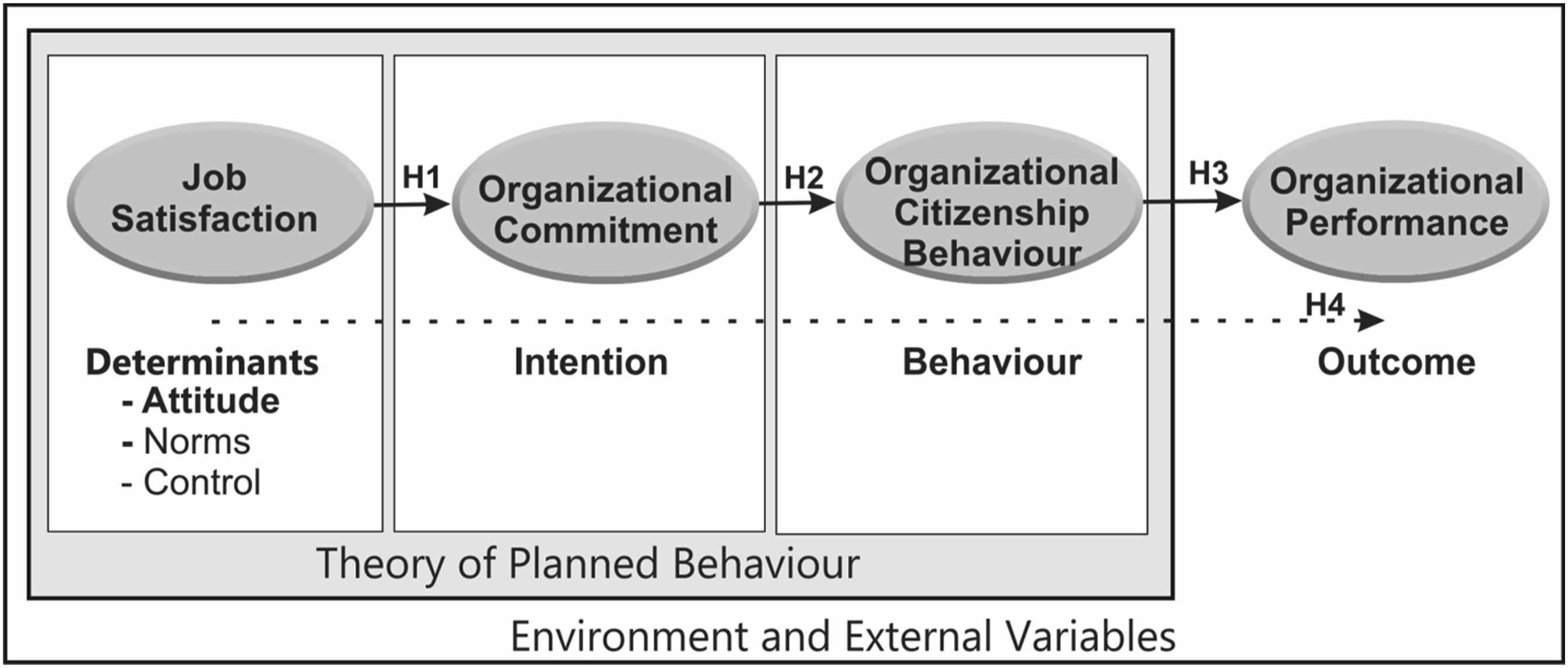
Recognizing that human behavior does not exist in isolation, we acknowledge the crucial role played by external and environmental variables, a dimension not explicitly addressed in the original TPB model. This recognition aligns with the perspective advocated by scholars like Montano and Kasprzyk (2015) who emphasize the significance of external factors such as organizational culture, demographic variables, and personality traits in shaping behavior. Within the TEPB framework, we seamlessly incorporate these external influences, recognizing their substantial impact on human behavior within organizational contexts. This broader contextual perspective enriches our model and enhances its applicability within complex organizational settings.
Determinants of Intention
As we navigate through the intricate layers of our model, we now delve into the determinants of intention that play a central role within both the TPB and TEPB frameworks. In the TPB model, intentions are a function of three independent determinants: attitude, subjective norm, and perceived Behavioral control. A meta-analysis (Armitage & Conner, 2001) involving 185 studies has determined that the regression weights/associations and variance explained for attitude were consistently greater (Ra = .49, R2 = .24) in magnitude for the attitude construct than subjective norms (Ra = .34, R2 = .12) and perceived Behavioral control (Ra = .43, R2 = .18). Although the latter two constructs are included in the proposed TEPB model for comprehensiveness, our research focused on only the strongest determinant.
Attitude towards behavior - Job Satisfaction (JS)
The first determinant of intention is attitude, which, in the context of this study, refers to an individual’s feelings or opinions about a person or situation. Attitude is shaped by a person’s beliefs about the consequences of performing the behavior (behavioral beliefs), influenced by evaluations of those outcomes (McEachan et al., 2011). As such, in relation to the TRB and TEPB, someone who believes that performing the behavior will lead to desirable outcomes is likely to hold a favorable attitude towards the behavior. Job satisfaction has been extensively studied in the field of organizational behavior (McShane & Von Glinow, 2013), spanning both public and private sector organizations (Cantarelli et al., 2016). Within the scope of this investigation, job satisfaction is viewed as an attitude toward one’s work (Brayfield & Rothe, 1951) and is anticipated to influence an employee’s degree of commitment to the organization (intention), as illustrated in the Theory of Planned Employee Behavior presented in Figure 1.
Subjective norms (SN)
The body of research investigating the influence on an individual(s) by another individual(s) has been the focus of a substantial amount of research. Ajzen (1991), refers subjective norms as the perceived social pressure to perform or not to perform the Behavior. This component was the second addition to the TPB model, and several authors have argued that it is the weakest component. For example, meta-studies by Armitage and Conner (2001) as well as McEachan et al. (2011) have found that although link between norms and intention has been found to be significant, it has the weakest relationship of the determinants.
Although this research does not primarily focus on them, defining Subjective Norms within the TEPB framework is essential. In the TEPB model, subjective norms take on a distinct interpretation, reflecting the perceived social pressure surrounding specific behaviors that contribute to organizational goals. This nuanced definition aligns with Ajzen’s (1991) original formulation while tailoring it to the unique dynamics of the workplace environment. Within the TEPB framework, we emphasize the significant influence of organizational culture and peer expectations on employee behavior. This perspective shifts the interpretation of subjective norms beyond the general notion of social influence, focusing squarely on the role of workplace-specific social dynamics. By doing so, we acknowledge the intricate interplay between an employee’s perceptions of social pressure and the organizational context in which these pressures manifest, ultimately enriching our understanding of how subjective norms operate within the TEPB model.
Perceived Behavioral Control
Ajzen (1991) introduced this construct as the final element in the determinants of intentions within his TPB model. Perceived Behavioral Control consists of beliefs about the frequency of occurrence of factors that either facilitate or inhibit engagement in a behavior, weighted by the perceived influence of each factor on the behavior (Conner & Sparks, 2005). The perception of how these factors, which may be beyond an individual’s control, either promote or hinder a specific behavior has been shown to impact the intention component of both the TPB and the proposed TEPB models. The effect of perceived control on intention can vary significantly; it may have little influence on actual behavior when attitudes and norms are robust. Conversely, when behaviors are perceived as difficult or when specific obstacles to performance exist, this construct becomes a more critical determinant in predicting behavior (Stone et al., 2009).
While not a primary focus of this research, it’s important to define how Perceived Behavioral Control are conceptualized within the TEPB framework. In the TEPB model, PBC takes on a tailored interpretation that emphasizes beliefs concerning the ease or difficulty of performing behaviors conducive to organizational goals. These beliefs encompass a range of factors, including the availability of resources, opportunities, and constraints within the workplace environment. This tailored perspective on PBC within the TEPB framework differs from the broader focus of TPB, which encompasses a wider range of behavioral contexts. In TEPB, the lens narrows to specifically address the control an employee perceives they have within their organizational environment to execute desired behaviors that align with organizational objectives. By adopting this refined perspective on PBC, we enhance our capacity to understand how perceived control operates within the intricate dynamics of the workplace, shedding light on its role in shaping intentions and behaviors that contribute to organizational outcomes.
Behavioral Intentions/Organizational Commitment (OC)
The intention construct is central to both the TPB and the TEPB. Intention within the framework of this research, is defined as is a mental state that represents a commitment to carrying out an action or actions in the future (Bratman, 1987). Ajzen (1991) asserted that the level of commitment influences the motivational factors and determine how much effort an individual would be willing to exert to perform the behavior. Thus, an employee’s commitment to the organization (OC) is seen as their intention to work towards the goals of the organization and is integrated into the TEPB as presented Figure 1. Accordingly, the stronger a person’s intention (organizational commitment), the greater the probability of the particular behavior (organizational citizenship Behavior) being elicited.
Behavior/Organizational Citizenship Behavior (OCB)
Behavior
The purpose of the TPB and TEPB models are to predict human Behavior. In the TPB model it is the final resultant, whereas in the TEPB model, Behavior facilitates the final outcome (organizational performance). The Behavior that we are trying to predict in the TEPB model, is organizational citizenship Behavior (OCB) which is defined “as any discretionary Behavior not explicitly recognized by the formal reward system, which exceeds the formally demanded expectations for the performance of a given role and which is beneficial for the organization itself” (Organ et al., 2005, p. 8). This is typically viewed as when the employee “goes above and beyond” what is required to maintain their jobs. Thus, organization citizenship Behaviors are classified in the Behavior section of the theory of planned employee Behavior as presented in Figure 1.
Numerous studies (e.g., Aguiar-Quintana et al., 2020; Jung & Yoon, 2015; Radaelli et al., 2015; Sussman & Gifford, 2019; Tsai et al., 2022) have effectively applied Ajzen’s Theory of Planned Behavior (TPB) to understand Organizational Citizenship Behavior (OCB), demonstrating the significant role of attitudes, subjective norms, and perceived behavior control in influencing OCB across various settings. For example, Tsai et al. (2022) extended TPB to examine service-oriented OCB, revealing how these TPB components influence service-centric discretionary behaviors in the workplace. Similarly, Sussman and Gifford (2019) delved into the causal relationships within TPB, offering a deeper understanding of how subjective norms and perceived behavioral control contribute to the formation of behavioral intentions and, subsequently, OCB. These studies collectively underscore the applicability of TPB in diverse organizational contexts, enriching the literature on OCB by highlighting the psychological underpinnings that drive such behaviors in employees.
Organizational Performance (OP)
Figure 1 incorporates organizational performance as the ultimate outcome component of the Theory of Planned Employee Behavior (TEPB), depicted in Figure 1. Organizational performance represents the tangible results of an organization’s efforts and the collective behaviors of its employees.
In the context of TEPB, we define organizational performance as the actual achievement of an organization concerning its intended outputs or objectives (Popova & Sharpanskykh, 2010). Traditionally, within the profit-making sector, organizational performance is often evaluated through financial indicators, which provide clear metrics for success. However, in the public sector, where governmental organizations operate, the evaluation of organizational success is more nuanced. Unlike profit-driven entities, public sector organizations do not have a straightforward measure of profit. Instead, they face the complex challenge of balancing the diverse expectations of various stakeholders.
This multifaceted nature of evaluating success aligns with the Competing Values Framework proposed by Quinn and Rohrbaugh (1981, 1983). This framework recognizes that organizational goals are influenced by the expectations of multiple constituencies, which can sometimes pull in opposing directions. Consequently, assessing organizational effectiveness in this context requires a consideration of conflicting criteria.
The Competing Values Framework offers four dimensions of effectiveness, each shedding light on different facets of organizational performance: 1. Rational Goal (RG): This dimension emphasizes that organizations exist for a purpose, and their goals should be clear and measurable. Effectiveness in this dimension is evaluated based on the organization’s ability to achieve its desired objectives. 2. Open System (OS): Here, the focus is on an organization’s capacity to acquire the necessary resources from its environment to facilitate goal attainment. Effectiveness is defined by the organization’s ability to effectively adapt to and exploit the external environment. 3. Internal Process (IP): The IP dimension highlights the importance of efficient information management, communication processes, stability, control, and continuity within the organization. Organizational effectiveness is achieved when these internal processes contribute to stability and control. 4. Human Relations (HR): In this dimension, organizational effectiveness is associated with fostering participation, openness, and group cohesion, which, in turn, lead to the overall development and well-being of employees.
By incorporating the Competing Values Framework into the TEPB model, we recognize that organizational performance is a multifaceted concept that extends beyond financial metrics. It encompasses the dynamic interplay of various factors, including clear goal setting, resource management, internal processes, and employee well-being. Understanding how these dimensions influence and interact with employee attitudes, intentions, and behaviors is essential for comprehending the broader landscape of organizational behavior research.
Hypotheses Development
Job Satisfaction and Organizational Commitment
Numerous research efforts have explored the connection between job satisfaction and organizational commitment (Markovits et al., 2010; Saha & Kumar, 2018). Some of these studies posit that job satisfaction precedes organizational commitment (e.g., Mowday et al., 1982; Mueller et al., 1994; Williams & Hazer, 1986), while others argue for the opposite relationship, with organizational commitment significantly affecting job (e.g., Supriyati et al., 2021). Despite these contrasting perspectives, the prevailing opinion suggests that job satisfaction contributes to heightened commitment levels within an organization, and contented employees are more likely to show up to work, remain with a company, and excel in their performance (Suri & Petchsawang, 2018). In line with this dominant viewpoint, the subsequent hypothesis is proposed:
H1. Job satisfaction has a positive impact on organizational commitment.
Organizational Commitment and Organizational Citizenship Behavior
Although predicting behavior relies on a multitude of elements (e.g., Shim & Faerman, 2015), both the TPB and TEPB contend that intentions serve as the most immediate predictor of behavior (Jimmieson et al., 2008). Meyer and Allen (1991) were the pioneering researchers to identify a link between Organizational Commitment (OC) and Organizational Citizenship Behavior (OCB). Subsequently, several other scholars have investigated this relationship, uncovering a positive correlation between OC and OCB (e.g., Gupta et al., 2016; Pradhan et al., 2016; Sawitri et al., 2016). Consistent with the general findings in the literature, the following hypothesis is proposed:
H2. Organizational commitment has a positive impact on organizational citizenship Behavior.
Organizational Citizenship Behavior and Organizational Performance
Organ (1988) defined organizational citizenship behaviors as “individual behavior that is discretionary, not directly or explicitly recognized by the formal reward system, and that in the aggregate, promotes the effective functioning of the organization” (p. 4). For instance, when employees participate in supportive actions, such as assisting one another to complete projects promptly, organizational performance is likely to be enhanced (Organ, 1988; Organ & Konovsky, 1989; Smith et al., 1983). The literature provides evidence for the connection between organizational citizenship behaviors and organizational performance (e.g., Ahearne, 2000; Basu et al., 2017; Binz et al., 2017; Kim, 2005; Podsakoff et al., 1997; Podsakoff et al., 2000; Podsakoff & MacKenzie, 1994). In line with existing research, the following hypothesis is formulated:
H3. Organizational citizenship Behavior has a positive impact on organizational performance.
Job Satisfaction and Organizational Performance
Iaffaldano and Muchinsky (1985) is one of the primary references in studying the relationship between job satisfaction and organizational performance. Although they suggest that their correlation is more indirect rather than direct (such as captured in the TEPB model), other studies, such as Organ and Ryan (1995) suggest that individuals who experience job satisfaction in an organization, perform better and find their jobs more enjoyable. A comprehensive meta-analysis revealed that the average correlation between Job Satisfaction (JS) and Organizational Performance (OP) stood at r = .3. Similarly, other studies have confirmed this relationship (e.g., Muthukumaran, 2018; Noah & Steve, 2012; Pugno & Depedri, 2010). Therefore, consistent with the literature above, the following hypothesis is proposed:
H4. Job satisfaction has a positive indirect impact on organizational performance as mediated by organizational commitment and organizational citizenship Behavior.
Methodology
Procedure and Sample Description
The study’s methodology was meticulously designed to explore the interactions between chief executive officers (CEOs) and their direct reports within county-level government institutions in the United States. County-level government institutions in the United States represent a key tier in the country’s complex local governance system. These entities operate below the state level and, depending on the state, can be considered the smallest administrative units of government.
Distribution of Questionnaires
To collect data for our study, we employed a systematic approach for questionnaire distribution. The surveys were primarily distributed online, utilizing secure and confidential survey platforms. Additionally, to ensure inclusivity and accessibility, we supplemented the online distribution with a few mailed surveys to accommodate participants who preferred or required a non-digital format. These measures were implemented to maximize the reach and convenience for participants, contributing to the diversity of responses in our sample.
Sample Frame
Our sample comprised CEOs and their direct reports, primarily department directors, from 1364 county governments across the U.S. The data for this study was collected pre-COVID. Consequently, all participants were working in-person during the time of the survey. To gather data, we adopted a mixed-method approach in line with Dillman (2011) recommendations. Surveys were primarily distributed online, with a few mailed surveys to ensure a broader reach of participants. This methodological choice aimed to maximize response rates and capture diverse perspectives from these county-level government institutions.
Matched Pairs Requirement
A critical aspect of our research design was the necessity for matched pairs of responses – one from each CEO (the leader) and at least one from their direct report (the follower). This design demanded explicit communication during participant recruitment to ensure that leaders were aware their responses would be paired with those of their direct reports, and vice versa. Confidentiality and anonymity were rigorously maintained, with participants assured that their responses would be aggregated and individual identities, as well as the specific timing of data collection would not be disclosed.
Rationale for Sample Size and Response Rate
The rationale for the chosen sample size in our study was multifaceted and grounded in both statistical and practical considerations. In alignment with Cohen’s (2013) recommendations, a statistical power analysis was conducted, suggesting that a minimum of 350 matched pairs would provide adequate power (0.80) at an alpha level of 0.05, assuming a moderate effect size. This informed our target of contacting 1364 county governments, accounting for anticipated non-responses and incomplete data. Balancing this statistical ideal, we acknowledged practical constraints such as resource availability, time limitations, and the feasibility of accessing participants. This led to selecting a large yet manageable number of counties. Furthermore, the sample size was deemed sufficient for ensuring representativeness and generalizability across various county governments, enhancing the external validity of our findings. Of the 1364 surveys sent to CEOs, 416 responded, yielding a response rate of approximately 30.5%.
Subsequently, we dispatched 1248 surveys to the followers, calculated as three per leader response. Of these, 911 were returned, with 892 qualifying as useable, signifying a high engagement rate of approximately 69.9% among followers. The distribution of responses from followers was diverse: 29 leaders had one direct report response, 166 leaders received responses from two direct reports, and 177 leaders had all three direct reports responding. In instances with more than one responding follower per leader, averages were computed to minimize standard error and common source bias. These responses were then matched with the leader data, culminating in 372 useable matched pairs for analysis. Given that the response rate per leader ranged from one to three followers, the degree of concordance among the follower respondents was estimated. The inter-follower correlations were found to be high (JS r = .82, p < .001, OC r = .78, p < .01, OCB r = .93, p < .01), indicating a high level of homogeneity in the respondents.
Demographic Overview
Demographically, most participants were male, with 316 male leaders and 495 male followers. Most leaders were appointed county executives (55%), while most followers were directors or department heads (98%), reporting directly to the surveyed leaders. Regarding tenure, the largest group of leaders had been in their current positions for six to 10 years (32%), followed by those with one to five years (31%). Similarly, the largest group of followers had tenures of one to five years (31%). The educational background of both groups was predominantly at the bachelor’s level or higher.
Measurement Instruments
Job Satisfaction (JS)
Means, Construct Reliability (α and CR), AVE, and Measurement Loadings.
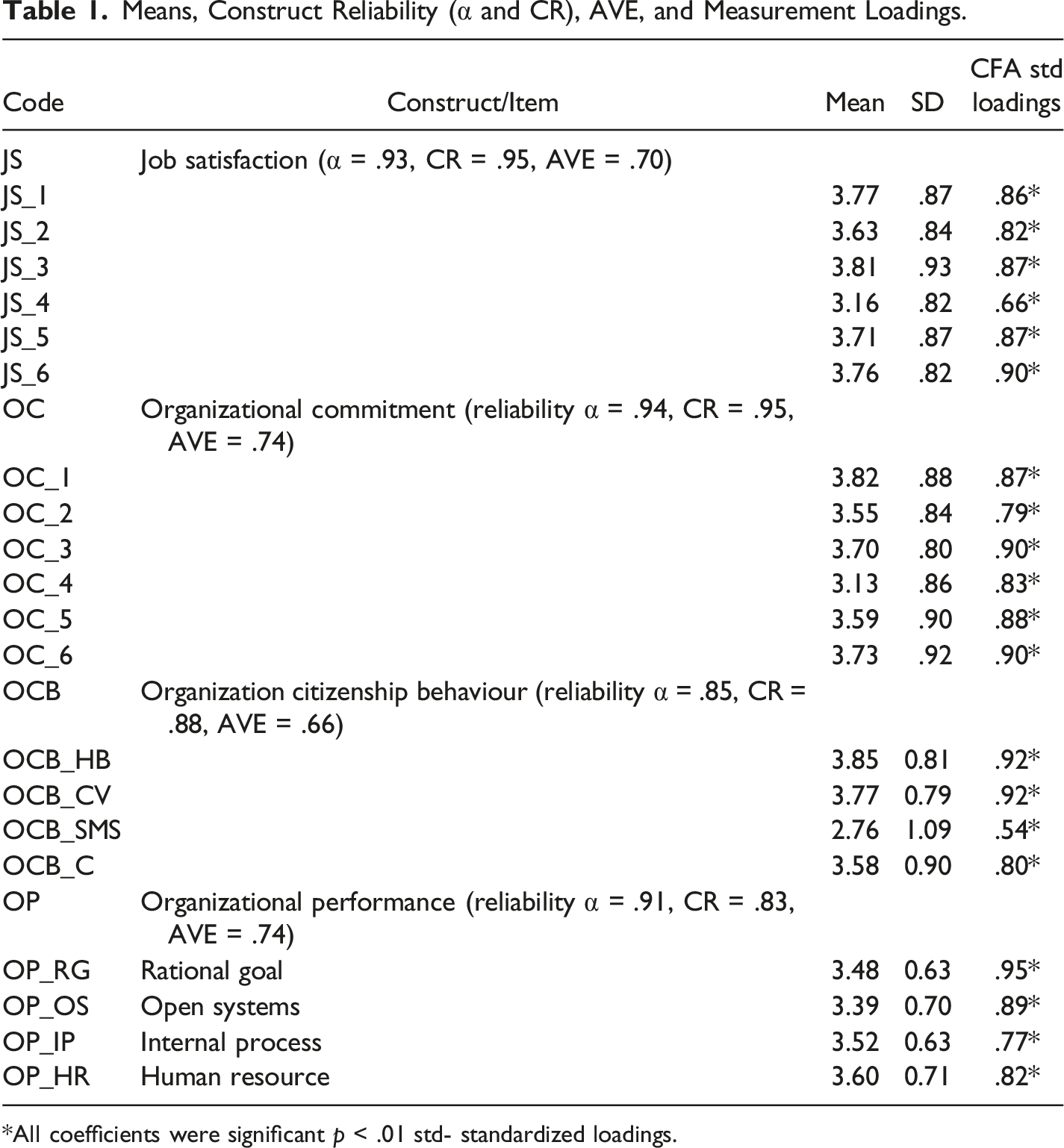
*All coefficients were significant p < .01 std- standardized loadings.
The Price and Mueller (1986) job satisfaction scale has been widely used in various studies related to job satisfaction. For instance, Schnettler et al. (2020) utilized a subset of items from the original 18-item index developed by Brayfield and Rothe, which were selected by Agho, Price, and Mueller and similarly, Muterera et al. (2018) used the scale in their study within the public sector. These studies demonstrate the applicability and use of the Price and Mueller (1986) job satisfaction scale in diverse settings and populations, hence highlighting its relevance and applicability in assessing job satisfaction in organizational psychology research.
Organizational Commitment (OC)
Assessed using the Affective Commitment Scale (ACS) by Allen and Meyer (1990). This six-item scale, rated on a five-point Likert scale, includes both positively and negatively keyed items to mitigate bias. For example, a positive item is “I would be very happy to spend the rest of my career with this organization,” and a negative item is “I do not feel emotionally attached to this organization.” Table 1 presents the averages, standard deviations, reliabilities, AVEs, and standardized loadings for each measurement variable of the OC construct.
The scale has been used in various contexts, such as in assessing hospital nurse employment outcomes and the relationship between commitment to supervisors and organizational citizenship behavior (Ada et al., 2021; Schraggeová & Stupková, 2021). Additionally, it has been employed in studies related to talent management competencies, turnover, and organizational commitment in different cultural and national contexts (Jonathan, 2020; Vandenberghe & Bentein, 2009).
Organizational Citizenship Behavior (OCB)
Measured using a four-part instrument by Podsakoff and MacKenzie (1994), which includes Helping Behavior (e.g., “Voluntarily assisting others with work-related problems”), Sportsmanship (e.g., “Willingness to tolerate work inconveniences without complaining”), Civic Virtue (e.g., “Participation in and concern about organizational life, such as attending meetings, staying informed about industry changes”), and Conscientiousness (e.g., “Adhering to organizational rules and exceeding minimum job requirements”). The measure’s psychometric properties have been validated in multiple studies (e.g., LePine et al., 2002; Podsakoff et al., 2000). Ahmad (2011) used the questionnaire to measure OCB in the context of training and the digital world. Specific details for each measurement variable of the OCB construct used in this study, including averages, standard deviations, reliabilities, AVEs, and standardized loadings, are provided in Table 1.
Organizational Performance
Given the challenge of obtaining objective data in the public sector, subjective measures were used to assess organizational performance. This approach is supported by previous research demonstrating a correlation between subjective and objective performance metrics (Chun & Rainey, 2005). Therefore, a 16-item questionnaire developed by Quinn (1988) was utilized, addressing the rational goal, open systems, internal process, and human resource models. Examples of items for each approach include: rational goal - “There is a constant striving for greater accomplishment,” open systems - “Outsiders perceive it as a vibrant, high-potential organization,” internal process - “The work process is coordinated and under control,” and human relations - “Participative decision making is widely and appropriately employed.” The Competing Values Instrument has been used widely, and its psychometric properties have been validated in multiple studies (e.g., Botti et al., 2018; Kalliath et al., 1999). Table 1 includes detailed statistical information for each measurement variable of the Organizational Performance construct used in this study.
This comprehensive methodology, with its targeted sample size and multi-modal data collection approach, ensured robustness in exploring the dynamics within county-level government institutions.
Results
The results section divided into two subsections: construct validation and model testing. A range of analyses were conducted to access the constructs utilized. Harmon’s single factor test was conducted to assess any common method bias (Podsakoff et al., 2003, p. 890). The reliability of each of the constructs was determined using Cronbach alpha as well as composite reliability scores. Inter-item and inter-scale correlations were estimated to determine if robust associations exist among the items composing each construct as well as between construct scales. Convergent validity was determined using AVE (average variance explained) and CFAs (confirmatory factor analysis). Discriminant validity was accessed using both Heterotrait-Monotrait Ratio (HTMT) and the Chi-square difference tests. Model fit and the associated hypotheses testing was conducted using structural equation modelling.
Table 1 displays the averages, standard deviations, reliabilities, AVEs, and standardized loadings for each measurement variable that comprises the constructs. Regarding the issue of common method bias, several strategies were implemented to mitigate this effect, as discussed in the methods section (e.g., employing leader-follower dyads, taking averages of follower responses, etc.) and as suggested by Podsakoff et al., (2000, pp. 887–889). To determine potential relationships, a thorough statistical examination was carried out. Harman’s single-factor test was conducted to ascertain if a single factor could explain the majority of the variance (Podsakoff et al., 2003, p. 890). In pursuit of this, a single factor confirmatory factor analysis (CFA) was performed, incorporating measurement variables from all four constructs (JS, OC, OCB, and OP). The findings revealed that this single-factor model was not a good fit, with a significant χ2 value (χ2 (170) = 2075.04, p = 00). Similarly, the χ2/df = 11.85, RMSEA = .17, RMSR = 6.24, NFI = .93, NNFI = 0.93, RFI = .92) were all outside the suggested minimum ranges of χ2/df < 3.0, RMSEA <0.08, NFI >.95, NNFI>0.95, RFI >.98. Consequently, the data did not support a single factor model, indicating that single source bias was not a significant concern.
Construct Validation
To test the theoretical model depicted in Figure 1, our initial step involved confirming the psychometric characteristics of the scales employed to quantify the four latent constructs of the investigation (JS, OC, OCB, and OP). To achieve this, we conducted reliability tests, analyzed inter-item and inter-scale relationships, carried out a confirmatory factor analysis (Anderson & Gerbing, 1988), and performed assessments of convergent and discriminant validity. In terms of the confirmatory factor analysis, we utilized various fit criteria to evaluate the suitability of the measurement models under consideration (Bollen & Long, 1993; Hair et al., 1995).
Scale Reliability
Reliability of a scale is indicative of its internal consistency and homogeneity of the constituent items (Churchill, 1979). It was determined using both Chronbach’s alpha and composite reliability (CR) scores. As depicted in Table 1, JS showed a reliability of α = 0.93, CR = 95; the reliability for OC was α = 0.94, CR = .95; OCB displayed reliability of α = 0.85, CR = .88; and for OP, the reliability was α = 0.91, CR = 83. Each of these scales exceeded the suggested reliability threshold of 0.70 (Churchill, 1979), strong evidence of the reliability of the scales used for the population under study.
Inter-item correlations
Correlations between items within each of the four scales (JS, OC, OCB, and OP) were assessed. The mean inter-item correlations for the scales were as follows: JS exhibited a correlation of r = .68; the correlation for OC was r = .74, OCB showed a correlation of r = .62, JS had a correlation of r = .67, and the correlation for OP was r = .72. The correlations were statistically significant (p < .01) within each scale and exceeded the recommended correlation coefficient of r = .3 (Hair et al., 1998), signifying robust inter-item associations among the variables for each construct.
Inter-scale correlations
Assessment of Discriminant Validity of the Constructs.
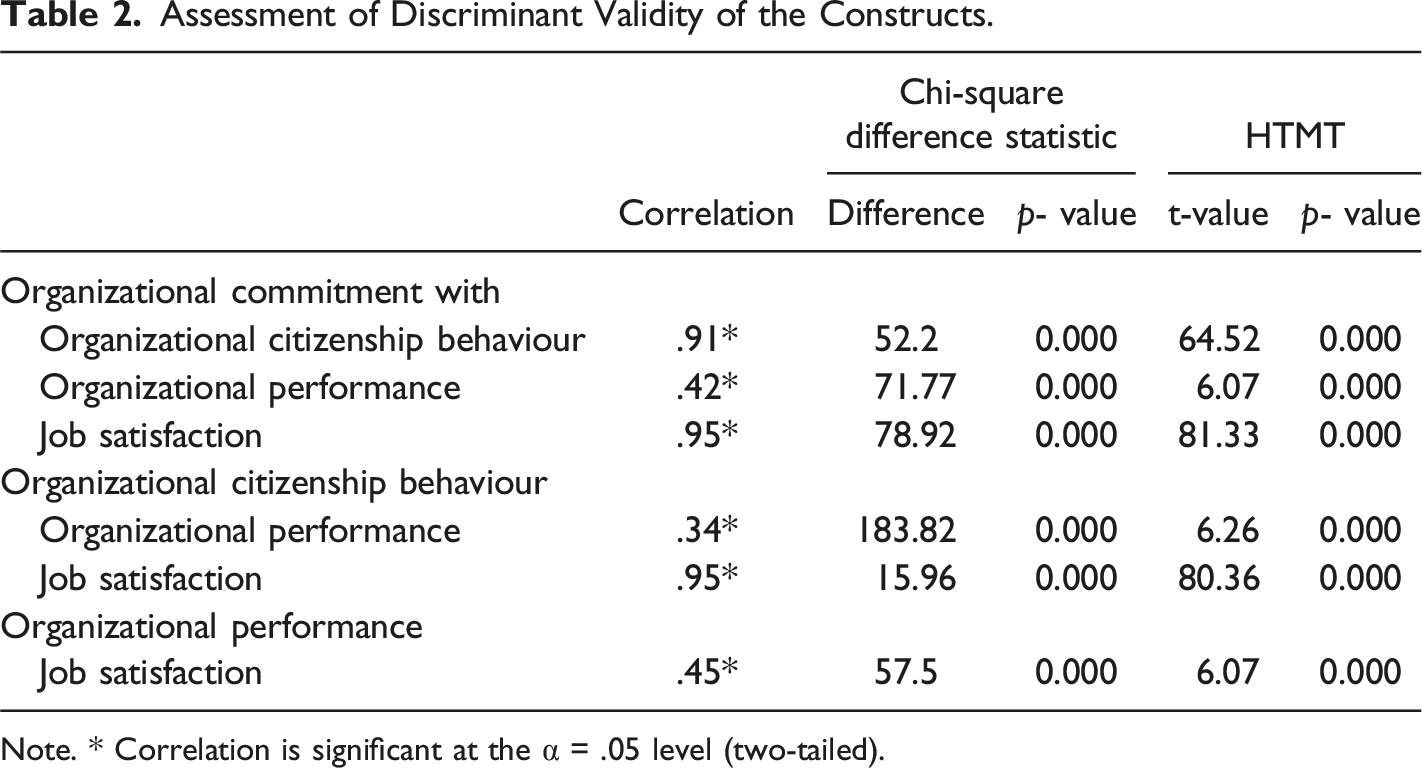
Note. * Correlation is significant at the α = .05 level (two-tailed).
Convergent Validity
To evaluate the convergent validity of reflective construct, researchers consider the loadings of the indicators and the average variance extracted (AVE)” (Hair Jr, Hult, Ringle, & Sarstedt, 2016, p. 113). Average Variance Extracted (AVE) scores and confirmatory factor analysis (CFA) were used to assess convergent validity.
The AVE values, as presented in Table 1, were AVEJS = .70, AVEOC = .74, AVEOCB = .66 and AVEOP = .74. According to the accepted guideline, a construct should account for at least 50% of the variance of its indicators, hence, all three constructs demonstrated satisfactory convergent validity.
By utilizing the CFA (Confirmatory Factor Analysis) methodology for assessing convergent validity, the model’s χ2 was found to be significant (χ2 (74) = 173.7375.78, p < .001). The model’s fit indices, χ2/df = 2.29, RMSEA = 0.059, NFI = .98, NNFI = 0.99, RFI = .98, were either equal to or exceeded the suggested minimum thresholds of χ2/df < 3.0, RMSEA <0.08, NFI >.95, NNFI>0.95, RFI >.95, indicating a good fit. The standardized loadings for the indicators varied from lx = 0.53 to lx = 0.93, all of which were statistically significant (t–values >2.576; p < .01). This evidence, in tandem with the previously mentioned high inter-item correlations, substantiates the convergent validity of the indicators utilized for measuring the constructs in this study.
Discriminant Validity
To evaluate discriminant validity of each of the constructs, we employed two specific tests: the Heterotrait-Monotrait Ratio (HTMT) and the Chi-square difference test.
The HTMT is the ratio of inter-construct correlation (between-trait) to the average correlations among items that measure the constructs (within-trait). To provide a confidence interval (5% and 95%), we used a bootstrap sample. If the confidence interval of the bootstrapped ratio includes the value 1 (i.e., if the ratio of the inter-construct to the inner-construct correlation is =>1) and thus the associated p-value >.05, discriminant validity is not present. The HTMT test results in Table 2 are all significant, suggesting that all the study’s latent constructs demonstrate discriminant validity.
The second test, the Chi-square difference test, was also used: By setting/constraining the correlation between pairs of constructs to 1.0 and then re-estimating the constrained model (Segars & Grover, 1993), we can assess discriminant validity between latent variables. This technique essentially transforms a two-construct latent variable model into a single-construct model. If the chi-square estimate difference between the unconstrained and constrained models is significant (1 df), it demonstrates discriminant validity. As shown in Table 2, all chi-square difference tests were significant, indicating discriminant validity exists between all latent variables.
Consequently, both HTMT and Chi-square difference tests suggest that discriminant validity is present among all four latent variables (JS, OC, OCB, and OP), with each measuring a distinct construct.
Model and Hypotheses Testing
When using SEM, the model’s overall fit needs to be first established, prior to assessing the study’s hypotheses (Bollen & Long, 1993). The chi-square statistic was significant (χ2 = 440.46, df = 167, p < .01). In relation to the fit indices, both the ratio χ2/df (173.72/74) and RMSEA yielded values of 2.63 and 0.066, respectively, which are under the suggested limit of 3.00 and 0.08 (Chau, 1997). Fit indices such as NFI = .98, NNFI = .99, RFI = .98 all exceeded the minimum threshold of 0.95 (Chau, 1997). Consequently, we can deduce that the model illustrated in Figure 2 provides a reasonable fit. Testing the proposed TEPB model.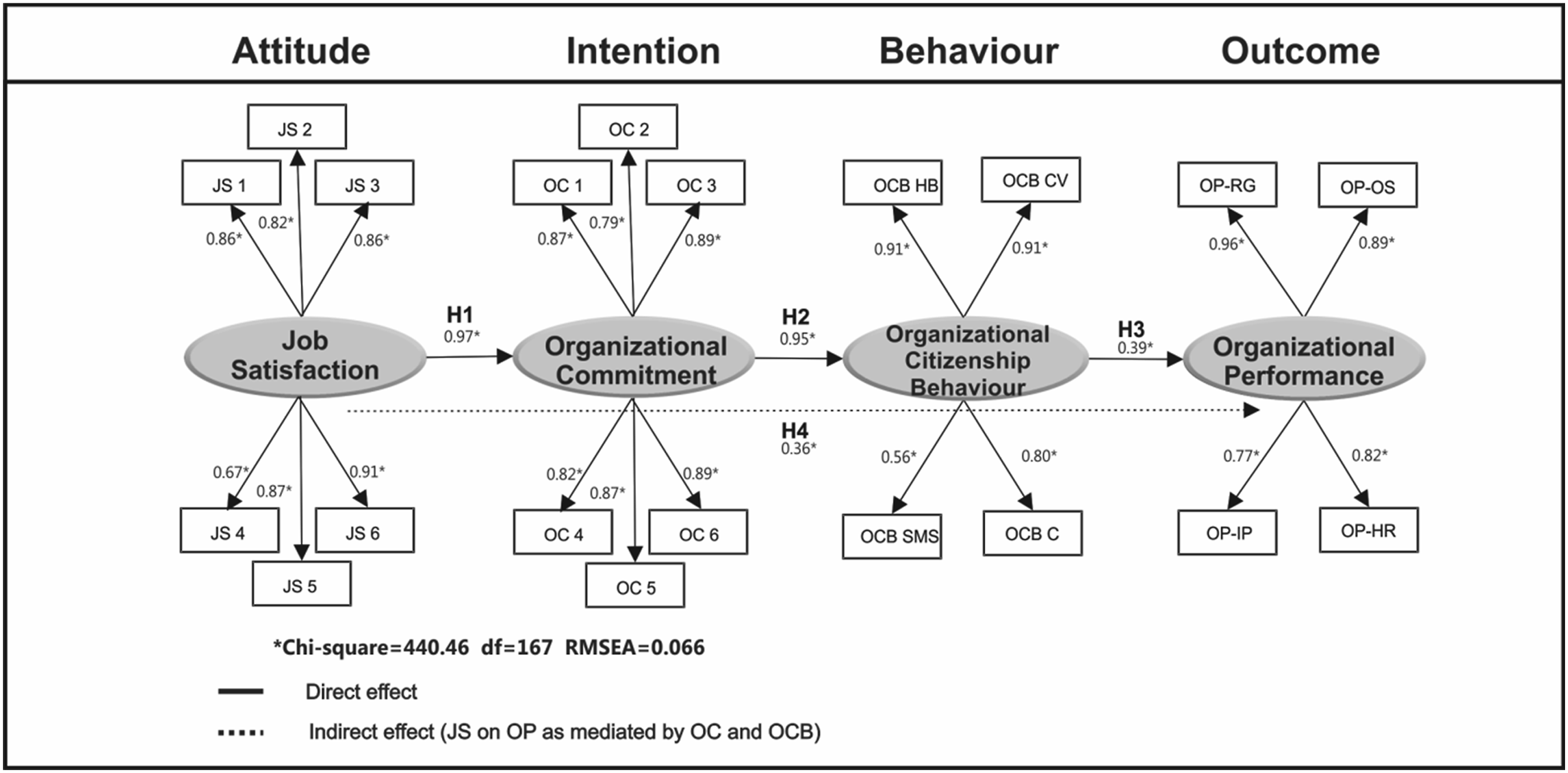
The test of the proposed hypotheses is derived from the direct effects of the SEM depicted in Figure 2. The coefficients connecting the constructs represent the relative strength of each relationship (Jöreskog & Sörbom, 1993). Each hypothesis was scrutinized at the p < .05 level of significance. All 20 measurement variables demonstrated significant loadings (p < .05) on their corresponding constructs (JS, OC, OCB, and OP), as can be seen in Figure 2.
The first hypothesis (H1) postulates a positive influence of job satisfaction on organizational commitment. As demonstrated in Figure 2, the pathway connecting these constructs was both positive and significant (standardized β1 coefficient = 0.97; t-value = 23.33, p < .05), hence strongly supporting H1. It suggests a correlation between elevated job satisfaction and increased levels of employee organizational commitment.
The second hypothesis (H2) purports a positive influence of organizational commitment on organizational citizenship Behavior. As displayed in Figure 2, the pathway between these two constructs was positive and significant (standardized β2 coefficient = 0.91; t-value = 21.22, p < .05), thus lending solid support to H2. This points to an association between a heightened level of organizational commitment and increased levels of employee organizational citizenship Behavior.
The third hypothesis (H3) suggests a positive influence of organizational citizenship Behavior on organizational performance. As depicted in Figure 2, the pathway linking these constructs was positive and significant (standardized β3 coefficient = 0.95, t = 3.37, p < .05), thereby strongly backing H3. Hence, increased levels of organizational citizenship Behavior correlate with heightened organizational performance.
The fourth hypothesis (H4) implies that job satisfaction indirectly positively influences organizational performance through the mediation of organizational commitment and organizational citizenship Behavior. The indirect effect of this hypothesis (JS on OP mediated through OC and OCB) was found to be positive and significant (β1-2-3 coefficient = 0.36, t = 3.24, p < .05). This suggests a correlation between higher levels of job satisfaction and indirectly increased organizational performance.
Our examination of direct effects, such as the impact of job satisfaction on organizational citizenship behavior (OCB) and organizational performance, yielded non-significant results. This contrasts with existing literature, like Organ (1988) and (Smith et al., 1983), which have shown direct impacts of job satisfaction on these outcomes. Such divergence necessitates a deeper exploration of the unique dynamics within our study’s public sector context, particularly at the county-level government institutions. The distinct motivational drivers and constraints in the public sector, as opposed to private corporations, could explain the lack of direct effects observed. For example, the regulatory and bureaucratic nature of government work might moderate the relationship between job satisfaction and OCB or performance.
Furthermore, our findings suggest that the influence of job satisfaction on OCB and performance is entirely mediated by organizational commitment, indicating a more complex interaction than direct causation. This is in line with the TEPB model’s framework, which posits that job satisfaction leads to organizational commitment, subsequently influencing OCB and affecting organizational performance.
Additionally, the potential impact of unobserved variables not included in our model, such as individual differences, leadership style, or workplace culture, should be considered. These factors might exert a moderating or mediating influence on the studied relationships. Given these findings, models suggesting partial mediation were not supported. Consequently, our study confirms a total mediation process, strongly endorsing the TEPB model and its hypotheses (1 through 4), as illustrated in Figure 2.
Discussion
This article presents the theory of employee planned Behavior (TEPB) model which was operationalized (presented in Figure 1) from Ajzen’s (1991) theory of planned Behavior (TPB) with the construct organizational performance being added as a final outcome variable. This model was tested using data from two related co-collected datasets (leader and follower) and based on their leader-follower dyad relationship. The first dataset measured the organizational performance as indicated by the leaders (CEO’s) of the individual public organizations, while the second measured job satisfaction (TEPB attitude), organizational commitment (TEPB intention), organizational citizenship Behavior (TEPB Behavior) as reported by individual followers (subordinates) associated with each leader in the first dataset. Using this leader-follower dyad as the unit of analysis, the corresponding two datasets were required because the leaders were the best choice to estimate their organization’s performance while the followers were the best choice to indicate their own levels of job satisfaction, organizational commitment, and organizational citizenship behaviours.
The constructs of job satisfaction (JS), organizational commitment (OC), organizational citizenship behavior (OCB), and organizational performance (OP), as investigated in this study, demonstrated impressive psychometric properties. This robustness is indicated by their high internal consistency, with all constructs exhibiting Cronbach’s alpha values greater than 0.85, a threshold commonly recommended for acceptable reliability (Nunnally & Bernstein, 1994). Such high internal consistency suggests that the items within each construct are homogenous and effectively measure the same underlying concept.
Furthermore, the high inter-item and inter-scale correlations indicate that not only do items within each construct correlate well with each other but also that the different constructs relate to each other in meaningful ways. This interrelationship is crucial, as it underpins the theoretical framework suggesting that these constructs are interconnected in the process of influencing organizational performance. The strong convergent validity, as demonstrated by the high average variance extracted (AVE) values for each construct, reinforces the idea that the items within each construct converge to measure the concept they are intended to (Fornell & Larcker, 1981).
Discriminant validity, on the other hand, was established by ensuring that the constructs were distinct from one another, a fundamental aspect of construct validity (Campbell & Fiske, 1959). This was evidenced by the Heterotrait-Monotrait Ratio (HTMT) and Chi-square difference tests, confirming that each construct measured a different aspect of organizational behavior.
The Structural Equation Modeling (SEM) used in this study demonstrated good model fit, indicating that the theoretical model adequately represents the data. This fit is crucial for validating the proposed theoretical framework (Kline, 2011). Each of the 20 measurement variables significantly loaded onto their corresponding constructs, further cementing the reliability and validity of the model.
The direct and indirect relationships among the constructs in our study were rigorously analyzed and found to be significant, revealing a comprehensive pathway from individual attitudes to organizational outcomes. This pathway elucidates how job satisfaction (JS) directly impacts organizational commitment (OC), which in turn influences organizational citizenship behavior (OCB), eventually leading to enhanced organizational performance (OP).
Job satisfaction, conceptualized as an employee’s attitude towards their job, plays a foundational role in this model. It is characterized not just by a general sense of contentment but also by deeper elements such as engagement, fulfillment, and alignment with one’s values and goals. The significance of job satisfaction in influencing organizational commitment is well-documented in organizational behavior literature (Judge et al., 2001). Our findings corroborate this link, illustrating that when employees are satisfied with their jobs, they develop a stronger psychological attachment to their organization, leading to a higher level of commitment. This commitment, as defined in our study, encompasses more than just an intention to remain with the organization; it also includes a willingness to go above and beyond in one’s role, aligning with the concept of affective commitment described by Allen and Meyer (1990).
Organizational commitment then serves as a crucial intermediary, fostering organizational citizenship behaviors. OCBs are discretionary in nature and not explicitly rewarded or recognized by the formal reward system, yet they play a vital role in the functioning of an organization (Organ, 1988). These behaviors include acts of altruism, civic virtue, sportsmanship, and courtesy, which, although not part of formal job descriptions, significantly contribute to the social and psychological environment of the workplace. The link between OC and OCB is a critical finding of our study, supporting the notion that emotionally attached and committed employees are more likely to engage in behaviors that benefit the organization as a whole (Meyer & Allen, 1991).
The culmination of this process is observed in enhanced organizational performance (OP). In this context, organizational performance is viewed as a broad construct that encompasses various dimensions, including productivity, efficiency, and overall effectiveness. The pathway suggests that satisfied employees, who are committed to their organization, engage in citizenship behaviors that collectively enhance the overall performance of the organization. This final link in the model highlights the importance of managing employee attitudes and satisfaction as a strategy for improving organizational outcomes, resonating with the findings of researchers like Harter et al. (2002), who have demonstrated the critical impact of employee attitudes on various dimensions of organizational performance.
The TEPB model elucidates this sequential process effectively, demonstrating how an employee’s attitude (JS) affects their intention (OC), which elicits behavior (OCB) that results in the final outcome (OP). This sequential mediation is a significant contribution to the field, providing a comprehensive framework to understand the dynamics of employee behavior and its impact on organizational outcomes, echoing the sentiments of Ajzen’s (1991) theory of planned behavior and extending it to the organizational context.
Overall, the TEPB model, as supported by our study, provides a nuanced understanding of how job satisfaction impacts organizational outcomes through a series of mediating factors. This comprehensive pathway from job satisfaction to organizational performance, mediated by organizational commitment and citizenship behavior, offers valuable insights for both researchers and practitioners in the field of organizational behavior and management.
Implications, Limitations and Future Research, and Conclusions
Theoretical Implications
Our study contributes to theory in several ways. First, the study extends the Theory of Planned Behavior (TPB) by integrating job satisfaction as a key antecedent to organizational commitment and citizenship behaviors, culminating in organizational performance. This integration enriches the TPB by highlighting the role of employee attitudes in predicting organizational behaviors, a connection less emphasized in traditional models.
Second, by empirically testing and validating the TEPB model, this study contributes to the theoretical advancement in the field of organizational behavior. It demonstrates the utility of TEPB in explaining the complex interplay between individual attitudes and organizational outcomes, thus establishing it as a valuable framework for future research.
Third, the study bridges the gap between individual-level psychological constructs (job satisfaction, organizational commitment) and organizational-level outcomes (OCB, organizational performance). This multi-level approach provides a more holistic understanding of organizational dynamics, challenging the traditional siloed perspective of individual and organizational studies.
Fourth, the study contributes to the understanding of how and why certain individual-level attitudes translate into organizational-level outcomes. By identifying the mediating roles of organizational commitment and citizenship behaviors, it provides a deeper insight into the mechanisms driving organizational performance.
Fifth, this study paves the way for future research utilizing the leader-follower dyad methodology. This approach enables a more accurate assessment of constructs such as organizational performance and job satisfaction, as it relies on the perspectives of those best positioned to evaluate them — leaders (e.g., CEOs) for organizational performance, and employees (followers) for job satisfaction. This methodological choice addresses a common limitation in organizational research where often a single respondent is asked to assess constructs outside their direct experience, such as leaders estimating employee job satisfaction. By employing a dyadic approach, our research minimizes this issue, offering a more reliable and valid assessment of the constructs of interest.
In essence, this research not only extends the TPB but also introduces a more refined and empirically robust model in TEPB, setting a new precedent for future investigations in organizational behavior and psychology. The integration of SEM and the leader-follower dyad methodology in this study marks a significant step forward in understanding the complex interplay of individual attitudes and organizational outcomes.
Practical Implications
For those in practice, this study provides a proven and verified conceptual model (theory of employee planned Behavior - TEPB). This model visually represents and elucidates the mechanism through which job satisfaction fosters enhanced organizational output. In particular, the TEPB framework successfully demystifies how the attitude of a Behavior, such as job satisfaction, influences intention (here, organizational commitment), which in turn prompts the subsequent Behavior (in this case, organizational citizenship Behavior), eventually leading to the final outcome (organizational performance). By understanding this process, managers can incorporate several strategies that leaded to improved organizational outcomes.
First, recognizing the pivotal role of job satisfaction in driving organizational outcomes, organizations can prioritize strategies to enhance employee satisfaction. This could involve improving work conditions, ensuring fair compensation, offering career development opportunities, and fostering a positive organizational culture.
Second, given the mediating role of organizational commitment, organizations can develop initiatives to strengthen the emotional and psychological attachment of employees. This could include employee recognition programs, transparent communication policies, and opportunities for meaningful participation in decision-making processes.
Third, organizations can encourage behaviors that go beyond the call of duty but significantly contribute to the organizational climate and performance. This might involve creating an environment that recognizes and values such behaviors, encouraging teamwork and collaboration, and providing support for employee initiatives.
Fourth, human resource management can align its practices and policies to foster job satisfaction, organizational commitment, and citizenship behaviors. This alignment includes performance management systems, training and development programs, and leadership development initiatives.
Finally, the TEPB model can serve as a diagnostic tool for identifying areas of improvement within organizations. For instance, a lack in organizational performance could be traced back to issues in employee satisfaction or commitment, guiding targeted interventions.
Limitations and Future Research
This study, while contributing significantly to the field of organizational behavior, is subject to certain limitations that present avenues for future research. Firstly, the reliance on self-reported data, a common approach in behavioral studies, can introduce biases like social desirability or response bias. Future studies might benefit from incorporating more objective measures, such as performance metrics, or using a triangulated approach to validate self-reported data. Additionally, the cross-sectional design of our research limits our ability to establish causality. Longitudinal or experimental designs in future studies could provide a more robust understanding of the causal relationships between the constructs.
Another limitation lies in the focus on county-level government institutions in the United States, which may limit the generalizability of findings to other sectors or cultural contexts. Expanding the scope of research to different industries or international settings could enhance the external validity of the findings.
Furthermore, our study, while comprehensive, did not include constructs such as leadership style, organizational culture, or external environmental factors, which could have significant impacts on the studied relationships. Future research should aim to include these variables for a more holistic understanding.
The exclusion of subjective norms and perceived behavioral control from the TPB model in our study also suggests an area for further exploration. Including these constructs could offer a more complete application of the TPB in organizational settings. Additionally, while the mediation relationships identified in our study are significant, exploring alternative or multiple mediation models could reveal additional insights. This could involve examining different pathways or the potential for nested or sequential mediation effects.
The use of the leader-follower dyad approach, though innovative, presents its challenges, such as accounting for potential power dynamics influencing responses. Refining this methodology in future studies or exploring other dyadic approaches could help overcome these limitations. Moreover, the generalizability of our findings across different levels of management and non-management employees remains an open question. Investigating these relationships across various organizational hierarchies could yield valuable insights.
Given the changing dynamics of the modern workplace, particularly the rise in remote work and rapid technological advancements, present a unique context for further research. The shift towards remote work has altered traditional work environments and employee interactions, potentially impacting factors like job satisfaction, organizational commitment, organizational citizenship behavior (OCB), and overall organizational performance. Future studies could investigate how remote working arrangements and the integration of advanced technology in the workplace influence these constructs. For instance, research could explore whether remote work enhances or diminishes job satisfaction and how virtual communication tools impact the development of organizational commitment. Additionally, examining the expression of OCB in remote settings and its effect on team dynamics and productivity could yield valuable insights. Understanding these dynamics is crucial for organizations aiming to adapt effectively to the evolving work landscape.
Finally, the application of advanced statistical techniques, the use of multi-level modeling or machine learning algorithms offers promising avenues for exploring complex datasets in organizational studies. Multi-level modeling can effectively analyze data with hierarchical structures, such as employee responses nested within different organizational levels or departments. This approach can provide a more nuanced understanding of how individual-level factors interact with group or organizational-level dynamics. On the other hand, machine learning algorithms can handle large and complex datasets, identifying patterns and relationships that traditional statistical methods might overlook. These techniques can be particularly useful in uncovering subtle but significant insights into how individual attitudes and behaviors aggregate to impact organizational outcomes. For instance, machine learning can help identify unique clusters of employee attitudes or behaviors and predict their implications for organizational performance. By leveraging these advanced techniques, future research can deepen our understanding of organizational behavior, providing more sophisticated tools for analyzing and interpreting the intricate web of factors that drive organizational success in today’s data-rich environment.
Conclusions
This research, centered on the Theory of Employee Planned Behavior (TEPB), represents a significant advancement in the domain of organizational behavior. Initially motivated by the need to understand how job satisfaction influences organizational performance, particularly within county-level government institutions in the United States, the study successfully extends the Theory of Planned Behavior (TPB) by integrating organizational performance as a critical outcome variable.
In this study, the methodological rigor is evidenced through the use of Structural Equation Modeling (SEM) and a multi-source, multi-level approach. SEM, a powerful statistical technique, allows for the analysis of complex relationships between observed and latent variables. This approach is particularly effective in validating theoretical models like the Theory of Employee Planned Behavior (TEPB), as it can handle multiple relationships simultaneously and provide a comprehensive view of the interconnections among variables. The multi-source aspect of the methodology, involving data from both leaders and followers, ensures a broad perspective on the organizational phenomena under study, while the multi-level approach acknowledges the hierarchical nature of organizations. These methodological choices facilitate a robust examination of the proposed relationships, establishing a sequential pathway from job satisfaction to organizational commitment, then to organizational citizenship behavior (OCB), and finally to enhanced organizational performance. This clearly defined mediation pathway not only highlights the critical role of job satisfaction within organizational settings but also maps its influence on more complex organizational outcomes.
Theoretically, the operationalization and empirical validation of the TEPB model represent a significant expansion of the TPB framework. This research enriches the understanding of how individual-level attitudes, particularly job satisfaction, interact with and impact organizational performance. By successfully integrating and testing these constructs within the TEPB model, the study contributes a nuanced perspective to the organizational behavior literature. It offers a comprehensive framework that effectively captures the progression from individual attitudes, through organizational commitment and citizenship behaviors, to broader organizational impacts. This theoretical contribution is vital for advancing academic discourse in the field.
Practically, the implications of this study are far-reaching. It offers actionable insights for organizations aiming to enhance performance. The clear linkage established between job satisfaction and subsequent organizational outcomes provides a strategic focus for organizational interventions. By improving job satisfaction, organizations can cultivate greater commitment and citizenship behaviors among employees, leading to improved overall performance. This has direct implications for human resource strategies, leadership approaches, and organizational culture development.
In summary, this study significantly advances the understanding of the dynamics between individual attitudes and organizational outcomes. By extending the TPB to encompass organizational performance and empirically validating the TEPB model, the research fills a notable gap in existing literature. It lays a solid foundation for future research aimed at unraveling the complexities of organizational behavior and performance, offering valuable insights for both academic research and practical application in organizational settings.
Footnotes
Declaration of Conflicting Interests
The author(s) declared no potential conflicts of interest with respect to the research, authorship, and/or publication of this article.
Funding
The author(s) received no financial support for the research, authorship, and/or publication of this article.

Data Availability Statement
The datasets generated during and/or analyzed during the current study are available from the corresponding author on reasonable request.