




Abstract
Students reporting symptoms of posttraumatic stress disorder (PTSD) and depression are at increased risk for suicidal ideation, putting them at greater risk for suicidal behavior and attempts. Perceived social support is a robust protective factor against the impact of PTSD and depression on suicidal ideation in college students, however different forms of social support (family, friends, significant others) may have greater influence on this association. In the current study, the influence of the different types of perceived social support on the relationship between PTSD-depression symptoms and suicidal ideation in college students were examined. College students (N = 928; 71% female) were recruited in part of a cross-sectional survey study examining the role of mental health on education functioning. A hierarchical regression indicated that PTSD-depression symptoms (b = .27, p < .001) and perceived family support (b = −.04, p < .01) were significantly associated with current suicidal ideation, while perceived support from friends (b = −.02, p = .417) and significant others (b = −.01, p = .301) were not. Perceived family support interacted with PTSD-depression symptoms (b = −.03, p < .05) to weaken the positive influence of symptoms on current suicidal ideation. Perceived family support appears to be the significant component of social support that moderates the relationship between PTSD-depression symptoms and suicidal ideation. Future research should focus on strengthening family support as a potential mechanism to mitigate suicide risk among college students who may be away from their families for the first time.
Introduction
Suicide is the second leading cause of death for college-aged adults in the United States (Heron, 2021), and one in five college students experience suicidal ideation within the past year (Liu et al., 2019). Meta-analytic data and systematic analyses of the literature indicate there is a robust association between posttraumatic stress disorder (PTSD), depression, and suicide risk in college students (Krysinska & Lester, 2010; Li et al., 2020). Further, students with PTSD and depression symptoms are more likely to have prior suicide attempts and greater suicidal ideation (Kratovic et al., 2021), and PTSD and depression are also associated with greater risk for engaging in future suicidal behavior (Schafer et al., 2021; Wilcox et al., 2010). These data are concerning given 70% of college students report experiencing a potentially traumatic event, and prevalence rates for PTSD within this group are as high as 34.4% (Cusack et al., 2019). Depression is also common among college students, with past-year prevalence rates as high as 18.5% (Auerbach et al., 2018), and frequently co-occurs with PTSD (Rytwinski et al., 2013).
Through the lens of the Interpersonal Psychological Theory of Suicide Behavior (IPTSB; Joiner et al., 2005), PTSD symptoms, specifically numbing and hyperarousal, are linked to higher perceived burdensomeness, thwarted belongingness, and fearlessness of death (Pennings et al., 2017). Further, emotional numbing symptoms of PTSD, specifically detachment and estrangement from others, are associated with greater suicidal ideation in college students, even after accounting for depression and other PTSD symptoms (Davis et al., 2014). Symptoms of depression are also linked to greater perceived burdensomeness and thwarted belonging, resulting in greater suicidal ideation (Kleiman, Riskind, et al., 2014). These findings indicate perceptions of interpersonal relationships play a key role in of the association between PTSD, depression, and suicidal ideation and behavior.
Indeed, perceived social support is a robust protective factor against suicide (Bryan & Hernandez, 2013; Du et al., 2021; Hirsch & Barton, 2011), as people with greater perceived social support are less likely to attempt suicide in their lifetime (Kleiman & Liu, 2013). Separate studies show social support also buffers the impact of PTSD and depression symptoms on suicidal ideation in college students (Kleiman, Liu, et al., 2014; Lamis et al., 2016), however different forms of social support may have greater influence on this association than others. Out of three main sources of perceived social support (family, friends, and significant others), increased family support has been found to be the only significant predictor of reduced suicidal ideation in college students (Olatunji et al., 2020) and young adults with major depressive disorder (Ashbaugh et al., 2016). It is currently unknown what specific forms of perceived social support influence the relationship between PTSD, depression symptoms, and suicidal ideation in college students. A greater understanding of perceived social support in a multi-faceted manner may inform future targeted prevention efforts, as college initiatives can help facilitate strengthening of certain social support systems for their students.
The purpose of the current study was to examine the relative influence of different forms of perceived social support on the association between PTSD-depression symptoms and suicidal ideation in college students. Consistent with the prior literature, it was hypothesized that both PTSD-depression symptoms and perceived social support from family, but not friends or significant others, would be associated with current levels of suicidal ideation. Moreover, it was hypothesized perceived family support would interact with PTSD-depression symptoms, in that high perceived family support would buffer the effects of high PTSD-depression symptoms on suicidal ideation, whereas low family support would intensify the relationship between PTSD-depression symptoms and suicidal ideation.
Method
Participants & Procedures
Undergraduate students (N = 1100) enrolled at The University of Texas at San Antonio were recruited through the psychology subject pool, other psychology courses, and across the university campus for a study examining the impact of mental health symptoms on academic success. Eligible students were at least 18 years of age and willing to allow researchers access to their academic transcripts. Participants who completed the study received one research credit hour, extra credit in an amount determined by their instructor, or a $10 Amazon gift card if recruited via advertisements posted on campus. In keeping with criteria from the Diagnostic and Statistical Manual for Mental Disorders, fifth Edition (DSM-5; American Psychiatric Association, 2013), only those who endorsed experiencing a traumatic event were included in the sample for the current study (n = 972), such that symptoms reported on the PTSD-Checklist for DSM-5 (PCL-5; Weathers, Litz et al., 2013) could be conceptualized as potential PTSD symptoms. As gender was a covariate for analyses, participants who identified as non-binary (n = 16) were excluded from analyses as there were an insufficient number to make an adequate comparison. Additional participants (n = 11) were excluded from analyses for missing data due to listwise deletion and for not following instructions in completing the survey (n = 17). The final sample included 928 participants.
Measures
Demographics
Demographic characteristics, including age, gender, race, ethnicity, and college classification level were assessed via self-report.
Potentially Traumatic Experiences and PTSD Symptoms
The Life Events Checklist (LEC-5; Weathers et al., 2013) was used to identify participants who had experienced potentially traumatic events. The LEC-5 contains 17 items describing distressing events (e.g., motor vehicle accident, natural disaster, sexual assault), and participants indicate how they have experienced each event by selecting 1 (Happened to me) to 6 (Does not apply). The scale has good convergent validity with other measures of trauma (Gray et al., 2004).
The PCL-5 consists of 20 items assessing the severity of PTSD symptoms according to DSM-5 criteria (Weathers, Litz et al., 2013). Participants rate the extent to which they were bothered by symptoms in the past month on a scale from 0 (Not at all) to 4 (Extremely). Example items include “Avoiding memories, thoughts, or feelings related to the stressful experience?”, “Trouble remembering important parts of the stressful experience?”, and “Being “superalert” or watchful or on guard?”. A total score ≥ 31 was used as a cut-off to determine probable PTSD (Ashbaugh et al., 2016). The scale has excellent psychometric properties within college students (Blevins et al., 2015). Cronbach’s alpha for the current study was .95.
Depression Symptoms
The Patient Health Questionnaire 9 (PHQ-9; Kroenke et al., 2001) contains nine items to assess depression symptom severity, where participants indicate symptoms experienced in the past 2 weeks. Example items include “Feeling down, depressed, or hopeless”, “Feeling tired or having little energy”, and “Little interest or pleasure in doing things”. Students with a total score ≥10 met criteria for probable depressive disorder (Manea et al., 2012). Item 9 (“Thoughts that you would be better off dead, or of hurting yourself”) was excluded to avoid overlap with the suicidal ideation outcome variable (r = .67, p < .001). Cronbach’s alpha for the 8-item scale in the current study was .91.
Social Support
The Multidimensional Scale for Perceived Social Support (MSPSS; Zimet et al., 1988) was used to assess the levels of perceived social support. The scale 12 items that assess perceived support from family, friends, and significant others, examples include “I can talk about my problems with my family,” “My friends really try to help me,” and “There is a special person in my life who cares about my feelings.”. Higher scores on each subscale indicate greater perceived social support. The subscales demonstrate an excellent internal consistency within college students (Ermis-Demirtas et al., 2018; Zimet et al., 1988), and Cronbach’s alphas for each of the subscales in the current study were .94 for family support, .94 for friend support, and .95 for significant other support.
Current Suicidal Ideation
The Depression Severity Index – Suicidality Subscale (DSI-SS; Joiner et al., 2002a, 2002b) self-report scale contains four items that describe thoughts, planning, and urges to attempt suicide in the past 2 weeks. Scores on each item range from 0 to 3, with greater scores indicating greater levels of suicidal ideation. Participants select the answer choice that applies to them; example choices include “I do not have thoughts of killing myself”, “Sometimes I have thoughts of killing myself”, “Most of the time I have thoughts of killing myself”, and “I always have thoughts of killing myself”. The scale has a good internal consistency (Joiner et al., 2002a, 2002b), and Cronbach’s alpha for the current study was .92.
Data Analysis
Analyses were conducted in SPSS version 25. Given that PTSD and depression symptoms were highly correlated in the current study (r = .68, p > .001), a composite factor for PTSD-depression symptoms was created using principal components analysis (PCA). The PCA results indicated PCL-5 and PHQ-9 total scores both loaded highly onto a single factor (.92 for both measures); factor scores were then used to represent PTSD-depression symptoms as a predictor in the hierarchical regression analysis (DeBeer et al., 2014). In addition, due to elevated skewness (2.48, SE = .08) and kurtosis (6.25, SE = .160) present in the distribution DSI-SS total scores, data were log-transformed. Continuous variables were mean-centered (with exception of the PTSD-depression factor scores), and interaction terms were derived from the product of PTSD-depression factor scores with each of the mean-centered MPSS subscale scores. Gender served as covariate to account gender differences in PTSD, depression symptoms, and suicidal ideation (Boyraz et al., 2015; Brownson et al., 2011).
Results
Sample Characteristics.
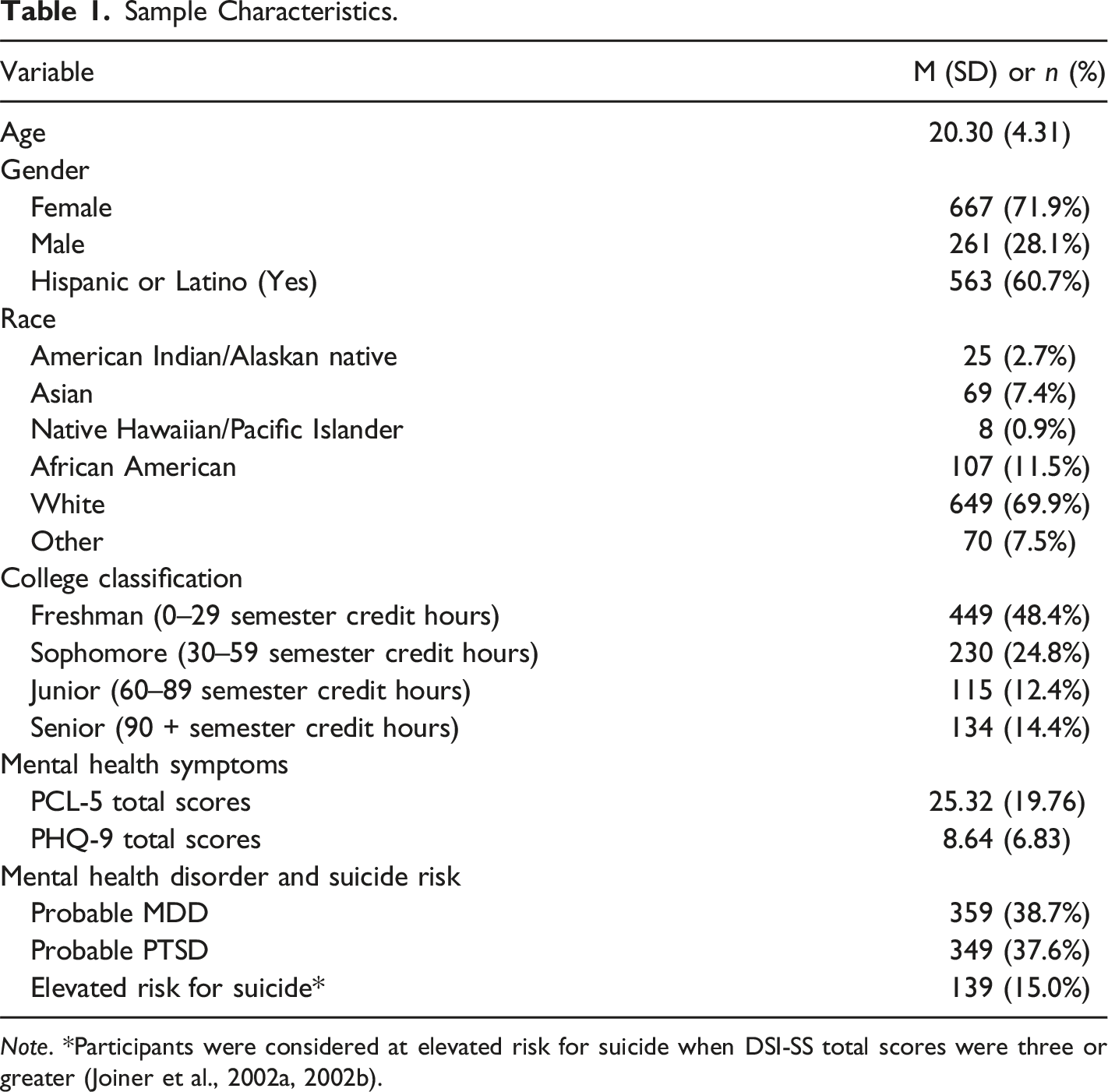
Note. *Participants were considered at elevated risk for suicide when DSI-SS total scores were three or greater (Joiner et al., 2002a, 2002b).
Predictors of Suicidal Ideation Using Hierarchical Regression.
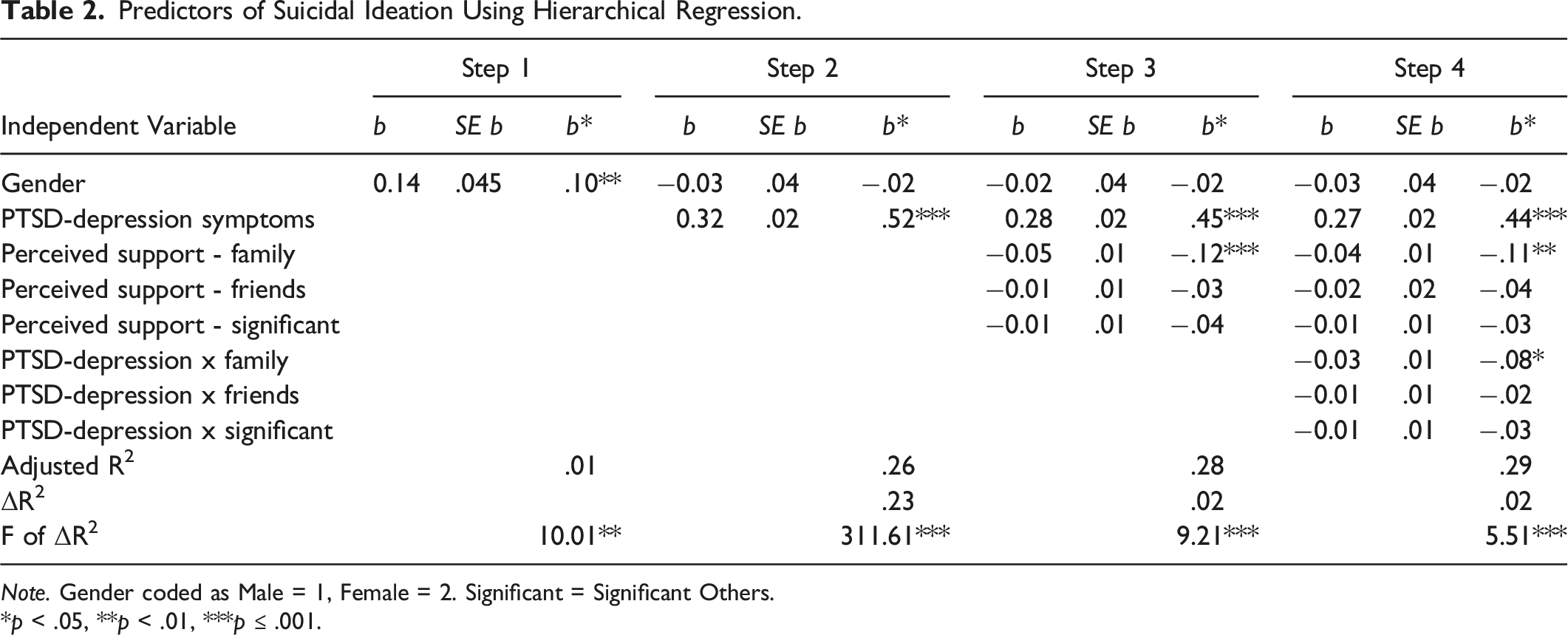
Note. Gender coded as Male = 1, Female = 2. Significant = Significant Others.
*p < .05, **p < .01, ***p ≤ .001.
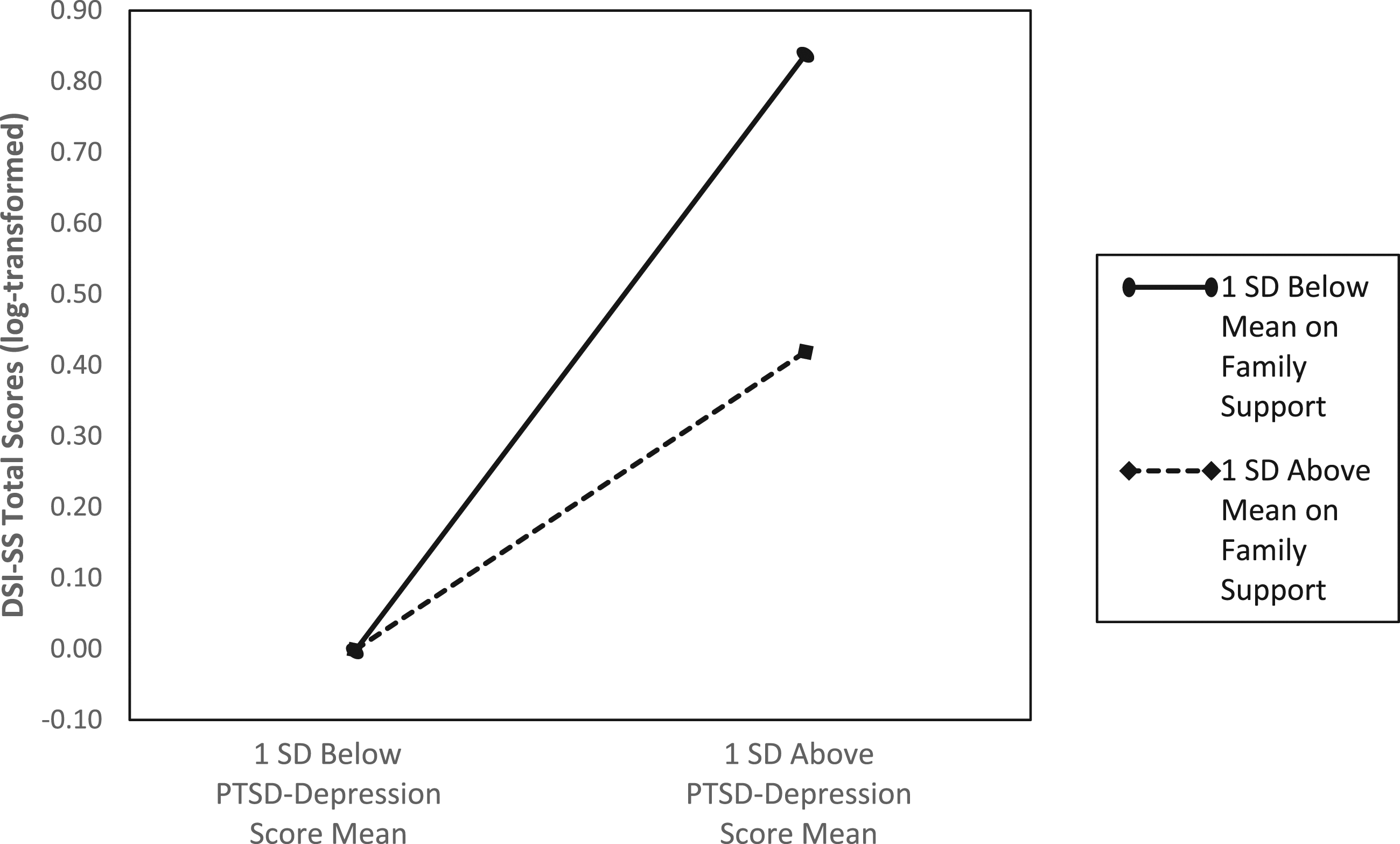
Plot depicting family support x PTSD-depression symptoms interaction predicting current suicidal ideation among college students. Note. Plot depicting family support x PTSD-depression symptoms interaction predicting current suicidal ideation among college students.
Discussion
The current study examined the protective influence of different subtypes of perceived social support on the association between PTSD-depression symptoms on current suicidal ideation in a diverse sample of college students. Results indicated that greater perceived family support was significantly associated with lower ideation, while perceived support from friends and significant others were not. This finding aligns with previous evidence that greater perceived family support is uniquely associated with lower suicidal ideation in college students (Olatunji et al., 2020).
Family support, but not other forms, also interacted with PTSD-depression symptoms. In the context of high PTSD-depression symptoms, students with greater perceived family support had lower suicidal ideation. By contrast, those with high PTSD-depression symptoms but low perceived family support had the highest suicidal ideation. Thus, perceived family support buffered the effects of PTSD-depression on suicidal ideation, suggesting this may be a key point of intervention for suicide prevention among college students. The results also provide additional evidence in support of clinical interventions built to target social impairments in persons with PTSD. For example, participation in Acceptance and Commitment Therapy to Improve Social Support in Veterans with PTSD (ACT-SS), a form of acceptance and commitment therapy specifically built to treat avoidance of social interactions and encourage acceptance of discomfort associated with social experiences, is associated with greater improvements in the quality of social relationships, engagement in social activities, and PTSD symptoms in comparison to participation in present-centered therapy (Kelly et al., 2022).
Perceived family support may be a unique protective factor due to possible differences in the stability of support, and other associated forms of support families can provide. Family support is often more consistent over a person’s lifetime, while relationships between friends and significant others may fluctuate for students entering college. Perceived family support could also be associated with greater financial support and reduced financial stress, as college student financial stress predicts increased odds of engaging in suicidal ideation, planning, and attempts (Assari, 2018). Families may also be able to provide tangible support more readily (i.e., access to material resources and handling of responsibilities), in turn buffering the influence of emotional distress on suicidal ideation (Bryan & Hernandez, 2013). Further research is needed to determine what properties of family support are key to influencing the relationship between mental health symptoms and suicidal ideation.
Perceived family support may be a strong protective factor given the current study’s predominately Hispanic sample. Hispanic and Latin people endorse greater familism (i.e., reverence of the family and emphasis on warm family relationships) than other ethnicities (Sabogal et al., 1987), and familism is associated with greater psychological health through greater perceived social support (Campos et al., 2014). Future research should assess how this cultural value interacts with perceived family support to influence PTSD-depression symptoms and suicidal ideation.
The current study addressed a critical gap in suicide literature by examining how subtypes of social support contributed to the relationship between PTSD-depression symptoms and suicidal ideation. In addition, the study findings have greater generalizability via using an ethnically diverse sample of college students, particularly to Hispanic and Latin college students. This study is not without limitations. These include the reliance on self-report measures in assessing mental health symptoms rather than diagnostic interviews. Further, the cross-sectional nature of the study limits inferences on causality in the relationship between PTSD-depression symptoms and suicidal ideation. Further, although suicidal ideation is highly associated with suicidal attempts (McHugh et al., 2019), suicidal attempts were not assessed. Extensions of this work would benefit from observing how fluctuations in perceived family support influence the relationship between mental health and suicidal ideation and behavior over students’ academic careers.
Footnotes
Declaration of Conflicting Interests
The author(s) declared no potential conflicts of interest with respect to the research, authorship, and/or publication of this article.
Funding
The author(s) disclosed receipt of the following financial support for the research, authorship, and/or publication of this article: This research was supported in part by the the University of Texas at San Antonio, Office of the Vice President for Research, Economic Development, and Knowledge Enterprise (Internal Research Award (NTRA)).

Author Biographies