




Abstract
Suicide has become one of the most important causes of death among college students, and thus it is essential to explore its risk factors and interventions. In this study, we investigated the effect of impostor syndrome on suicidal ideation and its mechanisms. A sample of 1,897 Chinese college students participated in the study (57.1% females; Mage = 19.92; SD = 1.50) and completed a series of related questionnaires at two time points with a six-month interval in the context of COVID-19. The results showed that impostor syndrome positively predicted suicidal ideation, and depressive symptoms mediated this effect. In addition, both family support and friend support weakened the prediction of depressive symptoms by impostor syndrome, but only family support weakened the prediction of suicidal ideation by depressive symptoms. These findings suggest that impostor syndrome may lead to serious consequences, but social support could be an effective intervention.
Introduction
Suicide is a global public health problem, with nearly 800,000 people dying by suicide each year across the globe (WHO, 2019). Early research has proven that suicidal ideation is an important predictor of suicidal behavior (Brown et al., 2000). Thus, it is important to identify the causes of suicidal ideation to prevent suicidal behavior. Based on the ideation-to-action framework, researchers have proposed several theories on suicidal ideation and suicidal behavior. Specifically, the Integrated Motivational-Volitional (IMV) model of suicidal behavior comprehensively explains the factors influencing suicidal ideation and the process from suicidal ideation to suicidal behavior (O’Connor & Kirtley, 2018).
The IMV model divides the emergence of suicidal behavior into pre-motivational phase, motivational phase, and volitional phase. The motivational phase is the key phase in the formation of suicidal ideation. In the motivational phase, defeat and humiliation lead individuals to develop feelings of entrapment and subsequently suicidal ideation. And these effects may be moderated by factors like social support and social problem-solving. The IMV model encompasses the mediating and moderating processes in the emergence of suicidal ideation and is extremely revealing for studying the mechanisms of suicidal ideation. The relationships among its core variables have been confirmed by numerous studies, but the role of some mild negative cognitions like impostor syndrome has received relatively less attention in the formation of suicidal ideation and should also be studied (Chelmari et al., 2019; Li et al., 2021; Ordóñez-Carrasco et al., 2021; Taylor et al., 2011).
The effect of impostor syndrome on suicidal ideation
Impostor syndrome was first identified by Clance and Imes (1978). Although “impostors” may be objectively successful, they believe that their achievements result from external factors (e.g., luck) and that their abilities do not match these achievements. Clance (1985) developed the Clance Imposter Phenomenon Scale (CIPS), which includes three dimensions: fear of failure, facing evaluation, and attribution to luck. This scale demonstrates strong internal consistency across clinical and non-clinical samples, with Cronbach's alpha ranging from 0.84 to 0.96. Luo (2009) translated and adapted the scale for the Chinese context, with empirical tests confirming its stable reliability and structural validity.
Impostor syndrome has some similarities to defeat, which refers to feelings of rejection and inability to deal with stresses in life (Tucker et al., 2016). Therefore, impostor syndrome may also predict the formation of suicidal ideation. College students often suffer from impostor syndrome, and the negative impact of impostor syndrome on their mental health has already received attention (King & Cooley, 1995). Impostor syndrome can cause individuals to feel depressed, trapped, and out of control (Kolligian & Sternberg, 1991). At the same time, people suffering from impostor syndrome see themselves as “deceivers.” As a result, they are often affected by numerous mental health issues (Gómez-Morales, 2021). Lester and Moderski (1995) found a significant association between impostor syndrome and suicidal ideation after controlling for variables such as depression. Related research also found that impostor syndrome predicted the development of suicidal ideation (Brennan-Wydra et al., 2021; Street & Lester, 2000). However, research on the effects of impostor syndrome on suicidal ideation in college students remains scarce, and there is a lack of exploration of its mechanisms (Bravata et al., 2020). Therefore, the present study sought to investigate the role of impostor syndrome on suicidal ideation.
The mediating role of depressive symptoms
In the IMV model, feelings of entrapment play a mediating role in the effect of defeat on suicidal ideation. Depressive symptoms, as a consequence of entrapment, may also play a role (Taylor et al., 2011). Numerous studies have demonstrated the effect of depressive symptoms on suicidal ideation (Liu, Han et al., 2023; Liu, Wang et al., 2023; Ribeiro et al., 2018).
Meanwhile, based on the IMV model and as discussed earlier, impostor syndrome, as a potential antecedent variable during the phase of suicidal ideation formation, may influence suicidal ideation through factors such as depressive symptoms, which involve pessimistic self-perceptions. Studies have demonstrated that impostor syndrome and depression are highly correlated (Sverdlik et al., 2020; Thomas & Bigatti, 2020). Higher impostor syndrome predicts higher levels of depressive symptoms (Liu et al., 2022). Similar results were also obtained in a network analysis study (Fimiani et al., 2021). In sum, depressive symptoms may mediate the effect of impostor syndrome on suicidal ideation.
The moderating role of social support
In addition to focusing on intra-individual factors, the IMV model also emphasizes the moderating role of external factors. Social support is considered as one of the most important motivational moderators (O’Connor & Kirtley, 2018). Social support is a resource from others that contributes to individuals’ mental health (Cohen & Syme, 1985). Cohen and Wills (1985) suggest that social support has a buffering effect that moderates the effects of stressful events on individuals’ psychology and behavior. Furthermore, research indicates a significant correlation between interpersonal factors and suicidal ideation (Li et al., 2023). Individuals are more likely to have positive attitudes and experience less entrapment when social support is present than when it is lacking (O’Connor & Kirtley, 2018).
However, the IMV model does not elaborate on the specific location of the role of social support. In other words, it remains worthwhile to explore whether social support can simultaneously buffer the effect of impostor syndrome on depressive symptoms and the effect of depressive symptoms on suicidal ideation. Previous research has shown that social support can mitigate a range of negative effects of impostor syndrome (Gottlieb et al., 2020). The predictive ability of depressive symptoms on suicidal ideation among college students was also diminished at high levels of social support (Lamis et al., 2016). Therefore, both paths may be moderated by social support.
Notably, social support can be categorized into different forms, such as family support and friend support. Some researchers found that only family support moderated the relationship between depression and suicidal ideation significantly (Brausch & Decker, 2014). Therefore, different types of social support may play distinct roles throughout the entire process of transitioning from mild negative cognitions to suicidal ideation. Furthermore, considering our data collection took place during the COVID-19 pandemic, participants’ direct contact with family members during home isolation was more prevalent than contact with friends. This may also lead to variations in the roles of family support and friend support. Nonetheless, studies that separately investigate the roles of different types of social support in such circumstances are relatively scarce. Thus, an exploratory study on the roles of various forms of social support within this mechanism is warranted.
The current study
In summary, although impostor syndrome is widespread among college students, there is little understanding of its possible impact (Holden et al., 2021). In addition, research on suicidal ideation in the context of the IMV model has paid little attention to moderating mechanisms (O’Connor & Portzky, 2018). Furthermore, most research has been cross-sectional, making it difficult to accurately assess the relationships between variables (O’Connor & Kirtley, 2018; Tucker et al., 2016). Therefore, the current study started with impostor syndrome, which is important but less previously focused on, and used a longitudinal research design to expand the understanding of the factors influencing suicidal ideation among college students.
Based on the IMV model and existing research, the current study aimed to validate the following two hypotheses and investigate whether family support and friend support play distinct moderating roles throughout the entire process.
Methods
Participants and procedure
Using the convenience cluster sampling method, we conducted the survey twice with a six-month interval at four universities at different developmental levels in China's central and southern provinces (Time 1 in October 2019; Time 2 in April 2020, when the COVID-19 pandemic was severe). Participants were drawn from all four years of the university, including both urban and rural households from different provinces and covering a range of family monthly income levels. The specific distribution is as follows: Less than ¥1,000 per month (117 participants, 6.2%), ¥1,000–¥3,000 per month (603 participants, 31.8%), ¥3,000–¥6,000 per month (631 participants, 33.3%), ¥6,000–¥10,000 per month (389 participants, 20.5%), ¥10,000–¥15,000 per month (97 participants, 5.1%), ¥15,000–¥20,000 per month (30 participants, 1.6%), and more than ¥20,000 (30 participants, 1.6%). We used the last four digits of the subject's mobile phone number plus the last four digits of their ID card number as a code to link the two waves of data, and the subject remained anonymous throughout the experiment. At Time 1, participants were asked to complete the questionnaires in the classroom using an online survey app under the guidance of a trained research assistant. At Time 2, due to the COVID-19 lockdown, participants were asked to complete the questionnaires using the same online survey app at home. In total, 4,647 students participated in the survey at Time 1 and 4,450 at Time 2. Hereinto, 1,897 students participated in both surveys, with 813 males (42.9%) and 1084 females (57.1%). The mean age of the participants was 19.92 (SD = 1.50; range 17 to 25) years. Class adjustments or suspensions are the main reasons for the loss of participants. No significant difference was found between the loss-to-follow-up participants and the general group for gender (χ2[1] = 3.32, p = .069), age at Time 1 (t[4645] = −1.67, p = .096), family monthly income at Time 1 (χ2[6] = 11.10, p = .085), and impostor syndrome at Time 1 (t[4645] = 1.08, p = .281). The research ethics committee of the first author's institution approved the study protocol. All participants signed informed consent and had the right to withdraw from the survey at anytime. Also, participants were told that school psychologists and teachers were available to provide follow-up psychological/counselling services they might need.
Measures
Impostor syndrome
The Chinese version of the Clance Impostor Phenomenon Scale (CIPS; Clance, 1985) was used to measure participants’ experience of impostor syndrome. The 20-item instrument is rated on a 5-point Likert-type scale ranging from 1 (strongly disagree) to 5 (strongly agree).
Social support
The Multidimensional Scale of Perceived Social Support (MSPSS; Zimet et al., 1988) was used to assess the participants’ subjective feelings of social support; this instrument shows good reliability and construct validity among Chinese populations (Chen et al., 2018; Chou, 2000). The 12-item inventory contains three dimensions indexing social support from family (4 items, α = 0.96), friends (4 items, α = 0.97), and others (4 items, α = 0.95). 1 The items were rated on a 7-point Likert-type scale ranging from 1 (very strongly disagree) to 7 (very strongly agree).
Depressive symptoms
The Center for Epidemiological Studies-Depression Scale (CES-D; Radloff, 1977) was used to assess participants’ depressive symptoms within the last week. The Chinese version was revised by Chen et al. (2009) and showed good reliability and construct validity among Chinese populations. For all 20 items, responses are rated on a 4-point Likert-type scale ranging from 0 (never) to 3 (always).
Suicidal ideation
The four-item suicidal ideation sub-questionnaire of the Hopeless Depression Symptom Questionnaire (HDSQ; Metalsky & Joiner, 1997) assessed participants’ suicidal ideation in the last six months. The scale showed good reliability and construct validity among Chinese populations (Yi & Feng, 2008). The items were rated on a 4-point Likert-type scale, with higher scores indicating more severe suicidal ideation. (Notably, the options for each of the four items differed. For item 1: 0 – I do not have thoughts of killing myself. 1 – Sometimes I have thoughts of killing myself. 2 – Most of the time I have thoughts of killing myself. 3 – I always have thoughts of killing myself.)
Statistical analysis
Data analysis was performed using IBM SPSS version 26.0. We first conducted descriptive statistics and correlation analyses. Second, the PROCESS macro for SPSS version 4.1 (Hayes, 2022) was used to test the mediation effect. PROCESS model 4 was used to fit the mediation model and model 58 was used to fit the moderated mediation model. Direct and indirect effects were estimated using 5,000-time bias-corrected bootstrapping techniques (Preacher & Hayes, 2004). A centering procedure was performed to alleviate non-essential multicollinearity between variables. All effects were examined after controlling for age, gender, and family monthly income.
Results
Descriptive statistics and correlations
Means, standard deviations, and intercorrelation among study variables are reported in Table 1. Impostor syndrome was positively associated with depressive symptoms and suicidal ideation, while family support and friend support showed a negative association with them. Additionally, gender, age, and family monthly income were significantly related to some of the study variables.
Means, standard deviations, and intercorrelation among all study variables.
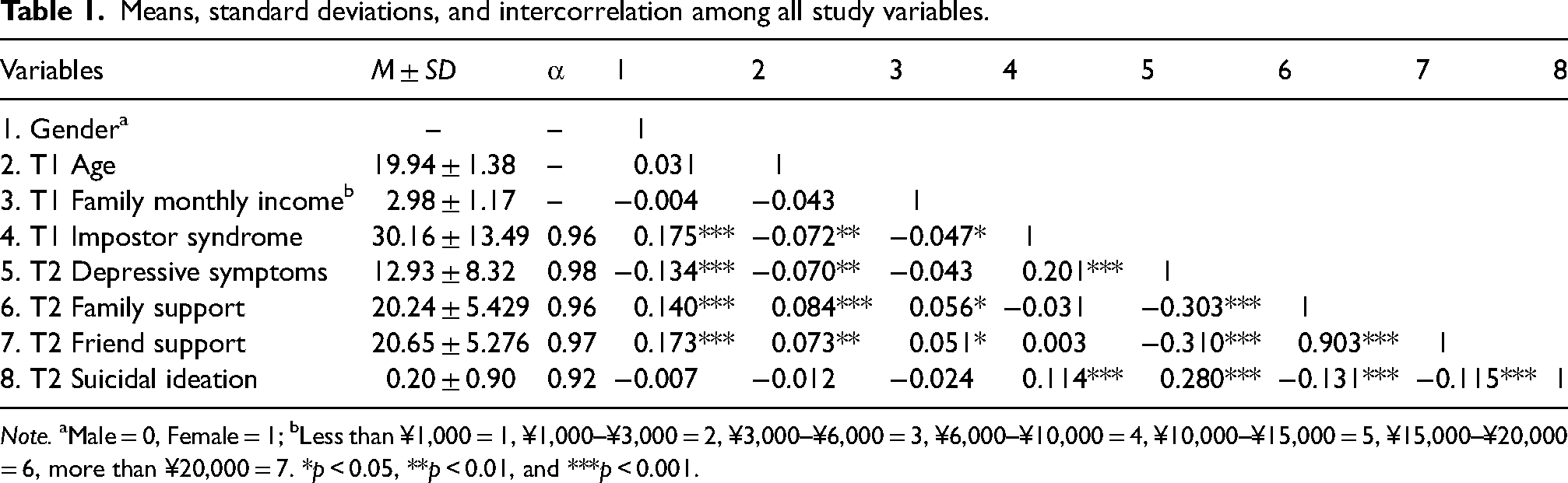
Note. aMale = 0, Female = 1; bLess than ¥1,000 = 1, ¥1,000–¥3,000 = 2, ¥3,000–¥6,000 = 3, ¥6,000–¥10,000 = 4, ¥10,000–¥15,000 = 5, ¥15,000–¥20,000 = 6, more than ¥20,000 = 7. *p < 0.05, **p < 0.01, and ***p < 0.001.
Preliminary mediation analysis
Both models predicting depressive symptoms (R2 = 0.073) and suicidal ideation (R2 = 0.082) demonstrated a good fit (see Table 2 and Figure 1). Specifically, impostor syndrome is positively associated with depressive symptoms and suicidal ideation. Depressive symptoms are positively associated with suicidal ideation. The indirect effect via depressive symptoms was significant (B = 0.004, SE = 0.001, 95% CI = [0.003, 0.006]).
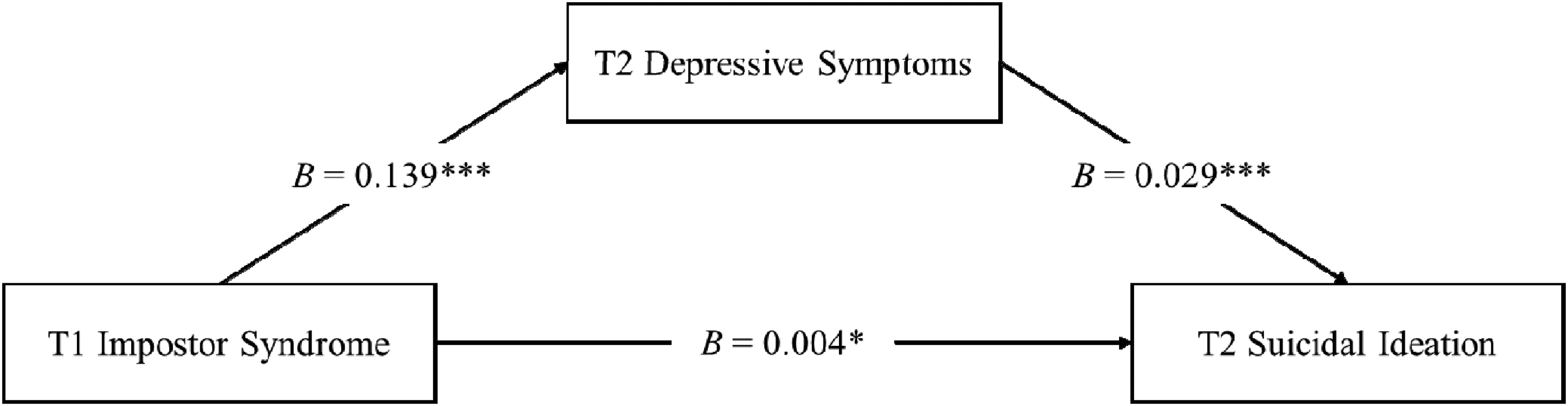
Model testing the mediating effect of depressive symptoms. *p < 0.05; ***p < 0.001. B stands for the unstandardized coefficient.
Model coefficients for the mediation effects of depressive symptoms.
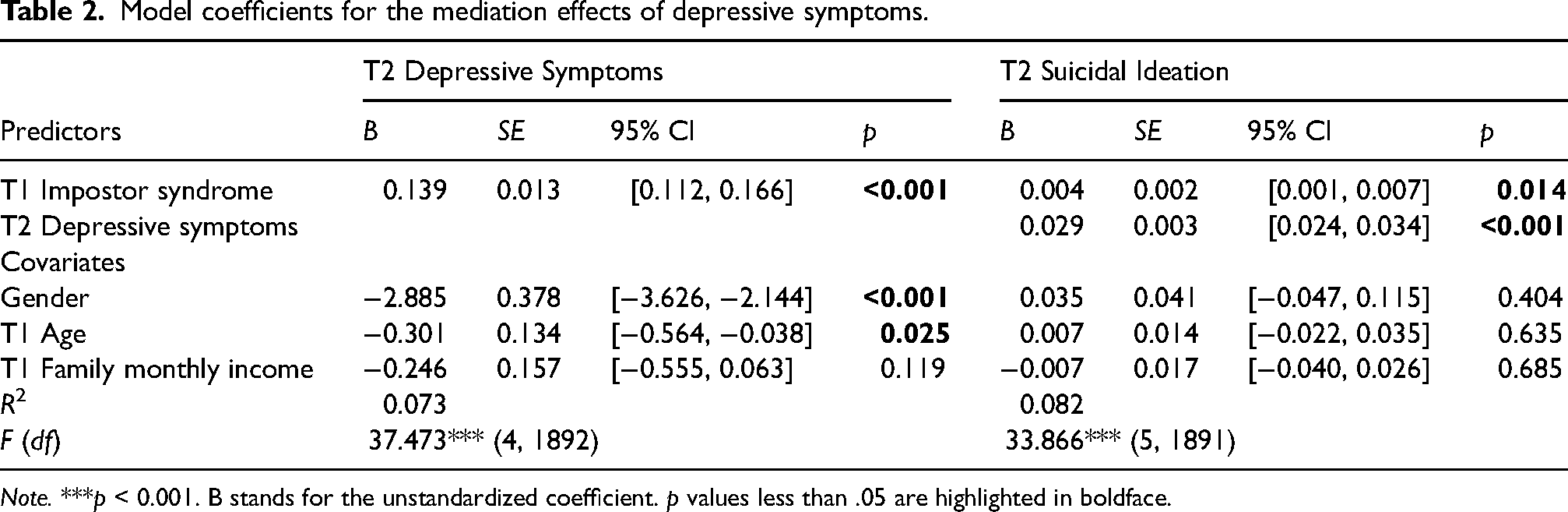
Note. ***p < 0.001. B stands for the unstandardized coefficient. p values less than .05 are highlighted in boldface.
Moderated mediation analysis
The moderating roles of social support's dimensions
All models predicting depressive symptoms (Model 1: R2 = 0.151, Model 2: R2 = 0.157) and suicidal ideation (Model 1: R2 = 0.088, Model 2: R2 = 0.085) demonstrated a good fit after adding family support or friend support as a moderator separately (see Table 3). The results indicated that both dimensions of social support moderated the relationship between impostor syndrome and depressive symptoms, and the simple slope analysis is presented in Figure 2. Specifically, the association between impostor syndrome and depressive symptoms was greater when both kinds of social support were low (Bs = 0.162 and 0.173, SEs = 0.016 and 0.018, 95% CIs = [0.130, 0.194] and [0.139 0.208], ps < 0.001) and weaker when both kinds of social support were high (Bs = 0.099 and 0.107, SEs = 0.017 and 0.016, 95% CIs = [0.066, 0.132] and [0.076, 0.138], ps < 0.001). Of note, only family support significantly moderated the relationship between depressive symptoms and suicidal ideation, and the simple slope analysis is presented in Figure 3. That is, the association between depressive symptoms and suicidal ideation was greater when family support was low (B = 0.033, SE = 0.003, 95% CI = [0.026, 0.039], p < 0.001) and weaker when family support was high (B = 0.023, SE = 0.003, 95% CI = [0.165, 0.289], p < 0.001). In addition, there were significant differences between conditional indirect effects for individuals with high and low social support (see Table 4).
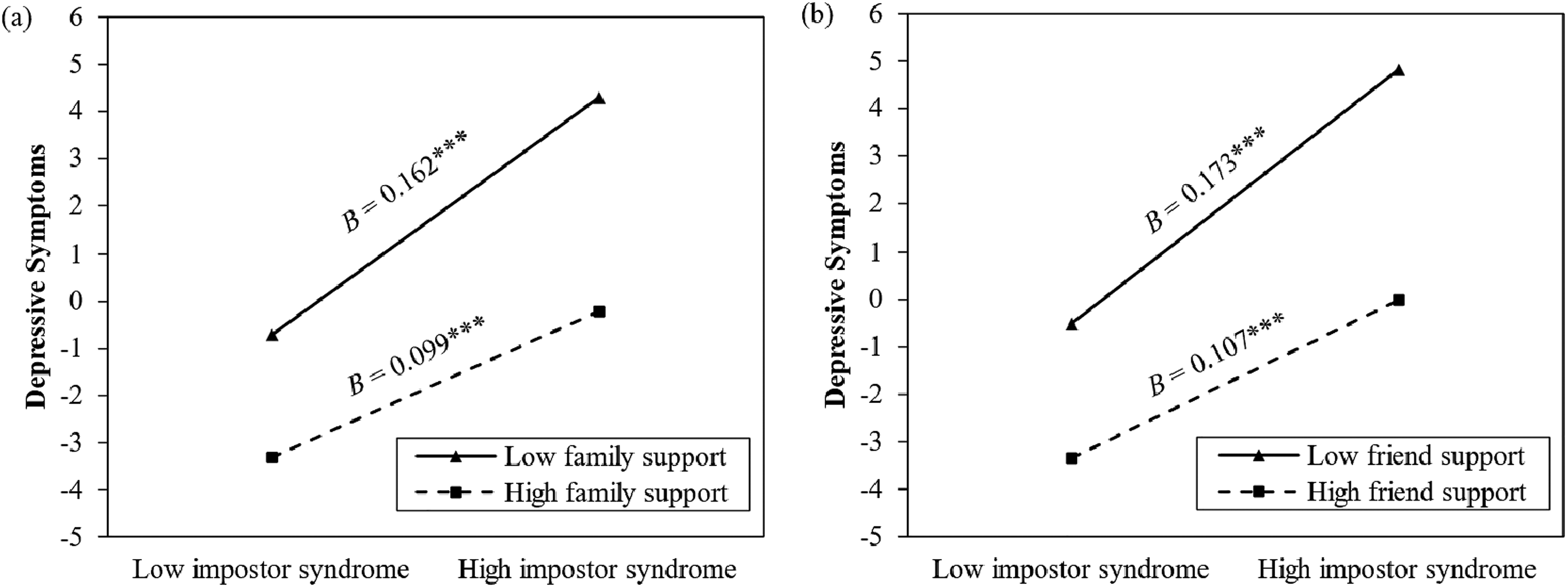
Relationship between impostor syndrome and depressive symptoms at different levels of social support. (a) Family support as the moderator. (b) Friend support as the moderator. The M +1/−1 SD were included to indicate high and low estimates of impostor syndrome and social support. B stands for the unstandardized coefficient.
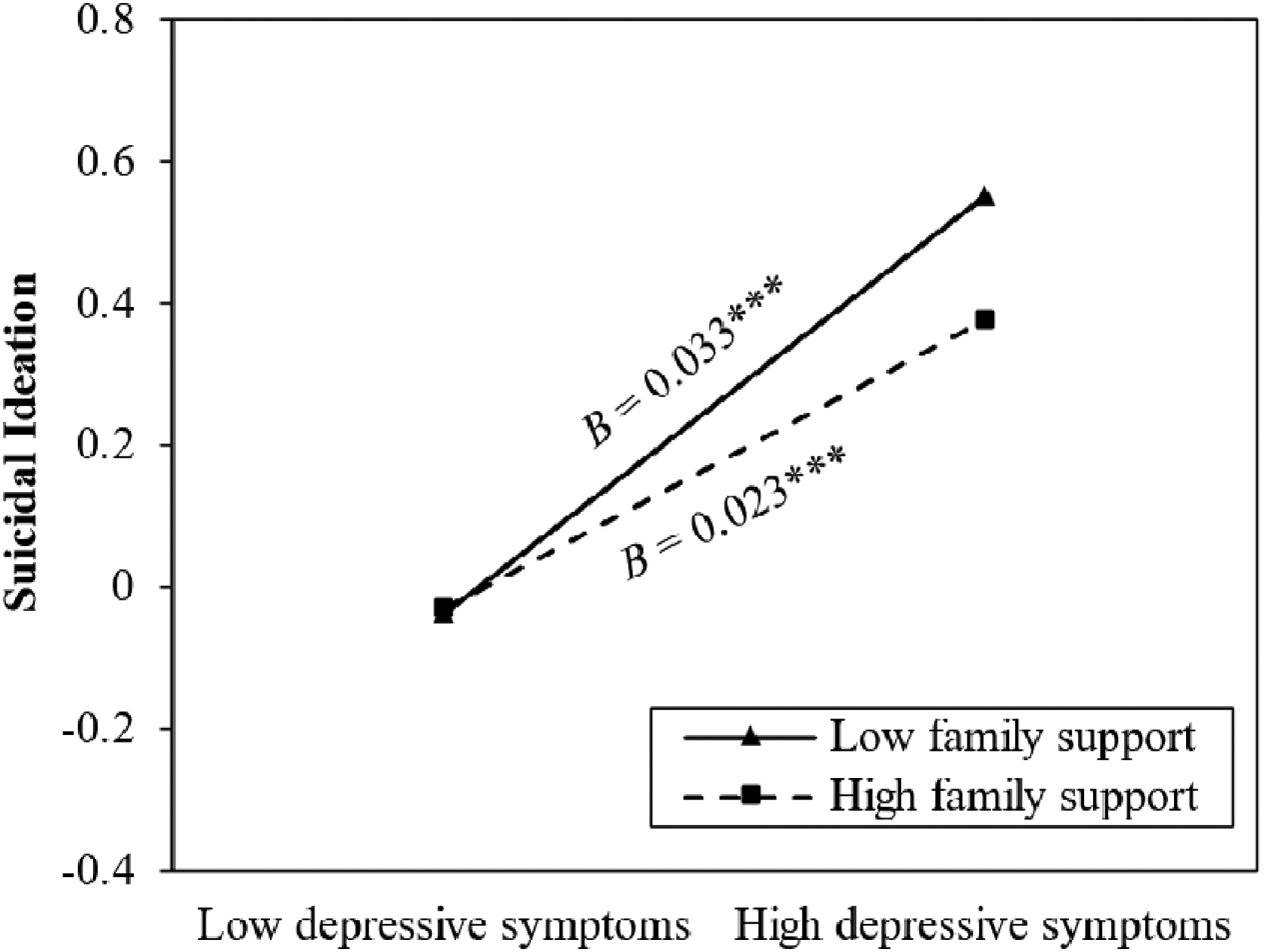
Relationship between depressive symptoms and suicidal ideation at different levels of family support. The M +1/−1 SD were included to indicate high and low estimates of depressive symptoms and family support. B stands for the unstandardized coefficient.
Model coefficients for the moderation effects of family support and friend support.
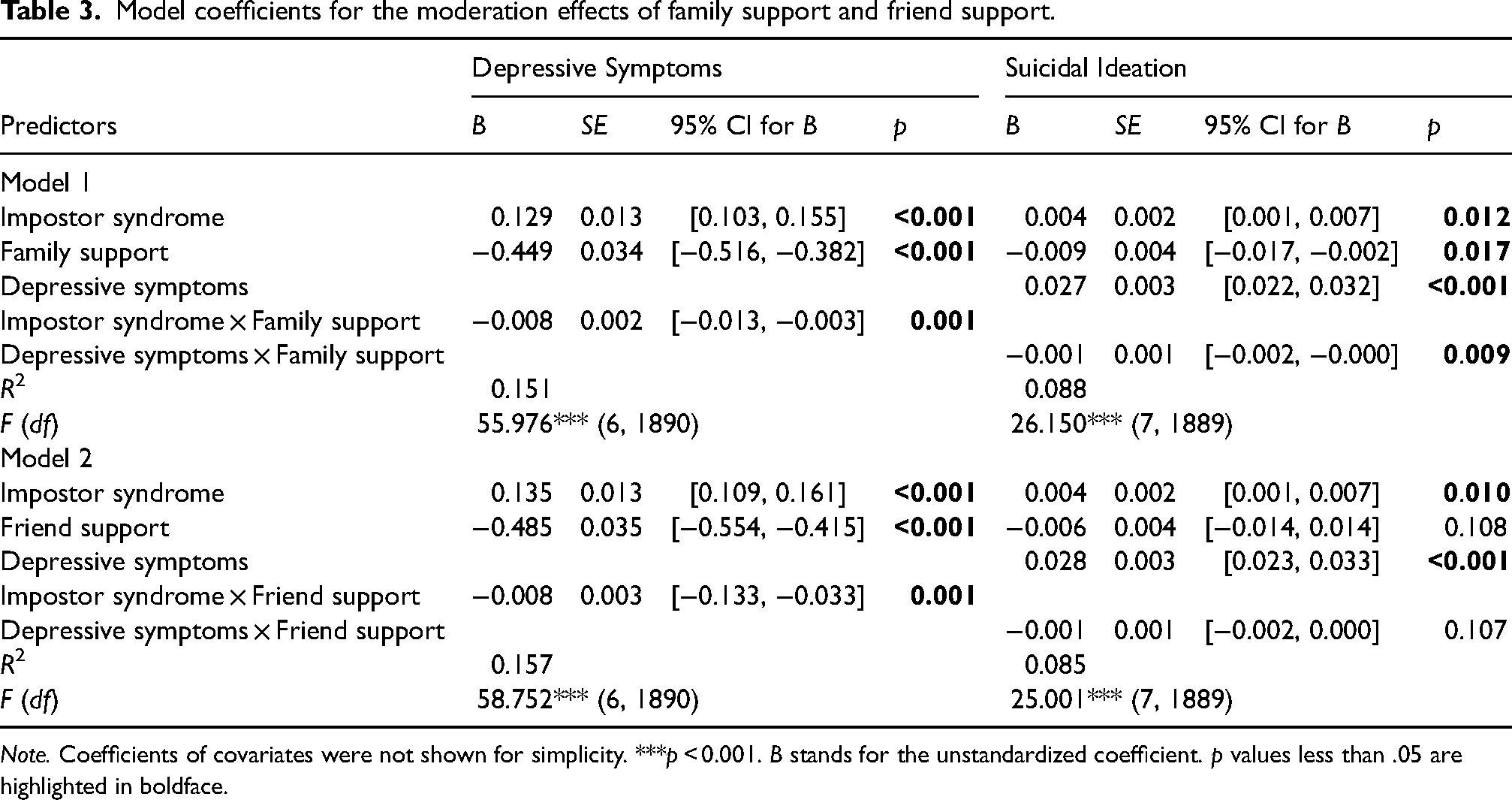
Note. Coefficients of covariates were not shown for simplicity. ***p < 0.001. B stands for the unstandardized coefficient. p values less than .05 are highlighted in boldface.
Conditional indirect effects of impostor syndrome on suicidal ideation at different levels of family support and social support.
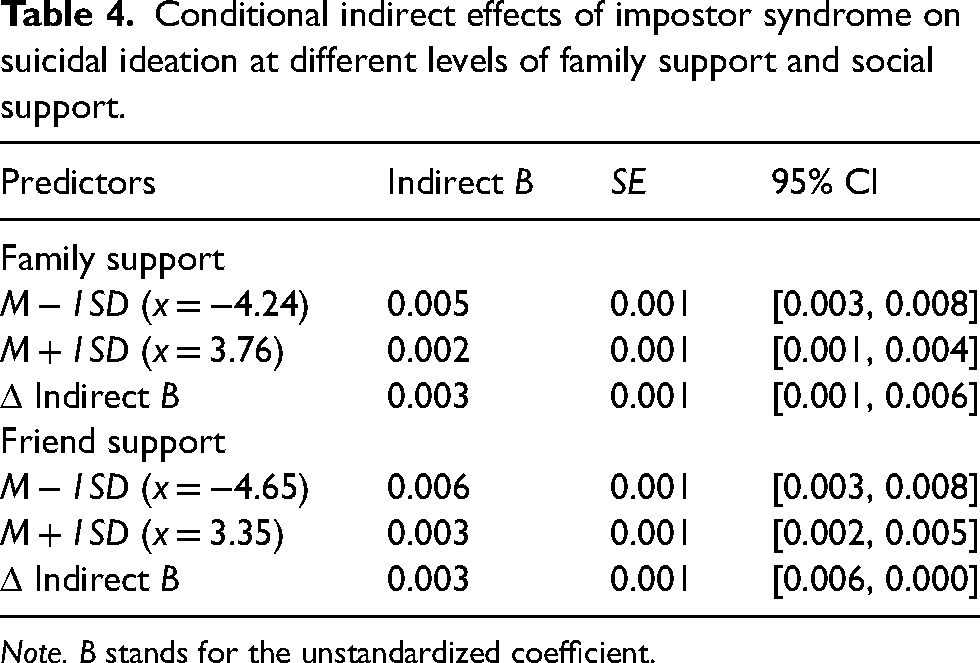
Note. B stands for the unstandardized coefficient.
Discussion
Despite the attention given to suicidality among college students, few studies have been conducted to address impostor syndrome as a risk factor. The current study used a longitudinal design to focus on the influence of impostor syndrome, a common negative thought among college students, on suicidal ideation and to explore its underlying mechanisms. The results identified the mediating role of depressive symptoms and the moderating role of family support and friend support, filling a gap in previous research and further expanding the understanding of the factors influencing suicidal ideation among college students.
Consistent with previous research (Brennan-Wydra et al., 2021; Street & Lester, 2000), impostor syndrome showed a predictive effect on suicidal ideation among college students. The mediation analysis also revealed that this effect was mediated by depressive symptoms, which supports the findings of studies that focused on impostor syndrome and depressive symptoms or depressive symptoms and suicidal ideation separately (Liu et al., 2022; Ribeiro et al., 2018; Sverdlik et al., 2020; Thomas & Bigatti, 2020). Individuals with higher levels of impostor syndrome are more likely to have depressive symptoms and thus more likely to have suicidal ideation. A range of negative emotions induced by impostor syndrome may be one reason for forming this mediating process. In addition, according to the self-schema theory (Markus & Wurf, 1987), individuals suffering from impostor syndrome may develop a negative self-schema, making them more receptive to negative information about the self, leading to depressive symptoms. The negative self-perceptions and emotions further increase the likelihood of suicidal ideation.
Further, our findings suggested that both family support and friend support moderate the effect of impostor syndrome on depressive symptoms, supporting the study of Gottlieb et al. (2020). Social support may provide a supportive environment for individuals with impostor syndrome, allowing them to regulate their emotions better and thus reduce the likelihood of depressive symptoms. In addition, social support improves individuals’ self-evaluation (Wethington & Kessler, 1986). For “impostors,” social support may reduce negative perceptions of themselves caused by excessive external attributions of success, thereby mitigating depressive symptoms.
However, it is noteworthy that only family support was a significant moderator of the relationship between depressive symptoms and suicidal ideation, which is consistent with Brausch and Decker's study (2014). During the COVID-19 pandemic, home isolation measures meant that college students might only access friend support through online means. In contrast, family support was far more accessible. As a result, the efficacy of friend support may have been diminished. However, given that impostor syndrome typically occurs in the early stages of a detrimental progression, interventions to mitigate its impact might be comparatively straightforward, enabling online friend support to be effective. On the other hand, the severity of the transition from depressive symptoms to suicidal ideation makes it more challenging for reduced friend support to have a significant impact. These results provide some evidence that different kinds of social support exert diverse effects, but further research is also needed to isolate the impact of differences in accessibility due to the epidemic.
There are some limitations to this study. First, a high attrition rate of participants in this study due to class adjustment and class suspensions brought about by COVID-19 may have reduced the reliability of the results. Second, all data for this study were obtained from participants’ self-reports, and the analysis only included two waves of data. More objective data measures could be adopted and additional time points could be added in future studies. In addition, the participants were limited to college students, so the results need to be generalized with extra caution to a broader group.
Despite the limitations, the current study still has several important theoretical and practical implications. First, the results of this study enrich the understanding of the causes of suicidal ideation and demonstrate the broad applicability of the IMV model. They also reveal that the specific location of the moderating effect of social support may be subtler than that described by the IMV model, which means social support and other motivational moderators may act in the smaller stages between entrapment and suicidal ideation. Besides, different forms of social support may exhibit distinct effects at different stages. This study provides a basis for further refinement of the overall theoretical system. Furthermore, high-stress learning environments, worries about the future, and high expectations for success make college students more likely to doubt their abilities. Still, impostor syndrome is less often seen as a problem. The present study confirms that impostor syndrome, a negative thought highly correlated with achievement, can lead to serious consequences, reminding us that more attention should be paid to it. Finally, the results of this study provide theoretical guidance on how to improve the negative effects of impostor syndrome and prevent depression and suicide. Timely social support is important to prevent more serious consequences of impostor syndrome. And when individuals with impostor syndrome already tend to develop suicidal ideation, family support has a more powerful effect than other kinds of social support. Therefore, it is important to take appropriate measures at different stages.
Conclusion
Our study examined the effect of impostor syndrome on suicidal ideation and explored the underlying mechanisms. The results showed that impostor syndrome increases depressive symptoms, which in turn increases suicidal ideation. In addition, both family support and friend support mitigated the effect of impostor syndrome on depressive symptoms, while only family support moderated the effect of depressive symptoms on suicidal ideation. We hope these findings will provide insight for future research and clinical practice.
Supplemental Material
sj-docx-1-pac-10.1177_18344909241228471 - Supplemental material for You are worth it: Social support buffered the relation between impostor syndrome and suicidal ideation
Supplemental material, sj-docx-1-pac-10.1177_18344909241228471 for You are worth it: Social support buffered the relation between impostor syndrome and suicidal ideation by Ziyi Wei, Yifan Li, Luming Liu, Xinchun Wu, Zhihong Qiao and Wenchao Wang in Journal of Pacific Rim Psychology
Footnotes
Acknowledgments
We much appreciate the participants and research assistants involved in the present research.
Authors’ contribution
Ziyi Wei: conceptualization, methodology, formal analysis, writing – original draft, writing – review and editing. Yifan Li: conceptualization, writing – original draft, writing – review and editing. Luming Liu: conceptualization, methodology, formal analysis, investigation, data curation, writing – review and editing. Xinchun Wu: resources, investigation, supervision, project administration. Zhihong Qiao: supervision. Wenchao Wang: conceptualization, investigation, data curation, writing – review and editing, supervision, project administration, funding acquisition.
Data availability

Declaration of conflicting interests
The authors declared no potential conflicts of interest with respect to the research, authorship, and/or publication of this article.
Ethics
The research ethics committee of the first author's institution approved the study protocol. All participants signed informed consent and were provided with mental health resources.
Funding
The authors disclosed receipt of the following financial support for the research, authorship, and/or publication of this article: The current study was supported by “Key Program of National Social Science Foundation of China” awarded to Xinchun Wu (Project No. 22AZD143).
Supplemental material
Supplemental material is available online with this article.
Notes
References
Supplementary Material
Please find the following supplemental material available below.
For Open Access articles published under a Creative Commons License, all supplemental material carries the same license as the article it is associated with.
For non-Open Access articles published, all supplemental material carries a non-exclusive license, and permission requests for re-use of supplemental material or any part of supplemental material shall be sent directly to the copyright owner as specified in the copyright notice associated with the article.
