




Abstract
We examine whether information about a female candidate’s relationship history, obtained from social media profiles, affects evaluations of her suitability for a student union board position. Moreover, we investigate whether it is possible to mitigate any bias against women with multiple partners by providing information about the origins of prejudice. We utilized a 2 (relationship history: multiple vs. one partner(s)) X 2 (mitigating information: explaining prejudice against promiscuous women vs. explaining prejudice against outgroups) experimental design across two studies. Participants were female students (Study 1: n = 209 American students; Study 2; n = 119 European students), who indicated whether they would hire the applicant for a job, and evaluated this applicant. Results show that generally, participants tended to evaluate the candidate with multiple partners less positively than the candidate with only one partner: They were less likely to hire her (Study 1), evaluated her less positively (Study 1), and considered her less of a fit with the organization (Study 1 and 2). The results regarding providing additional information were not consistent. Our findings suggest that private social media information can influence applicant evaluations and hiring decisions, and therefore organizations should be careful when utilizing social information in recruitment processes.
Introduction
Social media screening for personnel selection, or cybervetting (Berkelaar, 2014; Zhang et al., 2020), is increasingly used by employers. An estimated 70% (CareerBuilder, 2018) to 90% (The Manifest, 2020) of employers and HR professionals routinely check applicants’ social media profiles, and up to 79% of them admit they have rejected candidates based on (inappropriate) information they encountered on these websites (The Manifest, 2020). Most employers maintain that such social media screening is aimed at gathering professional information about the candidate. However, employers also encounter personal information about applicants – e.g. ethnicity, sexual orientation, social life – that may subsequently influence hiring decisions (e.g. Melão & Reis, 2021; Zhang et al., 2020). Indeed, Berkelaar (2017) showed that recruiters’ use of social networking sites screening seems intuitive and heuristic, increasing the risk for (implicit) hiring bias caused by personal social media information, which in turn can lead to discrimination (e.g. Macan & Merritt, 2011).
Recruiters are known to pay specific attention to ‘red flags’ on applicants’ social media profiles, specifically to posts or pictures related to unprofessional behavior – e.g., substance use and abuse, discriminatory posts or comments, or provocative pictures (Becton et al., 2019; Berkelaar, 2017; Henderson, 2019; Zhang et al., 2020). For example, in an early experimental study, Bohnert and Ross (2010) showed that candidates with a social media profile emphasizing drinking alcohol were less likely to be invited for an interview and were offered significantly lower starting salaries than candidates with profiles indicating a family or professional orientation. More recently, Rui (2020) showed that especially females were evaluated as violating perceived organizational norms if their social media profile indicated they regularly consumed alcohol. Interestingly, Becton and colleagues (2019) found evidence for an integration bias, in which negative information has a stronger effect on impression formation than comparable or more extreme positive information. Specifically, in their study they presented participants with identical applicant CVs, but varied the content of these applicants’ social media profiles to be either positive or negative (i.e., partying and alcohol use). The results indicated that regardless of applicants’ qualifications, unprofessional social media profiles negatively affected applicant evaluations, whereas professional, positive social media profiles had little to no effect on these ratings (Becton et al., 2019).
One type of information that is often used to evaluate and classify individuals, and that is often readily available in individuals’ social media accounts, is one’s (sexual) relationship history. Interestingly, as far as we are aware, the implicit influence of individuals’ relationship history on hiring decisions or applicant evaluations has not yet been investigated, even though pervasive stereotypes and attitudes about gender-specific sexual activity exist. Specifically, the sexual double standard is the phenomenon whereby women are derogated for (casual) sexual activity, whereas men are rewarded for sexual activity (Marks & Fraley, 2005). A recent meta-analysis of 99 published studies (Endendijk et al., 2020) found evidence for a traditional sexual double standard – i.e. highly sexually active men and low sexually active women were evaluated most positively – although the effect was rather small, especially in countries with higher levels of gender equality. Nonetheless, there are indications that these perceptions about men’s and women’s sexuality also result in different treatment of men versus women already from a young age, resulting in higher status and popularity for sexually active boys, and ‘slut shaming’ and peer rejection for sexually active adolescent girls (e.g., Kreager & Staff, 2009).
Disapproval of women’s sexual activity has been explained from various theoretical perspectives (see Zaikman & Marks, 2017). Social role theory, for example, emphasizes that men and women traditionally are expected to occupy different roles in society, with men often having more power and agency – also with regard to sexuality and intimate relationships – whereas women often lack (sexual) agency and are afforded less power (Eagly & Wood, 1999). Gender roles also create expectations regarding ‘appropriate’ male or female behavior, and violations of gender roles and the associated expectations are socially sanctioned – that is, disapproved. With regard to sexual behavior, social role theory predicts that whereas sexually active men are evaluated positively, sexually permissive women are evaluated negatively, by both men and women (Eagly & Wood, 1999). A second theoretical perspective that yields similar expectations regarding derogation of female sexuality, but is based on different premises, is the evolutionary psychological perspective (see e.g. Buss & Schmitt, 1993). Sexual selection theory emphasizes that in terms of reproductive fitness, women’s casual sexual activity would threaten men’s paternity certainty, whereas men would benefit from having multiple sexual partners. Conversely, women benefit most from having an investing, long-term partner. As a result of these evolutionary pressures, women also actively try to stifle one another’s sexuality, since sex is “[…] a limited resource that women use to negotiate with men and scarcity gives women an advantage” (p.166, Baumeister & Twenge, 2002).
In the current research, we focus on women’s evaluations of other women’s competence and organizational fit in light of information about her relationship history (as a proxy for sexual activity). This focus on women was inspired in part by research on the ‘Queen Bee’ phenomenon (e.g. Ellemers et al., 2004; Staines et al., 1974). This phenomenon concerns women in the workplace who have achieved career success – often those in positions of power or leadership – who take on ‘masculine’ traits, and distance themselves from female colleagues and subordinates by judging and treating them more harshly. Additionally, research shows that women generally are intolerant of sexy, provocative, and flirtatious women (Borau & Bonnefon, 2019; Vaillancourt & Sharma, 2011), often resulting in indirect aggression towards these peers. Specifically, women engage in social exclusion of, and spreading rumors about, other women they consider rivals in some manner, and research has shown that these competitive processes extend to the workplace (e.g. Buunk et al., 2016). Indeed, Gabriel and colleagues (2018) recently showed that women experience more incivility in the workplace then men, and in particular from other women. Thus, in light of these findings, here we explore whether knowledge about an applicant’s relationship history – particularly, evidence of multiple partners versus only one partner – could negatively affect women’s evaluations and hiring decisions of same-sex applicants.
Cognitive biases and implicitly held stereotypes are known to influence decision-making, but are not necessarily set in stone: Research has shown that ‘debiasing’ is possible, even for implicitly held social impressions (see e.g. Cone et al., 2019). Specifically, Cone et al. (2019) show that providing diagnostic and believable information can result in rapid updating of biased implicit and explicit social impressions, and that this effect can persist over time (Cone et al., 2019, 2021). However, there are also indications that providing additional information, or a warning, about stimuli an individual will be exposed to, can increase already existing implicitly held biases. This so-called ‘backfire effect’ occurs when individuals increase their belief in the very misconception that one is trying to correct by providing additional information or a warning (see e.g. Swire-Thompson et al., 2020). In the current research, we therefore explore whether providing information about the evolutionary roots of some commonly held stereotypes, including women’s casual sexual activity, affects participants’ hiring decisions and evaluations of job applicants.
The current research
The aim of the current research is to investigate whether - and how (A) social media information about a female applicant’s relationship history, and (B) debiasing information about the evolutionary roots of stereotypes, affect female student recruiters’ evaluations of and decision to hire this applicant. In light of the research and theories reviewed above, we expect that women in positions of power – i.e. evaluating a candidate for a student union board position – will be less positive about a candidate that is described as having had multiple relationships (compared to only one relationship). Please note that to prevent socially desirable answering, and to somewhat disguise the crucial manipulation of sexual activity, in the current research we purposely referred to the candidate’s relationships rather than her sexual partners. Moreover, since research has shown that stereotypes about women’s sexual activity differ depending on the gender equality of a society (Endendijk et al., 2020), we collected data from two different samples, 1 i.e. female students from the US (Study 1) and from Western-Europe (Study 2).
Method
Participants
Study 1. Using a crowdsourcing platform (Amazon Mechanical Turk) we invited female university students from the US to participate in our study. After exclusion of male respondents (n = 117), incomplete (n = 90), and duplicate responses (n = 63), the final sample for analysis consisted of N = 209 participants. The Qualtrics survey was programmed such that individuals who indicated they were male were directed immediately to the end of the survey. Age ranged between 18 and 53, M = 24.21 (SD = 4.21), 33% had completed secondary education, 54.5% obtained a bachelor degree, 11% obtained a master’s degree, and 1.4% obtained a PhD degree. The participants were mainly from the US (93.31%), as well as Asian (5.26%), and European (1.43%). The participants indicated being highly familiar with social media (M = 7.25, SD = 1.64), and 97.1% had a social media account. 2
Study 2. We recruited female psychology undergraduates from [withheld for review purposes] University, who received partial course credit for completing the survey. After removing incomplete responses (n = 13) the final sample for analysis consisted of N = 118 participants. Ages ranged between 17 and 31 years, M = 19.87 (SD = 2.38), 84.75% had completed secondary education, and 15.25% had obtained a bachelor degree. The sample was varied in nationality: 60.17% German, 17.80% Dutch, 4.24% Belgian, and 17.79% ‘other’ (e.g., Italian, Polish). The participants indicated being highly familiar with social media (M = 7.08, SD = 1.43), and 99.2% had a social media account. 2
Design and Procedure
The design and procedure of Study 1 and Study 2 were identical: After entering the online study environment, participants received information about the study, and proceeded to give informed consent. Next, they were randomly assigned to one of the four conditions of a 2 (relationship history: high vs. low number of partners) x 2 (information: about the evolutionary basis of prejudice against promiscuous women vs. prejudice against outgroups) design. Subsequently, participants read that the purpose of the study was to choose the most suitable applicant for the position of board member for a student union, based on the application letter as well as information obtained from social media sites. This text further emphasized that the board did not accept any form of discrimination. Immediately after receiving the two manipulations, participants answered questions about the applicant and completed validated measures (see below). At the end of the study, participants were thanked and received information about the true purpose and hypotheses of the study. The Research Ethics Committee of [withheld for review purpose] University approved materials and procedures for both studies.
Materials 3
With the exception of the addition of the Intrasexual Competition Scale in Study 2, the materials for Study 1 and Study 2 were identical:
Background information. Participants provided their age, gender, nationality, familiarity with social media (1 = totally unfamiliar, 9 = very familiar) and whether they had a social media account themselves (1 = yes, 2 = no).
Manipulation 1: Relationship history. In Study 1 and Study 2, participants viewed identical CVs of a candidate, Anna (without profile picture; see Figure 1). The CV differed only with regard to the information gathered from social media, which was supposedly added by the student association. In the condition with low number of partners, this information mentioned that: “She is recently single after being in relationship for 5 years. The man she just broke up with was her second boyfriend since the beginning of high school.” In the condition with multiple partners, this text read: “She is active in the dating world and has been in many relationships in the past year, but until now has not yet been in a stable relationship for a longer period of time.” Candidate CV (manipulation 1) presented to participants in study 1 and study 2.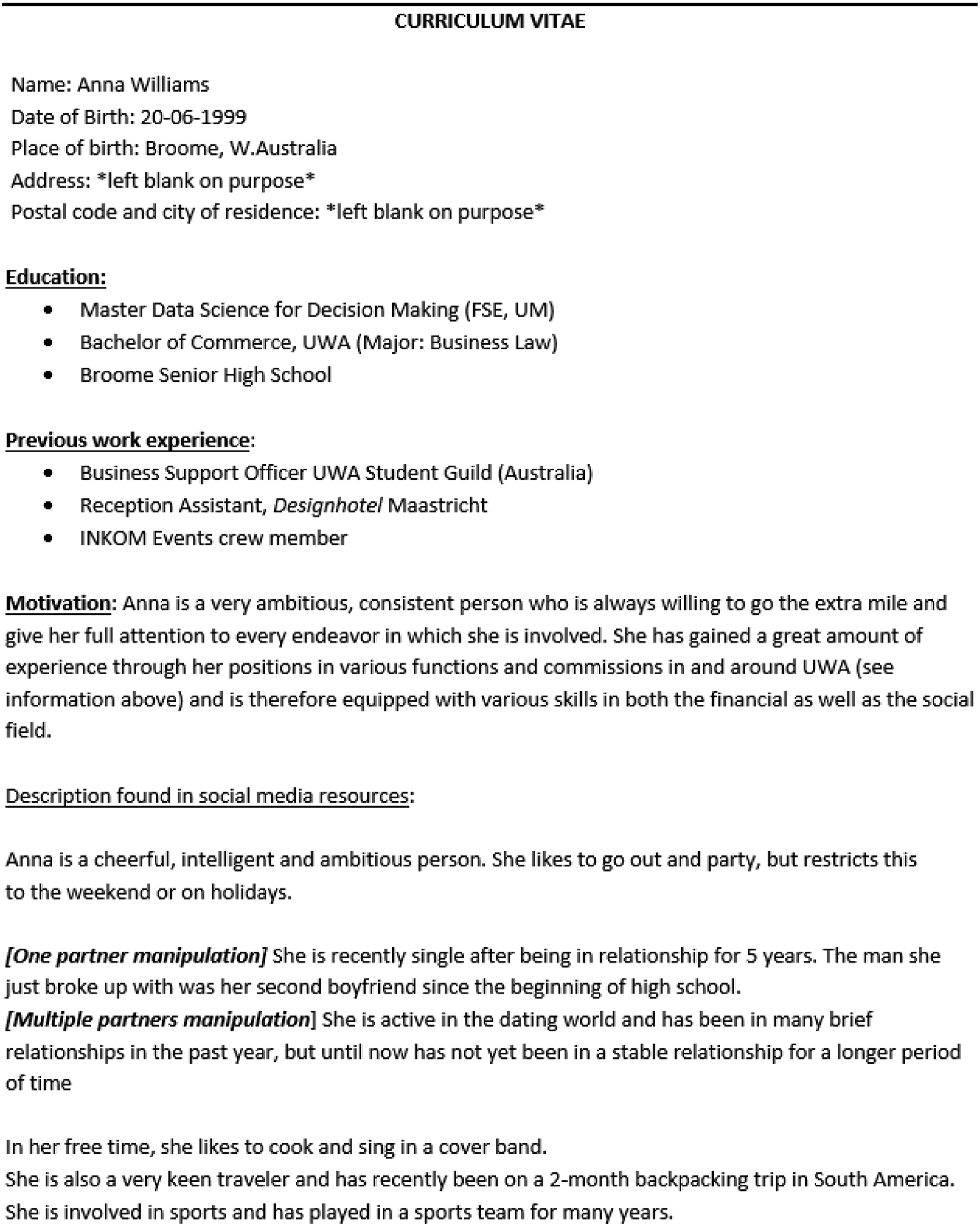
Manipulation 2: Information on evolutionary roots of prejudice. After viewing the candidate’s CV and being exposed to the first manipulation, all participants read a text about the evolutionary basis of prejudice against outgroups, including physically disabled individuals (e.g., Schaller et al., 2003).
For participants in the promiscuity information condition, the first paragraph of this text reads: “A good example of this is that females should not have a lot of partners. Considered from an evolutionary point of view, this is dangerous behavior because being unselective about their men means women are at risk of having a child that does not have the right genes and, more importantly, the man may abandon the care for the female and the baby. Throughout the ages this biological motive has become the societal norm, and has led to a negative view of promiscuous women.”
Hiring decision. Immediately after reading the CV and the information text, participants were asked whether they would hire the applicant for this job (no = −1; yes = +1), and how sure they were about this decision (0 = extremely unsure, to 8 = extremely sure). The final scale is the multiplication (−8 to +8).
Evaluation of the applicant. Three questions measured participants’ evaluation of the applicant with respect to the job, i.e. “How likely do you think it is that you will find a more suitable applicant?” (1 = very likely, 7 = very unlikely), “How likely do you think it is that the applicant will be a fit for the organization?” (1 = very likely, 7 = very unlikely), and “How much would you like this person to be a colleague” (1 = not at all, 9 = very much). Given the inter-correlations between questions (Study 1 r’s > .34; Study 2, r’s > .33) we created a composite measure of ‘applicant fit evaluation’.
Additionally, participants were asked to rate the participant with respect to seven trait-like characteristics: “How kind/attractive/caring/intelligent/loyal/dedicated/competent do you think the applicant is?” (1 = not at all, 7 = very much). The internal reliability of the composite score, ‘applicant trait evaluations’, was acceptable: Cronbach’s alpha Study 1 = .86, and Cronbach’s alpha Study 2 = .66.
Results
Descriptives and Correlations of the Outcome Variables of Study 1 and Study 2.
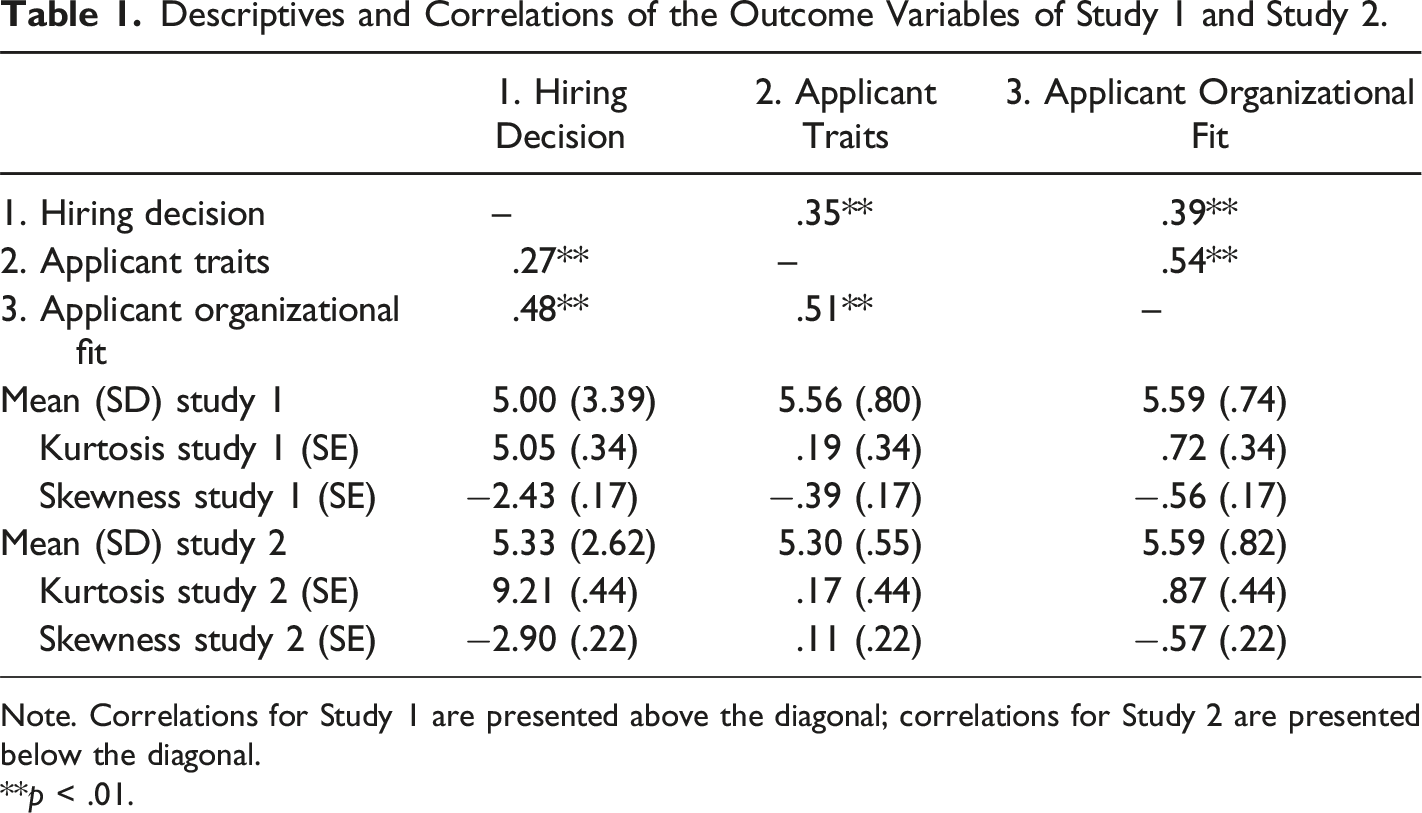
Note. Correlations for Study 1 are presented above the diagonal; correlations for Study 2 are presented below the diagonal.
**p < .01.
Study 1
Hiring decisions. A full factorial ANOVA revealed that the interaction effect between the relationship history manipulation and the information on prejudice manipulation, on decision to hire was non-significant, F (1,205) = 1.39, p = .24; partial η 2 = .007. In addition, there was no significant main effect of information about the evolutionary basis of prejudice, F (1,205) = .06, p = .80. However, the results did show a significant main effect of the relationship history manipulation (F (1,205) = 11.96, p = .001, partial η 2 = .055), indicating that participants felt more positive about hiring Anna if she was described as having had only one partner (M = 5.75, SD = 4.03), compared to the condition where she was depicted as someone with multiple partners (M = 4.17, SD = 2.47).
A follow-up Chi-Square test on the absolute hiring decision (yes/no) indicated that participants in the one-partner condition significantly more often opted for hiring the applicant than participants in the multiple partners condition, χ2 = 4.88, df = 1, p = .027.
Applicant evaluations. First, we used the composite score of the candidate trait evaluations as the dependent measure for an ANOVA. This analysis again revealed only a significant effect of the partner condition, with significantly lower evaluations for the applicant with multiple partners (M = 5.44, SD = 0.87), than for the applicant with one partner (M = 5.67, SD = 0.73), F (1,205) = 4.48, p = .035; partial η 2 = .021. There was no interaction effect (F (1,205) = 1.85, p = .18, partial η 2 = .009), and the main effect of the information manipulation also was not significant (F (1,205) = .45, p = .50, partial η 2 = .002).
Second, we conducted an ANOVA for the applicant organization fit evaluations. This analysis revealed a marginally significant interaction between relationship history and evolutionary information (F (1,195) = 4.80, p = 0.052, partial η 2 = .018), and a significant main effect of partner history (F (1.195) = 7.19, p = .008, partial η 2 = .034). The main effect of evolutionary information was not significant (F (1,195) = .30, p = .58, partial η 2 = .001). Inspection of the interaction revealed that when participants read information about the evolutionary roots of promiscuity, they thought Anna would be a better fit for the organization when she was presented as having had only one partner (M = 5.62, SD = .75) versus multiple partners (M = 4.98, SD = 1.24; p = .003). When exposed to evolutionary information about groups, participants’ evaluation of Anna did not differ whether she was presented as having had only one partner (M = 5.27, SD = .89) or multiple partners (M = 5.17, SD = 1.09; p = .60).
Study 2
Hiring decisions. A full factorial ANOVA revealed no significant effects: Interaction F (1,114) = .91, p = .34, η 2 = .008; main effect of information on the evolutionary basis of prejudice F (1,114) = .45, p = .50; η 2 = .004; main effect of relationship history manipulation F (1,114) = 1.22, p = .27, η 2 = .011. Only 4% (n = 5) of our participants indicated they would not hire Anna for the job of student representative (overall χ2 = 2.16, df = 1, p = .19).
Applicant evaluations. First, we conducted an ANOVA with the composite score of the candidate evaluations as the dependent measure. This analysis revealed a significant effect of the evolutionary information condition, with significantly higher evaluations for the applicant in the promiscuity information condition (M = 5.42, SD = .50) than in the group prejudice condition (M = 5.18, SD = .57), F (1,114) = 5.40, p = .02, partial η 2 = .05. The main effect of partner history and the interaction were not significant (F’s < .06, p’s > .82).
Second, we conducted an ANOVA for organizational fit evaluations. This analysis revealed only a significant main effect of partner history (F (1,114) = 3.95, p = .049, partial η 2 = .033): Participants were more likely to indicate Anna would be a good fit for the organization when she was described as having had only one partner (M = 5.75, SD = .50) versus when she was described as having had multiple partners (M = 5.48, SD = .85). The main effect of evolutionary information and the interaction were not significant (F’s < 1.37, p’s > .24).
Discussion
The current research indicates that despite identical professional qualifications, a female candidate with a history of having multiple partners is overall evaluated less positively and is less likely to be hired than a candidate with only one partner. These findings are in line with theoretical explanations about women’s negative responses to other women’s sexual activity (e.g. social role theory and an evolutionary psychological perspective; see Zaikman & Marks, 2017), as well as findings regarding the Queen Bee phenomenon of women in the workplace (e.g. Ellemers et al., 2004). We also reasoned that stereotypes about women’s sexual activity could negatively affect applicant evaluations, and therefore also investigated whether providing additional – ‘debiasing’ – information could mitigate possible negative evaluations of a candidate described as having had multiple partners. Unfortunately, this information did not result in the expected reduced bias. The inclusion of candidate relationship history is novel in research about social media screening, which is surprising given the availability of such information in many social media profiles. We collected data among female students in two countries (the United States and the Netherlands) that differ with respect to gender equality, since research has indicated this affects perceptions of women’s sexuality (e.g. Endendijk et al., 2020).
Although there are striking differences in the findings from Study 1 and Study 2, the most interesting findings are the commonalities. Generally, participants exhibited a tendency to evaluate the candidate with multiple partners less positively than the candidate with only one partner: They were less likely to hire her (Study 1), evaluated her less positively (Study 1), and considered her less of a fit with the organization (Study 1 and 2). Although we did not focus explicitly on ‘sexiness’, but on relationship history as a proxy for sexual activity, our findings fit into a larger evolutionary psychological literature on female intrasexual competition (Buunk et al., 2016; Gabriel et al., 2018; Vaillancourt & Sharma, 2011), which consistently shows that women are more intolerant of, uncivil towards, and hesitant to hire other women – especially when these women exhibit signs of being sexy or promiscuous. Our results also fit in with recent research by Cuadrado et al. (2021), who showed that women in the workplace who were categorized as sexy (versus professional) were perceived as less moral, competent, and sociable, and elicited less positive emotions. Generally, monogamy is seen as morally superior to other relationship forms (Conley et al., 2013), and our results suggest that these perceptions seem to generalize to person perceptions, even with all other – more relevant – qualities such as education and professional experience being equal across applicants.
Moreover, our findings indicate that even though we did not explicitly refer to sexual partners but to ‘relationships’, participants interpret this information as being reflective of sexual activity, and judged the candidates accordingly. Indeed, this finding confirms predictions from social role theory (e.g. Eagly & Wood, 1999), which proposes that both genders will evaluate sexually active women more negatively than sexually permissive males, presumably because the first are seen to violate socially sanctioned gender roles. Indeed, this sexual double standard – disapproval of women’s sexual permissiveness – exists even when participants are evaluating acquaintances or close friends (Marks et al., 2018). Our research provides less evidence for a Queen Bee effect (e.g., Ellemers et al., 2004): Even though the female participants in our studies were instructed to imagine being in a position of power (i.e., being on the board of the student association), they were overall quite positive in their evaluations of the candidates. However, future studies should also include male candidate evaluations, to be able to determine whether women in powerful positions indeed judge female subordinates more harshly than male subordinates.
The effect of our manipulation with information about the evolutionary roots of stereotypes also affected some of the dependent measures. Specifically, whereas in Study 1 information about the evolutionary roots of a bias against female promiscuity seemed to have reinforced participants’ ideas about the non-suitability of the applicant with multiple partners for the advertised job, in Study 2 there were some indications that this additional information ‘debiased’ the participants – i.e. they evaluated the candidate with multiple partners slightly more positively than in the condition where they only received information about groups.
In general, the results from both studies also indicate that the participants from the United States were less positive about the candidate with multiple partners than the participants from the Netherlands. In addition to gender inequality being higher in the United States, the US are a highly religious and sexually more conservative country (e.g. Gallup, 2021; Schmitt & Fuller, 2015), whereas the Netherlands is a secular and sexually liberal country (e.g. CBS, 2021). Most religions prohibit promiscuous or causal sex, and religiosity has consistently been associated with more conservative sexual attitudes (e.g., Ahrold et al., 2011), as well as having regrets about engaging in casual sex (Bendixen et al., 2017). Since religiosity is also associated with evolution skepticism (e.g., Ecklund et al., 2017), the finding that participants in Study 1 decreased their evaluations of the applicant with multiple partners (versus one partner) after reading about the evolutionary roots of bias against female sexuality indeed suggests a backfire effect (Swire-Thompson et al., 2020). However, these interpretations need to be made cautiously, since we did not measure or analyze religiosity in the current studies.
The current results also imply that simply providing information about the cause of commonly held stereotypes, including those about women’s sexuality, might not be the best approach to combat biased person impressions and hiring decisions. Conscious repression of stereotypes can sometimes be effective, but only when people are highly motivated to do so, and when they have some experience with suppressing stereotypic thoughts (Bos et al., 2013). Indeed, defensive processing after receiving ‘debiasing information’ often leads to self-protective attitudes and actions, since the awareness that one’s beliefs or actions are biased is threatening to one’s self-image (Vitriol & Moskowitz, 2021). Rather, Vitriol and Moskowitz (2021) show that debiasing interventions that decrease (moral) blameworthiness and increase one’s perceived ability to control one’s biases are most effective. Nevertheless, debiasing decisions, including HR decisions (Döbrich et al., 2014), is possible, even with a single training intervention (Morewedge et al., 2015) even though not always effective (Zhang et al., 2020). Additionally, in recent years, big data and AI technologies have been put forward as a solution to reduce bias in recruitment and selection, and there has been a rapid increase in the use of algorithms and ‘bots’ to assist with various HR tasks, such as correcting biased language in job descriptions and sorting through candidate CVs. One might envision that indeed, algorithms might be more ‘objective’ during social media screening, and could be programmed to exclude all manner of personal information while screening applicants. However, as Yarger, Payton, and Neupane (p. 391, 2020) state: “[…] these algorithms are ultimately human decision-making processes embedded in code … […] even well-intentioned algorithms are not neutral and should be audited for morally and legally unacceptable decision making”.
Limitations and suggestions
The current research has some limitations, specifically, the reliance on an undergraduate student sample, the use of a hypothetical recruitment procedure, and the provision of a summary of social media information (rather than access to real or constructed social media profiles). Although we took care to use a hypothetical job opening that would be relevant for students – a student union board vacancy – it is likely the participants would take a real recruitment procedure more seriously, and would evaluate candidates differently because there is more at stake in such situations. Nevertheless, our manipulation consisted of only one sentence and was sufficient to have an influence on evaluations, whereas screening social media profiles may result in much more information about a candidate’s private life, and exacerbate the findings we report here. Indeed, research has already shown that job recruiters penalize job seekers who display ‘undesirable’ content on their social media profiles, including information about sexual activity (Zhang et al., 2020). Thus, even though these limitations should be addressed in future research, we are confident that similar findings would emerge in actual recruitment processes involving professional recruiters.
Another limitation pertains to the internal reliability of the applicant trait evaluations in Study 2, which was quite low (α = .66), which poses limitations on the conclusions we can draw from the results, and these results should therefore be interpreted cautiously. Removing one trait (‘attractive’) increased α to .72, which is considered acceptable. However, the results of the full factorial ANOVA were similar to when we used this composite rather than the original one. For future research, it is recommended that a validated measure is used for candidate evaluations, or that these traits are analyzed separately (for the latter, see e.g. Richardson et al., 2013). Further, as can be seen in Table 1, the results for the candidate hiring decisions were very (negatively) skewed. However, the skewness can be explained by the fact that the candidate in both conditions would be an excellent fit for the vacancy of student union board member, and most participants indeed indicated they would hire her.
Future researchers should also take the possible influence of confounding variables into account, foremost individual differences in perceptions of sexual permissiveness (i.e. the sexual double standard). In line with this, it might also be of interest to focus on gender differences, and to include male participants to investigate whether men would evaluate both candidates differently than women. From an evolutionary perspective it would be predicted that women, but not men, are expected to punish other women for being sexually permissive – e.g. being less likely to hire her – whereas both men and women are likely to evaluate a promiscuous woman less positively than a non-promiscuous one (see e.g. Ayers & Goetz, 2022; Muggleton et al., 2019). Similarly, the limited effectiveness and inconsistent results of our second manipulation, the provision of information about the evolutionary roots of interpersonal prejudices, could be explained by individual differences in skepticism towards evolutionary explanations of human behavior. Future research should therefore also include – and control for – a measure of such skepticism.
Conclusion
To conclude, our findings suggest that social media information can influence hiring decisions, and that merely providing information about the origins of some of our prejudices is not sufficient to mitigate this influence. Even though in many countries laws are in place that regulate which information is allowed to play a role in recruitment processes, recent research also indicates that a variety of biases may exert strong effects on hiring decisions, often outside individuals’ conscious awareness. We caution organizations to rely too much on social media information in recruitment processes, and to remain aware of these implicit biases.
Supplemental Material
Supplemental Material - Social Media as Input for Recruiment: Does Women’s Relationship History Affect Candidate Evaluations?
Supplemental Material for Social Media as Input for Recruiment: Does Women’s Relationship History Affect Candidate Evaluations? by Karlijn Massar and Gill A. Ten Hoor in Psychological Reports
Footnotes
Author’s Note

Acknowledgments
We thank Stefan Gruijters and Gerjo Kok for their help with data analysis and comments on a previous version of this manuscript.
Declaration of Conflicting Interests
The author(s) declared no potential conflicts of interest with respect to the research, authorship, and/or publication of this article.
Funding
The author(s) received no financial support for the research, authorship, and/or publication of this article.
Data Availability Statement
Supplemental Material
Supplemental material for this article is available online.
Notes
Author Biographies
References
Supplementary Material
Please find the following supplemental material available below.
For Open Access articles published under a Creative Commons License, all supplemental material carries the same license as the article it is associated with.
For non-Open Access articles published, all supplemental material carries a non-exclusive license, and permission requests for re-use of supplemental material or any part of supplemental material shall be sent directly to the copyright owner as specified in the copyright notice associated with the article.
